Alaska Gov. Mike Dunleavy speaks during a news conference on Friday, March 15, 2024. (Photo by James Brooks/Alaska Beacon)
NOTN- Governor Mike Dunleavy on Thursday released his proposed Fiscal Year 2027 budget, a plan that would rely heavily on state savings to cover a substantial revenue gap.
The Office of Management and Budget projects the state will receive $15.3 billion in total revenue for the fiscal year beginning July 1, 2026, including $6.2 billion in unrestricted general funds available for lawmakers to appropriate, according to the statement release by Governor Dunleavy.
With declining revenue forecasts and rising costs attributed to inflation, Dunleavy’s proposal calls for withdrawing $1.5 billion from the Constitutional Budget Reserve, Alaska’s primary savings account, which currently holds about $3 billion.
Dunleavy said he plans to introduce a fiscal plan next session aimed at stabilizing state finances without raising taxes. He said the proposal will focus on expanding the private sector, controlling government growth and broadening the state’s economic base beyond oil.
Key elements of the governor’s FY 2027 budget include full statutory funding for K–12 public education, a full statutory Permanent Fund dividend of $3,650 per person and continued investment in public safety.
In an interview with KINY earlier this morning Juneau Senator Jessie Kiehl said, “The expectation is that it will be a budget that grapples with low oil prices. They’re closing below $64 a barrel, and that’s that’s really rough on the Treasury, and costs are going up for state services, just like they’re going up for Alaska. The governor has said that he’s submitting a fiscal plan, and that will be a very welcome change of pace, and if he is serious about that, it will give us a huge amount of work to do in this coming session, if we can get the state’s finances stabilized, not fat and happy, just stable, so we’re off the roller coaster. Alaska is poised for great things.”
Pet food and supplies donations, Photo courtesy of Grateful Dogs of Juneau
Organizers of Juneau’s 16th annual Holiday Pet Food Drive say community support is more critical than ever for families struggling to afford pet food and supplies.
The drive, organized by Grateful Dogs of Juneau, began December 8, and runs through December 14, with donation boxes at Petco, Juneau Animal Rescue, and the main lobby of Bartlett Regional Hospital.
According to Pam Nelson of Grateful Dogs of Juneau, the organization distributes roughly 1,000 pounds of pet food to community food pantries every month.
“We’ve seen the need rise every month this year to the point that even in spring, our first spring pet food drive, we actually ran out of food.” She said, “This year has been an especially hard year for people.”
Pam said rising heating and utility costs leave many families forced to choose between paying bills and feeding their pets.
“If you have to choose between getting your heating oil, paying your electric bill, which is going to go up higher because it’s so cold, we can help offset having to make the choice between whether you can buy pet food.” Said Nelson.
Larger bags are broken down into smaller four- to five-pound portions to serve more families. A single 40-pound bag of dog food can help as many as 10 households, Pam said.
“I love Juneau.” She said, “I’ve lived here for almost 30 years, and just the amount that come out for their community members is just awesome.”
Donation bins will remain available at Petco and Juneau Animal Rescue during business hours, and at the Bartlett hospital lobby from 6 a.m. to 6 p.m. through Sunday. Grateful Dogs accepts donations year-round and will arrange pickup for those unable to deliver items.
Gulls hunting seeking scraps of fish swarm the docked fishing vessel Gold Rush, which harvests pollock and other groundfish, and Trident Seafood’s Kodiak plant on Oct. 3, 2022. The North Pacific Fishery Management Council set 2026 Bering Sea and Gulf of Alaska ccatch limits for pollock and other groundfish species, but the prolonged federal government shutdown interrupted the flow of information that would normally be used to set those harvests. (Photo by Yereth Rosen/Alaska Beacon)
Lacking the usual amount of data to guide them, federal fishery managers relied on last year’s reports to set the coming year’s harvests for the nation’s top-volume commercial fish species: Alaska pollock.
The North Pacific Fishery Management Council, the panel that sets harvest levels and other rules for fisheries conducted in federal waters off Alaska, voted on Sunday to keep 2026 pollock catch limits in the Bering Sea at about the same level as this year’s limits while paring back the pollock catch limit for the Gulf of Alaska.
Pollock, one of key species in the North Pacific Ocean, is widely sold as fish patties and fillets, fish sticks, imitation crab meat and other products.
The council, which sets the coming year’s groundfish harvest limits each December, typically bases those decisions on detailed annual Stock Assessment and Fishery Evaluation reports, known as SAFE reports. But this year, the prolonged federal government shutdown prevented National Oceanic and Atmospheric Administration scientists and their partners from completing SAFE reports for the Bering Sea and Gulf of Alaska.
Instead, the council used the 2024 SAFE reports, supplemented with some newer data about harvests completed this year and some preliminary information about ecosystem conditions. The newer information did not reveal any conservation concerns that would justify harvest reductions, the council determined.
Information that goes into SAFE documents comes from ocean surveys and analysis done by NOAA’s Alaska Fisheries Science Center, with cooperation from research partners. Like all years’ SAFE reports, the 2024 documents for the Bering Sea and Gulf of Alaska featured two-year projections, extending through 2026.
Bob Foy, the center’s director, said that while all of this year’s planned ocean surveys were completed, despite numerous challenges, information from them had not been fully reviewed or vetted.
However, last year’s reports are solid, Foy said.
“Those stock assessments are incredibly robust,” he told the council on Thursday. “What we put together last December was based on decades of information, decades of decisions, piles of information on biology, surveys and whatnot.”
Counting all species of groundfish, a category that includes Pacific cod, sablefish, arrowtooth flounder and mackerel as well as pollock, the council set the total Bering Sea and Aleutian harvest limit at 2 million metric tons, unchanged from the 2025 limit.
The council set the Gulf of Alaska pollock harvest limit at 129,749 metric tons, considerably below the 2025 limit of 176,496 metric tons. The total Gulf of Alaska groundfish harvest limit was set at 464,336, compared to the 514,619 metric ton limit set for this year. Less than half of that 2025 limit has been harvested as of early November, according to council data.
Caitlin Yeager, representing owners of catcher-processor trawl vessels that harvest pollock, said the 2024 SAFE report held the “best scientific information available” to set 2026 harvests.
The North Pacific Fishery Management Council’s December meeting, held at the William A. Egan Civic and Convention Center in Anchorage, is seen underway on Dec. 6, 2025. (Photo by Yereth Rosen/Alaska Beacon)
Yeager, vice president for policy and engagement for the Seattle-based At-sea Processors Association, told the council that its plans for the 2026 pollock harvest were responsible.
“Maintaining these specifications ensures not only continuity but also legal defensibility and avoids the risk of a regulatory lapse that would otherwise halt our fishery operations” next spring, she said in testimony to the council on Saturday.
Some industry representatives, citing positive indicators turned up by scientists’ surveys this year, argued for an increase in the allowable catch of Gulf of Alaska Pacific cod. The council did not take that step, but members agreed to revisit cod catch limits in the next few months if Alaska Fisheries Science Center scientists are able to provide enough information to warrant an adjustment.
While fishing industry representatives welcomed the council’s decisions, some environmental and community advocates expressed concern.
Some testifying to the council or submitting written comments argued that catch limits for pollock and other groundfish should be reduced, citing information gaps and the ongoing and controversial incidental catches of river-bound salmon. Those accidental catches are called bycatch.
Megan Williams, fisheries scientist with Ocean Conservancy, was among those urging caution. She noted that this year, the annual ecosystem reports were not completed. That “represents another key data gap in 2026,” she said.
Abbreviated reports available in October contained some “red flags” that justified a more cautious approach to harvest limits, she said. “Data from 2024 and 2025 indicated a return to warm conditions with marine heatwaves occurring in all regions at given points, and reduced sea ice and cold-pool extent in the Bering Sea,” she said. The cold pool is an area of chilled deepwater that usually lingers in the Bering Sea in the summer, separating fish populations in the southern part of the sea from those in the north.
Francis Thompson, president of the Algaaciq Native Village in the Yukon River village of St. Marys, said the council was jumping too far ahead with its projections, not only for the coming year but for the year after that, given lack of information about salmon and other issues.
“It amazes me that you guys are already projecting 2026 and 2027 for allowable harvest of pollock,” he said in testimony on Saturday.
It is not fair that industrial fishing operators in the Bering Sea are allowed to continue their harvests at steady levels, he said, while subsistence users on the Yukon and elsewhere in Western Alaska have been forced to stop fishing because of low runs. The subsistence fishers account for only about 1 percent of the salmon catch, at most, but are bearing all the conservation burden, he said.
“We’re not going to be fishing for a while. And many of the folks in our area, the 1 percent that have put aside their fishing to save the resource for the escapement, are tired,” he said.
Escapement is the term used to describe salmon that reach their freshwater spawning grounds, allowing them to reproduce.
The council did not take action on salmon bycatch. Limits on Chinook bycatch already exist for the pollock fleet, and action on a chum salmon bycatch limit is scheduled to be taken at the council’s next meeting, to be held in February.
Council member Anne Vanderhoeven, during Sunday’s deliberations, said there is not yet any justification to reduce pollock harvests to conserve depressed runs of salmon in Western Alaska.
“The impacts of the salmon crisis are truly devastating to subsistence users and Alaska Native culture,” she said. “But the best scientific information available does not support the assertion that relatively small adjustments to the pollock (total allowable catch) will measurably or significantly increase salmon escapement to Western Alaska rivers.”
The Cold Bay dock is seen in 2021 during a visit by the ferry Tustumena. (Photo by Sean Maguire/contributed image)
The Alaska Department of Transportation and Public Facilities is planning a new dock at Cold Bay, one of the most remote stops on the state ferry system’s route map.
More than 600 miles southwest of Anchorage, on the Alaska Peninsula, the town of just 56 people is the gateway to the Izembek National Wildlife Refuge and home to a 10,000-foot runway used as an emergency stop for trans-Pacific flights.
Cold Bay is a stop on the ferry route between Kodiak and Dutch Harbor, but the dock serves more than ferries — it connects the town with ships that supply groceries, water and almost everything else it needs.
State surveys have found that the existing dock “is nearing the end of its serviceable life and is at risk of failing.”
Most of the funding for the new dock is expected to come from the federal government; the Infrastructure Investment and Jobs Act passed by Congress during the Biden administration included $43.4 million for the dock, and the state will contribute another $8.7 million in matching funds.
The final cost of the dock may be higher than that; inflation has driven the cost of all construction projects higher than they were in 2023, when the federal government awarded a construction grant.
Under DOT’s timeline, the project will go out to bid in spring 2027, with construction beginning the following year, and projected to be completed in 2029.
The new dock is expected to be large enough to support the planned replacement for the ferry Tustumena.
One public meeting about the project has already taken place; a second is planned for Tuesday evening, Dec. 16, by Zoom.
Sen. Jesse Bjorkman, R-Nikiski, speaks Wednesday, April 23, 2025, on the floor of the Alaska Senate. (Photo by James Brooks/Alaska Beacon)
In a Friday hearing, members of the Alaska Senate spoke critically about a proposed new ferry terminal in Juneau, questioning why the project would be worth its multimillion-dollar cost.
Earlier this year, state legislators planned to divert $62 million from a variety of transportation projects in order to pay for the state share of federal transportation grants worth between $500 million and $600 million.
Lawmakers included the diversion in their budget for the year, but Dunleavy vetoed the maneuver, saying that the “funding is either still obligated in the original project or has been fully expended and is unavailable for reappropriation.”
That left legislators’ spending plan partially unfunded.
One of lawmakers’ biggest targets this past spring was DOT’s plan to build a new ferry terminal in Juneau, roughly 30 miles north of the existing terminal in Auke Bay, in Juneau at a place called Cascade Point, which would shorten ferry runs to Haines and Skagway.
Legislators sought to divert $37 million from an account intended to fund that new terminal, but Dunleavy vetoed the transfer and the Department of Transportation subsequently signed a $28.5 million contract for work on the terminal.
In October, the state’s ferry advisory board concluded that the project likely did not make economic sense.
“Do you agree with that study?” asked Sen. Jesse Bjorkman, R-Nikiski, during Friday’s hearing of the Senate Transportation Committee.
“Can you please make the case to the Alaska people why you think investing this money … in the Cascade Point project makes fiscal sense for Alaskans?”
Anderson responded that “as a public agency, we’re more than economics. In this case, there’s this idea of saving people time with a much shorter run, saving money, the cost of operating that ship, we’re saving fuel. It’s less carbon emissions. I mean, there’s a lot of good benefits to shorter ferry runs.”
Lawmakers don’t have the votes to override the governor’s vetoes, which means that when they reconvene in January, they’ll have to come up with a new way to fund construction work this summer.
According to documents presented to the committee on Friday, the Alaska Department of Transportation has “deferred” about 25 projects 1-3 years “to remain within available match.”
Without new money, “fewer projects will move to contract award, limiting construction activity.”
Ryan Anderson, commissioner of the Alaska Department of Transportation and Public Facilities, told the transportation committee that his agency is prioritizing “shovel ready” projects, those that are about to go to construction.
“As we go and prioritize projects through this year, we’ll continue that action, and we’ll be ready. That’s really how we’re looking at this program,” he said.
Wooden gavel with books in background, News of the North File
The state of Alaska has settled lawsuits against Juul and Altria, two nicotine vapor manufacturers, for a combined $7.8 million, the state Department of Law said on Friday.
The suits were part of a nationwide pattern: Alaska and other U.S. states had alleged that the companies deliberately targeted children with advertising, something that likely contributed to a surge in nicotine use among children and young adults.
Altria settled Alaska’s lawsuit for $2 million last year, and the state announced a $5.8 million consent judgment with Juul on Friday.
Under the settlements, neither Juul nor Altria must admit fault, but both must abide by marketing restrictions. One key point in the settlement: Juul can’t use cartoons to advertise its products.
“This case took five years and a great deal of work from our public health and consumer
protection teams, but it was worth it,” said Alaska Attorney General Stephen Cox, in a prepared statement.
“We now have strong court-enforceable limits on how these companies can operate in
Alaska, and we’ve obtained a per-capita recovery that ranks near the top nationally, with
those dollars going straight into prevention and consumer protection.”
Alaska was one of the last states in the country to settle with Juul, which has already paid more than $1 billion to states across the country.
Some states have since filed additional lawsuits against vape distributors, alleging that they contributed to a surge in nicotine vapor use among children and young adults.
Money from Alaska’s Juul settlement is to be paid over the next five years.
Under the financial terms of the consent judgment, half of the proceeds would be used to fund tobacco control and prevention programs, and the other half would go to the Department of Law’s consumer protection program.
Typically, the spending of money earned in financial judgments must be approved by the Alaska Legislature before becoming official.
“The use of vapes and other nicotine products among youth in Alaska remains a concern,” said Alaska Department of Health Commissioner Heidi Hedberg in a prepared statement. “This funding will help families and communities continue to access education, prevention, and cessation programs.”
NOTN- The Juneau Assembly spent its Saturday retreat examining an estimated $11 million budget shortfall, Mayor Beth Weldon said it will take one to two years to fully understand as the city assesses the effects of recent voter-approved ballot measures.
“This is just an estimate because it will take us a year or two to figure out exactly what the ramifications of the ballot measures are, good or bad.” Weldon Said.
According to Weldon, about $4.4 million of the projected deficit is considered one-time cost.
The Assembly directed the manager to split reductions between delaying capital projects, including a planned waterfront museum, and pushing back one year of planned street work funded through the 1% temporary sales tax.
The remaining $6.6 million is tied to recurring costs. Weldon noted that additional financial pressures remain, including school district funding questions and outstanding police and fire labor contracts.
“To give people an idea of how big that is, when we did our priority list budgeting, all of our recreational facilities, everything together was $6 million. So we’re looking at some definitely cuts in service.” She said, “And on top of that, we also have to keep in mind that we have to have funding for glacial lake outburst floods and we have to have contracts out there for police and fire.”
To address the recurring shortfall, the city said it will tighten budget assumptions, such as eliminating long-vacant positions and delaying the launch of new programs, increase revenue, primarily through higher dockage fees and begin service reduction.
“We’re looking for community input on this, because this is where the community is going to feel it.” Weldon said.
An exploration site at ConocoPhillips’ Willow prospect is seen from the air in the 2019 winter season. Willow is located in the National Petroleum Reserve in Alaska. (Photo by Judy Patrick/provided by ConocoPhillips Alaska Inc.)
The White House announced Friday evening that Trump had signed Senate Joint Resolution 80 into law.
SJR 80 uses the Congressional Review Act to reverse restrictions enacted during the administration of President Joe Biden. Those restrictions, imposed as part of a 2022 activity plan for the reserve, were intended to protect environmentally sensitive areas against harm from oil and gas drilling.
Developers and drilling advocates opposed the restrictions, saying they could deter work that would provide revenue for local residents and Alaskans at large. Trump has also been interested in developing Alaska’s oil reserves as part of a broader effort to increase American energy production and reduce imports.
ConocoPhillips’ Willow project is in the northeast corner of the National Petroleum Reserve-Alaska. (Map by USGS, Department of Interior)
The National Petroleum Reserve-Alaska is approximately 23.5 million acres. Located to the west of Alaska’s vast Prudhoe Bay oil fields it — unlike the Arctic National Wildlife Reserve to the east — has been the subject of interest from oil companies.
ConocoPhillips’ Willow Project, approved during the Biden administration, was the first major project to take place in the reserve, and others are planned.
Friday’s signing was one of several Trump administration actions taking place simultaneously to reduce regulatory obstacles for developers interested in drilling within the reserve.
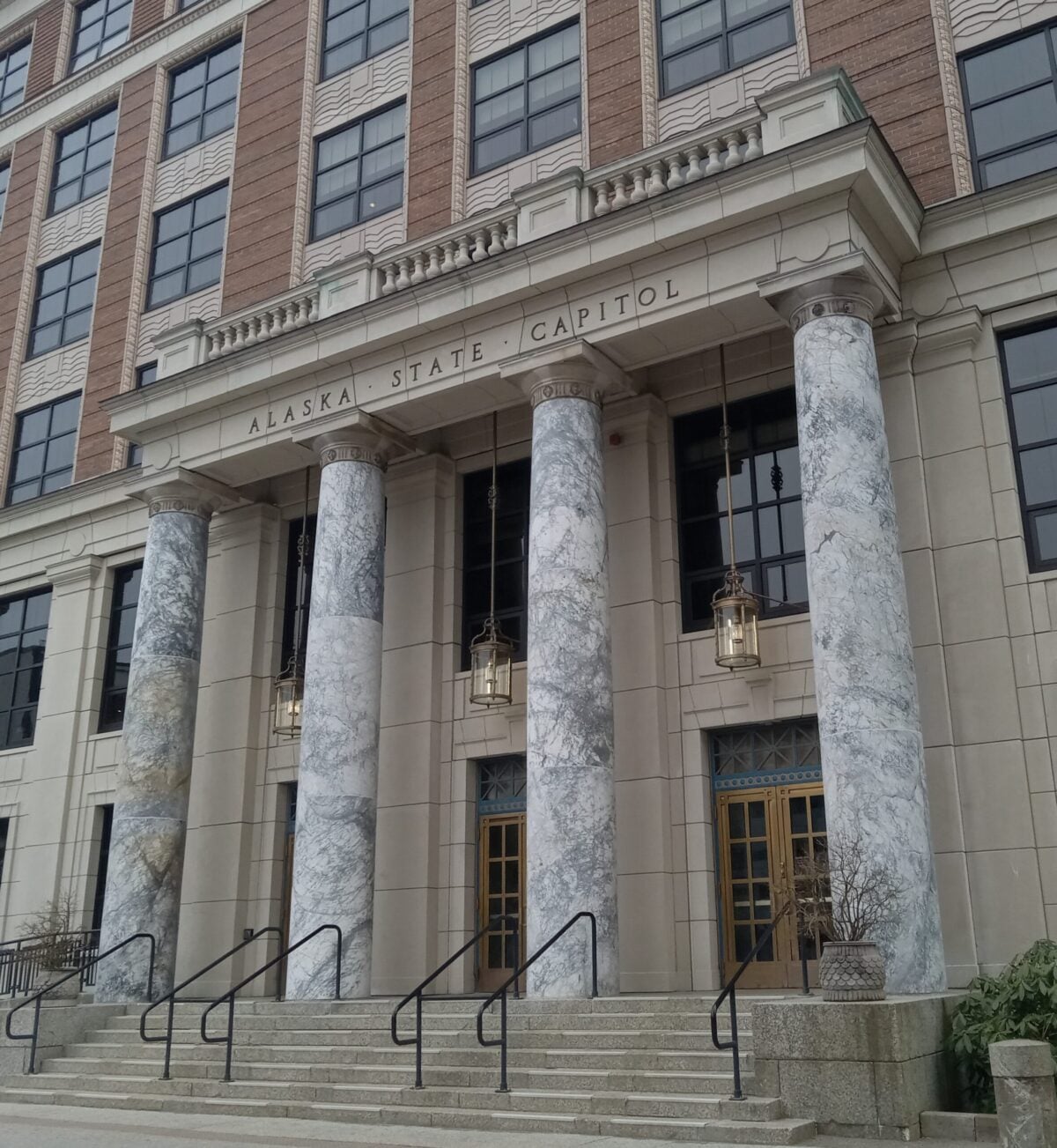
The Alaska State Capitol in downtown Juneau.
(Photo by Greg Knight/News of the North)
The Alaska State Capitol in downtown Juneau. (Photo by Greg Knight/News of the North)
NOTN- Juneau Mayor Beth Weldon said the city is finalizing its annual list of legislative funding priorities, shaped by months of committee work, public input and recommendations from numerous city boards and commissions.
“The planning commission, Systemic Racism Review Committee, General Commission on Sustainability, Utilities Advisory Board, Docks and harbours, Eagle Crest, Parks and Rec Advisory Committee, Historic Resources Committee, General School District and the General Commission on Aging, lots of hands have touched this list.” Weldon said.
The list, which guides Juneau’s requests to state lawmakers and Alaska’s congressional delegation, will be introduced to the full Assembly on Dec. 15 and is scheduled for a public hearing in January.
“What this list is, is it’s our priorities that we’re looking at, so it’s not all of our capital priorities by any stretch of imagination, but this is the list that we send to the State Delegation and the Federal Delegation in the hopes that there’s some money, either state money, which we know there’s not much of, or federal, that we can get help with. So again, this is not our complete list.” Weldon said.
The top projects on Juneau’s 2025 legislative priority list are; Mendenhall Glacier outburst flood response, North Douglas crossing, Mendenhall Wastewater Treatment Plant upgrades, Peterson Hill housing development, Juneau School District security and safety upgrades, Gold Creek flood control rehabilitation, prompted by flume failures, Bartlett Regional Hospital emergency department renovation, Statter Harbor wave attenuator project and Telephone Hill redevelopment.
Weldon said Juneau hopes to secure funding for even a portion of its top five projects. “We’ll be shocked to get any money on the top five. But you got to have a list for people to look at to help support you.” She said, “So this is to help our state delegates, who are having an open house today.”
The mayor encouraged residents to take advantage of the opportunity to speak with lawmakers during their open house at the state Capitol today.
Juneau Senator Jessie Kiehl added, “We’re opening up our offices from 11:30 to 1:00 today. We’ll have some snacks, some beverages, and good cheer.” He said, “Come on by the Capitol, just say hi. We don’t have an agenda, we don’t have a presentation, but we want to talk to you.”
The scales of justice are seen in an undated photo. (Getty Images)
The Alaska Court of Appeals has rejected an appeal from a man who received one of the highest prison sentences ever given in Alaska to a juvenile convicted of murder.
In an order published Friday, the court concluded that the recantation of a key witness is not enough to warrant a retrial for Brian Hall, who was 17 at the time. In 1995, Hall was sentenced to 159 years in prison for the killing of two men in Anchorage, Mickey Dinsmore and Stanley Honeycutt.
Despite the rejection, wrote Judge Marjorie Allard on behalf of the court, Hall is eligible for resentencing as part of a wave of juvenile punishments being reconsidered by state courts.
“At sentencing, the court sentenced Hall to 159 years to serve, one of the highest sentences — if not the highest sentence — that a juvenile tried as an adult in Alaska has ever received,” she wrote. “As a juvenile sentenced in 1995 to a de facto life without parole sentence, Hall has been granted the opportunity for a resentencing in which his youth and the unique attributes of youth will be appropriately considered.”
In 2012, the U.S. Supreme Court ruled that the Eighth Amendment prohibits courts from sentencing children to life in prison without the possibility of parole, except in homicide cases.
Two years ago, the state appeals court said the Alaska Constitution imposes further limits in addition to those provided by the U.S. Constitution.
Since then, Alaska courts have resentenced several former juveniles who were sentenced to long terms in prison. In September, Alaska’s youngest convicted female murderer was released from prison on parole after 40 years behind bars.
Hall, who has been in prison for 30 years, could receive similar treatment.
At the time of his trial, Hall claimed he acted in self-defense and that he believed, based on a statement from then-15-year-old Monica Shelton, that Dinsmore and Honeycutt — the people he killed — were armed.
At trial, Shelton denied telling Hall that the two were armed. Hall was convicted and sentenced with that testimony.
While in prison, Hall married Angela Diaz (now Angela Hall), and Angela hired a defense investigator who got in contact with Shelton. In a recorded interview, Shelton said she was scared at trial and lied in her testimony.
In an interview with the Anchorage Daily News, Hall said he is full of remorse about his crime and isn’t the same person he was at 17.
Years of legal arguments followed the investigator’s interview as Hall first requested a new trial, then asked for post-conviction relief.
Superior Court Judge Adolf Zeman dismissed that request, siding with state prosecutors who had raised procedural errors, including the idea that Hall’s filings were too late.
He also concluded that Hall failed to show that Shelton’s recantation would “probably result in an acquittal,” the standard that applies to timely filings for post-conviction relief.
Allard, writing on behalf of the appeals court, overruled Zeman on the procedural elements of Hall’s argument but concluded that even with the recanted testimony, it wasn’t clear that a new trial would result in a new outcome.
“The problem that Hall still faces, notwithstanding Shelton’s recantation, is that the rest of the evidence from trial indicates that Hall’s mistaken belief that he had to use deadly force … was not objectively reasonable,” she wrote.
“Hall was required to show that, viewing all the well-pleaded facts in the light most favorable to Hall, it is “highly probable” that Shelton’s recantation would result in an acquittal at any retrial,” Allard said.
“But while Shelton’s recantation constitutes important new evidence that sheds more light on Hall’s motivations and the reasons for his subjective fear, it does not alter the fact that his actions in shooting both men still appear overly impulsive and objectively unreasonable under the circumstances.”
Even with that finding, Hall is eligible for resentencing, Allard said.
“As part of that resentencing, the court should take into account Shelton’s recantation and the effect of that recantation on Hall’s level of culpability.”