Categories
Featured Juneau News juneau Juneau Local Juneau Local Ketchikan Local News Feeds Sitka Local

Alaska House advances bill intended to boost workforce housing

By: Sean Maguire, Alaska Beacon
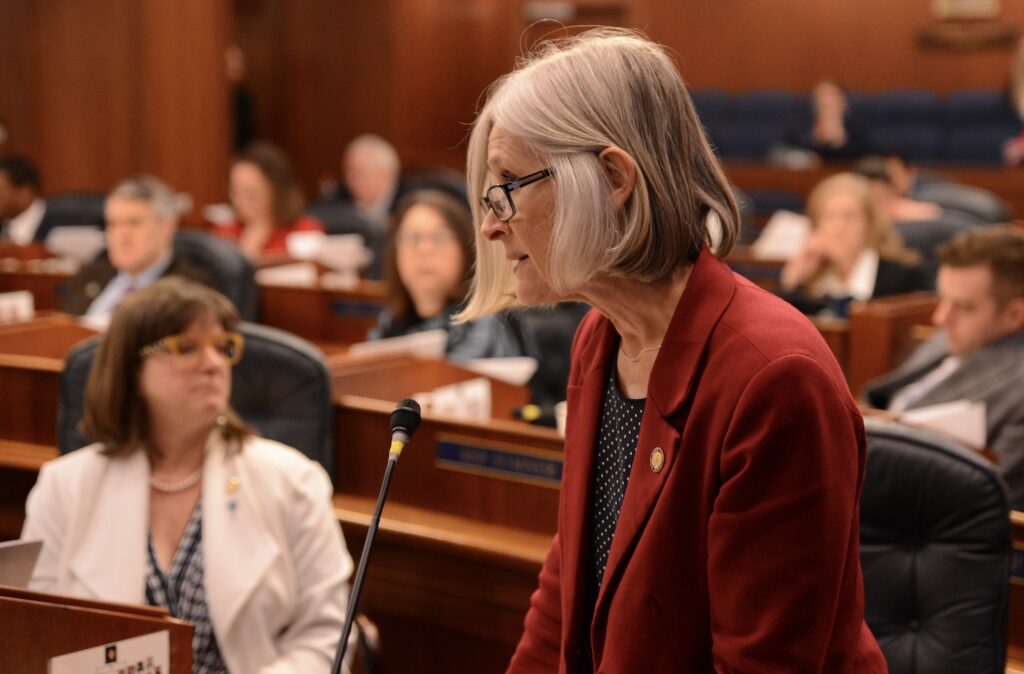
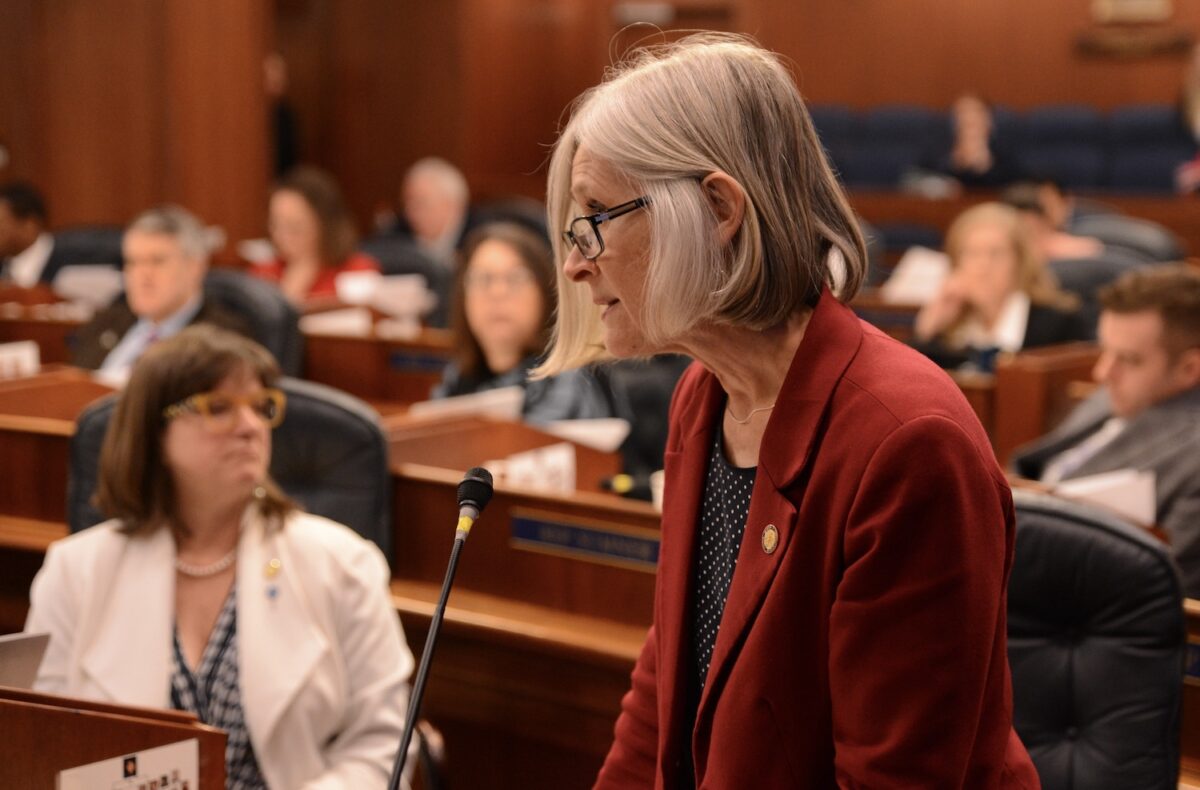
Rep. Andi Story, D-Juneau, speaks Wednesday, May 8, 2024, on the floor of the Alaska House of Representatives. (Photo by James Brooks/Alaska Beacon)

The Alaska House on Friday advanced legislation intended to increase construction of workforce housing.

Alaska has long had a severe and persistent housing shortage. House Bill 184 attempts to address that by allowing the Alaska Industrial Development and Export Authority, the state’s economic development agency, to finance construction of commercial housing with more than five units.

The House approved the bill on a 23-15 vote with two lawmakers absent.

Juneau Democratic Rep. Andi Story, the bill’s prime sponsor, said that Alaska’s housing shortage is “at crisis levels,” which is contributing to workforce challenges. 

“This shortage is very discouraging to Alaskans and businesses, and it is a persistent barrier to economic growth,” she said before Friday’s final vote.

In 2023, Agnew::Beck Consulting estimated that Alaska would need to build 27,500 new units over the next decade to meet demand. However, actual construction numbers have fallen far below those targets.

HB 184 was supported by all present members of the Democrat-dominated House majority and three minority Republicans.

Supporters said the legislation would help with resource development projects and to address workforce shortages more generally. Story cited examples of health care workers who had turned down jobs in Juneau due to a lack of housing. 

Rep. Jeremy Bynum, a Ketchikan Republican in the minority, voted for the bill. He said shipyard projects and fish processors in Ketchikan and Wrangell were exciting developments for Southeast Alaska, but a shortage of housing remained a concern.

“We have a tremendous need for workforce housing,” he said on Friday.

Opponents of the bill noted that AIDEA already has the authority to invest in multi-unit housing for workers. 

Mark Davis, special counsel for the agency, told lawmakers last year that AIDEA does have that authority and it has invested in workforce housing in the past. He cited examples of the agency financing construction of work camps in Prudhoe Bay.

“However, we have also said that this provides clarification that we would have that power,” he said, later adding that it would be a “positive bill.”

Some opposition to the bill centered on whether new housing units would actually serve workers in critical industries or if it would direct construction of affordable housing. 

A previous version of HB 184 used the U.S. Department of Housing and Urban Development definition of workforce housing: “(as) residential housing that costs the occupants less than 30 percent of the income of a household with 120 percent of the median family income.”

But that definition was removed from the bill in committee. Instead, the bill states that AIDEA should facilitate the financing of “new workforce housing facilities containing five or more dwelling units.”

Big Lake Republican Rep. Kevin McCabe on Friday suggested the legislation was a “thinly-veiled attempt” to direct AIDEA into the construction of “community housing.” He said the agency, which was established in 1967, should be focused on “job creation.” He said that HB 184 would change AIDEA’s basic structure.

McCabe attempted to amend the bill on Wednesday to limit its scope, but he was unsuccessful. 

HB 184 now heads to the Senate for its consideration. A similar bill in that legislative chamber has advanced to the Senate Finance Committee.
Categories
Featured Juneau News Juneau Local Juneau Local Ketchikan Local News Feeds Sitka Local

Almost one in four Alaska workers doesn’t live in the state, new report concludes

By: James Brooks, Alaska Beacon

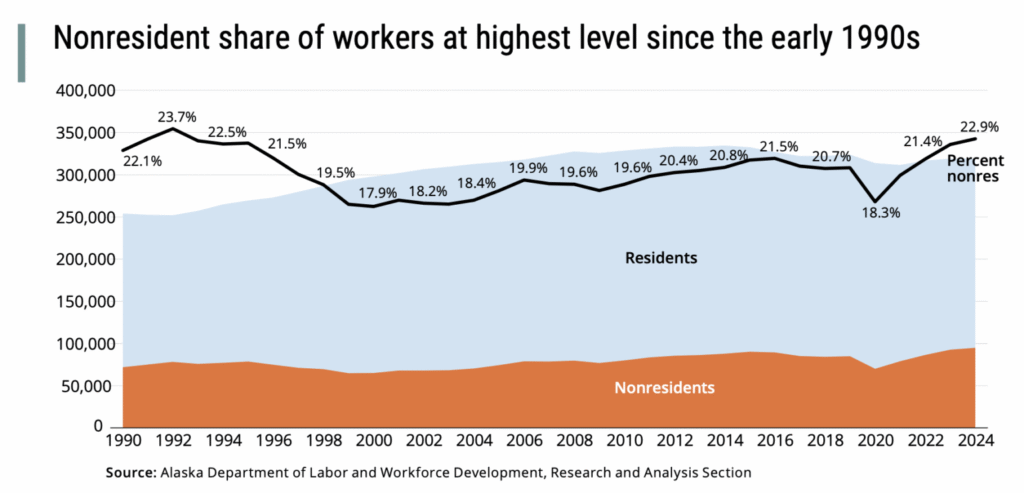
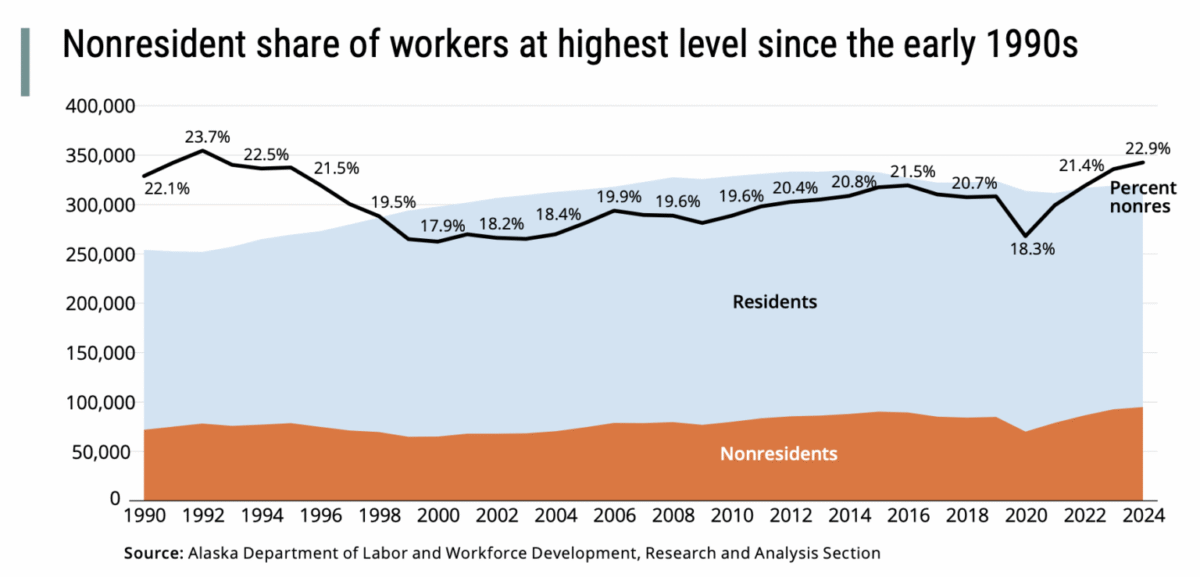
This chart from the February 2026 edition of Alaska Trends Magazine shows the growth in Alaska’s nonresident workforce since the COVID-19 pandemic emergency. (Alaska Department of Labor and Workforce Development chart)

The number of out-of-state workers in Alaska is continuing to rise and is near an all-time high, according to a new report published this week by the Alaska Department of Labor and Workforce Development.

In 2024, almost 23% of non-federal jobs in Alaska were held by someone who did not live in the state. Nonresidents earned roughly $3.8 billion, or about 17% of every dollar earned from a non-federal job.

In some industries, the proportion of nonresident workers was much higher: In 2024, more than four in five seafood processing workers were nonresidents. Among oil and gas workers, 40.5% were nonresidents. Among miners, nonresidents made up 44.2% of all workers, and nonresidents averaged higher wages than residents did. 

The state has been collecting nonresident worker data since 1990, and the new figures are the second-highest on record, behind only 1992, which used a different job classification system. That year, 23.7% of Alaska workers were nonresidents.

The proportion of nonresident workers has been rising steadily since the COVID-19 pandemic emergency layoffs of 2020. 

Rob Krieger, an economist with the Department of Labor, wrote about the new report in an article for this month’s Alaska Trends magazine

He noted that the rise comes amid a decline in the number of Alaskans who are between 18 and 64 years old, what economists call “prime working age.”

From 2013 to 2024, the number of Alaskans in that age range has declined by about 34,000 people, or 7%.

During that stretch, more people have moved out of the state than have moved in, and the state’s average age has risen steadily, leading to more deaths and fewer births.

“It’s pretty clear that is kind of what’s contributing to what we’re seeing with employers having to rely heavily on nonresidents,” he said. 

“Every industry now is starting to lean more heavily on nonresidents, including ones that have historically not. Even things like state government and local government, we’re starting to see more nonresidents,” Krieger said.

In most industries, nonresidents earned less than residents did because nonresidents tended to hold seasonal jobs.

Across the state, nonresidents averaged $16,302 in wages for any given quarter of the year. Residents averaged $16,531, indicating that nonresidents and residents were generally paid about the same.

Gunnar Schultz, a Department of Labor analyst who compiled this year’s report, said the numbers are based on unemployment insurance reports filed by employers with the state. Alaska requires employers and employees to pay into the state’s unemployment insurance fund. 

Those numbers are then contrasted with Permanent Fund dividend applications.

“Did you apply for a 2024 PFD or 2025 PFD? If you applied for neither, you’re a nonresident,” he said.

Alaska had almost 15,500 federal workers in 2024; those aren’t included in the report, nor are members of the military and self-employed Alaskans. 

That last category includes many commercial fishermen. 

The report separately analyzed those jobs, and based on permit data and other information, “nonresidents were an estimated 49 percent of the harvesting workforce, which includes permit holders and their crew, and nonresidents took in 57 percent of gross harvesting earnings.”

Categories
Featured Juneau News Juneau Local Ketchikan Local Music News Feeds Sitka Local

Seniors and teens becoming more important in Alaska’s workforce, statistics show

Yereth Rosen, Alaska Beacon

Stryder Greenhalgh, 17, serves a latte he made on Oct. 9, 2025. Greenhalgh works at Black Cup, a coffee shop in Midtown Anchorage. The population of Alaskans of prime working age has diminished; teens and seniors now account for bigger percentages of the state’s workforce. (Photo by Yereth Rosen/Alaska Beacon)

As Alaska’s population of working-age adults shrinks, according to economists, other demographic groups have become bigger segments of the labor force: seniors and teenagers.

Residents who are 65 and older made up 6.2% of the Alaska worker population in 2023 after steadily increasing over two decades, according to an analysis by the state Department of Labor and Workforce Development. In 2003, that age group made up just 1.8% of all working Alaskans, according to the data.

For teenagers, the two-decade trend has been different. In 2003, teenagers 14 to 17 years old made up 4.4% of Alaska’s resident workers, but that percentage dropped in subsequent years – reflecting national trends — until it bottomed out at 2.7% during the COVID-19 pandemic year of 2020. Since then, the percentage of teens in Alaska’s workforce rebounded, and it hit 3.7% in 2023.

The information is detailed in a pair of articles in the current issue of Alaska Economic Trends, the department’s monthly magazine published by the department’s research section. 

The analysis of  senior workers was written by state labor economist Karinne Wiebold; labor economist Rob Kreiger reported on the labor trends among  teenagers.

A big difference between older and younger workers is the degree of the male-female pay gap, Wiebold’s analysis showed.

For workers 65 and older, the gap is wide. Men in that age group had average annual earnings of $54,835, compared to average earnings of$38,797 for women 65 and older. 

In dollar terms, older women in Alaska earned 71 cents for every $1 earned by men 65 and older. 

The gap widens with age, the analysis found. The gap existed even in the highest-paid job category, the analysis found. Top male executives who were at least 65 years old earned $112,799 a year on average in 2024, while top female executives in the same age group earned an average of $87,514.

Statewide, across all age groups, women earn 73 cents for every $1 earned by men, her article said.

Wiebold said numerous factors contribute to the wage gap and the way it widens with age. Those might include historic discrimination, but other factors are work experience, training, education, hours worked, job and industry choice and time out of the workforce for reasons like childcare and elder care, she said.

“All of these choices and conditions are amplified with age,” she said by email.

In contrast, the male-female pay gap among teens aged 14 to 17 was very small, Kreiger’s analysis showed. On average, girls in that age group earned 96 cents for every $1 earned by boys in 2023, the statistics showed.

For the most part, teenaged boys and girls worked in similar jobs. Accommodation and food-service jobs accounted for more than a third of employment, while retail jobs accounted for 18.4%.

By working mostly in similar industries and at similarly entry-level positions, the teens “haven’t had time for other factors to influence the wage gap,” Weibold said.

Demographic shift

Alaska’s loss since 2013 of residents of prime working ages, considered to be 18 to 64, has been well-documented.

There are multiple and interplaying causes, said Dan Robinson, research chief for the Department of Labor and Workforce Development.

Part of the reason is net outmigration – with more people moving away from Alaska than moving to the state. Another factor is the aging of Alaska’s population, he said.

There are also numerous responses to the loss of Alaskans of prime working age residents. One has been more employment of nonresident workers, he said.

Nonresident hire hit a new record in 2023, the department said earlier this year.

Increased workforce participation by teens and seniors is part of the multifaceted picture, he said.

“For teens, it’s because a higher percentage of them have been working since the pandemic, and for seniors there are simply more of them,” Robinson said by email. “It could be that seniors are postponing retirement as a result of the worker shortage, and for teens they are likely lured into the labor force by recent wage growth in low wage jobs,”

State officials and employers have also taken actions to entice more seniors and teens into the workforce.

Last month, the state marked an official “Employ Older Workers Week,” with a Sept. 21 gubernatorial proclamation noting that “older workers play an increasingly important role in maintaining Alaska’s economy and leadership in the global marketplace, adding depth in perspective, social networks, and talent.”

The proclamation mentioned the Department of Labor and Workforce Development’s Mature Alaskans Seeking Skills Training program, which trains people 55 and older who might have encountered barriers to employment in the past, such as disabilities.

As for the young Alaskans, the Legislature this spring passed a bill allowing workers as young as 18 to serve alcohol at restaurants. Key support for the bill came from the Alaska Cabaret, Hotel, Restaurant, and Retailers Association, which cited a labor shortage as one of the significant challenges facing its members.

However, that labor shortage might not continue.

“There are early signs that the labor shortage is easing and we’re returning to a more normal balance between job openings and job seekers, but we’re still gathering and thinking about that data,” Robinson said.

Categories
Featured Juneau News Juneau Local Ketchikan Local News Feeds Sitka Local

ConocoPhillips plans large layoffs, potentially slowing or reversing Alaska’s oilfield jobs growth

By: James Brooks, Alaska Beacon

The ConocoPhillips Alaska Inc. building in Anchorage is seen on June 28, 2023. (Photo by Yereth Rosen/Alaska Beacon)


The top oil-producing company in Alaska is planning significant layoffs, it announced last week.

In a series of statements, the oil giant ConocoPhillips said it will be firing between 20% and 25% of its global workforce of about 13,000 people. That would mean between 2,600 and 3,250 layoffs worldwide.

“We are always looking at how we can be more efficient with the resources we have. As part of this process, we have informed employees that a 20% to 25% reduction in our global workforce, which includes employees and contractors, is anticipated. The majority of these reductions will take place in 2025,” said Rebecca Boys, director of external affairs for ConocoPhillips Alaska, on Thursday.

Boys declined to say how many people the company employs in Alaska, but prior documents published by the company say that it has “about 1,000 people in Alaska,” and of those, about 80% live in the state.

Altogether, the oil and gas industry employed 8,800 people in Alaska as of July, according to state statistics. If ConocoPhillips were to lay off a quarter of its Alaska workforce, it likely would reverse an upward trend for the oil and gas industry here.

Since bottoming out at 6,100 people in November 2020, during the COVID-19 pandemic emergency, the number of people employed by the oil and gas industry rose throughout President Joe Biden’s administration.

ConocoPhillips produces the most oil of any company operating on the North Slope and holds the second-most oil and gas lease area in the state.

According to state data, ConocoPhillips leases about 490,000 acres of Alaska land and water for oil and gas drilling. That’s behind only privately owned Hilcorp, whose holdings exceed 500,000 acres.

ConocoPhillips is developing the large Willow project in the National Petroleum Reserve-Alaska, which is expected to begin producing oil in 2029. 

According to the Alaska Division of Oil and Gas, ConocoPhillips is also planning to drill four exploration wells in other parts of the reserve this winter.

On its production side, ConocoPhillips was planning to drill 12 new production wells this year and next from the Kuparuk oilfield west of Prudhoe Bay.

Categories
Featured Juneau News Juneau Local Ketchikan Local News Feeds Sitka Local

Sick leave is now mandatory in Alaska. Here’s what you need to know.

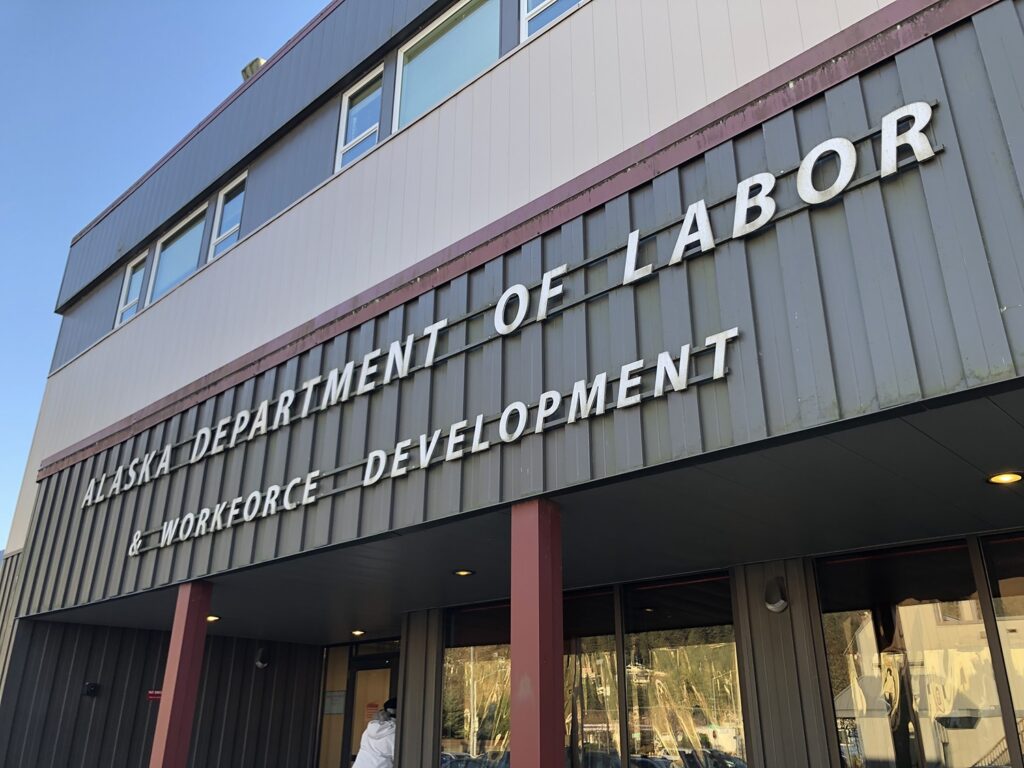
The offices of the Alaska Department of Labor and Workforce Development in Juneau are seen on Thursday, Oct. 26, 2023. (Photo by James Brooks/Alaska Beacon)

By: James Brooks, Alaska Beacon

On July 1, Alaska’s new sick-leave and minimum wage increase law took effect.

Approved by voters in November, it states that someone working at a business with 15 or more employees will earn one hour of paid sick leave for every 30 hours worked, up to a maximum of 56 per year, unless the employer voluntarily increases that limit.

Someone working at a business with fewer than 15 employees earns sick leave at the same rate, but the maximum per year is 40 hours.

The law also raised the state’s minimum wage to $13 per hour. The minimum wage rises to $14 per hour next year and $15 per hour in 2027. It will rise with the rate of inflation for each year after that.

The law also forbids bosses from forcing their employees to attend meetings about religious or political issues, including whether or not to join a labor union, political group or church.

There are exemptions for religious organizations. 

Under the law, sick leave can be used for an employee’s illness or to take care of a family member who needs care. It can also be used in cases of domestic violence, sexual assault or stalking. 

While workers can access the benefits now, it will be a few weeks before the state formalizes some of the details of how employers must implement the law. On June 25, the Alaska Department of Labor and Workforce Development proposed new regulations. Those won’t take effect until August at the earliest, but they would add some new rules to the sick leave law.

In the meantime, the department has published an informal Q&A about how the law works.

Under those regulations, all of the state’s employers “shall notify each employee in writing” about its sick leave policy.

Those policies may include the amount of advance notice required when using sick leave for a prescheduled medical appointment or “other forseeable absence.”

An employer can’t require more than 10 days’ notice in that case.

If someone is unexpectedly sick, the proposed regulations would require the sick employee to “notify the employer before the start of the employee’s shift or as soon as is possible.”

If someone uses sick leave for more than three consecutive days, their boss may require them to show proof of their need for sick leave, if that requirement is included in the written policy.

Someone who needs to take sick leave because of domestic violence, sexual assault, harassment or stalking, cannot be required to verify that explanation.

Under the law, someone can carry over unused sick leave from one year to the next, but they can’t exceed the maximum, unless their employer voluntarily allows them to do so.

Employers are forbidden from retaliating against employees who use their sick leave, and nothing prevents an employer from “front-loading” sick leave by giving them the hours in advance instead of accruing them over time.

The Department of Labor’s new regulations are subject to public comment through July 31. Anyone with questions may email dol.lss.regulations@alaska.gov.