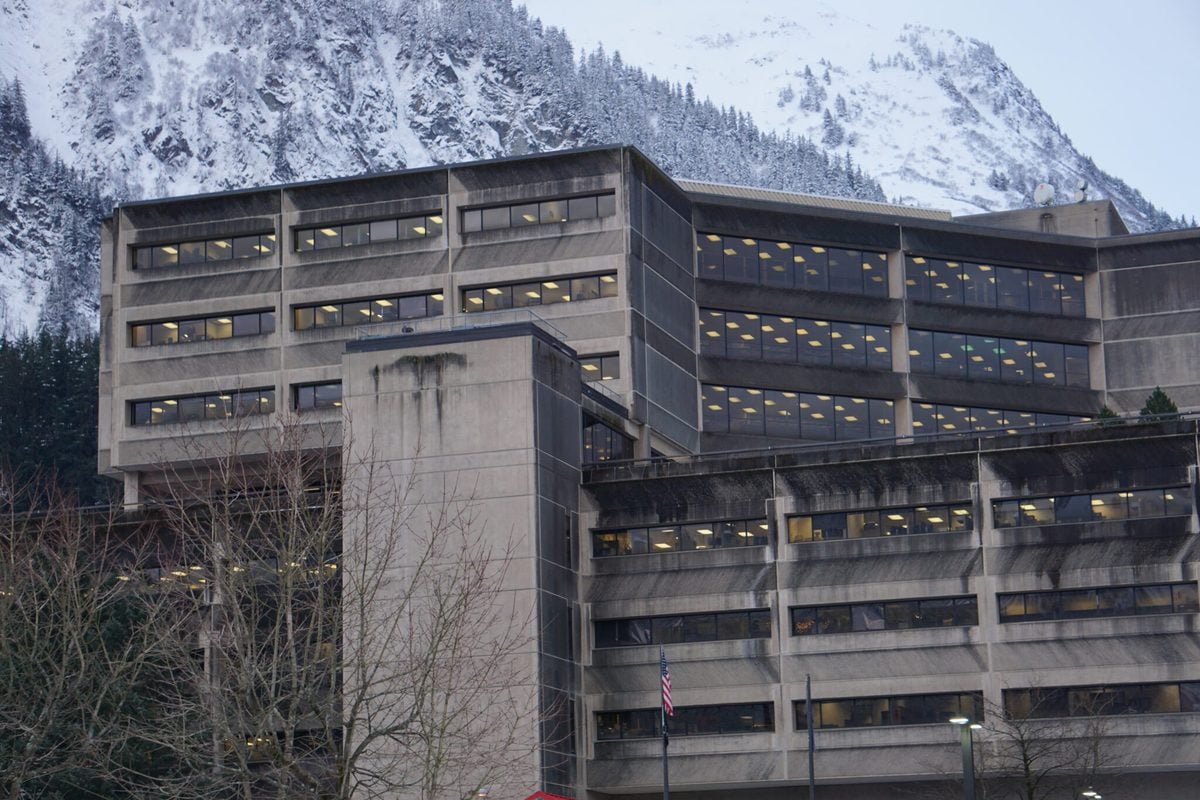
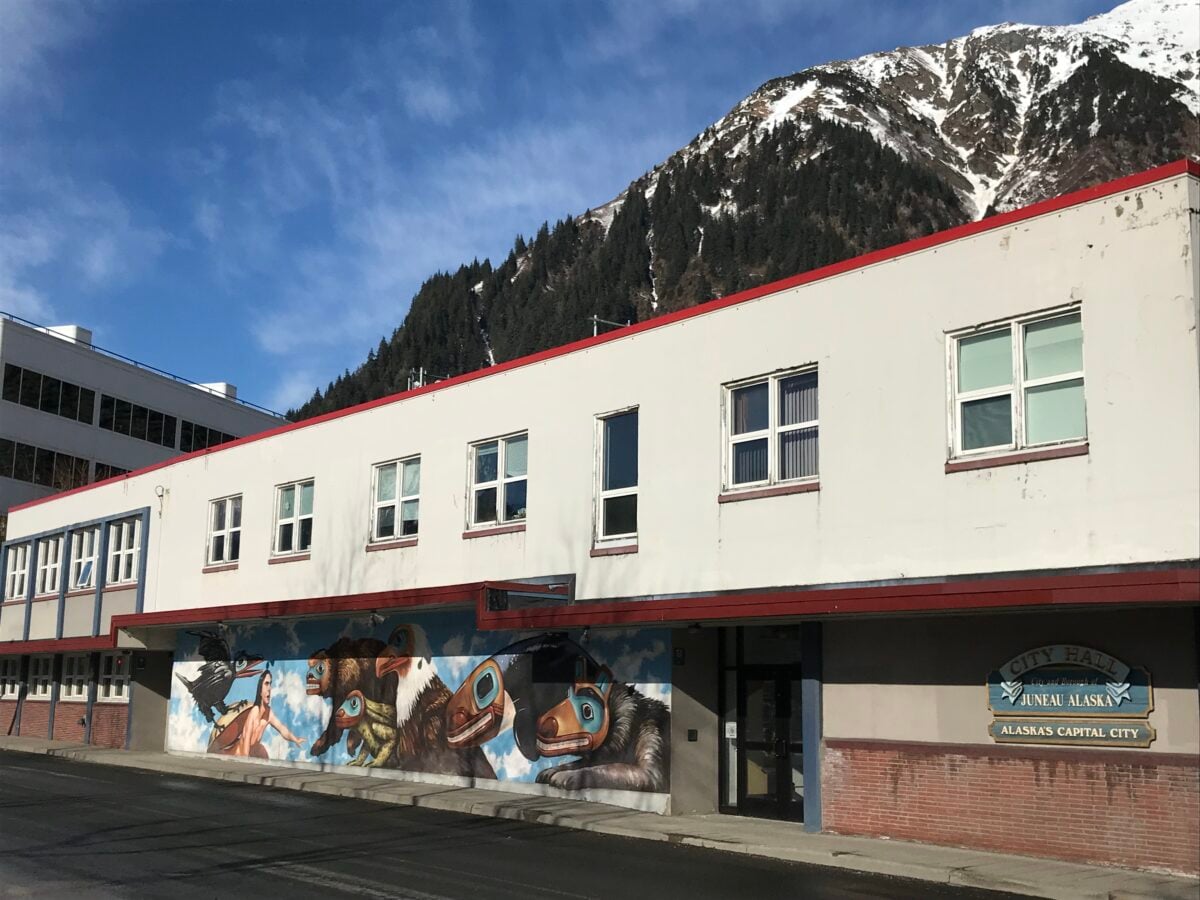
The Alaska State Office Building in Juneau, the state capital, is seen on Feb. 16, 2023. (Photo by Yereth Rosen/Alaska Beacon)
By the end of 2027, as many as 14,000 Alaska state workers could be paid by someone outside the state.
After years of trouble within the payroll department within the Alaska Department of Administration, the agency is planning to outsource the state’s public employee payroll to an outside company.
Proposals from interested companies were due Thursday, and in an internal letter, DOA Commissioner Paula Vrana said “it likely will be several weeks before a final decision is made.”
Vrana implied that if the proposals aren’t affordable or are otherwise unfavorable, the state will not proceed with outsourcing.
“As of now, we are exploring what options are available to the state and what value may be realized by this approach,” she wrote. “The final decision will be based on the proposals we receive.”
Vrana wrote that the department will begin talking with unions “to explore the options for transfers/placements of employees displaced by outsourcing” and if DOA does choose to outsource, “we will also work with the vendor to include as many existing state payroll employees as possible in their staffing plan.”
The state’s payroll department has struggled with staffing issues for years, leading to times when employees missed paychecks or encountered other problems with their pay.
In April, DOA published a request for information from companies that might be interested in providing “comprehensive payroll processing” for the state.
A three-page feasibility study dated Sept. 28 states that payroll work involves 78 employees in different agencies; all would be affected by outsourcing.
According to the state’s formal request for proposals, it is prepared to pay $4 million per year for a company to handle payroll. It currently spends about $10 million per year on payroll employees and functions, the feasibility study stated.
According to the study, in fiscal year 2025, state employees filed more than 1,500 “notice of pay problem” reports, and reducing the number of problems could make employees in other departments happier.
The first outsourced paychecks would come to a handful of departments on April 1, 2027, and other departments would be transferred to the outsourced payroll company through the rest of the year.
The outsourcing company would have to use the state’s existing payroll software programs, the document states, and the work would have to be done in the United States, but the contractor could get a waiver from the state that would allow payroll work to be done in a foreign country.
“The goal is not to change the system used to process payroll but to make payroll processing more efficient and ensure the state’s existing systems and processes are supported by qualified contracted professionals who can maintain continuity, reduce errors, and uphold the state’s obligations to its employees and the public,” the document states.
DOA provided a copy of the RFP documents to the Beacon this week; they were not previously published on the state’s public notice system, and the two public employee unions whose members would be affected by the outsourcing said they also had not previously seen the documents.
The Beacon asked DOA for an interview with Vrana or someone else involved with the outsourcing decision but was turned down.
In response to a written question asking why the department is planning to outsource, a spokesperson said by email: “Ensuring that employees are paid correctly and on time is the essential duty of payroll. Challenges stemming from high turnover and persistent vacancies within the Department have resulted in pay problems for some state employees. The administration has determined that outsourcing payroll may both provide significant recurring cost-savings to the State and improve services to its employees. However, no final decision on outsourcing payroll will be made until responses to the RFP issued earlier are evaluated.”
Jeff Kasper is the business manager of the Alaska Public Employees Association, which represents payroll workers. He’s not a fan of outsourcing.
“It usually costs more and doesn’t provide the efficiencies that you’re looking for. When you’re talking about public services, you’re essentially having the public pay more for something that’s probably not as good,” he said.
Kasper isn’t convinced that the Department of Administration has done enough to fix the problems that have deterred Alaskans from working for the payroll department.
“If people aren’t applying for jobs and accepting jobs, it’s usually because it doesn’t pay enough or it doesn’t provide benefits or it’s bad working conditions. This one could be all three, and I don’t think any of them have been addressed,” he said.
The state’s own feasibility study acknowledged those problems.
“Payroll processing occurs on a bi-weekly basis and does not have down time. This work environment and the entry level pay range are likely reasons for low retention and high staff turnover,” the study concluded.
As of last month, the study said, 58% of all payroll positions in the state are vacant, and it can take as long as a year of training before a new worker is capable of working independently.
MaryAnn Ganacias is the interim executive director of the Alaska State Employees Association, whose members are paid by the payroll department.
“Alaskans deserve to know what the problem is with the state and what they’re trying to solve by privatizing payroll,” she said.
Ganacias said state money spent outside Alaska is money that doesn’t benefit Alaskans.
“We need to do better investing in our own employees here in Alaska, and not outsourcing where the money actually goes,” she said.
Kasper said he doesn’t think the timeline described in the state’s RFP follows collective bargaining agreements or is realistic.
“The union’s not just gonna sit down and let this happen,” he said. “We don’t think the state has been following the process that’s in the contract.”
Kasper said his union’s contract with the state requires a 30-day consultation period before any outsourcing takes place, and even though the state’s RFP calls for a contract in November, he doesn’t think one is likely before Gov. Mike Dunleavy leaves office in the first week of December.
Kate Sheehan, policy adviser for the Department of Administration, said by email in response to Kasper’s comments, “The State engaged the Confidential Employees Association (CEA) on September 25th, and we have entered into the 30-day period for the union to submit any alternate plans to be considered during this process. DOA does not intend to contract out prior to the Union’s response and analysis of their input.”
Sen. Dan Sullivan, R-Alaska, speaks about Alaska natural gas at an event Wednesday in the White House. President Donald Trump, seated, announced what he said was a deal with the Republic of Korea to invest in the Alaska liquefied natural gas project. Korean officials, however, said the government has not committed to invest in the project but only to continue to examine it. Behind Trump and Sullivan are U.S. Commerce Secretary Howard Lutnick, U.S. Interior Secretary Doug Burgum and U.S. Energy Secretary Chris Wright. (Screenshot from White House video)
By: Yereth Rosen, Alaska Beacon
President Donald Trump on Wednesday announced that he had secured a deal with the Republic of Korea to spend $54 billion on a long-desired Alaska natural gas pipeline project, part of a $200 billion package of investments that include a major power plant in Texas and several nuclear power plants.
South Korea’s trade minister quickly shot down that claim, saying the government is simply reviewing the Alaska project and will proceed with investment “only if its commercial viability is established,” the Korea JoongAng Daily newspaper reported.
Trump spoke in glowing terms of an Alaska liquefied natural gas project as a sure accomplishment — even though half a century of efforts by state and federal officials and the energy industry have failed to make the project a reality, and even though Korean officials have disputed his claim that they are committed to investing in it.
“This alone will be one of the largest energy projects in American history and a gigantic win for the people of Alaska,” Trump said at the event, held in the White House’s Oval Office. “It will create up to 12,000 construction jobs immediately and 1,000 operational jobs. It’ll also save Alaska households up to $1,500, maybe even as much as $2,200 a year in energy costs. It’s amazing.”GET THE MORNING HEADLINES.SUBSCRIBE
The Alaska LNG investment is part of a “colossal package of investments” stemming from his trade and tariff policies that make “a major step toward securing our critical energy supply chain, ensuring American energy dominance, and making our partnership with South Korea and the entire Pacific region stronger than ever before,” Trump said.
South Korea’s industry, trade and resources minister quickly shot down Trump’s claim about securing $54 billion for the Alaska project. Minister Kim Jung-kwan said the Korean government is simply reviewing the Alaska project and will proceed with investment “only if its commercial viability is established,” the Korea JoongAng Daily newspaper reported.
Trump made the announcement while flanked by a crowd of men that included three cabinet members, Republican Gov. Mike Dunleavy and U.S. Sen. Dan Sulivan, R-Alaska, and U.S. Rep. Nick Begich III, R-Alaska. Also in the group was Brendan Duval, chief executive of the Glenfarne Group, the investment company leading the current proposal for a natural gas project in Alaska.
The current proposal is to ship gas from the North Slope through a yet-to-be-built 807-mile pipeline from the North Slope to tidewater at Southcentral Alaska’s Cook Inlet, where it would be liquefied and put on tankers for shipment to Asian markets.
Alaska’s North Slope holds vast amounts of natural gas along with its oil resources. But geographic distance and costs have kept that natural gas stranded from markets, despite numerous schemes proposed over the years to build different types of pipeline systems to ship the product to either Asia or to the Lower 48.
The natural gas pipeline has been a perennial issue in Alaska elections, including this year’s U.S. Senate race, which is hotly contested. The energy investments Trump announced also affect Texas, another state where there is a competitive Senate race.
Trump and others who spoke at the ceremony spent much of their time praising Sullivan, whom he called “a great senator who is totally responsible for this pipeline,” and urging that he be reelected.
Sullivan is facing a stiff challenge from former Democratic U.S. Rep. Mary Peltola, who led in votes in the primary election. But Trump spent much of his time at Wednesday’s Oval Office event talking about retired Petersburg teacher Dan J. Sullivan, the third U.S. Senate candidate on the Alaska ballot whose candidacy has been challenged by state election officials.
“That Dan Sullivan is a disgraceful fraud,” Trump said.
“It’s so corrupt. The Democrats are corrupt. . . When they put up a man with his exact name, they picked him out of a hat. They said, ‘Anybody named Dan Sullivan in Alaska?”
Trump has said he is planning to come to Alaska to campaign for the senator and against the Petersburg candidate.
Sullivan, in turn, praised Trump and also described the natural gas pipeline projects as if it is a sure thing.
“Mr. President, I would say this is the most important project in our state by far,” he said. “This is the project that is going to keep our kids and grandkids in Alaska, with a great, bright future. This is the project that our state has been working on to try to get done for almost a half century.”
Positive reaction, and also skepticism
Peltola, whom Trump did not mention but who finished 8.1 percentage points ahead of Sen. Sullivan in Alaska’s Aug. 18 open primary, issued a statement saying she welcomes Korean investment in the gas project.
She cited “bipartisan work” she did in the state legislature and Congress and said she will continue to do that work if elected to the Senate. “Today’s announcement is great news for Alaska, and I appreciate President Trump’s work to unleash Alaska energy. I look forward to continuing this bipartisan work with the President as Alaska’s next United States Senator,” she said in the statement.
Also issuing a positive statement was former State Rep. Jonathan Kreiss-Tomkins, a Democrat running for governor.
“Alaska should welcome foreign investment that helps responsibly develop our resources, creates good-paying jobs, and builds new markets for Alaska’s natural gas,” Kreiss-Tomkins said in the statement, in which he describes himself as “an enthusiastic champion” of the gas project. “I’m thrilled to see President Trump’s support, and interest from South Korea, for moving this project forward,” he said.
However, the statements made by Trump, Sullivan and others on Wednesday differ vastly from the position articulated by the Republic of Korea government, according to news reports in that nation.
A map shows various Alaska natural gas pipeline routes proposed as of 2011. (Map from the Congressional Research Service publication, “The Alaska Natural Gas Pipeline: Background, Status, and Issues for Congress,” by Paul W. Parfomak, Specialist in Energy and Infrastructure Policy, June 9, 2011)
The Korean government is not committing to spending any money on Alaska LNG, a project it considers to be a matter for further consultation, according to Korean publications. The actual commitment to Alaska LNG, as described in a memorandum of understanding, is to ‘explore the possibility of investment’ in the project, “while stopping short of making any binding financial commitment,” according to Korean reports.
Additionally, a law in Korea enacted earlier this year limits government investment in the U.S. to $20 billion a year.
One Alaska lawmaker pointed to the information from Korea as a reason to be skeptical about Trump’s announcement.
State Sen. Scott Kawasaki, D-Fairbanks, noted that Korea’s president had not backed Trump’s account.
Rather, Trump’s announcement seemed like one in a series of “boisterous” statements about things that people want, with details not provided, Kawasaki said.
“I think that, again, this is another bold pronouncement from a president who’s been known for making bold pronouncements but not following through,” he said.
It reminded him of Trump’s promise to build a wall at the Mexico border and make the Mexican government pay for it, Kawasaki said. “That never happened,” he said.
And he cautioned Alaskans against raising their expectations based on Trump’s announcement.
“I don’t want to tell the public and my voters that are just struggling, you know, trying to make ends meet that, ‘Don’t worry, the pipeline’s coming tomorrow; don’t worry, your gas problems are going to be solved overnight,’ because that’s just not going to happen,” he said.
Trump, in addition to making claims that are at odds with the Korean government’s public positions, made other questionable statements.
“For five decades, politicians have talked about the Alaska pipeline. I’ve been hearing about it from the time I’m a little boy: ‘The Alaska pipeline is going to be built someday.’ I was always fascinated by it,” he said.
It was unclear whether he was talking about the existing Trans Alaska Pipeline System, which has been shipping North Slope crude oil from Prudhoe Bay to Valdez since 1977, or the proposed gasline project. Discussions about either pipeline began after oil was discovered at Prudhoe Bay in 1968, when Trump, who is now 80, was 21.
Trump also claimed that he won the presidential vote in Alaska by 22 percentage points. His margin of victory in Alaska in 2024 was 13.1 percentage points.
Long history of international efforts
Wednesday’s announcement about Korean investment comes as part of a decades-long history of highly touted international agreements aimed at developing North Slope natural gas.
Those date back to 1977, when the U.S. and Canada struck a deal to develop an overland system that was to deliver natural gas to the Lower 48.
Other agreements were promoted in the 1980s and 1990s. At the time Yukon Pacific Corp., which ultimately held federal and state permits to build an LNG export project, was actively negotiating with would-be Asian partners and buyers. During the time, Yukon Pacific announced agreements with potential partners in Korea and Taiwan.
There were bold pronouncements about exports made during that era that were similar to those made in the Oval Office on Wednesday.
“ALASKA GAS IS POISED FOR EXPORT TO ASIANS,” said a headline in the Jan. 11, 1988, issue of the Journal of Commerce. The story referred to efforts by President Ronald Reagan and Japanese Prime Minister Noboru Takeshita to try to secure that Asian country as a partner in the Alaska LNG project.
Other international negotiations and agreements followed.
In 2008, for example, the China Petroleum and Chemical Corporation, also known as Sinopec, submitted a formal proposal to the administration of Gov. Sarah Palin to build an LNG project with a pipeline running along the existing oil pipeline’s route from the North Slope to the port of Valdez.
Nine years later, the Alaska Gasline Development Corporation — which became the main sponsor of the project — and the state announced a “Joint Development Agreement” with Sinopec and other would-be partners from China. Along with Sinopec, parties to the agreement were CIC Capital Corporation and the Bank of China. It was “the most significant step forward for Alaska LNG,” AGDC said at the time.
The signing of that agreement was witnessed by Trump in his first administration during a trip to China, according to AGDC’s account.
In February of 2025, Trump announced a “joint venture” with Japan on Alaska LNG in terms similar to those he used on Wednesday to describe what he said was a commitment for Korean investment.
At the time, Sullivan praised Trump in terms similar to those he used on Wednesday.
“With his leadership, we will get the Alaska LNG Project built, which will create thousands of good-paying jobs, reinvigorate our American steel industry, significantly reduce our trade deficit in Asia, and deliver clean-burning Alaska gas for Americans, our military, and our allies in the Asia-Pacific, like Japan,” Sullivan said in a statement then.
Correction: Dan J. Sullivan is the U.S. Senate candidate from Petersburg.
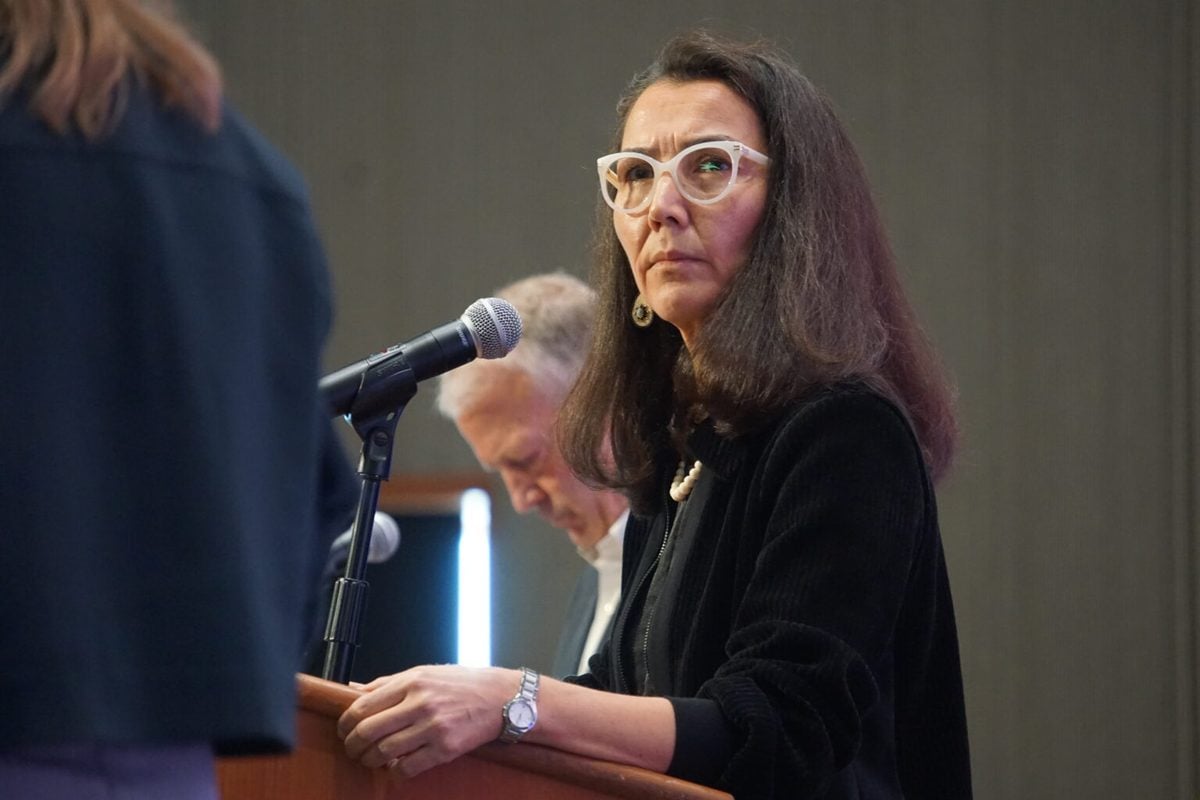
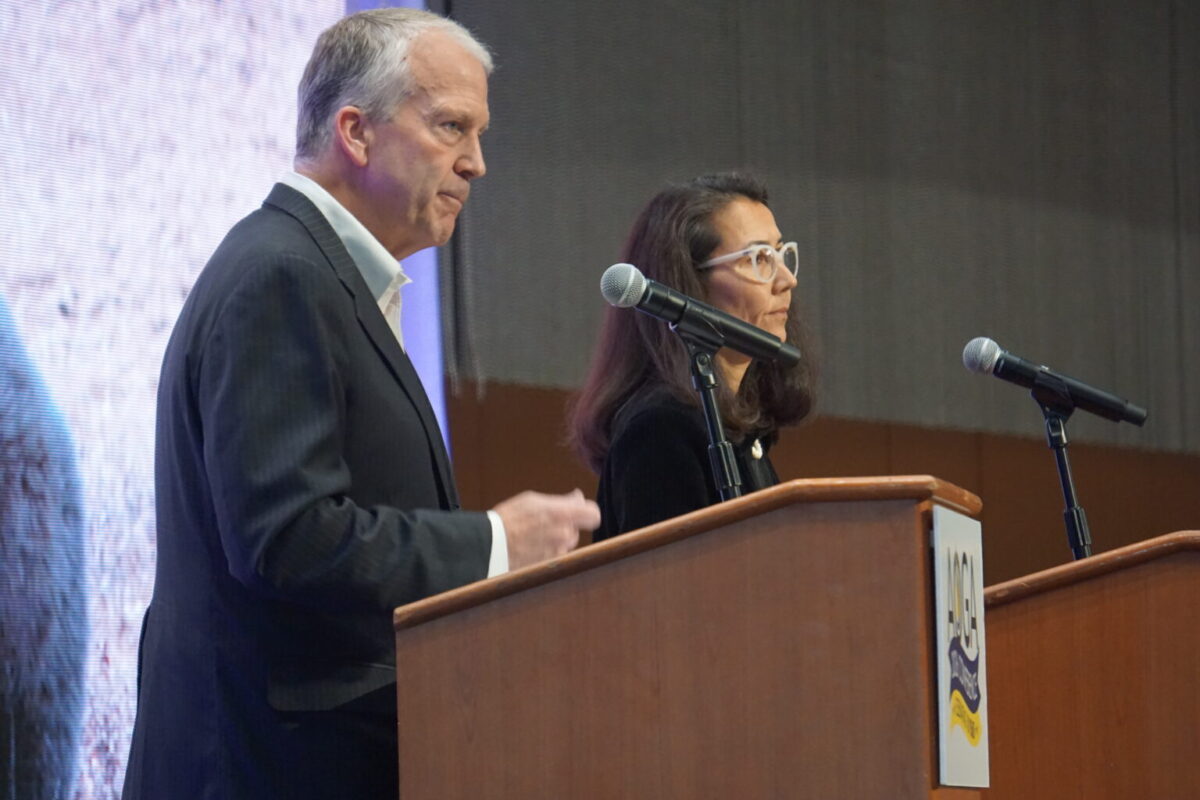
Mary Peltola listens to a question posed by moderator Michelle Egan at a candidate forum held by the Alaska Oii and Gas Association on Aug. 27, 2026. Next to Peltola is i Sen. Dan Sullivan. Peltola, a Democrat and former U.S. House member, is challenging Sullivan. (Photo by Yereth Rosen/Alaska Beacon)
Alaska observers say it is too early to say how reports of bad behavior by Democratic U.S. Senate candidate Mary Peltola might affect the state’s closely watched election, and some supporters suggested this week that she may be subject to a double standard because of her gender.
“While it’s surprising news, I think there’s a very hefty proportion of people who go, ‘It’s a hit job. It’s typical politics,’ and kind of brush it off,” said Ivan Moore of Alaska Survey Research, a political polling firm active in the race.
“It takes a lot to swing someone over from being a Peltola voter to all of a sudden going, ‘Oh, OK, I’ll vote for Sullivan.’ So we’ll see,” Moore said.
On Wednesday, the New York Times published an anonymously sourced article documenting abusive behavior by the former Alaska congresswoman, now a leading candidate for Senate. The article said she was hostile to her staff and used slurs and profanity to privately criticize others.
The article detailed accounts from former staff members who said she required aides to feed her family’s pet chameleon and said that in 2024, she wrote that she hoped a local Planned Parenthood board member would “die of a botched abortion.”
That comment came after the group was slow to endorse Peltola in that year’s election. This year, she does not appear on the group’s endorsement list.
“Planned Parenthood has been called worse and withstood more in its 100+ years; we’ll talk with her about what was reported when she’s Senator-elect,” said Morgan Lim, Alaska state director for Planned Parenthood Alliance Advocates. “Nothing has changed in the stakes of this race and we remain laser-focused on ousting Sullivan from the Senate — making sure Alaska voters know that Dan Sullivan is an anti-abortion, anti-LGBTQ fanatic who will continue to rubber stamp Trump’s judicial nominees.”
Peltola was elected in 2022 to fill the remainder of Congressman Don Young’s term after his death that spring. She subsequently won the general election in November and served a two-year term of her own.
Her time in office coincided with a period of personal loss. Five months after she began her full term, her mother died. Three months after that, her husband died in a plane crash. She sued his employer a year and a half later, and a trial is set to begin in March.
Harry Child, a spokesman for Peltola’s campaign, said by text that the Times article is exaggerated.
“Like any person who has gone through multiple personal tragedies in the span of a few months, Mary sometimes struggled to deal with her grief. But she treats her staff with respect and care, and she maintains close positive relationships with her staff spanning her nearly 30 years in public service,” he said. “Exaggerating and outright lying about moments from the hardest period of her life, and falsely presenting them as a pattern of behavior, is wrong.”
A double standard for judging Peltola?
Polling indicates Peltola, a Democrat, is in a close race against Republican incumbent Dan S. Sullivan for one of Alaska’s two U.S. Senate seats. The winner of that election may decide whether Democrats or Republicans hold a majority of the Senate.
Moore said he doesn’t know whether the Times article will affect the eventual result.
Readers of the Anchorage Press said they don’t think it will, with some labeling the Times article a “nothingburger.”
The Times found something similar in a followup article of its own. A spokesperson for the Alaska Democratic Party called the initial article “a hit piece.”
“Mary grew up working on a fishing boat and was made in the mold of great Alaskan leaders that came before her. She’s the only candidate in this race who will actually fight to lower costs and put Alaska first, and Alaskans will send her to the Senate this fall because she will deliver,” the spokesperson said.
Nate Adams, a spokesperson for the Sullivan campaign, said by email, “Nearly 30 people close to Mary Peltola were interviewed and more than 100 screenshots informed this reporting. What the Times printed is only a fraction of it, so imagine what was left out, and what else Mary Peltola is hiding from Alaskans.”
Jim Lottsfeldt, a veteran political campaigner who is working on pro-Peltola efforts this year, said he sees somewhat of a double standard in the way she’s being treated.
“Stevens blew his stack, and we were all like, ‘That’s great, because he blew his stack for our benefit.’ And then you had Don Young saying the most outrageous things occasionally, but got like tons of things passed,” Lottsfeldt said. “So when all this stuff happens with the guys, nobody really clutches their pearls, and now we have little Mary Sunshine, Mary Peltola, who may have said the word f**k when she was mad, and now we’re acting like it’s a major political story, and I don’t think it is.”
Some former staffers back Times reporting, others dispute it
After the Times published its initial article, the Beacon contacted more than a dozen former Peltola aides in an attempt to verify its contents. Some, speaking anonymously, said they could not confirm all the incidents described by the Times but said the article matched the tone and mood of their time in her Congressional office or with her campaign.
They asked to not be named in order to offer frank opinions and because their current jobs may require them to work with Peltola in the future.
But at least some defended their former boss.
Kate Consenstein worked for Peltola in the Alaska Legislature and now runs a communications firm in Anchorage. The Peltola campaign suggested her as someone whose experience doesn’t match the Times article.
“I wouldn’t want to engage in denying the veracity or the accuracy of those people’s accounts, especially because I don’t know who they are,” she said, “but I would just say the person that I worked for, and the person that I still know, is kind, generous, and not an abusive boss.”
Current U.S. Sen. Lisa Murkowski is a Republican who endorsed Peltola’s 2024 U.S. House run but is backing Sullivan this year. She told reporters in Washington, D.C. on Thursday, “I do acknowledge that while she was here in her first term, she was not only thrown into a very challenging situation immediately running for campaign, but then to lose her husband in that airplane crash and to deal with all of that. That’s pressure that is hard for anybody to bear.”
Sullivan, also interviewed by D.C. reporters on Thursday, said, “I think it’s very sad, very disturbing that so many Alaskans had to get put through that kind of severe abuse, which is very disturbing, but not surprising.”
Tyson Fick, a fisherman from Juneau who worked as a special assistant in Peltola’s congressional office, said there’s no doubt that Peltola would want a “mulligan” for some of the things she said, and he feels she was frequently second-guessed by East Coast staff.
“She never, I thought, was abusive, but also she often got some inadequate staff work,” he said.
“Having been around some operations where they were a little more, you know, systematic and organized, it was hard for me. I had to get out of there. I love Mary. I’ll be with Mary till I die, but I knew I couldn’t sign up for them again,” he said.
Fick and other Alaskans interviewed for this article were particularly critical of Anton McParland, who replaced Alex Ortiz as Peltola’s chief of staff. Ortiz, who declined to comment for this article, had previously worked for Young. When Peltola was elected, McParland did not live in Alaska; he has since registered as an Alaska voter.
In addition to the personal losses that Peltola suffered, there was also a conflict between the people Peltola brought from Alaska and the people she hired from the East Coast.
Peltola and Fick are fishermen and accustomed to salty language, he said. Someone with a trust fund may not understand it, he said.
“Sometimes you say some salty stuff just for effect, and it doesn’t reflect a cultural bias … I get that words mean things, and words hurt, and people get their feelings hurt, and maybe it’s not right, but there’s also times when you’re under super stress, and you’re grieving, that stuff comes out like in inopportune moments, and it’s like, yeah, we could communicate better, we could do better, but also we could have — I could have done better for her,” Fick said.
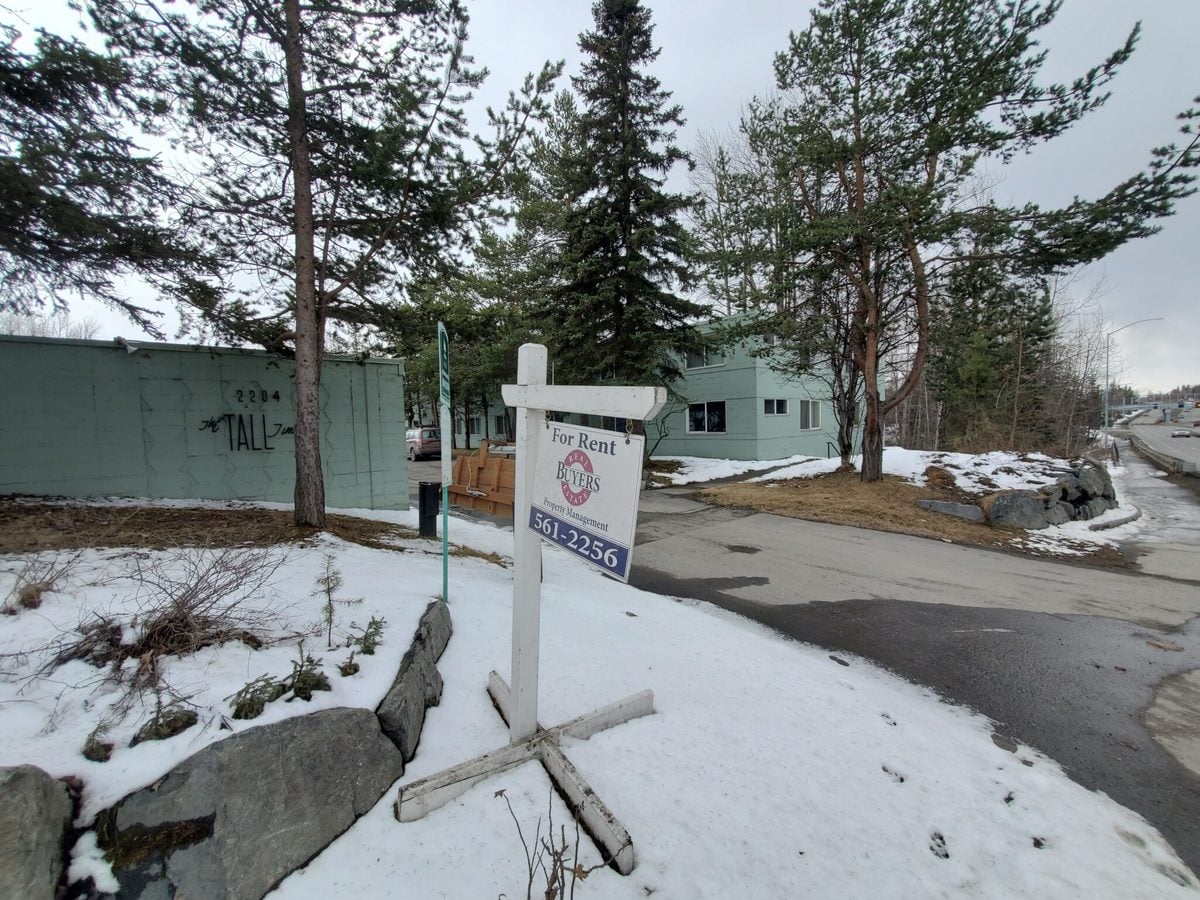
A sign seen on April 9, 2025, advertises rental availability at an apartment building in Anchorage’s Turnagain neighborhood. (Photo by Yereth Rosen/Alaska Beacon)
Apartment rents in Alaska rose 2.1% over the past year, the most modest increase in five years, according to analysis by the state Department of Labor and Workforce Development.
The statistics on rental costs are part of a package of articles about housing costs published in the September issue of Alaska Economic Trends, the monthly magazine of the department’s research section.
Rental statistics, based on prices recorded in March of this year, show some striking geographic differences.
The Wrangell-Petersburg area in Southeast Alaska had the cheapest rent of the 11 cities and areas analyzed, with a median monthly rate of $1,288 for a two-bedroom apartment. Bethel, a rural hub in Western Alaska, had the highest rents, with a median of $2,030 a month for a two-bedroom apartment.
Kodiak, Anchorage, the Fairbanks North Star Borough and Juneau were behind Bethel with monthly median rentals above $1,700.The Matanuska-Susitna Borough, just north of Anchorage, was on the low side for median rents, at $1,567 a month, but it had the biggest yearly increase, measured at 12.8%.
That reflects demographic characteristics in the bustling borough, where many residents are commuters who work in Anchorage, said Gunnar Schultz, a state labor economist and one of the authors of the housing-cost stories.
“Mat-Su obviously has been growing in contrast to most of the rest of the state,” he said. “So I think that that obviously puts upward pressure on price.” Proximity to Anchorage is another contributor because it means money is coming into the borough from the state’s largest city, he said.
The analysis is part of the department’s regular monitoring of housing costs. The rental comparisons covered much but not all of the state; the North Slope Borough and Bering Strait region, for example, were not included.
For homebuyers in Alaska, there are some economic headwinds, according to the economists’ analysis. Mortgage costs are much higher than they used to be, they said.
For a 30-year fixed rate mortgage on a $415,000 Alaska home — the median value — the monthly payment in 2025 was about $2,050. That is 84% higher than the estimated median monthly mortgage payment in 2019, the analysis said.
A big driver is the rise in home values, from an average of about $300,000 in 2019 to an average of $415,000 just six years later. Another factor is the increase in interest rates, from a median under 3% in 2020 to 6.5%in 2023, the analysis said.
But while home values and thus monthly mortgage costs increased, so did wages in Alaska.
The result of all those combined changes was that purchasing a home became marginally more affordable in 2025 than in the two years prior, according to the analysis.
Alaska’s Housing Affordability Index, the number that represents how many people earning the average monthly are needed to make mortgage payments, dropped a bit in 2025 to 1.37. That is down from last year’s index of 1.39 and from the 2024 index of 1.4, which was the highest in recent years. But it is above the indexes measured in previous years; from 2019 to 2021, the index was below 1, indicating that a single person earning average Alaska wages had enough money to afford monthly mortgage payments.
Despite the slight improvement in the affordability index, buying a house remains a hefty burden in Alaska, Schultz said. “It’s still so much higher than it was during COVID and before,” he said.
A slight decline in interest rates last year was a contributing factor to the small improvement in housing affordability. However, interest rates are now heading up, the analysis pointed out.
Also affecting housing affordability is the availability of homes, and on that subject, there is positive news for would-be buyers, according to the economists’ analysis.
Housing construction in 2025 hit a 10-year high after years of increases that followed the big drop during the COVID-19 pandemic. A total of 2,261 single-family and multifamily housing units were built last year, the analysis said. That compares to 1,747 in 2020 and 1,726 in 2021. Home construction has been steadily rising since those years, according to the data.
The Alaska Economic Trends articles did not compare housing costs in the state to those nationwide, but the U.S. Census Bureau has some U.S. statistics that provide some contest.
Nationally, home ownership costs remained flat from 2020 to 2024, while rents increased by $100 more a month to a median $1,413 during the period, according to the Census Bureau. The analysis considers areas around the nation with populations over 5,000, so most of Alaska’s rural communities are not included.
Former state Rep. Jonathan Kreiss-Tomkins, third from left, speaks at a gubernatorial candidate forum on Wednesday, while former Attorney General Treg Taylor, Anchorage business owner and talk-show host Bernadette Wilson and former Anchorage Mayor Dave Bronson listen. The forum was held by the Alaska Hospital and Healthcare Association and the organization’s annual conference in Girdwood. Taylor, Wilson and Bronson are Republicans. Kreiss-Tomkins is a Democrat. (Photo by Yereth Rosen/Alaska Beacon)
The three Republicans and one Democrat seeking to become Alaska’s next governor pitched their visions for state healthcare policy on Wednesday to an audience of experts: members of the Alaska Hospital and Healthcare Association.
The organization capped its two-day annual conference in Girdwood with a forum among the gubernatorial candidates who are running under Alaska’s ranked-choice voting system.
Along with addressing healthcare issues, all four candidates repeated talking points they have used at past events.
Former State Rep. Jonathan Kreiss-Thomkins, the only Democrat on the general election ballot, spoke about consensus-building across party lines, and he criticized outgoing Republican Gov. Mike Dunleavy for failing to do so.
Kreiss-Tomkins recounted his experience in a bipartisan coalition focusing on problems rather than party. “That’s a real North Star for me,” he said. “That philosophy of government, that principle has been painfully absent in the governor’s office for the last eight years, and it has really distressed me to see the direction Alaska is going as a consequence of that leadership in our governor’s office the last eight years. And I’m running to change that.”
Former Attorney General Treg Taylor spoke about his desire to cut bureaucratic red tape, including his experience with a real estate license that took a year and a half to transfer, an account he has described at numerous other gubernatorial events.
“We need to have government run at the speed of business,” he said, repeating a slogan he has used elsewhere.
Talk show host and business owner Bernadette Wilson, who has never held public office, pitched herself as an outsider and “the only one up on this stage that has never taken a check from government.” She said she breaks with past practices, including bipartisanship, that she said do not work. The current debates are about many of the same issues that faced gubernatorial candidates in past years, she said.
“And the question that each of us will have to answer is, ‘What are we going to do differently this time?’” she said.
In contrast, former Anchorage Mayor Dave Bronson touted the experience he gained in his three years as chief executive of the state’s largest municipal government.
Former Anchorage Mayor Dave Bronson, a Republican, speaks at a gubernatorial candidate forum held in Girdwood on Sept. 16, 2026, by the Alaska Hospital and Healthcare Association. (Photo by Yereth Rosen/Alaska Beacon)
“I ask you to just look at the resumes. I’ve already held the closest job in this state to the governor’s job. I governed 40% of the population of the state as the mayor,” he said. He “paid in blood” for the hard lessons that he learned, he said, experience that will serve him well as governor, a job for which “there’s no time for on-the-job training.”
Lost Medicaid coverage
On specific health topics, the candidates had many areas of agreement, but the discussion also revealed some key differences.
One divide emerged during a discussion about the loss of Medicaid coverage over the past two years for low-income Alaskans. At least a quarter of those being dropped from enrollment are not losing coverage because of lack of eligibility, Alaska Hospital and Healthcare Association President Jared Kosin said as he posed the question. Rather, they are being dropped because of long wait times and the bureaucratic hurdles they face in getting their applications considered.
Kreiss-Tomkins, who said he is proud of his record as a lawmaker working with the administration of Gov. Bill Walker to expand Medicaid coverage, said staff shortages are causing some of the problems. And he said some are caused by new rules imposed by the Trump administration, such as the work requirement that was embedded in the sweeping budget bill called the “One Big Beautiful Bill Act,”, have exacerbated problems for qualified Medicaid recipients, who are among society’s most vulnerable members.
And he made a veiled jab at U.S. Sen. Dan Sullivan and U.S. Rep. Nick Begich, both Alaska Republicans who voted for the bill and are running for reelection.
It is important to be “very clear about who voted for that legislation that is about to make it harder for Alaskans to get the care they need,” he said. “We need to be very clear-eyed about that.”
Taylor, in contrast, said he supports the bill’s requirement that Medicaid recipients work at least 80 hours a month, either at a paid job or in volunteer service or training.
“It is not unreasonable for an able-bodied adult, without dependents,” he said. Medicaid funds are not infinite,” so stewardship is needed to make sure they are spent properly, he said. Additionally, he said, fewer people on Medicaid could be a good sign. He said unemployment rates in Alaska have dropped.
“So that’s good. That’s the program working,” he said.
Alaska’s unemployment rate, though following a volatile pattern, has been on a long-term decline, according to the Federal Reserve Bank of St. Louis. In recent years, the rate bottomed out at 3.9% in August of 2022, rose to 4.8% in December 2025 and then declined again, falling to 4.3% as of July, according to the Federal Reserve bank’s statistics. Alaska’s rates have been above the national rate for most of the years in the past decade, according to the U.S. Bureau of Labor Statistics.
Former State Rep. Jonathan Kreiss-Tomkins, a Democrat, speaks at a gubernatorial candidate forum held in Girdwood on Sept. 16, 2026, by the Alaska Hospital and Healthcare Association. (Photo by Yereth Rosen/Alaska Beacon)
Wilson said a business-like approach is needed to fix the Medicaid problems.
“We need to treat Medicaid like a business that is failing Alaskans,” she said. “We need to come in and we need to look at how can we hire people from the private sector that know processes and can hold these processes to a more accountable timeline.”
Bronson said Kosin’s statistics show that a large percentage of qualified Alaskans are being dropped from services.
“We are failing at a state level, especially in the Department of Health,” he said. Upon taking office as governor, “I would direct the Department of Health to conduct a review of all operations, and that includes the processing of paperwork for Medicaid,” he said.
Bronson also said that the One Big Beautiful Bill Act is causing extra problems for Alaska, and that he would seek an extension of the national Jan. 1 deadline for states to comply with all of its provisions.
Rural health ideas
On the subject of rual health care in general and, more specifically, what to do with “rural health transformation” funds granted from the federal government to the state, two of the candidates referred to their own family experiences.
Kreiss-Tomkins, who is from Sitka, spoke about his mother, an Indian Health Service doctor who spent her entire career at the Southeast Alaska Regional Health Consortium. He said he got his own health care from that tribal organization.
Wilson, noting that her grandmother was born in the Bristol Bay community of Naknek and that she is of part Aleut ancestry, said she has experience as a patient at the Alaska Native Medical Center.
As for the $272 million in rural health transformation funds that the state got from the federal government and that the Department is disbursing in a series of grants, the candidates offered a variety of suggestions.
Wilson said the state should invest in technology, especially technological advances that might help rural Alaskans avoid the need to travel to Anchorage or elsewhere for care.
Former Attorney General Treg Taylor, a Republican, speaks at a gubernatorial candidate forum held in Girdwood on Sept. 16, 2026, by the Alaska Hospital and Healthcare Association. (Photo by Yereth Rosen/Alaska Beacon)
She sees the travel-related challenges when she is at the Alaska Native Medical Center, she said. “You have people who are pulled out of their community, pulled out of their village, they’re coming into Anchorage. Sometimes it’s for an unknown length of time,” she said. The state needs to try to find ways to ensure that rural patients can be treated at home, she said.
Bronson made similar observations about the need to minimize travel for rural patients, citing “robust telehealth” as one tool.
Kreiss-Tomkins said the state should be seeking to make the rural transformation grants “leverage structural and systems change that will have lasting and enduring benefit to the system” rather than use them for construction or for one-time projects. The state should not count on getting similar money in the future, he said.
Taylor called the funding a “gift” that he hopes will be used “to help reinvent healthcare in Alaska.”
There was a split among the candidates over mandatory staffing ratios for nurses, as proposed in a bill that emerged late in this year’s session, Senate Bill 283. The Alaska Hospital and Healthcare Association opposed the bill, which did not advance out of the Senate Labor Committee.
Three of the gubernatorial candidates said they also opposed the idea of codifying such ratios into law, but Taylor spoke out in support. He cited a 2016 study in Australia that found that for each patient taken off a a nurse’s workload, there was a 7% drop in the likelihood of death and a 3% shorter hospital stay.
However, establishing firm ratio requirements would also necessitate related action to ensure sufficient numbers of nurses in the state, he said.
“You cannot mandate nurses into existence,” he said.
The other three candidates said mandatory staffing ratios would not be workable in Alaska’s diverse healthcare settings.
However, Kreiss-Tomkins said, the idea behind the proposal is laudable. “I appreciate where the impulse comes from,” he said. “I mean, everybody wants safe standards of care for patients, and you don’t want nurses or other practitioners spread thin.”
Complex subjects
Concerning mental and behavioral health, Bronson repeatedly defended his controversial attempt as Anchorage’s mayor to build a huge shelter and “navigation center” in the city’s university-medical district to serve the unhoused.
Anchorage business owner and talk-show host Bernadette Wilson, a Republican, speaks at a gubernatorial candidate forum held in Girdwood on Sept. 16, 2026, by the Alaska Hospital and Healthcare Association. (Photo by Yereth Rosen/Alaska Beacon)
“That facility, I think, was the right answer to dealing with a lot of the healthcare issues we face in the city of Anchorage and across the state because we’re kind of the homeless center for the state,” he said. “We almost had it done. We actually started pouring concrete.”
Bronson’s plan was for a tented facility to house and serve hundreds of people at a site across the street from the Alaska Native Tribal Health Consortium campus. The Anchorage Assembly rejected the plan after it was revealed that the Bronson administration awarded a contract and started construction illegally. The plan had drawn backlash from residents in the area, which currently is the site of ballfields and recreational trails.
Taylor said Alaska’s mental health challenges are daunting, with suicide and alcohol death rates that are twice the national average.
But there has also been positive movement under the Dunleavy administration, he said. He cited a bill that the governor signed in 2022, House Bill 172, that supports the use of crisis centers and teams to treat patients in emergencies.
There are now mobile crisis centers in four communities, Taylor said. “The added effect of that is keeping people out of your emergency rooms,” he said. “Youth suicides are down sharply now.”
It was unclear whether Taylor was referring only to the communities where the mobile crisis teams are operating or to the state as a whole.
Statewide, the rate of youth suicide fatalities reached a 10-year high in 2025, according to the Department of Health’s epidemiology section.
Other subjects discussed at the forum included the rising cost of health insurance in Alaska and qualities that the candidates are seeking in officials they would hire to manage healthcare services.
At the event’s conclusion, Kosin thanked the candidates for delving into healthcare topics that are complex.
“This is not always the most comfortable environment, and you guys were here. And that says a lot about your character,” Kosin said to the candidates.
Former Attorney General Treg Talor speaks at a gubernatorial candidate forum on Sept. 16, 2026, while Anchorage business owner and talk-show host Bernadette Wilson, former state Rep. Jonathan Kreiss-Tomkins and former Anchorage Mayor Dave Bronson listen. At the lecturn is Jared Kosin, president of the Alaska Hospital and Healthcare Association. The organization held the forum in Girdwood, and the event was focused on healthcare issues. (Photo by Yereth Rosen/Alaska Beacon)
NOTN- The Juneau Assembly has indefinitely tabled a proposal that would have required nonprofits to collect sales tax on purchases, after a marathon debate that Mayor Beth Weldon described as increasingly confusing for the public.
Speaking on Monday night’s meeting, Weldon said the measure drew intense public interest, but efforts to carve out protections for smaller nonprofits only muddied the policy.
“We were just creating confusion. Just for instance, what’s intermediate fundraising? How do the raffle tickets fit in there? 14 days isn’t long enough for a raffle ticket period, and so at the end, especially after talking with the finance, Ms. Woll proposed an amendment to table it indefinitely. And what that means is, unless we bring it up at our next meeting, it dies at this time.” Weldon said.
At the meeting, 17 nonprofit leaders testified against the measure, raising concerns about fairness, added financial burdens and more confusion over how the ordinance would work.
“What I have a hard time understanding is the policy rationale for carving out certain types of non-profits as ineligible for the sales tax exemption, though we have an important charitable mission, it sends a message that it’s not important enough. Crafting tax law is tricky. Our Internal Revenue Code is 3000 pages. The regs are another 70,000. I get it. I understand interpretations have to be made and lines drawn, and I also understand-I truly do-the desire to protect basic human services, food, and shelter to those who need it most. But I question whether the city should be in a position of determining where to draw that line and what services and missions are important.” Said Bridget Lujan, Executive Director of Juneau Dance Theater.
The proposal was projected to raise closer to $1–2 million in new revenue, down from earlier estimates of $3 million, according to Weldon. She said the financial benefit no longer justified the level of community angst.
The Assembly also approved funding for Hesco barriers and other work related to glacial outburst flood mitigation.
President Donald Trump speaks to the media as he arrives with his then-personal attorney Todd Blanche in court for opening statements in his trial for allegedly covering up hush money payments at Manhattan Criminal Court on April 22, 2024, in New York City. Trump was convicted of falsifying business records in the first of his criminal cases to go to trial. Since his election, he’s nominated Blanche to be attorney general of the United States. (Photo by Yuki Iwamura-Pool/Courtesy of Alaska Beacon, Getty Images)
During a lengthy, meandering series of remarks last week, President Donald Trump offered another hint that his administration may seek to disrupt Alaska’s U.S. Senate election.
Dan J. Sullivan has repeatedly said his campaign was inspired by his dissatisfaction with incumbent Republican U.S. Sen. Dan S. Sullivan, and that he did not work with officials from Democratic candidate Mary Peltola’s campaign on his initial run for office.
Despite that, Trump and Dan S. Sullivan have repeatedly claimed — without providing evidence — that Dan J. Sullivan is a fraudulent candidate.
Hours later, talking with Republican lawmakers at a dinner in the Rose Garden, Trump again brought up the Alaska race.
“I’m going to go up to Alaska for Dan Sullivan. Think of it,” Trump said. “They have a man named Dan Sullivan running against him, the Democrats.”
“I think, Todd, you have a legal case on that,” the President said, referring to Attorney General Todd Blanche.
The U.S. Senate confirmed Blanche by a 50-49 margin on Aug. 8. Sen. Dan S. Sullivan was one of the decisive votes in favor of confirmation.
In the August primary election, Democratic candidate Mary Peltola had 49.5% of the vote, Dan S. Sullivan had 41.4%, and Dan J. Sullivan had 2.5% of the vote.
Under Alaska’s election system, the top four candidates advance to the November general election. The fourth-place finisher in the primary, Democratic candidate David Leslie, withdrew after the results were finalized, which advanced the fifth-place finisher, Gerald Heikes, who had 1.1% of the vote.
Trump, speaking on Sept. 2, said that even though Dan J. Sullivan had only 2.5% of the vote, his appearance on the November ballot could be decisive in a close contest between Peltola and Dan J. Sullivan.
“Let’s say he takes two or three points away. That’s the difference between winning and losing. It should be illegal. I don’t know how the judges are ruling (on) it, but it really is terrible,” Trump said.
Dan J. Sullivan did not immediately respond to an inquiry from the Beacon about the President’s remarks, but after the publication of this article, he answered by email: “I will not let President Trump’s threats of retribution force me out of this race. I’m running to give a voice to the Alaskans who voted for me and to honor the intent of our ranked choice voting system.”
Editor’s note: This article was updated on Sept. 9, 2026, at 9:03 a.m. with a response from Dan J. Sullivan.
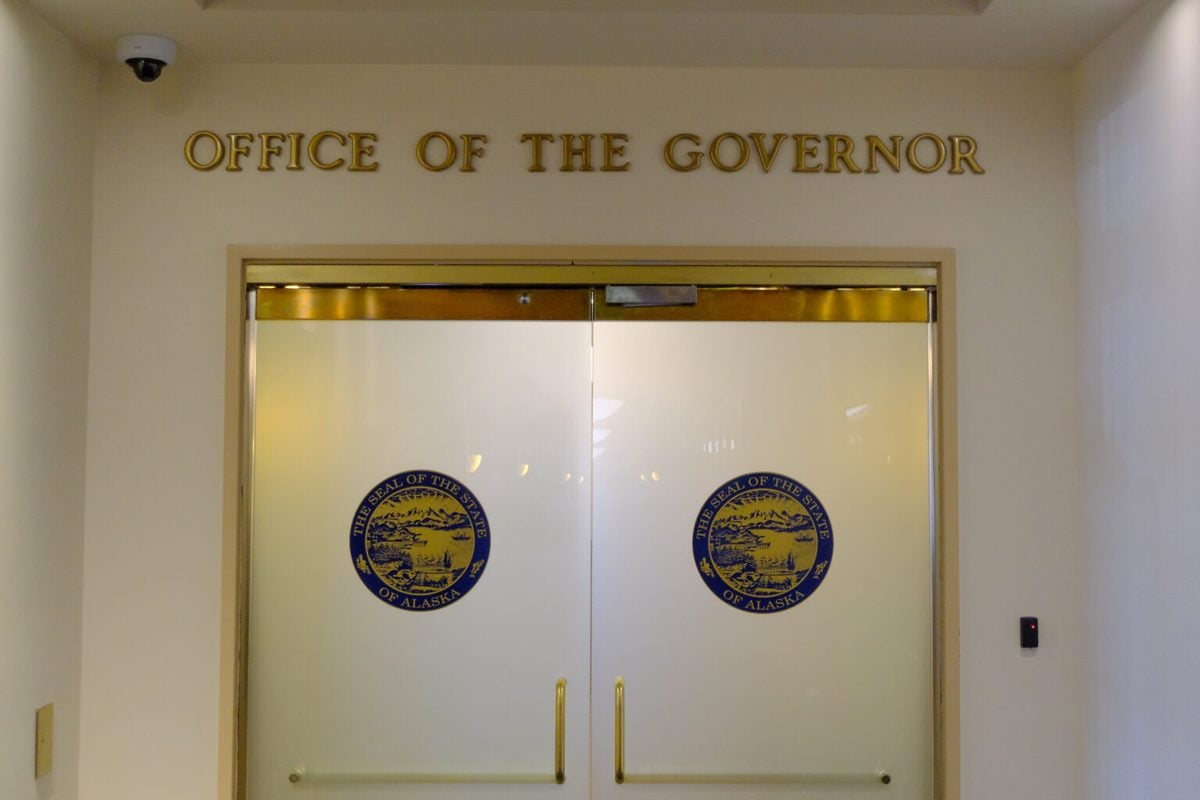
The doors of the governor’s office in the Alaska State Capitol is seen on Apr. 10, 2026. (Photo by Corinne Smith/Alaska Beacon)
Alaska’s November election for governor will include one Democrat and three Republicans after a final-days shakeup that included a wild last-hour substitution on Monday, the deadline to make changes after August’s primary election.
Under Alaska’s unique elections system, all candidates for an office run against each other in the primary election. The top four candidates, regardless of political party, advance to the general election in November.
Former state Rep. Jonathan Kreiss-Tomkins, a Democrat from Sitka, finished August’s primary election with 22.5% of the vote, the most out of 16 candidates seeking to replace incumbent Republican Gov. Mike Dunleavy.
The second-place finisher, Democratic candidate Tom Begich, withdrew from the race officially on Monday despite earning 20.8% of the vote.
That promoted Anchorage businesswoman Bernadette Wilson, a Republican, to the second spot on the November ballot. Wilson had 10.1% of the vote in the primary.
Begich’s withdrawal put former Anchorage Mayor Dave Bronson, a Republican, into the third spot for November. Bronson earned 8.1% of the primary vote.
The withdrawal would also have promoted Republican candidate and former Attorney General Treg Taylor into the fourth spot, but on Monday, Lt. Gov. Nancy Dahlstrom disqualified Taylor because of gaps in a legally required financial report.
Alaska Attorney General Treg Taylor speaks at a news conference on Thursday, Dec. 15, 2022, at the Alaska State Capitol in Juneau. (Photo by James Brooks/Alaska Beacon)
That left Taylor’s lieutenant governor candidate, Republican businesswoman Candice English, to decide by 5 p.m. whether to withdraw or continue with another running mate.
English found one — Taylor’s wife, Jodi Taylor, who became English’s lieutenant governor candidate in a form filed less than an hour before the 5 p.m. deadline.
According to the Anchorage Press, which was on the scene in Anchorage, English told election workers, “I’m stepping up to governor.” She also told another visitor to the office: “It’s all for the good of the state. The state needs the right people in place. We can’t get it wrong.”
It was not immediately clear on Monday evening whether the substitution is legal. Jodi Taylor’s required personal financial disclosure form contains the same information as Treg Taylor’s, and state regulators found it inadequate.
State law gives Jodi Taylor 30 days to amend her report before a final determination on her candidacy.
In Alaska’s November general election, voters will rank the four candidates (and any write-in candidates) in order of preference.
When ballots are counted, the candidate with the fewest top rankings is eliminated, and any votes for them are redistributed to their voters’ second choices.
The process continues until only two candidates are left, and the person with the most votes wins.
Ranked choice voting reduces the chances that candidates from the same party will split available voters and improve the odds for a candidate from a different party, but the system does not eliminate that chance entirely.
Since 2022, when Alaska began using the current system, a significant number of voters have continued to rank just one candidate.
As a result, political parties have pressured lower-finishing primary candidates to withdraw ahead of the general election in order to consolidate support.
In the case of Alaska’s governor race, where governor and lieutenant governor run as a single ticket, that led to talks around consolidation, where a lower-finishing governor candidate takes the place of a lieutenant governor on a higher-finishing ticket.
That didn’t happen on the Republican side, but it did on the Democratic one.
Second-place finisher Tom Begich confirms withdrawal
Hours before the 5 p.m. deadline to withdraw, second-place finisher Tom Begich, a Democrat and former state senator, officially filed his paperwork to quit the race.
Begich had announced his intentions on Friday, saying he is now supporting the first-place finisher, former state Rep. Jonathan Kreiss-Tomkins, a fellow Democrat.
In a written statement, prerecorded video and interviews after the announcement, Begich said that withdrawing means Democratic support is consolidated around a single candidate.
That means more money for the Kreiss-Tomkins’ campaign and less chance of a split vote in November.
While Alaska uses ranked choice voting, which would allow voters to pick both Kreiss-Tomkins and Begich, results over the past four years show a significant number of voters decline to rank multiple candidates.
Lieutenant governor rejects fourth-place finisher Treg Taylor
Lt. Gov. Nancy Dahlstrom on Monday declined to certify former Attorney General Treg Taylor as one of the four finalists in Alaska’s top-four primary election for governor.
Taylor, who finished fifth in the primary, was promoted to fourth after the withdrawal of the second-place finisher, Democratic candidate Tom Begich.
Nick Begich III announces endorsement of Bernadette Wilson
Alaska’s incumbent U.S. Representative, Republican Nick Begich III, said he is endorsing Republican businesswoman Bernadette Wilson as his preference for Alaska’s next governor.
Begich is running for re-election this year; Wilson worked on his prior campaigns for U.S. House, and Begich had previously vowed to support the top-finishing Republican candidate.
Arkansas Gov. Sarah Huckabee Sanders endorsed Wilson on Saturday, as did U.S. Rep. Byron Donalds, the leading Republican candidate to become Florida’s next governor.
Turnout is highest for regular primary election since 2014
According to Monday’s certified results, 166,992 voters participated in the August primary election, the most since the 2022 primary, which coincided with a special general election following the death of U.S. Rep. Don Young, R-Alaska, earlier that year.
Excluding that race, turnout this year was the highest for a primary since 2014, when voters decided a high-profile referendum on whether or not to repeal an oilindustry tax cut.
In terms of the number of votes cast, the 2026 primary was the fourth-largest in state history; in terms of percentage turnout, it was the 18th largest since 1974.
Louis Wagner Jr. pulls up ooligan nets on the Unuk River in southeastern Alaska in March 2024. He and his wife, Cindy Wagner, have fished in the area for years. (Photo by Sonia Luokkala/courtesy of the Southeast Alaska Indigenous Transboundary Commission)
The salmon and the ooligan that spawn in the Unuk and Stikine rivers have no say in the expansion of mining operations in British Columbia. Neither do the Alaskan tribes that live on the same rivers.
The power lies across the border in Canada, where the mining companies and the provincial, federal and Tahltan Nation authorities have joined forces in a modern-day gold rush to expand the Red Chris Mine at the headwaters of the Stikine River. Plans are also underway to restart the idled Eskay Creek Mine on the Unuk River.
The investment of a half-billion Canadian dollars supporting the expansion of the Red Chris mine by Prime Minister Mark Carney’s government has heightened an international conflict between the Native peoples and others in southeastern Alaska and the First Nations people in Canada who support the project.
A pictograph of the rising sun along the Unuk River is thousands of years old and reflects the influence of the Tèiḵwèidi Tlingit Clan of the Sàanyàa Ḵwáan, the people of the Unuk River, according to river advocates. (Photo by Sonia Luokkala/courtesy of the Southeast Alaska Indigenous Transboundary Commission)
Seven tribal nations could be affected by the Eskay Creek Mine, and the Red Chris expansions poses similar threats, according to officials with the Southeast Alaska Indigenous Transboundary Commission, or SEITC, a collective of 14 Haida, Tlingit and Tsimshian nations that have united to uphold stewardship over the lands, waters and sacred sites in their territories.
“The expansion of Red Chris means more risk in the headwaters of a river that has sustained our people since time immemorial, “ said SEITC President Esther Aaltseen Reese, Eagle Tsaagweidí (Killerwhale) from Ḵéex̱ʼ Kwáan (Kake), who lives down river of the Red Chris Mine.
“We are salmon people,” Reese told ICT. “The Stikine is part of who we are. We are already seeing contamination from Red Chris entering waters that feed the Stikine, yet British Columbia approved a major expansion without consulting the tribal nations downstream whose ways of life are on the line.”
The Tahltan Nation, which has agreements in place for both mining projects, did not respond to questions about the project posed by ICT via email.
In November 2025, the SEITC filed a judicial review in the British Columbia supreme court to force “meaningful consultation” with Alaskan tribes on mining projects in the headwaters of the Unuk, Stikine and Taku rivers.
“There is no legal or moral basis for B.C. to exclude our tribes who have deep ancestral ties and relationships to land and territory on both sides of the border,” Reese said in a statement issued at the time. “We deserve a seat at the table when decisions are made upstream that could obliterate our way of life.”
Canada’s Ministry of Environment and Parks responded to ICT questions in a written statement.
“We are not expediting projects at the expense of meeting our consultation obligations or compromising our high standards of environmental protection — we are finding opportunities that can do both in our processes,” according to the statement.
In regards to concerns from Alaskan tribes, officials said, “The matter of consultation with Alaska tribes for the environmental assessment of the Eskay Creek project near the B.C./Alaska border is currently before the courts, we are not able to comment.”
Eskay Creek Mine
The Unuk and Stikine rivers are part of the transboundary watershed, a collection of rivers, streams and tributaries that also include the Taku and Salmon rivers that flow south from British Columbia into Alaska and then on to the Pacific Ocean.
The watershed is crucial spawning grounds for salmon and other fish, and provides sustenance to Indigenous people and others along the rivers.
Cindy Wagner, Haida/Tsimshian, is concerned that the rapid expansion of mining in Canada will have significant environmental impacts on the transboundary watersheds in Alaska.
Louis Wagner Jr., rear left, delivers ooligan with his daughter Lee, center, and wife Cindy in this undated photo. (Photo courtesy of Cindy Wagner)
Wagner, assistant executive director of the SEITC, and her husband, Louis Wagner Jr., live downstream of the Eskay Creek Mine on the Annette Islands Reserve in Alaska on the Unuk River, where she has lived and fished all her life.
She has seen first hand the impact of mining on the Unuk.
The Eskay Creek Mine operated from 1994 to 2008, and the ooligan fishery on the river was closed in 2001. In recent years, ooligan, a small fish also known as eulachon, have begun to return, along with salmon and mackerel.
But she fears that could change with the reopening now underway of the Eskay Creek Mine on a much-larger scale. The mine received its Environmental Assessment Certificate in January.
“This is all for the Unuk River,” Wagner told ICT. “It’s a major salmon river, an ooligan spawning river, a mackerel spawning river, and vital to southeast Alaska.”
Ooligan, shown here, are small fish used in a variety of ways by Indigenous people and others in southeastern Alaska. (Photo by Sonia Luokkala/courtesy of the Southeast Alaska Indigenous Transboundary Commission)
Reese says her people are concerned about a possible overflow or dam breach at the tailings ponds that collect the mining byproducts. In 2014, a breach at the Mount Polley copper and gold mine tailings dam resulted in billions of liters of wastewater spilling into the waterways. The mine is owned by Imperial Metals, which also owns a share of the Red Chris mine.
“Contamination or a failure at Red Chris could travel downstream, across the border, and through one of the most intact salmon systems left in the world,” Reese said. “The cumulative impacts of multiple large mines only magnify that risk.”
A waterway in transition
Tribes on the American side of the border have been living with the impact of mining for decades and fighting, to no avail, to stop expansion, local officials said.
On June 19, however, the province of British Columbia approved the transition of the Red Chris mine from an open-pit mine to a block cave mine that would largely be underground. On July 2, the Canadian government approved the funding support.
The Tahltan Nation in British Columbia has signed on with Red Chris mine’s owners and operators, Newmont Corporation and Imperial Metals, according to a statement from the companies.
The outlook is not as rosy downstream. The Annette Islands Reserve of the Metlakatla Alaska Native Community is Alaska’s only reservation, with other Native lands transferred to Alaska Native Corporations under the Alaska Native Claims Settlement Act, or ANCSA.
The reserve sits on the pristine Alexander Archipelago about 250 miles south of Juneau.
The Tongass rainforest towers over the Unuk River in southeastern Alaska. (Photo by Sonia Luokkala/courtesy of the Southeast Alaska Indigenous Transboundary Commission)
Wagner has lived off the Unuk River for most of her life, and in recent years has been defending Alaska’s waterways against mining development in Canada.
“I have always been fishing, even as a child,” she said. “My parents brought us out, all four of us, on a little 35-foot boat … I met my husband. The first time I helped him was down on his brother’s boat. He was selling ooligan and he didn’t have anyone to help him, and so I helped him.”
Wagner and her husband have always watched the waters of the Unuk River, and taken note of how clean and deep they were, and how the fish changed in appearance and in number. Then, in 1999, after the Eskay Creek Mine began operating, they noticed that industrial waste was piling up in the low part of the river.
“We are way up this river,” Wagner said. “How does a rusted-up oil drum get this far? How does all this plastic and old tarps and old pallets get up here? This looks to be an important part where the moose stepped into the river to get across, and it’s blocked with junk.”
The fish noticed, too, she said.
“In about 2001, we started noticing the ooligan bypassing the Unuk River,” she said.
Ooligan are different from mackerel and salmon, which return to the waters where they were spawned. Ooligan go to where the water is best, she said.
Dramatic escalation
The Unuk River was beginning to recover after the Eskay Creek Mine shut down in 2008, Wagner said, when a mining boom began on the Canadian side, in an area in northwest British Columbia called the “Golden Triangle.”
By 2022, just two mines were in operation, BruceJack and Red Chris. But four mines were proposed, seven were under development and seven more exploration projects were underway, mostly to dig for gold, according to a provincial report on mines. The ore extracted from the ground is processed to pull out the valuable gold and copper that it can contain.
Guy Archibald, executive director of the transboundary commission and a self-described “reformed miner,” said the transition from an open-pit mine to a block cave mine at Red Chris will mean a dramatic escalation involving hydraulic fracturing, known as fracking, a controversial method also used for extracting natural gas.
Archibald said the SEITC member nations “upholding their sovereign rights and defending the transboundary Stikine, Taku and Unuk Rivers from rapidly expanding mining development occurring in the Canadian headwaters.”
An environmental chemist, Archibald has been with the commission since its inception in 2014. Before that, he worked in the uranium industry in southeastern Utah and the oil shale industry in western Colorado in the 1970s and 1980s, he said.
Archibald explained the process behind a block cave mine.
“They’ve mined out the ore body that’s closest to the surface, and in order to go deeper, they’re going to have to access it underground,” he said. “They’re going to drive a ramp underneath the ore body, and then … they’re going to fracture the ore body pretty much the same as they do hydraulic fracturing, fracking for natural gas.”
The crumbled ore falls into the ramp and is carted above ground, he said.
“They’re going to just start scooping it out from the bottom as this cavity, this cave, just naturally collapses in,” he said. “It’s just going to turn into a big crater in the earth, and that’s block cave mining.”
The practice is not new, but in the past, miners would use drilling. With this project, they’ll use fracking.
“Block cave mining has been around for a long time,” Archibald said. “The only difference I see with the way Red Chris is doing it is by doing the hydraulic fracturing from the surface, drilling down and then pumping high pressure water into the ore body to break it up.”
The introduction of fracking to the block cave operation is a major concern to the SEITC. Officials say the mine can’t contain its current tailings, which already end up in the groundwater.
“The studies have been showing the tailings dam leaks into the groundwater 26 percent of its volume every year,” Archibald said. “Those tailings have to be constantly covered with water so that they don’t oxidize and turn acidic. We already have downstream pollution problems in groundwater and surface water…Using more water to frack this ore body is not going to help that situation.”
‘A critical step’
The Red Chris mine operation is a joint venture partnership between the Newmont Corporation, which owns 70 percent, and Imperial Metals, which owns 30 percent.
The Red Chris was one of 18 major projects named by Canada’s Major Projects Office, the new federal department created by the Carney government to push forward his “Build Canada Strong” strategy. The half-billion-dollar investment may be just the beginning.
“With the authorizations granted by the province and the support of the Tahltan Nation, the stage has been set for the development of Red Chris into a Block Cave mine,” Imperial President Brian Kynoch said, following the approval of the British Columbia government. “These approvals are a critical step in advancing a final investment decision by the joint venture partnership.”
Newmont officials welcomed the news in a statement promising that the project would not only increase Canada’s copper production by an estimated 15 percent but that the infrastructure could be a hub for mining for decades.
“The project is expected to extend the life of the current Red Chris mine by approximately 14 years and sets the foundation for decades of potential additional mining,” Newmont stated. “It represents a significant opportunity to create long-term value for Newmont’s shareholders, strengthen critical mineral supply chains, and deliver long-term benefits for local communities, Indigenous partners, British Columbia, and Canada.”
Canada’s Major Projects office is promoting both production and Indigenous participation, stating that the project was “developed in close collaboration with the Tahltan Nation, whose Traditional Territory overlaps directly with the mine site” and that “the project supports reconciliation while strengthening Canada’s role as a reliable supplier of critical minerals.”
Provincial leaders have changed the laws, however, to eliminate participation of U.S. tribes when it comes to environmental impacts. The province passed Bill 15 in April to amend the dispute resolution processes in British Columbia’s Environmental Assessment Act to limit participation of tribes in the U.S. and exclude them as “participating Indigenous nations.”
Archibald says the moves have raised concerns for taxpayers as well.
“Subsidizing the Red Chris just furthers the privatization of profit while transferring the risk on to the taxpayer,” he said. “If Newmont and Imperial Metals can’t afford their own infrastructure, what assurance do we have that adequate funds will be available for long-term tailings management, closure, and cleanup to protect the Stikine River for hundreds of years into the future?”
The Eskay Creek Mine, owned by Skeena Gold + Silver, is an open-pit gold and silver mine that is being redeveloped with a projected 12-year mine life.
In approving the mine’s expansion, British Columbia Premier David Eby hailed the relationship with First Nations.
“Today marks success for yet another multibillion-dollar investment in our province that will deliver prosperity, jobs and stability for all British Columbians, achieved in true partnership with the Tahltan,” Eby said in a Jan. 27, 2026, press release. “Congratulations to all who were involved in this important work. Those who want to end our work with First Nations would not have delivered these thousands of jobs, period. Following their advice would leave us poorer, tied up in court and in a place of uncertainty.
Kerry Carlick, president of the Tahltan Central Government, issued a statement in the same press release.
“This is a hugely important day,” Carlick said. “TCG’s decision to consent to the Eskay Creek Project reflects a historic, precedent-setting process that affirms Tahltan Nation’s authority over development in our Territory, recognized by the Province and Skeena Gold + Silver.”
When asked to comment regarding concerns of Indigenous Alaskans about environmental concerns, a spokesperson for Skeena Gold + Silver responded that they had answered those concerns.
“We have already addressed many questions regarding concerns from the Alaskan groups, as we were going through our permitting process,” Galena Maleger, the vice president of investor relations told ICT in an email. “There is a significant amount of information available online as to how Eskay Creek is adhering to the highest standards in environmental management.”
Looking ahead
Downstream on the Unuk River, Wagner and her husband are already seeing more and more boats hauling material north to the dam site. They can only imagine the size of the massive project based on the garbage that piles up in the river.
Wagner has a message for the Tahltan Nation whose members will profit from the two mines.
“I think they should be more aware of what’s coming down the river, because it’s not staying up there on their territory,” Wagner said. “It’s coming down on my territory, my tribe’s territory, all southeast territory, and we have to deal with it.”
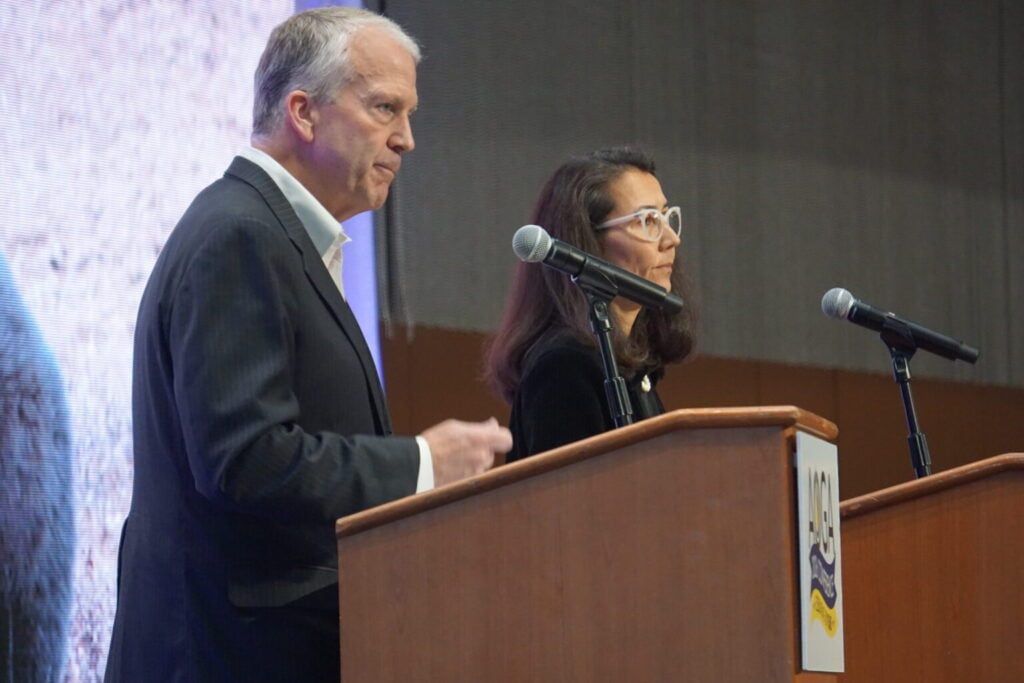
Sen. Dan Sullivan, R-Alaska, and former U.S. Rep. Mary Peltola, D-Alaska, listen to a question at a candidate forum held Aug. 27, 2026, by the Alaska Oil and Gas Association. The Alaska Senate race is considered critical to control of the body, which currently has a Republican majority. (Photo by Yereth Rosen/Alaska Beacon)
In their first faceoff since the Aug. 18 primary election, Republican U.S. Sen. Dan Sullivan used the term “Lower 48 liberal” or some variation of it 16 times to attack his opponent, Democrat Mary Peltola.
U.S. Sen. Dan Sullivan, R-Alaska, speaks at ae U.S. Senate candidate forum held Aug. 27, 2026, at the Alaska Oil and Gas Association Conference in Anchorage. (Photo by Yereth Rosen/Alaska Beacon)
Speaking at a candidate forum held Thursday at the Alaska Oil and Gas Association’s annual conference in Anchorage, Sullivan used nearly every question as an opportunity to tie Peltola, a former U.S. House member, to former Democratic President Joe Biden, whom he accused of maliciously trying to destroy Alaska’s economy.
“My opponents’ liberal Lower 48 anti-Alaska allies in the Congress and the White House were focused on completely shutting down Alaska oil and gas and killing thousands of jobs,” he said.
Sullivan and Peltola are the front-runners among four top vote-getters advancing to the general election. The winner will represent Alaska in the U.S. Senate for a six-year term.
Sullivan claimed Peltola “consistently voted with Lower 48 liberal allies of hers against our interests, and that is why this election is so important.”.
And he warned that a Peltola victory would allow Democrats and environmentalists to resume what he chacterized as deliberate attempts to harm Alaska. They would continue their efforts to block oil development in the Arctic National Wildlife Refuge and impose environmental restrictions on development elsewhere in Alaska, he said.
“If my opponents’ liberal Lower 48 allies get power again, the Democrats, if (Senate Minority Leader) Chuck Schumer is in charge again — she’s committed to supporting them — they will,” he said. “If elected, she would once again empower, vote with, and be beholden to the same far-left politicians who for decades have worked to crush our state.”
The primary election results indicate that Sullivan is facing headwinds as he runs for a third term in the Senate.
Former U.S. Rep. Mary Peltola, D-Alaska, speaks at the U.S. Senate candidate forum held Aug. 27, 2026, at the Alaska Oil and Gas Association Conference in Anchorage.
In the nonpartisan, open primary, Sullivan had about 41.4% of the total vote, 8 percentage points behind Peltola, who was at 49.5%, according to the most recent count, released on Friday.
The race is considered pivotal to control of the Senate, where Republicans currently hold the majority.
Peltola voices support for oil and gas development
At Thursday’s event, Peltola largely refrained from attacking Sullivan directly.
She described herself as pro-development and a champion for the oil industry.
Peltola was the first Alaska Native woman elected to U.S. Congress in 2022, and served a two-year term before being defeated by current U.S. Rep. Nick Begich III in 2024.
At the event, she took credit for winning approval for ConocoPhillips’ huge Willow project on the North Slope from a reluctant President Biden.
She is “proud of the work that I did within the Biden administration to talk about Willow in a way that they could understand,” she said. “And we moved Willow forward, thanks to me.”
Sullivan took issue with that statement, pointing out that Willow development had been approved in the first Trump administration, before Peltola was elected to the House. However, a court ruling in 2021 overturned that Trump approval, finding it to be based on flawed analysis that violated federal law. That left the decision about Willow approval up to the new Biden administration.
Peltola, in line with a message common among Alaska Republicans, used several remarks at the forum to criticize Lower 48 regulators whom she said do not understand Alaska conditions. Among those conditions are seasonal restrictions, she said.
“Our construction windows are so short in Alaska. They’re like nowhere else. Developing in the Arctic is so unique,” she said. “If we miss a barge, that can cause a year’s delay or two years’ delay. if we miss a shipping window that can have devastating effects for the life of the project.”
Overall, Peltola lauded the Alaska oil industry as critical to the state and its economy.
Mary Peltola listens to a question posed by moderator Michelle Egan at a candidate forum held by the Alaska Oii and Gas Association on Aug. 27, 2026. Next to Peltola is i Sen. Dan Sullivan. Peltola, a Democrat and former U.S. House member, is challenging Sullivan. (Photo by Yereth Rosen/Alaska Beacon)
“You know, over 80% of the oil revenues, of the revenues that state of Alaska operates with are generated by oil and gas and in large part the Trans Alaska Pipeline,” she said.
That percentage is outdated, however. Oil royalties, taxes and fees once provided as much as 90% of the money used for state government operations, that percentage has diminished over time. As of December, oil royalties, taxes and fees provided only about a quarter of the unrestricted general funds, according to the Alaska Department of Revenue. Investment earnings of the Alaska Permanent Fund, the state’s sovereign wealth fund that was established with oil revenues, actually provide the majority of unrestricted-use revenues, and that has been the case for several years.
In many of her remarks at the AOGA forum, Peltola had somewhat similar comments to those Sullivan made. She lobbed a bit of criticism at the Biden administration. Her specific target was former Interior Secretary Deb Haaland.
Peltola faulted Sullivan for voting to confirm Haaland, the first Native American to serve in that position. She claimed Haaland was “one of the biggest stumbling blocks Alaska has ever seen.”“We need to make sure that we’re confirming secretaries that are going to understand our mission and not be roadblocks and not be activists,” she said.
Haaland, a Laguna of Pueblo tribal member, is now running for governor in New Mexico. While serving as Interior Secretary, she visited Alaska and spoke at the Alaska Federation of Natives conventions and was celebrated by that organization.
Most of the AOGA event focused on issues directly related to the oil industry. High-profile issues like inflation, healthcare policy and the Iran war and their effects on Alaskans were not discussed.
Peltola did slip in a mention of fisheries issues, which have become a hot debate topic in this year’s election.
She said she worked to prevent an Endangered Species Act listing for Alaska Chinook salmon, and that such a listing would have had unintended ripple effects on other fisheries. Other species of salmon, such as sockeyes and chums, swim with Chinook salmon, she said. “If we preclude Alaskans from being able to harvest Chinook, that means we’re precluding them from harvesting just about everything during the summer,” she said.
Trump administration impacts
Peltola also voiced a specific criticism of the Trump administration.
The mass federal government firings carried out through the administration’s so-called Department of Government Efficiency, or DOGE, exacerbated staffing shortages that were already slowing needed federal services in Alaska – including permitting for development projects, she said.
Sen. Dan Sullivan, R-Alaska, and U.S. Energy Secretary Chris Wright confer during a panel discussion at the Alaska Oil and Gas Association annual convention iin Anchoroage on Aug 27, 2026. Photo by Yereth Rosen/Alaska Beacon)
“DOGE impacted Alaska more than any other state, and no other state is more impacted by our federal agencies and our federal employees in Alaska,” she said. “No other state is as dependent on the decisions and the work of our federal employees as Alaska is. We’ve got to fully staff all of our agencies from top to bottom.”
Sullivan has tied himself closely to the Trump administration, delivering effusive praise for the president and his cabinet members. As he has elsewhere, he spoke at the forum of his close relationship with Trump and said he has helped the president focus on pro-development Alaska policies.
“We were able to get the Trump administration, who issued an executive order on day one to unleash Alaska’s extraordinary resource potential,” he said, referring to an order that overturned Biden-era environmental protections around the state.
Trump administration cabinet members, in turn, have praised Sulivan in their recent visits to Alaska and described him as a close Trump ally.
One was U.S. Energy Secretary Chris Wright, a keynote speaker at the AOGA conference. In his speech to the industry audience on Thursday, he said Sullivan has been a staunch ally of oil developers and the Trump efforts to reverse past environmental policies and deemphasize renewable energy in favor of oil, natural gas and coal.
He said Sullivan and the other two members of Alaska’s all-Republican congressional delegation, with their defense of fossil fuel production, “have been there in a battle to try to roll back some of these choosing-expensive-energy policies that have so burdened Americans.”
Earlier in the month, at an airport stop during a tour of Alaska, U.S. Homeland Security Secretary Markwayne Mullin also praised the senator.
“No one advocates for Alaska and what is the need today and the future buildout of what it’s going to look like down the road than Dan does,” Mullin said during a brief airport news conference on Aug. 11 with Sullivan and the commandant of the U.S Coast Guard. “It’s amazing, because he’s got such a good relationship with the president, which, that’s vital to be able to get something done.”
But support among voters has declined. Recent polling puts Trump’s national approval rating below 40% and indicates that he has net disapproval in almost all states, including Alaska.
U.S. House candidates speak
Candidates in Alaska’s other federal race, the contest for the state’s sole U.S. House seat, met later in the day for what turned out to be a more congenial and low-key forum.
U.S. Rep. Nick Begich III, R-Alaska, listens to a question at an Anchorage candidate forum held Aug. 27, 2026, by the Alaska Oil and Gas Association. Next to him is his challenger, independent candidate Bill Hill. (Photo by Yereth Rosen/Alaska Beacon)
Incumbent Rep. Nick Begich III, R-Alaska, and independent challenger Bill Hill delivered largely similar messages on what they said was a need for regulatory certainty, development opportunity and the benefits of oil and gas production in the state.
Begich used the forum to talk about what he said were his successes during his first term in office. Begich has also aligned closely with President Trump and his administration.
“I’m only one member of the United States House out of 435, but we have delivered historic wins for our great state,” he said.
He cited numerous bills that mandate more oil drilling and other resource development on public lands in Alaska. Those successes, he said, included opening the Arctic National Wildlife Refuge to oil development and winning a higher share of future royalties from oil produced on federal land. Those victories “are 50-year objectives” that generations of Alaskans have tried to achieve, he said.
“I’m also proud to report that I’ve passed more legislation into law than any other member of Congress in the 119th Congress,” he said. “I’m also proud to report that we have passed more legislation, had more legislative wins than any freshman in House history.”
Begich, though a Republican and an ally of President Trump, is a member of a Democratic family active in Alaska politics. His grandfather, also named Nick Begich, was a Democratic U.S. House member who died in a plane crash in 1972. One of his uncles, Mark Begich, was Anchorage’s mayor and served one term as a Democratic U.S. senator. Another uncle, former state Sen. Tom Begich, is currently a Democratic candidate for governor.
Hill, a former teacher and school superintendent whom polls indicate is not well known among a wide swath of Alaska voters, used the forum to describe his biography.
He is a Dena’ina Athabascan from the Bristol Bay region and has fished commercially since he was 8 years old, he told the AOGA audience. He worked as a construction worker, spent 25 years working in education and is the owner of a small business, he said.
Hill said he is grateful for the benefits that oil development has brought to the state.
“As a young kid, I worried about the idea that I would have to fly out of my home community of Kokhanok to attend high school,” he said, naming the Iliamna Lake village where he grew up. “But then the oil and gas industry came to Alaska. It transformed Alaska. It transformed opportunities in Alaska.”
Independent candidate Bill Hill, a former teacher and school superintendent from Bristol Bya, speaks at a U.S. House candidate forum held Aug. 27, 2026, by the Alaska Oil and Gas Association. (Photo by Yereth Rosen/Alaska Beacon)
Oil revenues paid for schools, services like water and sewer systems and produced a Permanent Fund dividend program that has transformed Alaskans’ lives, he said.
“So I am a product of the oil and gas industry,” he said.
As an independent, he would be in position to work effectively if control of the administrative or legislative branches switched in the midterms or later, he said.
“We can weather the swings between administrations. Part of that requires having somebody who can work across party lines, and I would like to do that work for you,” he said.
The forum ended on a friendly note, with both candidates naming their preferred fish — red salmon for Begich, Bristol Bay salmon for Hill — and discussing their affinities for muktuk and pilot bread, two iconic Alaska food items.
But the morning after the forum, the National Republican Congressional Committee issued a news release attacking Hill as an anti-fossil fuel “radical” who wants Alaska to transition from its oil dependence.
“Liberal Bill Hill wants to bring back Biden’s failed energy policies and put D.C. Democrats ahead of Alaskans. Hill’s radical agenda would raise costs, crush Alaska’s economy, and kill jobs. Liberal Bill Hill will be resoundingly rejected this fall,” committee spokesperson Zach Bannon said in the statement.
As of Friday, Begich had 44.6% of the vote in the open primary, while Hill had 32.5%, according to the Division of Elections. Matt Schultz, a Democrat who suspended his campaign in July and threw his support to Hill, had 8.1%, according to the results. He has now officially withdrawn from the race. In third place is Eric Hafner, a Democrat currently serving a federal prison sentence in New York, with 3.8% of the vote. Democrat John Williams got 2.7% of the vote and fourth place, advancing to the general election in November.
U.S. Sen. Dan Sullivan, R-Alaska, and his wife, Julie Fate Sullivan, listen to the U.S. House candidate forum held Aug. 27, 2026, by the Alaska Oil and Gas Association. On the stage are independent candidate Bill Hill, iincumbent U.S. Rep. Nick Begich, R-Alaska, and moderatoro Tara Sweeney. (Photo by Yereth Rosen/Alaska Beacon)