Categories
Alaska News Featured Juneau News juneau Juneau Local Juneau Local Ketchikan Local News Feeds Sitka Local

Dead endangered Fin Whale found on cruise ship bow in Seward; Investigation underway

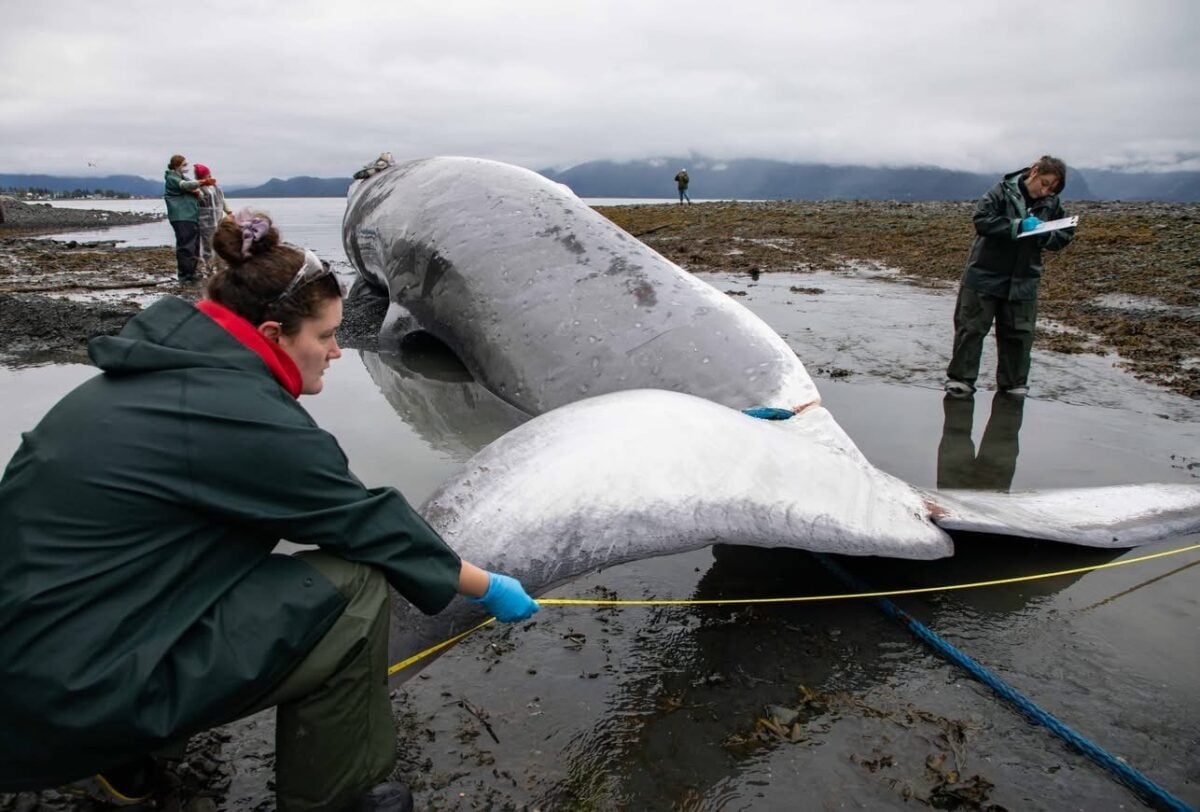
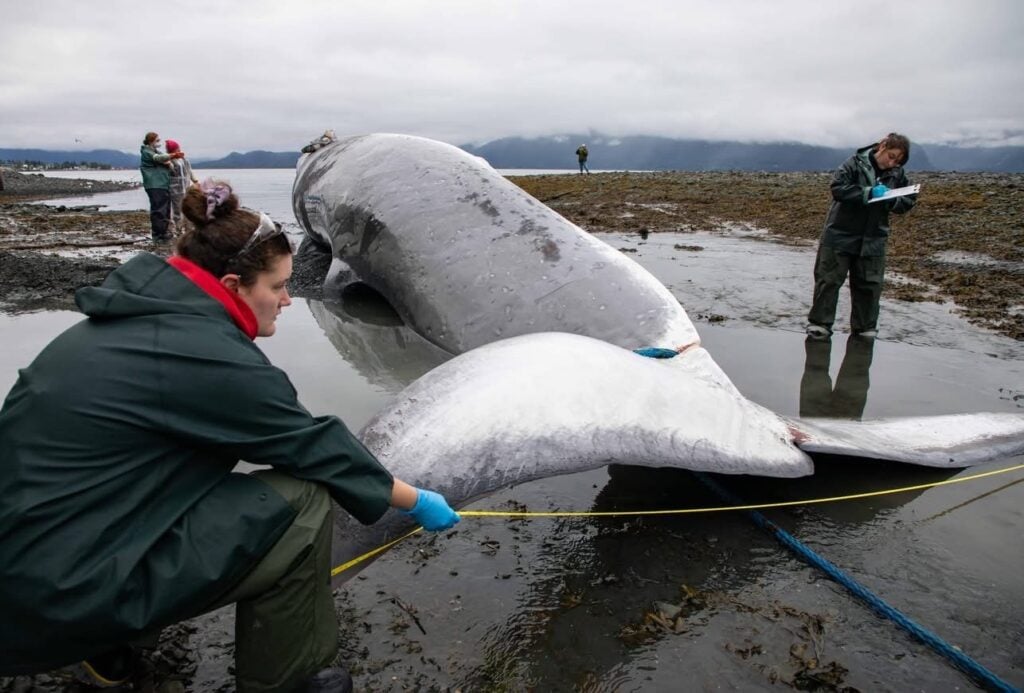
Images credit: Kaiti Grant/Alaska SeaLife Center

NOTN- A dead fin whale was discovered draped over the bow of a cruise ship when it arrived at the dock in Seward on Friday, prompting a federal investigation and an animal autopsy to determine how the endangered whale died.

The whale, a 61-foot adult female, was found on the ship’s bow after the vessel arrived in the port on June 19. A local marine towing company later moved the whale to a nearby beach, where biologists are conducting a necropsy, or animal autopsy.

Officials are working with the Alaska SeaLife Center to examine the whale and determine its cause of death. Preliminary findings indicate the whale was pregnant at the time of its death.

Authorities have asked the public to avoid the beach where the necropsy is taking place, citing safety concerns and the need for researchers to have adequate space to collect samples and conduct the examination.

The NOAA Fisheries Office of Law Enforcement has opened an investigation into the incident. Officials are asking anyone with information about the whale’s death to contact the agency’s 24-hour enforcement hotline at 800-853-1964.

Fin whales are listed as endangered under the Endangered Species Act. They are the second-largest animals on Earth and can grow to more than 80 feet in length.

Officials also reminded the public that it is illegal to collect tissue, baleen or any other part of the whale without authorization. An exception exists for Alaska Natives who are collecting tissue or parts for subsistence purposes or use in traditional handicrafts, as allowed under federal law.

Categories
Featured Juneau News Juneau Local Ketchikan Local News Feeds Sitka Local

Republican lawmakers try to rewrite 50-year-old law protecting marine mammals

A gray seal surveys its surroundings, Tuesday, Sept. 30, 2025, off the coast of Brunswick, Maine. (AP Photo/Robert F. Bukaty)

AP- Republican lawmakers are targeting one of the U.S.’s longest standing pieces of environmental legislation, credited with helping save rare whales from extinction.

Conservative leaders feel they now have the political will to remove key pieces of the Marine Mammal Protection Act, enacted in 1972 to protect whales, seals, polar bears and other sea animals. The law also places restrictions on commercial fishermen, shippers and other marine industries.

A GOP-led bill in the works has support from fishermen in Maine who say the law makes lobster fishing more difficult, lobbyists for big-money species such as tuna in Hawaii and crab in Alaska, and marine manufacturers who see the law as antiquated.

Conservation groups adamantly oppose the changes and say weakening the law will erase years of hard-won gains for jeopardized species such as the vanishing North Atlantic right whale, of which there are less than 400, and is vulnerable to entanglement in fishing gear.

Here’s what to know about the protection act and the proposed changes.

Why does the 1970s law still matter

“The Marine Mammal Protection Act is important because it’s one of our bedrock laws that help us to base conservation measures on the best available science,” said Kathleen Collins, senior marine campaign manager with International Fund for Animal Welfare. “Species on the brink of extinction have been brought back.”

It was enacted the year before the Endangered Species Act, at a time when the movement to save whales from extinction was growing. Scientist Roger Payne had discovered that whales could sing in the late 1960s, and their voices soon appeared on record albums and throughout popular culture.

The law protects all marine mammals, and prohibits capturing or killing them in U.S. waters or by U.S. citizens on the high seas. It allowed for preventative measures to stop commercial fishing ships and other businesses from accidentally harming animals such as whales and seals. The animals can be harmed by entanglement in fishing gear, collisions with ships and other hazards at sea.

The law also prevents the hunting of marine mammals, including polar bears, with exceptions for Indigenous groups. Some of those animals can be legally hunted in other countries.

Changes to oil and gas operations — and whale safety

Republican Rep. Nick Begich of Alaska, a state with a large fishing industry, submitted a bill draft this summer that would roll back aspects of the law. The bill says the act has “unduly and unnecessarily constrained government, tribes and the regulated community” since its inception.

The proposal states that it would make changes such as lowering population goals for marine mammals from “maximum productivity” to the level needed to “support continued survival.” It would also ease rules on what constitutes harm to marine mammals.

For example, the law currently prevents harassment of sea mammals such as whales, and defines harassment as activities that have “the potential to injure a marine mammal.” The proposed changes would limit the definition to only activities that actually injure the animals. That change could have major implications for industries such as oil and gas exploration where rare whales live.

That poses an existential threat to the Rice’s whale, which numbers only in the dozens and lives in the Gulf of Mexico, conservationists said. And the proposal takes specific aim at the North Atlantic right whale protections with a clause that would delay rules designed to protect that declining whale population until 2035.

Begich and his staff did not return calls for comment on the bill, and his staff declined to provide an update about where it stands in Congress. Begich has said he wants “a bill that protects marine mammals and also works for the people who live and work alongside them, especially in Alaska.”

Fishing groups want restrictions loosened

A coalition of fishing groups from both coasts has come out in support of the proposed changes. Some of the same groups lauded a previous effort by the Trump administration to reduce regulatory burdens on commercial fishing.

The groups said in a July letter to House members that they feel Begich’s changes reflect “a positive and necessary step” for American fisheries’ success.

Restrictions imposed on lobster fishermen of Maine are designed to protect the right whale, but they often provide little protection for the animals while limiting one of America’s signature fisheries, Virginia Olsen, political director of the Maine Lobstering Union, said. The restrictions stipulate where lobstermen can fish and what kinds of gear they can use. The whales are vulnerable to lethal entanglement in heavy fishing rope.

Gathering more accurate data about right whales while revising the original law would help protect the animals, Olsen said.

“We do not want to see marine mammals harmed; we need a healthy, vibrant ocean and a plentiful marine habitat to continue Maine’s heritage fishery,” Olsen said.

Some members of other maritime industries have also called on Congress to update the law. The National Marine Manufacturers Association said in a statement that the rules have not kept pace with advancements in the marine industry, making innovation in the business difficult.

Environmentalists fight back

Numerous environmental groups have vowed to fight to save the protection act. They characterized the proposed changes as part of the Trump administration’s assault on environmental protections.

The act was instrumental in protecting the humpback whale, one of the species most beloved by whale watchers, said Gib Brogan, senior campaign director with Oceana. Along with other sea mammals, humpbacks would be in jeopardy without it, he said.

“The Marine Mammal Protection Act is flexible. It works. It’s effective. We don’t need to overhaul this law at this point,” Brogan said.

What does this mean for seafood imports

The original law makes it illegal to import marine mammal products without a permit, and allows the U.S. to impose import prohibitions on seafood products from foreign fisheries that don’t meet U.S. standards.

The import embargoes are a major sticking point because they punish American businesses, said Gavin Gibbons, chief strategy officer of the National Fisheries Institute, a Virginia-based seafood industry trade group. It’s critical to source seafood globally to be able to meet American demand for seafood, he said.

The National Fisheries Institute and a coalition of industry groups sued the federal government Thursday over what they described as unlawful implementation of the protection act. Gibbons said the groups don’t oppose the act, but want to see it responsibly implemented.

“Our fisheries are well regulated and appropriately fished to their maximum sustainable yield,” Gibbons said. “The men and women who work our waters are iconic and responsible. They can’t be expected to just fish more here to make up a deficit while jeopardizing the sustainability they’ve worked so hard to maintain.”

Some environmental groups said the Republican lawmakers’ proposed changes could weaken American seafood competitiveness by allowing imports from poorly regulated foreign fisheries.

Categories
Featured Juneau News Juneau Local Ketchikan Local News Feeds Sitka Local

Coast Guard issues contract for major icebreaker port expansion in Seattle

By: James Brooks, Alaska Beacon

U.S. Coast Guard Cutter Polar Star (WAGB 10) (left) sits moored next to U.S. Coast Guard Cutter Healy (WAGB 20) at Coast Guard Base Seattle, Aug. 25, 2024. The Polar Star and Healy are routinely deployed to Arctic and Antarctic locations to support science research or help resupply remote stations. (U.S. Coast Guard photo by Lt. Chris Butters)

The U.S. Coast Guard announced Tuesday that it has awarded a $137 million contract for the first phase of a project intended to allow its Seattle base to host two new heavy icebreakers.

The contract, awarded to The Whiting-Turner Contracting Company, covers dredging of the Coast Guard’s Slip 36 and construction of two ship berths capable of hosting the new icebreakers, formally known as Polar Security Cutters.

The first of those ships, the Polar Sentinel, is expected to be complete in 2030. When accepted into the Coast Guard, it will be the service’s first new heavy icebreaker since the Polar Star was commissioned in 1977.

The Coast Guard operates the federal government’s icebreaker fleet, and the Polar Star is key to supplying American research bases in Antarctica from its Seattle home port. 

A second and third heavy icebreaker were fully funded with $4.3 billion included as part of the Republican budget package approved by Congress and President Donald Trump earlier this year. 

The budget package also included $300 million for port construction in Juneau to support the newly commissioned Coast Guard icebreaker Storis, a converted oilfield services ship. Until that work is complete, the Storis will be homeported in Seattle.

The Republican budget package, known as the “Big Beautiful Bill Act,” includes billions of dollars for shoreside port facilities like those in Juneau and Seattle.

Additional phases of work are expected in Seattle, which is expected to be the home port of four new major Coast Guard cutters, the service said in a written statement.

Categories
Featured Juneau News Juneau Local Ketchikan Local News Feeds Sitka Local

New Alaska-bound ocean mapping ship begins construction in Louisiana

By: James Brooks, Alaska Beacon

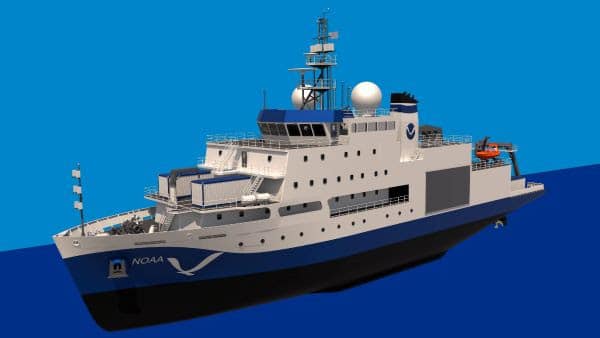
This undated image, provided by the National Oceanic and Atmospheric Administration, shows a mockup of the Surveyor, an ocean-floor-mapping ship under construction and scheduled to be homeported in Ketchikan. (NOAA image)

Next week, the National Oceanic and Atmospheric Administration is planning to host a ceremony in Louisiana to mark the start of construction on the NOAA ship the Surveyor, a new charting and mapping ship scheduled to be homeported in Ketchikan.

NOAA announced the keel-laying ceremony, scheduled for Aug. 14, by email.

The Surveyor is expected to be finished in 2027, and its sister ship, the Navigator, is expected to be finished in 2028.

NOAA operates a fleet of 15 charting, mapping and fisheries ships using an unarmed officer corps like a scientific version of the U.S. military. The Surveyor and Navigator will be used primarily for ocean mapping and nautical charting.

Two other deep-sea ships, the Oceanographer and Discoverer, are also under construction and are expected to be complete in 2026. 

All four ships are part of an ongoing effort to keep the NOAA fleet afloat; as of 2023, the fleet’s average age was 30 years old, and six of the fleet’s current ships are expected to reach the end of their service life by 2030. 

The ships will be built by Thoma-Sea Marine Constructors in Houma, Louisiana, under a $624.6 million contract that would allow NOAA to construct two more ships if funding is available.