Sen. Mike Shower, R-Wasilla, speaks Friday, April 12, 2024, on Senate Bill 187, the capital budget. (Photo by James Brooks/Alaska Beacon)
Senate Minority Leader Mike Shower, R-Wasilla, will resign from the Alaska Senate on Monday, according to a resignation letter submitted to Senate President Gary Stevens, R-Kodiak.
The resignation was expected. Shower was named the lieutenant governor candidate for Republican gubernatorial candidate Bernadette Wilson in September, and he said he would resign from his seat early.
Shower did not immediately respond to a phone call and text messages seeking comment on Thursday afternoon.
Under Alaska law and Republican Party rules, party officials in Shower’s district will nominate possible replacements to Gov. Mike Dunleavy, who will select the replacement.
It’s a process Dunleavy will be familiar with: Before being elected governor in 2018, Dunleavy served in the Senate and resigned early to focus on his election. Then-Gov. Bill Walker nominated Mike Shower to fill Dunleavy’s seat and Shower went on to win the next election in his own right.
Shower’s possible replacements must be Republicans, because Shower is a Republican, and otherwise meet the Alaska Constitution’s requirements for office.
The governor’s selection must be confirmed by the Senate’s other Republicans before being seated. That includes the other five Republicans in the Senate’s six-person minority caucus, as well as the five Republicans in the bipartisan Senate majority caucus.
Confirmation isn’t guaranteed: In 2018, Republican senators rejected Walker’s first choice to replace Dunleavy. Walker’s second choice withdrew his name from consideration.
In 2019, Republicans rejected Dunleavy’s first choice to replace Anchorage Republican Sen. Chris Birch, who died in office.
Each of Alaska’s state senate districts consists of two House districts. Reps. George Rauscher, R-Sutton, and Kevin McCabe, R-Big Lake, respectively represent each of the House districts within Shower’s Senate district, and both men said they will be putting their names forward for consideration.
Rauscher had already announced his intention to seek Shower’s seat in the 2026 election.
It was not immediately clear on Thursday if additional candidates would be proposed for consideration by party officials.
If either Rauscher or McCabe are chosen, it would set off a domino effect: Dunleavy would then be able to select a new House representative to replace the person who moved to the Senate.
Sen. Robert Myers, R-North Pole, said he believes Shower has been talking to Dunleavy about possible options.
“I think the expectation at this point is Rep. Rauscher, but I don’t want to weigh in any further than that,” Myers said of his preference.
Myers said the resignation makes sense.
“Honestly, it makes some relationships a little bit awkward if you’re still in the Legislature while running for a statewide seat like that. It could have potentially complicated next year’s session a little bit,” he said. “I wish him well on what he embarks on for the future, whether that’s politically or personally.”
While the Senate minority caucus will now need to pick a new leader, Myers said he doesn’t expect the next legislative year will have other significant changes because there’s someone new in Shower’s seat.
“The (senate) majority has already laid out what their priorities are,” he said. “I don’t see votes changing, numbers changing, majority-minority votes on major bills, or anything like that.”
At least one more Senate resignation is expected soon. Sen. Shelley Hughes, R-Palmer, is running for governor and has said she will resign in time for a replacement to be selected before the legislative session begins in January.
“I typically put in about 40 hours of work, even during the interim, 40 hours or more. And so, juggling that along with the governor electoral campaign is tricky, but there’s certain things I want to finish up and make sure I’m leaving things in good order as I pass out of the district,” she said.
At the same time, she wants to leave time for Dunleavy to pick both her replacement and a replacement for a House member if he selects either Reps. Cathy Tilton, R-Wasilla, or DeLena Johnson, R-Palmer, to replace her.
Tilton has already filed to run for Senate in 2026.
Hughes said that regardless of the replacement, she doesn’t think the Senate will change significantly. She also said that she’s going to stay out of the discussion of who will replace Shower as Senate Minority Leader.
“That’s up to that group to decide,” she said. “I’m not going to be one of them. I’m not going to meddle and try to tell them who should or should not be Senate Minority Leader.”
A federal judge in Boston ruled Friday that the U.S. Department of Agriculture’s plan to pause a food assistance program for 42 million people was illegal — but gave the Trump administration until Monday to respond to her finding before she decides on a motion to force the benefits be paid despite the ongoing government shutdown.
At nearly the same time Friday, a Rhode Island federal judge in a similar case brought by cities and nonprofit groups ordered USDA to continue payments and granted a request for a temporary restraining order.
In Massachusetts, in a Friday afternoon order, District Court of Massachusetts Judge Indira Talwani said she would continue to take “under advisement” a coalition of Democratic states’ request to force the release of funds from a contingency account holding about $6 billion.
Her ruling came a day before a cutoff of Supplemental Nutrition Assistance Program, or SNAP, benefits to low-income households.
Because Congress is locked in a stalemate over a stopgap spending bill and did not appropriate money for the fiscal year that began Oct. 1, administration officials say the program cannot provide federal funds beginning Saturday. In states, SNAP benefits are loaded onto cards on varying dates, but the cutoff would be effective for November benefits.
Talwani, who was appointed by former President Barack Obama, called the administration’s conclusion it can’t provide SNAP funding “erroneous,” and said the reserve fund was sufficient for SNAP benefits to flow to states and the vendors that add money to debit-like cards issued to the program’s beneficiaries that are used to purchase groceries.
The law creating the program mandated that benefits continue, she said.
“Defendants are statutorily mandated to use the previously appropriated SNAP contingency reserve when necessary and also have discretion to use other previously appropriated funds,” Talwani wrote.
Talwani ordered the administration to say by Monday whether it would provide at least partial benefits for November.
The 25 states that sued were Massachusetts, California, Arizona, Minnesota, Connecticut, Colorado, Delaware, Hawaii, Illinois, Maine, Maryland, Michigan, Nevada, New Jersey, New Mexico, New York, North Carolina, Oregon, Rhode Island, Vermont, Washington state, Wisconsin Kansas, Kentucky and Pennsylvania. The District of Columbia also sued.
In Rhode Island, where the judge granted a temporary restraining order, the advocacy group Democracy Forward, which was among those bringing the suit, praised the move.
“A federal court today granted a temporary restraining order blocking the Trump-Vance administration’s unlawful effort to halt the Supplemental Nutrition Assistance Program (SNAP) during the ongoing government shutdown,” the group said. “The decision ensures that millions of children, seniors, veterans, and families will continue to receive essential food assistance while the case proceeds.”
The judge in that case, John James McConnell Jr., said the administration’s actions violated a key federal administrative law against arbitrary and capricious executive action and federal spending laws “by disregarding Congress’s direction that SNAP must continue operating,” Democracy Forward said.
NOTN- The City and Borough of Juneau formally accepted Advance Measures Assistance from the U.S. Army Corps of Engineers, to begin Phase 2 of the temporary flood barrier project along the Mendenhall River, city officials announced Thursday.
This marks the next major step in the city’s ongoing effort to protect homes and infrastructure from recurring glacial outburst floods or GLOFs originating from Suicide Basin.
“The Army Corp has committed to helping, really, really substantially with phase two of our short-term mitigation efforts.” Said Deputy City Manager Robert Barr, “And also, to really pursue a quite ambitious timeline for an enduring solution, solutions that would mitigate GLOFS, in such a way that we won’t be seeing these massive 15, 16 plus flood events. So thats really, really good news.”
The Army Corps will provide 100% federally funded assistance to install new riverbank armoring and temporary flood barriers along unprotected sections of the Mendenhall River. The agency will also offer technical support and repairs to the existing flood barrier system completed earlier this year under Phase 1.
“The Phase 2 project is almost three times the size of the first,” said Mayor Beth Weldon.
Construction could begin as early as next spring, Weldon said.
Thursday night’s briefing also featured presentations from scientists and engineers with the University of Alaska Southeast and the National Weather Service.
“The science presentations we received from the university and the weather service were just phenomenal. They’ve been such impressive partners and so important in this work.” Said Barr, “It’s hard to imagine where we would be were it not for the work, it’s really guided and advised us and everyone that’s been working in emergency response and policy management. So really huge kudos to the university and the geological service and the weather service.”
The Army Corps, and the Natural Resources Conservation Service also presented. The NRCS discussed its Emergency Watershed Protection Program, which could provide funding for potential buyouts of flood-prone properties on View Drive.
Phase 2 of the temporary flood barrier would extend protection to remaining populated areas along the river not covered in the first phase.
The carapace, or upper shell, of an invasive European green crab and a live live green crab are shown in this undated photo. Ever since Alaska’s first green crabs were found on Annette Island in 2022, numbers have exploded and the invaders have spread north. (Photo by Linda Shaw/National Oceanic and Atmospheric Administration Fisheries Service)
When a young Sealaska intern walking a beach in July 2022 found the first evidence of European green crab presence in Alaska – a discarded shell on a beach on Annette Island in the state’s far southeast corner – it was an ominous sign about the invasive species’ northward spread.
Since then, the Metlakatla Indian Community, the tribe based on Annette Island, and its partners, which include Alaska Sea Grant, have found not just more shells, but live invasive crabs. Discoveries numbered just a handful at first, then dozens, then hundreds, then thousands.
This year, the Metlakatla tribe’s team has trapped more than 40,000 of them on and around Annette Island, a representative said.
“This year we’ve had a complete explosion of green crab — over seven new locations on Annette Island we found green crab, and eight new locations off Annette Island,” said Nicole Reynolds, an environmental specialist working with the tribe, in a presentation at a three-day Anchorage meeting on invasive species in Alaska this week.
The more than 40,000 crabs removed this year compares to last year’s total of 1,800, Reynolds said.
European green crabs are small, usually measuring no more than 4 inches wide, but they are powerful forces of destruction. They mow down eelgrass beds that are vital habitat for salmon and other native species. And they gobble up native marine life like juvenile salmon, clams, mussels and juvenile Dungeness and other crabs that are important to commercial and subsistence harvests.
“They’ll eat the baby crabs. They’re meaner and tougher than the Dungeness,” Reynolds said during a break in the annual Alaska Invasive Species Partnership Workshop.
European green crabs have already spread north of Annette Island. Last year, they were found at Gravina Island, and this summer they were found by participants in a local university class at beaches in Ketchikan that lie about 30 miles north of the initial Annette Island discovery site.
Just this month, they were found at Etolin Island, Reynolds said. Etolin Island is roughly 60 miles northwest of the city of Ketchikan, making it the northernmost North America discovery to date.
And now European green crabs appear to be entrenched in Alaska waters for good, Reynolds and Genelle Winter, a grant administrator with the tribal government, told the workshop audience.
That means the fight against green crabs will also have to be long-term, Winter said, with a permanent staff and a strategy of what is known as “functional eradication.” That is an eradication strategy that accepts the reality of the invaders’ presence in some places, but tries to keep them out of other places with resources that are most important to protect.
Nicole Reynolds and Genelle Winter of the Metlakatla Indian Community pose on Oct. 28, 2025, with a sticker bearing a European green crab design created by local artist, Elizabeth Anderson. The crab face was made intentionally angry and mean-looking, to help send the message about the destruction caused by this invasive species. Reynolds and Winter presented information at the annual Alaska Invasive Species Partnership Workshop in Anchorage about the Tribe’s work to combat the spread of European green crabs. The first discovery of the crabs in Alaska was in 2022 at Annette Island in the far southeast corner of the state, and they have proliferated in Alaska waters since then. (Photo by Yereth Rosen/Alaska Beacon)
Such a strategy involves “focusing all our efforts on protecting the most vital subsistence and commercial resources,” she said.
Conditions in Alaska waters, the farthest-north spots in North America where the crabs have spread, do not faze the invaders, DNA analysis shows. For that information, the tribe consulted with an expert, Carolyn Tepolt of the Woods Hole Oceanographic Institute. Tepolt has also been investigating the genetics of green crabs that have invaded Washington state.
Tepolt’s analysis found that the green crabs in Alaska are a genetic blend of those in Washington and British Columbia, diverse enough to persist in the more northern waters, Reynolds said.
“She even called it a ‘super-crab’ just because of how perfectly genetically suited it is for the environment in Southeast Alaska,” Reynolds said.
European green crabs have been altering North American marine ecosystems for a long time.
They were first found in East Coast waters in the early 1800s, likely carried there in ship ballast water. The first West Coast discovery was in 1989 in San Francisco Bay. Since then, they have been spreading north up the Pacific coast. They were first confirmed in British Columbia in 1999 and continued moving up that Canadian province’s coast before being found at Annette Island three years ago.
Beyond the accidental releases through ballast water, scientists say warming conditions are aiding the spread of green crabs. Larvae are more likely to survive in warmer waters brought on by climate change and weather events like El Nino cycles.
The 2023-2024 El Nino, which warmed Alaska waters, is a possible factor in this year’s explosion of green crabs in Southeast Alaska, the Metlakatla tribal representatives said.
Warmer temperatures than those that used to be normal in Alaska marine waters are known to encourage green crab proliferation.
A study by Danish scienetists that was published in September identifies a temperature range that appears ideal for the crabs. At temperatures of 12.5 to 16.6 degrees Celsius, or 54.5 to 61.9 degrees Fahrenheit, European green crab abundance peaked, the scientists found.
Average temperatures in Southcentral Alaska’s Cook Inlet were within that range this August, an indication that conditions would be suitable for green crabs if they somehow reach that area.
Nicole Reynolds, an environmental specialist with the Metlakatla Indian Community, shows a photo stored on her phone of an unusual-looking European green crab collected this year. The Tribal government is at the forefront of the campaign to try to control the spread of the invasive species, which eats native species and damages habitat used by fish. Reynolds presented information about the Tribe’s work at the annual Alaska Invasive Species Partnership Workshop in Anchorage. (Photo by Yereth Rosen/Alaska Beacon)
Preparations are already underway in Alaska for what experts believe is an inevitable spread north from the Southeast region.
In Southcentral Alaska’s Kachemak Bay, over 700 miles northwest of Ketchikan, residents this summer deployed over 60 traps in what was effectively a pre-invasion drill. The program was a cooperative effort of the Kachemak Bay National Estuarine Research Reserve, the Seldovia Village Tribe and its council member, Michael Opheim, and the U.S. Fish and Wildlife Service.
There and elsewhere, a big part of the fight against green crab infestations is public education.
European green crabs can be identified by the array of bumps on their shells. They have five sharp spikes on either side of their eyes and three lobes in between their eyes. Despite their name, they are not always green – they can be red, yellow or mottled. Some of those found by her team have even been blue, Reynolds said.
To help boost awareness, local Tsimshian artist Elizabeth Anderson has designed a green crab logo – with an angry face to reinforce the message that the species is a bad actor, Winter said.
In Metlakatla, awareness appears to be keen already, including among some of the youngest residents.
“The other day, the mayor was driving down the street and got flagged down by two little kids. And they said, ‘We found some green crab! We know its green crab because it’s 5-3-5,’” Winter said during the workshop presentation. The numbers reference the array of shell bumps on a green crab. “Those little kids absolutely knew how to identify the European green crab.”
Those crabs, found at a beach right in front of town, were stashed in a plastic bag and added to this year’s count, Winter said.
Aside from identifying, trapping, counting, measuring and analyzing the European green crabs, the inundated community faces another challenge: what to do with thousands of unwanted invaders.
In Metlakatla, the ultimate destination is the community compost heap. That is a good end use, Reynolds said. “They add heat to the compost, and because it’s cold and wet in Southeast, it’s actually really helpful to have more heat,” she told workshop attendees.
On the East Coast and elsewhere, some of the eradication work involves eating the invaders. Experts say they have little meat but can be useful for making soups. One organization, Greencrab.org, has compiled recipes and sells a cookbook and T-shirts with a catchy slogan: “If you can’t beat them, eat them.”
European green crab specimens preserved in plastic are displayed on Oct. 28, 2025, at the annual Alaska Invasive Species Partnership Workshop in Anchorage. Although they are called green crabs, they come in different colors, and heat can turn their shells orange. (Photo by Yereth Rosen/Alaska Beacon)
Longtime Juneau broadcaster Pete Carran, a voice synonymous with “News of the North” and a cornerstone of Alaska journalism for more than five decades, died Wednesday October 22.
He was an Alaska Broadcasters Association Hall of Fame inductee, recognized for his lifelong contributions to radio and television news across the state.
Pete’s path to the microphone ran through service as a young man, he trained at the Defence Information School and was assigned to Alaska during the Vietnam era, a twist of fate he called the most fortuitous of his life.
Carran’s career stretched from Anchorage to Homer to Juneau, , Carran worked on the air at KFQD-AM, KAKM-TV, KTNX Radio, and KTUU-TV, all in Anchorage. He also took a year and put KBBI public radio on the air in Homer. There, he served as General Manager.
Here in Juneau, Carran’s career included stints at KJNO, KTOO-TV and most recently KINY.
Listeners across Southeast Alaska knew Carran as the familiar voice behind KINY’s “News of the North,” a program he helmed for more than 20 years. He also hosted the community talk show “Action Line” and served as a mentor to generations of young broadcasters and journalists.
His induction into the Alaska Broadcasters Association Hall of Fame cemented his legacy as one of the state’s most respected and enduring voices.
Carran had been battling Idiopathic Pulmonary Fibrosis.
A recent poll found that 64% of Americans think the country is too politically divided to solve the nation’s problems.Kevin Dietsch/Getty Images
The United States government has been shut down for nearly a month, yet another indication that the political system has become deeply dysfunctional.
President Donald Trump has blamed the Democrats and called their negotiating strategy a “kamikaze attack.” Democrats are keen to stand their ground, hoping that the fallout is worse for Republicans. While each side casts blame on the other, it is Americans who suffer.
But the shutdown is just another episode in a series of polarization-fueled events that are leading Americans to lose faith in their government. Every nation has it limits, and one wonders how much America can take before the pressure to divide into separate countries becomes too great.
These are merely the latest examples of the mounting pressure on the American political system. A recent New York Times/Siena poll found that 64% of Americans think the country is too politically divided to solve the nation’s problems. The same poll showed that only 42% of Americans held that position in 2020.
It should come as no surprise, then, that some are calling for radical solutions like a national divorce.
On Sept. 15, 2025, five days after Kirk’s killing, Georgia Congresswoman Marjorie Taylor Greene tweeted that America needs “a peaceful national divorce. Our country is too far gone and too far divided, and it’s no longer safe for any of us.”
National divorce is the term used to describe the splitting of America into two parts: a red America and a blue America. Secessionist movements like Yes California and Red-State Secession have for over a decade been calling for a national divorce along political lines. And a 2023 Axios poll found that as many as 20% of Americans see national divorce as a solution to political polarization.
As a political scientist who studies secessionist conflict, I’ve found that the national divorce argument is commonly used as an analogy with marital divorce. Just as two spouses may be extremely ill-suited for one another, and far better off if they separated, the same can be said of red and blue America. They no longer see eye to eye on a range of issues, from reproductive rights to the environment and gun control.
If they seceded from one another and formed their own countries, the argument goes, then they could establish policies that would ensure the future they wanted.
Rep. Marjorie Taylor Greene, R-Ga., called for a ‘peaceful national divorce’ in September 2025. AP Photo/J. Scott Applewhite
But as I show in my new book, there is no way to disentangle red and blue America without tremendous violence. Additionally, a large and increasingly ignored percentage of Americans hold moderate views.
There is no doubt that polarization in America is a problem that is getting worse, but a national divorce is simply not the solution.
And yet America’s leaders continue to lead their country toward that outcome. The deployment of National Guard troops to blue cities, the polarization-enhancing consequences of competitive gerrymandering in states like Texas and California, and the spectacle of government shutdown are eroding the public trust. By continuing with policies that amplify polarization and erode the public trust, America’s leaders are fueling the calls for a national divorce.
How much can the country take?
The trend toward heightened polarization in America is not irreversible, but there are limits to how much the country can take before secession becomes a serious project. Some of the limits can be identified in advance.
First, it’s important that the country’s leaders take the pulse of America. If 20% of Americans favored national divorce in early 2023, what is the percentage now? That kind of sentiment can increase surprisingly fast.
Between 2006 and 2014, for example, Catalonian support for independence from Spain increased from 14% to 45%. If something like 50% of Americans concluded that America didn’t work and was better off broken up into smaller parts, then the country could tip rapidly into a secessionist crisis.
People hold up signs during a memorial for Charlie Kirk on Sept. 21, 2025, in Glendale, Ariz. After Kirk’s killing, Trump administration officials vowed to crack down on left-leaning groups. AP Photo/John Locher
Second, high levels of secessionist support make the country vulnerable to trigger events that convince Americans that secession is the answer. The polarization-inspired assassination of prominent leaders can lead to a cycle of recrimination. Upcoming elections are also a concern. If they are closely contested and the losing side is unwilling to admit defeat, then the bedrock of democracy is broken. Both triggers can accelerate polarization and the turn to secessionism.
A third threshold moment is when a prominent leader decides to champion the cause of a national divorce.
Should someone like California Gov. Gavin Newsom, Texas Gov. Greg Abbott or the sore loser of a 2028 election conclude that the system is rigged, and secession is the only solution, then the entire project gains legitimacy.
It was that kind of elite conversion to the secessionist cause that energized the movement in places like Scotland and Catalonia.
The U.S. is a robust country and the longest-running democracy in the world. Americans have more in common than they realize, and the country can be a positive force in the world.
But without decisive action by political leaders to reduce the polarization that threatens to tear the country apart, the United States is at risk of turning from one country into two.
Ryan D. Griffiths receives funding from the National Science Foundation.
The new congressional districts in Texas, and the ones proposed for California, are pervasive upheavals of the relationship between voters and those they elect. Douglas Rissing/iStock/Getty Images Plus
After the U.S. census is conducted every 10 years, each state must redraw its congressional districts to account for any loss or gain of congressional seats and to maintain an equal population in each district.
But in 2025, breaking from standard practice, President Donald Trump has asked Republican states to redraw their districts mid-decade to provide a greater Republican advantage in the upcoming 2026 midterm elections.
As other states join the fray, this battle for control of the U.S. House of Representatives has escalated to what the media has called a “Redistricting War.” In this war, the control of the House may be determined more by how each party is able to redistrict states they control and less by how citizens vote.
The media and politicians focus on which party is winning or losing seats. But are the citizens winning or losing in this conflict?
Changing a resident’s congressional district will sever any existing relationship or understanding of who their current representative is and how to seek help or share policy concerns. This forces residents to navigate unfamiliar political terrain as they figure out their new district, who is running, and what the candidates stand for. This added complexity discourages residents from voting.
Districts being contorted for political purposes makes it more difficult for constituents to know who their representatives are and lowers voter participation in elections. Circlon Tech/Getty Images
Staggering scale of changes
Just how big are the changes already enacted in Texas and proposed in California?
The University of Richmond Spatial Analysis Laboratory, which co-author Kyle Redican directs, has analyzed the impact of the mid-decade redistricting changes. The number of redistricting casualties – residents reassigned to a new congressional district – caused by these mid-decade changes in Texas and California is nearly 20 million. That’s about 6% of the overall U.S. population.
The scale of the changes is staggering: 10.4 million Texas residents, about 36% of the state’s population, and 9.2 million California residents, about 23% of the state’s population, will find themselves in new, unfamiliar congressional districts.
Only one district in Texas, of 38 total districts, and eight districts in California, of 52 total districts, remain untouched, making this a pervasive upheaval, not a surgical adjustment.
Most dramatically, nine districts in California and eight districts in Texas will have more than 50% new residents, fundamentally changing the overall composition of those districts.
The 41st District in California will have 100% new residents, while the 9th District in Texas will have 97% new residents, essentially becoming entirely different constituencies.
Making a change of this size mid-decade, as opposed to once every decade, will be highly disruptive and represent a major tear in the fabric of representative democracy.
Lawmakers picking their voters
So who exactly is being moved? The demographic patterns reveal the calculated nature of these partisan manipulations.
In Texas, Black and Hispanic residents are disproportionately shuffled into new districts compared to white residents.
Minorities constitute 67.1% of Texans who have been moved into a new district, while minorities constitute only 56.4% of Texans who get to remain in their same district. By moving more minorities out of a district and into another reliably Republican district, partisan mapmakers are able to reduce the likely Democratic voter share in that district and swing it to be a Republican-leaning district.
California follows the opposite playbook: White residents are disproportionately moved.
There, 41.2% of those moved into a new district are white, while only 32.7% of those who get to remain in their same district are white. In this case, California is moving likely Republican voters into another reliably Democratic district, which reduces the Republican voter share in the original district and swings it to be a Democratic-leaning district.
In either case, legislators are making deliberate decisions about which residents to move to achieve a political goal.
Yet fundamental to a representative democracy is a simple principle: The people choose their representatives. It’s not that representatives choose their constituents. The founders envisioned the House of Representatives as the people’s house, representing and accountable to the voters.
In the current mid-decade redistricting, the legislators are handpicking their constituencies.
Mocking the fundamental idea
Does the redistricting battle ever end?
If mid-decade redistricting becomes an accepted way to win elections, each time a party wins control of a state legislature and governorship they will have the incentive to redistrict. Each of these future redistrictings will continue to negatively affect citizens’ participation in the representative process and mock the fundamental idea that citizens should choose their representatives.
It’s entirely possible that redistricting could happen every two years – though that is an extreme outcome of this competition.
Texas and California have fired the opening shots in the redistricting arms race. Other states – Missouri, North Carolina and Virginia – are joining the fight, each time diminishing the public trust in our democratic process.
Today, it’s 20 million Americans caught in the crossfire. Tomorrow, it could be 100 million as this conflict spreads from state to state. With tit-for-tat redistricting offsetting gains in seats, who is really winning?
For sure, we know who is losing – the people and representative democracy.
Spatial Analysis Lab intern Ryan Poulsen worked on the block data processing for this story.
The authors do not work for, consult, own shares in or receive funding from any company or organization that would benefit from this article, and have disclosed no relevant affiliations beyond their academic appointment.
Will the title Sister Wives ever be appropriate again?
As TLC viewers know well at this point, the long-running reality show remains very much on the air — even though Kody Brown no longer has any sister wives.
Over the past few years, Christine, Janelle and Meri have all left the father of 18.
This leaves Robyn as Kody’s only remaining spouse. But will it remain that way?
(TLC)
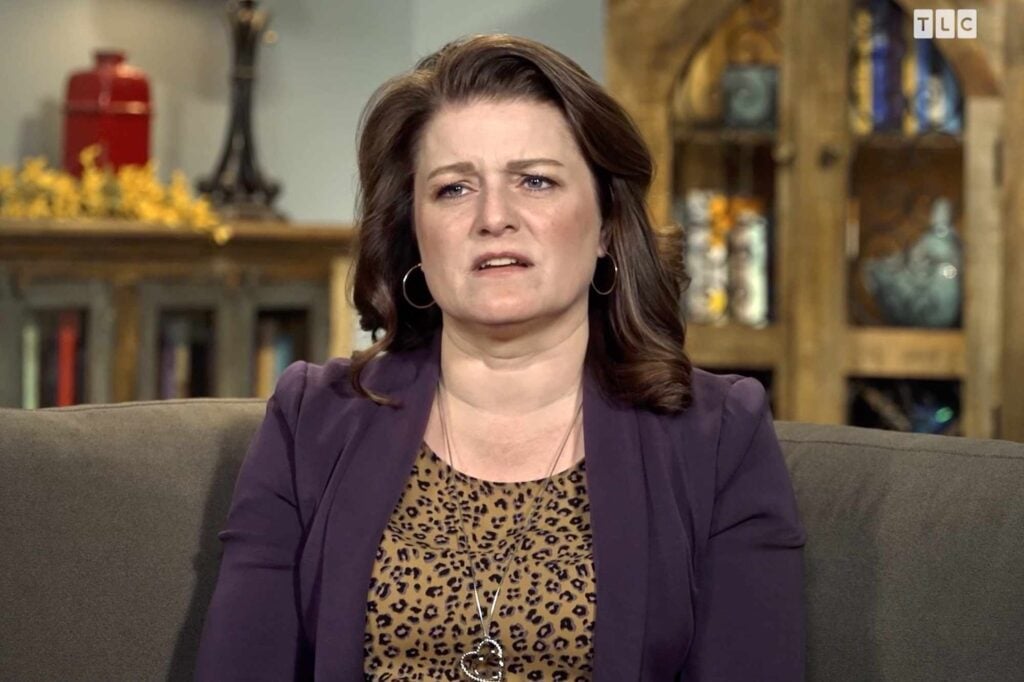
In a sneak peek at the November 2 episode of the program, courtesy of People Magazine, Kody tells Robyn that he got an email from a woman.
“She’s kind of chastising me for deciding to quit plural marriage. She’s calling me out then asking, sort of, to get to know us for the purpose of joining the family,” Kody explains of this apparent stranger.
Robyn doesn’t have a lot to say to her husband at first in response. But in a confessional shortly afterward?
“I find it very inappropriate that they would send it to Kody,” she tells the camera. “It’s not usually proper to go hitting on a guy. You have to go through the sister wives, you have to go through, like, at least one.”
Kody and Robyn Brown have managed to stay together through the years. (TLC)
Kody Brown never really looks to happy, does he? (TLC)
Elsewhere in this clip, meanwhile, Kody admits that he’s had “a lot of letters come in” from perspective lovers asking him to “reconsider” plural marriage.
“Who doesn’t like a little bit of attention? But at the same time, that’s a craziness that I don’t want to indulge,’ he says on air.
Kody also tells Robyn she’s his “sweetheart” and will therefore always be candid with her, prompting the mother of six to reply:
“Thanks for telling me. It would’ve been weird probably if you didn’t.”
Kody addresses Robyn in an intense moment. (TLC)
Robyn and Kody got married in 214.
They discussed the potential of a future plural marriage on last month’s season premiere.
At the time, Kody brought up how a relative asked Robyn if they were still in a plural marriage.
“I wasn’t quite sure what to say to him,” Robyn confessed. “I didn’t want to speak for you. I feel like if this is still something that’s a part of me, then wouldn’t I live it?”
Robyn went on to explain that if “there was somebody who was really supportive and really wanted to work and really wanted a relationship with me as well as with you, not just you… and then we had a guarantee that it was going to be okay and it was going to be wonderful and it was going to be what I always dreamed it was supposed to be?”
Well. Then she would consider plural marriage again more seriously.
Robyn and Kody Brown pose here for a TLC promotional shot. (TLC)
Back then, it didn’t appear as if either side really wanted to return to the whole polygamy thing.
“It’s you and me, baby. Monogamy, does it work for you? Will it work for you?” Kody eventually asked as Robyn answered:
Dr. Phil McGraw’s latest business venture is not going according to plan.
In fact, the once-beloved TV personality is now dealing with legal drama that could have major ramifications.
In April of 2024, McGraw launched a media company and television network called Merit Street Media, which filed for bankruptcy less than a year later.
Dr. Phil McGraw visits SiriusXM at SiriusXM Studios on February 27, 2024 in New York City. (Photo by Jamie McCarthy/Getty Images)
Now, a judge is accusing Phil of attempting to deceive the court during bankruptcy proceedings.
Judge blasts Dr. Phil amid bankruptcy proceedings
Merit Street Media filed for Chapter 11 bankruptcy, but this week, Judge Scott W. Everett of the U.S. Bankruptcy Court for the Northern District of Texas ruled that the company only qualified for Chapter 7 liquidation and would therefore need to liquidate its assets.
According to The Hollywood Reporter, a trustee will oversee both the sale of Merit Street Media’s media library and litigation over whether broadcast partner Trinity Broadcasting breached its contract with the company.
The judge specifically singled out Phil for his alleged deletion of a text message that was part of discovery in the case.
Talk Show Host Dr. Phil McGraw visits SiriusXM Studios on April 24, 2019 in New York City. (Photo by Nicholas Hunt/Getty Images)
Everett claims that McGraw deleted an “unflattering” text message, a tactic he described as a “gangster move.”
“Mr. McGraw’s actions violated not only the discovery order…but also a broader principle that the debtors, board members, or de facto officers or agents should not destroy property of the estate to help them in pending litigation,” Everett said.
With a Chapter 7 trustee, he added, “Creditors can have faith that the process will play out fairly and neutrally.”
“Dismissal, on the other hand, would allow Mr. McGraw to pay his favored creditors and not pay his unfavored creditors, as his own deleted text makes clear he wants to do,” the judge continued, adding:
“Dismissal would also allow the debtor or friendly creditors to file another bankruptcy case in a different jurisdiction to try to get different rulings that favor Mr. McGraw and his interests, including on the pending sanctions motion that I’ve yet to rule on,” he said.
U.S. President Donald Trump speaks alongside Dr. Phil McGraw during a National Day of Prayer event in the Rose Garden at the White House on May 1, 2025 in Washington, DC. (Photo by Alex Wong/Getty Images)
What’s next for Dr. Phil?
A spokesperson tells THR that Phil and his company intend to appeal the judge’s decision:
“We take great exception to the court’s improper assertions regarding the alleged destruction of evidence, which simply did not happen,” the statement read.
“We will not let this stand given all that Dr. Phil and Peteski Productions have done to protect Merit Street employees, distributors, and other interested parties and to resolve this unfortunate situation.”
We will have further updates on this developing story as new information becomes available.
Kailyn has shared a series of tantalizing thirst traps as she shows off her body in lingerie.
A tearful Kailyn Lowry speaks on her podcast abut how she wants better for her children than what she feels as an adult. (Image Credit: YouTube)
Kailyn Lowry is hot and she knows it
This week, Kailyn Lowry took to her Instagram page to share an array of photos.
Obviously, Teen Mom fans are familiar with the reality TV alum sharing snaps from her life, podcast work, and more.
But these photos showcased Kail in a new light.
In these selfies, she’s wearing various skimpy ensembles — from a lace corset crop top with black leggings to a SKIMS bralette and panty.
And, as we said, she looks jaw-droppingly gorgeous. That applies whether she looks like she’s dressed for yoga or in sweatpants and (another) SKIMS bra for casual lounging.
For her caption, Kailyn merely wrote: “My favorite support systems.”
That appears to be a pun, playing upon terms for mental, social, and emotional support systems and the physical support that bras offer to breast-wielders.
It is a clever play on words.
And, obviously, the photos are not merely showing off her confidence.
She posted a gallery of thirst traps. And fans and followers took the bait.
On her Karma & Chaos podcast, Kailyn Lowry discussed her deadbeat dad in what are likely his final days. (Image Credit: Apple Podcasts)
Commenters are eating it up!
In the comments below Kailyn Lowry’s alluring lingerie snaps, social media users shared their awe.
“I know others will say SURGERY but regardless you look good. Great weight for you,” wrote one fan.
“GIRL IS HOTTTTT,” raved another.
And another follower wrote: “You look AMAZING.”
One commenter, jokingly conflating Kailyn’s alluring photos with an attack, wrote: “You didn’t have to do them like that kail!!!!”
In June of 2025, Kailyn Lowry sat down for a special episode of her podcast. (Image Credit: YouTube)
Several were very defensive of Kail.
“God forbid a woman does something for her self confidence after having children without people being haters,” penned another commenter.
Meanwhile, some folks seemed more focused upon the SKIMS brand than the reality TV personality.
“The skims plunge bra is actually sooo comfy,” a commenter raved. “I’m obsessed!”
Were there negative remarks? Of course. But overall, the results seemed very positive.
Kail cries during one of her final MTV appearances. (Image Credit: MTV)
There is a sad undercurrent to all of this
Some folks did, in fact, ask for Kailyn Lowry’s “secret.” But it is not, in fact, a secret.
She has undergone many cosmetic surgeries over the years.
Back in January, she underwent a tummy tuck. Just weeks earlier, she had breast reduction surgery.