Categories
Alaska News Featured Juneau News juneau Juneau Local Juneau Local Ketchikan Local News Feeds Sitka Local

Higher temperatures spur Alaska’s invasive pike to eat more, a bad sign for salmon

By: Yereth Rosen, Alaska Beacon
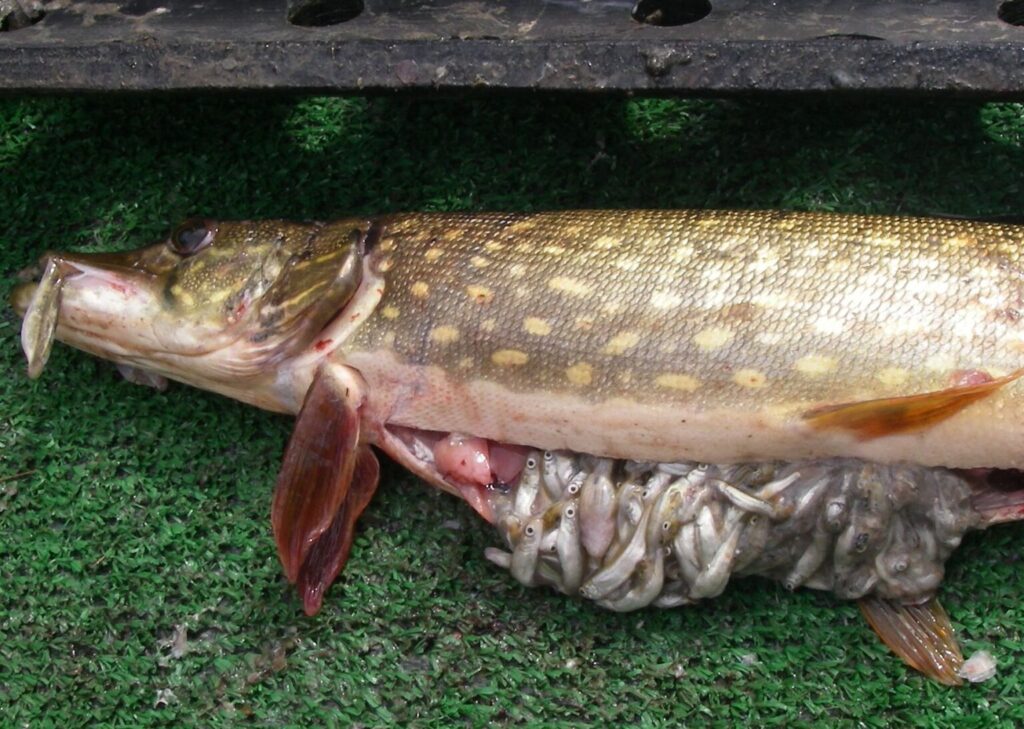
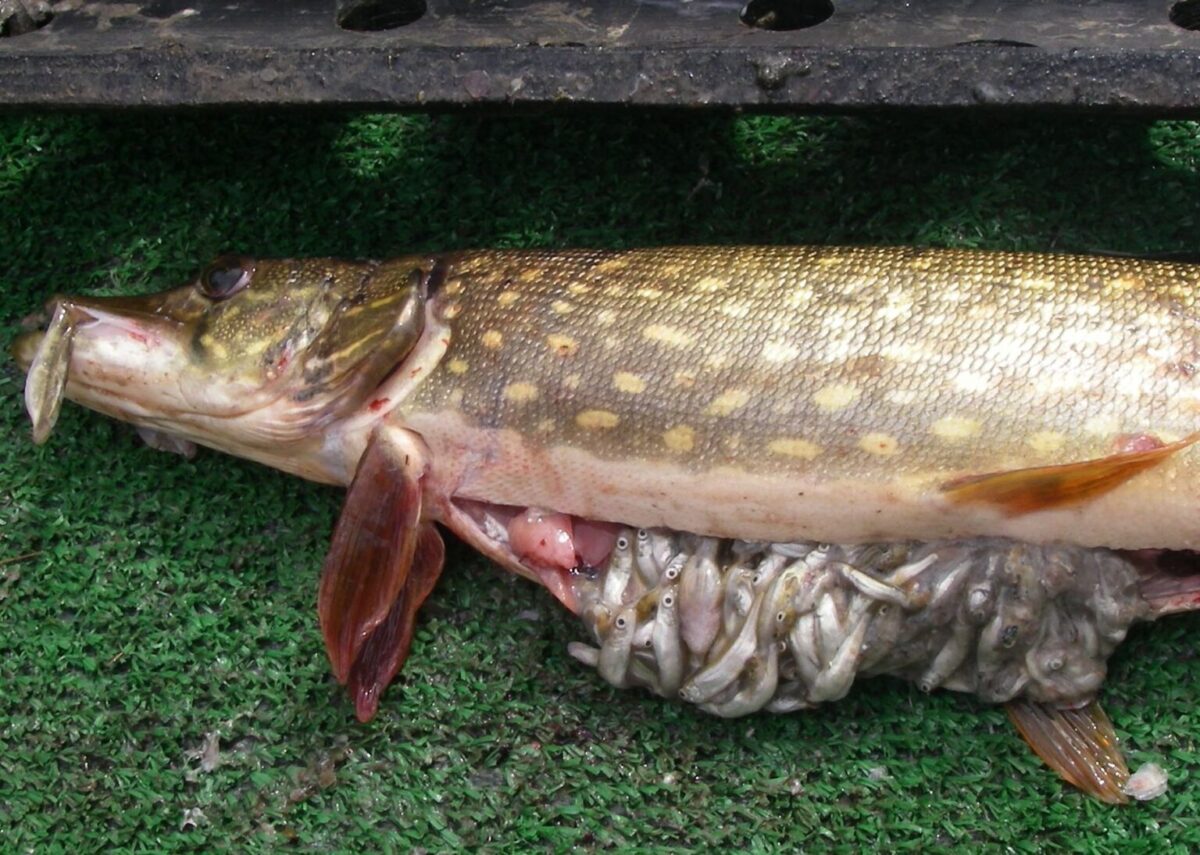
An invasive northern pike is shown to have its stomach stuffed with tiny juvenile salmon. Invasive northern pike are well-established on the Deshka River, where they are eating their way through the supply of salmon and other fish. As tempertures have risen, pike are eating more, a new study found. (Photo provided by the Alaska Department of Fish and Game)

Invasive northern pike have wreaked havoc in Southcentral Alaska rivers and lakes. Introduced illegally in the 1950s, they have been devouring juvenile salmon and other native species.

Now a University of Alaska Fairbanks study warns that matters could get even worse.

As temperatures rise in waterways, invasive pike eat more, said the study, published in the journal Biological Invasions. And as temperatures continue to rise, that trend will continue, the study said. Based on expected temperature trends, invasive northern pike will eat 6% to 12% more by the end of the century, the study said.

“We expect there will be significant warming in the future, and the amount of fish that pike consume is going to increase with it,” Benjamin Rich, who led the study while earning a master’s degree at UAF’s College of Fisheries and Ocean Sciences, said in a statement released by the university.

The UAF study found that over the past decade, northern pike of all age classes ate more as waters warmed. The increase was most dramatic in year-old pike, which upped their intake by about 63% over the period.

The study site was the Deshka River, a Matanuska-Susitna Borough waterway that is an important feeder to Cook Inlet and commercial fisheries there. The 44-mile river, a tributary of the Susitna River, is also a cherished destination for Southcentral Alaska sport anglers.

It is famous for its abundance of salmon — or it has been. Salmon in the Deshka is a lot less abundant now than in the past.

The decline is a decades-long problem that affects king salmon in particular. State and federal biologists have cited numerous reasons for  the decline.

The presence of invasive pike is one of them; pike have eaten a lot of juvenile king salmon, also known as Chinook, and coho salmon, also known as silver salmon.

Southcentral Alaska. (Photo by Benjamin Rich/U.S. Fish and Wildlife Service)
A pair of juvenile Chinook salmon emerge from the stomach of a northern pike caught on the Deshka River in Southcentral Alaska. (Photo by Benjamin Rich/U.S. Fish and Wildlife Service)

Heat stress is also among the myriad causes of declines. The Deshka is particularly vulnerable to heat. It is in a flat area and not glacier-fed, and it is known to be one of the warmest river systems in the Matanuska-Susitna Borough.

It is the subject of ongoing temperature monitoring and studies by the U.S. Fish and Wildlife Service, the conservation group Cook Inletkeeper and others.

In 2019, a record-hot year in Alaska, waters in the Deshka were particularly warm — exceeding 81 degrees Fahrenheit that July, according to readings by Cook Inletkeeper.

Warmer temperatures, along with speeding pike metabolism and spurring more food consumption, appear to be sharpening the northern pikes’ predation skills, said Erik Schoen, a UAF fisheries biologist and a study co-author.

Fish, which are cold-blooded animals, have varying physiological responses to heat, Schoen said. Compared to salmon, which get sluggish in warm temperatures, northern pike thrive and become speedier swimmers, he said.

“If it keeps getting warmer, they get much better at catching salmon,” he said. “They’re amazing ambush predators.”

Deshka pike are actually eating less salmon than they did in past years, analysis of stomach content shows. But that is not because they are turning away from salmon; rather, it is evidence of salmon declines in the river.

The abundance of adult king salmon in the Deshka dropped by 42% over the past decade. At about the same time, the biomass of juvenile salmon eaten by northern pike decreased by 30% to 74%, depending on age class.

Do not expect the pike to go away if they deplete all the salmon, warned Schoen, who grew up in Anchorage and spent a lot of time fishing in the Deshka.

Rather, they will turn to other fish, as they appear to have done in the Deshka, such as whitefish and rainbow trout. If they can’t eat fish, they eat flies, he said. Northern pike are even known to eat birds, such as eagle chicks and ducklings, small mammals like voles and shrews — and, on occasion, each other.

“Once they wipe out the salmon, the pike don’t die off because they run out of food,” Schoen said.

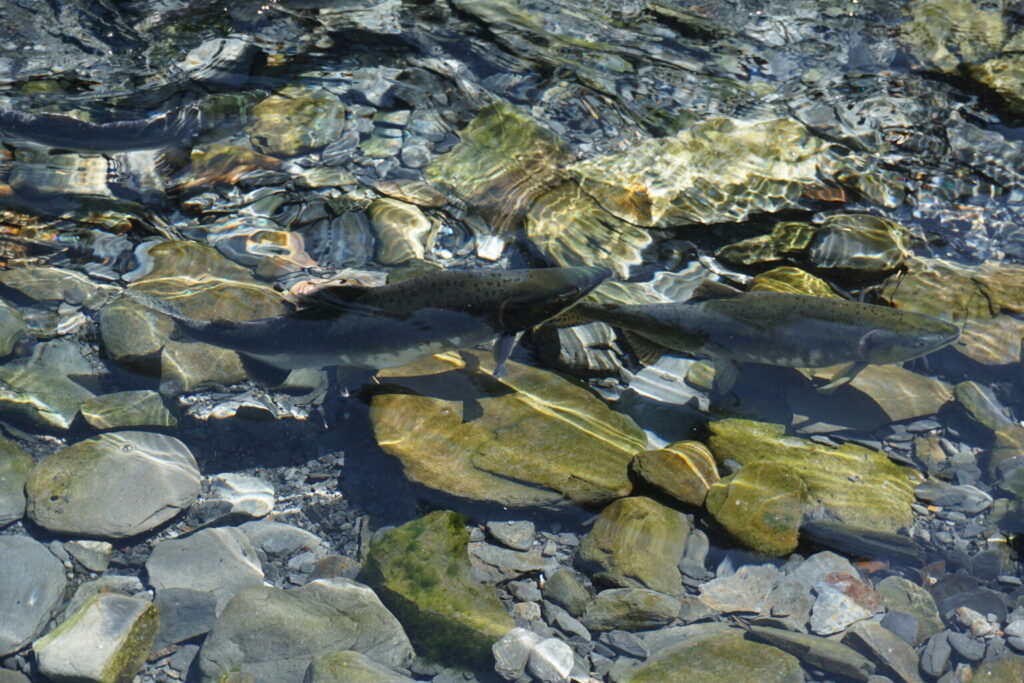
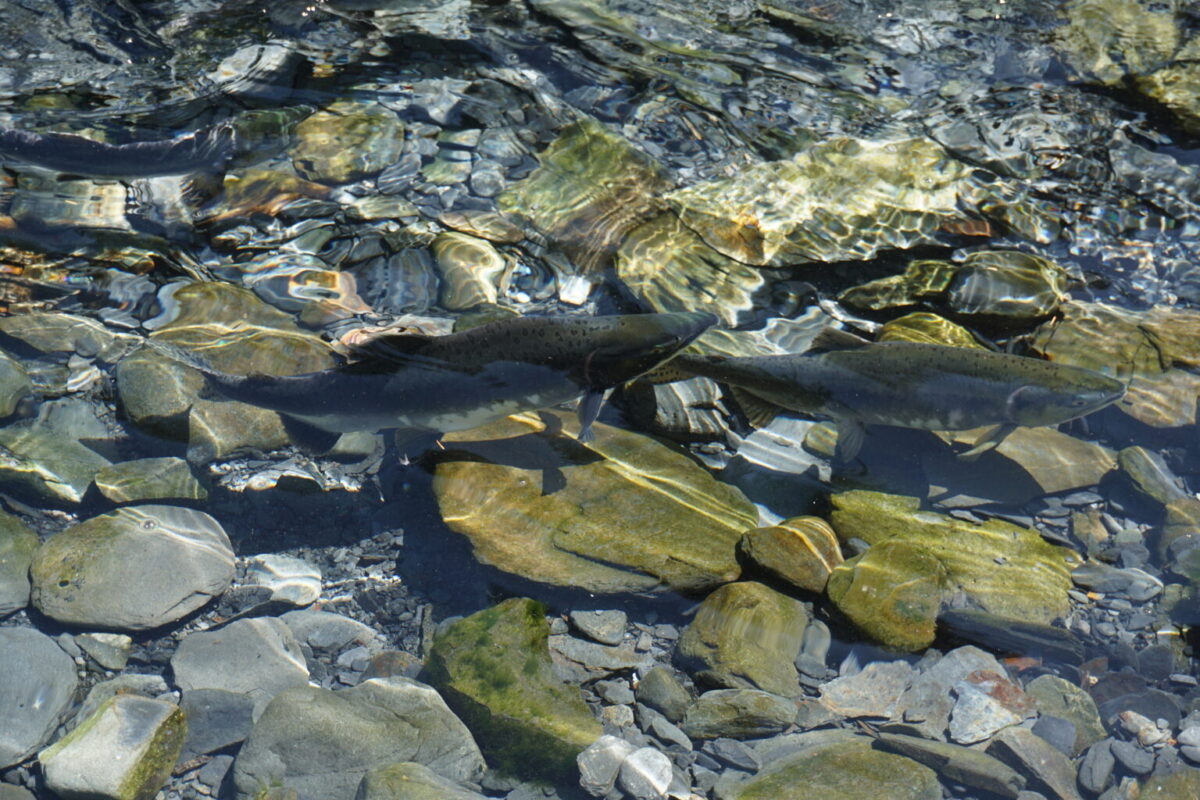
Two Chinook salmon, also known as king salmon, migrate up the Deshka River. (Photo by Katrina Liebich/U.S. Fish and Wildlife Service)
Two Chinook salmon, also known as king salmon, migrate up the Deshka River in this undated photo. The Matanuska-Susitna Borough river is a popular spot for sport anglers, but its salmon runs, especially its runs of Chinook salmon, have dwindled. (Photo by Katrina Liebich/U.S. Fish and Wildlife Service)

Northern pike are native to the Interior and northern parts of Alaska, but they are not part of the natural ecosystem south of the Alaska Range. The first introduction was about seven decades ago, prior to statehood, and traced to the Bulchitna Lake, which is part of the Susitna River drainage. Through the following years, flooding and reproduction spread the fish to new places. And they have proved persistent, showing up not just around the Matanuska-Susitna Borough but also in Anchorage and, to biologists’ dismay, on the Kenai Peninsula.

As entrenched as the pike infestation is in the Matanuska-Susitna Borough, the salmon picture there is not beyond hope, Schoen said.

Pike prefer areas with slow-moving waters and lots of plants. That means areas with swift-flowing waters and gravelly banks are much less likely to be invaded by pike, and there are several such pike-resistant spots in the borough.

Even though it can’t get rid of all the pike, the Alaska Department of Fish and Game has had some success suppressing the invaders in certain important Matanuska-Susitna spots, Schoen said.

One is Alexander Creek, a 40-mile waterway that was one of the most important Northern Cook Inlet freshwater sites for king and silver salmon.

A multiyear program launched by the department resulted in removal of more than 25,000 Northern pike from Alexander Creek by 2021, according to a department report. Salmon numbers have improved. But pike remain a persistent problem, and suppression should continue, the report concluded.

Through its activities as part of the Alaska Invasive Species Partnership, a multiagency organization, the department is pursuing a long-term plan to control northern pike.
Categories
Alaska News Featured Juneau News juneau Juneau Local Juneau Local Ketchikan Local News Feeds Sitka Local

Biologists forecast a reduced Alaska commercial salmon harvest

By: Yereth Rosen, Alaska Beacon

Two spawning pink salmon head upstream in shallow water in Cove Creek in Whittier on Aug. 5, 2024. Pink salmon have two-year life cycles, the shortest of all of Alaska’s five salmon species, and in recent years big pink salmon runs have alternated with smaller runs. A smaller run is expected this year, leading to a forecast of a smaller statewide commercial salmon harvest compared to last year’s total harvest of over 197 million fish. (Photo by Yereth Rosen/Alaska Beacon)

Alaska’s statewide commercial salmon harvest this year is expected to total 125.5 million fish, less than two thirds of the total landed by commercial harvesters in 2025, according to the annual forecast released last week by state biologists.

The anticipated 2026 total, detailed in Alaska Department of Fish and Game 2026 forecast and 2025 review, is lower than annual statewide harvests in all but four years since 2000, according to department records.

The lowered expectations for the statewide salmon harvest are driven mostly by anticipated declines in runs of pink salmon, also known as humpback salmon, according to the forecast.

Pink salmon are the most plentiful, smallest and cheapest of Alaska’s five salmon species. They have two-year life cycles, the shortest of all of Alaska’s salmon species. Although there are regional variations, the general pattern for the recent past is alternating big-run and smaller-run years, with 2025 as one of the big-run years.

The year-to-year difference has been significant, said Forrest Bowers, who heads the department’s commercial fishing division.

“We have been seeing a pronounced even-odd year difference in pink salmon returns, with much larger returns in odd-numbered years,” Bowers said by email.

In all, about 197.4 million salmon were harvested commercially last year, 120 million of which were pink salmon, the forecast said. This year, about 60 million pink salmon are expected to be harvested commercially, according to the forecast.

For Alaska’s other four salmon species, the forecast is for a lower total catches as well, with a combined reduction of 11% below the 2025 non-pink salmon total harvest, Bowers siad..

That is not considered a precise prediction. There are estimate ranges for different species and locations, which put the anticipated 2026 harvest in the general ballpark of last year’s harvest, except for pink salmon.

Alaska commercial salmon harvest totals from 1975 to 2024 are shown on a graph. In recent years, totals have fluctuated widely from year to year, reflecting the pattern in pink salmon returns. (Graph provided by the Alaska Department of Fish and Game)
Alaska commercial salmon harvest totals from 1975 to 2024 are shown on a graph. In recent years, totals have fluctuated widely from year to year, reflecting the pattern in pink salmon returns. The 2025 total, not shown on the graph, was over 197 million fish, putting it among the top years in the past five decades for salmon numbers. (Graph provided by the Alaska Department of Fish and Game)

“When we consider forecast uncertainty and the distribution of harvests across the state, the forecast for non-pink salmon is fairly similar to the 2025 actual harvest,” Bowers said.

Sockeye salmon, also known as red salmon, is the second-most plentiful of Alaska’s five species, and the statewide harvest is dominated by Southwestern Alaska’s Bristol Bay, site of the world’s largest sockeye salmon runs.

That status will continue this year, according to the forest. Bristol Bay’s estimated 2026 harvest for this year is 33.5 million fish, a little over the average over the last 20 years — but smaller than in some recent years, when harvests in that region hit or approached records. Last year’s Bristol Bay sockeye harvest was about 41.2 million fish, a little more than three quarters of the statewide sockeye harvest.

This year, the statewide sockeye salmon harvest is forecasted to total 49.7 million fish, of which about two thirds are expected to come from Bristol Bay.

The forecasted chum salmon commercial harvest this year is 17.2 million fish, compared to 21.7 million last year. This year’s forecasted harvest of coho salmon, also known as silver salmon, is 2.4 million fish, compared to 2.7 million harvested last year. This year’s forecasted harvest of Chinook salmon, also known as king salmon, is 197,000 fish, compared to last year’s total harvest of 201,000 fish.

The department’s forecast details regional differences along with species differences.

In the Yukon and Kuskokwim river systems, salmon runs are expected to continue to be weak, as they have been for the past several years, according to the forecast. There is no commercial fishing anticipated on either of those river systems. The only commercial fishing in the Arctic-Yukon-Kuskokwim region is expected to be in Norton Sound and in the Kotzebue area, as was the case last year and in other recent years.

The newly released forecast is for commercial harvesting alone. It does not include subsistence or sports harvests. Reports detailing last year’s subsistence harvests are expected to be released in the future, the forecast said.

Pink salmon are seen in an undated photo. (NOAA Fisheries photo)
Pink salmon are seen in an undated photo. Male pink salmon develop humps on their backs, and the fish are also known as humpback salmon or “humpies.”(Photo provided by the National Oceanic and Atrmospheric Administration Fisheries Service)
Categories
Alaska News Featured Juneau News juneau Juneau Local Juneau Local Ketchikan Local News Feeds Sitka Local

Roe seized from factory trawler accused of fishing violations in Alaska’s Bering Sea

By: Yereth Rosen, Alaska Beacon

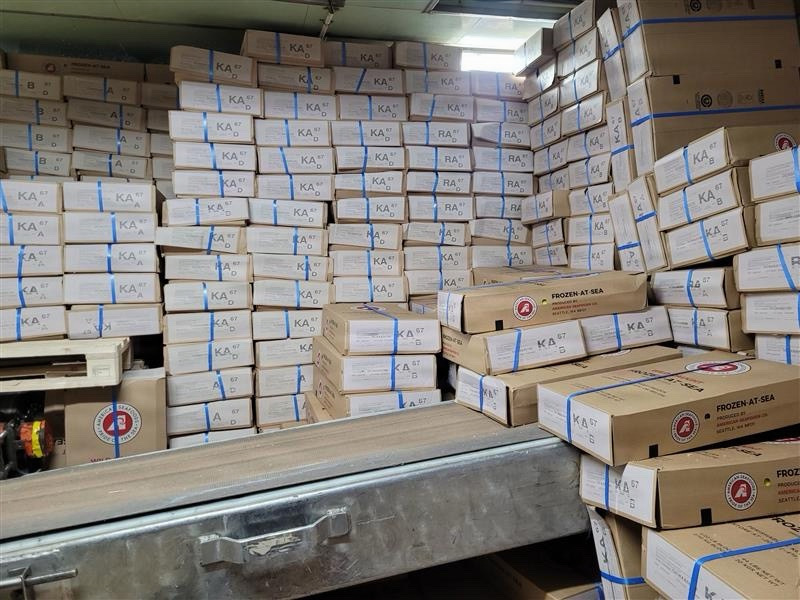
The crew of the U.S. Coast Guard Cutter Waesche (WMSL 751) seized approximately 5.4 metric tons of unreported pollock roe from the catcher-processor vessel Northern Eagle approximately 17 miles north of Dutch Harbor March 28, 2026. At the request of NOAA Fisheries OLE, Waesche ‘s boarding team remained with the Northern Eagle as it transited to Dutch Harbor. They observed the offload and documented 11,524 boxes of pollock roe, which was 241 boxes more than the 11,283 declared in the vessel’s production report. (U.S. Coast Guard courtesy photo)

The U.S. Coast Guard said it has seized 5.4 metric tons of allegedly unreported pollock roe and discovered several significant fishing violations aboard one of the biggest factory trawlers operating in the Bering Sea off Alaska.

The enforcement action, announced by the Coast Guard on Monday, is against the Northern Eagle, a catcher-processor owned and operated by Seattle-based American Seafoods. The company disputes the allegation.

A team from the cutter Waesche boarded the Northern Eagle on March 26 when the trawler was about 15 nautical miles north of Dutch Harbor, the Coast Guard said in a statement. The action followed an alert from the National Oceanic and Atmospheric Administration Fisheries Office of Law Enforcement about discrepancies between the vessel’s production reports and electronic logbook. 

“The integrity of fisheries data is paramount for the sustainability of our nation’s living marine resources,” Captain Tyson Scofield, commanding officer of the Waesche, said in the Coast Guard statement. “This seizure highlights the Coast Guard’s commitment to enforcing federal law with our partner agencies to ensure a level playing field for all fishermen who follow the rules.”

Pollock roe is considered a delicacy in some Asian nations; Japan and Korea are the main markets for it.

The unreported roe aboard the Northern Eagle was worth $65,000, the Coast Guard said. 

The Coast Guard team remained with the Northern Eagle as it sailed to Dutch Harbor, and the team observed and documented the crew offloading 11,524 boxes of pollock roe, the statement said. That was 241 more boxes than what had been declared in the Northern Eagle’s log.

The catcher-processor vessel Northern Eagle, owned by Seattle-based American Seafoods, is seen by the Coast Guard approximately 17 miles north of Dutch Harbor. The Coast Guard said a crew from the cutter Waesche boarded the ship on March 26, 2026, and seized approximately 5.4 metric tons of allegedly unreported pollock roe. (Photo provided by the U.S. Coast Guard)

The investigation also uncovered evidence indicating that the Northern Eagle crew, in a previous voyage, had underreported about 12.4 metric tons of pollock roe worth an estimated $150,000, the Coast Guard said.

American Seafoods on Tuesday disputed the Coast Guard’s characterization of events and issued a statement “to correct the public record, address inaccurate narratives, and clarify the nature of this regulatory inquiry.”

The company said the issue is a simple paperwork discrepancy arising from different methodologies rather than deliberate misreporting. The discrepancy was the result of minor and routine differences between estimated daily numbers and final reconciled numbers, the company said in the statement.

“We strongly reject any narrative that portrays a discrepancy in daily estimated production as an intentional breach of conservation measures that protect our fishery,” Inge Andreassen, American Seafoods’ president, said in the statement. “There is no economic motive to report anything other than exactly what we produce.” 

American Seafoods is one of the major harvesters of Bering Sea pollock. The company has a fleet of seven vessels, five of which are engaged in the pollock fishery. The Northern Eagle, at 341 feet and with space for 143 crew members, is American Seafoods’ longest vessel, according to the company’s website.

Roe is collected from Bering Sea pollock in the early part of the year. The annual Bering Sea pollock harvest is divided into two parts. A winter-spring “A Season” is conducted in the first half the year, usually from January to April, and targets fish when they are spawning and the females are carrying eggs. A subsequent “B Season” starts in June and runs through the fall, usually resulting in a total harvest of higher quantity but focused more on fish fillets and products that are made from them.

Categories
Alaska News Featured Juneau News juneau Juneau Local Juneau Local Ketchikan Local News Feeds Sitka Local

Alaska lawmakers push for continued ban on Russian seafood imports

By: Yereth Rosen, Alaska Beacon

Fishing vessels are seen in Homer’s harbor on Oct. 22, 2025. A resolution passed by state lawmakers urges federal officials to extend the ban on Russian seafood imports. Russian fish competes for market share with Alaska’s fish. (Photo by Yereth Rosen/Alaska Beacon)

A legislative resolution urging a continued and better-enforced ban on Russian seafood in the United States is headed to Gov. Mike Dunleavy.

Part of a series of actions by Alaska lawmakers to try to shore up the state’s ailing seafood industry, House Joint Resolution 29 won final passage last week and was transferred to the governor on Monday.

The resolution calls for continuation of the ban on Russian seafood imports imposed in 2022, after that country’s invasion of Ukraine. The ban was expanded in 2023 to cover imports of Russian seafood to the U.S. through a third-party country, usually China, where fish are processed.

The import ban is set to expire later this year. That makes the resolution timely, supporters aid.

Among the supporters is Jeremy Woodrow, executive director of the Alaska Seafood Marketing Institute.

Woodrow, in testimony to the Senate Resources Committee on Feb. 27, said a stockpile of Russian fish that was in the U.S. before the ban went into full effect is just now being depleted.

“We need more time to really capture the U.S. marketplace. Our industry has not recovered yet,” Woodrow said. Even though last year’s fishing season was better, it was still one of the worst years in the last 20 years, he said.

“This is one measure that will help our fishermen. We’re starting to see the fruits of this ban coming into play, but we need more time to provide stability to our industry. We need more time to see it come to fruition,” he told the committee.

In addition to seeking an extension of the import ban, the resolution calls for stronger monitoring and enforcement to “ensure fair trade, protect the state’s seafood industry, and promote sustainable and ethical seafood production.”

Legislative resolutions do not have the power of law, but they can influence actions by Congress, the federal executive branch or other institutions.

The Russian seafood import ban resolution was not among the measures introduced by the Joint Legislative Task Force Evaluating Alaska’s Seafood Industry, formed in 2024. However, it addresses an aspect of international trade, one of the issues raised by the task force. The task force’s report recommended an update to a Russia-focused resolution passed by the legislature in 2022, Senate Joint Resolution 16.

Russian king crab is displayed at a Costco in Anchorage on Nov. 14, 2022. The crab, from the Barent Sea, was distributed by Arctic Seafoods of San Francisco, and was part of inventory stockpiled before the U.S. government banned fish imports from Russia. (Photo by Yereth Rosen/Alaska Beacon)

The eight-member task force, comprising Senate and House members from fishery-dependent districts, issued its recommendation report in January 2025, at the start of last year’s session. Recommendations for action resulted in the introduction of a series of bills intended to help the industry, which has struggled with low fish prices, glutted international markets, high costs and other challenges.

Other bills focus on tax credits and revenues

One of the task force’s bills, aimed at encouraging seafood product development and diversification, is headed for a vote in the Senate this week.

That measure, Senate Bill 130, concerns the state’s fisheries product development tax credit system. Currently, seafood companies are allowed to deduct the cost of new equipment used to develop value-added products from salmon, herring, pollock, sablefish and Pacific cod. The bill would expand that to all fish species, including shellfish. That is in line with the recommendation in the task force report, which identifies arrowtooth flounder, fish meal and crab shells as examples of some underused or discarded products that could be processed into something marketable.

The bill, in the amended form before the Senate, also seeks to expand the range of technology for which investment would qualify for credits, and it would extend the sunset date for the credit to 2037. Currently, the tax credit is due to expire next year.

The revenue impact of the bill, if it wins final passage, is difficult to determine because there are several unknown variables, said the fiscal note prepared by the state Alaska Department of Revenue. Estimated annual revenues losses to the state would range from $1 million to nearly $4 million, according to the fiscal note.

Another task force bill, aimed at helping fishery-dependent local governments, had not moved out of the Senate Finance Committee as of Tuesday. That measure, Senate Bill 135, would allow municipalities to increase their share of fisheries business tax and fishery resource landing tax revenues. Currently, the state and local governments split those tax revenues equally. The bill would allow local governments to get up to 75% of the tax revenues.

The legislature passed two seafood task force bills last year, each of which had wide support. However, Dunleavy vetoed one of the bills.

The bill that escaped the governor’s veto, House Bill 116, allows for the formation and operation of member-owned commercial fishing insurance cooperatives. Such cooperativesexist in other states and were used by some Alaska fishers. The bill passed unanimously.

The vetoed bill, Senate Bill 156, would have transferred $3.69 million from a defunct state loan fund to the Alaska Commercial Fishing and Agriculture Bank. The state-owned bank needed the boost to keep serving the seafood industry, bill supporters argued. But Dunleavy argued that the cost of the action was too great for the state budget to bear.

Categories
Featured Juneau News Juneau Local Ketchikan Local News Feeds Sitka Local

AFN alarmed by proposed review of Alaska’s system of subsistence hunting and fishing

By: James Brooks, Alaska Beacon

Strips of sockeye salmon harvested from the Kuskokwim River are seen on July 19, 2017. Sockeye salmon, also known as red salmon, is among the species harvested for subsistence. (Photo provided by U.S. Fish and Wildlife Service)

The U.S. Department of the Interior is considering whether to change Alaska’s unique system of hunting and fishing, which gives rural residents priority on federal land in Alaska.

According to a notice published Dec. 15 in the Federal Register, the Interior Department is conducting “a targeted review” of the program mandated by the Alaska National Interest Lands Conservation Act.

While no specific changes were identified in the notice, it prompted the Alaska Federation of Natives to react with concern.

In a message to members, it called the new proposal “a serious threat and a major step backward” in fish and game management within Alaska, according to a report Tuesday by the Anchorage Daily News.

Federal law requires rural residents to receive a priority when subsistence hunting and fishing, but because Alaska’s constitution prohibits the state from operating a system that gives one resident priority over another, the federal government uses one set of rules for hunting and fishing on federally controlled waters and lands, and the state uses another set for state-controlled water and land.

That has frequently led to conflicts between the state and federal government over management, and several lawsuits over the issue are currently in progress in federal court.

The Daily News reported that the suggestion to revise the two-tiered program came from Safari Club International, a large sport-hunting organization that has frequently sided with the state in lawsuits against the federal government.

Information posted online by the Interior Department indicates that the agency may consider:

  • Changing the makeup of the board that regulates subsistence hunting and fishing on federal land;
  • Reconsidering the rules that determine what parts of the state are “rural” and thus eligible for preferential treatment;
  • And the role of the Alaska Department of Fish and Game in the program.

Comments may be emailed to subsistence@ios.doi.gov before Feb. 13.

Categories
Featured Juneau News Juneau Local Ketchikan Local News Feeds Sitka Local

Alaska fisheries in 2025: turmoil, economic and environmental challenges and some bright spots

Commercial fishing and recreational vessels are docked in the Homer harbor on Oct. 23, 2025. The commercial fishing industry endured a series of challenges over the year, some of them imposed by the new Trump administration. (Photo by Yereth Rosen/Alaska Beacon)

For Alaska’s fishing industry and fishing-dependent communities, 2025 was a year of turmoil and uncertainty, much of it imposed by ideological pursuits from the new Trump administration.

The short-lived agency called the Department of Government Efficiency hacked away at federal funding for science across the board. The National Oceanic and Atmospheric Administration in particular was in its crosshairs; the Heritage Institute’s Project 2025 blueprint for the second Trump administration heaped scorn on NOAA, saying its National Weather Service, National Marine Fisheries Service and other agencies “form a colossal operation that has become one of the main drivers of the climate change alarm industry and, as such, is harmful to future U.S. prosperity.” The NMFS’ Alaska Fisheries Science Center, which does the bulk of the research on which fishery managers depend, was among the agencies that suffered deep budget and staffing cuts

The prospect of more cuts is unsettling, some officials said. “I guess now we’re getting to a point that I’m getting really concerned and almost freaked out about how much data that we’re potentially losing that we’re used to having,” Anne Vanderhoeven, a member of the North Pacific Fishery Management Council, said on Dec. 4 during that body’s December meeting.

Even as the Trump administration cuts the support fishery management, it is demanding that the industry harvest more fish, in line with an administrative order issued by the president on April 17.

The federal government shutdown created more problems for fisheries managers, but the North Pacific Fishery Management Council used data from last year to set next year’s harvest limits for Alaska pollock — the nation’s top-volume commercial seafood — and other groundfish in the Bering Sea and Gulf of Alaska.

Hannah Scholosstein, international marketing and grants manager for the Alaska Seafood Marketing Institute, works in her office in Juneau on May 22, 2025, amid promotional materials. (Photo by Yereth Rosen/Alaska Beacon)
Hannah Scholosstein, international marketing and grants manager for the Alaska Seafood Marketing Institute, works in her office in Juneau on May 22, 2025, amid promotional materials. A legislative task force has recommended boosted funding and support for ASMI, among other actions. (Photo by Yereth Rosen/Alaska Beacon)

Alaska’s seafood industry continues to endure a variety of economic challenges — competition in markets that are glutted, rising costs, declines of some important fish stock and labor shortages, among them. There are fewer people harvesting seafood commercially in Alaska than at any time on record.

Alaska legislators have tried to address some of those woes. A legislative task force made numerous recommendations about financial systems, marketing, industry diversification, workforce development and other subjects. Those recommendations produced a series of bills. Two of them passed during the 2025 session, gaining unanimous support, but Gov. Mike Dunleavy vetoed one of them, which would have shored up the Alaska Commercial Fishing and Agriculture Bank. The Legislature has the opportunity to address the subject again in the coming session.

The Dunleavy administration ran into trouble with two of its other fishery-related efforts. The governor introduced a bill that would legalize salmon farming, which is widely disdained in the state. The bill went nowhere. The administration is also continuing to try to overturn federal subsistence management on federal sections of the Kuskokwim River, but it has lost in court so far.

There were some notable improvements in 2025.

Bering Sea snow crab stocks are starting to rebound after a massive crash that closed harvests for two years, the first. However, there has been a puzzling boom in the number of snow-tanner crab hybrids. The Alaska Department of Fish and Game is treating the hybrids as snow crabs for harvest-management purposes.

The overall salmon harvest was much bigger and more lucrative than last year’s dismal totals. Bristol Bay reds were not as small as last year’s record tiny fish, and the region also had a bigger run than predicted. However, salmon runs in the Yukon River continue to be poor.

But trouble is brewing in the marine and freshwater environments that support fish.

In areas of thawing permafrost, particularly Northwestern Alaska, a phenomenon called “rusting rivers,” has released such high levels of metals that conditions at times are toxic for fish. The thaw creates acid rock drainage, similar to the type of pollution that can come from hardrock mining. Iron and other metals that are freed through the process turn clear waters orange or red. The problem is serious enough to have merited a chapter in this year’s Arctic Report Card, issued on Dec. 16 by NOAA.

A member of a multi-organization team combatting the spread of invasive European green crabs holds one of the crabs trapped in Southeast Alaska in the summer of 2023. (Photo by Ginny Eckert/Alaska Sea Grant)
A member of a multi-organization team combatting the spread of invasive European green crabs holds one of the crabs trapped in Southeast Alaska in the summer of 2023. The invasive crabs were first discovered in Alaska in 2022. The Metlakatla Indian Community is leading the effort to combat their spread, and this year workers in the program trapped more than 40,000 of the crabs. (Photo by Ginny Eckert/Alaska Sea Grant)

Alaska scientists have also confirmed that invasive northern pike, a bane to native salmon runs in Southcentral Alaska, can swim across Cook Inlet to colonize new territory. The freshwater pike, which gobble up salmon fry and other fish, are too entrenched in the Matanuska-Susitna Borough to be eradicated from waterways there. Biologists have been working to keep Kenai Peninsula pike-free and believed they were successful in 2018, until scientists discovered that pike are able to survive the relatively short swim through the inlet’s saltwater into new freshwater sites. The eradication work has continued, and state biologists believe the peninsula is again pike-free.

Another looming threat comes from the south. Resource managers with the Metlakatla Indian Community, the tribal government in Alaska’s most southeastern spot, have been battling what its officials term an “explosion” of invasive European green crabs. The first Alaska discovery of the invasive crabs, which can devastate native fish stocks, was in 2022 in the Metlakatla area. At first, there were only a few shells. But this year, workers in the tribal program trapped more than 40,000 of the crabs, which have been steadily expanding north.

Categories
Featured Juneau News Juneau Local Ketchikan Local News Feeds Sitka Local

Without completed 2025 reports, federal fishery managers use last year’s data to set Alaska harvests

By: Yereth Rosen, Alaska Beacon

Gulls hunting seeking scraps of fish swarm the docked fishing vessel Gold Rush, which harvests pollock and other groundfish, and Trident Seafood’s Kodiak plant on Oct. 3, 2022. The North Pacific Fishery Management Council set 2026 Bering Sea and Gulf of Alaska ccatch limits for pollock and other groundfish species, but the prolonged federal government shutdown interrupted the flow of information that would normally be used to set those harvests. (Photo by Yereth Rosen/Alaska Beacon)

Lacking the usual amount of data to guide them, federal fishery managers relied on last year’s reports to set the coming year’s harvests for the nation’s top-volume commercial fish species: Alaska pollock.

The North Pacific Fishery Management Council, the panel that sets harvest levels and other rules for fisheries conducted in federal waters off Alaska, voted on Sunday to keep 2026 pollock catch limits in the Bering Sea at about the same level as this year’s limits while paring back the pollock catch limit for the Gulf of Alaska.

Pollock, one of key species in the North Pacific Ocean, is widely sold as fish patties and fillets, fish sticks, imitation crab meat and other products.

The council, which sets the coming year’s groundfish harvest limits each December, typically bases those decisions on detailed annual Stock Assessment and Fishery Evaluation reports, known as SAFE reports. But this year, the prolonged federal government shutdown prevented National Oceanic and Atmospheric Administration scientists and their partners from completing SAFE reports for the Bering Sea and Gulf of Alaska.

Instead, the council used the 2024 SAFE reports, supplemented with some newer data about harvests completed this year and some preliminary information about ecosystem conditions. The newer information did not reveal any conservation concerns that would justify harvest reductions, the council determined.

Information that goes into SAFE documents comes from ocean surveys and analysis done by NOAA’s Alaska Fisheries Science Center, with cooperation from research partners. Like all years’ SAFE reports, the 2024 documents for the Bering Sea and Gulf of Alaska featured two-year projections, extending through 2026.

Bob Foy, the center’s director, said that while all of this year’s planned ocean surveys were completed, despite numerous challenges, information from them had not been fully reviewed or vetted.

However, last year’s reports are solid, Foy said.

“Those stock assessments are incredibly robust,” he told the council on Thursday. “What we put together last December was based on decades of information, decades of decisions, piles of information on biology, surveys and whatnot.”

Council members voted to set the Bering Sea and Aleutian Islands harvest of pollock at 1.375 million metric tons, slightly below the limit set for 2025. 

Counting all species of groundfish, a category that includes Pacific cod, sablefish, arrowtooth flounder and mackerel as well as pollock, the council set the total Bering Sea and Aleutian harvest limit at 2 million metric tons, unchanged from the 2025 limit.

The council set the Gulf of Alaska pollock harvest limit at 129,749 metric tons, considerably below the 2025 limit of 176,496 metric tons. The total Gulf of Alaska groundfish harvest limit was set at 464,336, compared to the 514,619 metric ton limit set for this year. Less than half of that 2025 limit has been harvested as of early November, according to council data.

Caitlin Yeager, representing owners of catcher-processor trawl vessels that harvest pollock, said the 2024 SAFE report held the “best scientific information available” to set 2026 harvests.

The North Pacific Fishery Management Council's December meeting, held at the William A. Egan Civic and Convention Center in Anchorage, is seen underway on Dec. 6, 2025. (Photo by Yereth Rosen/Alaska Beacon)
The North Pacific Fishery Management Council’s December meeting, held at the William A. Egan Civic and Convention Center in Anchorage, is seen underway on Dec. 6, 2025. (Photo by Yereth Rosen/Alaska Beacon)

Yeager, vice president for policy and engagement for the Seattle-based At-sea Processors Association, told the council that its plans for the 2026 pollock harvest were responsible.

“Maintaining these specifications ensures not only continuity but also legal defensibility and avoids the risk of a regulatory lapse that would otherwise halt our fishery operations” next spring, she said in testimony to the council on Saturday.

 Some industry representatives, citing positive indicators turned up by scientists’ surveys this year, argued for an increase in the allowable catch of Gulf of Alaska Pacific cod. The council did not take that step, but members agreed to revisit cod catch limits in the next few months if Alaska Fisheries Science Center scientists are able to provide enough information to warrant an adjustment.

While fishing industry representatives welcomed the council’s decisions, some environmental and community advocates expressed concern. 

Some testifying to the council or submitting written comments argued that catch limits for pollock and other groundfish should be reduced, citing information gaps and the ongoing and controversial incidental catches of river-bound salmon. Those accidental catches are called bycatch.

Megan Williams, fisheries scientist with Ocean Conservancy, was among those urging caution. She noted that this year, the annual ecosystem reports were not completed. That “represents another key data gap in 2026,” she said.

Abbreviated reports available in October contained some “red flags” that justified a more cautious approach to harvest limits, she said. “Data from 2024 and 2025 indicated a return to warm conditions with marine heatwaves occurring in all regions at given points, and reduced sea ice and cold-pool extent in the Bering Sea,” she said. The cold pool is an area of chilled deepwater that usually lingers in the Bering Sea in the summer, separating fish populations in the southern part of the sea from those in the north.

Francis Thompson, president of the Algaaciq Native Village in the Yukon River village of St. Marys, said the council was jumping too far ahead with its projections, not only for the coming year but for the year after that, given lack of information about salmon and other issues.

“It amazes me that you guys are already projecting 2026 and 2027 for allowable harvest of pollock,” he said in testimony on Saturday.

It is not fair that industrial fishing operators in the Bering Sea are allowed to continue their harvests at steady levels, he said, while subsistence users on the Yukon and elsewhere in Western Alaska have been forced to stop fishing because of low runs. The subsistence fishers account for only about 1 percent of the salmon catch, at most, but are bearing all the conservation burden, he said.

“We’re not going to be fishing for a while. And many of the folks in our area, the 1 percent that have put aside their fishing to save the resource for the escapement, are tired,” he said.

Escapement is the term used to describe salmon that reach their freshwater spawning grounds, allowing them to reproduce.

The council did not take action on salmon bycatch. Limits on Chinook bycatch already exist for the pollock fleet, and action on a chum salmon bycatch limit is scheduled to be taken at the council’s next meeting, to be held in February.

Council member Anne Vanderhoeven, during Sunday’s deliberations, said there is not yet any justification to reduce pollock harvests to conserve depressed runs of salmon in Western Alaska.

“The impacts of the salmon crisis are truly devastating to subsistence users and Alaska Native culture,” she said. “But the best scientific information available does not support the assertion that relatively small adjustments to the pollock (total allowable catch) will measurably or significantly increase salmon escapement to Western Alaska rivers.”

Categories
Featured Juneau News Juneau Local Ketchikan Local News Feeds Sitka Local

Alaska’s commercial salmon harvest rebounds after ultra-low harvest last year

By: Yereth Rosen, Alaska Beacon

Salmon returning from the ocean attempt to jump Brooks Falls in Katmai National Park and Preserve’s Brooks River on July 12, 2018. Alaska’s commercial salmon harvest this year was nearly twice as big as last year’s small harvest. (Photo by Russ Taylor/National Park Service)

Alaska commercial fishers caught much more salmon in 2025 than they did last year, but the money they earned was modest, according to the statewide harvest report.

The state commercial salmon haul totaled 194.8 million fish, the 12th largest since 1985, according to the Alaska Department of Fish and Game’s preliminary annual summary, released this month.

Measured in pounds, the 2025 harvest was about average compared to the last 40 years the agency has been keeping an all-species record, the Fish and Game summary said.

But the amount of money paid to harvesters delivering their fish – known as ex-vessel value – was the 13th lowest since 1975, when adjusted for inflation. This year’s total was $541 million, the department said.

Copper River sockeye salmon fillets are displayed at New Sagaya Midtown Market in Anchorage on June 12, 2025. Sockeye salmon is also called red salmon. (Photo by Yereth Rosen/Alaska Beacon)
Copper River sockeye salmon fillets are displayed at New Sagaya Midtown Market in Anchorage on June 12, 2025. Sockeye salmon is also called red salmon. This year, sockeye salmon accounted for 58% of the value of Alaska’s total commercial salmon harvest, though it reprsented only about a quarter of the fish caught. (Photo by Yereth Rosen/Alaska Beacon)

This year’s totals represent a big improvement from last year, when only 101.2 million salmon were harvested. It was the third lowest haul since 1985 and the ex-vessel value was $304 million, the third lowest since 1975 when adjusted for inflation. In weight, the 2024 harvest totaled 450 million pounds, the lowest on record.

Alaska salmon, particularly Chinook, have been shrinking in size over the past decades, a trend that scientists attribute to a variety of factors, including climate change and ocean conditions.

This year, sockeye salmon accounted for the most value among Alaska’s five salmon species, continuing the long-term pattern in the industry. A little over a quarter of the landed fish were sockeye, but they made up 58% of the value, according to the Department of Fish and Game’s summary.

Pink salmon, the most plentiful and cheapest of the Alaska species, made up 61% of the total fish harvested and 21% of the total ex-value. The pink salmon harvest was about 14% less than expected at the start of the season, the department said.

At the other end of the volume spectrum, the statewide Chinook harvest, which accounted for only 181,892 of the 194.8 million total, was 26% higher than predicted in the preseason forecast, the department said.

Chum salmon accounted for 10% of the harvest and coho accounted for 1%, the department said.

The harvest totals are preliminary and subject to revision as more information is received, the department said.

Categories
Featured Juneau News Juneau Local Ketchikan Local News Feeds Sitka Local

Number of Alaska fishers and seafood workers hits record low, state report finds

By: James Brooks, Alaska Beacon

 Commercial fishing boats are lined up at the dock at Seward’s harbor on June 22, 2024. (Photo by Yereth Rosen/Alaska Beacon)

The number of people working in Alaska’s famed seafood industry has set a new record low, surpassing last year’s record low, according to figures published this month by the Alaska Department of Labor and Workforce Development in its magazine, Alaska Economic Trends.

In 2024, an average of 5,393 people were employed as fishers, processors or other seafood workers each month in Alaska, wrote analyst Joshua Warren. That’s down by 443 jobs from the same figure in 2023.

Alaska remains the No. 1 seafood producer among U.S. states, according to federal statistics, and produces more seafood than every other state combined.

The state department of labor has kept a monthly tally of seafood jobs in the state since 2001, and industry employment has been in a steady decline since 2019 due to a variety of factors, including a lack of available fish, competition from cheaper international sources, and high operating costs that can make fishing uneconomic. 

Since the start of 2001, the high point of fishing employment was in 2015, when an average of 8,501 people were employed in the seafood industry each month.

Historically, seafood employment was significantly higher due to reduced rates of automation and the fact that Alaska seafood tended to be processed and packaged locally. 

The modern trend has been toward direct export and processing internationally, where wages are lower.

Seafood employment in Alaska is extremely seasonal, with a peak in June and July during the salmon season and a low ebb in December, before a new season of fishing in federal waters offshore.

In July 2024, only 17,361 people worked in the Alaska seafood industry, the lowest annual peak on record since January 2021. In July 2013, the highest peak, more than 25,000 people were employed in the state’s seafood industry.

Categories
Featured Juneau News Juneau Local Ketchikan Local News Feeds Sitka Local

‘Explosion’ of invasive European green crabs reported in Southeast Alaska

By: Yereth Rosen, Alaska Beacon

The carapace, or upper shell, of an invasive European green crab and a live live green crab are shown in this undated photo. Ever since Alaska’s first green crabs were found on Annette Island in 2022, numbers have exploded and the invaders have spread north. (Photo by Linda Shaw/National Oceanic and Atmospheric Administration Fisheries Service)

When a young Sealaska intern walking a beach in July 2022 found the first evidence of European green crab presence in Alaska – a discarded shell on a beach on Annette Island in the state’s far southeast corner – it was an ominous sign about the invasive species’ northward spread.

Since then, the Metlakatla Indian Community, the tribe based on Annette Island, and its partners, which include Alaska Sea Grant, have found not just more shells, but live invasive crabs. Discoveries numbered just a handful at first, then dozens, then hundreds, then thousands.

This year, the Metlakatla tribe’s team has trapped more than 40,000 of them on and around Annette Island, a representative said.

“This year we’ve had a complete explosion of green crab — over seven new locations on Annette Island we found green crab, and eight new locations off Annette Island,” said Nicole Reynolds, an environmental specialist working with the tribe, in a presentation at a three-day Anchorage meeting on invasive species in Alaska this week.

The more than 40,000 crabs removed this year compares to last year’s total of 1,800, Reynolds said.

European green crabs are small, usually measuring no more than 4 inches wide, but they  are powerful forces of destruction. They mow down eelgrass beds that are vital habitat for salmon and other native species. And they gobble up native marine life like juvenile salmon, clams, mussels and juvenile Dungeness and other crabs that are important to commercial and subsistence harvests.

“They’ll eat the baby crabs. They’re meaner and tougher than the Dungeness,” Reynolds said during a break in the annual Alaska Invasive Species Partnership Workshop.

European green crabs have already spread north of Annette Island. Last year, they were found at Gravina Island, and this summer they were found by participants in a local university class at beaches in Ketchikan that lie about 30 miles north of the initial Annette Island discovery site.

Just this month, they were found at Etolin Island, Reynolds said. Etolin Island is roughly 60 miles northwest of the city of Ketchikan, making it the northernmost North America discovery to date.

And now European green crabs appear to be entrenched in Alaska waters for good, Reynolds and Genelle Winter, a grant administrator with the tribal government, told the workshop audience.

That means the fight against green crabs will also have to be long-term, Winter said, with a permanent staff and a strategy of what is known as “functional eradication.” That is an eradication strategy that accepts the reality of the invaders’ presence in some places, but tries to keep them out of other places with resources that are most important to protect.

Nicole Reynolds and Genelle Winter of the Metlakatla Indian Community pose on Oct. 28, 2025, with a sticker bearing European green crab design created by a local artist, Elizabeth Anderson. The crab face was made intentionally angry and mean-looking, helping send the message about the destruction caused by this invasive species. Reynolds and Winter presented information at the annual Alaska Invasive Species Partnership Workshop in Anchorage about the Tribe's work to combat the spread of European green crabs. The first discovery of the crabs in Alaska was in 2022 at Annette Island in the far southeast corner of the state, and they have proliferated in Alaska waters since then. (Photo by Yereth Rosen/Alaska Beacon)
Nicole Reynolds and Genelle Winter of the Metlakatla Indian Community pose on Oct. 28, 2025, with a sticker bearing a European green crab design created by local artist, Elizabeth Anderson. The crab face was made intentionally angry and mean-looking, to help send the message about the destruction caused by this invasive species. Reynolds and Winter presented information at the annual Alaska Invasive Species Partnership Workshop in Anchorage about the Tribe’s work to combat the spread of European green crabs. The first discovery of the crabs in Alaska was in 2022 at Annette Island in the far southeast corner of the state, and they have proliferated in Alaska waters since then. (Photo by Yereth Rosen/Alaska Beacon)

Such a strategy involves “focusing all our efforts on protecting the most vital subsistence and commercial resources,” she said.

Conditions in Alaska waters, the farthest-north spots in North America where the crabs have spread, do not faze the invaders, DNA analysis shows. For that information, the tribe consulted with an expert, Carolyn Tepolt of the Woods Hole Oceanographic Institute. Tepolt has also been investigating the genetics of green crabs that have invaded Washington state.

Tepolt’s analysis found that the green crabs in Alaska are a genetic blend of those in Washington and British Columbia, diverse enough to persist in the more northern waters, Reynolds said.

“She even called it a ‘super-crab’ just because of how perfectly genetically suited it is for the environment in Southeast Alaska,” Reynolds said.

European green crabs have been altering North American marine ecosystems for a long time.

They were first found in East Coast waters in the early 1800s, likely carried there in ship ballast water. The first West Coast discovery was in 1989 in San Francisco Bay. Since then, they have been spreading north up the Pacific coast. They were first confirmed in British Columbia in 1999 and continued moving up that Canadian province’s coast before being found at Annette Island three years ago.

Beyond the accidental releases through ballast water, scientists say warming conditions are aiding the spread of green crabs. Larvae are more likely to survive in warmer waters brought on by climate change and weather events like El Nino cycles.

The 2023-2024 El Nino, which warmed Alaska waters, is a possible factor in this year’s explosion of green crabs in Southeast Alaska, the Metlakatla tribal representatives said.

Warmer temperatures than those that used to be normal in Alaska marine waters are known to encourage green crab proliferation.

study by Danish scienetists that was published in September identifies a temperature range that appears ideal for the crabs. At temperatures of 12.5 to 16.6 degrees Celsius, or 54.5 to 61.9 degrees Fahrenheit, European green crab abundance peaked, the scientists found.

Average temperatures in Southcentral Alaska’s Cook Inlet were within that range this August, an indication that conditions would be suitable for green crabs if they somehow reach that area.

Nicole Reynolds, an environmental specialist with the Metlakatla Indian Community, shows a photo stored on her phone of an unusual-looking European green crab collected this year. The Tribal government is at the forefront of the campaign to try to control the spread of the invasive species, which eats native species and damages habitat used by fish. Reynolds presented information about the Tribe's work at the annual Alaska Invasive Species Partnership Workshop in Anchorage. (Photo by Yereth Rosen/Alaska Beacon)
Nicole Reynolds, an environmental specialist with the Metlakatla Indian Community, shows a photo stored on her phone of an unusual-looking European green crab collected this year. The Tribal government is at the forefront of the campaign to try to control the spread of the invasive species, which eats native species and damages habitat used by fish. Reynolds presented information about the Tribe’s work at the annual Alaska Invasive Species Partnership Workshop in Anchorage. (Photo by Yereth Rosen/Alaska Beacon)

Preparations are already underway in Alaska for what experts believe is an inevitable spread north from the Southeast region.

In Southcentral Alaska’s Kachemak Bay, over 700 miles northwest of Ketchikan, residents this summer deployed over 60 traps in what was effectively a pre-invasion drill. The program was a cooperative effort of the Kachemak Bay National Estuarine Research Reserve, the Seldovia Village Tribe and its council member, Michael Opheim, and the U.S. Fish and Wildlife Service.

There and elsewhere, a big part of the fight against green crab infestations is public education.

European green crabs can be identified by the array of bumps on their shells. They have five sharp spikes on either side of their eyes and three lobes in between their eyes. Despite their name, they are not always green – they can be red, yellow or mottled. Some of those found by her team have even been blue, Reynolds said.

To help boost awareness, local Tsimshian artist Elizabeth Anderson has designed a green crab logo – with an angry face to reinforce the message that the species is a bad actor, Winter said.

In Metlakatla, awareness appears to be keen already, including among some of the youngest residents.

“The other day, the mayor was driving down the street and got flagged down by two little kids. And they said, ‘We found some green crab! We know its green crab because it’s 5-3-5,’” Winter said during the workshop presentation. The numbers reference the array of shell bumps on a green crab. “Those little kids absolutely knew how to identify the European green crab.”

Those crabs, found at a beach right in front of town, were stashed in a plastic bag and added to this year’s count, Winter said.

Aside from identifying, trapping, counting, measuring and analyzing the European green crabs, the inundated community faces another challenge: what to do with thousands of unwanted invaders.

In Metlakatla, the ultimate destination is the community compost heap. That is a good end use, Reynolds said. “They add heat to the compost, and because it’s cold and wet in Southeast, it’s actually really helpful to have more heat,” she told workshop attendees.

On the East Coast and elsewhere, some of the eradication work involves eating the invaders. Experts say they have little meat but can be useful for making soups. One organization, Greencrab.org, has compiled recipes and sells a cookbook and T-shirts with a catchy slogan: “If you can’t beat them, eat them.”

European green crab specimins preserved in plastic are displayed on Oct. 28, 2025, at the annual Alaska Invasive Species Partnership Workshop in Anchorage. Although they are called green crabs, they come in different colors, and heat can turn their shells orange. (Photo by Yereth Rosen/Alaska Beacon)
European green crab specimens preserved in plastic are displayed on Oct. 28, 2025, at the annual Alaska Invasive Species Partnership Workshop in Anchorage. Although they are called green crabs, they come in different colors, and heat can turn their shells orange. (Photo by Yereth Rosen/Alaska Beacon)