Categories
Alaska News Featured Juneau News juneau Juneau Local Juneau Local Ketchikan Local News Feeds Sitka Local

Higher temperatures spur Alaska’s invasive pike to eat more, a bad sign for salmon

By: Yereth Rosen, Alaska Beacon
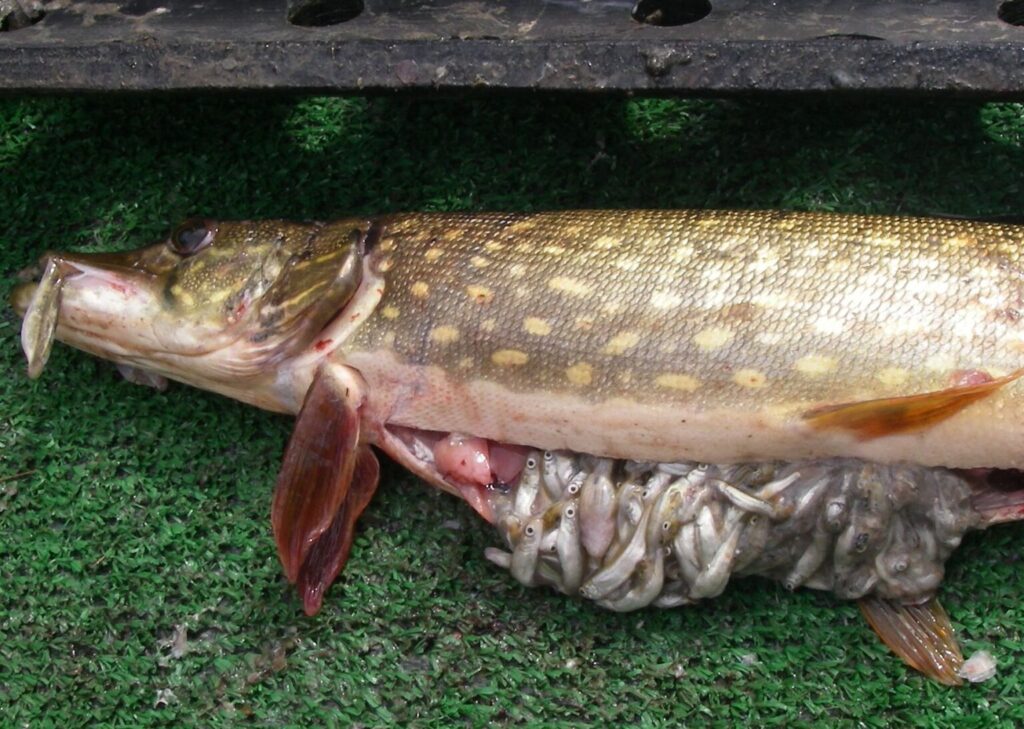
An invasive northern pike is shown to have its stomach stuffed with tiny juvenile salmon. Invasive northern pike are well-established on the Deshka River, where they are eating their way through the supply of salmon and other fish. As tempertures have risen, pike are eating more, a new study found. (Photo provided by the Alaska Department of Fish and Game)

Invasive northern pike have wreaked havoc in Southcentral Alaska rivers and lakes. Introduced illegally in the 1950s, they have been devouring juvenile salmon and other native species.

Now a University of Alaska Fairbanks study warns that matters could get even worse.

As temperatures rise in waterways, invasive pike eat more, said the study, published in the journal Biological Invasions. And as temperatures continue to rise, that trend will continue, the study said. Based on expected temperature trends, invasive northern pike will eat 6% to 12% more by the end of the century, the study said.

“We expect there will be significant warming in the future, and the amount of fish that pike consume is going to increase with it,” Benjamin Rich, who led the study while earning a master’s degree at UAF’s College of Fisheries and Ocean Sciences, said in a statement released by the university.

The UAF study found that over the past decade, northern pike of all age classes ate more as waters warmed. The increase was most dramatic in year-old pike, which upped their intake by about 63% over the period.

The study site was the Deshka River, a Matanuska-Susitna Borough waterway that is an important feeder to Cook Inlet and commercial fisheries there. The 44-mile river, a tributary of the Susitna River, is also a cherished destination for Southcentral Alaska sport anglers.

It is famous for its abundance of salmon — or it has been. Salmon in the Deshka is a lot less abundant now than in the past.

The decline is a decades-long problem that affects king salmon in particular. State and federal biologists have cited numerous reasons for  the decline.

The presence of invasive pike is one of them; pike have eaten a lot of juvenile king salmon, also known as Chinook, and coho salmon, also known as silver salmon.

Southcentral Alaska. (Photo by Benjamin Rich/U.S. Fish and Wildlife Service)
A pair of juvenile Chinook salmon emerge from the stomach of a northern pike caught on the Deshka River in Southcentral Alaska. (Photo by Benjamin Rich/U.S. Fish and Wildlife Service)

Heat stress is also among the myriad causes of declines. The Deshka is particularly vulnerable to heat. It is in a flat area and not glacier-fed, and it is known to be one of the warmest river systems in the Matanuska-Susitna Borough.

It is the subject of ongoing temperature monitoring and studies by the U.S. Fish and Wildlife Service, the conservation group Cook Inletkeeper and others.

In 2019, a record-hot year in Alaska, waters in the Deshka were particularly warm — exceeding 81 degrees Fahrenheit that July, according to readings by Cook Inletkeeper.

Warmer temperatures, along with speeding pike metabolism and spurring more food consumption, appear to be sharpening the northern pikes’ predation skills, said Erik Schoen, a UAF fisheries biologist and a study co-author.

Fish, which are cold-blooded animals, have varying physiological responses to heat, Schoen said. Compared to salmon, which get sluggish in warm temperatures, northern pike thrive and become speedier swimmers, he said.

“If it keeps getting warmer, they get much better at catching salmon,” he said. “They’re amazing ambush predators.”

Deshka pike are actually eating less salmon than they did in past years, analysis of stomach content shows. But that is not because they are turning away from salmon; rather, it is evidence of salmon declines in the river.

The abundance of adult king salmon in the Deshka dropped by 42% over the past decade. At about the same time, the biomass of juvenile salmon eaten by northern pike decreased by 30% to 74%, depending on age class.

Do not expect the pike to go away if they deplete all the salmon, warned Schoen, who grew up in Anchorage and spent a lot of time fishing in the Deshka.

Rather, they will turn to other fish, as they appear to have done in the Deshka, such as whitefish and rainbow trout. If they can’t eat fish, they eat flies, he said. Northern pike are even known to eat birds, such as eagle chicks and ducklings, small mammals like voles and shrews — and, on occasion, each other.

“Once they wipe out the salmon, the pike don’t die off because they run out of food,” Schoen said.

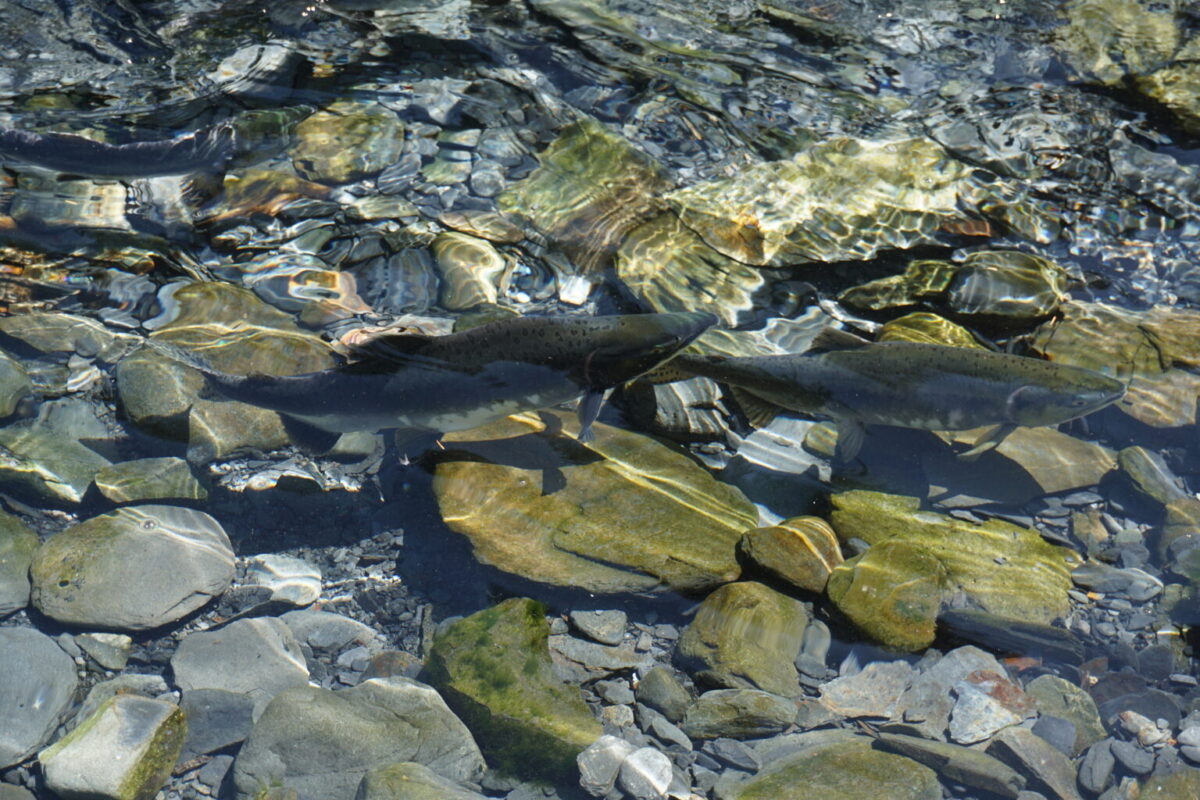
Two Chinook salmon, also known as king salmon, migrate up the Deshka River. (Photo by Katrina Liebich/U.S. Fish and Wildlife Service)
Two Chinook salmon, also known as king salmon, migrate up the Deshka River in this undated photo. The Matanuska-Susitna Borough river is a popular spot for sport anglers, but its salmon runs, especially its runs of Chinook salmon, have dwindled. (Photo by Katrina Liebich/U.S. Fish and Wildlife Service)

Northern pike are native to the Interior and northern parts of Alaska, but they are not part of the natural ecosystem south of the Alaska Range. The first introduction was about seven decades ago, prior to statehood, and traced to the Bulchitna Lake, which is part of the Susitna River drainage. Through the following years, flooding and reproduction spread the fish to new places. And they have proved persistent, showing up not just around the Matanuska-Susitna Borough but also in Anchorage and, to biologists’ dismay, on the Kenai Peninsula.

As entrenched as the pike infestation is in the Matanuska-Susitna Borough, the salmon picture there is not beyond hope, Schoen said.

Pike prefer areas with slow-moving waters and lots of plants. That means areas with swift-flowing waters and gravelly banks are much less likely to be invaded by pike, and there are several such pike-resistant spots in the borough.

Even though it can’t get rid of all the pike, the Alaska Department of Fish and Game has had some success suppressing the invaders in certain important Matanuska-Susitna spots, Schoen said.

One is Alexander Creek, a 40-mile waterway that was one of the most important Northern Cook Inlet freshwater sites for king and silver salmon.

A multiyear program launched by the department resulted in removal of more than 25,000 Northern pike from Alexander Creek by 2021, according to a department report. Salmon numbers have improved. But pike remain a persistent problem, and suppression should continue, the report concluded.

Through its activities as part of the Alaska Invasive Species Partnership, a multiagency organization, the department is pursuing a long-term plan to control northern pike.
Categories
Alaska News Featured Juneau News juneau Juneau Local Juneau Local Ketchikan Local News Feeds Sitka Local

Biologists forecast a reduced Alaska commercial salmon harvest

By: Yereth Rosen, Alaska Beacon

Two spawning pink salmon head upstream in shallow water in Cove Creek in Whittier on Aug. 5, 2024. Pink salmon have two-year life cycles, the shortest of all of Alaska’s five salmon species, and in recent years big pink salmon runs have alternated with smaller runs. A smaller run is expected this year, leading to a forecast of a smaller statewide commercial salmon harvest compared to last year’s total harvest of over 197 million fish. (Photo by Yereth Rosen/Alaska Beacon)

Alaska’s statewide commercial salmon harvest this year is expected to total 125.5 million fish, less than two thirds of the total landed by commercial harvesters in 2025, according to the annual forecast released last week by state biologists.

The anticipated 2026 total, detailed in Alaska Department of Fish and Game 2026 forecast and 2025 review, is lower than annual statewide harvests in all but four years since 2000, according to department records.

The lowered expectations for the statewide salmon harvest are driven mostly by anticipated declines in runs of pink salmon, also known as humpback salmon, according to the forecast.

Pink salmon are the most plentiful, smallest and cheapest of Alaska’s five salmon species. They have two-year life cycles, the shortest of all of Alaska’s salmon species. Although there are regional variations, the general pattern for the recent past is alternating big-run and smaller-run years, with 2025 as one of the big-run years.

The year-to-year difference has been significant, said Forrest Bowers, who heads the department’s commercial fishing division.

“We have been seeing a pronounced even-odd year difference in pink salmon returns, with much larger returns in odd-numbered years,” Bowers said by email.

In all, about 197.4 million salmon were harvested commercially last year, 120 million of which were pink salmon, the forecast said. This year, about 60 million pink salmon are expected to be harvested commercially, according to the forecast.

For Alaska’s other four salmon species, the forecast is for a lower total catches as well, with a combined reduction of 11% below the 2025 non-pink salmon total harvest, Bowers siad..

That is not considered a precise prediction. There are estimate ranges for different species and locations, which put the anticipated 2026 harvest in the general ballpark of last year’s harvest, except for pink salmon.

Alaska commercial salmon harvest totals from 1975 to 2024 are shown on a graph. In recent years, totals have fluctuated widely from year to year, reflecting the pattern in pink salmon returns. (Graph provided by the Alaska Department of Fish and Game)
Alaska commercial salmon harvest totals from 1975 to 2024 are shown on a graph. In recent years, totals have fluctuated widely from year to year, reflecting the pattern in pink salmon returns. The 2025 total, not shown on the graph, was over 197 million fish, putting it among the top years in the past five decades for salmon numbers. (Graph provided by the Alaska Department of Fish and Game)

“When we consider forecast uncertainty and the distribution of harvests across the state, the forecast for non-pink salmon is fairly similar to the 2025 actual harvest,” Bowers said.

Sockeye salmon, also known as red salmon, is the second-most plentiful of Alaska’s five species, and the statewide harvest is dominated by Southwestern Alaska’s Bristol Bay, site of the world’s largest sockeye salmon runs.

That status will continue this year, according to the forest. Bristol Bay’s estimated 2026 harvest for this year is 33.5 million fish, a little over the average over the last 20 years — but smaller than in some recent years, when harvests in that region hit or approached records. Last year’s Bristol Bay sockeye harvest was about 41.2 million fish, a little more than three quarters of the statewide sockeye harvest.

This year, the statewide sockeye salmon harvest is forecasted to total 49.7 million fish, of which about two thirds are expected to come from Bristol Bay.

The forecasted chum salmon commercial harvest this year is 17.2 million fish, compared to 21.7 million last year. This year’s forecasted harvest of coho salmon, also known as silver salmon, is 2.4 million fish, compared to 2.7 million harvested last year. This year’s forecasted harvest of Chinook salmon, also known as king salmon, is 197,000 fish, compared to last year’s total harvest of 201,000 fish.

The department’s forecast details regional differences along with species differences.

In the Yukon and Kuskokwim river systems, salmon runs are expected to continue to be weak, as they have been for the past several years, according to the forecast. There is no commercial fishing anticipated on either of those river systems. The only commercial fishing in the Arctic-Yukon-Kuskokwim region is expected to be in Norton Sound and in the Kotzebue area, as was the case last year and in other recent years.

The newly released forecast is for commercial harvesting alone. It does not include subsistence or sports harvests. Reports detailing last year’s subsistence harvests are expected to be released in the future, the forecast said.

Pink salmon are seen in an undated photo. (NOAA Fisheries photo)
Pink salmon are seen in an undated photo. Male pink salmon develop humps on their backs, and the fish are also known as humpback salmon or “humpies.”(Photo provided by the National Oceanic and Atrmospheric Administration Fisheries Service)
Categories
Featured Juneau News Juneau Local Ketchikan Local News Feeds Sitka Local

Alaska’s commercial salmon harvest rebounds after ultra-low harvest last year

By: Yereth Rosen, Alaska Beacon

Salmon returning from the ocean attempt to jump Brooks Falls in Katmai National Park and Preserve’s Brooks River on July 12, 2018. Alaska’s commercial salmon harvest this year was nearly twice as big as last year’s small harvest. (Photo by Russ Taylor/National Park Service)

Alaska commercial fishers caught much more salmon in 2025 than they did last year, but the money they earned was modest, according to the statewide harvest report.

The state commercial salmon haul totaled 194.8 million fish, the 12th largest since 1985, according to the Alaska Department of Fish and Game’s preliminary annual summary, released this month.

Measured in pounds, the 2025 harvest was about average compared to the last 40 years the agency has been keeping an all-species record, the Fish and Game summary said.

But the amount of money paid to harvesters delivering their fish – known as ex-vessel value – was the 13th lowest since 1975, when adjusted for inflation. This year’s total was $541 million, the department said.

Copper River sockeye salmon fillets are displayed at New Sagaya Midtown Market in Anchorage on June 12, 2025. Sockeye salmon is also called red salmon. (Photo by Yereth Rosen/Alaska Beacon)
Copper River sockeye salmon fillets are displayed at New Sagaya Midtown Market in Anchorage on June 12, 2025. Sockeye salmon is also called red salmon. This year, sockeye salmon accounted for 58% of the value of Alaska’s total commercial salmon harvest, though it reprsented only about a quarter of the fish caught. (Photo by Yereth Rosen/Alaska Beacon)

This year’s totals represent a big improvement from last year, when only 101.2 million salmon were harvested. It was the third lowest haul since 1985 and the ex-vessel value was $304 million, the third lowest since 1975 when adjusted for inflation. In weight, the 2024 harvest totaled 450 million pounds, the lowest on record.

Alaska salmon, particularly Chinook, have been shrinking in size over the past decades, a trend that scientists attribute to a variety of factors, including climate change and ocean conditions.

This year, sockeye salmon accounted for the most value among Alaska’s five salmon species, continuing the long-term pattern in the industry. A little over a quarter of the landed fish were sockeye, but they made up 58% of the value, according to the Department of Fish and Game’s summary.

Pink salmon, the most plentiful and cheapest of the Alaska species, made up 61% of the total fish harvested and 21% of the total ex-value. The pink salmon harvest was about 14% less than expected at the start of the season, the department said.

At the other end of the volume spectrum, the statewide Chinook harvest, which accounted for only 181,892 of the 194.8 million total, was 26% higher than predicted in the preseason forecast, the department said.

Chum salmon accounted for 10% of the harvest and coho accounted for 1%, the department said.

The harvest totals are preliminary and subject to revision as more information is received, the department said.

Categories
Featured Juneau News Juneau Local Ketchikan Local News Feeds Sitka Local

Another bust year for Yukon River king salmon returns, sonar counters show

By: James Brooks, Alaska Beacon

 Whole troll-caught king salmon offered for sale is seen on June 23 at New Sagaya Market in Anchorage. (Photo by Yereth Rosen/Alaska Beacon)

Last year, Alaska and Canada set a new, lower goal for the number of king salmon returning up the Yukon River and into Canada’s Yukon Territory. 

Now, fish counters show 2025 returns have again failed to meet that lower target after missing in 2024 as well.

Through Aug. 28, when officials at the Alaska Department of Fish and Game stopped counting, an estimated 23,806 Chinook salmon — informally known as kings — had been counted by workers at the sonar site at Eagle, just west of the Yukon border.

Under international agreements, the United States is supposed to allow a minimum number of fish to travel upriver and into the Yukon to maintain the king salmon run and allow fishing in the territory.

Last year, following years of poor returns, officials in Alaska and Canada agreed to restrict king salmon fishing, including Indigenous subsistence fishing, of king salmon on the river until escapement — the number of king salmon crossing into Canada — exceeds 42,500 fish.

The ultimate goal of the agreement is to rebuild the number of king salmon returning until 71,000 kings reach Canada each summer. 

This year’s figures are slightly lower than they were last year, when 24,183 kings reached Canada, but are nearly double the low of 2022, when only an estimated 12,025 kings returned.

King salmon returns on the Yukon River have steadily declined since 2017, when 73,313 fish passed the sonar at Eagle. 

Attention now falls on the Yukon River’s much larger chum salmon run, which is also expected to fail international treaty obligations. As of Sept. 7, ADF&G estimates 276,000 fall chums in the Yukon River, less than a third of the historical run size.

“A run size below 300,000 fall chum salmon is not anticipated to be large enough to meet U.S. tributary goals or Canadian treaty objectives for fall chum salmon,” the department said in an estimate published Tuesday.

As a result of the shortfall, subsistence fishing for chum salmon, a vital part of Alaska Native traditional culture, continues to be suspended. 

Changes in deep-ocean conditions caused by climate change, warming river conditions caused by climate change, commercial fishing, and endemic disease have all been cited as possible reasons for the declining salmon runs.

Categories
Featured Juneau News Juneau Local Ketchikan Local News Feeds Sitka Local

Federal court upholds State control in Cook Inlet salmon fishery dispute

Sockeye salmon at Tazimina Lake. NPS Photo / D. Young. 2013

U.S. District Judge Sharon Gleason has sided with Alaska in a contentious case about who gets to control salmon fishing in certain waters.

Gleason upheld the National Marine Fisheries Service’s (NMFS) adoption of Amendment 16 to the federal salmon fishery plan for the Cook Inlet Exclusive Economic Zone (EEZ). The ruling confirms that NMFS is not obligated to regulate salmon fishing in state waters.

Opponents of Amendment 16 had argued that the measure violated the Magnuson-Stevens Act, which is the primary law governing marine fisheries in U.S federal waters and was created to prevent overfishing, rebuild depleted fish stocks and protect marine eco systems.

Opponents also argued the measure violated the Administrative Procedure Act (APA), a law that governs how federal agencies can create and enforce rules, claiming that NMFS should be required to manage salmon stocks across their full range or everywhere that salmon swim, including within state-managed nearshore waters.

The court disagreed. Judge Gleason affirmed that the MSA permits NMFS to manage fisheries as distinct units, and that the Cook Inlet EEZ salmon fishery qualifies. The decision also reinforced that NMFS’s jurisdiction is limited to federal waters, which begin three miles offshore.

Attorney General Treg Taylor praised the decision, calling it “a victory for Alaska and our salmon fishery.” He added, “It upheld the state’s rights and responsibilities to managing our waters. I want to congratulate the hard work and dedication of our Department of Law attorneys, especially Aaron Peterson, who have been tirelessly defending Alaska’s interests.”