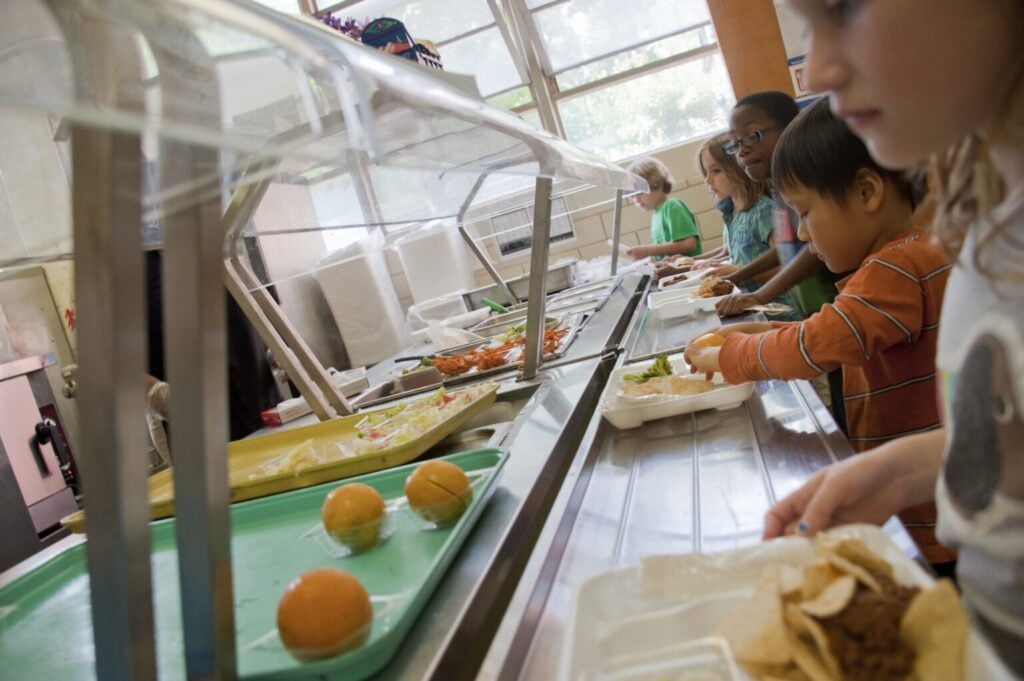
Children pick up their school lunches. (Photo by Amanda Mills/Centers for Disease Control and Prevention)
The Alaska Senate passed a bill Monday that would ban public schools in Alaska from serving certain food dyes in school breakfasts or lunches.
Lawmakers expressed concerns that certain petroleum-based food dyes in processed foods have unhealthy side effects on children.
Sen. Bill Wielechowski, D-Anchorage, the sponsor of Senate Bill 187, said Monday, “We like to sell our petroleum to fuel our cars and generate our power plants, not to feed our kids.”
Wielechowski pointed to studies that suggested that artificial dyes are linked to increased hyperactivity, inattentiveness and allergic reactions in children.
The bill would ban red dyes Nov. 3 and No. 40, yellow dyes No. 5 and No. 6, blue dyes No. 1 and No. 2 and green dye No. 3.
The U.S. Department of Health and Human Services and the U.S. Food and Drug Administration announced a campaign in April 2025 to eliminate synthetic dyes from the U.S. food supply by the end of 2027 and to authorize natural color alternatives. Alaska proposes banning the same food dye in schools that HHS and the FDA are working with the food industry to eliminate.
The bill received strong support from Alaska Community Action on Toxics and opposition from the International Association of Color Manufacturers, which maintains that synthetic dyes are safe for consumers.
Carlee Johnson McIntosh, Petersburg School District food service director, wrote in a letter to legislators that the bill aligns with work the school district is already doing to remove synthetic dyes from school meal programs. She said the bill would not create a significant burden for the school district.
“Schools should be environments where students are set up for success, and access to nutritious meals plays an important role in that success,” Johnson McIntosh wrote. “Establishing these standards in state law would demonstrate Alaska’s ongoing commitment to student health, regardless of potential shifts at the federal level.”
The bill passed the Senate with 19 yes votes. Sen. Donny Olson, D-Golovin, was excused absent.
If it passes the House and becomes law, it would go into effect in January 2028. Alaska would join states including Arizona, California, Delaware, Louisiana, Virginia and West Virginia in banning artificial food dyes in schools.
Pet food and supplies donations, Photo courtesy of Grateful Dogs of Juneau
Organizers of Juneau’s 16th annual Holiday Pet Food Drive say community support is more critical than ever for families struggling to afford pet food and supplies.
The drive, organized by Grateful Dogs of Juneau, began December 8, and runs through December 14, with donation boxes at Petco, Juneau Animal Rescue, and the main lobby of Bartlett Regional Hospital.
According to Pam Nelson of Grateful Dogs of Juneau, the organization distributes roughly 1,000 pounds of pet food to community food pantries every month.
“We’ve seen the need rise every month this year to the point that even in spring, our first spring pet food drive, we actually ran out of food.” She said, “This year has been an especially hard year for people.”
Pam said rising heating and utility costs leave many families forced to choose between paying bills and feeding their pets.
“If you have to choose between getting your heating oil, paying your electric bill, which is going to go up higher because it’s so cold, we can help offset having to make the choice between whether you can buy pet food.” Said Nelson.
Larger bags are broken down into smaller four- to five-pound portions to serve more families. A single 40-pound bag of dog food can help as many as 10 households, Pam said.
“I love Juneau.” She said, “I’ve lived here for almost 30 years, and just the amount that come out for their community members is just awesome.”
Donation bins will remain available at Petco and Juneau Animal Rescue during business hours, and at the Bartlett hospital lobby from 6 a.m. to 6 p.m. through Sunday. Grateful Dogs accepts donations year-round and will arrange pickup for those unable to deliver items.
Photo of typical smorgasbord with breaded ham, meatballs, sausage, pickled herring and side dishes.
AP- A recent survey finds 81% of Americans show love for family and friends by preparing holiday dishes, but there’s always one dish at Christmas that tests how polite your family is. Someone’s one forkful away from blessing the cook’s heart, but nobody dares to leave that recipe off the menu. It might be a wobbly mold of aspic with floating shrimp, a salad that doesn’t contain a single leaf of lettuce or a fruitcake packed with neon cherries and nuts so dense it could double as a doorstop.
It’s probably not as bad as Aunt Bethany’s crispy cat food congealed salad from “National Lampoon’s Christmas Vacation,” but it still gets a few side-eyes and maybe even a small gag from the kids who have to take a bite.
No one is entirely sure who started the tradition, but it stuck. Christmas wouldn’t feel complete without it. The dish may not win any awards, but it earns its place through sheer persistence. It outlasts trendy desserts, fancy sides and every attempt to modernize the holiday spread.
What makes a recipe weird
A weird Christmas recipe isn’t always outrageous. Sometimes it’s just a dish that doesn’t quite fit. It might be sweet when everything else is savory or built from ingredients that shouldn’t go together. These recipes often come from old cookbooks and church potlucks: lime Jell-O with cottage cheese, cranberry molds shaped like wreaths or even a tomato soup cake. Dishes that were once modern and exciting now sit somewhere between nostalgic and highly questionable.
In the 1950s and 1960s, home cooks embraced new products like canned fruit, instant pudding, gelatin and every version of cream-of-whatever soup. These products represented convenience and creativity. A pie made with saltine crackers or a casserole bound by condensed soup was considered inventive at the time.
Aspic, a savory gelatin made with meat stock, was once considered elegant enough for dinner parties. Cookbooks from the early 20th century featured versions with chicken, eggs, seafood and vegetables suspended in translucent layers. What once signaled sophistication now makes people cringe, yet a few families still set it out every December because it’s what they’ve always done.
“The holidays always include spaghetti in my family, but with a secret ingredient,” says Ashley Wali of Wanderlux. “We add grape jelly to the tomato sauce, and while it sounds crazy, you just get the sweetness and no fruit flavor. My cousin asked for the recipe just the other day!”
Why it stays on the menu
Some recipes are harder to get rid of than tinsel. They show up every Christmas, no matter what’s on the menu. Someone hangs the ornaments while Dad curses the tangled lights, and someone else digs through old recipe cards, trying to remember which casserole dish belongs to which story.
Michelle Price of Honest and Truly says, “We have salad for every Christmas dinner, except it’s a marshmallow salad. We call it Marguerite salad for my grandmother, who instituted the tradition, and anyone who comes to Christmas dinner who didn’t grow up with it always looks at it askance. But Christmas dinner wouldn’t be complete without this sitting on the plate next to our mashed potatoes and ham and green beans. Of course, marshmallows and pineapple and maraschino cherries pair perfectly with that!”
It’s a habit, but it’s also comforting. And it’s good for a laugh. Every family has a running joke or two, and the weird recipe gives you something to talk about between the standing rib roast and the chocolate fudge pie. There’s always one relative who takes a second helping, one who politely avoids it and one who swears it tastes better this year.
Anyone who marries into the family learns quickly that this dish is a rite of passage. You take a scoop, smile bravely and pretend it’s delicious. It’s a kind of holiday hazing everyone endures once before earning the right to roll their eyes next year like the rest of the family.
Regional quirks
Three out of four Americans prefer traditional holiday dishes. It’s no wonder a few strange ones have stuck around. Once a recipe becomes part of the family, it’s hard to cross it off the list. Every time someone suggests replacing it, another person declares, “We can’t have Christmas without that.”
In the South, there’s pear salad made from canned pear halves topped with mayonnaise, shredded cheddar and a cherry in the middle. In the Midwest, cookie salad blurs the line between dessert and side dish with pudding, whipped topping and crushed cookies. Some New England tables feature molded cranberry salad with nuts, while parts of Pennsylvania and Ohio favor ham loaf baked in a sticky, sweet glaze.
The stories that stick
Every odd Christmas recipe has a story. Some were pulled from a magazine decades ago and somehow became permanent. Others came from a church cookbook or a neighbor’s potluck dish that everyone pretended to like, and the tradition just stuck.
Most of the time, the recipe is tied to a person more than to taste. It might have been your grandmother’s creation or your dad’s yearly experiment. Before long, it’s not really about the food at all. It’s about remembering where it came from and who brought it to the table in the first place.
That’s how these dishes last. They hang on through the stories that go with them. They remind us of the people who came before and the meals that felt the same, no matter how much else changed. That small connection matters more than the recipe itself.
Keeping the weird stuff on the table
What to do when it’s your turn to host and you want to make changes to that weird family recipe? Go ahead and swap in fresh fruit or ditch the gelatin if you want, but don’t try to fancy it up too much. Half the charm is that it’s a little ridiculous, and everyone knows it. You don’t want to miss an opportunity for someone to say, “Is that Great Aunt Edith’s chicken cherry Jell-O salad?”
Set it out proudly and tell the story. Let people laugh and take pictures. Someone will take a spoonful, and someone else will ask for the recipe, even if they don’t really want it. That old recipe may never be your favorite, but it’s part of your family’s Christmas. It has survived generations of teasing and still shows up every year. That alone is reason enough to keep it.
Lucy Brewer is a professional writer and fourth-generation Southern cook who founded Southern Food and Fun. She’s passionate about preserving classic Southern recipes while creating easy, crowd-pleasing dishes for the modern home cook. Lucy currently lives in Augusta, Ga.
NOTN- City and Borough of Juneau (CBJ) Utility Billing is applying sales tax exemptions passed in the October 2025 municipal election to CBJ’s December 2025 utility billing period. Residential, non-commercial customers of CBJ water and wastewater will not be charged sales tax starting this December. Residential, non-commercial customers with a current senior sales tax exemption will also receive a 100% sales tax exemption.
Juneau Mayor Beth Weldon said the changes are intended to remove sales tax from residential utility costs, though the city has instituted a 180-day grace period to correct any misclassifications.
“In order to do the intent the voters wanted, we just had to make a very high level residential versus commercial, and the exemptions are only supposed to be on residential. So we may end up putting some sales tax back on some things if we erroneously labelled them as residential and they were actually commercial. So if houses and that kind of stuff are used for commercial means, like offices or Airbnbs, then they wouldn’t be exempt, necessarily.”
Grocery stores are adapting to the food-tax exemptions as well with each store processing the adoption differently.
Weldon said some stores are automatically removing tax on eligible food items, while others may require customers to separate food from non-food items at checkout. Prepared or hot foods, such as deli fried chicken or macaroni salad, may not exempt under the measure.
Customers who believe they are incorrectly designated as commercial may need to apply for a sales tax exemption card to affirm residential and non-commercial status. Visit juneau.org/finance/sales-tax for more information about Proposition 2 implementation.
NOTN- Free Thanksgiving Dinners are being offered across Southeast on Thursday, offering warm meals and a place to gather for those who need it.
In Juneau, the Salvation Army will serve a Community Thanksgiving Dinner from 11 a.m. to 1 p.m. at the Juneau Yacht Club.
Resurrection Lutheran Church will hold its annual Thanksgiving Dinner from 6 p.m. to 8:30 p.m. in the church’s community cafeteria and dining room.
The Eagle River United Methodist Camp will open its lodge at 10 a.m., with dinner service beginning around 1:30 p.m. The camp is located at Mile 28 of Glacier Highway, just before Eagle Beach State Park.
The Haines Ministerial Association will host a free holiday meal at the Haines School from noon to 2 p.m. at 604 Main Street.
In Gustavus, the community is invited to a Thanksgiving gathering at the Gustavus Chapel, otherwise known as the Red Church. Dinner will be served from 1 p.m. to 4 p.m.
Organizers say all are welcome, and no reservations are required.
“Happy Thanksgiving.” Said Juneau Mayor Beth Weldon, “We can be thankful for family and friends, but most important, we can be thankful for a great community we live in, even though we disagree at times, we still have each other’s backs. we’ll get through everything this year together.”
Fresh produce is seen at the Alaska Commercial Company grocery store in Bethel on Oct 15, 2025. (Photo by Corinne Smith/Alaska Beacon)
U.S. Agriculture Secretary Brooke Rollins’ call for a close reexamination of the 42 million people who receive federal food aid has befuddled advocates and lawmakers, coming mere days after recipients began to see benefits that had been stalled during the government shutdown.
Details remain scant a week after Rollins during an interview on the right-wing Newsmax network first publicly broached the startling idea that every beneficiary would have to reapply for the Supplemental Nutrition Assistance Program, or SNAP, often called food stamps.
The U.S. Department of Agriculture, asked for an explanation, referenced existing requirements and suggested more changes in SNAP rules could be in store.
“Secretary Rollins wants to ensure the fraud, waste, and incessant abuse of SNAP ends,” a USDA spokesperson wrote Wednesday. “Rates of fraud were only previously assumed, and President Trump is doing something about it. Using standard recertification processes for households is a part of that work. As well as ongoing analysis of state data, further regulatory work, and improved collaboration with states.”
The 2008 law governing SNAP leaves states responsible for administration. Part of that role includes periodically making sure that the low-income people in the program meet the qualifications for inclusion, but the law allows states to determine how often that occurs.
“It’s not clear what she would be proposing that is different from what is already happening,” said Katie Bergh, a senior policy analyst for food assistance at the left-leaning think tank Center for Budget and Policy Priorities.
One interpretation of Rollins’ comments is that she would remove all 42 million individuals from SNAP’s rolls and ask them to resubmit applications. Bergh said that would lead to people losing money they need for groceries. About 40% of those enrolled in SNAP are children.
“If she’s suggesting that they’re going to somehow redo that process for more than 40 million people who already demonstrated their eligibility and who already have to periodically recertify their eligibility, that would be pretty duplicative and would likely create pretty significant paperwork backlogs that would cause people who are eligible to lose the food assistance that they need,” Bergh said.
Administration critics have suggested that, while the comments are unlikely to lead to policy changes, they introduce even more confusion for a program that was used as a political token during the record government shutdown that ended this month.
Making people reapply would underscore the Trump administration’s opposition to the nearly $100 billion program, which accounts for 70% of federal nutrition assistance. USDA says the average SNAP household in fiscal 2023 received a monthly benefit of $332, or $177 a person based on the average SNAP household size of 1.9 people.
“Secretary Rollins and the Trump administration have cut food assistance for 42 million Americans multiple times this year,” U.S. House Agriculture ranking member Angie Craig said in a Wednesday statement to States Newsroom. “Now, they’ve once again shown that they do not understand the program.”
What did Rollins say?
In the Nov. 13 interview on Newsmax, Rollins said SNAP was beset by widespread fraud, citing data that 29 mostly Republican-run states submitted to the department. Acquiring data from the 21 other states would give the department a way to wholly remake the program, she said.
“Can you imagine when we get our hands on the blue state data, what we’re going to find?” she said. “It’s going to give us a platform and a trajectory to fundamentally rebuild this program, have everyone reapply for their benefit, make sure that everyone that’s taking a taxpayer-funded benefit through SNAP or food stamps that they literally are vulnerable, and they can’t survive without it. And that’s the next step here.”
In an interview Monday on Fox News, host Maria Bartiromo asked Rollins about the move to have recipients “reapply.”
“Business as usual is over,” Rollins answered in part. “The status quo is no more. We know that the SNAP program is rife with fraud.”
She added that guarding against fraud would help those the program is meant to serve.
The comments touched off widespread confusion about what specifically Rollins meant.
Asked about the initiative during a Thursday press conference, Craig, a Minnesota Democrat, said she was unclear about how it would work and predicted that Rollins would take credit in the future for the existing low rate of fraud.
“We’re hearing off the record that, you know, maybe people don’t know what the hell they’re talking about,” she said. “In fact, I think they’re trying to take credit for the already very strict standards and the actual low fraud rate in the SNAP program … So we can find no real plan there. Not even sure there’s concepts of a plan there.”
In response to a States Newsroom request this week for details about the initiative, USDA provided the statement that did not answer how the department would proceed or under what authority, but said Rollins was seeking to reduce fraud in the program.
Spokespeople did not respond to follow-up questions, or a request to respond to Craig’s remarks Thursday.
Low fraud rate
Program experts say fraud is not a widespread problem for SNAP.
An April report from the nonpartisan Congressional Research Service found that retailers illegally trafficked about 1.6% of SNAP benefits from fiscal 2015 to 2017.
Fraud by households applying for SNAP, which appear to be the main target of Rollins’ proposal, is even lower.
According to a USDA report, about 26,000 applications were referred for an administrative review or prosecution on suspicion of fraud. That number accounts for about 0.1% of the 22.7 million households enrolled in the program, according to the Pew Research Center.
“Long-standing data sources indicate that intentional fraud by participants is rare,” Bergh said.
At Thursday’s press conference, Craig called Rollins’ comments “bullsh*t” and “propaganda.”
“Secretary Rollins goes on TV and talks about all the fraud,” she said. “This most effective anti-hunger program in our history has a fraud rate of 1.6%. It’s actually one of the most effective, well-run programs in the country … The bullsh*t this administration is peddling is egregious.”
More targeted reforms
Even experts who advocate for reforms to SNAP say eligibility fraud is not a major issue.
Romina Boccia, director of budget and entitlement policy at the libertarian Cato Institute, said high-net-worth individuals can receive SNAP benefits, but aren’t committing fraud by doing so.
“Some of the issues with SNAP … aren’t because of fraud or abuse, but they are because of bad program rules,” said Boccia.
Boccia also cited an “incentive misalignment” inherent in the state-federal program. States have little incentive to control payments because the federal government funds the program, she said.
Forcing all beneficiaries to reapply would likely reduce the cost of the program by reducing the number of its beneficiaries, including by forcing out higher earners who may not consider the benefits they don’t actually need to be worth the onerous reapplication process, Boccia said.
But it would also result in a percentage of low earners dropping off the program, as well as many who would be affected by the administrative backlog that would come with processing tens of millions of new applications, she said.
Shutdown, the big beautiful bill, and confusion
Bergh said Rollins’ comments “add insult to injury” because they come after congressional Republicans and President Donald Trump signed a major tax cuts and spending law that is expected to shrink federal SNAP spending by $187 billion over 10 years. The law added work requirements for many SNAP recipients and shifted some costs to states.
That was followed by the six-week shutdown that saw a dizzying back-and-forth over whether November SNAP benefits would be paid.
“There has been huge amounts of chaos and confusion and disruption for both states and participants in recent weeks, largely due to the shutdown, but also because simultaneously, the administration has required states to implement many of the reconciliation bill’s SNAP cuts,” Bergh said.
Craig, in her statement, also said Rollins’ comments would hurt the people who need the program.
“I am astounded by the secretary’s careless disregard for the hungry seniors and children who can afford to eat because of this program,” she said.
Sara Naomi Bleich, a public health policy professor at Harvard University, said in a phone interview the confusion from Rollins’ comments compounded hardships produced by the Republican reconciliation law, known as the One Big Beautiful Bill Act.
“Big picture with the One Big Beautiful Bill Act is that there’s basically this tidal wave coming to families that have low income,” Bleich, who worked at USDA during the Obama and Biden administrations, said. “They’re going to lose Medicaid. They’re going to lose SNAP. There could be collateral impacts on the school meals. This is going to be a really hard time for families to navigate.”
A sign in a convenience store along Barlowe Road in Hyattsville, Maryland, on Oct. 28, 2025, advertises that it accepts SNAP benefits. (Photo by Ashley Murray/States Newsroom)
The U.S. Department of Agriculture will reduce the largest monthly food assistance payments by about 35% in November, a smaller decrease than the department initially estimated, according to a court filing late Wednesday.
That means the maximum monthly benefit likely would be roughly two-thirds of the usual benefit flowing to recipients, rather than the half initially projected.
USDA miscalculated how to adjust benefit payments for the Supplemental Nutrition Assistance Program, or SNAP, to account for a lack of full funding during the government shutdown, a department official said in a filing to the U.S. District Court for Rhode Island.
The formula the government initially used and sent to states Tuesday would have resulted in about a 50% cut to the maximum monthly benefits, and left some households without benefits.
SNAP pays benefits on a sliding scale depending on the size of a household, the household’s income and other expenses such as housing. By cutting the maximum benefit by one-half, the department would have spent about $3 billion from a SNAP contingency fund instead of the full $4.65 billion in the fund, which is what the court ordered it to spend.
The error was first reported to U.S. District Chief Judge John J. McConnell Jr. by the coalition of cities and nonprofit organizations that sued to force the government to pay SNAP benefits this month.
An analysis submitted by Sharon Parrott, a former White House budget officer who now leads the left-leaning think tank Center for Budget and Policy Priorities, showed that the table the department submitted to the court and sent to states on Tuesday would fall short of the court’s order to spend the entire contingency fund.
The groups said the department’s error was another reason the court should compel the government to transfer funds to pay out full benefits for November.
“Defendants’ approach means that only around $3 billion—out of the $4.65 billion Defendants have said is available—will be spent on SNAP benefits in November, leaving more than $1.5 billion in contingency funds unspent,” they wrote in a Wednesday brief. “Defendants opted for partial (and delayed) SNAP payments, but even then, did not manage to do that correctly.”
The department said in its filing later Wednesday that it independently discovered its miscalculation and worked to fix it before Parrott’s declaration hit the court docket.
“Defendants realized this error and worked to issue new guidance and tables as soon as it was discovered, not in response to Plaintiffs’ notice filed earlier this evening,” USDA’s brief said.
The parties are scheduled to argue before McConnell again Thursday afternoon.
Maureen Hall and Jennifer Skinner of St. Vincent de Paul
With Thanksgiving fast approaching, St. Vincent de Paul is gearing up for an anticipated community tradition, the annual Thanksgiving Basket Program, which provides full holiday meals to hundreds of local families in need.
Jennifer Skinner and Maureen Hall of St. Vincent de Paul spoke about the effort Monday noting that the organization expects higher demand this year due to recent cuts and delays in federal food assistance programs.
“We’ve been providing meals at Thanksgiving time for families in Juneau for a few decades now,” Skinner said. “We definitely see the need and meet the need for our neighbors here in Juneau. We anticipate, about 400 Thanksgiving baskets a year, but this year, given the current climate in our area, we are certain we’re going to see higher numbers than that.”
Families can register to receive baskets by visiting svdpjuneau.org and clicking on the events page, by calling 907-789-5535, or by scanning QR codes posted around town.
The baskets include all the fixings for a traditional Thanksgiving meal turkey, stuffing, canned yams, cranberry sauce, gravy, and more.
“So the items we’re looking for donation as well are, you know, the stuffing mix, canned yams, instant mashed potatoes, cranberry sauce, gravy mix, pies, butter, turkeys, and anything that goes into your own personal Thanksgiving meal prep is stuff we try to provide for our families.” said Skinner.
Volunteers play a crucial role in the program. Skinner said many Juneau residents make the annual basket delivery a personal tradition.
“We have a couple of folks that return every year as a day date to go and deliver Thanksgiving baskets. And they just really get a kick out of spending that time together and helping neighbors in need.”
Deliveries will take place on November 22, a pre-covid addition to the Holiday tradition that Hall said was inspired by a local man in town.
“I remember one year seeing an elderly gentleman come all the way from Douglas on the city bus, having to walk the extra couple blocks to where we were handing them out, he had a roller suitcase with him, and I thought, My gosh, we need to expand how we do the deliveries.” Hall said, “Instead of having people, often with disabilities or lack of transportation come to us, we continue to go to people’s homes and do all the deliveries that way.”
Skinner said local businesses and organizations are also encouraged to contribute food or monetary donations. “There’s always a way to give,” she said.
Nearly 2,000 Juneau families rely on SNAP, she said, and with the federal government shutdown surpassing records and funding running dry, those numbers could make this year’s Thanksgiving distribution one of the most critical yet.
United Way of Southeast Alaska has published an updated list of local food resources, including food pantries, meal programs, and emergency support services, to help residents access food assistance.
The Alaska and American flags fly in front of the Alaska State Capitol on Tuesday, April 22, 2025. (Photo by James Brooks/Alaska Beacon)
President Donald Trump backtracked Tuesday on a pledge by his administration in court filings to partially fund November food assistance during the government shutdown, posting on social media that benefits “will be given only when the Radical Left Democrats open up government, which they can easily do, and not before!”
White House press secretary Karoline Leavitt said later Tuesday that Trump was referring to future uses of a food assistance contingency fund and that the administration was complying with the court order, though that description did not match Trump’s post.
Trump’s declaration appeared to have little effect on the federal court case over food aid. The U.S. Department of Agriculture wrote in a court filing late Tuesday it would continue with a plan to provide partial November payments.
The benefits usually are provided to some 42 million Americans and, at the moment, are shut off pending the partial payments.
Before Trump’s post Tuesday, a coalition of cities and nonprofits suing the USDA said the delayed partial payments were not enough.
The coalition that filed suit, led by the Rhode Island State Council of Churches, just prior to Trump’s social media post Tuesday asked a Rhode Island federal court to compel the government to pay full benefits.
The USDA’s promise Monday that it would provide partial payments to households who use the Supplemental Nutrition Assistance Program, or SNAP, from a roughly $4.5 billion contingency fund, was an insufficient response to a court order, the groups said.
USDA officials said Monday they could not complete partial payments for November benefits by Chief District Court Judge John J. McConnell Jr.’s deadline of Wednesday, and warned it could take several months for beneficiaries to receive the funding because of the administrative difficulties of recalculating and processing partial benefits.
The groups suing said Tuesday that if paying partial benefits created such delays, McConnell should force the government to pay full benefits instead.
“If Defendants cannot comply with the Court’s command to expeditiously resolve the hurdles to making ‘timely’ partial payments, then that is a problem of their own making,” the groups wrote.
“They chose—unlawfully and contrary to past agency precedent and guidance—to withhold all funding for SNAP,” they continued. “That this unlawful decision may have made it impossible for them to clear the administrative hurdles now is no excuse. They still have a straightforward path to meeting the directives in the Court’s order.”
The department could legally and relatively easily tap into a separate child nutrition program account that holds $23 billion, the groups said. That would more than cover the $9 billion needed for a month of SNAP benefits, they said.
McConnell ordered the government to respond to the challengers’ motion, and set a hearing on the issue for Thursday afternoon.
Trump changes course
Within an hour of the groups’ filing, Trump, who had said he was eager to restore SNAP benefits, responded on social media with his defiant message that he would only release any SNAP funding once Democrats in Congress agreed to end the government shutdown that began Oct. 1.
Trump had said Friday he told government lawyers to seek clarification on how the government could legally send out benefits during the shutdown, adding he did not want Americans to go hungry.
“If we are given the appropriate legal direction by the Court, it will BE MY HONOR to provide the funding,” he wrote Oct. 31, following an oral order by McConnell.
McConnell issued a written order the next day that benefits be provided either in full by Monday or partially by Wednesday.
The USDA responded Monday that it would provide partial benefits from the contingency fund that held about half of a month’s worth of benefits, but that the process could take weeks or even months for states to recalibrate the amount each beneficiary would receive and to process those payments.
Agriculture Secretary Brooke Rollins echoed that commitment just before the challengers submitted their motion to compel full payments.
“This morning, @USDA sent SNAP guidance to States,” Rollins wrote on X. “My team stands by to offer immediate technical assistance. This will be a cumbersome process, including revised eligibility systems, State notification procedures, and ultimately, delayed benefits for weeks, but we will help States navigate those challenges.”
Spokespeople for the USDA did not return messages seeking an explanation for the course change Tuesday morning.
At the White House press briefing Tuesday afternoon, Leavitt said she had just spoken with Trump and sought to clarify his statement.
“We are digging into a contingency fund,” she said. “The president doesn’t want to tap into this fund in the future and that’s what he was referring to.”
Skye Perryman, the president and CEO of Democracy Forward, an advocacy group representing the groups challenging the administration, said in a Tuesday post to social media that Trump’s post was “immoral” and that the group would make use of it.
“See you in court,” Perryman said.
Shutdown lingers
The dispute over SNAP benefits stems from the lapse in government funding that began when Congress failed to appropriate money for federal programs by the start of the fiscal year on Oct. 1.
The USDA said in a plan published just ahead of the shutdown — and since deleted — that it would use the contingency fund, which then held $6 billion, to cover SNAP benefits if needed.
But the department reversed itself within weeks, telling states in an Oct. 10 letter that benefits would not be paid in November if the government remained shut down on the first of the month.
Members of each party have blamed the other for the lack of SNAP benefits.
Democrats have demanded the administration reshuffle funds to cover the program, as it has with other federal funding during the shutdown, while Republicans have called on Democrats to approve a stopgap spending bill to reopen the government at fiscal 2025 spending levels.
Democrats in Congress have blocked Republicans’ “clean” continuing resolution to reopen the government in a bid to force negotiations on expiring tax credits for people who buy insurance on the Affordable Care Act marketplace.
As of Tuesday, the parties showed little sign of softening their positions.
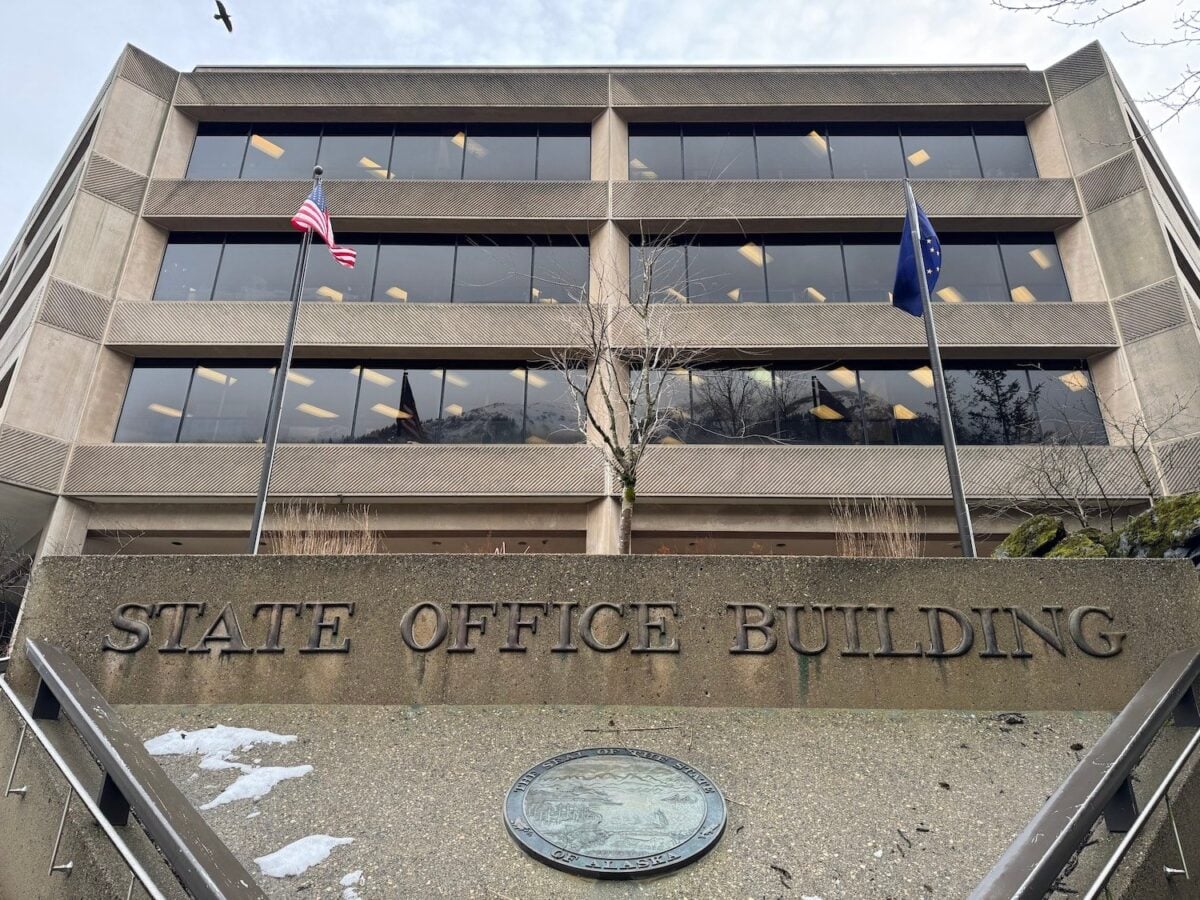
The State Office Building in Juneau is seen on Thursday, Feb. 20, 2025. (Photo by James Brooks/Alaska Beacon)
The State Office Building in Juneau is seen on Thursday, Feb. 20, 2025. (Photo by James Brooks/Alaska Beacon)
NOTN-Alaskans who rely on the Supplemental Nutrition Assistance Program, known as SNAP or food stamps, did not receive their November benefits as scheduled Saturday.
In a social media post Friday afternoon, President Trump said he would ask the courts for additional guidance before releasing SNAP funds to states.
Alaska Governor Mike Dunleavy issued a state disaster to ensure food security, this 30 day declaration will allow the state to work with the federal contractor that manages SNAP benefits, loading funds onto EBT cards weekly instead of monthly so families can continue to buy food.
The Department of Health will also coordinate with food banks to fill any gaps in aid. The full declaration can be found below.
November 3, 2025 (Anchorage, AK) — Governor Mike Dunleavy has issued a state disaster declaration to deal with the food security issue as a result of inaction on the federal budget in Washington D.C. The Governor will declare a 30 day disaster declaration that ensures food security in two ways for the thousands of Alaskan households that utilize Supplemental Nutrition Assistance Program (SNAP) benefits. The Dunleavy Administration will work with the federal contractor responsible for loading EBT cards to deposit benefits on a weekly schedule. This ensures Alaskans will not struggle to put food on the table during the shutdown The Alaska Department of Health will begin discussions with food banks and work with them to ensure the resources are available to assist Alaskans that may otherwise fall between the cracks The Governor has been meeting with Speaker Edgmon and President Stevens to ensure the process for Legislative concurrence is expedited. Those discussions have gone well and demonstrate that the executive and legislative branches work well when Alaskans are in need. “I want to thank Speaker Bryce Edgmon and President Gary Stevens for working with me the past few days to craft an approach to deal with this issue,“ said Governor Mike Dunleavy. “I’m grateful and deeply relieved that help will reach Alaskans in need without further delay,” said House Speaker Bryce Edgmon (I-Dillingham). “I want to thank the Governor and Senate President for acting swiftly and working together to make this happen.” “Alaskans shouldn’t have to worry about how they’ll feed their families because of a federal stalemate,” said President Gary Stevens (R-Kodiak). “I appreciate and support the Governor’s declaration to ensure that Alaskans are not left behind because of inaction in Washington, D.C. Congress must reconcile their differences and act quickly so Alaskans, and all Americans, can continue to have the support and stability to care for their families.” The disaster declaration will last no longer than 30 days or as soon as the federal government reopens. Click here for a copy of the disaster declaration and the legislative notification.