By: James Brooks, Alaska Beacon
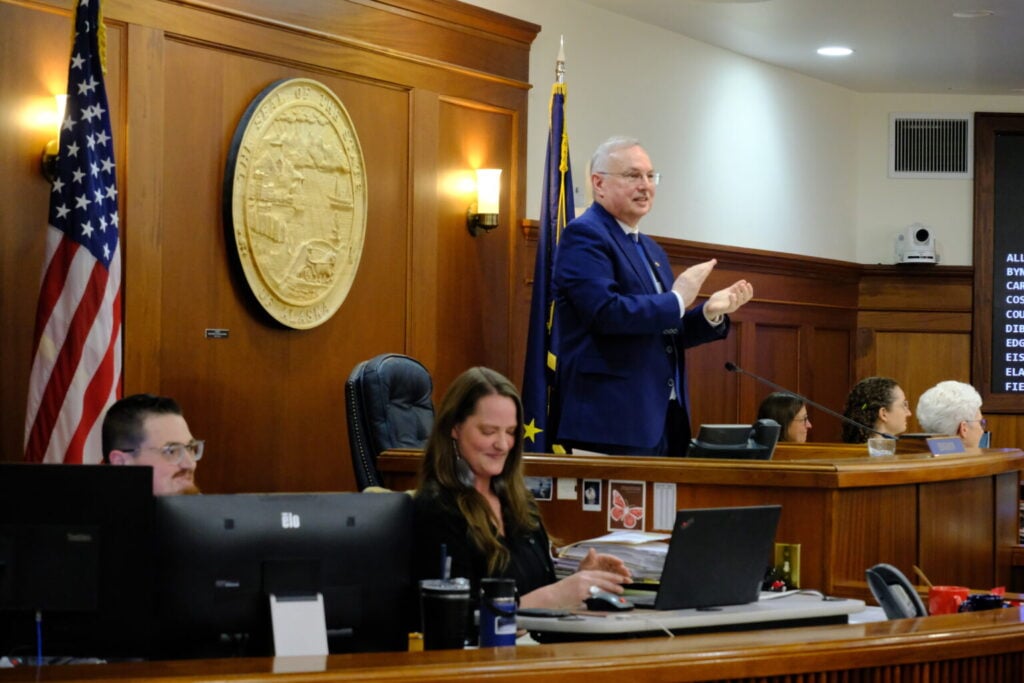
An Alaska Legislature defined by its conflicts with Gov. Mike Dunleavy came to an end at 9:43 p.m. Wednesday night as legislators officially adjourned their second regular session.
Lawmakers will return to work Thursday as they open a special session focused on the planned trans-Alaska natural gas pipeline. As with other topics, the Legislature and the governor appear far apart on the issue.
“I would say farewell, except I get to see you at 10 a.m.,” said Speaker of the House Bryce Edgmon, I-Dillingham, shortly before final adjournment.
Before adjourning, the 34th Alaska State Legislature passed a large, multi-part crime bill that raises the state’s age of consent and criminalizes the act of using AI to create child sexual abuse material. Lawmakers voted to ban foam food containers, named the giant cabbage the state vegetable, approved a fast lane through airport security and passed dozens of small bills that were priorities for local communities and individuals across Alaska.
Bills that fail to pass before adjournment die and must be reintroduced at the start of the next Legislature. Among this year’s casualties were a proposal to offer paid leave for new parents, a bill to stabilize public school budgets, a right-to-repair bill, and all of the proposed constitutional amendments.
This fall is an election year and many incumbents are retiring, which means that when lawmakers return next year, the House and Senate will include many new faces. They also will work with a new governor: Because of term limits, Dunleavy may not run for re-election.
The Alaska Legislature is the only one in the United States controlled by multipartisan coalitions in both the House and Senate.
“The Senate majority and the House majority have worked extremely well together. We’ve been on the same page through this entire two years,” said Senate President Gary Stevens, R-Kodiak.

In their two-year term, the 34th Legislature passed 111 bills, on par with the 33rd Legislature, which passed 101 bills, and the 32nd Legislature, which passed 112.
Of the 111 bills passed by the 34th Legislature, Dunleavy has vetoed 12, including one he vetoed less than three hours before lawmakers adjourned on Wednesday.
Dunleavy is vetoing bills at a higher rate than any governor since statehood. Though other governors have issued more vetoes, Dunleavy’s represent a higher proportion of the number of bills passed through the Capitol.
At the start of the 34th Legislature, the House and Senate majority coalitions set education funding as their top priority.
Last year, they voted to permanently increase the core of the state’s public school funding formula, putting themselves at odds with the governor and setting up a historic set of veto override votes with the help of some Republicans from the House and Senate minority caucuses.
This year, the majorities passed a significantly less ambitious package of education policy reforms but also approved $144 million in one-time bonus payments to public schools and millions more in funding for maintenance and construction projects across the state. Some of the bonus payments are contingent on oil prices remaining high through July 1.

They were less successful with other stated priorities, including pension legislation. Alaska has been without a public pension program since 2006, and the 34th Legislature was the first since then to pass a bill creating a new pension plan.
Dunleavy vetoed that bill on Monday and lawmakers failed to override it on Tuesday.
The governor’s veto came after legislators failed to reach agreement with him on one of their other stated priorities, energy.
Dunleavy has urged lawmakers to cut the state’s petroleum property tax in order to incentivize the proposed trans-Alaska natural gas pipeline. Building the pipeline, the governor has said, is critical for lowering energy prices and improving the state’s economy.
Many legislators are skeptical of those claims.
This week, Dunleavy and House Majority Leader Chuck Kopp, R-Anchorage, had negotiated a deal in which the governor would allow the pension bill to become law if legislators approved a gas pipeline bill that aligned with his vision.
When the pipeline bill failed to materialize on Monday, the governor vetoed the pension bill.
The Senate Majority also prioritized elections reform and passed a bill on the topic earlier this year, but Dunleavy vetoed it.
Legislators fell two votes short of an override because two Republican supporters flip-flopped and voted to sustain the governor’s choice. They had previously voted in favor of the bill.
“We passed the bills, and that’s all we can really get. It’s out of our hands at that point,” said Senate Majority Leader Bill Wielechowski, D-Anchorage.
The House Majority’s fourth priority was balancing the state’s budget, and while lawmakers successfully did so this year, the budget was balanced on the back of high oil prices caused by the Iran war, not because of a particular legislative action.
“In the beginning, we were worried about just keeping the (Permanent Fund dividend) alive and getting a balanced budget,” said Sen. Bert Stedman, R-Sitka, “and talking about how long our (Constitutional Budget Reserve) is going to last. Then, within a period of a couple of months, things totally changed, and the revenue forecast jumped up.”
When oil prices recede, legislators expect the state will again face major budget deficits.
“Next year will be a very, very difficult session,” Wielechowski said.
In the meantime, the state treasury is reaping wartime rewards, and lawmakers were able to balance the budget without spending from savings.
They passed a multibillion-dollar state spending plan spread across four budget bills: $2.5 billion in construction and renovation projects, $13.9 billion for services, $450 million in retroactive budget changes, and a $1,000 Permanent Fund dividend bolstered by a $200 one-time energy relief bonus payment.
“Folks, this is what we accomplished, and we accomplished it on time and under budget,” said Rep. Andy Josephson, D-Anchorage, as he presented the final version of the operating budget bill on the House floor.
Members of the Republican House minority criticized the adopted budget for not spending more wartime oil revenue on the dividend.
“My primary objection to this budget is that in FY26, the state is absolutely swimming in money,” said Rep. Will Stapp, R-Fairbanks.
“We should have waterfalled that extra money into the Permanent Fund dividend,” he said.
Both the operating budget and the capital budget are subject to the governor’s line-item veto powers. The governor can eliminate or reduce individual items, but he cannot add or increase them.
Kopp gave the majority coalition a “B” for its performance. Senate President Gary Stevens, R-Kodiak, thought the majority coalition there warranted an “A,” while Senate Minority Leader Mike Cronk, R-Tok, thought the Legislature overall merited a “B”.
The last day of the session saw several lawmakers offer their goodbyes, including some who had not previously announced their retirement.
“I am not planning on being back here for the 35th Alaska Legislature,” said Rep. Dan Saddler, R-Eagle River. Saddler has served for 12 nonconsecutive years in the House.

Rep. Andy Josephson, D-Anchorage, is retiring after 14 years in the House and received multiple rounds of applause. Rep. Louise Stutes, R-Kodiak, is leaving the House as well, but for a state Senate run rather than retirement.
Speaker of the House Bryce Edgmon, I-Dillingham, has not announced plans to leave the House, but he has been repeatedly named as a possible replacement for Sen. Lyman Hoffman, D-Bethel. Hoffman is retiring as the longest-serving state legislator in Alaska history.
Senate President Gary Stevens, R-Kodiak and the oldest member of the Legislature, is also retiring. The Legislature’s youngest member is also leaving — Rep. David Nelson, R-Anchorage, is getting married this summer.
After the final gavel fell, staff and legislators cheered and filed out of the chambers.
Within an hour, Saddler was leading a group of them in songs that echoed up and down the Capitol’s stairwell.
Corinne Smith contributed reporting from Juneau.