By: James Brooks, Alaska Beacon
A vote pending on the last day of the Alaska Legislature’s regular session could end up canceling a long-planned ballot measure that would restrict financial donations to political candidates in the state.
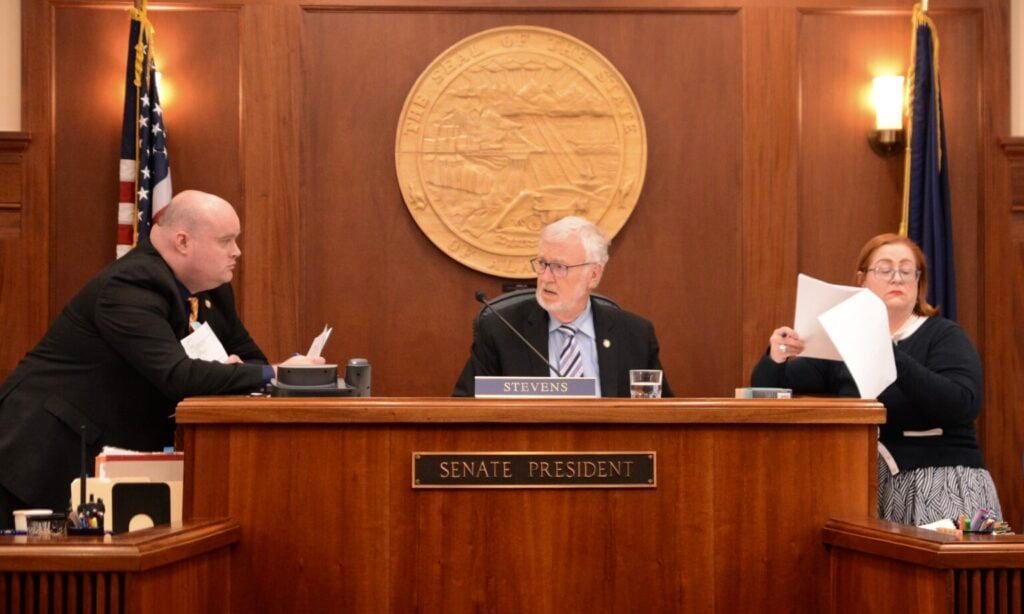
Late Tuesday night, the Alaska Senate voted 12-8 to approve House Bill 16, which would impose limits on the amount of money that individuals and groups can donate to political candidates.
That action sends the bill to the House for a simple up-or-down concurrence vote. Success would send it to Gov. Mike Dunleavy for enactment or veto.
HB 16 is substantially similar to a ballot measure scheduled for a vote during the August primary election. Under the Alaska Constitution, if lawmakers enact a substantially similar law to a ballot measure scheduled for a vote, the ballot measure vote is canceled.
Both methods would change state law, but there’s one key difference: A ballot measure cannot be repealed for two years after voters approve it. A law may be repealed the following year if legislators and the governor approve.
In 2018, a scheduled ballot measure dealing with legislators’ conflicts of interest was removed from the ballot after legislators passed a substantially similar law. In 2019, they rolled back that law.
Sen. Bill Wielechowski, D-Anchorage, arranged Tuesday night’s vote on HB 16. He has previously sought to impose campaign finance limits.
“I think (the ballot measure) is going to pass overwhelmingly, and this would save a little bit of money,” he said of the decision to advance HB 16.
State law requires ballot measure information be published in a pamphlet that is sent to voters. In addition, the Division of Elections is required to hold in-person presentations at locations across the state to explain each ballot measure.
Rep. Calvin Schrage, I-Anchorage, helped orchestrate the ballot measure and House Bill 16.
Late Tuesday, he said he was surprised by the Senate’s action and was not informed until shortly before it took place.
“To see them pass it relatively unchanged was quite surprising, and a pleasant surprise,” he said, noting that he and his colleagues have been seeking new campaign finance limits in Alaska for five years.
In 2021, a three-judge panel of the 9th U.S. Circuit Court of Appeals ruled Alaska’s then-existing campaign finance limits were unconstitutional.
The Alaska Department of Law declined to appeal that ruling. Speaking to reporter Nat Herz months later, Dunleavy said, “You know me: I’m the guy that wants people to be able to drive four wheelers on the road. I’m a freedom guy,” he said. “My tendency is to just let people do what they want in campaign finance law, as long as it’s disclosed and it’s accurate.”
As a result, the state’s 2022, 2024 and 2026 elections have operated with no restrictions on the amount of money a person can give to a candidate.
The Alaska House passed Schrage’s bill in April 2025, but the Senate took no action before adjourning that year. That inaction meant the 2026 election cycle opened without limits.
“We took it up last year, and there just wasn’t the support to do it at that time,” Wielechowski said.
What changed?
“I don’t know,” he said. “I mean, people just — honestly, it just kind of got buried in everything else, and just going through bills, we saw it was there, and we said, ‘Well, I have a chance to maybe take it off the ballot and pass it.’”
Neither Wielechowski or Schrage have talked to Dunleavy about whether he would veto the measure or allow it to become law.
If HB 16 becomes law, or if the proposed ballot measure is adopted by voters, new limits would be in place for the 2028 election.
The new individual limits would be $2,000 in donations per candidate in each two-year election cycle. For the governor’s race, where a lieutenant governor candidate and governor candidate run together on a single ticket, the limit would be $4,000. The limit for donations from one person to a political party or group would be $5,000.
If a group wants to donate to a candidate, the limit is $4,000, or $8,000 for the governor’s race.
Those limits would be adjusted for inflation every 10 years.
Schrage said he’s open to either HB 16 or the ballot measure.
“It is very widely popular, and so — one way or another, I just want to see this taken and taken up and put back into law,” he said.