







Categories
Alaska News Featured Juneau News juneau Juneau Local Juneau Local Ketchikan Local News Feeds Sitka Local

SNAP work requirements don’t boost jobs, but drop participation, research finds

By: Kevin Hardy, Stateline
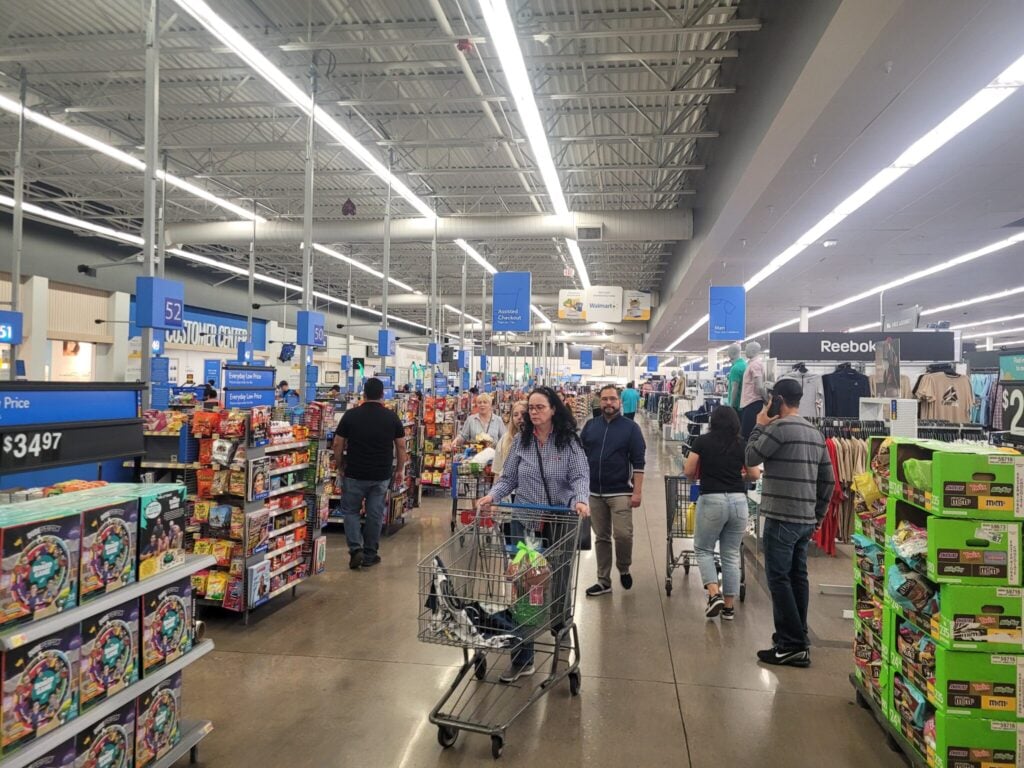
People shop for groceries at a Walmart store in Ohio. New research suggests SNAP work requirements won’t enhance employment and will push more people off of food assistance. (Photo by Marty Schladen/Ohio Capital Journal)

As states enact stricter work requirements for the federal food stamp program, a new analysis suggests those requirements won’t enhance employment and will push more people off of food assistance. 

The researchers conducted a review of studies on work requirements and concluded that “the best evidence shows they do not increase employment. Moreover, this research finds work requirements cause a large decrease in participation in SNAP.”

The research from The Hamilton Project, an economic policy initiative at the left-leaning Brookings Institution, comes at a time of major upheaval for the Supplemental Nutrition Assistance Program, or SNAP. Participation is already declining as states implement changes mandated by the president’s major tax and domestic policy law enacted last summer. 

Since the fall, states and counties that administer SNAP have been notifying residents who rely on food stamps that they must meet work requirements or lose their food assistance. Those changes affected exemptions to work requirements for older adults, homeless people, veterans and some rural residents, among others. 

Known as the One Big Beautiful Bill Act, the law mandated cuts to social service programs, including Medicaid and food stamps.

While SNAP enrollment is declining nationally, more people will likely lose food assistance as states continue to implement the work requirements and recertify participants, said Lauren Bauer, a fellow in economic studies at Brookings Institution and the associate director of The Hamilton Project. 

“Everything that we know about work requirements is that they do not increase employment among the groups that are subject to them,” she told Stateline. “All they do is make it more likely that they are disenrolled from the program. And so, should these work requirements continue to be rolled out and implemented, we would expect to see declining enrollment and no changes in employment.”

Bauer said the growing body of research on SNAP has changed her mind about its ability to affect employment. While food stamps reach millions of people each year, the program’s work requirements have proven ineffective, confusing and burdensome, she said. 

“I am now of the mind that SNAP should be an anti-hunger program, and there are many, many ways to do workforce development, career ladders, career training, job search — all of those things. That’s not an anti hunger program and it shouldn’t be associated with it.”

What’s more concerning to her is how the stricter work requirements will affect people who lose jobs in an economic downturn. Traditionally, SNAP has been one of the most effective social supports for the unemployed, helping people who lose their jobs quickly gain food assistance. But laid-off workers will increasingly be told they cannot receive benefits without working. 

“It’s just this dissonant, unhelpful interaction that you have with the government,” Bauer said. “I lost my job, I need food benefits. Well, you can only get food benefits if you have a job.”

At least 2.5 million low-income people, or 6% of those enrolled, have lost SNAP benefits since the legislation was signed into law, according to a study by the left-leaning Center on Budget and Policy Priorities published Wednesday.

Bauer said it’s unclear how much of that decline is directly related to the federal legislation. That’s because SNAP participation generally declines during times of economic prosperity and increases during downturns.

But the program is facing unprecedented changes: Under the new law, states have also lost funding for nutrition education programs, must end eligibility for noncitizens such as refugees and asylees, and will lose work requirement waivers for those living in areas with limited employment opportunities. States are also forced to cover more of the costs of the program. 

Earlier this week, a USDA spokesperson applauded the drop in SNAP participation, noting the program’s rolls had fallen below 40 million for the first time since the pandemic. The spokesperson told States Newsroom the program would continue “to serve those with the greatest need while also strengthening program integrity.”

Republicans, including  U.S. House Speaker Mike Johnson of Louisiana, have defended the legislative changes to SNAP, arguing they will help eliminate waste and fraud in the program.

In a June news release, he characterized SNAP as a “bloated, inefficient program,” but said Americans who needed food assistance would still receive it.

“Republicans are proud to defend commonsense welfare reform, fiscal sanity, and the dignity of work,” Johnson said in the release.

Stateline reporter Kevin Hardy can be reached at khardy@stateline.org.

This story was originally produced by Stateline, which is part of States Newsroom, a nonprofit news network which includes Alaska Beacon, and is supported by grants and a coalition of donors as a 501c(3) public charity.

Categories
Featured Juneau News Juneau Local Ketchikan Local News Feeds Sitka Local

Trump vows no SNAP payments until Democrats cave on shutdown

By: Jacob Fischler, States Newsroom

The Alaska and American flags fly in front of the Alaska State Capitol on Tuesday, April 22, 2025. (Photo by James Brooks/Alaska Beacon)

President Donald Trump backtracked Tuesday on a pledge by his administration in court filings to partially fund November food assistance during the government shutdown, posting on social media that benefits “will be given only when the Radical Left Democrats open up government, which they can easily do, and not before!” 

White House press secretary Karoline Leavitt said later Tuesday that Trump was referring to future uses of a food assistance contingency fund and that the administration was complying with the court order, though that description did not match Trump’s post.

Trump’s declaration appeared to have little effect on the federal court case over food aid. The U.S. Department of Agriculture wrote in a court filing late Tuesday it would continue with a plan to provide partial November payments. 

The benefits usually are provided to some 42 million Americans and, at the moment, are shut off pending the partial payments. 

Before Trump’s post Tuesday, a coalition of cities and nonprofits suing the USDA said the delayed partial payments were not enough.

The coalition that filed suit, led by the Rhode Island State Council of Churches, just prior to Trump’s social media post Tuesday asked a Rhode Island federal court to compel the government to pay full benefits. 

The USDA’s promise Monday that it would provide partial payments to households who use the Supplemental Nutrition Assistance Program, or SNAP, from a roughly $4.5 billion contingency fund, was an insufficient response to a court order, the groups said.

USDA officials said Monday they could not complete partial payments for November benefits by Chief District Court Judge John J. McConnell Jr.’s deadline of Wednesday, and warned it could take several months for beneficiaries to receive the funding because of the administrative difficulties of recalculating and processing partial benefits.

The groups suing said Tuesday that if paying partial benefits created such delays, McConnell should force the government to pay full benefits instead.

“If Defendants cannot comply with the Court’s command to expeditiously resolve the hurdles to making ‘timely’ partial payments, then that is a problem of their own making,” the groups wrote. 

“They chose—unlawfully and contrary to past agency precedent and guidance—to withhold all funding for SNAP,” they continued. “That this unlawful decision may have made it impossible for them to clear the administrative hurdles now is no excuse. They still have a straightforward path to meeting the directives in the Court’s order.”

The department could legally and relatively easily tap into a separate child nutrition program account that holds $23 billion, the groups said. That would more than cover the $9 billion needed for a month of SNAP benefits, they said. 

McConnell ordered the government to respond to the challengers’ motion, and set a hearing on the issue for Thursday afternoon. 

Trump changes course

Within an hour of the groups’ filing, Trump, who had said he was eager to restore SNAP benefits, responded on social media with his defiant message that he would only release any SNAP funding once Democrats in Congress agreed to end the government shutdown that began Oct. 1.

Trump had said Friday he told government lawyers to seek clarification on how the government could legally send out benefits during the shutdown, adding he did not want Americans to go hungry.

“If we are given the appropriate legal direction by the Court, it will BE MY HONOR to provide the funding,” he wrote Oct. 31, following an oral order by McConnell.

McConnell issued a written order the next day that benefits be provided either in full by Monday or partially by Wednesday. 

The USDA responded Monday that it would provide partial benefits from the contingency fund that held about half of a month’s worth of benefits, but that the process could take weeks or even months for states to recalibrate the amount each beneficiary would receive and to process those payments.

Agriculture Secretary Brooke Rollins echoed that commitment just before the challengers submitted their motion to compel full payments.

“This morning, @USDA sent SNAP guidance to States,” Rollins wrote on X. “My team stands by to offer immediate technical assistance. This will be a cumbersome process, including revised eligibility systems, State notification procedures, and ultimately, delayed benefits for weeks, but we will help States navigate those challenges.”

Spokespeople for the USDA did not return messages seeking an explanation for the course change Tuesday morning.

At the White House press briefing Tuesday afternoon, Leavitt said she had just spoken with Trump and sought to clarify his statement.

“We are digging into a contingency fund,” she said. “The president doesn’t want to tap into this fund in the future and that’s what he was referring to.” 

Skye Perryman, the president and CEO of Democracy Forward, an advocacy group representing the groups challenging the administration, said in a Tuesday post to social media that Trump’s post was “immoral” and that the group would make use of it.

“See you in court,” Perryman said.

Shutdown lingers

The dispute over SNAP benefits stems from the lapse in government funding that began when Congress failed to appropriate money for federal programs by the start of the fiscal year on Oct. 1.

The USDA said in a plan published just ahead of the shutdown — and since deleted — that it would use the contingency fund, which then held $6 billion, to cover SNAP benefits if needed.

But the department reversed itself within weeks, telling states in an Oct. 10 letter that benefits would not be paid in November if the government remained shut down on the first of the month.

Members of each party have blamed the other for the lack of SNAP benefits. 

Democrats have demanded the administration reshuffle funds to cover the program, as it has with other federal funding during the shutdown, while Republicans have called on Democrats to approve a stopgap spending bill to reopen the government at fiscal 2025 spending levels.

Democrats in Congress have blocked Republicans’ “clean” continuing resolution to reopen the government in a bid to force negotiations on expiring tax credits for people who buy insurance on the Affordable Care Act marketplace.

As of Tuesday, the parties showed little sign of softening their positions.

Ariana Figueroa contributed to this report.

Categories
Featured Juneau News Juneau Local Ketchikan Local News Feeds Sitka Local

More than 66,000 Alaskans will lose food stamps within weeks if government shutdown continues

By: James Brooks, Alaska Beacon

The Alaska and American flags fly in front of the Alaska State Capitol on Tuesday, April 22, 2025. (Photo by James Brooks/Alaska Beacon)

If the federal government shutdown continues, more than 66,000 Alaskans will lose federal food aid within weeks, the state of Alaska is warning.

On Monday, the Division of Public Assistance within the Alaska Department of Health said that the federal government “has directed states to stop the issuance of Supplemental Nutrition Assistance Program (SNAP) benefits for the month of November due to insufficient federal funds. This means that Alaskans may not receive SNAP benefits for November, even if they are authorized to receive them.”

The division estimates that 66,471 Alaskans would be eligible for benefits under the program.

In its written statement, the division said that it tried to pay for the program with state money “and determined that a state subsidy was not mechanically possible under the federal payment system.”

Similar warning messages went out from other states across the country starting Friday. In Kentucky, where one in eight residents receives food aid, Gov. Andy Beshear said the pending cut makes this “a scary and stressful time.”

In Oklahoma, more than half a million residents receive food stamps and are expected to lose that help. 

Altogether across the country, more than 42 million Americans rely on the food stamp program, which the federal government funds and individual states administer.

On Tuesday, the 21st day of the federal government shutdown, there appeared to be no progress toward resolution.

Sixty votes in the U.S. Senate are needed to advance a House-passed stopgap funding bill. That would require the support of some Senate Democrats, but they oppose its passage unless lawmakers also agree to extend subsidies for health insurance purchased through the federal marketplace.

Existing subsidies are scheduled to expire at the end of the year, sending prices soaring.

Thus far, Republicans have been unwilling to agree to the Democratic demand, and Senate Republicans also have been unwilling to change the Senate’s filibuster rule. Doing so would allow them to advance the stopgap funding bill with 50 votes instead of 60.