Categories
Alaska News Featured Juneau News juneau Juneau Local Juneau Local Ketchikan Local News Feeds Sitka Local

SNAP work requirements don’t boost jobs, but drop participation, research finds

By: Kevin Hardy, Stateline
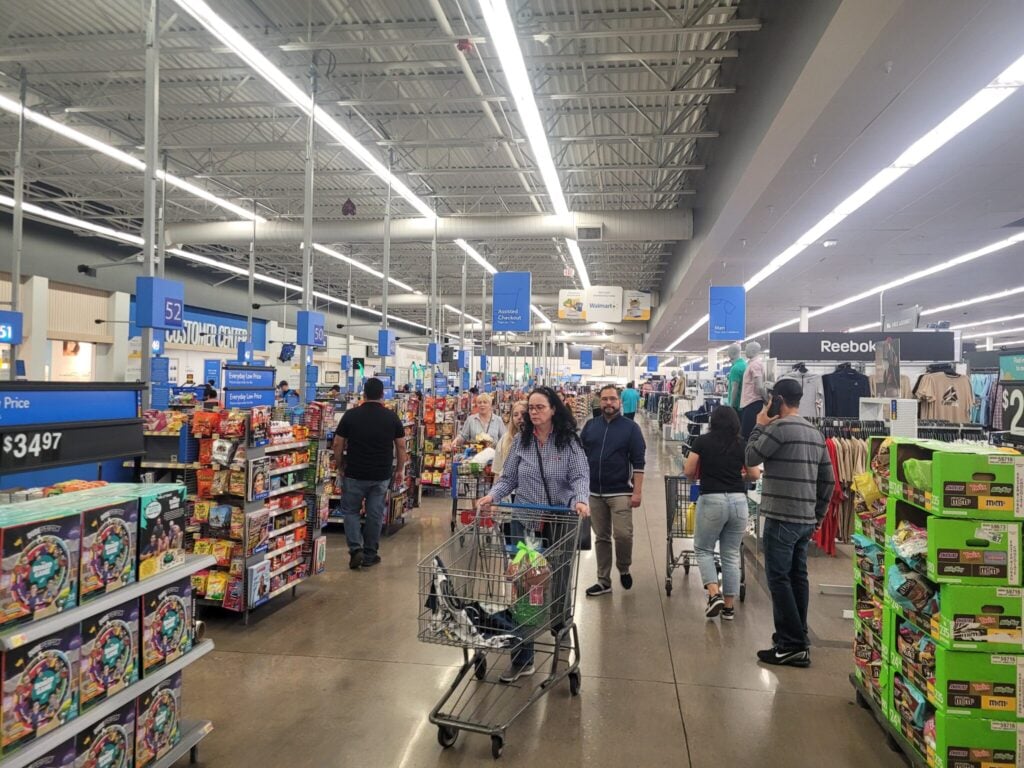
People shop for groceries at a Walmart store in Ohio. New research suggests SNAP work requirements won’t enhance employment and will push more people off of food assistance. (Photo by Marty Schladen/Ohio Capital Journal)

As states enact stricter work requirements for the federal food stamp program, a new analysis suggests those requirements won’t enhance employment and will push more people off of food assistance. 

The researchers conducted a review of studies on work requirements and concluded that “the best evidence shows they do not increase employment. Moreover, this research finds work requirements cause a large decrease in participation in SNAP.”

The research from The Hamilton Project, an economic policy initiative at the left-leaning Brookings Institution, comes at a time of major upheaval for the Supplemental Nutrition Assistance Program, or SNAP. Participation is already declining as states implement changes mandated by the president’s major tax and domestic policy law enacted last summer. 

Since the fall, states and counties that administer SNAP have been notifying residents who rely on food stamps that they must meet work requirements or lose their food assistance. Those changes affected exemptions to work requirements for older adults, homeless people, veterans and some rural residents, among others. 

Known as the One Big Beautiful Bill Act, the law mandated cuts to social service programs, including Medicaid and food stamps.

While SNAP enrollment is declining nationally, more people will likely lose food assistance as states continue to implement the work requirements and recertify participants, said Lauren Bauer, a fellow in economic studies at Brookings Institution and the associate director of The Hamilton Project. 

“Everything that we know about work requirements is that they do not increase employment among the groups that are subject to them,” she told Stateline. “All they do is make it more likely that they are disenrolled from the program. And so, should these work requirements continue to be rolled out and implemented, we would expect to see declining enrollment and no changes in employment.”

Bauer said the growing body of research on SNAP has changed her mind about its ability to affect employment. While food stamps reach millions of people each year, the program’s work requirements have proven ineffective, confusing and burdensome, she said. 

“I am now of the mind that SNAP should be an anti-hunger program, and there are many, many ways to do workforce development, career ladders, career training, job search — all of those things. That’s not an anti hunger program and it shouldn’t be associated with it.”

What’s more concerning to her is how the stricter work requirements will affect people who lose jobs in an economic downturn. Traditionally, SNAP has been one of the most effective social supports for the unemployed, helping people who lose their jobs quickly gain food assistance. But laid-off workers will increasingly be told they cannot receive benefits without working. 

“It’s just this dissonant, unhelpful interaction that you have with the government,” Bauer said. “I lost my job, I need food benefits. Well, you can only get food benefits if you have a job.”

At least 2.5 million low-income people, or 6% of those enrolled, have lost SNAP benefits since the legislation was signed into law, according to a study by the left-leaning Center on Budget and Policy Priorities published Wednesday.

Bauer said it’s unclear how much of that decline is directly related to the federal legislation. That’s because SNAP participation generally declines during times of economic prosperity and increases during downturns.

But the program is facing unprecedented changes: Under the new law, states have also lost funding for nutrition education programs, must end eligibility for noncitizens such as refugees and asylees, and will lose work requirement waivers for those living in areas with limited employment opportunities. States are also forced to cover more of the costs of the program. 

Earlier this week, a USDA spokesperson applauded the drop in SNAP participation, noting the program’s rolls had fallen below 40 million for the first time since the pandemic. The spokesperson told States Newsroom the program would continue “to serve those with the greatest need while also strengthening program integrity.”

Republicans, including  U.S. House Speaker Mike Johnson of Louisiana, have defended the legislative changes to SNAP, arguing they will help eliminate waste and fraud in the program.

In a June news release, he characterized SNAP as a “bloated, inefficient program,” but said Americans who needed food assistance would still receive it.

“Republicans are proud to defend commonsense welfare reform, fiscal sanity, and the dignity of work,” Johnson said in the release.

Stateline reporter Kevin Hardy can be reached at khardy@stateline.org.

This story was originally produced by Stateline, which is part of States Newsroom, a nonprofit news network which includes Alaska Beacon, and is supported by grants and a coalition of donors as a 501c(3) public charity.

Categories
Featured Juneau News Juneau Local Ketchikan Local News Feeds Sitka Local

Free Thanksgiving community dinners happening across Southeast tomorrow

NOTN- Free Thanksgiving Dinners are being offered across Southeast on Thursday, offering warm meals and a place to gather for those who need it.

In Juneau, the Salvation Army will serve a Community Thanksgiving Dinner from 11 a.m. to 1 p.m. at the Juneau Yacht Club.

Resurrection Lutheran Church will hold its annual Thanksgiving Dinner from 6 p.m. to 8:30 p.m. in the church’s community cafeteria and dining room.

The Eagle River United Methodist Camp will open its lodge at 10 a.m., with dinner service beginning around 1:30 p.m. The camp is located at Mile 28 of Glacier Highway, just before Eagle Beach State Park.

The Haines Ministerial Association will host a free holiday meal at the Haines School from noon to 2 p.m. at 604 Main Street.

In Gustavus, the community is invited to a Thanksgiving gathering at the Gustavus Chapel, otherwise known as the Red Church. Dinner will be served from 1 p.m. to 4 p.m.

Organizers say all are welcome, and no reservations are required.

“Happy Thanksgiving.” Said Juneau Mayor Beth Weldon, “We can be thankful for family and friends, but most important, we can be thankful for a great community we live in, even though we disagree at times, we still have each other’s backs. we’ll get through everything this year together.”

Categories
Featured Juneau News Juneau Local Ketchikan Local News Feeds Sitka Local

The Trump administration wants everyone to reapply for food stamps. What does that mean?

By: Jacob Fischler, States Newsroom

Fresh produce is seen at the Alaska Commercial Company grocery store in Bethel on Oct 15, 2025. (Photo by Corinne Smith/Alaska Beacon)

U.S. Agriculture Secretary Brooke Rollins’ call for a close reexamination of the 42 million people who receive federal food aid has befuddled advocates and lawmakers, coming mere days after recipients began to see benefits that had been stalled during the government shutdown.

Details remain scant a week after Rollins during an interview on the right-wing Newsmax network first publicly broached the startling idea that every beneficiary would have to reapply for the Supplemental Nutrition Assistance Program, or SNAP, often called food stamps.

The U.S. Department of Agriculture, asked for an explanation, referenced existing requirements and suggested more changes in SNAP rules could be in store.

“Secretary Rollins wants to ensure the fraud, waste, and incessant abuse of SNAP ends,” a USDA spokesperson wrote Wednesday. “Rates of fraud were only previously assumed, and President Trump is doing something about it. Using standard recertification processes for households is a part of that work. As well as ongoing analysis of state data, further regulatory work, and improved collaboration with states.”

The 2008 law governing SNAP leaves states responsible for administration. Part of that role includes periodically making sure that the low-income people in the program meet the qualifications for inclusion, but the law allows states to determine how often that occurs.

“It’s not clear what she would be proposing that is different from what is already happening,” said Katie Bergh, a senior policy analyst for food assistance at the left-leaning think tank Center for Budget and Policy Priorities.

One interpretation of Rollins’ comments is that she would remove all 42 million individuals from SNAP’s rolls and ask them to resubmit applications. Bergh said that would lead to people losing money they need for groceries. About 40% of those enrolled in SNAP are children.

“If she’s suggesting that they’re going to somehow redo that process for more than 40 million people who already demonstrated their eligibility and who already have to periodically recertify their eligibility, that would be pretty duplicative and would likely create pretty significant paperwork backlogs that would cause people who are eligible to lose the food assistance that they need,” Bergh said.

Administration critics have suggested that, while the comments are unlikely to lead to policy changes, they introduce even more confusion for a program that was used as a political token during the record government shutdown that ended this month. 

Making people reapply would underscore the Trump administration’s opposition to the nearly $100 billion program, which accounts for 70% of federal nutrition assistance. USDA says the average SNAP household in fiscal 2023 received a monthly benefit of $332, or $177 a person based on the average SNAP household size of 1.9 people.

“Secretary Rollins and the Trump administration have cut food assistance for 42 million Americans multiple times this year,” U.S. House Agriculture ranking member Angie Craig said in a Wednesday statement to States Newsroom. “Now, they’ve once again shown that they do not understand the program.”

What did Rollins say?

In the Nov. 13 interview on Newsmax, Rollins said SNAP was beset by widespread fraud, citing data that 29 mostly Republican-run states submitted to the department. Acquiring data from the 21 other states would give the department a way to wholly remake the program, she said.

“Can you imagine when we get our hands on the blue state data, what we’re going to find?” she said. “It’s going to give us a platform and a trajectory to fundamentally rebuild this program, have everyone reapply for their benefit, make sure that everyone that’s taking a taxpayer-funded benefit through SNAP or food stamps that they literally are vulnerable, and they can’t survive without it. And that’s the next step here.”

In an interview Monday on Fox News, host Maria Bartiromo asked Rollins about the move to have recipients “reapply.”

“Business as usual is over,” Rollins answered in part. “The status quo is no more. We know that the SNAP program is rife with fraud.”

She added that guarding against fraud would help those the program is meant to serve.

The comments touched off widespread confusion about what specifically Rollins meant. 

Asked about the initiative during a Thursday press conference, Craig, a Minnesota Democrat, said she was unclear about how it would work and predicted that Rollins would take credit in the future for the existing low rate of fraud.

“We’re hearing off the record that, you know, maybe people don’t know what the hell they’re talking about,” she said. “In fact, I think they’re trying to take credit for the already very strict standards and the actual low fraud rate in the SNAP program … So we can find no real plan there. Not even sure there’s concepts of a plan there.”

In response to a States Newsroom request this week for details about the initiative, USDA provided the statement that did not answer how the department would proceed or under what authority, but said Rollins was seeking to reduce fraud in the program.

Spokespeople did not respond to follow-up questions, or a request to respond to Craig’s remarks Thursday.

Low fraud rate

Program experts say fraud is not a widespread problem for SNAP.

An April report from the nonpartisan Congressional Research Service found that retailers illegally trafficked about 1.6% of SNAP benefits from fiscal 2015 to 2017.

Fraud by households applying for SNAP, which appear to be the main target of Rollins’ proposal, is even lower. 

According to a USDA report, about 26,000 applications were referred for an administrative review or prosecution on suspicion of fraud. That number accounts for about 0.1% of the 22.7 million households enrolled in the program, according to the Pew Research Center.

“Long-standing data sources indicate that intentional fraud by participants is rare,” Bergh said.

At Thursday’s press conference, Craig called Rollins’ comments “bullsh*t” and “propaganda.”

“Secretary Rollins goes on TV and talks about all the fraud,” she said. “This most effective anti-hunger program in our history has a fraud rate of 1.6%. It’s actually one of the most effective, well-run programs in the country … The bullsh*t this administration is peddling is egregious.”

More targeted reforms

Even experts who advocate for reforms to SNAP say eligibility fraud is not a major issue.

Romina Boccia, director of budget and entitlement policy at the libertarian Cato Institute, said high-net-worth individuals can receive SNAP benefits, but aren’t committing fraud by doing so.

“Some of the issues with SNAP … aren’t because of fraud or abuse, but they are because of bad program rules,” said Boccia.

Boccia also cited an “incentive misalignment” inherent in the state-federal program. States have little incentive to control payments because the federal government funds the program, she said.

Forcing all beneficiaries to reapply would likely reduce the cost of the program by reducing the number of its beneficiaries, including by forcing out higher earners who may not consider the benefits they don’t actually need to be worth the onerous reapplication process, Boccia said. 

But it would also result in a percentage of low earners dropping off the program, as well as many who would be affected by the administrative backlog that would come with processing tens of millions of new applications, she said. 

Shutdown, the big beautiful bill, and confusion

Bergh said Rollins’ comments “add insult to injury” because they come after congressional Republicans and President Donald Trump signed a major tax cuts and spending law that is expected to shrink federal SNAP spending by $187 billion over 10 years. The law added work requirements for many SNAP recipients and shifted some costs to states.

That was followed by the six-week shutdown that saw a dizzying back-and-forth over whether November SNAP benefits would be paid.

“There has been huge amounts of chaos and confusion and disruption for both states and participants in recent weeks, largely due to the shutdown, but also because simultaneously, the administration has required states to implement many of the reconciliation bill’s SNAP cuts,” Bergh said.

Craig, in her statement, also said Rollins’ comments would hurt the people who need the program.

“I am astounded by the secretary’s careless disregard for the hungry seniors and children who can afford to eat because of this program,” she said.

Sara Naomi Bleich, a public health policy professor at Harvard University, said in a phone interview the confusion from Rollins’ comments compounded hardships produced by the Republican reconciliation law, known as the One Big Beautiful Bill Act.

“Big picture with the One Big Beautiful Bill Act is that there’s basically this tidal wave coming to families that have low income,” Bleich, who worked at USDA during the Obama and Biden administrations, said. “They’re going to lose Medicaid. They’re going to lose SNAP. There could be collateral impacts on the school meals. This is going to be a really hard time for families to navigate.”

Categories
Featured Juneau News Juneau Local Ketchikan Local News Feeds Sitka Local

Alaska didn’t use $5M set aside to fund SNAP during the shutdown, even though benefits were late

By: Claire Stremple, Alaska Beacon

Fresh produce is seen at the Alaska Commercial Company grocery store in Bethel on Oct 15, 2025. (Photo by Corinne Smith/Alaska Beacon)

Alaskans who qualify for the Supplemental Nutrition Assistance Program received half of their benefits nearly a week late as a result of the federal government shutdown this month. Their full benefits were two weeks late, even though the state had emergency funds to prevent that.

Officials say the state never used the $5 million per week it set aside to keep people from waiting for food benefits because the state’s system had to be reconfigured to use state money rather than its usual federal funding source. SNAP is a federal food assistance program that is run by the state.

Division Director Deb Etheridge said the state is now prepared to react quickly if a similar situation arises in the future.

“We went through all the steps we needed to create an opportunity for a state-only benefit to be issued through our EBT contractor,” she said. “So in the event that anything like this happens again, we can move swiftly to issue that state-only benefit.”

Gov. Mike Dunleavy signed an emergency order declaration on Nov. 3, following a request by state legislators and similar action by other states. 

Etheridge said information technology and system operations teams had to scramble to come up with solutions, but by the time they found a way to get money to Alaskans, the federal government had begun to partially fulfill its obligations. 

She said the state was closing in on a solution when the federal government released 50% of the money for benefits on Nov. 4. She said that money was processed and ready for Alaskans to spend by Nov. 6.

Etheridge said the eligibility technicians that process benefits were not excessively burdened by the shutdown.

“Eligibility workers were doing business as usual, processing cases and managing, obviously, increased phone calls — people wanted to know where their benefits were,” she said. “The pressure came on our system operations and our IT.”

The shutdown delayed service in a state division with a history of slowdowns in recent years. The DPA has battled long backlogs in processing food benefit applications as a result of staff shortages and technology issues since 2022. The division made progress against its backlog before slipping again in 2023. Paperwork slowdowns kept thousands waiting again earlier this year.

Etheridge says the division is currently working to make sure people displaced by the October storms in Western Alaska continue to receive benefits, even if they have lost access to critical paperwork.

Categories
Featured Juneau News Juneau Local Ketchikan Local Music News Feeds Sitka Local

States face uncertainty as Trump administration tries to reverse SNAP food payments

AP- States administering a federal food aid program serving about 42 million Americans faced uncertainty Monday over whether they can — and should — provide full monthly benefits during an ongoing legal battle involving the U.S. government shutdown.

President Donald Trump’s administration over the weekend demanded that states “undo” full benefits that were paid under the Supplemental Nutrition Assistance Program during a one-day window between when a federal judge ordered full funding and a Supreme Court justice put a temporary pause on that order.

A federal appeals court in Boston left the full benefits order in place late on Sunday, though the Supreme Court order ensures the government won’t have to pay out for at least 48 hours.

“The record here shows that the government sat on its hands for nearly a month, unprepared to make partial payments, while people who rely on SNAP received no benefits a week into November and counting,” Judge Julie Rikleman of the U.S. 1st Circuit Court of Appeals wrote.

The Supreme Court gave the Trump administration until 11 a.m. EST Monday to say whether it wanted to keep the full payments on hold. The pause the court imposed last week will expire Tuesday night without further court action. Congress is considering whether to fund SNAP as part of a proposal to end the government shutdown.

Some states are warning of “catastrophic operational disruptions” if the Trump administration does not reimburse them for those SNAP benefits they already authorized. Meanwhile, other states are providing partial monthly SNAP benefits with federal money or using their own funds to load electronic benefit cards for SNAP recipients.

Millions receive aid while others wait

Trump’s administration initially said SNAP benefits would not be available in November because of the government shutdown. After some states and nonprofit groups sued, judges in Massachusetts and Rhode Island each ruled the administration could not skip November’s benefits entirely.

The administration then said it would use an emergency reserve fund to provide 65% of the maximum monthly benefit. On Thursday, Rhode Island-based U.S. District Judge John J. McConnell said that wasn’t good enough, and ordered full funding for SNAP benefits by Friday.

Some states acted quickly to direct their EBT vendors to disburse full monthly benefits to SNAP recipients. Millions of people in those states received funds to buy groceries before Justice Ketanji Brown Jackson put McConnell’s order on hold Friday night, pending further deliberation by an appeals court.

Millions more people still have not received SNAP payments for November, because their states were waiting on further guidance from the U.S. Department of Agriculture, which administers SNAP.

“Continued delays deepen suffering for children, seniors, and working families, and force nonprofits to shoulder an even heavier burden,” Diane Yentel, President and CEO, National Council of Nonprofits, one of the plaintiffs in the lawsuit, said in a statement Monday. “If basic decency and humanity don’t compel the administration to assure food security for all Americans, then multiple federal court judges finding its actions unlawful must.”

Trump’s administration has argued that the judicial order to provide full benefits violates the Constitution by infringing on the spending power of the legislative and executive branches.

States are fighting attempt to freeze SNAP benefits

On Sunday, the Trump administration said states had moved too quickly and erroneously released full SNAP benefits after last week’s rulings.

“States must immediately undo any steps taken to issue full SNAP benefits for November 2025,” Patrick Penn, deputy undersecretary of Agriculture, wrote to state SNAP directors. He warned that states could face penalties if they did not comply.

Wisconsin, which was among the first to load full benefits after McConnell’s order, had its federal reimbursement frozen. As a result, the state’s SNAP account could be depleted as soon as Monday, leaving no money to reimburse stores that sell food to SNAP recipients, according to a court filing submitted by those that had sued.

Some Democratic governors vowed to challenge any federal attempt to claw back money.

In Connecticut, Democratic Gov. Ned Lamont said “those who received their benefits should not worry about losing them.”

“No, Connecticut does not need to take back SNAP benefits already sent to the 360,000 people who depend on them for food and who should have never been caught in the middle of this political fight,” Lamont said. “We have their back.”

Categories
Featured Juneau News Juneau Local Ketchikan Local News Feeds Sitka Local

Juneau Hunger Jam raises funds for Southeast Alaska Food Bank amid rising need

NOTN- With food insecurity surging and federal food assistance programs in limbo after November, Resurrection Lutheran Church is hosting the first-ever Juneau Hunger Jam today to raise funds and awareness for the Southeast Alaska Food Bank, along with their own meal programs.

The event will be a live-streamed telethon on the church’s YouTube channel and will feature performances from more than a dozen local musicians, including community choirs and High Cost of Living. Organizers say all proceeds will go directly to support the food bank, which supplies groceries to pantries and meal programs across Southeast Alaska.

“The food banks have been hit hard. They lost federal programs that were benefiting them and us, that got them food. As an example. We’re being hit really hard right now.” said Bradley Perkins, event organizer and church representative. “Our food pantries open on Tuesdays from noon to 4:30 and we are pretty much, running out of food by 2:30 or 3:00, and we have huge numbers of people coming in, not just those who we normally see that experience food scarcity, we’re seeing federal workers, we’re seeing teachers, and we’re seeing just all kinds of people, and our meal service program is also just gone off the charts.”

The food bank’s supplies have been strained since the recent federal freeze on SNAP benefits and other food distribution programs.

“When things happen like the cutting off of SNAP and federal workers being furloughed, we wanted to raise some money for them so that they can have a buffer to handle these blips that hit in the system.”Said Karen Lawfer, “We want to make sure that they have food security to handle all of these ups and downs. So how else to do that, but by having a lot of fun and raising money? So that’s when we came up with the Juneau Hunger Jam.”

The telethon will take place from 6 to 10 p.m. at Resurrection Lutheran Church. The event will include live performances, a silent auction, and an in-person studio audience. Food donations, particularly shelf-stable items will also be accepted at the church during the event.

Categories
Featured Juneau News Juneau Local Ketchikan Local News Feeds Sitka Local

USDA revises SNAP benefit amounts during shutdown after admitting miscalculation

By: Jacob Fischler, States Newsroom

A sign in a convenience store along Barlowe Road in Hyattsville, Maryland, on Oct. 28, 2025, advertises that it accepts SNAP benefits. (Photo by Ashley Murray/States Newsroom)

The U.S. Department of Agriculture will reduce the largest monthly food assistance payments by about 35% in November, a smaller decrease than the department initially estimated, according to a court filing late Wednesday.

That means the maximum monthly benefit likely would be roughly two-thirds of the usual benefit flowing to recipients, rather than the half initially projected.

USDA miscalculated how to adjust benefit payments for the Supplemental Nutrition Assistance Program, or SNAP, to account for a lack of full funding during the government shutdown, a department official said in a filing to the U.S. District Court for Rhode Island. 

The formula the government initially used and sent to states Tuesday would have resulted in about a 50% cut to the maximum monthly benefits, and left some households without benefits. 

SNAP pays benefits on a sliding scale depending on the size of a household, the household’s income and other expenses such as housing. By cutting the maximum benefit by one-half, the department would have spent about $3 billion from a SNAP contingency fund instead of the full $4.65 billion in the fund, which is what the court ordered it to spend.

The error was first reported to U.S. District Chief Judge John J. McConnell Jr. by the coalition of cities and nonprofit organizations that sued to force the government to pay SNAP benefits this month. 

An analysis submitted by Sharon Parrott, a former White House budget officer who now leads the left-leaning think tank Center for Budget and Policy Priorities, showed that the table the department submitted to the court and sent to states on Tuesday would fall short of the court’s order to spend the entire contingency fund.

The groups said the department’s error was another reason the court should compel the government to transfer funds to pay out full benefits for November.

“Defendants’ approach means that only around $3 billion—out of the $4.65 billion Defendants have said is available—will be spent on SNAP benefits in November, leaving more than $1.5 billion in contingency funds unspent,” they wrote in a Wednesday brief. “Defendants opted for partial (and delayed) SNAP payments, but even then, did not manage to do that correctly.”

The department said in its filing later Wednesday that it independently discovered its miscalculation and worked to fix it before Parrott’s declaration hit the court docket.

“Defendants realized this error and worked to issue new guidance and tables as soon as it was discovered, not in response to Plaintiffs’ notice filed earlier this evening,” USDA’s brief said.

The parties are scheduled to argue before McConnell again Thursday afternoon.

This report will be updated.

Categories
Featured Juneau News Juneau Local Ketchikan Local Music News Feeds Sitka Local

Juneau’s Thanksgiving Basket program may be more important than ever as federal funding runs dry

By: Grace Dumas, News of the North

Maureen Hall and Jennifer Skinner of St. Vincent de Paul

With Thanksgiving fast approaching, St. Vincent de Paul is gearing up for an anticipated community tradition, the annual Thanksgiving Basket Program, which provides full holiday meals to hundreds of local families in need.

Jennifer Skinner and Maureen Hall of St. Vincent de Paul spoke about the effort Monday noting that the organization expects higher demand this year due to recent cuts and delays in federal food assistance programs.

“We’ve been providing meals at Thanksgiving time for families in Juneau for a few decades now,” Skinner said. “We definitely see the need and meet the need for our neighbors here in Juneau. We anticipate, about 400 Thanksgiving baskets a year, but this year, given the current climate in our area, we are certain we’re going to see higher numbers than that.”

Families can register to receive baskets by visiting svdpjuneau.org and clicking on the events page, by calling 907-789-5535, or by scanning QR codes posted around town.

The baskets include all the fixings for a traditional Thanksgiving meal turkey, stuffing, canned yams, cranberry sauce, gravy, and more.

“So the items we’re looking for donation as well are, you know, the stuffing mix, canned yams, instant mashed potatoes, cranberry sauce, gravy mix, pies, butter, turkeys, and anything that goes into your own personal Thanksgiving meal prep is stuff we try to provide for our families.” said Skinner.

Volunteers play a crucial role in the program. Skinner said many Juneau residents make the annual basket delivery a personal tradition.

“We have a couple of folks that return every year as a day date to go and deliver Thanksgiving baskets. And they just really get a kick out of spending that time together and helping neighbors in need.”

Deliveries will take place on November 22, a pre-covid addition to the Holiday tradition that Hall said was inspired by a local man in town.

“I remember one year seeing an elderly gentleman come all the way from Douglas on the city bus, having to walk the extra couple blocks to where we were handing them out, he had a roller suitcase with him, and I thought, My gosh, we need to expand how we do the deliveries.” Hall said, “Instead of having people, often with disabilities or lack of transportation come to us, we continue to go to people’s homes and do all the deliveries that way.”

Skinner said local businesses and organizations are also encouraged to contribute food or monetary donations. “There’s always a way to give,” she said.

Nearly 2,000 Juneau families rely on SNAP, she said, and with the federal government shutdown surpassing records and funding running dry, those numbers could make this year’s Thanksgiving distribution one of the most critical yet.

United Way of Southeast Alaska has published an updated list of local food resources, including food pantries, meal programs, and emergency support services, to help residents access food assistance.

Categories
Featured Juneau News Juneau Local Ketchikan Local News Feeds Sitka Local

Democratic leaders fresh from election wins demand Trump meeting over shutdown


By: Ariana Figueroa, States Newsroom

WASHINGTON — Following major Democratic wins in local and state elections across the country on Election Day, top Democratic congressional leaders pushed for a meeting with the president to end the federal government shutdown, which on Wednesday became the longest in U.S. history at day 36.

“The election results ought to send a much-needed bolt of lightning to Donald Trump that he should meet with us to end this crisis, his shutdown,” Senate Minority Leader Chuck Schumer said on the Senate floor Wednesday. “It’s time to hold a bipartisan meeting. The takeaway from last night was simply unmistakable.” 

Schumer and House Minority Leader Hakeem Jeffries, both New York Democrats, sent a Wednesday letter to President Donald Trump, calling for a bipartisan meeting at the White House to end the government shutdown and to address the spike in individual health care premiums.

“Last night, Republicans felt political repercussions,” Schumer said after Tuesday’s Election Day wins for Democrats. They included passage of a redistricting measure in California to offset partisan gerrymandering by GOP states, governorships in New Jersey and Virginia and local races across the country.

For more than a month, Democrats have voted against approving the House-passed GOP stopgap spending measure over concerns that health care tax subsidies will expire at the end of the year. As open enrollment begins, people who buy their health insurance through the Affordable Care Act Marketplace are seeing a drastic increase in premium costs. 

Sanders pushes back on dealmaking

Schumer did not detail what kind of deal Democrats would accept, but said any negotiation “must address the health care needs of the American people.”

However, independent Sen. Bernie Sanders of Vermont said that Democrats should not accept any agreement with the GOP unless there is a commitment from House Speaker Mike Johnson and the president to pass legislation to extend those tax credits.

“Bottom line is, we need to be successful in protecting the health care of the American people, and if it’s just a piece of legislation that passes the Senate … so what? Where does it go? Then it becomes just a meaningless gesture,” Sanders said. 

Republicans have maintained that they will only have a discussion on health care after Democrats agree to resume government funding. 

This week, the Senate failed for the 14th time to pass a stopgap spending measure that would fund the government until Nov. 21. 

Lawmakers have acknowledged that a new stopgap spending bill will need to be extended past the Nov. 21 deadline, but have not come to an agreement on a new deadline.

Thune plays down Democratic victories

Senate Majority Leader John Thune told reporters Wednesday that he was skeptical the government shutdown played into major wins for Democrats across the country. 

“The shutdown doesn’t benefit anyone,” he said.

The South Dakota Republican noted the shutdown may have played a role in suburban Virginia, where a large share of federal workers live and are furloughed due to the government shutdown.

“In Northern Virginia, that has a lot of federal workers, so it certainly could have been a factor in the elections,” Thune said. “But I think it’s hard to draw conclusions.”

But Thune said he’s focused on ending the government shutdown, and hopes progress can continue to be made before senators are scheduled to be out next week for recess due to the Veterans Day holiday. 

Transportation Secretary Sean Duffy this week warned that if the shutdown continues into next week, it could lead to certain airspace needing to be closed due to a shortage of air traffic controllers who have continued to work amid the shutdown.

Trump, in a social media post, blamed two factors for Republicans not performing well on Tuesday: his absence from the ballot, and the government shutdown.

“I think if you read the pollsters, the shutdown was a big factor, negative for the Republicans, and that was a big factor, and they say that I wasn’t on the ballot was the biggest factor,” Trump said during a Wednesday press conference.

Withholding SNAP benefits

As the government shutdown has continued, the Trump administration has tried to get Senate Democrats to agree to the stopgap spending measure by directing the U.S. Department of Agriculture to not tap into its contingency fund to provide food assistance to 42 million people.

Two federal courts found that the Trump administration acted unlawfully in holding back those Supplemental Nutrition Assistance Program, or SNAP, benefits, and USDA agreed that it would partially release SNAP benefits. 

Trump earlier this week wrote on his social media platform that SNAP benefits would only be released when Democrats vote to reopen the government, a move that would likely violate the two court orders.

“SNAP BENEFITS, which increased by Billions and Billions of Dollars (MANY FOLD!) during Crooked Joe Biden’s disastrous term in office (Due to the fact that they were haphazardly ‘handed’ to anyone for the asking, as opposed to just those in need, which is the purpose of SNAP!), will be given only when the Radical Left Democrats open up government, which they can easily do, and not before!,” he wrote.

However, White House press secretary Karoline Leavitt seemed to walk back that statement on Tuesday, arguing that the president’s social media post did not refer to the court order, but to future SNAP payments.

“The president doesn’t want to tap into this (contingency) fund in the future and that’s what he was referring to,” Leavitt said.

Categories
Featured Juneau News Juneau Local Ketchikan Local News Feeds Sitka Local

Trump vows no SNAP payments until Democrats cave on shutdown

By: Jacob Fischler, States Newsroom

The Alaska and American flags fly in front of the Alaska State Capitol on Tuesday, April 22, 2025. (Photo by James Brooks/Alaska Beacon)

President Donald Trump backtracked Tuesday on a pledge by his administration in court filings to partially fund November food assistance during the government shutdown, posting on social media that benefits “will be given only when the Radical Left Democrats open up government, which they can easily do, and not before!” 

White House press secretary Karoline Leavitt said later Tuesday that Trump was referring to future uses of a food assistance contingency fund and that the administration was complying with the court order, though that description did not match Trump’s post.

Trump’s declaration appeared to have little effect on the federal court case over food aid. The U.S. Department of Agriculture wrote in a court filing late Tuesday it would continue with a plan to provide partial November payments. 

The benefits usually are provided to some 42 million Americans and, at the moment, are shut off pending the partial payments. 

Before Trump’s post Tuesday, a coalition of cities and nonprofits suing the USDA said the delayed partial payments were not enough.

The coalition that filed suit, led by the Rhode Island State Council of Churches, just prior to Trump’s social media post Tuesday asked a Rhode Island federal court to compel the government to pay full benefits. 

The USDA’s promise Monday that it would provide partial payments to households who use the Supplemental Nutrition Assistance Program, or SNAP, from a roughly $4.5 billion contingency fund, was an insufficient response to a court order, the groups said.

USDA officials said Monday they could not complete partial payments for November benefits by Chief District Court Judge John J. McConnell Jr.’s deadline of Wednesday, and warned it could take several months for beneficiaries to receive the funding because of the administrative difficulties of recalculating and processing partial benefits.

The groups suing said Tuesday that if paying partial benefits created such delays, McConnell should force the government to pay full benefits instead.

“If Defendants cannot comply with the Court’s command to expeditiously resolve the hurdles to making ‘timely’ partial payments, then that is a problem of their own making,” the groups wrote. 

“They chose—unlawfully and contrary to past agency precedent and guidance—to withhold all funding for SNAP,” they continued. “That this unlawful decision may have made it impossible for them to clear the administrative hurdles now is no excuse. They still have a straightforward path to meeting the directives in the Court’s order.”

The department could legally and relatively easily tap into a separate child nutrition program account that holds $23 billion, the groups said. That would more than cover the $9 billion needed for a month of SNAP benefits, they said. 

McConnell ordered the government to respond to the challengers’ motion, and set a hearing on the issue for Thursday afternoon. 

Trump changes course

Within an hour of the groups’ filing, Trump, who had said he was eager to restore SNAP benefits, responded on social media with his defiant message that he would only release any SNAP funding once Democrats in Congress agreed to end the government shutdown that began Oct. 1.

Trump had said Friday he told government lawyers to seek clarification on how the government could legally send out benefits during the shutdown, adding he did not want Americans to go hungry.

“If we are given the appropriate legal direction by the Court, it will BE MY HONOR to provide the funding,” he wrote Oct. 31, following an oral order by McConnell.

McConnell issued a written order the next day that benefits be provided either in full by Monday or partially by Wednesday. 

The USDA responded Monday that it would provide partial benefits from the contingency fund that held about half of a month’s worth of benefits, but that the process could take weeks or even months for states to recalibrate the amount each beneficiary would receive and to process those payments.

Agriculture Secretary Brooke Rollins echoed that commitment just before the challengers submitted their motion to compel full payments.

“This morning, @USDA sent SNAP guidance to States,” Rollins wrote on X. “My team stands by to offer immediate technical assistance. This will be a cumbersome process, including revised eligibility systems, State notification procedures, and ultimately, delayed benefits for weeks, but we will help States navigate those challenges.”

Spokespeople for the USDA did not return messages seeking an explanation for the course change Tuesday morning.

At the White House press briefing Tuesday afternoon, Leavitt said she had just spoken with Trump and sought to clarify his statement.

“We are digging into a contingency fund,” she said. “The president doesn’t want to tap into this fund in the future and that’s what he was referring to.” 

Skye Perryman, the president and CEO of Democracy Forward, an advocacy group representing the groups challenging the administration, said in a Tuesday post to social media that Trump’s post was “immoral” and that the group would make use of it.

“See you in court,” Perryman said.

Shutdown lingers

The dispute over SNAP benefits stems from the lapse in government funding that began when Congress failed to appropriate money for federal programs by the start of the fiscal year on Oct. 1.

The USDA said in a plan published just ahead of the shutdown — and since deleted — that it would use the contingency fund, which then held $6 billion, to cover SNAP benefits if needed.

But the department reversed itself within weeks, telling states in an Oct. 10 letter that benefits would not be paid in November if the government remained shut down on the first of the month.

Members of each party have blamed the other for the lack of SNAP benefits. 

Democrats have demanded the administration reshuffle funds to cover the program, as it has with other federal funding during the shutdown, while Republicans have called on Democrats to approve a stopgap spending bill to reopen the government at fiscal 2025 spending levels.

Democrats in Congress have blocked Republicans’ “clean” continuing resolution to reopen the government in a bid to force negotiations on expiring tax credits for people who buy insurance on the Affordable Care Act marketplace.

As of Tuesday, the parties showed little sign of softening their positions.

Ariana Figueroa contributed to this report.