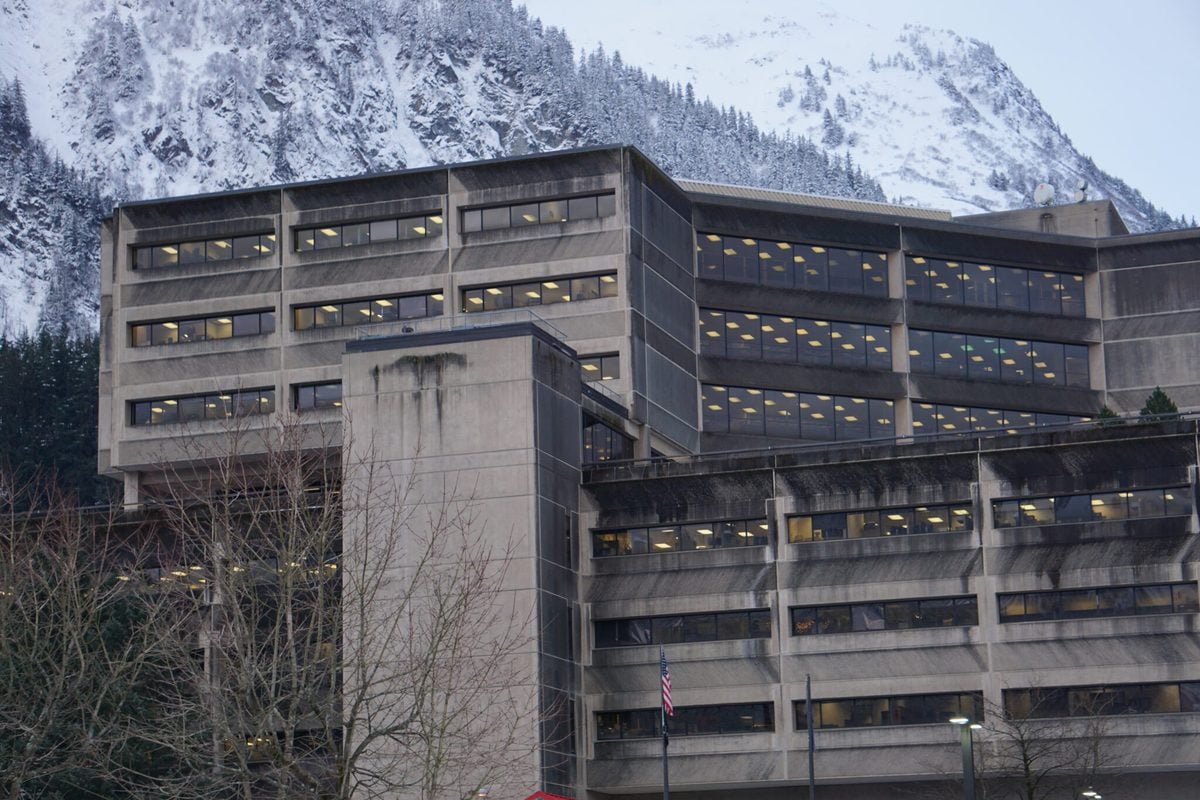
The Alaska State Office Building in Juneau, the state capital, is seen on Feb. 16, 2023. (Photo by Yereth Rosen/Alaska Beacon)
By the end of 2027, as many as 14,000 Alaska state workers could be paid by someone outside the state.
After years of trouble within the payroll department within the Alaska Department of Administration, the agency is planning to outsource the state’s public employee payroll to an outside company.
Proposals from interested companies were due Thursday, and in an internal letter, DOA Commissioner Paula Vrana said “it likely will be several weeks before a final decision is made.”
Vrana implied that if the proposals aren’t affordable or are otherwise unfavorable, the state will not proceed with outsourcing.
“As of now, we are exploring what options are available to the state and what value may be realized by this approach,” she wrote. “The final decision will be based on the proposals we receive.”
Vrana wrote that the department will begin talking with unions “to explore the options for transfers/placements of employees displaced by outsourcing” and if DOA does choose to outsource, “we will also work with the vendor to include as many existing state payroll employees as possible in their staffing plan.”
The state’s payroll department has struggled with staffing issues for years, leading to times when employees missed paychecks or encountered other problems with their pay.
In April, DOA published a request for information from companies that might be interested in providing “comprehensive payroll processing” for the state.
A three-page feasibility study dated Sept. 28 states that payroll work involves 78 employees in different agencies; all would be affected by outsourcing.
According to the state’s formal request for proposals, it is prepared to pay $4 million per year for a company to handle payroll. It currently spends about $10 million per year on payroll employees and functions, the feasibility study stated.
According to the study, in fiscal year 2025, state employees filed more than 1,500 “notice of pay problem” reports, and reducing the number of problems could make employees in other departments happier.
The first outsourced paychecks would come to a handful of departments on April 1, 2027, and other departments would be transferred to the outsourced payroll company through the rest of the year.
The outsourcing company would have to use the state’s existing payroll software programs, the document states, and the work would have to be done in the United States, but the contractor could get a waiver from the state that would allow payroll work to be done in a foreign country.
“The goal is not to change the system used to process payroll but to make payroll processing more efficient and ensure the state’s existing systems and processes are supported by qualified contracted professionals who can maintain continuity, reduce errors, and uphold the state’s obligations to its employees and the public,” the document states.
DOA provided a copy of the RFP documents to the Beacon this week; they were not previously published on the state’s public notice system, and the two public employee unions whose members would be affected by the outsourcing said they also had not previously seen the documents.
The Beacon asked DOA for an interview with Vrana or someone else involved with the outsourcing decision but was turned down.
In response to a written question asking why the department is planning to outsource, a spokesperson said by email: “Ensuring that employees are paid correctly and on time is the essential duty of payroll. Challenges stemming from high turnover and persistent vacancies within the Department have resulted in pay problems for some state employees. The administration has determined that outsourcing payroll may both provide significant recurring cost-savings to the State and improve services to its employees. However, no final decision on outsourcing payroll will be made until responses to the RFP issued earlier are evaluated.”
Jeff Kasper is the business manager of the Alaska Public Employees Association, which represents payroll workers. He’s not a fan of outsourcing.
“It usually costs more and doesn’t provide the efficiencies that you’re looking for. When you’re talking about public services, you’re essentially having the public pay more for something that’s probably not as good,” he said.
Kasper isn’t convinced that the Department of Administration has done enough to fix the problems that have deterred Alaskans from working for the payroll department.
“If people aren’t applying for jobs and accepting jobs, it’s usually because it doesn’t pay enough or it doesn’t provide benefits or it’s bad working conditions. This one could be all three, and I don’t think any of them have been addressed,” he said.
The state’s own feasibility study acknowledged those problems.
“Payroll processing occurs on a bi-weekly basis and does not have down time. This work environment and the entry level pay range are likely reasons for low retention and high staff turnover,” the study concluded.
As of last month, the study said, 58% of all payroll positions in the state are vacant, and it can take as long as a year of training before a new worker is capable of working independently.
MaryAnn Ganacias is the interim executive director of the Alaska State Employees Association, whose members are paid by the payroll department.
“Alaskans deserve to know what the problem is with the state and what they’re trying to solve by privatizing payroll,” she said.
Ganacias said state money spent outside Alaska is money that doesn’t benefit Alaskans.
“We need to do better investing in our own employees here in Alaska, and not outsourcing where the money actually goes,” she said.
Kasper said he doesn’t think the timeline described in the state’s RFP follows collective bargaining agreements or is realistic.
“The union’s not just gonna sit down and let this happen,” he said. “We don’t think the state has been following the process that’s in the contract.”
Kasper said his union’s contract with the state requires a 30-day consultation period before any outsourcing takes place, and even though the state’s RFP calls for a contract in November, he doesn’t think one is likely before Gov. Mike Dunleavy leaves office in the first week of December.
Kate Sheehan, policy adviser for the Department of Administration, said by email in response to Kasper’s comments, “The State engaged the Confidential Employees Association (CEA) on September 25th, and we have entered into the 30-day period for the union to submit any alternate plans to be considered during this process. DOA does not intend to contract out prior to the Union’s response and analysis of their input.”
Sen. Dan Sullivan, R-Alaska, speaks about Alaska natural gas at an event Wednesday in the White House. President Donald Trump, seated, announced what he said was a deal with the Republic of Korea to invest in the Alaska liquefied natural gas project. Korean officials, however, said the government has not committed to invest in the project but only to continue to examine it. Behind Trump and Sullivan are U.S. Commerce Secretary Howard Lutnick, U.S. Interior Secretary Doug Burgum and U.S. Energy Secretary Chris Wright. (Screenshot from White House video)
By: Yereth Rosen, Alaska Beacon
President Donald Trump on Wednesday announced that he had secured a deal with the Republic of Korea to spend $54 billion on a long-desired Alaska natural gas pipeline project, part of a $200 billion package of investments that include a major power plant in Texas and several nuclear power plants.
South Korea’s trade minister quickly shot down that claim, saying the government is simply reviewing the Alaska project and will proceed with investment “only if its commercial viability is established,” the Korea JoongAng Daily newspaper reported.
Trump spoke in glowing terms of an Alaska liquefied natural gas project as a sure accomplishment — even though half a century of efforts by state and federal officials and the energy industry have failed to make the project a reality, and even though Korean officials have disputed his claim that they are committed to investing in it.
“This alone will be one of the largest energy projects in American history and a gigantic win for the people of Alaska,” Trump said at the event, held in the White House’s Oval Office. “It will create up to 12,000 construction jobs immediately and 1,000 operational jobs. It’ll also save Alaska households up to $1,500, maybe even as much as $2,200 a year in energy costs. It’s amazing.”GET THE MORNING HEADLINES.SUBSCRIBE
The Alaska LNG investment is part of a “colossal package of investments” stemming from his trade and tariff policies that make “a major step toward securing our critical energy supply chain, ensuring American energy dominance, and making our partnership with South Korea and the entire Pacific region stronger than ever before,” Trump said.
South Korea’s industry, trade and resources minister quickly shot down Trump’s claim about securing $54 billion for the Alaska project. Minister Kim Jung-kwan said the Korean government is simply reviewing the Alaska project and will proceed with investment “only if its commercial viability is established,” the Korea JoongAng Daily newspaper reported.
Trump made the announcement while flanked by a crowd of men that included three cabinet members, Republican Gov. Mike Dunleavy and U.S. Sen. Dan Sulivan, R-Alaska, and U.S. Rep. Nick Begich III, R-Alaska. Also in the group was Brendan Duval, chief executive of the Glenfarne Group, the investment company leading the current proposal for a natural gas project in Alaska.
The current proposal is to ship gas from the North Slope through a yet-to-be-built 807-mile pipeline from the North Slope to tidewater at Southcentral Alaska’s Cook Inlet, where it would be liquefied and put on tankers for shipment to Asian markets.
Alaska’s North Slope holds vast amounts of natural gas along with its oil resources. But geographic distance and costs have kept that natural gas stranded from markets, despite numerous schemes proposed over the years to build different types of pipeline systems to ship the product to either Asia or to the Lower 48.
The natural gas pipeline has been a perennial issue in Alaska elections, including this year’s U.S. Senate race, which is hotly contested. The energy investments Trump announced also affect Texas, another state where there is a competitive Senate race.
Trump and others who spoke at the ceremony spent much of their time praising Sullivan, whom he called “a great senator who is totally responsible for this pipeline,” and urging that he be reelected.
Sullivan is facing a stiff challenge from former Democratic U.S. Rep. Mary Peltola, who led in votes in the primary election. But Trump spent much of his time at Wednesday’s Oval Office event talking about retired Petersburg teacher Dan J. Sullivan, the third U.S. Senate candidate on the Alaska ballot whose candidacy has been challenged by state election officials.
“That Dan Sullivan is a disgraceful fraud,” Trump said.
“It’s so corrupt. The Democrats are corrupt. . . When they put up a man with his exact name, they picked him out of a hat. They said, ‘Anybody named Dan Sullivan in Alaska?”
Trump has said he is planning to come to Alaska to campaign for the senator and against the Petersburg candidate.
Sullivan, in turn, praised Trump and also described the natural gas pipeline projects as if it is a sure thing.
“Mr. President, I would say this is the most important project in our state by far,” he said. “This is the project that is going to keep our kids and grandkids in Alaska, with a great, bright future. This is the project that our state has been working on to try to get done for almost a half century.”
Positive reaction, and also skepticism
Peltola, whom Trump did not mention but who finished 8.1 percentage points ahead of Sen. Sullivan in Alaska’s Aug. 18 open primary, issued a statement saying she welcomes Korean investment in the gas project.
She cited “bipartisan work” she did in the state legislature and Congress and said she will continue to do that work if elected to the Senate. “Today’s announcement is great news for Alaska, and I appreciate President Trump’s work to unleash Alaska energy. I look forward to continuing this bipartisan work with the President as Alaska’s next United States Senator,” she said in the statement.
Also issuing a positive statement was former State Rep. Jonathan Kreiss-Tomkins, a Democrat running for governor.
“Alaska should welcome foreign investment that helps responsibly develop our resources, creates good-paying jobs, and builds new markets for Alaska’s natural gas,” Kreiss-Tomkins said in the statement, in which he describes himself as “an enthusiastic champion” of the gas project. “I’m thrilled to see President Trump’s support, and interest from South Korea, for moving this project forward,” he said.
However, the statements made by Trump, Sullivan and others on Wednesday differ vastly from the position articulated by the Republic of Korea government, according to news reports in that nation.
A map shows various Alaska natural gas pipeline routes proposed as of 2011. (Map from the Congressional Research Service publication, “The Alaska Natural Gas Pipeline: Background, Status, and Issues for Congress,” by Paul W. Parfomak, Specialist in Energy and Infrastructure Policy, June 9, 2011)
The Korean government is not committing to spending any money on Alaska LNG, a project it considers to be a matter for further consultation, according to Korean publications. The actual commitment to Alaska LNG, as described in a memorandum of understanding, is to ‘explore the possibility of investment’ in the project, “while stopping short of making any binding financial commitment,” according to Korean reports.
Additionally, a law in Korea enacted earlier this year limits government investment in the U.S. to $20 billion a year.
One Alaska lawmaker pointed to the information from Korea as a reason to be skeptical about Trump’s announcement.
State Sen. Scott Kawasaki, D-Fairbanks, noted that Korea’s president had not backed Trump’s account.
Rather, Trump’s announcement seemed like one in a series of “boisterous” statements about things that people want, with details not provided, Kawasaki said.
“I think that, again, this is another bold pronouncement from a president who’s been known for making bold pronouncements but not following through,” he said.
It reminded him of Trump’s promise to build a wall at the Mexico border and make the Mexican government pay for it, Kawasaki said. “That never happened,” he said.
And he cautioned Alaskans against raising their expectations based on Trump’s announcement.
“I don’t want to tell the public and my voters that are just struggling, you know, trying to make ends meet that, ‘Don’t worry, the pipeline’s coming tomorrow; don’t worry, your gas problems are going to be solved overnight,’ because that’s just not going to happen,” he said.
Trump, in addition to making claims that are at odds with the Korean government’s public positions, made other questionable statements.
“For five decades, politicians have talked about the Alaska pipeline. I’ve been hearing about it from the time I’m a little boy: ‘The Alaska pipeline is going to be built someday.’ I was always fascinated by it,” he said.
It was unclear whether he was talking about the existing Trans Alaska Pipeline System, which has been shipping North Slope crude oil from Prudhoe Bay to Valdez since 1977, or the proposed gasline project. Discussions about either pipeline began after oil was discovered at Prudhoe Bay in 1968, when Trump, who is now 80, was 21.
Trump also claimed that he won the presidential vote in Alaska by 22 percentage points. His margin of victory in Alaska in 2024 was 13.1 percentage points.
Long history of international efforts
Wednesday’s announcement about Korean investment comes as part of a decades-long history of highly touted international agreements aimed at developing North Slope natural gas.
Those date back to 1977, when the U.S. and Canada struck a deal to develop an overland system that was to deliver natural gas to the Lower 48.
Other agreements were promoted in the 1980s and 1990s. At the time Yukon Pacific Corp., which ultimately held federal and state permits to build an LNG export project, was actively negotiating with would-be Asian partners and buyers. During the time, Yukon Pacific announced agreements with potential partners in Korea and Taiwan.
There were bold pronouncements about exports made during that era that were similar to those made in the Oval Office on Wednesday.
“ALASKA GAS IS POISED FOR EXPORT TO ASIANS,” said a headline in the Jan. 11, 1988, issue of the Journal of Commerce. The story referred to efforts by President Ronald Reagan and Japanese Prime Minister Noboru Takeshita to try to secure that Asian country as a partner in the Alaska LNG project.
Other international negotiations and agreements followed.
In 2008, for example, the China Petroleum and Chemical Corporation, also known as Sinopec, submitted a formal proposal to the administration of Gov. Sarah Palin to build an LNG project with a pipeline running along the existing oil pipeline’s route from the North Slope to the port of Valdez.
Nine years later, the Alaska Gasline Development Corporation — which became the main sponsor of the project — and the state announced a “Joint Development Agreement” with Sinopec and other would-be partners from China. Along with Sinopec, parties to the agreement were CIC Capital Corporation and the Bank of China. It was “the most significant step forward for Alaska LNG,” AGDC said at the time.
The signing of that agreement was witnessed by Trump in his first administration during a trip to China, according to AGDC’s account.
In February of 2025, Trump announced a “joint venture” with Japan on Alaska LNG in terms similar to those he used on Wednesday to describe what he said was a commitment for Korean investment.
At the time, Sullivan praised Trump in terms similar to those he used on Wednesday.
“With his leadership, we will get the Alaska LNG Project built, which will create thousands of good-paying jobs, reinvigorate our American steel industry, significantly reduce our trade deficit in Asia, and deliver clean-burning Alaska gas for Americans, our military, and our allies in the Asia-Pacific, like Japan,” Sullivan said in a statement then.
Correction: Dan J. Sullivan is the U.S. Senate candidate from Petersburg.
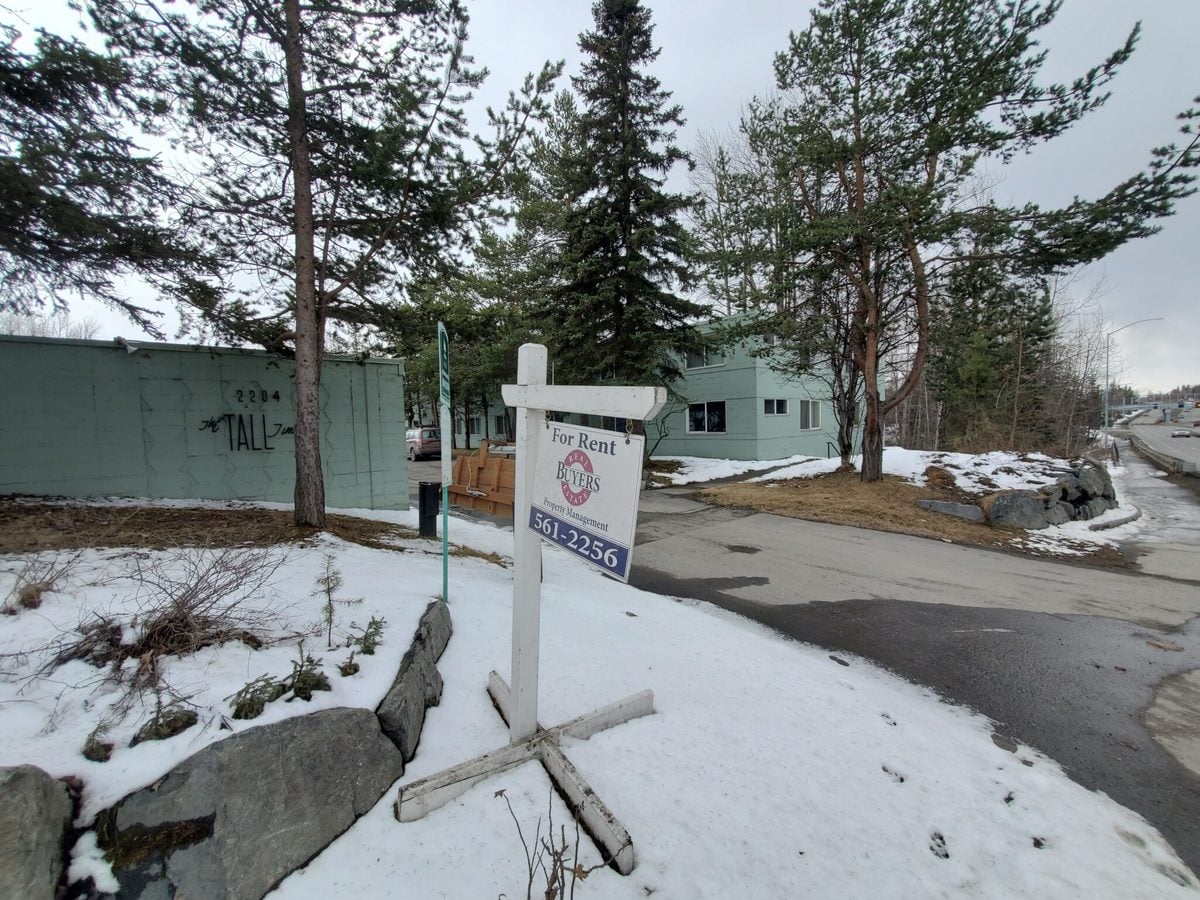
A sign seen on April 9, 2025, advertises rental availability at an apartment building in Anchorage’s Turnagain neighborhood. (Photo by Yereth Rosen/Alaska Beacon)
Apartment rents in Alaska rose 2.1% over the past year, the most modest increase in five years, according to analysis by the state Department of Labor and Workforce Development.
The statistics on rental costs are part of a package of articles about housing costs published in the September issue of Alaska Economic Trends, the monthly magazine of the department’s research section.
Rental statistics, based on prices recorded in March of this year, show some striking geographic differences.
The Wrangell-Petersburg area in Southeast Alaska had the cheapest rent of the 11 cities and areas analyzed, with a median monthly rate of $1,288 for a two-bedroom apartment. Bethel, a rural hub in Western Alaska, had the highest rents, with a median of $2,030 a month for a two-bedroom apartment.
Kodiak, Anchorage, the Fairbanks North Star Borough and Juneau were behind Bethel with monthly median rentals above $1,700.The Matanuska-Susitna Borough, just north of Anchorage, was on the low side for median rents, at $1,567 a month, but it had the biggest yearly increase, measured at 12.8%.
That reflects demographic characteristics in the bustling borough, where many residents are commuters who work in Anchorage, said Gunnar Schultz, a state labor economist and one of the authors of the housing-cost stories.
“Mat-Su obviously has been growing in contrast to most of the rest of the state,” he said. “So I think that that obviously puts upward pressure on price.” Proximity to Anchorage is another contributor because it means money is coming into the borough from the state’s largest city, he said.
The analysis is part of the department’s regular monitoring of housing costs. The rental comparisons covered much but not all of the state; the North Slope Borough and Bering Strait region, for example, were not included.
For homebuyers in Alaska, there are some economic headwinds, according to the economists’ analysis. Mortgage costs are much higher than they used to be, they said.
For a 30-year fixed rate mortgage on a $415,000 Alaska home — the median value — the monthly payment in 2025 was about $2,050. That is 84% higher than the estimated median monthly mortgage payment in 2019, the analysis said.
A big driver is the rise in home values, from an average of about $300,000 in 2019 to an average of $415,000 just six years later. Another factor is the increase in interest rates, from a median under 3% in 2020 to 6.5%in 2023, the analysis said.
But while home values and thus monthly mortgage costs increased, so did wages in Alaska.
The result of all those combined changes was that purchasing a home became marginally more affordable in 2025 than in the two years prior, according to the analysis.
Alaska’s Housing Affordability Index, the number that represents how many people earning the average monthly are needed to make mortgage payments, dropped a bit in 2025 to 1.37. That is down from last year’s index of 1.39 and from the 2024 index of 1.4, which was the highest in recent years. But it is above the indexes measured in previous years; from 2019 to 2021, the index was below 1, indicating that a single person earning average Alaska wages had enough money to afford monthly mortgage payments.
Despite the slight improvement in the affordability index, buying a house remains a hefty burden in Alaska, Schultz said. “It’s still so much higher than it was during COVID and before,” he said.
A slight decline in interest rates last year was a contributing factor to the small improvement in housing affordability. However, interest rates are now heading up, the analysis pointed out.
Also affecting housing affordability is the availability of homes, and on that subject, there is positive news for would-be buyers, according to the economists’ analysis.
Housing construction in 2025 hit a 10-year high after years of increases that followed the big drop during the COVID-19 pandemic. A total of 2,261 single-family and multifamily housing units were built last year, the analysis said. That compares to 1,747 in 2020 and 1,726 in 2021. Home construction has been steadily rising since those years, according to the data.
The Alaska Economic Trends articles did not compare housing costs in the state to those nationwide, but the U.S. Census Bureau has some U.S. statistics that provide some contest.
Nationally, home ownership costs remained flat from 2020 to 2024, while rents increased by $100 more a month to a median $1,413 during the period, according to the Census Bureau. The analysis considers areas around the nation with populations over 5,000, so most of Alaska’s rural communities are not included.
Former state Rep. Jonathan Kreiss-Tomkins, third from left, speaks at a gubernatorial candidate forum on Sept. 16, 2026, while former Attorney General Treg Taylor, Anchorage business owner and talk-show host Bernadette Wilson and former Anchorage Mayor Dave Bronson listen. The forum was held by the Alaska Hospital and Healthcare Association and the organization’s annual conference in Girdwood. Taylor, Wilson and Bronson are Republicans. Kreiss-Tomkins is a Democrat. (Photo by Yereth Rosen/Alaska Beacon)
In a candidate forum Thursday, three of the four candidates to be Alaska’s next governor voiced support for a long-debated plan to restructure the Alaska Permanent Fund in order to permanently cap the amount of money that can be spent from it without a statewide vote.
“You’ve got to protect the Permanent Fund. You simply have to,” said Republican candidate and former Anchorage Mayor Dave Bronson, speaking at the Commonwealth North forum.
Bronson referred to the Permanent Fund as “one of the two big engines” driving the state’s future. The other, he said, is developing Alaska’s natural resources.
Created in 1976, the Alaska Permanent Fund has been the No. 1 source of revenue for state services and the annual Permanent Fund dividend since 2018, when legislators and then-Gov. Bill Walker enacted a law that automatically diverts a portion of the now-$88 billion fund to the state treasury annually.
Even in years like this one, when oil prices are high and the state’s oil revenue booms, the annual transfer is worth more than oil and all other taxes combined and accounts for more than half of the state’s general-purpose revenue.
Currently, the Permanent Fund is divided into two parts. There’s the constitutionally protected corpus, which can only be spent via a statewide vote, and the earnings reserve, which collects the investment earnings of the corpus.
Money in the reserve can be spent by a simple majority vote of the Legislature and the assent of the governor.
Currently, only the 2018 law restricts spending from the earnings reserve, and that law is a flimsy limit — it could be overridden at any time by the Legislature and governor.
The trustees of the Alaska Permanent Fund have advocated that the two funds be combined into one, both to prevent overspending and to eliminate the possibility of the earnings reserve being drained, which would cause an instant state fiscal crisis.
“I think this is arguably the single most important question laying in wait for the next governor and the forthcoming Legislature,” said Democratic candidate Jonathan Kreiss-Tomkins. “I share Mayor Bronson’s belief that the Permanent Fund is a cornerstone of the state, and it is the single most important reform I want to pass as governor, working with the Legislature.”
Merging the two accounts would require a constitutional amendment. That needs the assent of two-thirds of the state House and two-thirds of the state Senate, plus a majority of voters in a statewide general election.
While serving as a member of the state House, Kreiss-Tomkins proposed such an amendment. His proposal passed through two legislative committees but was never voted upon by the full House or the full Senate.
Other, similar amendments have also failed to reach a vote of the House or Senate for two main reasons.
First, legislators would have to agree on the size of the Permanent Fund spending cap. Over the past eight years, the fund has struggled to earn enough money from its investments to make up for the annual transfer.
But reducing the size of the transfer means less money for services and dividends.
In 2025, state budgeters estimated that reducing the transfer by half a percentage point would open a $380 million gap in the budget. Reducing it by a full percentage point — to a level common in trust funds — would require finding $760 million per year in new revenue or cost cuts.
The second issue is the Permanent Fund dividend. Currently, legislators split the annual transfer from the Permanent Fund on an ad hoc basis, deciding each year how much to spend on dividends and services.
In practice, the Legislature has followed a “surplus dividend” strategy, setting the amount of the dividend based on what’s left over after services are paid for.
As operating costs have risen, the amount of money left for the dividend has shrunk. Some legislators now believe that without a policy change, the dividend is on course to disappear by the end of the decade.
State law mandates that dividends be paid using a specific formula in state law, but legislators have ignored that formula since 2016, and the Alaska Supreme Court upheld the legality of that approach.
“I’m going to fight like hell for that Permanent Fund dividend,” Wilson told Alaska Public Media in August.
She said she feels strongly about the issue because resources in Alaska are collectively owned by the state’s residents.
“It has nothing to do with the amount of a check. It has everything to do with the fact that Alaskans own the rights to those resources. And when you concede on that Permanent Fund dividend, you’re not just conceding on the amount of a check. You are conceding on the very idea that Alaskans no longer own those resources,” she said.
While permanently capping spending from the Permanent Fund does not directly alter the amount of the Permanent Fund dividend, it does eliminate a way to pay for larger dividends. Lawmakers who want larger dividends would have to either find new revenue or cut services in order to make money available for the dividend.
Some legislators have proposed that any revised structure for the Permanent Fund transfer reserve a portion of the transfer for dividends specifically, effectively guaranteeing a minimum payment.
Former Alaska attorney general Treg Taylor, speaking at an event in Kodiak, said he sees the Permanent Fund in the same way as the state’s fisheries — a resource that must be handled carefully in order to stay renewable.
Overfishing, or overspending, could endanger it.
“I think we have to lock up the Permanent Fund,” Taylor said, reiterating his position at this week’s Commonwealth North forum. “We have to protect that corpus. If we do not, there’s so much — I mean, JKT had it right. There’s just too much temptation to raid that. We’ve got to lock it up because that is our future.”
Former Attorney General Treg Taylor, at right, speaks at a Sept. 9. 2026, forum held by the Last Frontier Republican Club at the Petroleum Club of Anchorage. Next to him, from left, are two of the other three gubernatorial candidates: former Anchorage Mayor Dave Bronson, and former state Rep. Jonathan Kreiss-Tomkins. (Photo by Yereth Rosen/Alaska Beacon)
As Americans grow frustrated with artificial intelligence software and concerned about the side effects of data centers, they have become a major issue in this year’s midterm elections. Alaska’s gubernatorial race is no exception, particularly since the Alaska Industrial Development and Export Authority announced plans for a development that could include data centers in Southcentral Alaska.
All four candidates — Republicans Dave Bronson, Treg Taylor and Bernadette Wilson and the Democratic Kreiss-Tomkins — have staked out different policy positions before Alaskans vote this fall.
Data centers need reliable connections to the internet, cheap electricity and a cooling method. Currently, the North Slope is the most promising location for all three.
Current Gov. Mike Dunleavy has backed data centers, saying they could be an economic driver — they would create construction jobs and demand for infrastructure that would enable further development.
Dunleavy is term-limited and cannot run again this year. Four candidates remain in the race to replace him.
“I’m a big believer in data centers. I know that might be unpopular with some folks here,” said Bronson at a candidate forum hosted by Commonwealth North in Anchorage on Thursday.
A former Anchorage Mayor, retired Air Force pilot and former director of the state’s largest airport, Bronson said he sees economic opportunity if data centers are built in Alaska, and he would like to encourage them.
“The logistics (are) minimal, and there’s a lot of money in data centers, but you’ve got to deal with the noise. You’ve got to deal with the cooling, and you’ve got to deal — certainly — with the electricity. And the groups that I’m talking to, they said we’re not going to take your electricity because it’s not reliable. … We will produce our own, and we will move, and we will build our own data centers. That’s good for us. That’s a very strong revenue source,” Bronson said.
“I think we need to embrace it,” he said of data centers.
“We have all the makings of a great place for a data center to thrive and produce good-paying jobs for Alaskans,” Taylor said.
He added that electricity costs are his biggest concern. Any data center must “bring their own energy,” he said, and if a data center then sells excess power it generates, it could be a benefit to Alaskans if it is cheaper than other power available nearby.
“It doesn’t have to drive up costs if you do it correctly. It can produce a net savings to the ratepayers in Alaska,” he said.
Bronson and Taylor each said they see data centers as the future and fear that Alaska will miss out if it doesn’t embrace them.
“It’s a service everybody’s using and everybody has to adapt to and use, or you’re going to get left behind,” Taylor said.
Kreiss-Tomkins is advocating a temporary pause on data center development in the state.
“I support a moratorium on data center development in Alaska until the Legislature can pass a comprehensive regulatory framework for that development in Alaska,” he said during a Sept. 8 forum in Anchorage.
Any limits on development would be decided by negotiations between himself and the Legislature, he said.
The sponsor of the bill, Sen. Löki Tobin, D-Anchorage, will return to the Legislature next year, and the coalition majority that passed the bill is also likely to return, meaning that the next governor will likely be confronted with similar legislation.
Kreiss-Tomkins has also endorsed legislation that would ban AI-generated fake images intended to mislead the public and a bill that would require political advertisers to disclose AI-generated content.
Wilson, asked about her position by text message, criticized Kreiss-Tomkins’ campaign for accepting large contributions from AI company employees.
“Unlike Democrat Jonathan Kreiss-Tomkins — better known as Chat JKT — our campaign is not funded with hundreds of thousands of dollars from California AI companies hoping to own our governor and exploit our state,” she said before explaining her position. “Our administration will make independent decisions that are in the best interest of Alaska, not big donors from the Lower 48. I will never allow Alaska to be littered with hyperscale data centers that take our resources and spoil our lands. Our natural beauty, environment and quality of life matter to every person who calls Alaska home and my job is to represent them, not big tech liberals.”
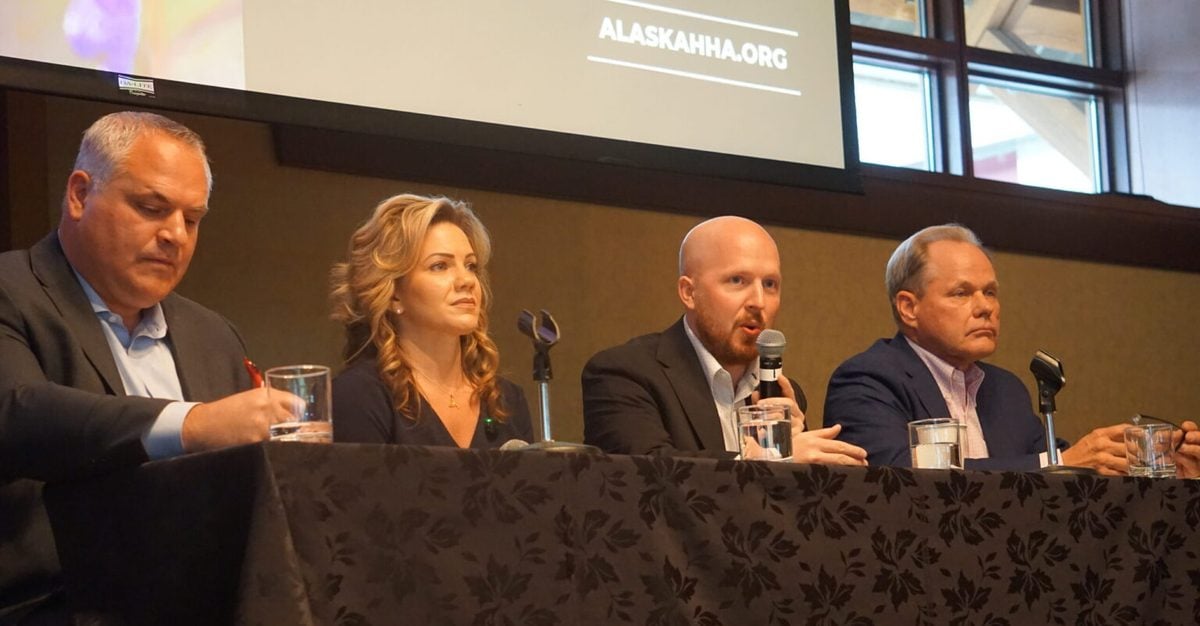
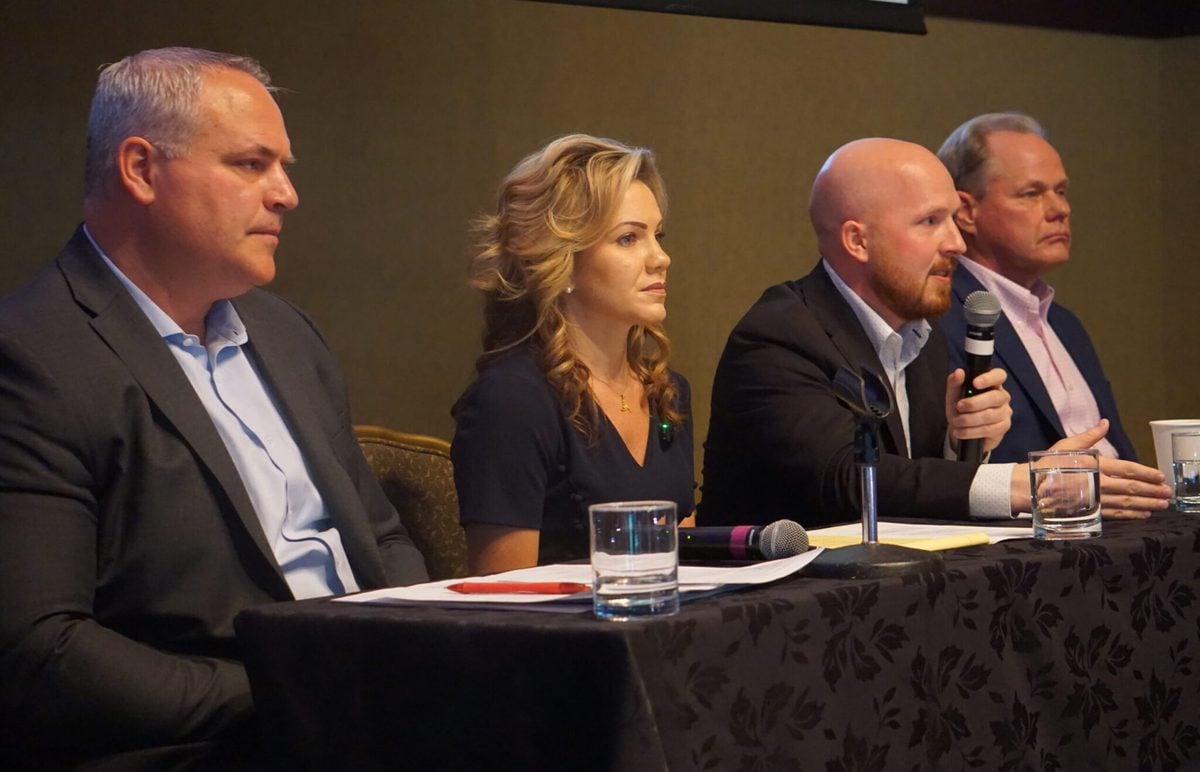
Former state Rep. Jonathan Kreiss-Tomkins, third from left, speaks at a gubernatorial candidate forum on Wednesday, while former Attorney General Treg Taylor, Anchorage business owner and talk-show host Bernadette Wilson and former Anchorage Mayor Dave Bronson listen. The forum was held by the Alaska Hospital and Healthcare Association and the organization’s annual conference in Girdwood. Taylor, Wilson and Bronson are Republicans. Kreiss-Tomkins is a Democrat. (Photo by Yereth Rosen/Alaska Beacon)
The three Republicans and one Democrat seeking to become Alaska’s next governor pitched their visions for state healthcare policy on Wednesday to an audience of experts: members of the Alaska Hospital and Healthcare Association.
The organization capped its two-day annual conference in Girdwood with a forum among the gubernatorial candidates who are running under Alaska’s ranked-choice voting system.
Along with addressing healthcare issues, all four candidates repeated talking points they have used at past events.
Former State Rep. Jonathan Kreiss-Thomkins, the only Democrat on the general election ballot, spoke about consensus-building across party lines, and he criticized outgoing Republican Gov. Mike Dunleavy for failing to do so.
Kreiss-Tomkins recounted his experience in a bipartisan coalition focusing on problems rather than party. “That’s a real North Star for me,” he said. “That philosophy of government, that principle has been painfully absent in the governor’s office for the last eight years, and it has really distressed me to see the direction Alaska is going as a consequence of that leadership in our governor’s office the last eight years. And I’m running to change that.”
Former Attorney General Treg Taylor spoke about his desire to cut bureaucratic red tape, including his experience with a real estate license that took a year and a half to transfer, an account he has described at numerous other gubernatorial events.
“We need to have government run at the speed of business,” he said, repeating a slogan he has used elsewhere.
Talk show host and business owner Bernadette Wilson, who has never held public office, pitched herself as an outsider and “the only one up on this stage that has never taken a check from government.” She said she breaks with past practices, including bipartisanship, that she said do not work. The current debates are about many of the same issues that faced gubernatorial candidates in past years, she said.
“And the question that each of us will have to answer is, ‘What are we going to do differently this time?’” she said.
In contrast, former Anchorage Mayor Dave Bronson touted the experience he gained in his three years as chief executive of the state’s largest municipal government.
Former Anchorage Mayor Dave Bronson, a Republican, speaks at a gubernatorial candidate forum held in Girdwood on Sept. 16, 2026, by the Alaska Hospital and Healthcare Association. (Photo by Yereth Rosen/Alaska Beacon)
“I ask you to just look at the resumes. I’ve already held the closest job in this state to the governor’s job. I governed 40% of the population of the state as the mayor,” he said. He “paid in blood” for the hard lessons that he learned, he said, experience that will serve him well as governor, a job for which “there’s no time for on-the-job training.”
Lost Medicaid coverage
On specific health topics, the candidates had many areas of agreement, but the discussion also revealed some key differences.
One divide emerged during a discussion about the loss of Medicaid coverage over the past two years for low-income Alaskans. At least a quarter of those being dropped from enrollment are not losing coverage because of lack of eligibility, Alaska Hospital and Healthcare Association President Jared Kosin said as he posed the question. Rather, they are being dropped because of long wait times and the bureaucratic hurdles they face in getting their applications considered.
Kreiss-Tomkins, who said he is proud of his record as a lawmaker working with the administration of Gov. Bill Walker to expand Medicaid coverage, said staff shortages are causing some of the problems. And he said some are caused by new rules imposed by the Trump administration, such as the work requirement that was embedded in the sweeping budget bill called the “One Big Beautiful Bill Act,”, have exacerbated problems for qualified Medicaid recipients, who are among society’s most vulnerable members.
And he made a veiled jab at U.S. Sen. Dan Sullivan and U.S. Rep. Nick Begich, both Alaska Republicans who voted for the bill and are running for reelection.
It is important to be “very clear about who voted for that legislation that is about to make it harder for Alaskans to get the care they need,” he said. “We need to be very clear-eyed about that.”
Taylor, in contrast, said he supports the bill’s requirement that Medicaid recipients work at least 80 hours a month, either at a paid job or in volunteer service or training.
“It is not unreasonable for an able-bodied adult, without dependents,” he said. Medicaid funds are not infinite,” so stewardship is needed to make sure they are spent properly, he said. Additionally, he said, fewer people on Medicaid could be a good sign. He said unemployment rates in Alaska have dropped.
“So that’s good. That’s the program working,” he said.
Alaska’s unemployment rate, though following a volatile pattern, has been on a long-term decline, according to the Federal Reserve Bank of St. Louis. In recent years, the rate bottomed out at 3.9% in August of 2022, rose to 4.8% in December 2025 and then declined again, falling to 4.3% as of July, according to the Federal Reserve bank’s statistics. Alaska’s rates have been above the national rate for most of the years in the past decade, according to the U.S. Bureau of Labor Statistics.
Former State Rep. Jonathan Kreiss-Tomkins, a Democrat, speaks at a gubernatorial candidate forum held in Girdwood on Sept. 16, 2026, by the Alaska Hospital and Healthcare Association. (Photo by Yereth Rosen/Alaska Beacon)
Wilson said a business-like approach is needed to fix the Medicaid problems.
“We need to treat Medicaid like a business that is failing Alaskans,” she said. “We need to come in and we need to look at how can we hire people from the private sector that know processes and can hold these processes to a more accountable timeline.”
Bronson said Kosin’s statistics show that a large percentage of qualified Alaskans are being dropped from services.
“We are failing at a state level, especially in the Department of Health,” he said. Upon taking office as governor, “I would direct the Department of Health to conduct a review of all operations, and that includes the processing of paperwork for Medicaid,” he said.
Bronson also said that the One Big Beautiful Bill Act is causing extra problems for Alaska, and that he would seek an extension of the national Jan. 1 deadline for states to comply with all of its provisions.
Rural health ideas
On the subject of rual health care in general and, more specifically, what to do with “rural health transformation” funds granted from the federal government to the state, two of the candidates referred to their own family experiences.
Kreiss-Tomkins, who is from Sitka, spoke about his mother, an Indian Health Service doctor who spent her entire career at the Southeast Alaska Regional Health Consortium. He said he got his own health care from that tribal organization.
Wilson, noting that her grandmother was born in the Bristol Bay community of Naknek and that she is of part Aleut ancestry, said she has experience as a patient at the Alaska Native Medical Center.
As for the $272 million in rural health transformation funds that the state got from the federal government and that the Department is disbursing in a series of grants, the candidates offered a variety of suggestions.
Wilson said the state should invest in technology, especially technological advances that might help rural Alaskans avoid the need to travel to Anchorage or elsewhere for care.
Former Attorney General Treg Taylor, a Republican, speaks at a gubernatorial candidate forum held in Girdwood on Sept. 16, 2026, by the Alaska Hospital and Healthcare Association. (Photo by Yereth Rosen/Alaska Beacon)
She sees the travel-related challenges when she is at the Alaska Native Medical Center, she said. “You have people who are pulled out of their community, pulled out of their village, they’re coming into Anchorage. Sometimes it’s for an unknown length of time,” she said. The state needs to try to find ways to ensure that rural patients can be treated at home, she said.
Bronson made similar observations about the need to minimize travel for rural patients, citing “robust telehealth” as one tool.
Kreiss-Tomkins said the state should be seeking to make the rural transformation grants “leverage structural and systems change that will have lasting and enduring benefit to the system” rather than use them for construction or for one-time projects. The state should not count on getting similar money in the future, he said.
Taylor called the funding a “gift” that he hopes will be used “to help reinvent healthcare in Alaska.”
There was a split among the candidates over mandatory staffing ratios for nurses, as proposed in a bill that emerged late in this year’s session, Senate Bill 283. The Alaska Hospital and Healthcare Association opposed the bill, which did not advance out of the Senate Labor Committee.
Three of the gubernatorial candidates said they also opposed the idea of codifying such ratios into law, but Taylor spoke out in support. He cited a 2016 study in Australia that found that for each patient taken off a a nurse’s workload, there was a 7% drop in the likelihood of death and a 3% shorter hospital stay.
However, establishing firm ratio requirements would also necessitate related action to ensure sufficient numbers of nurses in the state, he said.
“You cannot mandate nurses into existence,” he said.
The other three candidates said mandatory staffing ratios would not be workable in Alaska’s diverse healthcare settings.
However, Kreiss-Tomkins said, the idea behind the proposal is laudable. “I appreciate where the impulse comes from,” he said. “I mean, everybody wants safe standards of care for patients, and you don’t want nurses or other practitioners spread thin.”
Complex subjects
Concerning mental and behavioral health, Bronson repeatedly defended his controversial attempt as Anchorage’s mayor to build a huge shelter and “navigation center” in the city’s university-medical district to serve the unhoused.
Anchorage business owner and talk-show host Bernadette Wilson, a Republican, speaks at a gubernatorial candidate forum held in Girdwood on Sept. 16, 2026, by the Alaska Hospital and Healthcare Association. (Photo by Yereth Rosen/Alaska Beacon)
“That facility, I think, was the right answer to dealing with a lot of the healthcare issues we face in the city of Anchorage and across the state because we’re kind of the homeless center for the state,” he said. “We almost had it done. We actually started pouring concrete.”
Bronson’s plan was for a tented facility to house and serve hundreds of people at a site across the street from the Alaska Native Tribal Health Consortium campus. The Anchorage Assembly rejected the plan after it was revealed that the Bronson administration awarded a contract and started construction illegally. The plan had drawn backlash from residents in the area, which currently is the site of ballfields and recreational trails.
Taylor said Alaska’s mental health challenges are daunting, with suicide and alcohol death rates that are twice the national average.
But there has also been positive movement under the Dunleavy administration, he said. He cited a bill that the governor signed in 2022, House Bill 172, that supports the use of crisis centers and teams to treat patients in emergencies.
There are now mobile crisis centers in four communities, Taylor said. “The added effect of that is keeping people out of your emergency rooms,” he said. “Youth suicides are down sharply now.”
It was unclear whether Taylor was referring only to the communities where the mobile crisis teams are operating or to the state as a whole.
Statewide, the rate of youth suicide fatalities reached a 10-year high in 2025, according to the Department of Health’s epidemiology section.
Other subjects discussed at the forum included the rising cost of health insurance in Alaska and qualities that the candidates are seeking in officials they would hire to manage healthcare services.
At the event’s conclusion, Kosin thanked the candidates for delving into healthcare topics that are complex.
“This is not always the most comfortable environment, and you guys were here. And that says a lot about your character,” Kosin said to the candidates.
Former Attorney General Treg Talor speaks at a gubernatorial candidate forum on Sept. 16, 2026, while Anchorage business owner and talk-show host Bernadette Wilson, former state Rep. Jonathan Kreiss-Tomkins and former Anchorage Mayor Dave Bronson listen. At the lecturn is Jared Kosin, president of the Alaska Hospital and Healthcare Association. The organization held the forum in Girdwood, and the event was focused on healthcare issues. (Photo by Yereth Rosen/Alaska Beacon)
On Oct. 1, the Alaska Department of Natural Resources will begin limiting how far in advance reservations can be made to three months, down from six months.
The only exceptions to the three-month reservation window will include the Wood-Tikchik Region and cabins on Afognak and Shuyak Islands in the Kodiak region, which will continue to allow reservations up to six months in advance.
The change is part of a shift to a new online booking system and website that also opens Oct. 1. Cabin-seeking Alaskans will be unable to change, modify or cancel their existing reservations from Sept. 28 through Sept. 30 as part of the transition.
Beginning Oct. 1, reservations for all facilities can be made for Jan. 1, 2027 and the 3-month rolling window will begin.
Wendy Sailors, community engagement manager for Alaska State Parks, said by email that the new shorter reservation window is the result of feedback from Alaskans who said “that it is difficult to plan that far out, often people forget that they had the reservation and have to cancel last minute or just don’t use it, etc. So in addition to the three-month rolling reservation window, we are incorporating a few new features like an email reminder 7 days out.”
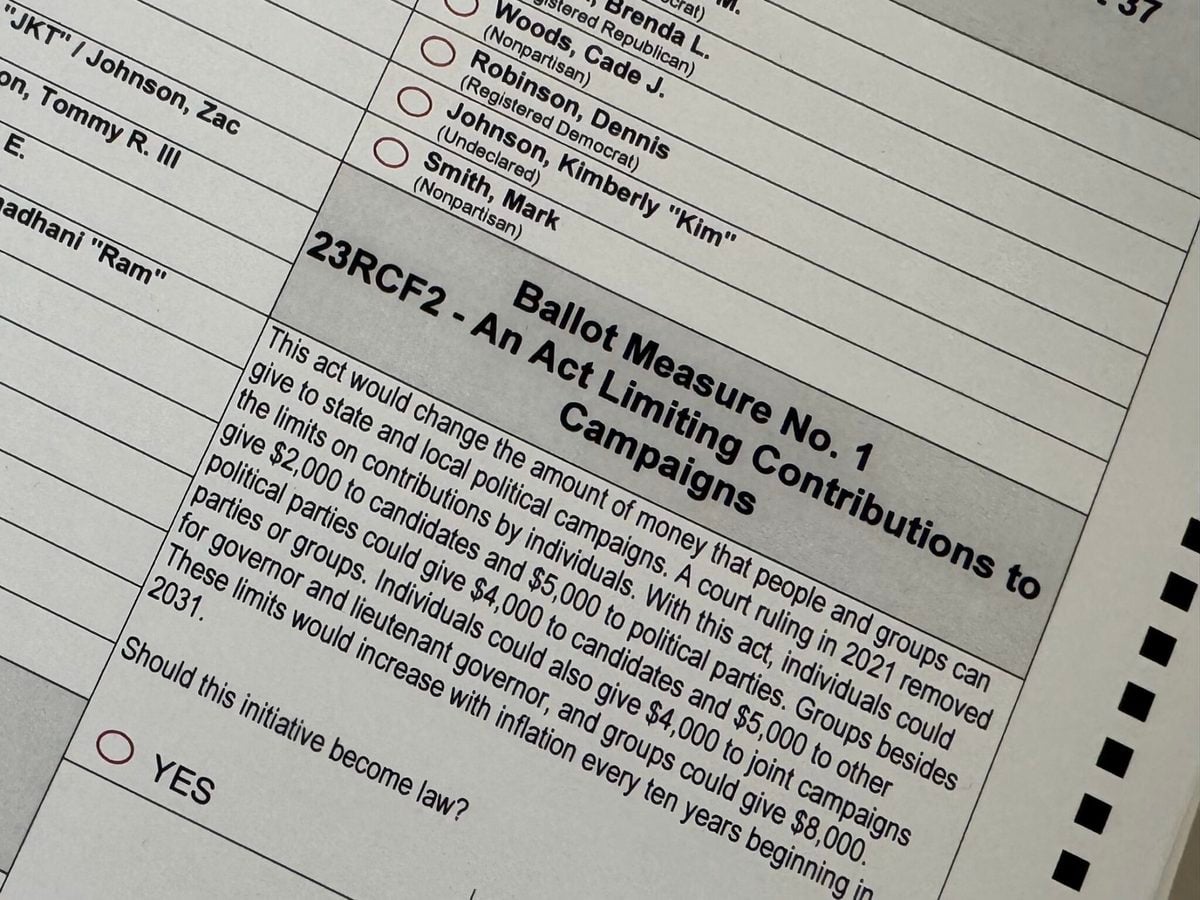
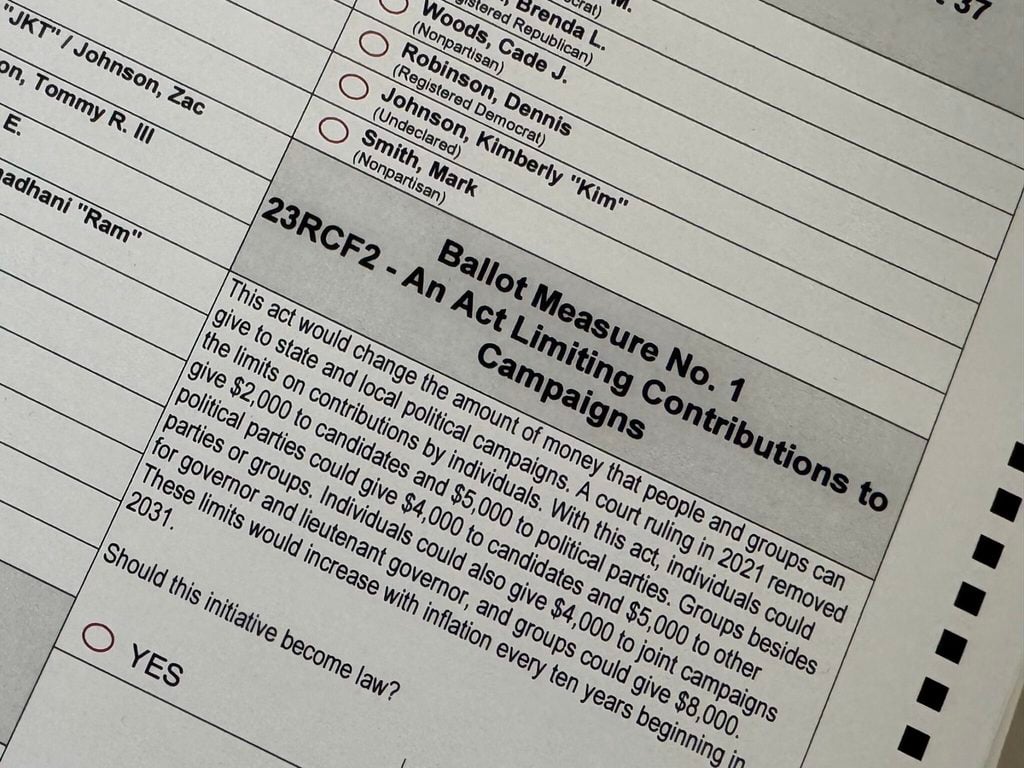
A sample ballot seen at the headquarters of the Alaska Division of Elections on Thursday, July 9, 2026, shows the language for the campaign finance ballot measure. (James Brooks photo/Alaska Beacon)
In August, more than 70% of participating Alaska voters supported Ballot Measure 1, voting to restrict the amount of money that individuals can contribute to campaigns for state office.
On Nov. 3, Alaskans will vote on Ballot Measure 2, and an overlooked section of that measure — intended to roll back the state’s election system to what it was in 2020 — almost certainly would repeal part of Ballot Measure 1.
“I mean, people are like, why didn’t you raise this earlier? I’m like, it’s got 91 sections, and I literally didn’t notice,” said Scott Kendall, the author of Alaska’s existing elections system and an attorney fighting Ballot Measure 2.
In 2020, Alaskans passed a different Ballot Measure 2. It installed three major changes to the state’s election system: An open primary, where all candidates run together, and the top four advance to the general election; a ranked choice general election, where voters sort those four candidates in order of preference; and a disclosure law requiring third-party groups to disclose their donors when the groups donate to political candidates and causes.
This year’s Ballot Measure 2 seeks to repeal all three parts, returning Alaska elections to what they were in 2020.
There’s also a new wrinkle because of this year’s Ballot Measure 1.
That single-ticket system was installed in 2020’s Ballot Measure 2. Ballot Measure 1 limited donations to that single ticket, putting the limits in Alaska Statute 15.13.070(g).
Ballot Measure 2 seeks to get rid of the combined single-ticket campaign, and Section 5 states, “AS 15.13.070(g) is repealed.”
That would get rid of the combined donation limit for governor and lieutenant governor. But some state officials say another law may then come into play.
Because candidates would — if Ballot Measure 2 passes — be running separately, they may be limited by a different part of Ballot Measure 1, AS 15.13.070(b), which applies to individual candidates.
That’s the position held by Alaska Public Offices Commission director Heather Hebdon. APOC is in charge of enforcing Alaska’s campaign finance laws.
By email, Hebdon said that if Ballot Measure 2 passes, “contribution limits for gubernatorial candidates would fall under those found in AS 15.13.070(b)(c) and (f).”
She believes APOC would likely write new regulations to deal with those limits’ applicability to governor and lieutenant governor candidates.
Kendall said he isn’t sure about that.
“I will say it’s really legally tenuous. I think when you have a statute that says a thing and you explicitly repeal that thing, you get what you get,” he said.
Supporters of Ballot Measure 2 said they don’t have a position on the issue.
“Repeal Now wrote Ballot Measure 2 as a full and complete repeal of the 2020 ballot measure that brought ranked choice voting to Alaska. We are unaware of any effect on Ballot Measure 1 and thus can’t comment on that,” said Bethany Marcum, treasurer of Repeal Now, the leading group behind Ballot Measure 2.
Craig Richards, a former attorney general who represented Repeal Now in court, said he was unfamiliar with the issue.
The Alaska Department of Law also declined to make a definitive statement on the topic.
Sam Curtis, a spokesman for the department, said by email that attorneys within the Alaska Legislature would make the final determination of what happens if Ballot Measure 2 passes.
That’s because the revisor of statutes — an obscure staff official — is in charge of mediating disputes between enacted laws.
Emily Nauman, the Legislature’s chief attorney, declined to say how the Legislature might interpret any conflict.
Rep. Calvin Schrage, I-Anchorage and a sponsor of Ballot Measure 1, said earlier this month that he has requested that Nauman’s office deliver a written ruling on the issue, but as of Tuesday afternoon, that memo had not yet been completed.
The Alaska Supreme Court has dealt with similar issues before. In 2021 and in 2006, the court ruled that later laws trump earlier ones.
“In general, if two statutes conflict, then the later in time controls over the earlier, and the specific controls over the general,” the court wrote in a 2006 decision.
On Sept. 11, Schrage said he doesn’t like the idea of repealing a campaign finance limit.
“It seems to fly in the face of what Alaskan voters have time and time again reaffirmed as a priority for them,” he said.
The Alaska Supreme Court had an opportunity earlier this month to address the issue but declined to take it up.
As a result, the final description on the ballot says only that Ballot Measure 2 would “remove the limits on donations to joint campaigns for governor and lieutenant governor.”
It doesn’t say whether anything will replace them.
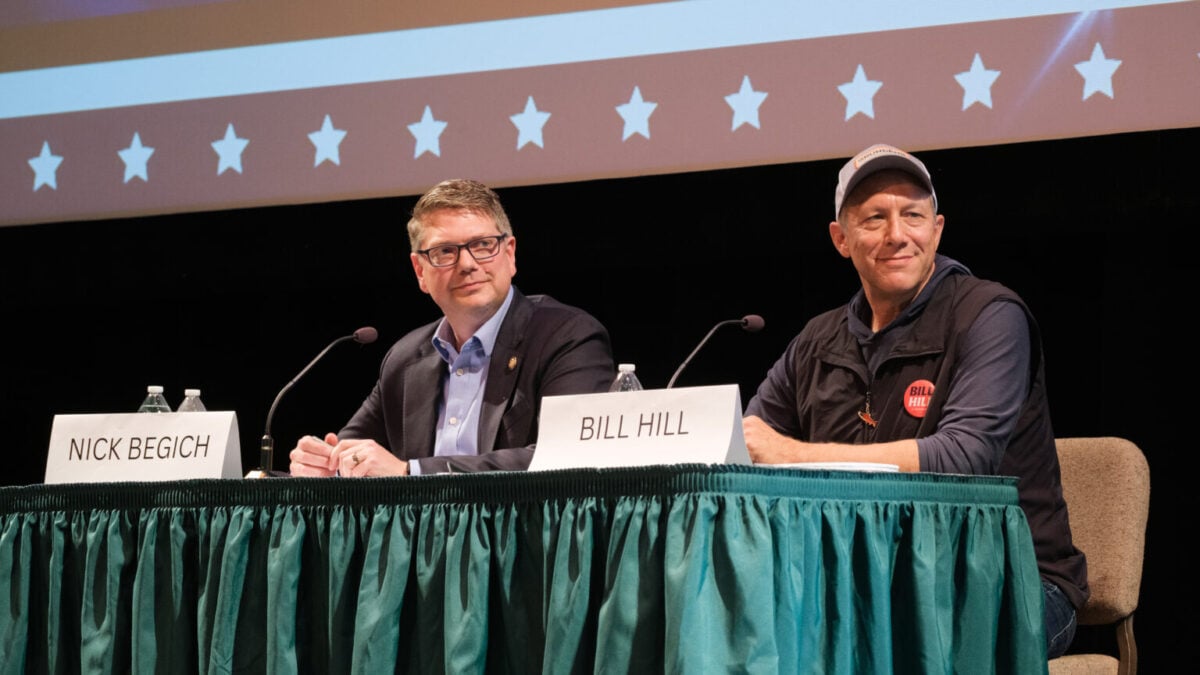
Alaska candidates for the U.S. House race incumbent Republican Nick Begich III (left) and independent challenger Bill Hill (right) squared off at a fisheries debate in Kodiak on Sep. 12, 2026. (Photo by Brian Venua/Alaska Beacon)
Front-runner candidates for Alaska’s sole U.S. House of Representatives seat expressed strong support for the fishing industry and coastal communities at a debate in Kodiak over the weekend.
Incumbent Republican U.S. Rep. Nick Begich III and independent challenger Bill Hill took very similar positions on issues including fisheries bycatch, declining fish stocks and representation in federal fisheries management, but there were some differences.
Begich touted his legislative record in his first two-year term as beneficial to Alaska fisheries, while Hill said his personal history as a lifelong fisherman in Bristol Bay is advantageous for representing Alaska in Congress.
Begich, a technology entrepreneur and business executive, garnered 44.6% of the vote in the primary election, while Hill, a former school superintendent and commercial fisherman, received 32.5% of the vote. Third and fourth place finishers in Alaska’s ranked choice general election include Eric Hafner — a registered Democrat serving a federal prison sentence in New York – with 3.8% of the vote, and Libertarian Jim McDermott of Fairbanks with 1.2%.
The winner of the November election will serve a two-year term as one of the 435 members of the U.S. House of Representatives.
Begich promoted his legislative record as a freshman in the Republican-controlled U.S. House. This spring, six bills he sponsored passed Congress to become law — a tie with another Arizona lawmaker for most bills passed as a freshman — but none of those bills directly address fisheries issues.
“I have passed more legislation than any freshman on record,” Begich said. “And those are good Alaska bills — they are bills that unlock lands for Alaskans, and they are bills that, in many cases, we’ve been working to achieve for decades.”
Hill repeatedly referenced his experience growing up subsistence and commercial fishing in Bristol Bay. “I raised three of my kids on my fishing boat, and understand the importance that state, national and international politics play in what happens on our back decks with our children, what happens in the income that we can take home, what taxation does to us, what tariffs do to us,” he said. “I’ve lived a life of fish.”
Bycatch
Several debate questions focused on bycatch, the accidental harvest of nontargeted fish. Bycatch has raised public concern around Alaska’s industrial trawl fleet, which has many vessels harbored in Kodiak, where the debate took place.
Both candidates said they support broader representation on the North Pacific Fishery Management Council, which oversees fishing policy in federal waters, including bycatch regulations.
Begich said he supports increasing representation for subsistence, sport fishers and small commercial operators, as well as large operators, in council decisions. He pointed to a bill he introduced, the Bycatch Reduction Act, which would require the council to implement gear performance standards to reduce bycatch, to make investments in fishing gear and fisheries research and to increase monitoring and reporting from the industry and the council, among others.
“We need transparency — more transparency for folks who may have conflicts of interest that currently serve on the NPFMC,” Begich said. He also expressed support for a chum bycatch limit established by the council this year for the Bering Sea pollock fishery.
Hill said he supports bycatch limits to protect salmon runs, and additional seats representing subsistence and tribal groups.
“Subsistence is sacred, and the very first thing that needs to happen, and I think you hear it from across the state — this is why there’s such a loud outcry — is because some of our subsistence users have not been able to access their resource, which is more than just protein, for quite a few years now,” he said.
In a question about Congress’ role in reducing bycatch, debate moderators noted all fisheries produce some bycatch harvest and said “a goal of zero bycatch isn’t reasonable.”
But both candidates pushed back on that framing and said that zero bycatch should be the ultimate goal.
The industrial trawl fleet, particularly boats that target pollock, has been the focus of public criticism because it contributes substantially to the state’s bycatch numbers for species including juvenile halibut, cod and salmon returning to spawning grounds throughout Alaska.
Begich said he agreed that every fishery produces some level of bycatch and it’s up to the council to manage each complex fishery. But he said the goal should be “aggressive.”
“I do think the goal should be zero. It’s going to be a long road to get there. But we also have to recognize that in every single fishery, whether it be subsistence, sport, small commercial or large commercial, they have a bycatch responsibility as well,” Begich said.
Hill said the goal should be zero bycatch. “We need to work towards that. We need to work towards a very low-threshold for our trawling industry, especially the out-of-state corporate trawlers,” he said.
And Hill expressed confidence that the trawl industry would be able to meet required limits.
“My perspective is when you set something out for industry to accomplish, they always find a way, and we’ve seen over and over again that our trawl fleet has met the standards that are being set for them. So, can we get to 0%? That would be everybody’s desire, but should we be working towards it? Yes, we should be,” Hill said. “But those who are bad actors, you’ve got to leave the fishery.”
When asked about the primary causes of king and chum salmon run declines, Begich responded it was “largely bycatch related.”
“You look at the Yukon, you look at the Kuskokwim — those runs are way down. We’re seeing some recovery in chums. I think that the cap that we put in with NPFMC is sort of that initial shot saying, ‘Hey, we’re going to be managing these more carefully,’” Begich said. “But I think that historical bycatch is the root cause.”
Hill said he agreed, and added that climate change driven factors are affecting Alaska’s salmon runs. “Climate change is a real thing, and we need to start mitigating for that,” he said. “But yes, we need to end bycatch.”
Processing and protecting Alaska’s fisheries
Both candidates said they would support investments in building the workforce in fishing and processing sectors, as well as more visas for hiring international workers in processing.
In a lightning round of questions, the candidates agreed on every issue. They supported science-based fisheries management, more investment in research and engaging with a wide range of fisheries interest groups prior to introducing new legislation or policies. They also agreed that rural and tribal communities should have more say in decisions affecting fish.
When asked how they would ensure the economic value of federally-managed fisheries would not come at the expense of Alaska communities, Begich said he supports labeling rules for farmed vs. wild-caught fish.
“Alaska seafood is competing with penned fish and farmed fish, and the end consumer doesn’t know it,” Begich said. “And so, when you’re buying an Alaska seafood product, we need to make sure that it’s labeled Alaska. That’s transparent because it gives us the best price for our product and it reduces some of the pressure on our fisheries.”
Hill said he would support more investment in in-state seafood processing to diversify processors to which fishing fleets can sell their harvests. “More processing in our state that’s not a consolidated, vertically integrated type of processing,” he said. “And we need to make sure that we’re legislating to make sure that farmed fishing does not come to our seas and that we keep them off for as long as we possibly can.”
Geopolitics
Both candidates expressed support for tariffs on international seafood to protect Alaska markets.
Hill also condemned the U.S. war in Iran for driving high costs of fuel and affecting fisheries.
“The Iran war is a terrible, terrible thing in terms of how it’s impacted our industry,” he said. “The fuel costs I paid this summer were $2 per gallon more than last year, and they were already high. And then we start talking about things like food and groceries, and the things that allow our crews to do good work for us while we’re fishing hard.”
Begich has expressed support for the Trump administration’s military action against Iran, and voted against a war powers resolution that passed Congress in June calling on President Donald Trump to remove armed forces against Iran, unless authorized by Congress or a declaration of war.
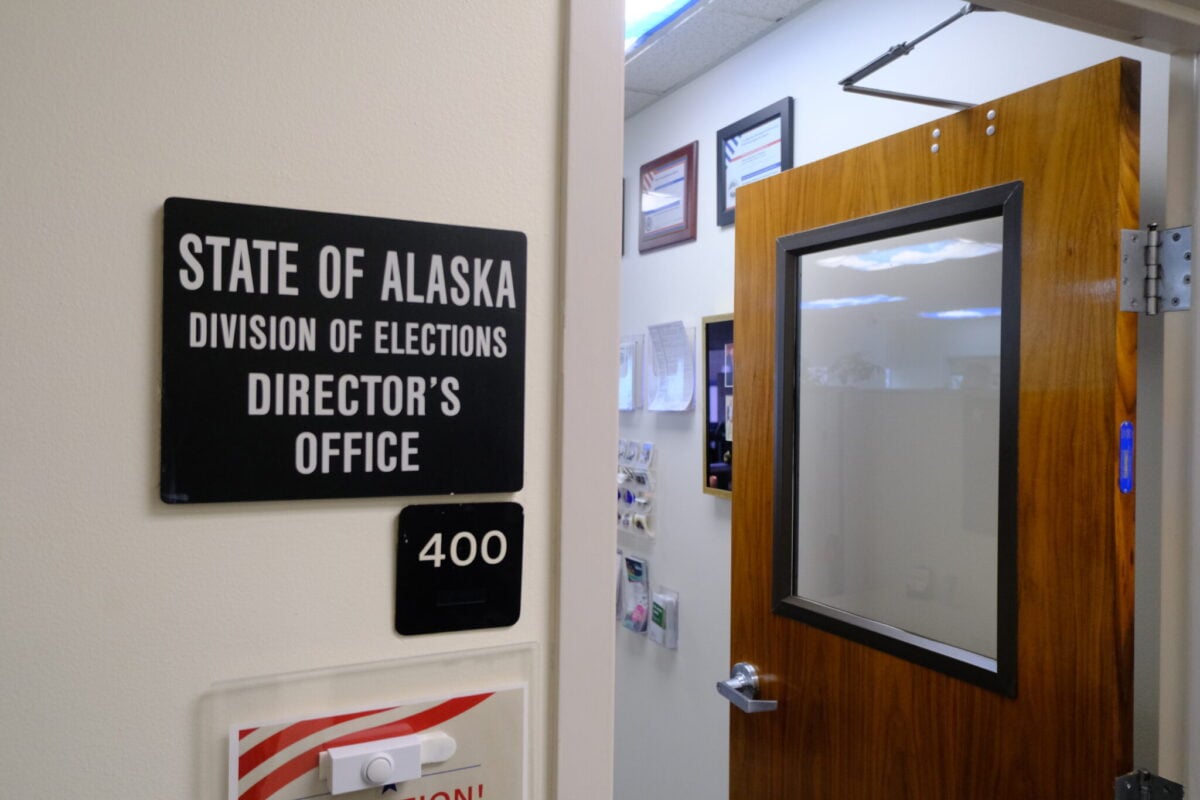
The Alaska Division of Elections director’s office in Downtown Juneau is seen on Aug. 26, 2026. (Photo by Corinne Smith/Alaska Beacon)
Rep. Andrew Gray of Anchorage is not a Swiss businessman. Speaker of the House Bryce Edgmon is not selling fire sprinkler systems. Lieutenant governor candidate Zac Johnson isn’t running an equestrian fox-hunting club in Indiana.
Days after the Alaska Department of Law said it found possible gaps in dozens of political candidates’ financial disclosure forms, a review by the Alaska Beacon and interviews with the affected candidates found many of the problems identified by the department either don’t exist, rely on old information, or amount to minor errors.
“I’ve talked to probably 10 legislators, and probably eight of them had something on that list that was just bogus,” said Rep. Julie Coulombe, R-Anchorage and one of the candidates in the report, “property they don’t even own anymore, businesses they don’t own, and yet they’re on the list.”
“On the basis of that additional information, the Lieutenant Governor will certify the two candidates,” said a statement released by Dahlstrom’s office at the time.
That restoration reversed one Dahlstrom took just five days before. On Aug. 31, Dahlstrom followed recommendations from the Alaska Public Offices Commission and disqualified Taylor and Tagle based on the fact that they had not submitted full Public Official Financial Disclosure forms within a 30-day deadline set by state law.
Former Attorney General Treg Taylor speaks at a Sept. 8, 2026, gubernatorial candidate forum held by the Last Frontier Republican Club at the Petroleum Club of Anchorage. (Photo by Yereth Rosen/Alaska Beacon)
Taylor, a former attorney general who used to lead the Department of Law, had been asked in 2025 to provide a list of tenants at his rental properties in Anchorage. He did not provide a partial list until late July, about three weeks before the primary election.
“My biggest issue is that APOC never reached out to me with any discrepancies when I filed the disclosure,” Coulombe said. “And so the difference with Treg (Taylor) is that he knew that there was an issue and chose not to change it.”
The Department of Law’s review was extraordinary. When they register to run for office, candidates are required to submit a form listing their personal finances from the previous year. If they don’t submit one, they cannot run. Normally, any gaps in a disclosure only come to light when someone files a complaint with the commission.
Officials with the Department of Law said at a Monday news conference with Dahlstrom and Gov. Mike Dunleavy that they initiated their review last week, expediting it ahead of ballot printing deadlines.
Rachel Witty, director of the civil division of the Department of Law, said the review was done in the course of a day and a half.
“So I can’t emphasize enough that this is a preliminary review. We didn’t have time to contact candidates. We didn’t have time to verify every apparent match. Nor is it our role to do that. There might be mistaken identities. It was not conducted with the kind of due diligence that APOC would do before making a determination that someone had violated the law.”
Witty said paralegals, not attorneys, conducted a search by reviewing business licensing databases, property records, and a large national database called TLOXP.
It’s unclear whether APOC, the agency that regulates financial and political disclosures, will follow up with candidates or take any enforcement actions.
Among the candidates flagged for review were all four lieutenant governor candidates and all four candidates for governor.
Republican candidates Dave Bronson and Democrat Jonathan Kreiss-Tomkins, through a campaign spokesperson, denied the department’s findings, and defended their financial disclosures. Kreiss-Tomkins immediately corrected one error that was identified.
Taylor and Republican Bernadette Wilson did not respond to requests for comment.
“This is getting more absurd by the moment,” said Edgmon when informed by the Beacon that the Department of Law had identified him as director and president of Inland Empire Fire Protection, a fire sprinkler company in Spokane, Washington.
That company is a subsidiary of Choggiung, Ltd., an Alaska Native corporation based in Dillingham.
Until 2017, Edgmon served as chairman of the board for Choggiung, but he hasn’t been in that role for almost a decade.
“I’ve never had a personal relationship with them,” he said of the fire sprinkler company.
The Department of Law report also said Edgmon failed to properly disclose some rental properties in Dillingham — they’re listed, but in the “debts” section of the report, rather than under “interests.”
The Department of Law flagged Rep. Will Stapp, R-Fairbanks, as possibly being the owner of William B Stapp LLC but also noted that the firm was dissolved in 2015, five years before Stapp first ran for office.
“I’m not actually sure why they even flagged me,” Stapp said on Friday.
Rep. Andrew Gray, D-Anchorage, published a video on social media after the report listed him as owning a business in Switzerland. Gray said he’s both never been to Switzerland and never owned a business.
In a comment posted by Fairbanks writer Dermot Cole, independent state House candidate Joy Beth Cottle of Fairbanks said that the Department of Law review incorrectly flagged her as having an out-of-date disclosure form.
Cottle filed to run for office in 2025, a year ahead of the deadline, and thus filed a form covering the 2024 tax year. State law doesn’t require an updated POFD in that case. Several other candidates were dinged for the same reason.
Cottle also noted that she was linked to a property she “sold in 2013 and has since burnt to the ground and changed owners several times. I drove by and took a picture of it — it’s a vacant lot.”
In Anchorage, Coulombe said she was faulted for not listing her husband’s last name. After 40-plus years of marriage, she said, she thought it would be assumed that they had the same last name.
She was also faulted for listing only the zip code of a rental property. She’s since submitted a revised form to fix the problem.
“If a mistake or something happened, then OK, email me and I’ll fix it,” Coulombe said. “But you know, the whole idea of putting this big list out like we’re all hiding something is just — I have no words for that.”
Coulombe and other legislators named in the report said they are suspicious of the way the Department of Law and Gov. Mike Dunleavy’s administration handled it.
Anchorage Republican Sen. Cathy Giessel was surprised to hear she was flagged by the review. The department said she failed to disclose being a director of Anchorage Community Mental Health Services, Inc., but that is the old name of Anchorage Behavioral Health which was changed in 2020. Giessel is president of the board, which is listed on her disclosure report.
“Well, see, the Department of Law is going after anyone that is not a staunch radical right Republican,” she said. “So that is really immaterial to me.”
The list of candidates in the department’s review include 24 Democrats, 49 Republicans and 17 independents.
“I have huge concerns about what the Dunleavy administration is doing with the departments under its control,” she said. “This is unbelievable — the overreach that’s happening, the inappropriate behavior, the obvious interference in elections. It’s no wonder, many of my constituents, as I knock door-to-door, don’t trust this election system because they’re seeing all of this, very — I’ll call it ‘very unusual’ in quotes — behavior by state government and the federal government.”
Witty responded to Giessel’s comment by email on Friday.
“I have worked for the Department of Law for 20 years, through five administrations, and I can tell you unequivocally, that what occurred last week was not motivated by politics. The informal review was done completely internally by line level staff who only want to do good work for the people of Alaska,” she said. “The list includes candidates from all party affiliations and does not target one political party over another. By its nature, it had to be done on an extremely expedited timeline and could not be as thorough as anyone would have wanted it to be. We have been very open that the list likely contained errors and we have consistently messaged this to the candidates and to the public. However, the preliminary findings contained enough potential discrepancies to raise questions about whether the law was being applied fairly across the field of candidates. The bottom line is that candidates were added back onto the ballot and the field remains broad — allowing voters to have the final say.”