Categories
Alaska News Featured Juneau News juneau Juneau Local Juneau Local Ketchikan Local News Feeds Sitka Local

Alaska Democratic U.S. House candidate says he had support but not enough money

By: James Brooks, Alaska Beacon
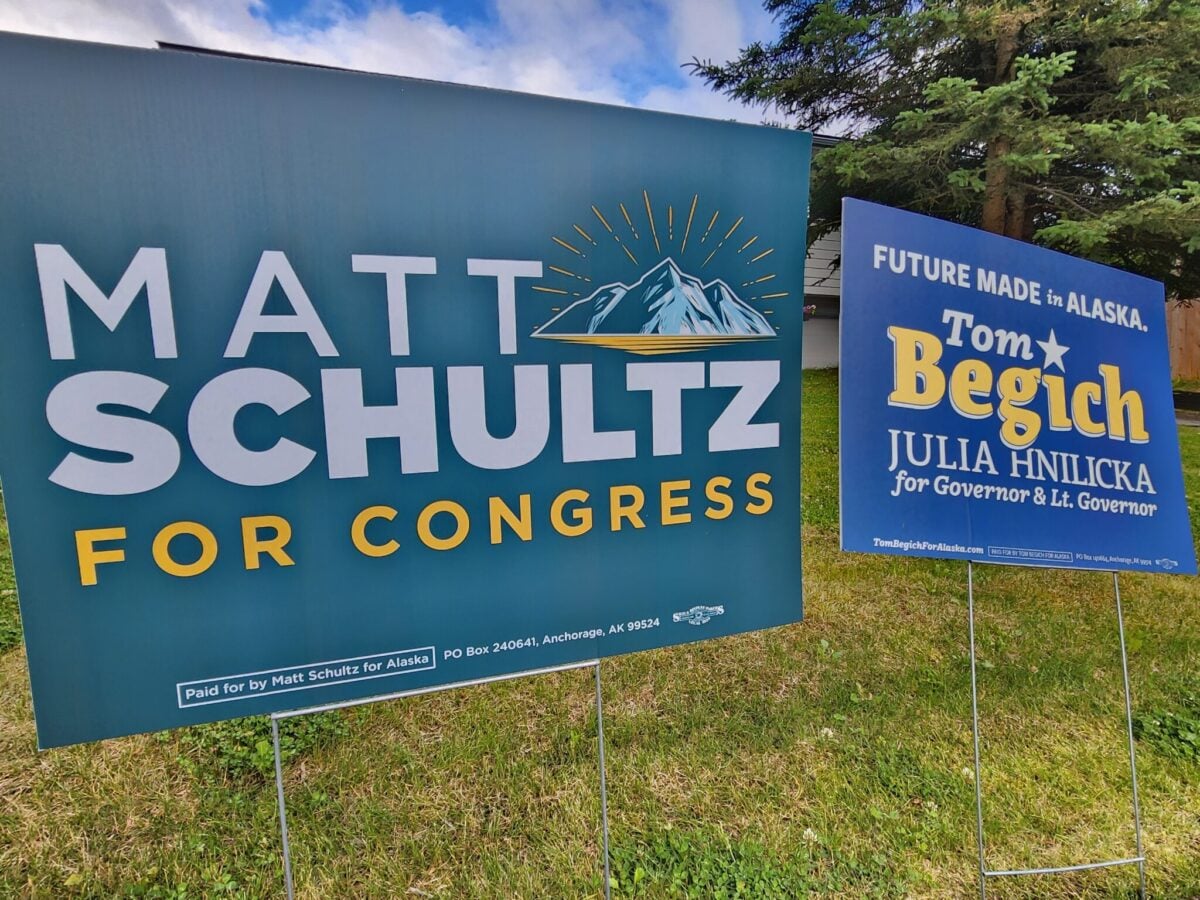
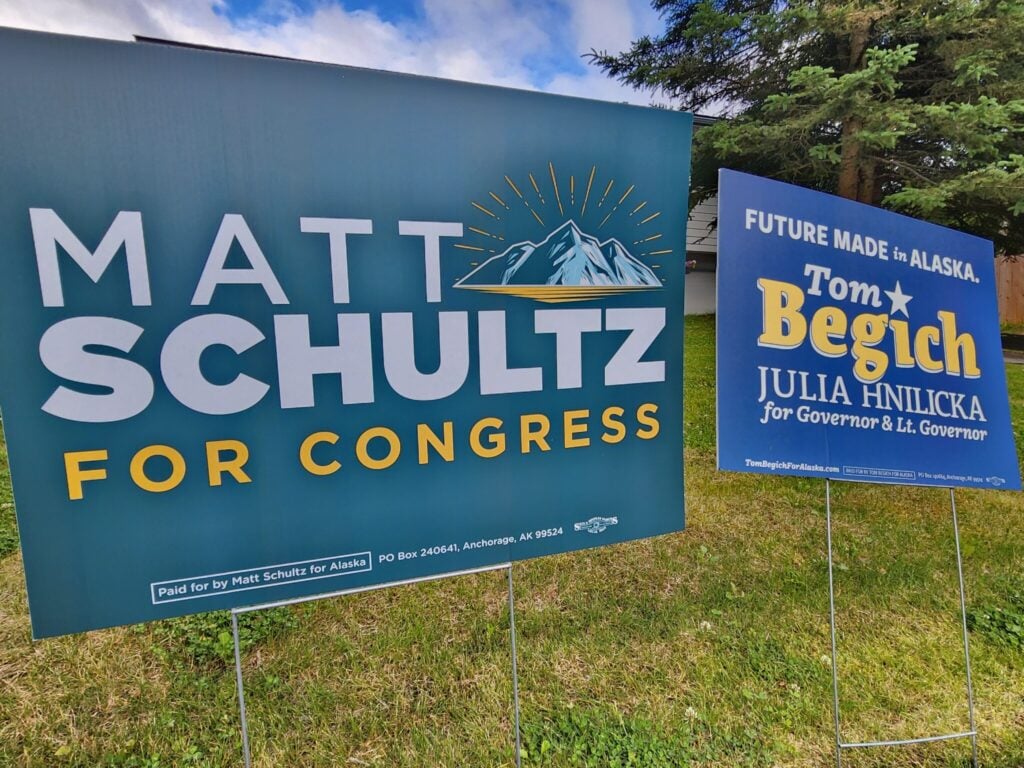
Campaign signs for Democrats Matt Schultz and Tom Begich are seen in a Midtown Anchorage yard on July 17, 2026. Schultz mounted his campaign to oust Republican U.S. Rep. Nick Begich. But he endorsed Nick’s uncle, Democratic gubernatorial candidate Tom Begich, a former state senator. Schultz suspended his campaign on July 17 and urged supporters to rally behind independent Bill Hill. (Photo by Yereth Rosen/Alaska Beacon)

On July 17, the leading Democratic candidate in Alaska’s U.S. House race suspended his campaign and announced his support for independent House candidate Bill Hill.

In an interview last week, Democrat Matt Schultz said his decision didn’t come from a lack of desire or a lack of support — it was simply a matter of money.

“One of the most disturbing things about the election process is how much … is determined by money, and I did not have a viable financial path forward,” Schultz said on July 17. 

Schultz will remain on the ballot for the Aug. 18 statewide primary but is expected to withdraw after the results become final.

Campaign finance reports through June 30 showed Schultz’s campaign with $470,681 in cash on hand. Hill’s campaign had $702,626. Incumbent Republican Rep. Nick Begich’s campaign had more than $3.2 million.

Begich and Hill are also being boosted by third-party groups. In Hill’s case, Wheel Dog PAC is preparing to spend more than $1 million and has already sent mailers to voters across the state. The National Republican Congressional Committee and other groups are spending similarly to back Begich.  

While Schultz has lagged in financial support, public opinion polling in the spring found him significantly ahead of Hill in Alaska’s top-four primary, but in head-to-head polling, Hill appeared to perform better against Begich than Schultz did. Neither polled ahead of Begich.

In Alaska’s election system, voters will pick one of the 14 U.S. House candidates during the Aug. 18 statewide primary. The top four vote-getters, regardless of party, advance to the general election. 

“If I had made it through the primary, which — I think there’s a real good chance I would have been the the frontrunner — but I would not have had the the financial war chest required to take on Nick Begich, and the priority here is to make sure that Nick Begich does not get back into office,” Schultz said.

As a candidate, Schultz has been a solid progressive. Speaking to the Beacon and writing in a column to the Anchorage Daily News, he said he feels that some Democrats are too motivated to seek a political “middle,” even when it doesn’t make sense.

“I think that shifting to the middle is not inherently virtuous. When we think about history, there are issues like slavery or in World War II when the Nazi Party was on the rise — there’s no value in saying ‘let’s be a moderate and meet them in the middle and compromise,’” he said. “I think this is a time in history right now. The reason I was so motivated to flip the House of Representatives is because the Republican Party is pulling us into fascism. They’re attacking our democracy and handing over our freedom to billionaires and trillionaires. The stakes are so very high, and yet the folks on our side of the playing field here seem to be willing to kneel and beg for our rights instead of standing and demanding them, and I think that happened in my race as well.”

Alaska’s labor unions have backed Hill, as did the Alaska Center, a progressive environmental and pro-democracy group that hasn’t supported an independent for U.S. House since Alyse Galvin in 2020. 

The Alaska Democratic Party itself declined to endorse Schultz during its April convention in Cordova, leaving open the possibility that it would support Hill instead of a party member.

The week before Schultz’s decision, the National Republican Campaign Committee signaled that it was preparing to run ads in favor of Schultz to boost his performance and help Begich. 

Both Schultz and Hill released statements denouncing the strategy. 

Under Alaska’s general-election system, voters are asked to rank their preferred candidates. The candidate with the lowest number of No. 1 votes is eliminated, and that candidate’s supporters have the option to give the vote to a second choice instead.

“Matt Schultz and the Alaska Democrat Party have been outspoken supporters for ranked choice voting, but when given the opportunity to present the public with their own candidate they chose to withdraw,” said Paul Smith, Begich’s campaign manager. “Despite raising nearly $1 million, making the case to progressives and traveling throughout the state, Democrats have proven that they support ranked choice voting only when it advantages them. Regardless, Alaskan voters will reject these political games and re-elect the most productive freshman Congressman on record, Congressman Nick Begich.”

Since 2022, when the system was used for the first time, statistics show that a significant number of voters have chosen to not rank a second or subsequent choice.

Hill and Schultz each said they believe that ads from the NRCC could have engendered bad feelings, reducing the odds that supporters would rank the other candidate.

Schultz said his top priority is ending Republican control of the U.S. House, and that holds whether or not he is elected.

“Once I recognized that I didn’t have a viable path forward, then it didn’t really matter what I’m being asked to sacrifice. I had to sacrifice (my candidacy) to make sure that we prevent that majority,” he said.

Reached by phone last week, Hill thanked Schultz.

“In his statement, he made it clear that it’s not about me or him. It’s about giving Alaskans the best chance to beat Nick Begich this fall,” he said.

“I think we’re both aligned on a lot of things that are not going right for Alaskans,” Hill said. “You look at things like, well, the cost of gas and groceries, the loss of health care to a lot of Alaskans who just can’t afford it with the loss of the (Affordable Care Act) premiums. There’s a lot of things that are going on in the House right now that are not benefiting Alaskans, and we definitely need to make sure that, in the long run, that there’s a change made there.”

One major difference between Hill and Schultz is that while Schultz sought to eliminate Republican control of the House, Hill is willing to join a Republican majority under certain circumstances.

“I am not committing to who I’m going to vote for (Speaker of the House, if elected), but I will tell you right up front that I’m not going to vote for Mike Johnson to be Speaker because he does not represent my values at all, and he has been the lead in doing things that have impacted Alaska negatively,” Hill said.

Asked what he will do to earn the votes of Schultz supporters, Hill said he understands that they may have concerns about his candidacy, “but I will assure them that I am there to make sure that we have a government that’s going to work on providing Alaskans with the opportunities and tools needed to build good lives, and that means things like making sure everybody has health care, to make sure that our school systems are good and solid, and providing the education that our that our children need.”

Categories
Alaska News Featured Juneau News juneau Juneau Local Juneau Local Ketchikan Local News Feeds Sitka Local

Alaska judge hears arguments in appeal of state striking Dan J. Sullivan from U.S. Senate race

By: Corinne Smith, Alaska Beacon

Dan Sullivan of Petersburg (left) filed to run against Republican incumbent U.S. Sen. Dan Sullivan. (Campaign photo by Dan Sullivan and photo of the senator by Corinne Smith/Alaska Beacon)

An Anchorage judge heard oral arguments on Thursday in a case poised to decide whether the Alaska Division of Elections has the authority to remove a candidate with the same name as the incumbent from the race for U.S. Senate. 

The court is expediting the case and a decision is expected Friday. Any appeals are expected to be before the Alaska Supreme Court on Monday, ahead of a looming deadline for the division to print primary ballots no later than noon on Tuesday, June 30. 

The division made the unprecedented decision to remove Dan J. Sullivan, a retired teacher from Petersburg, from the ballot on June 15, citing a “preponderance of evidence” the candidate had not filed a “good faith candidacy” and filed with the purpose to “confuse or mislead” voters. 

Sullivan appealed that decision, saying he meets all eligibility requirements to run for office. He challenged the state’s decision as unlawful, and requested the court overturn the decision and restore his candidacy on the Alaska ballot for U.S. Senate. 

In opening arguments, attorneys for the Division of Elections defended the decision to disqualify Sullivan from the ballot. They said the state has a duty to protect voters from confusion, and that the state is not obligated to place a candidate on the ballot where evidence shows t

Sullivan was one of sixteen candidates to file to run for one of Alaska’s U.S. Senate seats, challenging Republican incumbent U.S. Sen. Dan Sullivan in the high-stakes election that could determine the control of the U.S. Senate after the November elections. One candidate has withdrawn since then, leaving 14 challengers, including former Democratic U.S. Rep. Mary Peltola. The November election results will determine a candidate for a six-year term. 

Critics of Sullivan said he was trying to confuse voters to the benefit of Peltola, the Democratic front-runner. Officials with the Peltola campaign and the Alaska Democratic Party have said they have no affiliation with either Sullivan. 

Attorneys representing the Petersburg Sullivan and the Alaska Division of Elections went head to head in livestreamed Superior Court hearing, where over 300 viewers tuned in but others were not able to watch the stream. Officials with the court later apologized calling it a “record-breaking” livestream and posted a recording on their website.

Jeffrey Robinson, representing Sullivan, opened his argument reiterating that Sullivan met all the constitutional requirements to run for office: at least 30 years old, a U.S. citizen, and an inhabitant of Alaska if and when elected.

Jeffrey Robinson, an attorney for Dan J. Sullivan, argues his appeal case in Anchorage Superior Court on June 25, 2026. (Screenshot of court livestream)

“Mr. Sullivan unambiguously meets each of these criteria,” Robinson said. “As seen in previous cases, states are not allowed to add to those qualifications.”

He cited the case where the Alaska Democratic Party sought to remove Eric Hafner, a U.S. House candidate imprisoned out of state, and the division did not investigate his motives but found he met the qualifications to run for office. Robinson argued the state has subjectively and unlawfully added additional criteria for Sullivan, including restrictions on his perceived political goals, how he presents his name, campaign and his party affiliation. 

“Here the division imposed a substantive mental state-based qualification for U.S. Senate candidates in Alaska, and then it cynically and arbitrarily determined that Mr. Sullivan did not meet that qualification,” he said. 

Robinson said it’s up to political campaigns to distinguish candidates and educate voters. He agreed the division has the authority to make sure candidates appearing on the ballot do not confuse voters, and noted that there are state regulations that offer solutions, like adding middle initials. But he said there are no “good faith” requirements, nor any other regulations that would give the division such broad authority to look at a candidate’s motives for office. 

“They have no explicit authority in situations like this to even look into a candidate’s motives. Any subjective standard for candidates imposed by the division necessarily erodes the trust of voters,” he said. “If this standard were to apply, the director could challenge any or disqualify any potential reasons of personal dislike, or that the candidate may lose to their preferred candidate.”

Arguing for the Division of Elections, attorney Chris Murray said the division has the authority to review candidates and make sure the ballot is not presented in a way that would be confusing to voters.

Chris Murray, a state attorney for the Alaska Division of Elections, argues against the appeal of Dan J. Sullivan in Anchorage Superior Court on June 25, 2026. (Screenshot of court livestream)
Chris Murray, an attorney for the Alaska Division of Elections, argues against the appeal of Dan J. Sullivan in Anchorage Superior Court on June 25, 2026. (Screenshot of court livestream)

In this case, he said the division director, Carol Beecher, reviewed complaints against the candidate filed by the Alaska Republican Party and the National Republican Senatorial Committee, which works to elect Republicans, that say his name, party affiliation and campaign materials mimic the incumbent’s. Murray said Beecher found that Sullivan “accentuated the similarity” between himself and Sen. Sullivan. 

“She was stuck with the preponderance of the evidence pointing to this being a declaration of candidacy filed for the purpose of seeking office, but a declaration of candidacy filed for an ulterior purpose to cause voter confusion,” he said. “The director does not have the ability to permit that.”

Murray said in the Hafner case, there was no complaint filed prior to the primary on Hafner’s candidacy. He said the division has authority to review complaints and determine whether candidates made a “proper filing” before the primary, which they did for Sullivan.

“So where’s the line? The line is: the decision on qualification has to be made before somebody is placed onto the primary ballot, that is where Alaska law, that’s where the ‘properly filed’ comes in, that’s when there’s discretion in the Division of Elections — but that’s when the Division of Election decides who goes on the ballot, it’s before the primary election, that case was after the primary election,” he said. 

Judge Thomas Matthews asked Murray how the division would handle the situation of three Dan Sullivans, in a hypothetical situation where a former Anchorage mayor, Dan A. Sullivan decided to enter the U.S. Senate race.

Superior Court Judge Thomas Matthews presides over the appeal case brought by Dan J. Sullivan challenging the Division of Elections decision to disqualify him for running for U.S. Senate on June 25, 2026. (Screenshot of court livestream)

Murray said a “genuine candidate” would seek to distinguish himself from other candidates, and the division could use a middle initial or notation like “challenger” or “nonincumbent” on the ballot.

“I would say that if you were dealing with all of them, and all of them were trying to get on the ballot in order to win, I think they would all be cooperatively participating in a process where they could be effectively distinguished from each other, so as to avoid voter confusion. That’s not what we have here,” he said. 

Judge Matthews asked if there was a way to effectively distinguish the two Dan Sullivans.

Murray said he did not believe that is the division’s responsibility if the candidate’s goal is to confuse voters. “Where the confusion is the goal, Your Honor, we don’t believe the division is under an obligation to try and mitigate it or accommodate it,” he said. “The court could order that the division implement some method to distinguish him, and I’ll say right now, we don’t think a middle initial is sufficient.”

Murray also argued the court ruling would be an important precedent for the division to administer elections.

“If this decision is not affirmed, and it turns out that the court holds that Alaska is just simply powerless, and the division is powerless to stop this sort of behavior, we’re going to be inviting more of this,” he said.

Judge Matthews said he will announce a ruling by Friday, and it could be after business hours.

Attorneys for Sullivan also filed a stay with the court to delay the division printing primary ballots until a final decision is ruled on by the courts. Matthews said he would consider the petition.  

After the ruling, both parties are expected to appeal before the Alaska Supreme Court on Monday.

Categories
Alaska News Featured Juneau News juneau Juneau Local Juneau Local Ketchikan Local News Feeds Sitka Local

Alaska legislators probe decision to remove candidate from the ballot

By: Corinne Smith, Alaska Beacon

Members of the Alaska House Judiciary and State Affairs committees held an investigatory hearing on Monday about the state’s decision to remove a candidate from the U.S. Senate election with the same name as the incumbent  — Dan Sullivan.

The Division of Elections announced that Dan J. Sullivan, a retired teacher from Petersburg, was not eligible to run for the U.S. Senate. It cited complaints from the incumbent and Republican groups when it decided his candidacy was not in “good faith,” and aimed at confusing voters with the incumbent U.S. Sen. Dan Sullivan. The division cited a state regulation that forbids the Division of Elections from listing a candidate’s name “in a manner that is confusing or misleading to voters or compromises the fairness or neutrality of the ballot.”

But some lawmakers questioned the decision and the division’s authority to remove the challenger candidate. An attorney representing the Alaska Legislature issued a legal memo Wednesday saying the decision to disqualify the candidate was likely unlawful, since he did not violate the U.S. Constitution’s qualifications to run for office. 

The hearing took place as Dan Sullivan of Petersburg filed an appeal of the state’s decision to disqualify him from the ballot on Monday, taking the issue before a state superior court. In the complaint, Sullivan defended his eligibility and challenged the division’s decision to remove him. He argues the action is unlawful, and is asking the court to overturn the decision and restore his name on the ballot for the August primary.

Lawmakers held a hearing in Anchorage to investigate the division’s decision. Division officials declined to appear so the committee relied on testimony from attorneys.  

Judiciary committee chair Rep. Andrew Gray, D-Anchorage, opened Monday’s hearing by saying the issue under scrutiny was not the particular candidate or his motives, but about the limits of the division’s authority and whether that authority is being applied fairly.

“What authority does the Division of Elections have to remove a candidate from the ballot, and has that authority been exercised consistently?” Gray said. “Those questions matter because public confidence in elections depends on more than accurate vote counting. It depends on the public’s confidence that the rules are applied equally to everyone.” 

Gray cited a previous case where the candidate’s political motives and eligibility were challenged, but the state took a different stance. When the Alaska Democratic Party sought to remove Eric Hafner, a U.S. House candidate imprisoned out of state, the division defended his right to run for office. The Alaska Supreme Court allowed him to remain on the ballot. Hafner is running for the seat again this year. Gray emphasized the difference in the state’s approach.

“When a government agency departs from positions it has taken in previous cases, the public deserves an explanation,” Gray said. “And when a government agency removes the candidate from the ballot, the public deserves a very clear explanation.”

Lawmakers called the hearing and requested the division director, Carol Beecher, appear and participate in providing further information and an explanation for removing Sullivan. Beecher declined last week, citing the division’s work preparing the ballot scheduled to be printed on June 28. 

Legislators then issued a rare legislative subpoena and served Beecher on Sunday to compel her to appear before the committee. 

Empty chairs for tesifiers at a June 22, 2026, hearing in Anchorage on candidate qualification. The hearing was held by the House State Affairs and House Judiciary committees. Seated in the background are Rep. Steve St. Clair, R-Wasilla, and Rep. Ky Holland, I-Anchorage. (Photo by Yereth Rosen/Alaska Beacon)

On Monday, Lt. Gov. Nancy Dahlstrom, who oversees the state’s election system, issued a letter again declining to appear and threatening legal action. 

“If you refuse, we may have no choice but to seek to quash the subpoena in court due to the unreasonable timeframe provided and the lack of urgency while the appeal period is still pending,” Dahlstrom wrote.

Gray noted that division officials gave Sullivan of Petersburg only one day to respond to questions, and then removed him from the ballot four days later. He announced at the hearing that they had rescinded the subpoena and agreed that elections officials would participate in another investigative hearing scheduled for July 22.

On Monday, the committee heard from several attorneys with experience working on elections issues, including Andrew Dunmire, a legislative attorney who wrote a legal memo saying the division’s actions were likely unconstitutional. 

Dunmire wrote that under the U.S. Constitution, there are three qualifications for federal candidates: they must be at least 30 years old, a U.S. citizen for at least nine years and an inhabitant of the state when elected. He said, as seen in previous cases, states are not allowed to add to those qualifications. 

“The US Constitution is the supreme source of law in our country, and there’s no administrative regulation that can override a constitutional requirement,” he said. 

Lawmakers discussed the state regulation cited by elections officials which prohibits the division from placing names on the ballot “in a manner that is confusing or misleading to voters or compromises the fairness or neutrality of the ballot.”

Several Republican members of the committee defended the division’s actions, including Rep. Mia Costello, R-Anchorage, who said the division has a responsibility to protect the ballot from confusing or misleading voters. 

“The division does have a responsibility to determine whether or not the voters are being misled, whether it has to do with how long they’ve lived here, whether it has to do with their name,” Costello said, and questioned whether Sullivan’s motives should be further investigated by the U.S Department of Justice or the Federal Elections Commission. 

“I hope that this issue is resolved, so that anybody who wants to run for office in the state of Alaska can do it, but they cannot do it in a manner that is going to confuse or undermine the importance of elections,” she said.

But Dunmire, with Legislative Legal Services, said while the state can investigate allegations of campaign misconduct, the division has no authority to investigate a candidate’s motives in running for office. 

“It is not the division’s role, they have no explicit authority in situations like this to look into a candidate’s motivations,” he said. 

Dunmire noted state regulation has rules for when two candidates with the same name appear on the ballot. Candidates’ names would appear with a middle initial, in this case the challenger as “Dan J. Sullivan,” and the incumbent as “Dan S. Sullivan.”

Hollis French, a former state senator and prosecutor, was invited to testify before the committee and did not mince words. 

“I don’t think you would need any special legal training to smell a rat here,” French said. “If a prisoner with no ties to the state of Alaska in New York state can be put on the ballot for federal office in the state of Alaska, I think the Division of Elections is sort of foreclosed from then on, from engaging in what they’ve engaged in this case.”

French said as a prosecutor, it’s nearly impossible to prove someone’s motives. He emphasized the division can take steps to distinguish the two names on the ballot, and then it’s up to candidates to campaign and appeal to voters. 

“There’s a way to designate that in a neutral manner on the ballot, and then put the burden on the candidates to remind everybody that they’re the Dan Sullivan from Fairbanks or the Dan Sullivan with an S, or the Dan Sullivan with a J,” he said. 

Rep. Ashley Carrick, D-Fairbanks and chair of the House State Affairs Committee, said she was highly concerned about a subjective standard for candidates imposed by the division that may erode the trust of voters. 

“I think there’s a clear risk in the longer term future to the Division of Elections and Alaska’s election integrity if we see mistakes or differences of opinion in how this authority to investigate can be utilized,” she said. 

“And really, truly, my biggest concern here is that if ‘good faith,’ as was stated in the memo from the Division of Elections, becomes an additional implicit standard for candidacy, Alaska will have added more than just an additional requirement. We will have functionally added a subjective standard for qualification to run for office.”

Demonstrators gathered outside the Alaska Division of Elections in Downtown Juneau and broadcast the House Judiciary Committee's hearing in protest of the decision to remove a candidate from the ballot they said was an abuse of power and compromising election integrity on June 22, 2026. (Photo by Corinne Smith/Alaska Beacon)
Demonstrators gathered outside the Alaska Division of Elections in Downtown Juneau and broadcast the House Judiciary Committee’s hearing in protest of the decision to remove a candidate from the ballot they said was an abuse of power and compromising election integrity on June 22, 2026. (Photo by Corinne Smith/Alaska Beacon)
Categories
Featured Juneau News juneau Juneau Local Juneau Local Ketchikan Local News Feeds Sitka Local

In legislative speech, Dan Sullivan reiterates support for Trump administration, denounces Democrats

By: James Brooks, Alaska Beacon

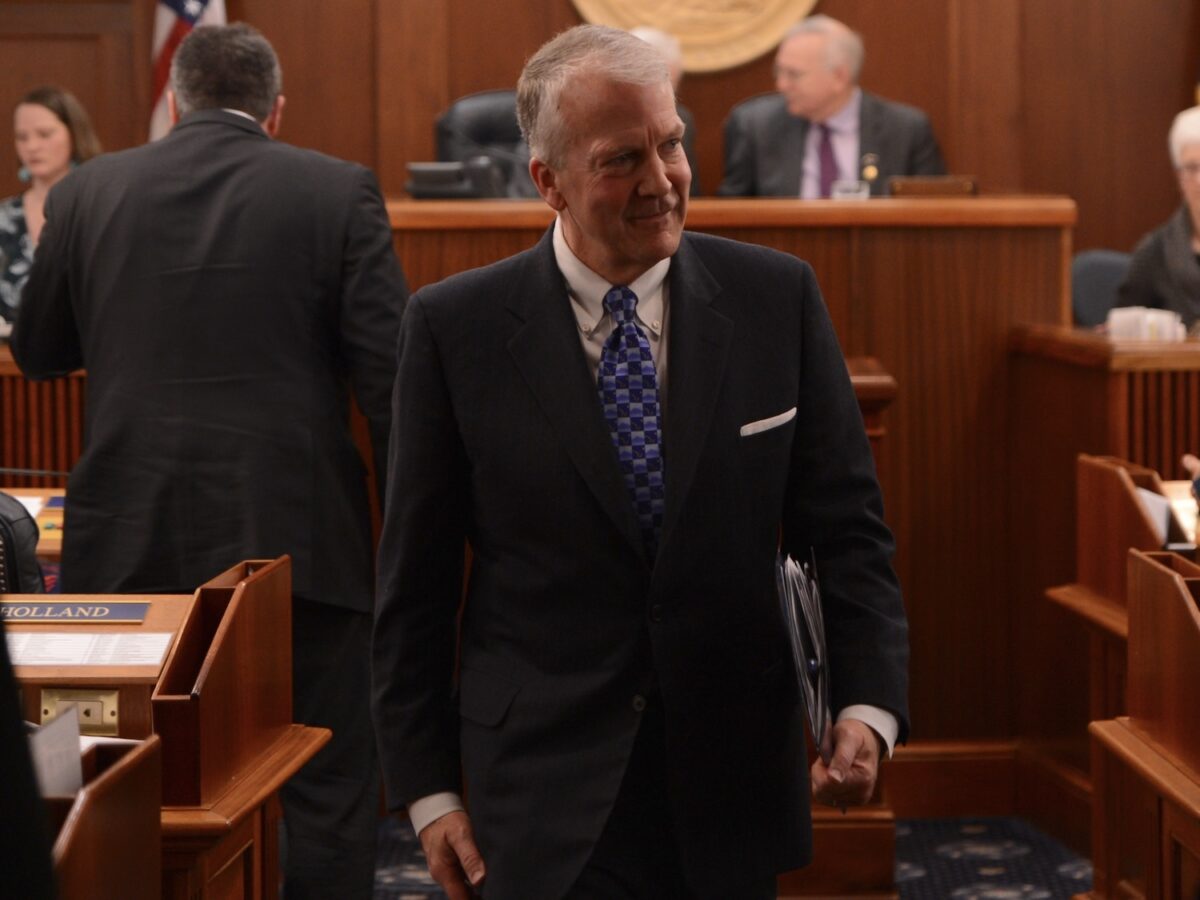
U.S. Sen. Dan Sullivan, R-Alaska, leaves the Alaska Legislature on Wednesday, Feb. 18, 2026, after his annual address to state legislators. (James Brooks photo/Alaska Beacon)

Facing a potentially difficult re-election campaign, U.S. Sen. Dan Sullivan came to the Alaska Legislature with praise for President Donald Trump’s administration and damnation for Democrats.

The Republican senator endured a gauntlet of protesters before he delivered his annual address to state lawmakers, saying his theme was an “Alaska comeback” brought about by the change between the Democratic presidency of Joe Biden and Trump’s Republican administration.

“We’re now beginning to see the beginnings of a real comeback and real progress on goals we’ve dreamed about collectively for decades,” he said, referring to the way the Trump administration has opened more parts of the North Slope to oil and gas drilling, and its stated support for a trans-Alaska natural gas pipeline.

Sen. Lyman Hoffman, D-Bethel, leads U.S. Sen. Dan Sullivan, R-Alaska, through a group of protesters in the Alaska Capitol on Wednesday, Feb. 18, 2026. Hoffman has endorsed Sullivan in this year’s U.S. Senate elections. (James Brooks photo/Alaska Beacon)

He reiterated his support for the Republican-drafted budget plan known as the Big, Beautiful Bill Act. It’s since been rebranded the “Working Families Tax Cuts Act.”

That plan calls for multiple oil and gas lease sales in Alaska, new military and Coast Guard construction in the state, and large personal tax cuts.

It also offered large one-time health care funding grants to compensate for a cut to Medicaid, cut federal food stamps and imposed work requirements for both programs. 

More Alaska-specific benefits in the Big Beautiful Bill were objected to by Senate Democrats and removed before the bill’s final passage, including a Medicaid increase that Sullivan had sought.

In his speech, Sullivan repeatedly criticized Democrats in the U.S. Senate.

“Alaskans should know who wants to help us and who wants to hurt us,” Sullivan said.

One of the legislators listening in the audience was state Sen. Forrest Dunbar, D-Anchorage.

“That was the most partisan speech I’ve ever heard a member of the congressional delegation give in the Alaska Legislature,” he said afterward.

“There was no critique of what the Trump administration has done in canceling projects in Alaska. There was no critique of what Trump has done, whether it comes to rule of law or democracy,” Dunbar said.

U.S. Sen. Dan Sullivan, R-Alaska, receives applause from the Alaska Legislature on Wednesday, Feb. 18, 2026, during his annual address to state legislators. (James Brooks photo/Alaska Beacon)

Also listening was state Sen. George Rauscher, R-Sutton. Afterward, Rauscher said he always appreciates the volume of Sullivan’s speeches and the range of subjects.

Did it feel like a campaign speech to him?

“If it felt like that, there’s probably a reason,” Rauscher said.

Until Sullivan was prompted by reporters and lawmakers, he didn’t address some of the nation’s most inflammatory issues, including the actions of Immigration and Customs Enforcement officers nationwide.

The day before Sullivan’s speech, ICE agents detained a Soldotna family, including a mother, two teenagers and a five-year-old.

Rep. Alyse Galvin, I-Anchorage, asked Sullivan about the incident. He responded that he hadn’t heard about it.

Answering reporters’ questions after his speech, Sullivan voiced soft disagreement with ICE policies nationwide, saying he supports deporting illegal immigrants with violent criminal records.

“I think that should be the focus of the administration’s efforts,” he said.

About ICE’s violent tactics in Minnesota, Sullivan said, “I put out statements, but also, importantly, weighed in with senior folks in the administration, saying, look, it’s really important to bring the temperature down on both sides — which ended up happening — and then very much that ICE needs to refine its techniques and tactics.”

Sullivan said he doesn’t believe protesters killed by ICE agents are “domestic terrorists,” as the White House has claimed.

“American citizens have the right to their Second and First Amendment rights, and I don’t think they should be targeted for that reason,” he said.

Categories
Featured Juneau News juneau Juneau Local Juneau Local News Feeds

Juneau Protesters Call on Sullivan to Reject ‘Authoritarian’ Policies

By: Grace Dumas, News of the North

Erin Jackson-Hill outside the Capitol, speaking to a group of protestors

Protesters gathered outside the Alaska State Capitol this morning, calling on U.S. Sen. Dan Sullivan to oppose what organizers described as growing authoritarianism at the federal level.

“Juneau for Democracy is a group of Juneau residents who get together in care and resistance.” Said Volunteer Anjali Grantham, “We really are a network of people trying to live our democracy and protect our democracy.”

The rally’s theme was “We the People Do Not Consent.” Participants held signs and delivered speeches criticizing Sullivan’s positions on immigration enforcement, federal spending and voting requirements.

“We are finished with the silence, we are finished with complicity, we demand a leader who will fight for us, we demand courage.” Said Erin Jackson-Hill of Stand up Alaska.

Grantham said protesters were urging Sullivan to support additional congressional oversight of immigration enforcement agencies and to oppose policies they believe undermine constitutional rights, such as the deployment of federal officers in U.S. cities, and increased funding for the Department of Homeland Security.

“We’re going to make sure that Sullivan knows it’s despicable that he has voiced support for the SAVE act.” Grantham said, this is federal legislation that would require voters to provide proof of citizenship, like a passport or birth certificate, to cast a ballot.

“Can you imagine what that would mean for Rural Alaskans? In addition to many women who have changed their name after getting married.” She said.

Voting by noncitizens has been found to be exceedingly rare nationwide and in Alaska.

“He’s an attorney, and he has not only watched but actually facilitated the erosion of our First Amendment rights, our Fourth Amendment rights, our Fifth Amendment rights and our Eighth Amendment rights. He’s a military officer, but he’s also justified the deployment of troops to U.S. cities. He’s a senator, and he’s totally abandoned the role of the legislative branch. He’s had the audacity to tell Alaskans that we should be grateful to the regime, meanwhile, the federal government has become predatory on its own people.” Grantham said.

The rally was held before Dan Sullivan delivered his annual speech to the Alaska Legislature.

“We want him to be someone who is standing against authoritarianism and not paving the way for authoritarianism.” she said.

Categories
Featured Juneau News Juneau Local Ketchikan Local News Feeds Sitka Local

Murkowski, Sullivan vote with Republicans against measure seeking release of Epstein files

By: James Brooks, Alaska Beacon

The U.S. Capitol on July 2, 2025. (Photo by Ashley Murray/States Newsroom)

Alaska Republican U.S. Sens. Lisa Murkowski and Dan Sullivan joined fellow Senate Republicans Wednesday night in voting to set aside a budget amendment that would have compelled the U.S. Department of Justice to release files related to the late sex offender Jeffrey Epstein.

The vote to table the amendment, stopping the Senate from considering it, was 51-49. 

All of the Senate’s Democrats voted in favor of the amendment, as did Republican Sens. Josh Hawley of Missouri and Rand Paul of Kentucky.

The failure of either of Alaska’s Republican senators to vote for the amendment drew criticism from the Alaska Democratic Party.

Alaska Republican U.S. Sens. Lisa Murkowski and Dan Sullivan (Alaska Beacon file photos)

Murkowski, talking by phone on Thursday, said the amendment, proposed by Senate Minority Leader Chuck Schumer, D-New York, came as a surprise, and she voted against it for procedural reasons, not because she opposes the idea of a release.

“What Schumer did was nothing more than a political stunt,” Murkowski said.

In July, Murkowski and other members of a Senate budget subcommittee voted unanimously to amend a proposed appropriations bill to mandate that the U.S. Department of Justice compile a report on the activities of Epstein, a sex trafficker with extensive ties to rich and powerful people worldwide. Epstein died in jail while awaiting trial in 2019. 

The final text of the bill requires a report, but not the release of original documents in the possession of the federal government.

President Donald Trump campaigned on releasing the documents during last year’s presidential election, but this summer has since broken that campaign pledge, downplaying the case 

In February, U.S. Attorney General Pam Bondi said she had Epstein’s client list “sitting on my desk right now.” But in July the FBI announced in a memo that there was no “client list” and no more public information would be released. The announcement caused a public outcry, and the federal government still has not released the documents.

Trump’s social relationship with Epstein was well-documented, and this week, the Wall Street Journal published a copy of a birthday greeting Trump sent to Epstein in 2003. Trump has claimed the letter doesn’t exist, but it bears his signature.

The letter was released to the public after being obtained by U.S. House members investigating the Epstein case.

“I have been — I don’t know if it’s fair to say one of the rare Republicans — certainly a very early Republican on the Senate side who said, ‘Look, just, just release these Epstein files. Just get this stuff out there,” Murkowski said.

The appropriations bill with Murkowski’s preferred Epstein language would fund the U.S. Department of Justice and other commerce and science-related parts of the federal government. For that reason, it’s been nicknamed the “CJS bill.”

It has not yet come to a floor vote, and with senators hurrying to pass budget bills before the end of the federal fiscal year on Sept. 30, it isn’t clear when it will come up.

“Will we see the CJS as part of a floor package that could move through the Senate? It’s not impossible, but we are kind of running out of daylight,” Murkowski said.

Part of that uncertainty is due to Senate Democrats’ opposition to the overall contents of the bill. That opposition has slowed the bill’s progress.

Schumer’s amendment would have forced the Senate to debate the Epstein issue immediately, as part of the annual defense authorization bill now under debate.

In response to a request for comment, Sullivan’s office issued a written statement that also criticized Schumer’s amendment and defended his vote.

It said in part, “Senator Sullivan has repeatedly said that he believes the DOJ should release as much information as possible on Epstein’s horrific crimes, while protecting survivors. Chuck Schumer tried slipping the Epstein provision into the National Defense Authorization Act (NDAA), knowing full well it would be stripped out as the bill went through the process, leaving no doubt he’s using Epstein’s atrocious crimes as a political pawn instead of focusing on building up our military in the NDAA, which Schumer has never shown any interest in doing.”

Murkowski said the amendment disrupted normal work on the defense bill and “threw a real wrench into the whole negotiated process that had really been moving along in a positive way.”

She said she believes Schumer brought up the Epstein issue because Senate Republicans are preparing to change the rules for the confirmation of Trump’s executive-branch nominations.

Ordinarily, the Senate approves uncontroversial nominees without a roll-call vote to make the process more efficient. Since the beginning of Trump’s second term, none of his nominees have been approved without a roll-call vote, an unprecedented change in the Senate, and one that has slowed both the Senate and the Trump administration’s confirmations.

In response, Senate Republicans are planning to change the Senate’s rules to allow the approval of multiple nominees with a single vote.

“I think he was trying to kind of change the narrative,” Murkowski said of Schumer’s proposed amendment. “I don’t think he was making much headway on his pushback on some of the nominations. And he made a decision that, I think, is going to be short-lived in its political fire. He really kind of poisoned the waters around here in terms of good-faith negotiations.”

The day after the vote, Alaska Democratic Party Chair Eric Croft released a statement, saying by email: “Just two months ago, Dan Sullivan called on the Department of Justice to release the documents to shine a light on convicted sex offender Jeffrey Epstein’s horrific crimes. But last night, Dan Sullivan was a deciding vote to continue the cover-up and block an effort to force the DOJ to release the Epstein files. Instead of listening to Alaskans and the victims of Jeffrey Epstein, Sullivan acted in his usual fashion – like a spineless politician who’s only loyal to his billionaire buddies. Alaskans and survivors deserve better.”

Sullivan faces re-election in 2026 and is running for another term in Congress.

To date, no Democrat has filed with the Alaska Division of Elections to challenge Sullivan. Filings with the Federal Elections Commission show Republican Christopher Miklos of Homer and Democrat Ann Diener of Fairbanks have filed forms necessary to begin fundraising.

The U.S. House, meanwhile, is close to having enough support to force a vote on the Epstein issue. While Speaker of the House Mike Johnson, R-Louisiana, opposes bringing up the topic, a bipartisan petition could override the Speaker if it has 218 signatures. As of Wednesday night, it had 217. Alaska’s lone member of the House of Representatives, Rep. Nick Begich, has not signed the discharge petition. His office did not respond to questions about his position on the Epstein issue and whether he will sign the petition.