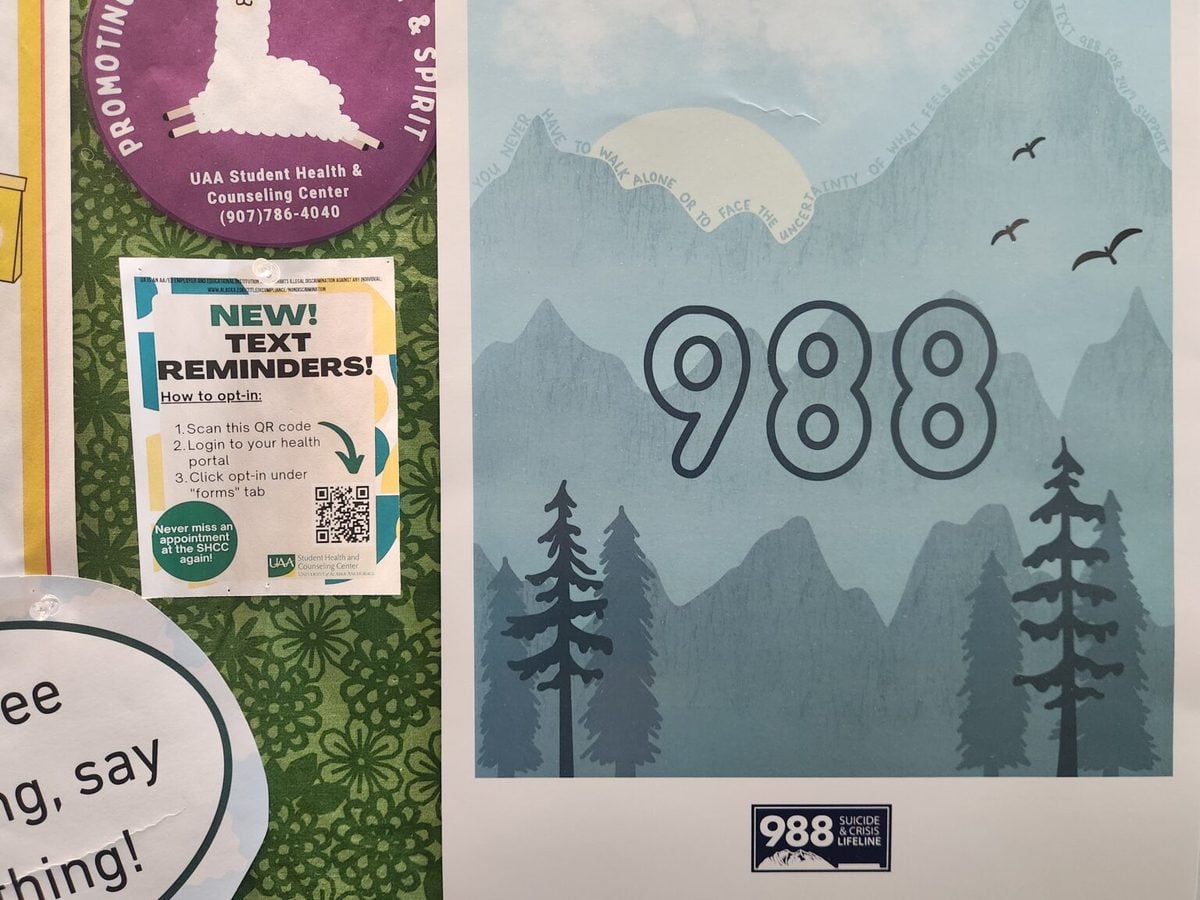
A flier seen Wednesday on a bulletin board at the University of Alaska Anchorage campus publicizes the 988 Suicide and Crisis Lifeline established in 2022. The 988 hotline is one of many programs aimed at preventing suicide. (Photo by Yereth Rosen/Alaska Beacon)
The suicide-death rate for young Alaskans hit a 10-year high last year and the rate of suicide attempts has increased over the past decade, state health officials reported.
From 2016 to 2025, there were 174 suicide deaths among Alaska youths under the age of 18 and 4,101 documented suicide attempts, according to a bulletin released by the Alaska Department of Health’s epidemiology section. The median age of those who died was 16, the bulletin said. The fatality rate, 19.2 per 100,000 children aged 10 to 18, was the highest rate since 2016.
Overall, Alaska’s youth suicide rate is nearly six times the nation average, the bulletin said.
Boys were victims in the vast majority of youth suicides over the 10-year period, accounting for 81% of the deaths, and most used firearms. Girls accounted for about three-quarters of the documented suicide attempts, according to the bulletin.
Those statistics point to “the need to prioritize timely follow-up and intervention following attempts among females and efforts to reduce access to highly lethal means (particularly firearms) among males during periods of crisis,” the bulletin siad..
For Alaska Native youths, the statistics are especially grim. Over the decade-long period, the suicide fatality rate among Alaska Natives aged 10 to 18 was 47 per 100,000 children, more than twice the state rate. The rate of documented suicide attempts was 1,098 per 100,000 children, also more than twice the state rate, according to the bulletin.
Special care should be used to address the problem among Indigenous youth, the bulletin said.
“The disproportionate burden of suicide among Alaska Native youth underscores the need for prevention strategies that are culturally responsive and community informed,” the bulletin said.
Statistics cited in the bulletin come from the Alaska Violent Death Reporting System and the Alaska Health Facilities Data Reporting system. The bulletin noted that statistics on suicide attempts likely understate the numbers because some attempts do not result in encounters with the healthcare system and therefore probably go unreported.
Suicide is also a major threat for adults in Alaska, state records show.
A graph shows suicide fatality and attempt rates per 100,000 people in Alaska from 2016 to 2025. (Graph provided by Alaska Division of Public Health epidemiology section)
It was the sixth leading cause of death in the state across all age groups, according to the most recent Department of Health status report in the Healthy Alaskans program. In comparison, suicide ranks 11th among causes of death nationally, according to the report.
There are some prevention programs in place in the state.
One is the national 988 crisis line, which in 2025 alone received nearly 44,000 calls from Alaskans.
Other programs are tailored to Alaska Native communities. One of those was designed for the rural Yukon-Kuskokwim region in Western Alaska by the Center for Alaska Native Health Research at the University of Alaska Fairbanks. And the Indian Health Service has a national program called the Zero Suicide Initative.
While suicides have been inching up over time, that “doesn’t necessarily mean that prevention strategies haven’t been successful,” Ashley Hannigan, a state epidemiologist who helped write the bulletin, said by email.
“It’s difficult or impossible to pin down the number of suicide attempts prevented by programming like the careline/988 or the Zero Suicide initiative,” Hannigan said. “The peak we see in 2025 for youth and adolescent suicide does emphasize the need to focus on youth-specific, and culturally tailored suicide prevention strategies, however.”
One idea for preventing youth suicide emerged this year in the Alaska State Legislature, but it was rejected by the governor.
Lawmakers passed a measure, Senate Bill 41, that would have established mental health guidelines for public schools. Sen. Elvi Gray-Jackson, D-Anchorage, the bill’s prime sponsor, described youth suicide as “a crisis that impacts every community in our state,” and said the bill would expand mental health services to children who need them but might otherwise lack access.
Gov. Mike Dunleavy vetoed the bill on June 18. In his veto message, he said student mental health was important but that the bill would place the state “in the role of imposing upon school districts to mandate the development of mental health education at a time when districts are already working to meet existing requirements.”
Lawmakers attempted the next day to override the veto but fell short of votes to do so.
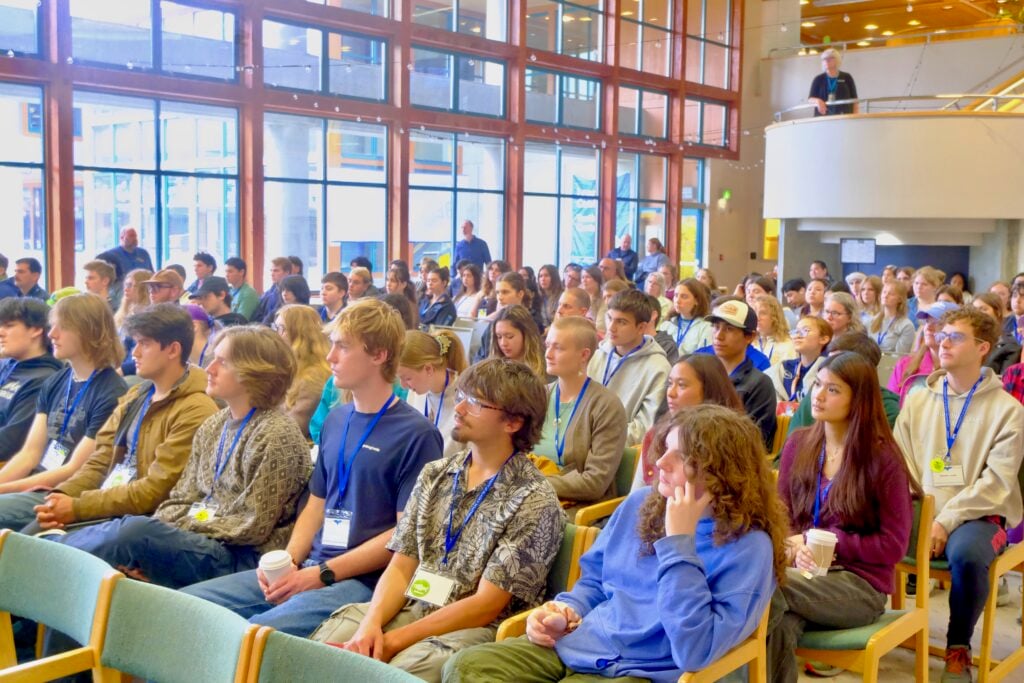
New students at the University of Alaska Southeast attend orientation at the Egan Library on the Juneau campus on Aug. 21, 2026. (Photo by Corinne Smith/Alaska Beacon)
Under a driving Juneau rain, dozens of new students at the University of Alaska Southeast gathered Friday for orientation and to kick off the fall semester. This year, the public university saw a boost in enrollment of out-of-state students, which officials and students say is largely due to a new policy eliminating the non-resident tuition rate.
UAS piloted the new tuition policy this year, called Alaska Unlocked, which offers the standard in-state tuition rate for all undergraduate courses, regardless of the student’s residency.
That’s resulted in an estimated 36% increase this year in out-of-state students enrolling at UAS compared to last year, according to university officials.
New students at the University of Alaska Southeast attend orientation at the Egan Library on campus in Juneau on Aug. 21, 2026. (Photo by Corinne Smith/Alaska Beacon)
“We are so thrilled with that much of an increase,” said UAS Chancellor Aparna Palmer, in an interview after her welcoming remarks to students at the Egan Library. “We know that a high percentage of our graduates stay in Alaska and work in Alaska within one year of graduation. And so most of these students are our future Alaskans.”
New students have arrived from 28 states, according to university data, with the top home states including Washington, California, Colorado, Idaho, Minnesota and Wisconsin.
The in-state tuition rate was a draw for 22-year-old Nicole Wilson of Phoenix, Arizona. After classes at community college, she enrolled at UAS to pursue a bachelor’s degree in marine biology with a focus on mammals. “I decided to come here both based on the in-state tuition and also because it was such, like, an ‘open to marine biology’ type school. My original plan was to go out to Hawaii, but it’s extremely expensive from out of state,” she said.
Wilson said housing was also a factor. “I did the math. If I were to take a dorm, which I would have had to, at any of the major universities in Arizona, it was actually more expensive than coming out to Alaska,” she said.
Cost of housing was the main consideration for 20-year-old Owen Kellon of Portland, Oregon, who is pursuing a bachelor’s degree in environmental sciences. “It was the bigger concern when it came to the cost of schooling, just because tuition was like a couple hundred bucks per class, which is perfectly reasonable. It’s about how much I was paying back at my community college in Portland, but the housing cost was the biggest factor.”
The John Pugh Hall student dorms houses 120 beds for students on-campus in Juneau, seen on Aug. 21, 2026. (Photo by Corinne Smith/Alaska Beacon)
The standard in-state tuition rate is expected to be available across the University of Alaska system next year. Earlier this month, the UA Board of Regents moved to eliminate out-of-state tuition rates for all locations and degree types, aiming to draw more students to Alaska.
Currently, out-of-state tuition is double to quadruple the amount of resident tuition, depending on degree type. The Board of Regents is expected to take up a final vote on the policy change in November.
UAS has the smallest student population of Alaska’s public universities, with roughly 3,600 students last year across campuses in Juneau, Ketchikan and Sitka.
This year’s preliminary enrollment data shows roughly the same number of students as last year, signalling Alaskan student enrollment may have declined. But Palmer emphasized that it’s too soon to tell, as enrollment numbers are subject to change in the next few weeks with more Alaska students possibly signing up for dual enrollment programs or classes beginning later in the fall.
University of Alaska Southeast Chancellor Aparna Palmer welcomes new students at orientation in Juneau on Aug. 21, 2026. (Photo by Corinne Smith/Alaska Beacon)
This year, UAS saw a 21% increase in applications from out-of-state students, and a 36% increase in newly enrolled out-of-state students. More than 80 new out-of-state students have enrolled this year, compared to 60 students last year, according to university officials.
UAS is an open access enrollment institution, Palmer noted. “What that means is, no matter where you are in life, whether you just graduated from high school, in high school, or whether you’re, you know, in your sixties or seventies, there is a way in which you can access UAS,” she said.
Most students are working adults or part-time students, Palmer said, and can enroll in classes in-person or online. “So, we do have a really diverse group of students,” she said.
In Juneau, new students had a jam-packed schedule for orientation week. On Friday, students were welcomed by UAS administrators, a Tlingit elder and student leaders, followed by a campus tour and briefings on campus resources, student clubs, tutoring, career counseling, and anti-discrimination and Title IX rights and reporting.
Students expressed excitement for the new school year and to be in Alaska, including Owen Kellon of Oregon.
“I love the rain,” he said. “ I am excited to see how the winter months will look like with only like six hours of sunlight. I’m scared, but I’m also excited.”
New students at the University of Alaska Southeast pose for a photo by Auke Lake during a campus tour as part of orientation in Juneau on Aug. 21, 2026. (Photo by Corinne Smith/Alaska Beacon)
Correction: This story has been updated to correct the number of students enrolled at UAS, which was roughly 3,600 students last year.
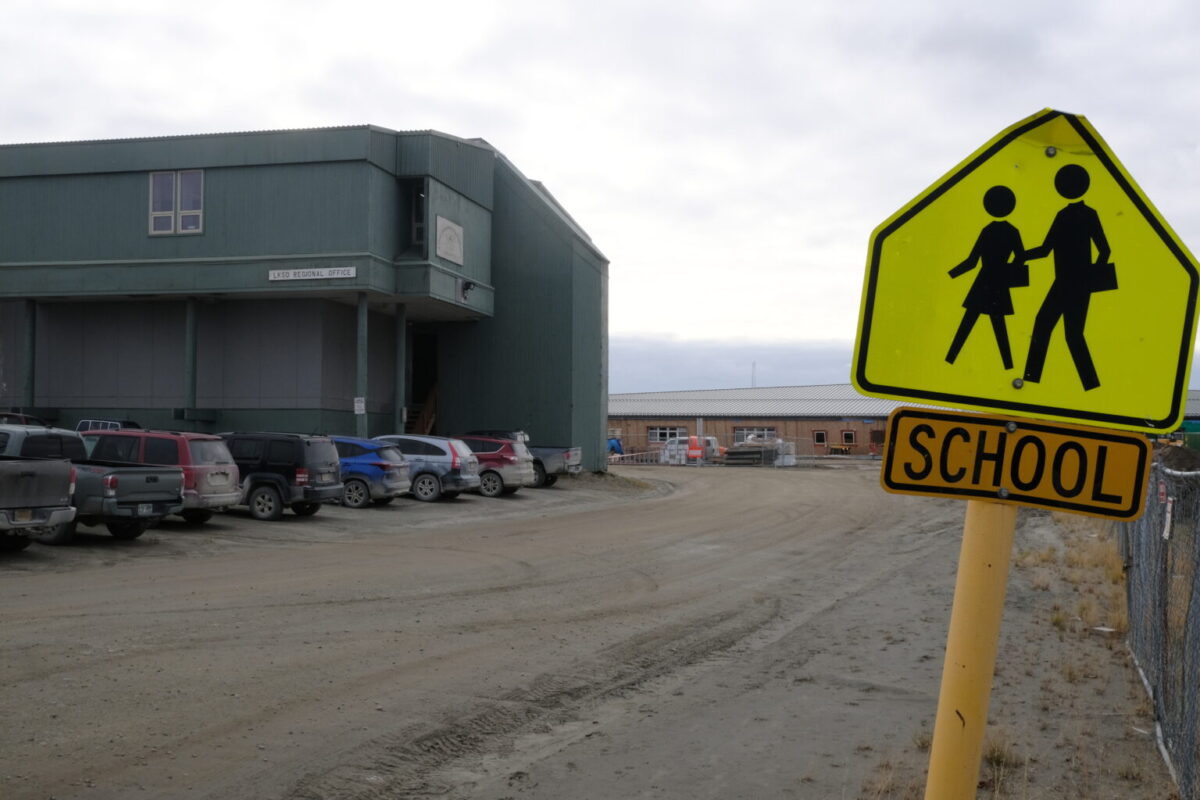
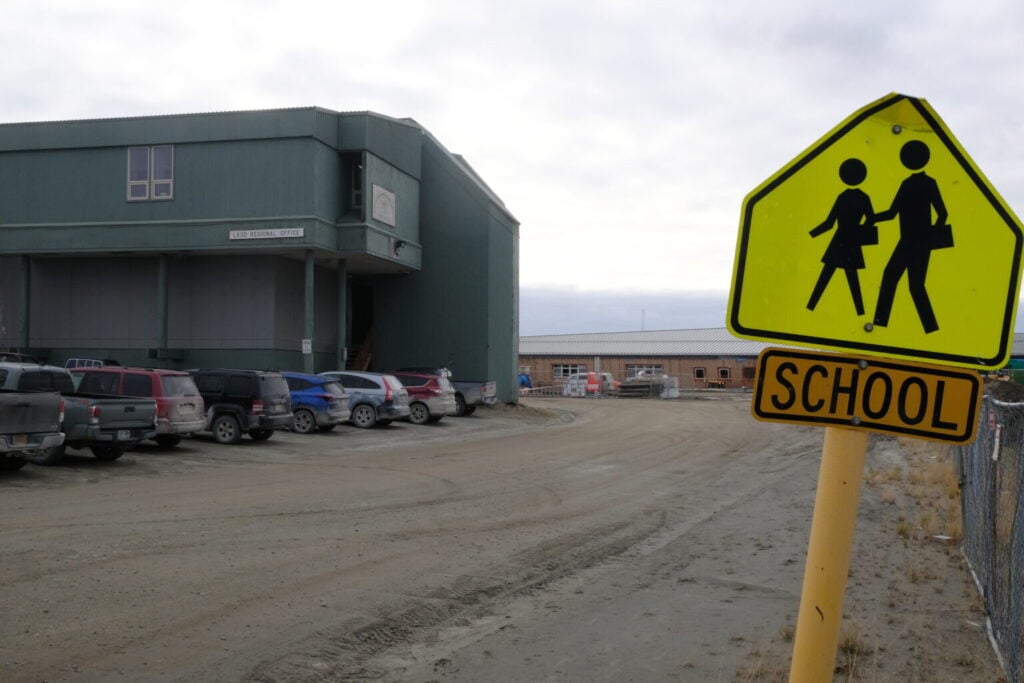
A road sign marks the road towards the Lower Kuskokwim School District offices and the Bethel High School on October 9, 2023. The district is a recipient of Alaska Native Education Program grant funding. (Photo by Claire Stremple/Alaska Beacon)
The U.S. Department of Education is expected to award $41.3 million in grant funding through the Alaska Native Education Program to 26 Alaska grantees after some delay, according to an announcement from Alaska Republican U.S. Sen. Lisa Murkowski.
The grant funding was expected on July 1, but has been delayed more than a month. Grantees alerted Murkowski’s office they had not yet received the funding, prompting Murkowski to press the U.S. Sec. of Education Linda McMahon to release the awarded funding, according to the statement on Aug. 5.
“Last week, I raised this issue with Secretary McMahon, and I’m pleased she agreed to expedite the obligation of the funds for the Alaska Native Education Program grants that Congress appropriated earlier this year,” Sen. Murkowski wrote.
The Alaska Native Education Program provides federal funding to “meet the unique education needs of Alaska Natives” and to support education programs to benefit Alaska Native people, according to the program website.
Officials with the U.S. Department of Education’s grant office for the program did not give a reason for the delay or specify when the funds will be dispensed after a query on Friday.
The grants are awarded to Tribes, tribal organizations and school districts with a majority of Alaska Native students to support a variety of initiatives across a three-year grant period.
“Grants provide, for example, culturally relevant curriculum, tutoring and other academic supports, indigenous language revitalization, workforce development opportunities, teacher professional development, postsecondary planning and support, and success, early childhood education, and afterschool programming,” Murkowski said in the statement.
“I will continue to champion this program and work with the Department to ensure this funding is administered more expeditiously going forward,” she said.
Grantees include several early learning and literacy programs. Millions are slated for Indigenous language, art, science, and medicine including $2.1 million for the Baby Raven Reads project by Sealaska Heritage Institute and $1.4 million for tutoring and college readiness programs through the Rural Indigenous Students College Readiness Alliance launched by the Bering Strait and Lower Kuskokwim School Districts, two of Alaska’s largest, rural districts.
Rosita Kaaháni Worl, president of the Sealaska Heritage Institute, a Native non-profit corporation focused on Tlingit, Haida and Tsimshian cultures, said her organization was one of the grantees that alerted Murkwoski’s office to the delay. Sealaska has not received its grant funds yet.
The Sealaska Cultural Values Totem Pole represents all three tribes of Southeast Alaska – Tlingit, Haida and Tsimshian. (Photo by Lisa Phu/Alaska Beacon)
Worl said in an interview Friday that federal funds and support for Alaska Native communities is critical, given Alaska’s history of suppressing Native education and language.
“So these programs have helped us overcome the effects of that kind of suppression,” she said. “Our data shows definitely that it promotes and enhances Native education, and we show that through all of our evaluations…it’s led to higher academic performance.”
She said SHI has seen success in early childhood programs like Baby Raven Reads project and initiatives to support students continuing education, which reduces drop out rates. “We’re still behind non-natives, but we’re gaining ground,” she said.
Worl said the federal support helps Sealaska Heritage Institute provide annual funding for education across Southeast Alaska where state funding has fallen short. SHI provides $1 million each year to the Juneau School District and $2 million annually to the University of Alaska Southeast, as well as funding to support school districts across the region for teacher training, arts and language programs.
“It’s a program that has proven benefits,” she said. “There, there’s no doubt about it.”
The Alaska Beacon, Alaska Public Media, KTOO and the Anchorage Daily News worked together this year and have created a voter guide to help Alaskans make informed choices when they vote.
The 2026 Alaska Voter Guide won’t replace debates, forums and public statements. Instead, it’s something extra, aimed at informing voters about what candidates believe and providing a tool to hold them accountable once elected.
We’ve been working for months on this and are pleased to present it to you today, on the opening day of early in-person voting.2026 Voter Guide
The candidates, the ballot measures, and the tools you need to cast your vote.
Each news organization asked its readers, viewers and listeners a basic question: What do you want candidates to talk about?
That’s what’s called the “citizens agenda” — where election reporting is less about determining who’s ahead, and more about what a candidate’s positions are and how they would affect things if elected.
We sent emails to every candidate in the first week of July and followed up by phone calls in the second week. We continued reaching out, by email, text message and phone call, throughout July.
In the end, 107 of 132 state legislative candidates responded — 81% of everyone running for the Legislature. That’s a huge improvement over two years ago, when 78 of 115 candidates answered a survey from the Beacon alone, or 67.8%. Four years ago, the Beacon’s rate was below 60%.
For the governor’s race, 14 of 17 candidates responded. For the U.S. House race, we received responses from 11 of 15 candidates, including Democratic candidate Matt Schultz, who has suspended his campaign but is still on the ballot. In the U.S. Senate race, we have answers from 11 of 16 candidates.
While it isn’t everyone — and we’ll continue pursuing answers — we’re proud to say that this questionnaire is the most complete one that you can find anywhere in Alaska.
When it comes to the Legislative races, the Beacon had the lead role and was in charge of questions. Here’s what we asked candidates and why:
Would you be willing to serve in a coalition majority where members of the other party are in leadership? Why or why not?
Whoever is in the majority controls the agenda and decides which bills advance and which bills fail. Alaska is the only state in the country with coalitions in both the House and Senate. The difference between a Republican-led majority and a coalition one is a big one in terms of what the Legislature does over the next two years.
What’s the biggest need in your district, and how would you address it?
This is an opportunity for candidates to show how much they know about local needs; it’s also a chance for them to talk about any issues we didn’t bring up.
What do you think should be done to improve public education in the state?
You, our readers, wanted candidates to talk about education more than anything else. This gave candidates a chance to talk about their platform.
How should the Alaska Legislature handle the Permanent Fund dividend?
This was probably the No. 2 issue that you brought up when we asked you what you wanted candidates to talk about.
How should lawmakers balance state revenue and expenses in the long term?
This is closely tied to the dividend question and meets your request to ask candidates about a fiscal plan.
When you look at the state budget, what’s the No. 1 thing you’d like to see cut or reduced, and what’s your No. 1 preferred way to raise new state revenue?
Like the previous question, this is a way to test candidates about their knowledge of the state budget and get their thoughts on a fiscal plan. That will be a major topic over the next two years.
What, if any, changes does the state need to make to its elections and voting system?
Voting and elections came up again and again when we asked readers what they wanted candidates to discuss. The Legislature has tried — and failed — to enact an elections bill over the past six years, so it’s a safe bet that the 35th Legislature will try again.
What threats do you see facing Alaska in the next four years?
This was our way of allowing candidates to show their priorities — what are they most worried about?
What should legislators do to make Alaska a better place for children and families?
This question came in response to your desire to see candidates talk about preschool, daycare, early childhood education and more.
As Alaska’s average age rises, what needs to be done to make the state a better place for older residents?
Alaska is the fastest-aging state in the country, and that trend is expected to continue. It’s something that the next Legislature will have to address. This question allows candidates to speak to older Alaskans directly.
What should Alaska do to keep residents and visitors safe from crime and disaster?
This question gave candidates a chance to talk about crime and climate change, data centers, energy shortages … it was really open-ended.
What, if any, change would you make to state law to support the Alaskans who are dependent on fish harvests and the fishing industry?
Candidates have been talking about fishing quite a bit this year, but it’d be a mistake to ask state-level candidates about trawling, given that most of it takes place in federal waters and there’s little the Legislature can do about it. So this question is more general.
What do people not know about you that you think they should know?
We’re not normally a fan of softball questions in these surveys, but they can be an opportunity to get to know a candidate’s personality, so this was an open-ended opportunity.
What should the Legislature do to help Alaskans with the high cost of living?
Inflation and cost of living came up as issues in a big way later in the spring, and we wanted to make sure we asked candidates about it.
How are the Trump administration’s policies working in Alaska? Where do you see them working well, and where do you see problems?
Our readers wanted very much to hear candidates talk about Donald Trump and whether they’re for or against him and his policies. This is a way to bring that question to a state level and make it applicable to the Legislature.
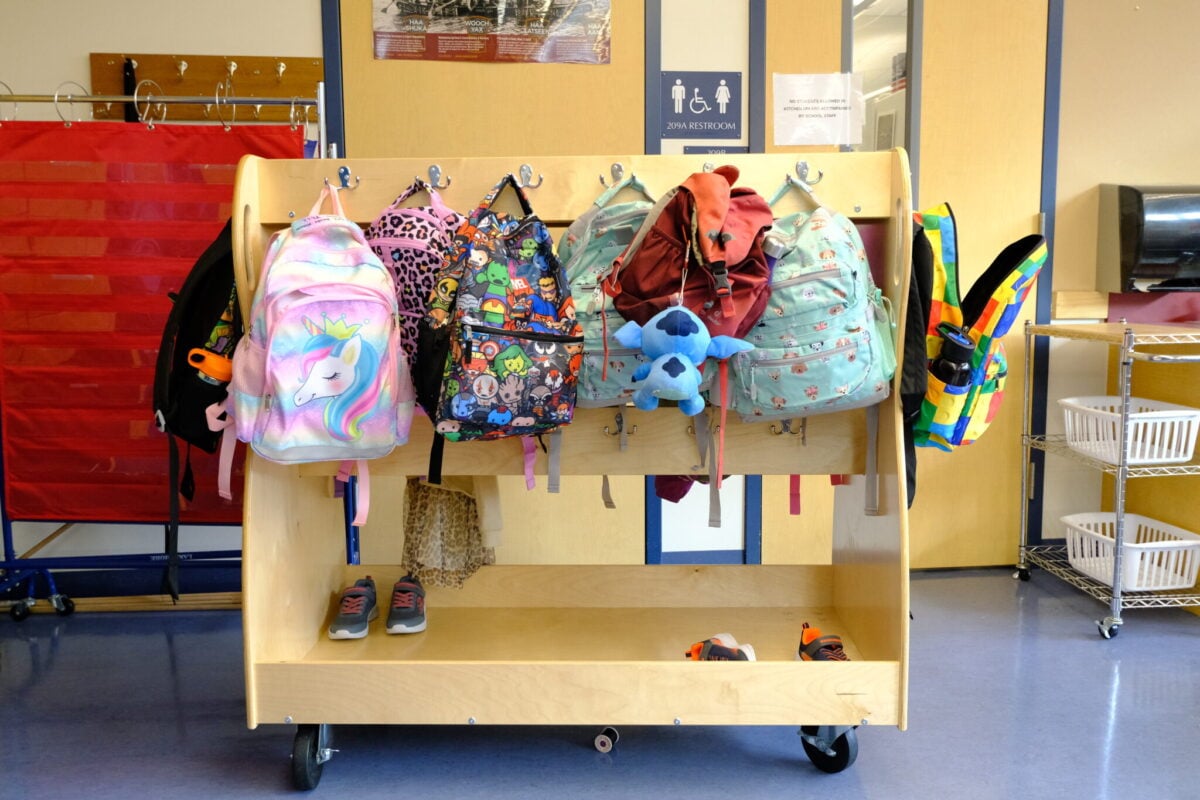
Student backpacks seen on the first day of school at Harborview Elementary School in Juneau on Aug. 15, 2025 (Photo by Corinne Smith/Alaska Beacon)
Content warning: This story contains references to sexual violence and abuse of children.
A new statewide initiative aims to prevent and reduce Alaska’s pervasively high rates of child sexual abuse.
The statewide prevention plan is led by the Alaska Children’s Trust, a non-profit advocacy group focused on supporting children and families and preventing child abuse and neglect.
Trevor Storrs, the president and CEO of the Alaska Children’s Trust, said a coordinated effort among state and community groups, service providers, schools, caregivers and youth is needed to make serious strides in intervening and preventing abuse.
“We should not expect children to fight off these predators. We want them equipped with the tools, but it’s our job, not just as adults, but as a community and society, to make sure kids are safe,” he said.
If you or someone you know has experienced sexual abuse or are healing from a crisis, resources are available:
The StrongHearts Native Helpline: Confidential 24/7 confidential helpline for Native Americans and Alaska Natives dealing with domestic and sexual violence. Call 1-844-762-8483 or use the chat feature.
Child sexual abuse prevention resources provided by the Alaska Children’s Trust can be found here.
AWARE’s list of resources, including housing, medical and financial resources
The plan was developed last year with a variety of statewide groups, including representatives from Child Advocacy Centers, the Alaska Department of Education and Early Development, the Office of Children’s Services, which runs the state’s foster care system, law enforcement, Tribes, health care providers, lived experience experts, faith communities, and the Alaska Network on Domestic Violence and Sexual Assault.
Storrs said the plan focuses on education and raising awareness, as well as preventing harm by developing and strengthening institutions so that questionable behavior is identified and stopped.
“If we don’t keep strong boundaries established, that’s when we start opening the door and predators see their opportunity,” he said. “If we keep those strong and not have those potential openings, it actually prevents the predators from ever accessing, or anybody who’s had even a slight inclination — they’re not being tempted to even try — and that is what our job is.”
The group launched the plan earlier this month and is providing an initial $100,000 in grant funding for prevention work in the three priority areas outlined by the initiative. Nonprofit organizations, tribes, local or state governments, schools and regional attendance areas are invited to apply by July 17.
Alaska has some of the highest rates of sexual violence and rates of child abuse, neglect, and child sexual abuse, in the nation. Many victims delay or never report abuse. A U.S. Department of Health and Human Services’ Child Maltreatment report published this year noted reports of child abuse and neglect have declined somewhat since 2020, but Alaska rates in 2024 were 80% above the nationwide average.
Nationwide, American Indian and Alaska Native children have the highest rates of victimization, and in Alaska national data from the maltreatment report shows rates of abuse among American Indian or Alaska Native children are nearly three times higher than the overall statewide average.
The Alaska Children’s Trust cites a national survey by the U.S. Centers for Disease Control and Prevention from 2013 to 2015 that showed on average one in five Alaska children experience sexual abuse. A 2023 report from the Alaska Children’s Justice Act Task Force showed that an estimated one in seven children will experience an allegation of sexual abuse before their 12th birthday.
“The majority of child abuse and neglect cases that are substantiated are neglect, then it’s physical, and then it’s a small fraction of child sexual abuse,” Storrs said. But sexual abuse can have severe impacts on a child’s development, according to the CDC, with short and long term effects, including chronic health conditions, mental health issues and even post-traumatic stress disorder, or PTSD.
Child sexual abuse is defined as any sexual activity between a child and adult or a child and another child that the child does not fully understand, does not consent to or is not developmentally prepared for and therefore cannot consent to. In Alaska, lawmakers this year changed the law to raise the age of consent to 18 years old.
An estimated 90% of child sexual abuse is perpetrated by someone known to the child or the child’s family, according to the CDC.
Perpetrators can exploit what Storrs calls “natural trust” to get close to a child, including people in positions like a coach, teacher, religious leader or friend of the family, in a pattern of behavior called grooming.
“Grooming is developing that relationship, developing a trust with the family that the child can be left alone with them,” Storrs said. “The trust with the child where their interactions may feel awkward, but are okay. The trust that it’s okay to keep secrets. They really build that trust and build that relationship that then allows them to abuse the child, to do what they do. And you see that in story after story when you talk to a survivor of child sexual abuse, they talk about the relationship.”
Storrs says addressing the stigma to intervene when behavior is inappropriate, also means implementing proper protocols for adults interacting with kids. He said for example, coaches should not text youth individually, but include parents in all communications.
That extends to online safety, he said. Nationally, there are increasing rates of predatory behavior and “sextortion,” a form of blackmail where perpetrators threaten to disclose information or images unless the victims make specific demands. Storrs said caregivers should talk with children and youth about what is and isn’t appropriate, in person and online.
“It’s also making sure that your child understands what the expectations and rules are, as well, of what it’s like to interact with an adult, and what are those boundaries,” he said.
Storrs said in raising awareness of potentially predatory behavior, it’s also important to trust children when they disclose inappropriate behavior.
“A lot of kids don’t disclose that X is happening, what they start disclosing is, ‘I don’t feel comfortable, I don’t want to go. I don’t like hanging out with this person anymore.’ They don’t feel connected,” he said. “That’s a sign.”
The statewide prevention plan likens preventing child sexual abuse to wildfire prevention. That means reducing risks, setting safety codes, educating communities and monitoring high risk situations — to prevent harm.
Three approaches to prevention
The statewide prevention plan has a three-pronged approach: educate and mobilize, cultivate safer environments and act early to prevent harm.
Storrs says all three involve children, families, and community-wide efforts, and the plan calls for local advocacy groups, service providers, schools and governments to gather community input and develop their own child sexual abuse prevention programs and resources best fit around cultural values. The initiative calls for local communities to develop and strengthen systems for children to safely report harm without fear of punishment and family disruption.
The first prong focuses on education: increasing awareness and reducing stigma, and increasing the number of people able to take action proactively. That means training for youth-focused employees like teachers and coaches, and building in protocols for reporting and addressing inappropriate behavior. It also involves providing educational resources for parents and caregivers on healthy boundaries, warning signs, and how to respond to concerns.
The plan calls for education and resources for children and youth on what’s appropriate. Storrs says the plan suggests children receive human development education, not necessarily sex education, so that children develop an understanding of consent, their body anatomy and healthy relationships.
“When you talk to a child about something, it does not give a child permission to engage in something or to act inappropriately,” he said, adding that teaching kids about sex does not give them permission to have it in the same way that teaching kids about car accidents doesn’t give them permission to drive recklessly.
Education is aimed at empowering children to identify when physical boundaries have been violated, Storrs said. “So when a kid needs to talk about any of their private areas or someone is trying to talk about it or touch it, they’re able to know what’s appropriate and what’s not appropriate,” he said.
Similarly, reducing shame and stigma can empower children to talk with an adult or caregiver when they’ve experienced or seen adults behaving inappropriately. Children should know that adults should never ask them to keep secrets, Storrs said, and when inappropriate behavior has occurred they can get help to stop it from continuing.
The second prong, “cultivating safer environments,” calls for state and local governments, Tribes and service organizations to support programs and policies that help families meet essential basic needs to address conditions that put children at risk for sexual abuse.
Storrs noted that children and families with unstable housing, inadequate child care or health care can create circumstances that put children at higher risk.
“Our safety net plays a critical part in keeping kids safe, not just of child sexual abuse, but child abuse in general,” he said. “We know when families have stable housing, food security, all those things, it puts less stress on the family.”
The plan calls for increasing safety of physical and digital spaces where youth spend time, and local community organizations to hold listening sessions in communities to identify risk factors and best prevention strategies.
The third prong aims to prevent harm by increasing access to resources to respond to harmful sexual attitudes or behaviors. That includes addressing people who have harmed or are at risk of harming children.
“I truly believe there’s more gray in our world ever than there is black and white,” Storrs said. “And there are definitely individuals who are 100% predators, and it’s very clear. Then you have individuals that may have some thoughts, but don’t act on it, or it’s controlled internally by themselves and by within the society they are.”
The approach includes responding to harmful and problematic sexual behavior among youth. Storrs said with youth having access to graphic sexual material online, problematic behaviors and attitudes may arise. The plan aims to expand treatment and support services for youth to address harmful behaviors.
“We’re seeing that kids are sexually maturing faster or becoming more hypersexual at a much younger age without the knowledge, skills, supports and resources to then deal with it or understand it,” Storrs said. “And if kids do not have an adult to talk to, or have learned this information, it starts creating hyper sexual experiences, which then can lead to this harmful sexual behavior.”
Alaska has unique challenges with rural and remote communities having less access to services, Storrs said, as well as grappling with legacies of trauma and adversity. He said the initiative aims to push a statewide focus and investment in policies and programs that support children and families that can help prevent harm. The plan is a collaborative effort, he said, and in the first year advocates with the Alaska Children’s Trust will visit communities to discuss the plan, help raise awareness, identify gaps and strengthen protocols and safer environments to prevent abuse.
“What we want to create that’s very clear in our community, in our state, that we as a community are watching and will not stand for any type of inappropriate behavior with our kids,” Storrs said. “And we will say something, we will step in, and you won’t be allowed.”
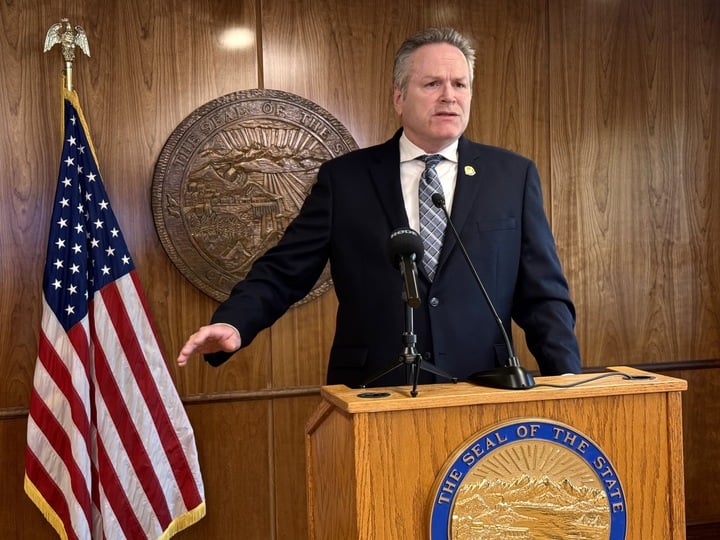
Gov. Mike Dunleavy speaks to reporters at a news conference in Juneau on June 19, 2026. (Photo by Claire Stremple/Alaska Beacon)
Alaska Gov. Mike Dunleavy canceled funding increases for a variety of state health and education programs on Wednesday, vetoing a combined $57.8 million in general-purpose money from state budget bills passed by the Legislature.
Under the Alaska Constitution, the governor has the ability to eliminate or reduce individual line items from the budget. Dunleavy struck $20 million in extra funding for cities and boroughs, $11.25 million to increase Medicaid payments to health care providers, $6.4 million to help child care centers find workers, $2 million for the state’s seafood marketing program, $3 million for tourism marketing, and more.
The governor did not veto most of a $300 million one-time bonus that lawmakers approved for Alaska’s public schools. He did cancel $3.7 million for Head Start grants, not quite a fifth of the proposed grant budget, and funding for a proposed public education spending adequacy study.
The governor’s vetoes were spread across the state’s operating budget, capital budget and mental health budget, the three bills that determine funding for state services in the fiscal year that starts July 1 and ends June 30, 2027.
It is the lowest amount of vetoes of any year in Dunleavy’s tenure. Last year, the governor initially vetoed a higher amount, but it was reduced after a successful veto override by lawmakers.
Altogether, Alaska will spend about $6.6 billion in general-purpose money during FY27, a figure that’s up by almost $600 million from the budget approved in spring 2025, according to figures published Wednesday by the Office of Management and Budget.
While high oil prices brought in more revenue than anticipated, they also burdened state agencies, local government and school districts with extra costs.
In response, Dunleavy said, the approved budget includes some extra funding for school districts around the state that are coping with high energy costs.
“While the state realized additional revenue, those same price pressures placed a real burden on school districts, particularly in rural Alaska. This budget makes targeted, responsible use of a temporary revenue increase to stabilize school facilities and address energy costs,” he said in a statement.
Earlier this year, legislators and the governor enacted a supplemental budget bill that added hundreds of millions in general-purpose spending to the FY26 budget; the FY27 supplemental will not be decided until next spring.
When federal funding and fee-funded programs are included, the FY27 budget totals about $16.4 billion, including $782 million earmarked for the Permanent Fund dividend. Overall spending is up by about $1.2 billion from last spring.
Entering the year, Dunleavy proposed to spend more than $1.5 billion from state savings accounts in order to pay a Permanent Fund dividend estimated at about $3,800 per recipient.
Legislators turned down that proposal, ultimately deciding on a $1,200 payment that includes a $1,000 dividend and a $200 one-time bonus.
Lawmakers avoided spending from savings altogether because the Iran War increased North Slope oil prices in March.
Those high prices caused Alaskans to pay more individually, but they also generated hundreds of millions of dollars in extra revenue for the state treasury.
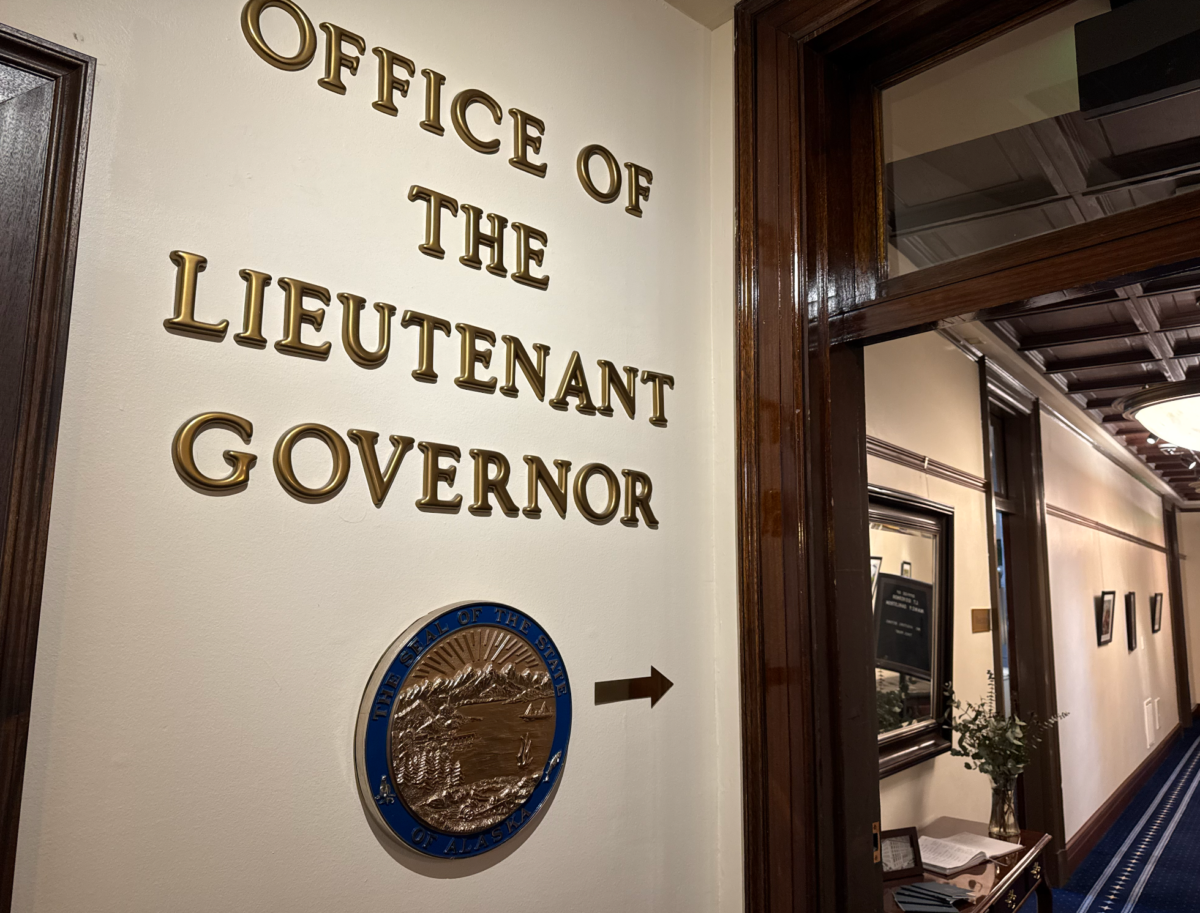
Alaska’s lieutenant governor maintains an office at the state Capitol in Juneau on the same floor as the governor. (Photo by James Brooks for Northern Journal)
Rep. Andrew Gray, D-Anchorage and chair of the House Judiciary Committee has scheduled a legislative hearing on Monday to discuss the disqualification.
In a memo to Gray, attorney Andrew Dunmire said “the Lieutenant Governor was likely not legally justified in her decision to reject Mr. Sullivan’s declaration of candidacy.”
Dan J. Sullivan of Petersburg has the same first and last name as incumbent Sen. Dan S. Sullivan.
The Alaska Republican Party filed twocomplaints against the Petersburg Sullivan, saying his candidacy was merely intended to confuse voters and he was not acting as a candidate in good faith.
Dahlstrom ultimately agreed with those complaints and disqualified Dan. J. Sullivan under a state regulation that forbids the Division of Elections from listing a candidate’s name “in a manner that is confusing or misleading to voters or compromises the fairness or neutrality of the ballot.”
Dunmire, analyzing the situation, said Dahlstrom was incorrect because state regulations cannot trump the U.S. Constitution’s requirements for candidates.
“As a general matter, the U.S. Constitution is supreme in all areas of law, and an administrative regulation cannot override or contravene a constitutional requirement. Therefore, if Daniel J. Sullivan is constitutionally entitled to be recognized as a candidate for U.S. Senate, then no regulation can prevent him from appearing on the ballot,” Dunmire wrote.
Amber Lee, a consultant working with Dan J. Sullivan, said by text message on Wednesday that the Petersburg Sullivan is still deciding what he will do after the lieutenant governor’s decision.
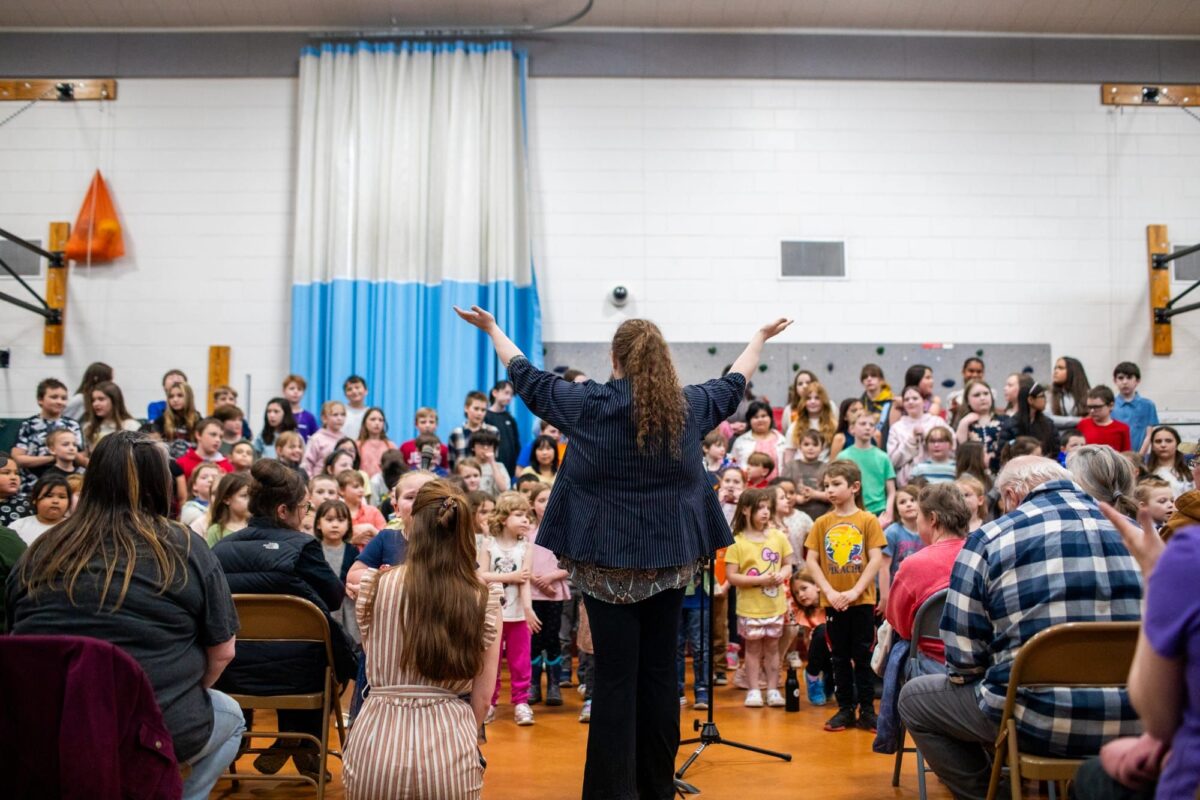
Students perform during a final spring concert on May 13, 2026 at Meadow Lakes Elementary, one of three schools closed by the Matanuska-Susitna Borough School District this year to address a budget deficit. (Photo by Elise Giordano/Mat-Su Sentinel)
Alaska saw an unprecedented wave of school closures this year. District officials grappling with severe budget shortfalls have opted to close 12 elementary and middle schools across the state — in Anchorage, Wasilla, Sutton, Seward, Sterling, Soldotna, Kasilof and Ketchikan.
With those closures, hundreds of students and staff will bus or commute to new schools next year, class sizes will grow as grades are combined and districts across the state are cutting programs, teachers, health aides, custodians, sports, library services and extracurriculars like music.
Officials in four districts say the closures were incredibly complex and difficult decisions but necessary to combat millions in budget shortfalls and years of state funding not meeting districts’ surging costs to operate schools.
“It was an incredibly trying time,” said Randy Trani, superintendent of the Matanuska-Susitna Borough School District that closed three elementary schools this year to address a $28 million budget shortfall. “Non-winnable… we did this to save teaching positions,” he said.
“This is devastating to everyone,” said Kylie Wilcox, a Soldotna mother of five. Her middle and high schoolers attended River City Academy, one of four schools closed on the Kenai Peninsula. “The district does not want to do this, the administration doesn’t want to do this, we just, it’s the reality of what we’re working with.”
At the same time, superintendents said it’s still unclear whether the closures and cuts have balanced district budgets because Gov. Mike Dunleavy has yet to sign off on next year’s increased budget for education funding. Last year, lawmakers flew back to Juneau for a special session, overruled Dunleavy’s veto and restored an education funding increase in a historic override vote in August, just weeks ahead of the first day of school.
This year, the Alaska Legislature approved one-time additional funding of $144 million for K-12 schools, including $29 million to offset rising energy costs, to total $1.8 billion approved for education next year. Lawmakers passed a budget with higher-than-expected state oil revenues driven by the Iran war, which is now before Dunleavy for his consideration.
Education Commissioner Deena Bishop said that the state has seen declining enrollment for more than 15 years, and as a result districts close schools due to what she called “excess capacity.” Bishop has served as commissioner under the Dunleavy administration since August 2023.
Deena Bishop, commissioner of the Alaska Department of Education and Early Development, speaks at a news conference Friday, March 15, 2024, with Gov. Mike Dunleavy. (Photo by James Brooks/Alaska Beacon)
“We’ve had several schools at 50% capacity, 55% capacity, that were within two miles of each other. And understanding that you want to use the majority of your money, you don’t want to put into facilities — the majority of your money you want to put into classrooms,” she said. “And so decisions, you know, things were weighed, and districts, hopefully working with their parents and communities, made decisions that they felt were the correct ones.”
Bishop said more families are opting for homeschool programs, and districts need to figure out how to provide education services for families that want choices for more flexibility.
Nearly one in six Alaska students were homeschooled last year, totaling an estimated 23,600 students, according to data compiled by the Association of Alaska School Boards.
“So we can’t really be upset that, you know, ‘Oh no, they’re not going to our schools,’” Bishop said. “Obviously they’re going to a school that their needs are met, if they’ve chosen that, so how do we work with it? You know, what does education look like, and what does it look like in serving a community? And more and more we’ll find that one size doesn’t fit all that schools really want to offer, and districts are starting to offer different programs.”
Alaska students have the option to enroll in homeschool or correspondence programs across the state, not necessarily with the district where they reside. While district officials say they are working to adapt and provide homeschool education services, districts receive less state funding per homeschool student which is contributing to district-wide deficits.
Matanuska-Susitna Borough School District closes three schools
The Matanuska-Susitna Borough School District, the state’s second largest district with almost 20,000 students, faced a $28 million budget deficit this year, prompting cuts across the district.
The school board closed Meadow Lakes and Larson elementary schools in Wasilla and Glacier View School in Sutton, affecting roughly 415 students and dozens of staff.
That comes after the district cut roughly 160 staff positions last year, said Superintendent Randy Trani. He said the district would have had to cut an additional 225 positions this year, which was unworkable.
“The very last thing that we wanted to do was lay off teachers, and the second last thing we wanted to do was close schools, but we’re to the point where if we didn’t close schools, it was only going to result in more teacher layoffs,” he said.
Trani said the district went through a process of evaluating schools based on a number of metrics, including number of students, costs to maintain and opportunities to bus students to schools nearby, in order to decide which schools to close. “The schools that we were forced to shut down were fantastic schools. This wasn’t a decision on academic merit. This was a decision about logistics and being forced into a really impossible choice,” he said.
Trani said closing the three schools wasn’t even enough to make up for the budget shortfall and the district had to cut deeper.
The school board considered various scenarios from cutting sports programs to transitioning to a four-day school week, Trani said, which were rejected by the school board. “These are all horrible choices,” he said.
While the Matanuska-Susitna Borough continues to have the fastest growing population in the state, Trani said declining birth rates combined with an ongoing wave of families opting to homeschool is leaving the district with declining enrollment of full-time students and reduced funding for the district. Roughly 3,200 students, or 16% of the district’s students, were enrolled in Mat-Su correspondence programs this year.
Trani said another cost driver had been double digit increases to healthcare insurance costs resulting in roughly $6 million more to the deficit, bumping it to $28 million.
But he emphasized the largest driver of the deficit was insufficient state funding. “State funding has not kept up with inflationary pressures, and it is by far the biggest driver,” he said. “Unless there is a long term fix to how K-12 education is funded this problem is going to continue.”
Ketchikan closes two of four elementary schools, with more cuts to come
Ketchikan serves roughly 1,800 students in the Southeast Alaska island community that is only accessible by plane or boat. This year, the district enacted major cuts, including 76 staff positions across the district to address a $3 million budget shortfall, plus $5 million in debt to the local borough. It closed two of the four elementary schools.
Point Higgins Elementary School was one of the two elementary schools closed this year in Ketchikan due to budget cuts. Staff and volunteers helped move out the school in early June 2026. (Photo by Niki Suomala)
The district closed Point Higgins and Fawn Mountain elementary schools, leaving one elementary, one middle and one high school in the community.
Niki Suomala, a third generation Ketchikan resident, attended Point Higgins elementary school, located 15 miles north of town. She said it was a special experience for her two children to go there — until the closure.
Her kids will be in the second and sixth grades next year, and they plan to commute into town for school. She said there were some tears at the news, but she said her children are adapting. She said she’s disappointed overall, but feels compassion for the district.
“It’s like, gosh, couldn’t we see this? Couldn’t we have seen this coming, and couldn’t we have tried to do something different?” she said. “But I also feel compassion, because I don’t know the answer to that question.”
Sheri Boehlert, the interim superintendent of Ketchikan Gateway Borough School District, also served as the principal of Point Higgins, spoke by phone after a full week of packing up and clearing out the schools. She said the reaction to the closures has been mixed: while there’s some in the community who want to see deeper cuts to balance budgets, there’s also a lot of grief in saying goodbye to neighborhood schools.
“It’s hard to dismantle something that was a big part of your career,” she said. “But on the flip side of that, the staff and community has really, by and large, been overwhelmingly supportive. We have tons of volunteers that are helping teachers pack and move, and they’re going to make something great at the next school for students, and there’s optimism out there.”
Class sizes will be effectively doubling in Ketchikan, Boehlert said, from about 15 students to class numbers in the twenties for elementary school and thirty students or more in the middle and high schools.
Boelert said the district has seen rising costs to operate, including for fuel, utilities and special education services. She said in particular the cost of staff health insurance is up 112% this year. Previous cost overruns for health insurance discovered last year created the over $5 million debt to the borough which the district will pay over over the next several years. “That is a unique situation,” Boehlert said. “They need their money back.”
Boehlert said with essentially flat state funding not meeting cost increases, the district cut roughly 26% of staff this year: “So it’s teachers, it’s principals, it’s custodians, health aides, like maintenance staff. No work group was unaffected.”
Even so, with the debt repayment, and this year’s state budgets still uncertain, Boehlert said Ketchikan faces more cuts across the district — unless there’s a significant population increase.
“We have a difficult road ahead of us in Ketchikan,” she said.
Four schools closed across the Kenai Peninsula
In the Kenai Peninsula Borough, the state’s third largest school district stretches across roughly 25,000 square miles — an area about the size of West Virginia — and serves nearly 8,400 students.
This year, the district faced an $8.5 million budget shortfall, after an $17 million deficit last year. The district is still in the midst of budget negotiations and determining cuts. An additional $3.3 million from the local borough and yet-to-be-determined one-time state funding this year may restore some programs, but officials opted to close four schools.
The district closed River City Academy in Soldotna, Tustumena Elementary School in Kasilof and Sterling Elementary School, sending students to other schools in Soldotna and Kenai. On the eastern side, the district closed Seward Middle School where classes will be consolidated into the elementary and high schools.
“The response was overwhelmingly that parents do not want these schools to close down. Communities did not want the schools to close down,” said Kari Dendurent, assistant superintendent of the Kenai Peninsula School District.
One of those parents is Kylie Wilcox, a mother of five living in Soldotna. Two of her children attended River City Academy, which was a standards-based school serving grades seven through 12. She said they liked the supportive environment and had hoped to continue through high school there.
River City Academy, a standards-based school serving grades 7 through 12 in Soldotna, was one of four schools closed by the Kenai Peninsula School District in May 2026. (Photo courtesy of Kylie Wilcox)
“They were starting to make friends at River City, and so they were really sad, like ‘I’ve got to start over again.’” she said. “And they were angry. They talked a lot about, you know, ‘why can’t they just give money to schools? Don’t they think that we’re worth it?’ My oldest was upset enough that they were willing to testify in the district meeting as well. I was really, really proud of them for doing that.”
Dendurent, the assistant superintendent, said the district worked through a transition plan to help students and families plan where to attend schools next year. She said some teachers from River City Academy transferred to Skyview and will be in homerooms with former students. She said it’s a difficult process with cuts across the district, including reading programs, library aides, English language learning programs, swimming pools and others.
“It’s very, very difficult, and it impacts everybody, and the other part that also makes it difficult is we are in contract negotiations right now with our certified and our classified employees as well,” she said.
Dendurent said the district has seen more students and families opt for homeschool programs, resulting in less state funding for the district. “It’s a borough issue, it’s a state issue, and it’s a national issue with declining enrollment,” she said.
She said rising health care costs is also a major factor for the district budget, as well as fuel and utilities costs. Even with the school closures, Dendurent said the district’s financial picture is still uncertain. “Predictable, sustainable funding is what I think all of us are looking for,” she said.
Wilcox said she has empathy for district officials and they handled the process fairly well, but wishes there was more support from the Kenai Peninsula Borough and from state leaders. She said her family is still evaluating options, but will likely homeschool her two middle and high school age students, with her 10th grader also pursuing classes at the Kenai Peninsula College.
“Honestly it feels sometimes like there are people in our state government that would rather see public schools fail, and rather see more homeschool and private school options happen for kids. And I feel like that’s not going to serve all of Alaska’s kids,” she said.
“Like, homeschool is a great option for a lot of people. I am a homeschool graduate,” she added. “But I know that there are families where that’s just simply not an option, and they deserve the support of the state for their child’s education, that’s one of our rights.”
Anchorage closes three elementary schools, with deep cuts across the district
In the state’s urban center, the Anchorage School District made severe cuts this year to address a $90 million deficit and opted to close three elementary schools. It is the largest school district that serves nearly 42,000 students.
The closures were at Fire Lake, Lake Otis and Campbell STEM elementary schools. A parent group filed a lawsuit challenging the district’s decision to close Campbell STEM, which is still under dispute. It’s the only one of the three schools without plans to move a charter school into the building.
Andy Ratliff, the district’s financial officer, said closing the three schools accounted for just a fraction of the deficit, and cuts were made across the district — including almost 500 staff positions, or about 10% of the district’s staff.
“We reduced millions of dollars in administrative costs. We’ve increased our class sizes by four. We reduced a lot of our IT positions, maintenance, everything,” he said. “Mental health, our teaching and learning department was cut by like 45 or 55%. Yeah, I mean it’s just kind of all across the board, even into our special education realm.”
Ratliff said the district has spent down its savings, and the small increase in state funding last year didn’t meet the district’s rising costs. He said health insurance rose in the double digits and now is about 20% of the total budget. “It’s really just this inconsistent funding that’s really just kind of dictated by the state that has put us in this position,” he said.
Ratliff noted the state’s energy relief funds are contingent on oil revenues and likely won’t reach districts until September. He said the uncertainty of funding this late in the year is challenging for staffing and determining what cuts if any can be restored.
“They did approve money, but we don’t have it yet,” he said. “So it’s hard for districts to do any sort of restoring of the cuts that they’ve made at this point.”
State legislature approves $144M in one-time next year, but funding still uncertain
District officials said the Legislature’s boost of $700 per student in the state’s funding formula last year was welcome, but did not significantly affect districts’ overall financial challenges.
A school bus drives by the Alaska State Capitol on Jan. 21, 2026. (Photo by James Brooks/Alaska Beacon)
The 12 school closures this year comes after five schools were closed last year in Kodiak, the Kenai Peninsula Borough and Fairbanks.
Many district officials, education advocates and lawmakers have emphasized that state funding has not kept pace for years with school districts’ needs and costs for providing public education.
But Bishop, education commissioner for the Dunleavy administration, rejected the notion that school funding has been flat.
“Over time in our state, because of the fluctuations of how we get resources to provide to schools, I think that’s exactly why money is either in the formula or out of the formula, but over time you will see that generally there’s been an increase in funds every year,” she said.
She acknowledged the rising costs of school districts, and said at the same time the governor and Legislature have competing priorities for the state budget. “Everybody in the state has to look at the picture as a whole,” she said.
“Hopefully when we can create new revenue, continue to really thrive in schools and innovate programs to match needs that families are seeking, that we’ll be able to move into the future,” she said.
This year, lawmakers seemed to have less appetite for taking on another education funding battle with Dunleavy, particularly among competing priorities of election reform and reviving the state’s pension system. Both initiatives were vetoed by Dunleavy and a legislative veto override effort failed for both. Citing increased oil revenues due to the Iran war, the Legislature passed $144 million in additional one-time funding and nearly $150 million for K-12 school maintenance and repairs.
Rep. Rebecca Himschoot, I-Sitka, speaks in favor of a veto override on House Bill 69 on Tuesday, April 22, 2025. (Photo by James Brooks/Alaska Beacon)
Rep. Rebecca Himschoot, I-Sitka, is a former teacher and vocal proponent of increasing education funding. She co-chairs the bipartisan task force on education funding launched last year.
“Closing a school feels like a death, and it is,” Himschoot said.
Himschoot pointed to budget problems, loss of enrollment and the shift to homeschool, but said the state, in her view, is not funding education as it should.
Himschoot said the task force is investigating short and long term funding solutions. The state approved an adequacy study this year to determine how much funding is needed to support schools, to be completed in the next few years. Another bill to allow districts to budget based on a three year average of student counts, failed in the Legislature this year, but Himschoot said the policy is likely to be revived next year to allow districts to set budgets earlier in the year. “It would take some of the uncertainty out and I think that’s going to have an impact on outcomes,” she said.
She said the task force is continuing its work looking at the problems and funding mechanisms, gathering input and evaluating solutions to address issues in the funding formula, major maintenance and rising costs like health care. Recommendations are due next January.
“The pain is felt by the students. That’s a straight line from state funding to what students get or don’t get,” she said. “It keeps me awake at night.”
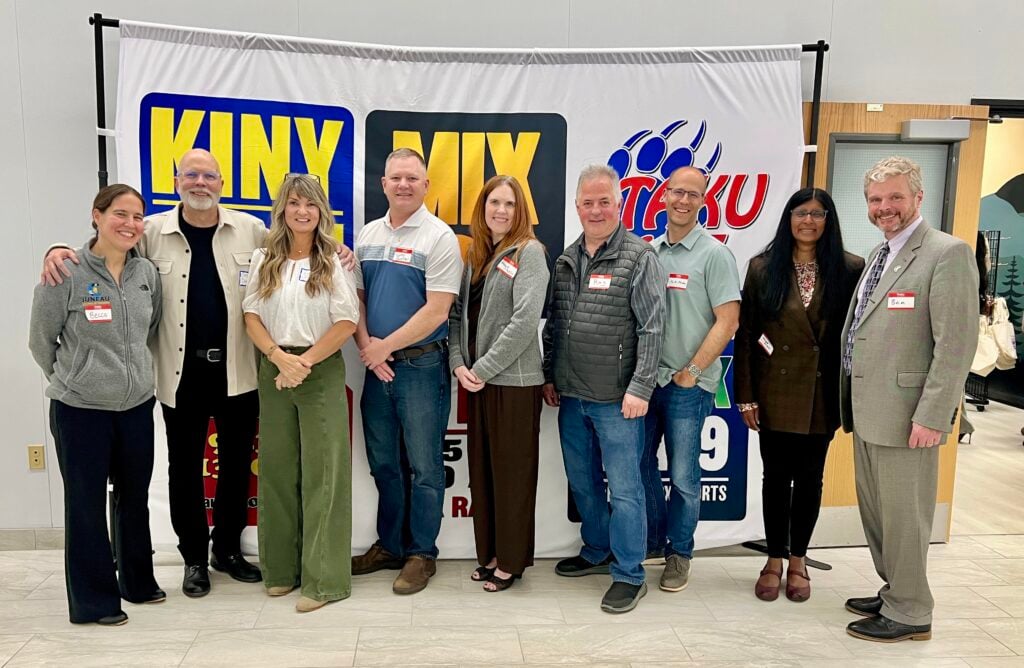
Ribbon cutting ceremony for the new Juneau Media Center at Mendenhall Mall.
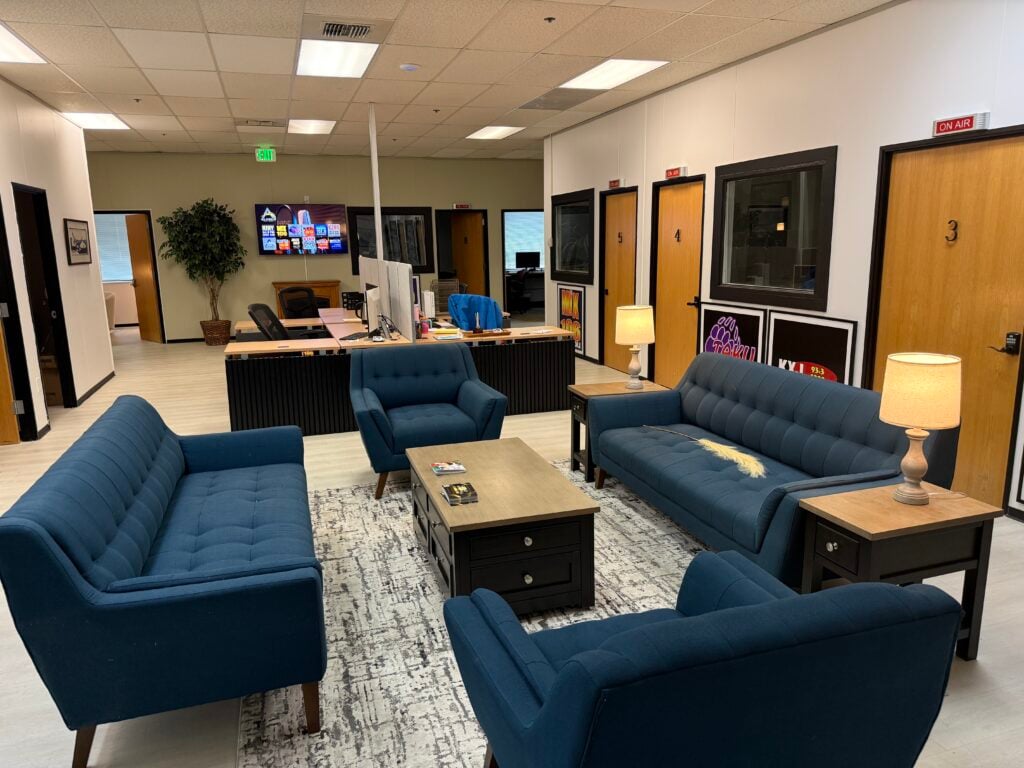
Thursday night, the Juneau Chamber of Commerce hosted a ribbon-cutting ceremony at the new address of a local tradition, the Juneau Media Center (formerly known as the Radio Center on Channel Drive). Now, six new studio spaces, including a dedicated newsroom, a recording studio, and an open-air office space, are housed in the annex section of the Mendenhall Mall.
Chamber Executive Director Becca Parks, Cliff Dumas, Lisa Dumas, and Chamber President Corey Baxter.
Under the ownership of Juneau’s own Cliff and Lisa Dumas, the move marks a renewed investment in local radio, local news, and the communities served by Alaska First Media across Southeast Alaska.
Juneau Chamber of Commerce Board of Directors.
For Cliff Dumas, the transition represents both a continuation and a new chapter. Dumas has been part of the Juneau radio scene for eight years, hosting the TAKU 105 morning show under the previous ownership group. His broader career includes recognition as a Radio Personality of the Year winner from the Country Music Association, the Academy of Country Music and the Canadian Country Music Association. He is also a Hall of Fame broadcaster with decades of experience as a radio host, and television writer and producer.
Alaska First Media Team- From left: Devon Stickler, Charlee Quintal, Justin Miller, Angel Montgomery, Cliff Dumas, Lisa Dumas, Brittany Rickard, Scott Mills, Jason Palmer
Lisa Dumas also brings an award-winning media background to the company, including her work as a host and television writer. Together, the couple, who met at a Toronto radio station thirty years ago, bring a deep understanding of broadcasting, storytelling, and community connection to the future of Alaska First Media. They instantly felt at home in Juneau, invested in a house on Douglas and quickly created community. When Lisa’s not on the radio, you might find her teaching a class at Auke Bay Yoga, or hiking a trail with friends she met through her work on the Juneau Symphony Board or the Glacier Valley Rotary Board.
Cliff and Lisa hosting the morning show at KRST in Albuquerque in the 90s.
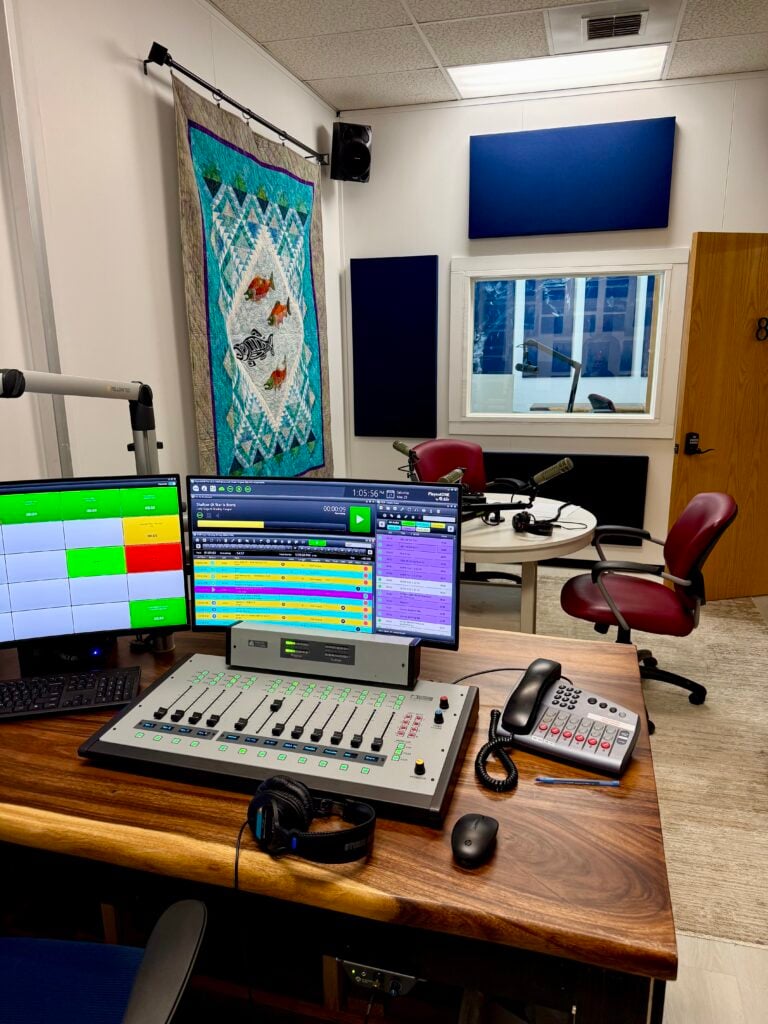
When the Dumas’ stepped into ownership roles, they recognized improvements needed to be made to ensure the sustainability of the product and to continue to serve Southeast Alaska in a meaningful way. The new location features brand new studios furnished with state-of-the-art broadcast equipment designed to improve sound quality, reliability, and daily operations for the company’s Juneau stations, including KINY, MIX 106, TAKU 105, KXJ, KJNO, and The Hawk-Juneau’s Sports Station.
Present day image of Cliff and Lisa.
The Dumas’ say the intention of the investment in new equipment and processes is to offer listeners a cleaner, more consistent sound and a commitment to local talent. The new space includes modern tools to support live interviews, local news, music programming, sports coverage, emergency information, and community service.
KINY Studio.
The relocation also includes the integration of brand-new robust music libraries across the company’s formats. From country and adult contemporary to classic hits, rock, news, talk and sports, each station is getting refreshed with updated music resources and programming tools designed to keep the stations current, familiar and connected to the community.
The investment extends beyond the studio walls.
Sales and meeting space.
Alaska First Media has improved its broadcast infrastructure, including new equipment and transmitter upgrades for TAKU 105, KINY, KJNO, and the HAWK, as well as other stations in the Juneau group. Additional improvements are underway across the company’s transmitter sites, including Douglas and Heintzleman Ridge, with continued upgrades at the company’s stations in Ketchikan and Sitka.
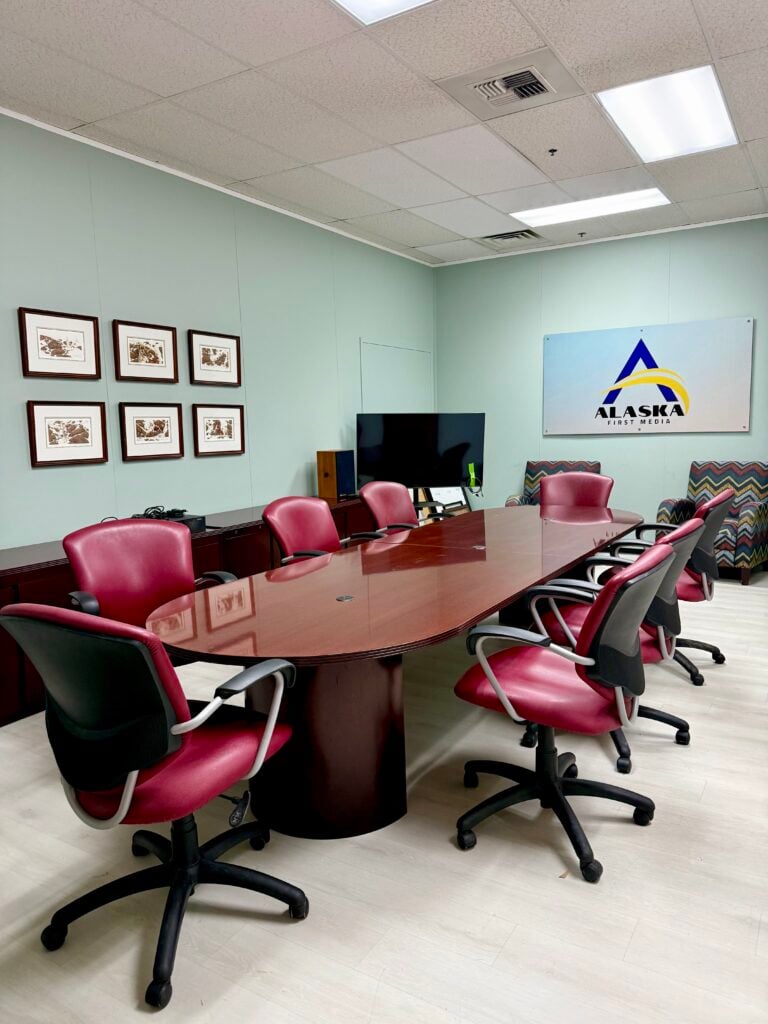
Board Room.
The Juneau Media Center’s new location creates a more visible and welcoming home for local radio. Cliff and Lisa hope it offers listeners, business owners, civic leaders, nonprofit organizations, coaches, athletes, musicians, and community voices a place to be part of the conversation.
MIX 106 Studio.
At a time when many media companies are cutting, Alaska First Media is investing in studios, equipment, music, transmitters, and most importantly, the people who make up their local team.
Cliff and Lisa say that last night’s New Location Celebration was a chance to open the doors and share a vision that has finally come to fruition. They hope it is a feel-good home for local radio, where a valued and talented team of local professionals work hard to support local businesses, non-profit organizations and community events and share a commitment to Southeast Alaska and a broadcast center designed for the future.
Lockers line the halls of Ben Eielson Junior Senior High School on April 22, 2024. (Photo by Claire Stremple/Alaska Beacon)
Alaska school districts that have grown to rely on international teacher hires are likely to do without them this year, even after a federal judge blocked the Trump administration’s fee hikes for highly skilled worker visas on Monday.
The Trump administration raised the fee from $5,000 to $100,000 last September, which put Alaska school districts’ international teacher hiring on hold. Districts have increasingly relied on international hiring to fill an ongoing teacher shortage across the state, particularly in rural and remote districts. The nearly 2,000% cost increase put the visas out of reach for districts that are already facing severe budget deficits and school closures.
Lisa Parady, executive director of the Alaska Council of School Administrators, a non-profit leadership and advocacy group that supports districts in hiring, said the court ruling was welcome news. However, she said there is concern the federal government could appeal and reinstate the fee.
“So that puts us in a really hard place. We are thrilled because we believe this is the right interpretation of the law, and we really hope that it will be sustained, and that the government will not be able to get a stay or would lose in an appeal, but in the meantime we’re still a little bit in limbo,” she said.
She said that school districts are unlikely to hire through the H-1B visa program now, due to the risk of losing tens of thousands of dollars of application processing fees if the federal government appeals the court decision successfully.
“The chance of taking a risk of losing those fees, if they could submit now, is just a risk. And I think our districts are largely risk averse because they don’t have those kinds of funds to take risks with,” she said.
Jennifer Schmitz, director of the Alaska Educator Recruitment and Retention Center, a division of the Alaska Council of School Administration, said some districts previously lost processing fees and even new international hires from the Philippines when the Trump administration enacted the increased visa fee last fall.
“Most districts are going to want to wait and watch over the next month or two and see what happens, and then maybe move forward,” she said.
The H-1B visa is valid for six years. As those Alaska-based teachers’ visas expire in the next several years, Parady said Alaska schools will reach a crisis point for hiring.
“We’re going to be in a full-blown crisis, because we don’t have people standing in line to fill those positions,” she said. “We have been operating in the largest crisis and educator shortage in America, and at the local level in Alaska’s the worst crisis we’ve ever seen. And so while we aren’t feeling the full effect of those not being available to districts, we’re going to. Unless this terrain changes.”
The Alaska Legislature unanimously passed a resolution in May that urges the Trump administration to waive the steep visa fee to allow the continued recruitment and hiring of international teachers.
Last year, Republican U.S. Sen. Lisa Murkowski introduced legislation to create an educator exemption from the increased fee. After the Monday ruling, her office said she will continue to work with the U.S. Secretary of the Department of Homeland Security, Markwayne Mullin to create an administrative waiver from the fee to help bring teachers to Alaska.
“I will continue working to eliminate this fee permanently so that Alaska’s students are receiving the best education possible, regardless of the outcome of future legal challenges,” she said in a social media post on Monday.