NOTN- The City and Borough of Juneau Assembly will hold a public hearing tomorrow on its proposed fiscal year 2027 budget, including property taxes, school funding, a multi-year capital improvement plan, Eaglecrest and the Gondola Project.
The special Assembly meeting is scheduled for 5:30 p.m. and it will be followed by the Assembly Finance Committee. Residents may testify in person or via Zoom.
At the hearing, Assembly members will take testimony on several key ordinances, including a measure setting the 2026 property tax rate to fund the FY27 budget.
According to the agenda, officials will also consider a $551.2 million operating budget for city and borough services, along with a separate $97.2 million budget for the Juneau School District.
In addition, the Assembly will review a resolution adopting the city’s capital improvement program for fiscal years 2027 through 2032, which outlines infrastructure priorities and planned project spending.
Another resolution would set aside up to $2.3 million from the city’s restricted budget reserve to cover an anticipated operating deficit at Eaglecrest Ski Area.
Separately, the Assembly is expected to introduce an ordinance to begin terminating a revenue-sharing agreement with Goldbelt Inc. tied to the proposed gondola project at Eaglecrest. City officials say the project is no longer financially feasible after cost estimates rose to more than $37 million, up from initial projections of about $10 million.
This is still up in the air, but under this agreement Juneau would be required to repay Goldbelt’s $10 million investment plus interest if the deal is terminated. Repayment would include general funds and previously allocated project money.
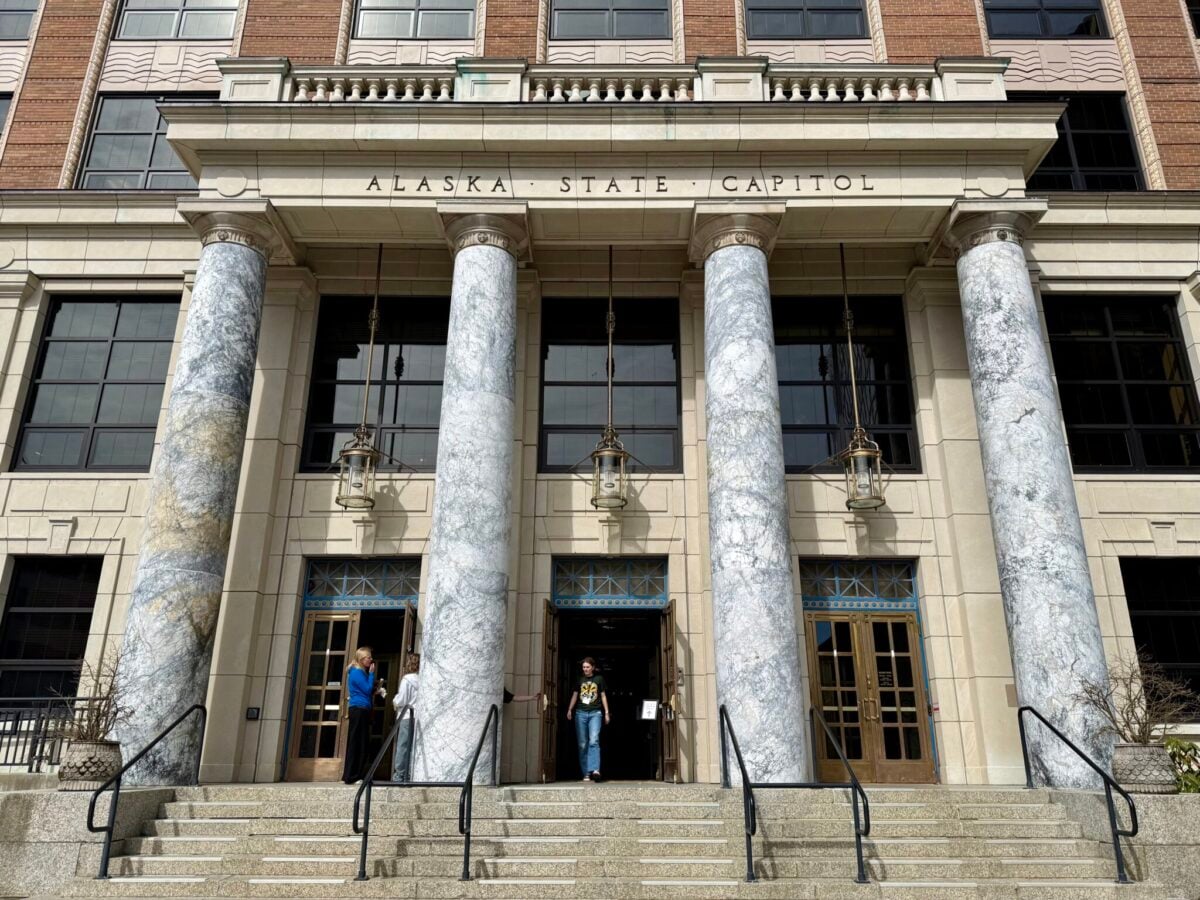
A school bus drives in front of the Alaska State Capitol on Monday, Feb. 3, 2025. (Photo by James Brooks/Alaska Beacon)
By: Corinne Smith, Alaska Beacon

A school bus drives in front of the Alaska State Capitol on Monday, Feb. 3, 2025. (Photo by James Brooks/Alaska Beacon)
While many school districts across Alaska are facing severe budget shortfalls, several bills to provide a sustained increase to education funding appear to have stalled in the Legislature. But a bill to add nearly $82 million one-time funding and education policy changes is moving forward with bipartisan support.
On Monday, the Senate Education Committee introduced a revised version of House Bill 28, that adds one-time funds for energy relief, transportation, reading and vocational training, to a bill that would establish a loan forgiveness program for Alaska teachers. It also includes a variety of policy changes related to home school programs and others.
Chair Sen. Löki Tobin, D-Anchorage, described it as a “mini-bus” bill on Wednesday, saying the new omnibus bill includes specific education funding to areas sought by the governor and lawmakers on both sides of the aisle.
“We heard that there is a deep concern about education reform still being left on the table, and so in those discussions we focused the new version of House Bill 28 on codifying some of the best practices that we know are going to improve education outcomes across the state,” Tobin said.
The underlying bill establishes a new three-year student loan forgiveness program to incentivize teachers to stay in Alaska. It’s focused on teachers specializing in special education, English as a second language, science, technology, engineering and math. It would provide up to $15,000 to pay off student loans for those who go out of state and return to work in Alaska. The House passed the bill last May.
“We need to incentivize teachers to stay here,” said Rep. Andi Story, D-Juneau, who sponsored the bill. “We’ve had such tremendous turnover, and we’ve got this tremendous shortage. And so I think the bill will help.”
The bill moved to the Senate this year, and education committee members tagged on a variety of items on Apr. 21. According to data provided by Tobin’s office, it contains an additional $21.8 million for reading proficiency grants, $9.7 million for career and technical education, $7.3 million for transportation, and $43 million to offset rising energy costs for school districts.
“We do not want to divert operating costs, dollars that should be in the classroom, to just keeping the lights on and buildings warm,” Tobin said.
Meanwhile many Alaska school districts are in the midst of budget negotiations and grappling with cuts to staff and programs to address large budget shortfalls.
Tobin said at a Senate Majority caucus news conference on Wednesday the goal of the education policy bill is to garner enough support on both sides of the aisle to be able to override a potential veto by the governor.
“It is obviously the hope for all of us that we will continue to increase stable and predictable funding for our schools and ensure that they have the resources they need,” she said. “However, at the end of the day, our goal is to get dollars into the classroom and to get support into our schools, and I will work diligently to do that with the number of people that I can guarantee will be there to get that bill across the finish line.”
Gov. Mike Dunleavy has been a staunch opponent of increasing funding for schools, saying that education policy changes are needed to improve student outcomes. Last year, he issued three vetoes of additional funding for K-12 schools sustained through the state’s funding formula, the base student allocation, and the last was narrowly overridden by the Legislature last summer.
This year, legislators introduced bills to again provide a sustained increase per student funding statewide. Rep. Rebecca Himschoot, I-Sitka, introduced a bill to add $158 million to boost the per student formula, but so far it hasn’t moved out of the House Education Committee.
Earlier in the session, Tobin introduced a bill that would add nearly $100 million in education funding. A portion of that money would go to per student funding through the BSA, and additional reading proficiency grants and transportation funding. But her bill proposed policy changes to enact reporting and testing requirements for homeschool programs that drew public criticism from homeschool proponents, so the Senate Education Committee stripped the provision and held the bill.
The new draft Senate bill also institutes more reporting requirements from school districts to the state on their homeschool programs, including how many students are enrolled by grade, where they live across the state and how their annual allotment is spent, among others.
The draft bill would commission a state audit to evaluate Alaska’s funding for schools, and make recommendations for changes or for alternative methods of education funding. There is no cost estimate yet for the study, or the entire bill.
Tobin said the funding adequacy study is a top priority of the joint Task Force on Education Funding. “We know that our foundation formula needs some reform, and it also needs some additional attention on particular components that have changed significantly in the last few years, the pandemic really showcased that,” she said.
Story said she supports the changes to the bill. “There’s some really good things that got put in there,” she said. “It’s the end of the session, lots of things are happening, so we’ll just see. But I’m hoping good things happen for teachers and families and for our kids to get more attention next year.”
The draft “mini-bus” bill was approved by the Senate Education Committee and now moves to the Senate Finance Committee for consideration.
Meanwhile, senators are debating the draft operating budget for next year that includes up to $100 million in additional funding for schools, but only if oil prices remain high. The House passed a draft operating budget with nearly $158 million in one-time funding for K-12 schools earlier this month.
A select group of lawmakers from both chambers will negotiate and reconcile a compromise between the two budget bills — and a final allocation for Alaska schools next year — in a conference committee in the last days of the legislative session, by May 20.
Rep. Maxine Dibert, D-Fairbanks, speaks Monday, Jan. 27, 2025, on the floor of the Alaska House of Representatives. (Photo by James Brooks/Alaska Beacon)
By: Haley Lehman, Alaska Beacon
Rep. Maxine Dibert, D-Fairbanks, speaks Monday, Jan. 27, 2025, on the floor of the Alaska House of Representatives. (Photo by James Brooks/Alaska Beacon)
The Alaska House of Representatives advanced a bill Wednesday that aims to address a lack of oversight for minors treated at psychiatric facilities in Alaska. The bill would mandate an annual report on conditions and treatment at such facilities from the state’s Health Department, as well as unannounced biannual inspections.
Rep. Maxine Dibert, D-Fairbanks and the bill’s sponsor, said the measure is a necessary step to increase accountability around the treatment of minors in psychiatric hospitals in the state, amid constituent concerns.
“These are not sweeping mandates, they are basic expectations of transparency, of communication and accountability of our youth here in Alaska,” she said on Wednesday.
The bill passed the House of Representatives with 37 yes votes. Three legislators were absent. It has been transmitted to the Senate for consideration.
The bill would also guarantee patients confidential telephone or video communication with a parent or guardian for two hours per week and require the Department of Health to notify a patient’s parent or legal guardian when seclusion or restraint is used within 72 hours.
The annual report would include information about the total uses of seclusion or restraint, findings of facility inspections and data on the number of minors who received residential care at psychiatric hospitals.
Dibert cited a 2004 investigation by the Disability Law Center of Alaska that found 261 episodes of seclusion and restraint over three months in psychiatric institutions, which the organization called “quite high.”
The United States Department of Justice issued a report in December 2022 that found that Alaskan youth are institutionalized in psychiatric hospitals and psychiatric residential treatment facilities at higher rates and for longer periods than minors in other states as a result of a lack of available and accessible community-based mental health services, violating the Americans with Disabilities Act.
Rep. Genevieve Mina, D-Anchorage and Chair of the House Health and Social Services Committee, voiced her support for the bill and drew attention to a finding by the DOJ that identified gaps in community-based services in Alaska.
Community-based services include home-based family treatment for early intervention services, intensive case management and crisis services, according to the DOJ.
“We have to face the reality that many of these kids are in these institutionalized settings because we have underinvested in our home and community based services in this broader continuum of care,” Mina said.
“The dearth of community-based services in Alaska is so pronounced and widespread that institutional placement has become, for many behavioral health service providers in the state, the default option to which they refer children with long-term behavioral health need,” DOJ investigators wrote in 2022.
According to the DOJ, more than 800 Alaskan children received behavioral health services in a psychiatric institution in 2020. Approximately a third of the patients were Alaska Native and parents reported to the DOJ concerns about separating their children from their culture while in residential treatment. In addition to four psychiatric residential treatment facilities in Alaska, the state sends children to 17 out of state psychiatric residential treatment facilities.
Rep. Justin Ruffridge, R-Soldotna, told legislators that the bill provides oversight and accountability that legislators are expected to institute.
The bill received support from the Alaska Federation of Natives, Lives in the Balance, a nonprofit that advocates for the fair treatment of children, Dot Lake Village, Citizens Commission on Human Rights, an organization that aims to eradicate abuse in mental health settings, and Aleutian Pribilof Islands Association.
The Department of Health estimated in a fiscal note that it would cost approximately $222,800 annually for a full-time nurse consultant to perform inspections, conduct interviews with patients and conduct investigations and for two nurse consultants to attend trauma informed care and cultural awareness training.
Children pick up their school lunches. (Photo by Amanda Mills/Centers for Disease Control and Prevention)
The Alaska Senate passed a bill Monday that would ban public schools in Alaska from serving certain food dyes in school breakfasts or lunches.
Lawmakers expressed concerns that certain petroleum-based food dyes in processed foods have unhealthy side effects on children.
Sen. Bill Wielechowski, D-Anchorage, the sponsor of Senate Bill 187, said Monday, “We like to sell our petroleum to fuel our cars and generate our power plants, not to feed our kids.”
Wielechowski pointed to studies that suggested that artificial dyes are linked to increased hyperactivity, inattentiveness and allergic reactions in children.
The bill would ban red dyes Nov. 3 and No. 40, yellow dyes No. 5 and No. 6, blue dyes No. 1 and No. 2 and green dye No. 3.
The U.S. Department of Health and Human Services and the U.S. Food and Drug Administration announced a campaign in April 2025 to eliminate synthetic dyes from the U.S. food supply by the end of 2027 and to authorize natural color alternatives. Alaska proposes banning the same food dye in schools that HHS and the FDA are working with the food industry to eliminate.
The bill received strong support from Alaska Community Action on Toxics and opposition from the International Association of Color Manufacturers, which maintains that synthetic dyes are safe for consumers.
Carlee Johnson McIntosh, Petersburg School District food service director, wrote in a letter to legislators that the bill aligns with work the school district is already doing to remove synthetic dyes from school meal programs. She said the bill would not create a significant burden for the school district.
“Schools should be environments where students are set up for success, and access to nutritious meals plays an important role in that success,” Johnson McIntosh wrote. “Establishing these standards in state law would demonstrate Alaska’s ongoing commitment to student health, regardless of potential shifts at the federal level.”
The bill passed the Senate with 19 yes votes. Sen. Donny Olson, D-Golovin, was excused absent.
If it passes the House and becomes law, it would go into effect in January 2028. Alaska would join states including Arizona, California, Delaware, Louisiana, Virginia and West Virginia in banning artificial food dyes in schools.
Sen. Loki Tobin, D-Anchorage, speaks in the Alaska Senate on Monday, April 28, 2025. (Photo by James Brooks/Alaska Beacon)
By: Haley Lehman, Alaska Beacon
Sen. Loki Tobin, D-Anchorage, speaks in the Alaska Senate on Monday, April 28, 2025. (Photo by James Brooks/Alaska Beacon)
The Alaska Senate advanced a resolution Monday to preserve three work visas to support Alaska’s economic security.
Alaska relies on J-1 visas to fill teacher positions, H-1B visas for highly skilled workers and the H-2B program for temporary nonagricultural workers in tourism, health care and seafood processing industries and for teachers.
Sen. Löki Tobin, D-Anchorage, said that Senate Joint Resolution 28, “puts Alaska on the record in support of these programs to fill jobs here in our state.”
The Trump administration raised the fee for highly skilled worker visas from $5,000 to $100,000 in September 2025.
Tobin said Monday that school districts in Alaska cannot absorb those costs and utilize the H-1B visa program to hire international teachers.
The Alaska House of Representatives passed a resolution in March urging the Trump administration to waive the $100,000 visa fee for international teachers. It was sponsored by Rep. Alyse Galvin, I-Anchorage.
According to Jennifer Schmitz, director of the Alaska Educator Retention and Recruitment Center, 20 school districts in Alaska employed 232 educators with J-1 visas and 341 educators with H-1B visas in 2025.
Alaska’s senior U.S. Senator, Republican Lisa Murkowski, introduced legislation in March that would exempt teachers from non-processing related fees for H-1B visas. U.S. Republican U.S. Sen. Dan Sullivan is a cosponsor.
The visa programs support other jobs, too. Marilyn Usibelli, owner of Black Diamond Resort Co. in Healy, wrote to legislators in March that J-1 visa holders play an essential role in staffing seasonal jobs in Alaska with lawful, reliable temporary workers.
“Despite extensive local recruitment, the small year-round population in the Denali Borough simply cannot meet the seasonal demand. J-1 participants fill critical roles that allow us to maintain safe, high-quality operations, support other local businesses, and contribute to the broader Denali-area economy,” Usibelli wrote.
The resolution passed the Senate with 19 yes votes with Sen. Donny Olson, D-Golovin, absent
An empty classroom at Juneau-Douglas High School: Yadaa.at Kalé in Juneau, Alaska (Photo by Lisa Phu/Alaska Beacon)
A professor at Furman University told the Alaska Legislature Task Force on Education Funding Wednesday afternoon that standardized test results might not be the most appropriate set of data on which to base education policy decisions.
During a routine presentation on the National Assessment of Educational Progress, known as the Nation’s Report Card, Paul Thomas backed a principle that legislators should not make decisions about students and schools based on a single standardized test.
“The key to understanding test data in Alaska is the information on poverty,” Thomas said.
Alaska’s NAEP scores of fourth- and eighth- grade Alaskans ranked lower than the national public in mathematics and reading in 2024. According to the Nation’s Report Card, approximately 69% of students performing below the 25th percentile are economically disadvantaged while economically disadvantaged students make up 48% of Alaskan students.
“Education policy and socioeconomic policy are really strongly connected,” Thomas said. “Test scores are a reflection of the socioeconomic status of the students.”
State education officials led legislators through a practice test of the Alaska System of Academic Readiness, commonly referred to as the AK STAR. Each fall, winter, and spring, Alaskan students in grades 3-9 take the MAP Growth assessment and each spring, Alaskan students take the AK STAR.
Kelly Melin, who works for the Department of Education and Early Development’s Assessments and Standards Administration, said the state’s standardized tests are designed to satisfy federal requirements set forth in the Every Student Succeeds Act.
“We’ve taken the power of an interim assessment and the need for a summative assessment as was dictated through ESSA and connected those to come up with what we have as AK STAR,” Melin said.
Kelly Manning, the department’s Director of Innovation and Education Excellence, said that the purpose of assessments is to measure the state’s ability to close the achievement gap and measure students’ ability to read at grade level by the third grade.
Statewide, about 33% of students tested at or above grade level expectations in language arts and 32% in math in 2025. Students in ninth grade demonstrated the greatest need for support in language arts and math.
The esting window for Alaska students closes on May 1. AK STAR results will be available to school districts in July and statewide in the fall.
Sen. Lyman Hoffman, D-Bethel, is seen in the Senate Finance Committee on Tuesday, April 25, 2023. A co-chair of the Senate Finance Committee, Hoffman is in charge of the state's capital budget. (Photo by James Brooks/Alaska Beacon)
By: Corinne Smith, Alaska Beacon
Sen. Lyman Hoffman, D-Bethel, is seen in the Senate Finance Committee on Tuesday, April 25, 2023. A co-chair of the Senate Finance Committee, Hoffman is in charge of the state’s capital budget. (Photo by James Brooks/Alaska Beacon)
The Alaska Senate Finance committee advanced a draft capital budget on Tuesday that would put nearly $250 million toward state facilities and maintenance projects next year.
The draft budget adds $88 million to Gov. Mike Dunleavy’s proposed capital budget of $159 million, with the largest additions going toward K-12 schools and university facilities maintenance.
That was a focused effort by the finance committee, said co-chair Sen. Bert Stedman, R-Sitka, who called funding for education facilities maintenance a “heavy concentration” on Wednesday.
Earlier this year, students and school officials testified to lawmakers that decades of deferred maintenance has reached crisis levels — with many rural school districts in particular grappling with deteriorating facilities, failing water and sewer systems — which they say is degrading student and staff morale. Lawmakers have expressed support and increased funding in recent years, but point to Gov. Mike Dunleavy’s history of vetoes as a roadblock for funding education.
The Senate draft includes $57.8 million in additional funding toward K-12 school maintenance through the Alaska Department of Education and Early Development and $17 million toward the University of Alaska. It also includes $5.7 million for the Alaska Court System’s facilities and $8 million for community infrastructure and workforce development programs through the Alaska Department of Commerce, Community, and Economic Development.
The Legislature relies on state ranked lists to prioritize where to direct funding to capital projects for K-12 schools, the university system and the court system.
For K-12 schools, the state’s current major maintenance list totals over $400 million needed for 103 school projects and repairs. Stedman said he recognized this year’s capital budget will only fund a fraction of those.
“Hopefully we get a quarter of it done, or something like that, but it’d be nice to retire the entire list,” Stedman said.
The draft budget would fund the top 15 school projects on the list, plus funds for three other schools in need of emergency fuel tank repairs. The top projects range from roof and boiler replacements to septic systems, fire suppression and safety upgrades in schools from Fairbanks to the Aleutian Islands.
In order to distribute funds more widely, members of the finance committee reduced funding for one project in Galena, in the Western Interior of Alaska, from roughly $35 million to $5 million for renovations to the Sydney C. Huntington Elementary and High Schools. They also allocated $17 million towards rebuilding the school in Stebbins in Western Alaska, after it burned down in 2024.
Mt. Edgecumbe High School student housing in Sitka is seen on Oct. 6, 2025. (Photo by Corinne Smith/Alaska Beacon)
The Senate draft also adds nearly $14 million in funding for the state-run Mt. Edgecumbe High School, which has been the focus of public attention and concern after a quarter of students disenrolled this year. The additional facilities dollars include $10 million to remodel the dining hall, $3.1 million to replace dorm windows, $460,000 to replace dorm furniture, $50,000 to replace mattresses and $125,000 to replace aging laundry machines.
Finance members added $17 million to fund the top nine projects across the University of Alaska system — three projects each within the three major campuses.
Sen. Jesse Kiehl, D-Juneau, serves on the finance committee and his district includes University of Alaska Southeast. He described the proposed funds as a “nickel” compared to the “colossal” deferred maintenance needs of the university system.
“That’s been built by Legislatures and Boards of Regents for 40 years,” he said on Wednesday, adding that it is a shared responsibility to put funding towards repairs and upgrades.
“The Constitution makes them a separate body within the executive branch that puts a lot of responsibility on them, too, more than the general state government,” he said “So university major maintenance is its own huge problem.”
The draft budget also includes $5.7 million for upgrades to state court facilities, mostly targeted to Anchorage and Sitka. It contains nearly $10 million for workforce development programs geared at the construction and oil and gas sectors, including for the Fairbanks Pipeline Training Center and Alaska Vocational Technical Center in Seward.
An amendment to add $25 million to the draft budget for the Port of Anchorage, sponsored by Sen. Kelly Merrick, R-Eagle River, was voted down on Tuesday by a 5 to 2 vote.
Before voting against the proposal, finance co-chair Sen. Lyman Hoffman, D-Bethel, said during committee deliberations the priority this year is to fund as many school maintenance projects on the list as possible, saying “schools are falling apart” and must be maintained to prevent further deterioration.
“Students that are trying to learn deserve better,” Hoffman said. “And if we are not able to provide this major maintenance, we are going to see these schools continue to crumble, and the financial burden to the state of Alaska will be hundreds of millions of dollars to rebuild schools.”
More funding for school maintenance and other capital projects could be added by the Alaska House of Representatives, who will take up the draft budget bill after it’s approved by the Senate in the coming weeks.
Alaska Gov. Mike Dunleavy speaks to reporters on Thursday, April 17, 2025, with Deena Bishop, commissioner of the Alaska Department of Education and Early Development, looking on in the background. (Photo by James Brooks/Alaska Beacon)
By: Corinne Smith, Alaska Beacon
Alaska Gov. Mike Dunleavy speaks to reporters on Thursday, April 17, 2025. (Photo by James Brooks/Alaska Beacon)
Gov. Mike Dunleavy signed off on a supplemental budget bill that authorizes nearly $450 million in additional state spending this year.
The budget bill covers additional costs incurred by the state this fiscal year ending in June, including funds for disaster relief, education, corrections and transportation.
The bill was approved by the Alaska State Legislature two weeks ago. Dunleavy signed the budget on Apr. 2, and transmitted it back to the Legislature on Thursday.
“I appreciate the Legislature’s support of these proposals,” Dunleavy said in a letter announcing his signature on the bill. “The supplemental budget I have signed into law today enables the State to meet current fiscal year responsibilities and represents prudent and fiscally responsible investments in emergency and fire response, public safety and statewide transportation needs.”
The budget includes $75 million for disaster relief to address the response to the Western Alaska storms last fall, and nearly $100 million for fire suppression, particularly in Interior Alaska. It includes $20 million for the Alaska Department of Corrections overtime expenses, as well as $70 million in time-sensitive funding for transportation — sought by the construction industry to unlock a federal match of $630 million for state construction projects.
It also includes $130 million for the Alaska Higher Education Fund which provides grants and scholarships for students, as well as $34.4 million for Medicaid and $12.8 million for other public assistance programs through the Alaska Department of Health.
The governor’s office submitted an additional $11.6 million request, but it was submitted too late to include in the budget bill, and will be rolled into the proposal for next year’s budget.
Additionally, the state is waiting on an appeal decision after failing a federal disparity test for education funding, and could potentially be liable for $72 million in K-12 funding for next year, according to officials with the Legislative Finance Division.
Oil revenues still uncertain
In the Legislature, the bill was delayed this year amid ongoing debate in the House of Representatives on whether to pay for the larger than usual budget bill out of state savings — an act that requires the approval of three-quarters of legislators.
Members of the House Republican minority caucus objected to spending from a state savings account, the Constitutional Budget Reserve. After the Alaska Department of Revenue projected the state would see an additional $500 million in oil revenue due to a surge in oil prices driven by the Iran war, they argued the state would not need to pull from savings to pay its bills.
Members of the multipartisan House majority caucus objected to the uncertainty of revenue forecasts and future oil prices, and argued for a draw from state savings to fund the budget bill immediately.
If oil-driven state revenues from now until the end of the fiscal year are not sufficient to cover the $450 million supplemental budget, then lawmakers agreed to draw from state savings. That means oil prices must average approximately $82 per barrel of oil through June for state revenue to cover spending, according to officials with the Legislative Finance Division.
House Speaker Rep. Bryce Edgmon, I-Dillingham, was among legislators who supported the draw from savings several weeks ago, instead of banking on uncertain future oil revenues. On Friday, he said it seems revenues will cover the budget bill.
“As appears now, oil prices are continuing to move in an upward trajectory, which means that the bill at the very end could be fully funded,” Edgmon said. “But there’s still a fair amount of time in front of us for oil prices to, you know, continue to be volatile.”
Edgmon said barring a dive in oil prices, he doesn’t expect another vote on drawing from the state savings this session.
“That’s pending a dramatic drop in oil prices, of course, which doesn’t seem to be on the horizon.”
NOTN- An Alaska Senate committee on Wednesday advanced a resolution backing federal visa programs that lawmakers say are critical to the state’s seasonal workforce and public schools.
Senate Joint Resolution 28, heard in the Senate Labor and Commerce Committee, puts the Alaska Legislature on record in support of the J-1 and H-1B visa programs and urges the state’s congressional delegation to work with federal policymakers to preserve and strengthen them.
A similar resolution was heard in the Senate Education committee Wednesday as well, in support of H-1B international educators.
“Senate Joint Resolution 28 very simply, recognizes the important role that visa programs such as the J1 visa program, and the H-1B program, play to the economy and the education of children and young adults across Alaska.” Said legislative aide Mike Mason, “These international visa workers are vital to filling Alaska’s diverse workforce needs. If you travel around Alaska, especially this summer, you are going to see these visa workers filling very important jobs across the state. This resolution simply puts the Alaska legislature on record as supporting these visa programs.”
The measure also objects to a steep federal fee increase on certain H-1B petitions, from $5,000 to $100,000, which supporters say has effectively shut Alaska’s public schools out of the program.
“That fee effectively ended most employers ability to fill these open jobs through this program.” Mason said.
Lawmakers adopted an amendment, to explicitly include H-2B visas, which cover temporary nonagricultural workers.
Public testimony on the resolution was brief but supportive.
Jonathan Schaffer said his experience working with J-1 participants in seasonal jobs across the country showed clear benefits for both employers and workers.
“Having worked in seasonal employment across the United States with a number of J-1 enrollees, I can say that the program, in my opinion, benefits both employers and those enrolled in it. It is remarkable the opportunities that are provided for people in small communities to learn about the world around them from the people who travel there to serve visitors, who travel from all over the place. It is remarkable the benefit that those who enroll in the J-1 program have in gaining a more positive view of the United States, which they take back to their communities around the world.”
The committee voted without objection to move the resolution.
It now heads to further consideration in the Legislature.
Lisa Parady (left) director of the Alaska Council of School Administrators and Katie Parrot (right) president of the Alaska Association of School Business Officials testify to a joint session of the House and Senate Education Committees on Mar. 30, 2026. (Photo by Corinne Smith/Alaska Beacon)
Alaska superintendents, principals and school officials delivered sobering testimony to lawmakers at the Alaska State Capitol last week. They painted a picture of schools struggling to continue to support teachers and students amid budget shortfalls, cuts to programs, teacher shortages, rising costs and increased facility maintenance needs.
Lisa Parady, director of the Alaska Council of School Administrators, the non-profit advocacy and leadership organization that organized the annual fly-in event, said the group is concerned for all the state’s children.
“There’s no room for division,” she said, noting that there are often divides between the needs of urban and rural districts, or districts that are on the road system versus off the road system. “All those need to fall to the wayside when we’re talking about the best interest for our children in Alaska.”
School officials from across the state addressed a joint session of the House and Senate Education Committees on Mar. 30, and presented lawmakers with a list of legislative priorities and challenges for Alaska’s 53 districts and roughly 130,000 students.
Despite a historic raise in per student funding, known as the base student allocation, last year, officials say state funding still does not meet districts’ needs to hire and retain teachers, provide services and programs to students and keep up with maintaining aging school facilities.
To match the pace of inflation since 2011, school administrators say it would require the state to increase funding by $1,283 to the BSA or $7,983 per student. (Screenshot of presentation by the Alaska Council of School Administrators)
To match the pace of inflation since 2011, school administrators said it would require the state to increase funding to the BSA by $1,283. Additionally, they highlighted student transportation costs have exceeded state funding by an estimated $65.5 million.
Several bills are currently being debated in the Legislature that would increase education funding, and a joint legislative task force on education funding is examining long term challenges with recommendations due in 2027.
High teacher turnover
School leaders’ presentation to lawmakers included research, data and testimony illustrating what the group described as converging crises faced by Alaska schools: teacher shortages, insufficient state funding and budget shortfalls and a growing number of students with disabilities needing special education services.
David Nogg, principal of Goldenview Middle School in Anchorage, highlighted how teacher shortages impact student achievement there.
“High teacher turnover is directly correlated with poor student achievement, and our children are suffering, unfortunately,” said Nogg, who is also president of the Alaska Association of Secondary School Principals, housed within ACSA.
Alaska teacher and principal turnover rates were high across urban and rural and remote districts in 2024, according to data from the the University of Alaska Anchorage Institute of Social and Economic Research. (Screenshot from presentation from the Alaska Council of School Administrators)
While teacher turnover has been historically high in rural and remote districts, teacher turnover was 30% in urban districts as well, according to 2024 data from the University of Alaska Anchorage’s Institute of Social and Economic Research.
Nogg pointed to ISER research that found that in the five districts with the lowest teacher turnover, average student proficiency in reading was roughly 85%, while among the five districts with the highest teacher turnover, the average number of students with reading proficiency was roughly 47%.
“An urgent response is needed to address the dire vacancy rates and the need for in-person educators and support personnel across Alaskan schools,” Nogg said.
Lisa Parady (left) director of the Alaska Council of School Administrators and David Nogg (right) principal of Goldenview Middle School in Anchorage testify to the teacher shortage impacting student performance to a joint session of the House and Senate Education Committees on Mar. 30, 2026. (Photo by Corinne Smith/Alaska Beacon)
Researchers estimated the average cost of teacher turnover was $27,000 per teacher, and approximately $75,000 per principal.
“Only one out of every four principals are in the same building after five years,” he said. “This high turnover rate of building principals is costly in dollars, time, relationships and most importantly, the impact on student learning.”
Nogg said his list of responsibilities has grown from managing students, staff and facilities to include additional duties like standing in as school nurse, an experience shared by principals across the state. He said many teachers and school leaders are stretched so thin they’re leaving the state.
According to a survey by ACSA of teachers on their reasons for leaving in Alaska, the No. 1 reason cited was the lack of a defined benefit retirement plan, followed by better job opportunities in other states, high cost of living in Alaska, and uncertainty of education funding.
The group said legislative action to establish and fund a public pension system, with competitive salary and benefits for educators would help retain teachers.
In the meantime, ACSA has created several programs to help districts, teachers and staff with training, professional development and mentorship throughout the state, including the Alaska Staff Development Network and the Alaska School Leadership Academy.
The Alaska Educator Recruitment and Retention Center, also a division of the ACSA, is continuing efforts to support hiring and retention of teachers, said director Jennifer Schmitz, like hosting in-person and virtual job fairs, and marketing campaigns. But there are serious challenges.
Lisa Parady (left) director of the Alaska Council of School Administrators and Jennifer Schmitz (right) director of the Alaska Educator Recruitment and Retention Center testify to a joint session of the House and Senate Education Committees on Mar. 30, 2026. (Photo by Corinne Smith/Alaska Beacon)
“Those are big turnover numbers that we’re looking at,” Schmitz said. “We had 345 positions that were not filled on the first day of school this year.”
There are nearly 600 international teachers working across Alaska districts this year. But with a steep visa fee for the H-1B visa program levied by the Trump administration this year, as well as new restrictions on J-1 visa placements, many districts can’t hire more international teachers, Schmitz said. “So that’s really out of reach for us right now, so we’re working through that with our immigration attorney and helping support districts and finding even finding international teachers who are already in the country, and trying to get them to Alaska.”
Schmitz noted that many international teachers are hired for their expertise in special education.
A ‘vacancy tax’ for special education
The number of students in need of special education services is growing, and school districts are struggling to meet the demand, lawmakers heard.
Melissa Matthews, director of student services for the Bering Strait School District and president of Alaska Council of Administrators of Special Education, said districts are hiring contract staff for special education services, at higher costs, which she called a “vacancy tax.”
“We are spending more on work arounds, travel, contracted itinerant staff and temporary staffing than we would on a stable, permanent workforce across Alaska. Districts are doing everything they can to uphold the civil rights of students with disabilities, but we are stretched thin,” she said.
“We need the tools to move forward from simply surviving to truly educating, because an Alaskan student’s civil rights should never depend on whether a district can find a teacher or budget constraints,” she said.
There are nearly 200 vacant special education positions across the state, according to ASCA data, Matthews said.
“These are not optional roles. They are federally required,” she said. “Within the state, we are starting to see schools without a resident special education teacher at all, relying on itinerant staff who fly or commute between sites to supervise and train paraprofessionals who will be providing the specialized services to the student. This increases costs and stretches staff to their limits.”
“It is not a model designed for student success. It is a survival strategy,” she added.
Matthews said since 2021, in the years since the COVID-19 pandemic, ASCA data shows Alaska has seen a 14% increase in the number of students with disabilities, requiring special education services.
She said that districts have to shoulder the legal obligation to meet those students’ needs, which can require increased staff because certain students’ needs require one-on-one settings.
Matthews said districts are also seeing an increase in students entering kindergarten with developmental delays, and urged the state to invest in infant learning programs and early education services to help address those delays and reduce the intensity of special education services required in later years.
Lawmakers passed increased funding for infant learning programs last year, but it was vetoed by Gov. Mike Dunleavy.
‘Budget slasher in chief’
Randy Trani is the superintendent of the Matanuska-Susitna Borough School District, which is facing a projected $23 million budget deficit and planning to close three elementary schools this year. He emphasized the state’s obligation under the Alaska Constitution to fund public education and said districts need predictable funding so educators can focus on student achievement.
He urged lawmakers to increase funding for the BSA and for deferred maintenance of school facilities, where the current statewide backlog is estimated at $535 million.
He said managing turnover and dwindling budgets is taking a toll on superintendents — where they would be focused on academics and school improvements, he said they’re now focused on budget cuts.
“Instead of being the academic leader in chief, we’re now the budget slasher in chief,” he said.
Trani showed lawmakers a slide of Alaska superintendents’ responses to the question of what keeps them up at night. The top three responses were budgets, school facilities, staff capacity, and “wrapping up my current job and preparing for the next job.”
“What’s on our mind, collectively, is budget and money, and you don’t see anything here about academic achievement, and that crushes people. It crushes our leaders,” he said.