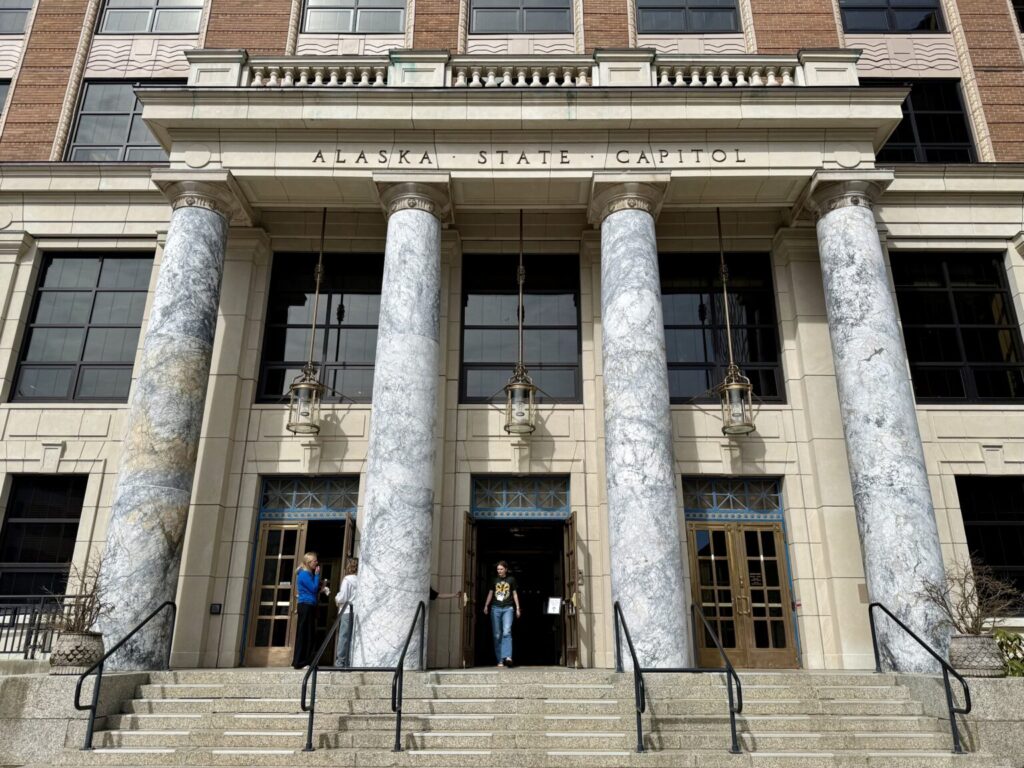
The Alaska State Capitol in Juneau is seen on Apr. 24, 2026. (Photo by Claire Stremple/Alaska Beacon)
NOTN- With just over a week left before Alaska lawmakers adjourn on May 20, the Legislature is entering its busiest stretch of the year as lawmakers scramble to pass budgets, major policy bills and a contentious natural gas tax proposal that lawmaker’s say has become the Governor’s biggest priority this session.
Alaska Public Media conjectured the final days of the session will likely center on three major areas: the state budget, the proposed Alaska LNG pipeline project and a flood of remaining legislation that must pass before the end of the two-year legislative cycle. Bills that don’t pass by adjournment will die and have to be reintroduced in a future session.
Negotiations are now underway between the House and Senate on the state operating budget. The House version includes a $1,500 Permanent Fund dividend, one-time school funding and expanded spending on child care and social programs. The Senate’s proposal is more conservative, with a $1,150 payment that includes an energy relief component and less education funding overall. Final negotiations may depend heavily on oil prices, which have recently remained above forecast levels.
Lawmakers are also debating how much tax relief should be offered to support the proposed Alaska LNG gasline project. Governor Mike Dunleavy has proposed replacing the state’s existing property tax on oil and gas infrastructure with a lower tax tied to pipeline throughput.
At the same time dozens of other bills are moving quickly through committees and floor votes, including a broad crime package, which includes bills targeting AI generated Child Sexual Abuse content, Sexual Assault kit tracking and raising the State’s age of consent.
There is a pension bill for state employees, a long time win for the legislature, that many expect Governor Dunleavy to veto before lawmakers leave Juneau.
But, the big question remains- will legislators pass these bills by the scheduled end of the session?
Juneau Senator Jesse Kiehl says it’s unclear pointing to that massive gas line bill that could push work into overtime.
“The Governor’s number one priority this year is the Gas line bill. He waited until two thirds of the way through the session to give us that.” He said, “The Resources Committees have been working like crazy, meeting multiple times a day. This is billions and billions of dollars worth of decisions, the kinds of things that will have impacts for 30 years to come. We’re working as hard and as fast as we can. Boy, it’s tough to see that passing before the end of the regular session. This time of year, it always looks like it’ll be overtime. Sometimes it is. Sometimes we can avoid it. But when I look at the issues that are pretty big, and may result in extra innings, we got that gas line bill on day 80 out of 121.”
Attorney General designee Stephen Cox answers questions from the House Judiciary Committee during a confirmation hearing on May 4, 2026. (Photo by Corinne Smith/Alaska Beacon)
As Alaska state lawmakers consider Gov. Mike Dunleavy’s pick for attorney general, several have questioned a potential conflict between his involvement with a private, religious school and his role in the state’s top legal office.
Stephen Cox currently leads the Alaska Department of Law, which is defending the state in a lawsuit that challenges the constitutionality of spending state homeschool funds on religious and private school tuition.
He is also the treasurer and a founding member of the Thomas More Classical School, a private Christian school for grades Kindergarten through sixth grade, slated to open in Anchorage in the fall, whose website invites the use of state homeschool funding for nonreligious courses.
Cox has served in the role since his appointment in August, and appeared before lawmakers in a series of legislative hearings last week and Monday, ahead of a confirmation vote for attorney general, expected in the next week.
Sen. Löki Tobin, D-Anchorage, who chairs the Senate Education Committee, noted the apparent conflict between the state constitution and the school’s financial plans at a May 1 hearing.
“Our constitution directly says ‘schools and institutions so established shall be free of sectarian control. No money shall be paid from public funds for the direct benefit of any religious or private education institution,’” she read.
She pointed to his role as treasurer as a direct conflict with the state constitution because the school’s “tuition assistance” web page said it anticipates accepting payment through state allotment funds for courses “that do not use religious-based publishers and/or content.”
The lawsuit that will decide whether that spending is constitutional is currently underway.
Cox said he was not aware of the school’s tuition information.
“I am on the board of that school. I am not involved in the day-to-day operations,” he said, adding that he was involved in hiring a headmaster and the formation of the school. “I am not aware of that part of the website and I’m also not aware of any decisions with respect to allotment programs.”
He declined to comment further saying the issue was in active litigation.
Each homeschooled student is eligible for up to $4,500 per year, to be spent on curriculum, supplies or other educational resources. But the question on whether that money can go toward religious or private institutions is currently being decided.
A group of parents brought the lawsuit to prohibit state money from going to such institutions against the state in 2023, and a judge ruled the allotment system unconstitutional in 2024, but that ruling was overturned by the Alaska Supreme Court. The case moved back to a lower court — four school districts were named as defendants — and last fall a judge denied a motion to dismiss the lawsuit, citing need for evidence of how allotments are actually spent. A discovery period for both sides to collect evidence is open until June 1.
At a Monday hearing before the House Judiciary Committee, Rep. Ted Eischeid, D-Anchorage, pressed the question.
“Does that mean that under Alaska ethics law, you would recuse yourself about decisions that might benefit your school, financially related to public money going to private schools?”
Cox answered a slightly different question. He told lawmakers, for background, he had already looked into the question of recusal given his three children are homeschooled through the Anchorage School District’s correspondence program, Family Partnership Correspondence School. He said that he was advised it wasn’t necessary.
“The advice that I received back from my ethics supervisor after an analysis was that it was not a reason for recusal, because I think there are, like, 25,000 Alaskan students that benefit from the allotment, and so the fact that my kids benefit in piano class and tutoring and whatnot wasn’t itself a reason to recuse,” he said.
Cox is Catholic, and is a parishioner at the Holy Family Catholic Church in Anchorage, according to the school’s website.
Cox said he learned that the Thomas More Classical School was anticipating receiving allotment funds during confirmation hearings last week. He said he was not directly involved with the state’s defense in the lawsuit and that he would seek ethics advice about recusing himself from the case.
“I will say that I’m not involved in any of the day-to-day litigation, or even really any of the supervision of the strategic litigation,” he added. “Recently, last week, I learned for the first time that on the website, there was a reference to the school anticipating becoming a vendor of the correspondent school allotment programs. So I have asked my staff to take another look at that from a recusal perspective.”
On Tuesday, the tuition information on the school’s website had been changed. It now says that it still anticipates taking allotment money, but only in accordance with state law.
At the hearing on Monday, Eischeid asked Cox if the school planned to receive public allotment funds.
Cox said the issue is being litigated in court now, and whether it’s constitutional has yet to be determined.
“I want to be very careful, because this is in active litigation, and these are the issues that the judge and the judges ultimately will have to grapple with,” he said. “But as I understand it, the school districts and their correspondence schools — so for example, ASD’s correspondent schools, Family Partnership — the school districts will decide whether or not and to what extent the allotment can be used for private educational or private institutions, and vendors.”
Cox said when a court rules on the question, the Thomas More Classical School will follow the law.
Rep. Andrew Gray, D-Anchorage, noted that the Thomas More Classical school board president is Charles Gartland, who is also working at the Alaska Department of Law as the civil division director.
“Would he need to recuse from any cases dealing with allotments and private schools?” Gray asked?
Cox said he has asked the department’s ethics lawyers to research the question.
“I would assume that the same analysis that existed for me would also apply with respect to Mr. Gartland,” he said. “But I do not have an answer on that question yet.”
Officials with Alaska Department of Law did not return a request for comment on Tuesday on how decisions on recusal are made.
Gray said Monday there appeared to be a conflict of interest.
“Even if it’s all above board, as a member of the public, I see that, and I think that I would be more comfortable if the chairman of the board of a private school and the treasurer of the board of the private school wouldn’t work on those particular cases,” he said.
Matt Cooper, newly appointed to be the University of Alaska president, is seen in an undated photo. (Photo courtesy of the University of Alaska)
The University of Alaska Board of Regents announced Matt Cooper as the new university president on Friday, after a closed-door, confidential hiring search.
Cooper is a Fairbanks-based attorney, and formerly served as legal representation for the university starting in 2011 and later as general counsel to the university from 2021 to 2024.
He will replace Pat Pitney, who announced her retirement in November, after 30 years of public service and five years as university president. She is planning to step down later this month. The regents said Cooper will begin his term on August 3.
The board appointed Michelle Rizk, vice president of university relations and chief strategy, planning and budget officer, to serve as interim president during the transition period from May 22 to August.
Following an executive session Friday, the board voted unanimously to select Cooper. Board of Regents Chair Scott Jepsen said after the vote that Copper was selected from among 50 candidates.
The University of Alaska Board of Regents and UA President Pat Pitney are seen on a web call, following the announcement of the new UA president, Matt Cooper on May 1, 2026. (Screenshot of web call)
“I think he brings a management style to university, which will help us be collaborative and work as a team to achieve the goals that we have set for the university,” Jepsen said. “We have a lot of challenges in front of us, and it’s going to take a skill set that has good interpersonal skills, understands the university, understands Alaska, and has that vision of where we want to go.”
UA President Pat Pitney told board members she was pleased with the selection.
“I’ve had the pleasure to work with Matt over the years, and he is a genuine leader. He looks for win-win solutions. He’s worked on numerous issues and opportunities for the university at all levels. So he knows he knows our institution, he knows the people he’s just going to bring a really strong energy and strong leadership to our university,” she said.
Cooper has been practicing law in Alaska since 2003. He is leaving a position with the law firm Davis Wright Tremaine, LLP where he focused on real estate and land use issues in Alaska, Washington state and other areas, according to the firm’s website.
He received a law degree from the University of Washington School of Law, and a bachelor’s degree at the University of Puget Sound.
Cooper will be charged with the chief executive role overseeing the state’s public university system across three university campuses, 13 community campuses and over 500 in-person and online degree programs, as well as a wide range of research initiatives. Currently, roughly 20,000 students are enrolled this year.
Cooper will continue to live in Fairbanks. He will earn a base salary of $420,000, with a total compensation package of $429,600 excluding benefits, according to the university.
That’s a slight increase from Pitney’s total compensation package of $427,565, which included a housing stipend and excluded benefits.
In a statement following the announcement, Cooper said he was grateful for the appointment.
“I’ve seen firsthand how UA empowers our communities and state, and I believe strongly that the future on our horizon is bright,” he said. “I look forward to building on the strong foundation President Pitney has established, and to working with the Board and university leadership and governance to support and advance the university’s long-term vision and goals.”
University changes hiring process
Cooper was one of three finalists for the top university position. Regents and university officials opted to conduct a closed-door, confidential hiring process that began last winter, instead of holding public forums and interviews of finalists.
The change in process was at the recommendation of a Texas-based hiring consultant, Wietkeffer, to protect candidates’ confidentiality and potentially draw from a larger applicant pool, said Jepsen in a Feb. 16 letter.
“In recent years, highly qualified candidates – especially sitting presidents and chancellors – have declined to participate in searches with a fully public evaluation process for finalists due to concerns about professional risk if they are not selected for the role,” he wrote. “Adopting a representative model helps ensure UA can attract and seriously consider the strongest possible candidates while still incorporating meaningful stakeholder input.”
The university’s hiring committee — made up of three regents, industry leaders, and university, city and education officials — narrowed the list down to six semifinalists, then three finalists.
Finalists made campus visits and met with select “constituent groups” this spring that included faculty, staff and student representatives from across the university system, according to a presidential search update. Each participant was required to sign a non-disclosure agreement, or NDA.
The groups submitted input to the Board of Regents, who made the final decision to select Cooper.
Correction: This story has been updated to clarify Michelle Rizk currently serves as the vice president of relations for the University of Alaska, and to reflect that the university’s candidate search narrowed down to three finalists from six semifinalists.
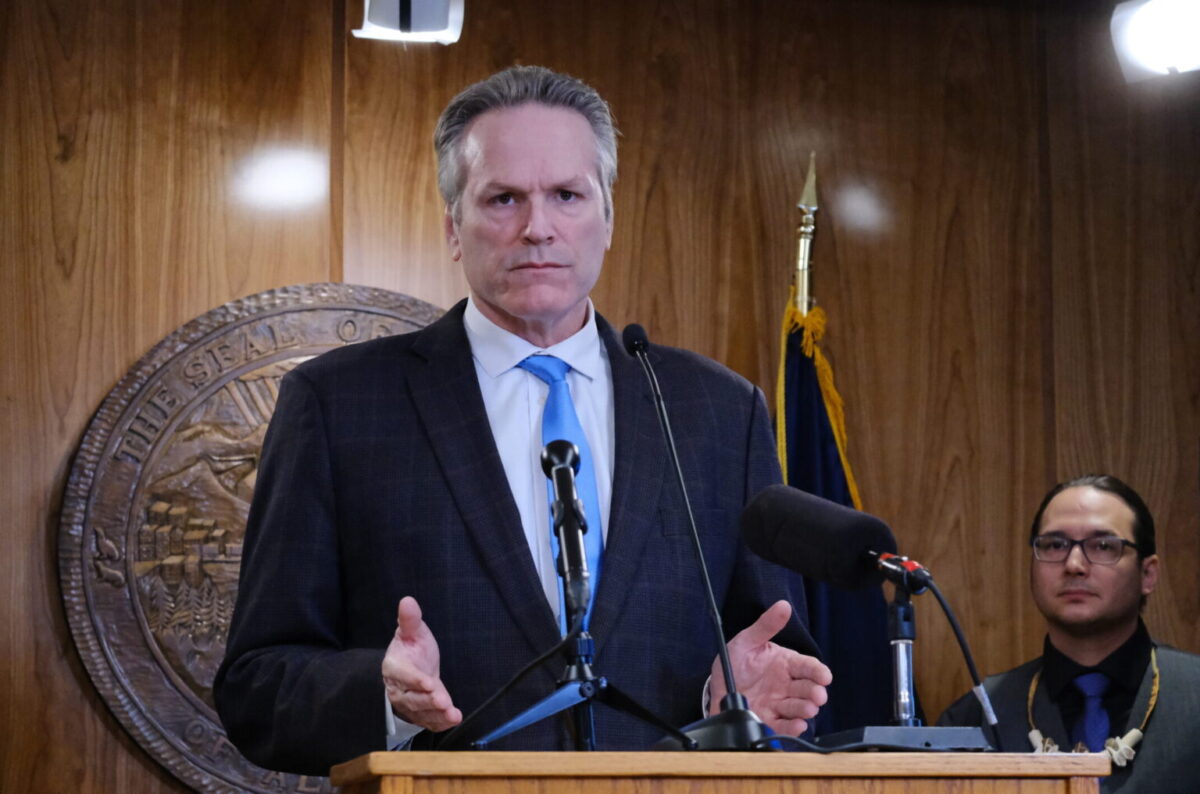
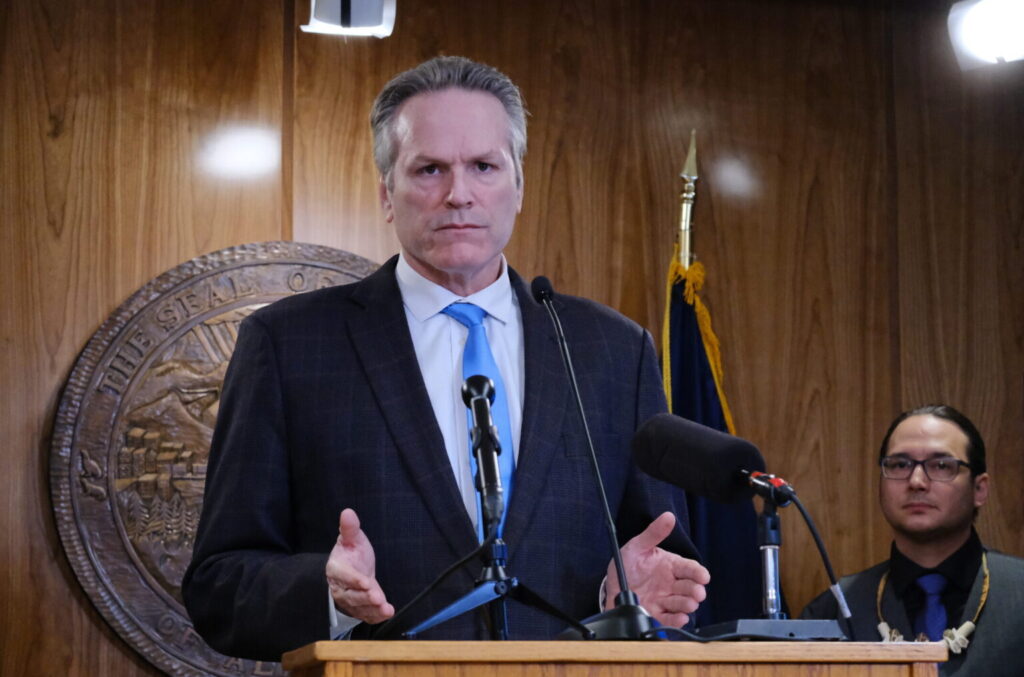
Gov. Mike Dunleavy discusses proposed education legislation at a news conference on Jan. 31, 2025. (Photo by Corinne Smith/Alaska Beacon)
Alaska Gov. Mike Dunleavy vetoed a bipartisan bill aimed at streamlining the state’s elections process on Thursday, just seven months ahead of high-stakes state and federal elections in November.
Leaders with the multipartisan House Majority caucus said there will be a joint legislative veto override vote within the next few days.
In a prepared statement announcing the veto, Dunleavy said while there are many provisions in the bills he supports, the bill contained “legal and operational challenges and could jeopardize the election process.” He told lawmakers his two main issues with the bill are related to when it would go into effect and voters’ signature verification.
“The Division of Elections warns such changes would be extremely difficult if not impossible, to implement securely and reliably in advance of the 2026 elections,” he wrote in a transmittal letter to the Legislature. He said the Division needs sufficient time to make necessary changes.
The Alaska House passed the bill in March along caucus lines, following passage by the Senate last year. It contained a variety of changes to the state’s elections system, which supporters say is years overdue and needed to update and strengthen the elections process and expand voter access.
The governor said that the bill would impose “significant operational hurdles” for the Alaska Division of Elections in administering state and federal elections in November.
Sen. Bill Wielechowski, D-Anchorage, who carried the legislation in the Senate, condemned the decision in a written statement following the announcement.
“Governor Dunleavy has said, by his veto, that Alaska’s elections are secure enough,” Wielechowski said. “Unfortunately, they are not, and even his supporters confirm that. Our voter rolls stood at 114% of the voting-age population in 2022. Ballots are being rejected over technical errors. Tampering with a voting machine is not explicitly a crime under current law. This bill addressed every one of those concerns. The Governor had every reason to sign it.”
The bill would have authorized checks to update Alaska’s voter rolls. Officials have said managing an updated voter registration list is a continuous challenge with Alaska’s transitional environment and many residents moving in and out of state, resulting in the number of registered voters currently outnumbering actual eligible voters in state.
The bill would also have enacted a new ballot tracking system, provided paid postage for all absentee mail-in ballots, strengthened security protocols, and implemented provisions for faster elections results, among others.
The Legislature has five days to convene in a joint session to consider an override of Dunleavy’s veto. A majority of 40 votes of the Legislature’s 60 members are needed for an override.
“There will be a veto override vote. I don’t think it will come as a surprise to the governor,” said House Speaker Rep. Bryce Edgmon, I-Dillingham, in a call Thursday evening.
On Thursday afternoon, members of the House Majority caucus slammed the decision Thursday following the announcement, saying in a joint statement the veto is “a significant setback for election integrity and a direct blow to voting access for Alaskans living in rural and off-road communities.”
Edgmon called the decision “deeply disappointing.”
“This was a bipartisan effort to address the real challenges of voting in a state as vast, rural and remote as Alaska. We worked in good faith to improve access, strengthen transparency, and maintain the integrity of our elections,” Edgmon said. “Alaskans deserve a system that reflects our unique geography, not one that ignores it. This veto does exactly that.”
Rep. Nellie Unangiq Jimmie, D-Toksook Bay, said that rural Alaska “is the hardest place in the state” to vote.
“Everyone who has looked at the data knows that. We passed a bill to clean up our rolls and remove barriers. It will not become law today,” she said. “My people have been patient with systems that were not built for us, distances that were not considered, delays inevitable in rural areas beyond our control. So today, the problem doesn’t go away. Neither do we.”
Dunleavy also took issue with provisions to establish a ballot tracking system and to allow voters to fix mistakes on their ballot — a process called ballot curing — by requiring the division to contact the voter by phone or email within 24 hours. Under the bill, voters would have been allowed to return a form to correct the ballot with a copy of identification by email or by mail within 10 days of the election for their ballot to be counted.
“The ballot-tracking and ballot-curing provisions are especially problematic,” Dunleavy wrote. “The ballot-curing provisions create tension with Alaska’s witness requirement by allowing a voter to cure a missing witness signature after the ballot has already been returned, even though Alaska’s absentee-ballot framework requires the voters certificate to be signed in the presence of a qualified attesting official or witness.”
The governor sent a letter following a meeting with presiding officers of the Legislature on Thursday with technical changes he’d like to see in legislation for fixing ballots, evaluating and verifying signatures.
Dunleavy said the potential Alaska gas line is his main priority, but he’s open to continuing negotiations on the elections bill this session.
“While the Alaska gas line bill is the most important bill this session, I am open to a conversation with lawmakers on how we can address the legal and operational issues this session.”
Other provisions in the now vetoed bill would have included:
Require all absentee ballots to be received within 10 days of Election Day;
Establish a new rural community liaison position within the Division of Elections to support rural districts, including recruitment and training of poll workers;
Require the Permanent Fund Dividend Division to share data to improve the accuracy of the voter rolls’
Require the state to develop a cybersecurity program, and notify the public if there is a data breach;
Require the division to publish results for all rankings in the precinct results.
Require presidential ballots to include a line for write-in votes for president and vice president
Updates crimes of unlawful interference with an election, ballot tampering and election official misconduct
Dunleavy said he applauded the Legislature’s efforts, but said the state needs more time to make changes to the state’s elections system.
“I appreciate the efforts made to improve Alaska’s elections. Going forward, I encourage those who wish to continue this work to use this bill as a starting point; ensure that any proposed changes comply with state and federal law; and pass any election legislation on a timeline that allows the Division of Elections to implement the necessary systems properly,” he said.
Edgmon said that the issues Dunleavy raised were “highly subjective” and lawmakers had heard from the division and the lieutenant governor, who is charged with overseeing state elections, that the timeline for implementing the bill was doable.
Edgmon said it’s unclear if there are the votes to override.
“You never know until the votes are tallied. You just never know,” he said. “And I know there will be plenty of votes. Will there be enough? I’m not going to hazard a guess at this point, because I’ve been proven wrong before.”
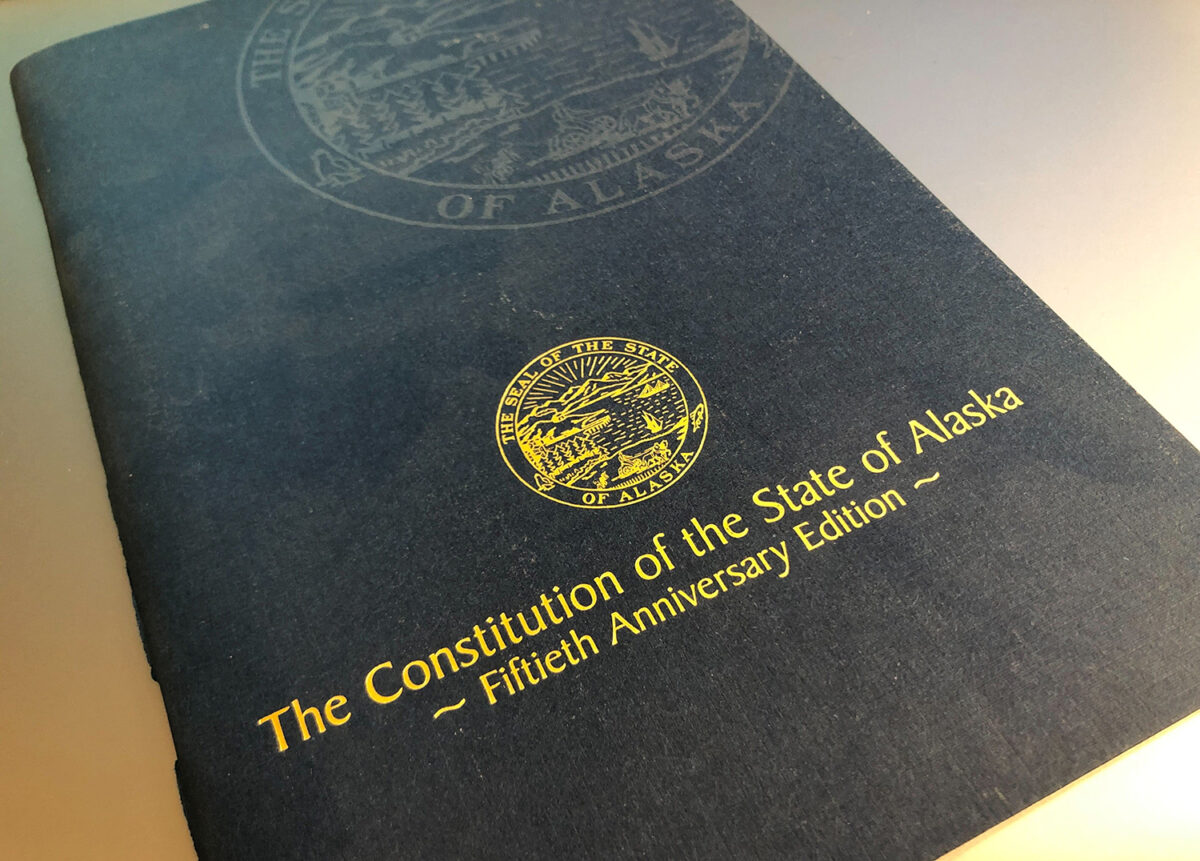
A copy of the Alaska Constitution is seen on Thursday, July 28, 2022. (Photo by James Brooks/Alaska Beacon)
By: Corinne Smith, Alaska Beacon
A copy of the Alaska Constitution is seen on Thursday, July 28, 2022. (Photo by James Brooks/Alaska Beacon)
A proposal to create civics education requirements for all Alaska high school students is advancing in the Legislature, amid a deepening decline in public trust in government nationwide.
Senate President Gary Stevens, R-Kodiak, sponsored Senate Bill 23, which would require high school students to take a semester of civics curriculum, pass a civics exam or complete a project-based assessment in order to graduate. The bill is under consideration in House committees after it passed the Senate in March.
Senate President Gary Stevens, R-Kodiak, talks to fellow legislators shortly before the Alaska Senate adjourned for the year on Tuesday, May 20, 2025. (Photo by James Brooks/Alaska Beacon)
Stevens, a longtime legislator and former University of Alaska professor, told House members at a hearing on March 18 the goal is to inspire students to be more engaged with their government and civic affairs.
“What we hope to do is to rekindle the spirit within our education system to help foster citizenship and voting and community engagement, which is really a fundamental purpose, I think, of public education,” Stevens said.
Civics education is the study of how local, state and federal government works in the constitutional democracy of the United States. That includes our government’s laws and history, the rights of citizens and structures of power.
Stevens said in an interview Wednesday that he sees expanding civics education as a way to combat growing distrust or misunderstanding of government.
“Certainly, I think there’s just a lack of understanding. I have talked to a lot of kids who just have no idea that there is a state government and there is a federal government. There’s a difference between the two,” he said, adding that each governments’ roles and responsibilities are important to understand.
Stevens said Alaska’s students should know that, states are responsible for administering public schools and running elections. “I think kids need to know that, and I think they’re interested in it.”
The bill would direct the Alaska State Board of Education to provide open access, no-cost educational resources to districts covering 14 areas of government, politics and public affairs. Those 14 areas include the founding principles of the United States, the Alaska and U.S. Constitutions, federalism, civil liberties and civil rights, political parties, campaigns and elections, comparative systems of government including by Alaska Native tribes, and others.
If enacted, students would have three options to fulfill the graduation requirement: take and pass a semester-long comparative government and civics course, pass a civics exam — with an option e-take the exam if they did not pass — or opt to complete a civics-related project.
In the second term of the Trump administration, public distrust and political polarization has continued to decline in the U.S. A survey completed in September by the Pew Research Center found public trust in government at one of the lowest points since 1958 — just 17% of respondents said they trust the federal government to do what is right. That’s down from 22% in 2024, and reported trust in government has not been higher than 30% since 2007.
Another 2025 survey by the center found that 8 in 10 U.S. adults said that on important issues facing the country, Republican and Democrat voters not only disagree on policy and plans, but also can’t agree on basic facts.
Shawn Healy with iCivics, a nonpartisan advocacy organization founded by former Supreme Court Justice Sandra Day O’Connor to promote civics learning, testified in support of the bill. He said many states across the country are taking steps to bolster civics education.
“Just since 2021, 33 states have adopted at least 51 policies to strengthen civics education, and just this spring, we’re following 218 bills in 40 states, including Senate Bill 23, that seek to strengthen civic education,” he said.
Healy told lawmakers that often people do not understand where to go to solve problems in their communities. He said supporting civics education in schools and dialogue on public issues — across political divides — can help address polarization.
“What we know actually, is when we have conversations across difference, that that’s actually a moderating force, that brings us close together, at least creates an opportunity for us to compromise and develop consensus. And classrooms are great venues for that.” he said.
Researchers with iCivics found that young people who experience civics education are more likely to vote, go to college, be confident in public speaking and volunteer and work on community issues. He said the growing interest in advancing civics education is an investment in future generations.
“We’re not sentenced to this current predicament in our country, where there’s widespread civic ignorance, there’s deep distrust of institutions and one another, and toxic levels of political polarization,” he said. “States across the country are embracing civic learning as a means of strengthening and sustaining our constitutional democracy.”
Many Alaska school districts, including Cordova, Haines, Kodiak and the Aleutian Region School District reported they already offer civics education, according to a survey conducted by the Alaska Council of School Administrators on the impacts of the bill.
Other districts, including Nome, Lower Kuskokwim and Petersburg school districts noted that implementation would require costs for training teachers and purchasing curriculum. As a result, the bill was revised to require Alaska Department of Education and Early Development to develop open, no-cost curriculum resources for districts.
Susan Nedza, superintendent of Hoonah City School District, testified to lawmakers she was initially concerned about the cost and now supports the revised bill.
“While there is often much debate about the reason schools exist and what schools should teach, it is my opinion that civics education is vitally important in preparing youth for the future as community members and citizens,” she said. “I have in the past been concerned about cost and about tests creating a barrier for school and students. The version before you offers pathways that eliminate my concerns.”
The revised bill now estimates a state cost of $40,000 for educator stipends to support a working group to evaluate the curriculum and education resources for districts to list on the DEED website. It estimates $12,000 for the initial design, printing and shipping of a civic education seal for all high school graduates, and $5,000 each year going forward.
Stevens has sponsored previous bills to strengthen civics education that were approved by the Senate in 2024 and 2022, but they were unsuccessful in gaining support and stalled before reaching a vote on the House floor.
Stevens said some of the past opposition was related to a concern the state would be imposing an unfunded mandate for schools, but that is addressed in the current bill, which requires the state to provide with the open, no-cost educational resources. Other concerns were related to what critics called a “high stakes” test requirement to graduate. He said those are addressed by having three options for meeting the requirement in the bill.
The civics education bill was advanced by the House Education Committee earlier this month and is now referred to the House Finance Committee for consideration. It has not yet been scheduled.
Civics curriculum in SB 23 would include:
the founding history of the United States, including foundational documents and the principles of government of the United States;
federalism, including the role and operations of local, state, and national governments;
the institutions of the United States government, including the responsibilities of the executive, legislative, and judicial branches;
the rights and responsibilities of United States citizenship;
civil liberties and civil rights;
the Constitution of the State of Alaska and the Constitution of the United States;
political parties and interest groups;
campaigns and elections;
the United States Congress;
domestic policy;
foreign policy;
comparative systems of governments used globally and by Alaska Natives;
international relations; and
major issues facing local, state, and the United States governments.
NOTN- The City and Borough of Juneau Assembly will hold a public hearing tomorrow on its proposed fiscal year 2027 budget, including property taxes, school funding, a multi-year capital improvement plan, Eaglecrest and the Gondola Project.
The special Assembly meeting is scheduled for 5:30 p.m. and it will be followed by the Assembly Finance Committee. Residents may testify in person or via Zoom.
At the hearing, Assembly members will take testimony on several key ordinances, including a measure setting the 2026 property tax rate to fund the FY27 budget.
According to the agenda, officials will also consider a $551.2 million operating budget for city and borough services, along with a separate $97.2 million budget for the Juneau School District.
In addition, the Assembly will review a resolution adopting the city’s capital improvement program for fiscal years 2027 through 2032, which outlines infrastructure priorities and planned project spending.
Another resolution would set aside up to $2.3 million from the city’s restricted budget reserve to cover an anticipated operating deficit at Eaglecrest Ski Area.
Separately, the Assembly is expected to introduce an ordinance to begin terminating a revenue-sharing agreement with Goldbelt Inc. tied to the proposed gondola project at Eaglecrest. City officials say the project is no longer financially feasible after cost estimates rose to more than $37 million, up from initial projections of about $10 million.
This is still up in the air, but under this agreement Juneau would be required to repay Goldbelt’s $10 million investment plus interest if the deal is terminated. Repayment would include general funds and previously allocated project money.
A school bus drives in front of the Alaska State Capitol on Monday, Feb. 3, 2025. (Photo by James Brooks/Alaska Beacon)
By: Corinne Smith, Alaska Beacon
A school bus drives in front of the Alaska State Capitol on Monday, Feb. 3, 2025. (Photo by James Brooks/Alaska Beacon)
While many school districts across Alaska are facing severe budget shortfalls, several bills to provide a sustained increase to education funding appear to have stalled in the Legislature. But a bill to add nearly $82 million one-time funding and education policy changes is moving forward with bipartisan support.
On Monday, the Senate Education Committee introduced a revised version of House Bill 28, that adds one-time funds for energy relief, transportation, reading and vocational training, to a bill that would establish a loan forgiveness program for Alaska teachers. It also includes a variety of policy changes related to home school programs and others.
Chair Sen. Löki Tobin, D-Anchorage, described it as a “mini-bus” bill on Wednesday, saying the new omnibus bill includes specific education funding to areas sought by the governor and lawmakers on both sides of the aisle.
“We heard that there is a deep concern about education reform still being left on the table, and so in those discussions we focused the new version of House Bill 28 on codifying some of the best practices that we know are going to improve education outcomes across the state,” Tobin said.
The underlying bill establishes a new three-year student loan forgiveness program to incentivize teachers to stay in Alaska. It’s focused on teachers specializing in special education, English as a second language, science, technology, engineering and math. It would provide up to $15,000 to pay off student loans for those who go out of state and return to work in Alaska. The House passed the bill last May.
“We need to incentivize teachers to stay here,” said Rep. Andi Story, D-Juneau, who sponsored the bill. “We’ve had such tremendous turnover, and we’ve got this tremendous shortage. And so I think the bill will help.”
The bill moved to the Senate this year, and education committee members tagged on a variety of items on Apr. 21. According to data provided by Tobin’s office, it contains an additional $21.8 million for reading proficiency grants, $9.7 million for career and technical education, $7.3 million for transportation, and $43 million to offset rising energy costs for school districts.
“We do not want to divert operating costs, dollars that should be in the classroom, to just keeping the lights on and buildings warm,” Tobin said.
Meanwhile many Alaska school districts are in the midst of budget negotiations and grappling with cuts to staff and programs to address large budget shortfalls.
Tobin said at a Senate Majority caucus news conference on Wednesday the goal of the education policy bill is to garner enough support on both sides of the aisle to be able to override a potential veto by the governor.
“It is obviously the hope for all of us that we will continue to increase stable and predictable funding for our schools and ensure that they have the resources they need,” she said. “However, at the end of the day, our goal is to get dollars into the classroom and to get support into our schools, and I will work diligently to do that with the number of people that I can guarantee will be there to get that bill across the finish line.”
Gov. Mike Dunleavy has been a staunch opponent of increasing funding for schools, saying that education policy changes are needed to improve student outcomes. Last year, he issued three vetoes of additional funding for K-12 schools sustained through the state’s funding formula, the base student allocation, and the last was narrowly overridden by the Legislature last summer.
This year, legislators introduced bills to again provide a sustained increase per student funding statewide. Rep. Rebecca Himschoot, I-Sitka, introduced a bill to add $158 million to boost the per student formula, but so far it hasn’t moved out of the House Education Committee.
Earlier in the session, Tobin introduced a bill that would add nearly $100 million in education funding. A portion of that money would go to per student funding through the BSA, and additional reading proficiency grants and transportation funding. But her bill proposed policy changes to enact reporting and testing requirements for homeschool programs that drew public criticism from homeschool proponents, so the Senate Education Committee stripped the provision and held the bill.
The new draft Senate bill also institutes more reporting requirements from school districts to the state on their homeschool programs, including how many students are enrolled by grade, where they live across the state and how their annual allotment is spent, among others.
The draft bill would commission a state audit to evaluate Alaska’s funding for schools, and make recommendations for changes or for alternative methods of education funding. There is no cost estimate yet for the study, or the entire bill.
Tobin said the funding adequacy study is a top priority of the joint Task Force on Education Funding. “We know that our foundation formula needs some reform, and it also needs some additional attention on particular components that have changed significantly in the last few years, the pandemic really showcased that,” she said.
Story said she supports the changes to the bill. “There’s some really good things that got put in there,” she said. “It’s the end of the session, lots of things are happening, so we’ll just see. But I’m hoping good things happen for teachers and families and for our kids to get more attention next year.”
The draft “mini-bus” bill was approved by the Senate Education Committee and now moves to the Senate Finance Committee for consideration.
Meanwhile, senators are debating the draft operating budget for next year that includes up to $100 million in additional funding for schools, but only if oil prices remain high. The House passed a draft operating budget with nearly $158 million in one-time funding for K-12 schools earlier this month.
A select group of lawmakers from both chambers will negotiate and reconcile a compromise between the two budget bills — and a final allocation for Alaska schools next year — in a conference committee in the last days of the legislative session, by May 20.
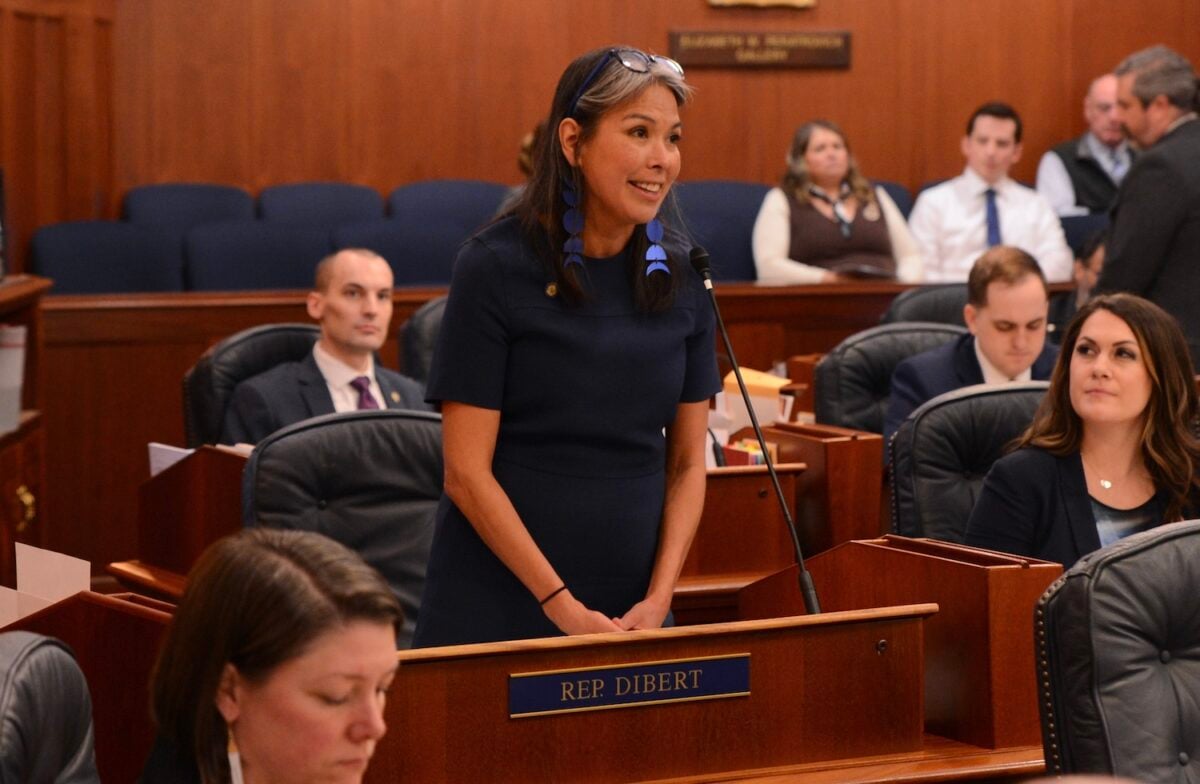
Rep. Maxine Dibert, D-Fairbanks, speaks Monday, Jan. 27, 2025, on the floor of the Alaska House of Representatives. (Photo by James Brooks/Alaska Beacon)
By: Haley Lehman, Alaska Beacon
Rep. Maxine Dibert, D-Fairbanks, speaks Monday, Jan. 27, 2025, on the floor of the Alaska House of Representatives. (Photo by James Brooks/Alaska Beacon)
The Alaska House of Representatives advanced a bill Wednesday that aims to address a lack of oversight for minors treated at psychiatric facilities in Alaska. The bill would mandate an annual report on conditions and treatment at such facilities from the state’s Health Department, as well as unannounced biannual inspections.
Rep. Maxine Dibert, D-Fairbanks and the bill’s sponsor, said the measure is a necessary step to increase accountability around the treatment of minors in psychiatric hospitals in the state, amid constituent concerns.
“These are not sweeping mandates, they are basic expectations of transparency, of communication and accountability of our youth here in Alaska,” she said on Wednesday.
The bill passed the House of Representatives with 37 yes votes. Three legislators were absent. It has been transmitted to the Senate for consideration.
The bill would also guarantee patients confidential telephone or video communication with a parent or guardian for two hours per week and require the Department of Health to notify a patient’s parent or legal guardian when seclusion or restraint is used within 72 hours.
The annual report would include information about the total uses of seclusion or restraint, findings of facility inspections and data on the number of minors who received residential care at psychiatric hospitals.
Dibert cited a 2004 investigation by the Disability Law Center of Alaska that found 261 episodes of seclusion and restraint over three months in psychiatric institutions, which the organization called “quite high.”
The United States Department of Justice issued a report in December 2022 that found that Alaskan youth are institutionalized in psychiatric hospitals and psychiatric residential treatment facilities at higher rates and for longer periods than minors in other states as a result of a lack of available and accessible community-based mental health services, violating the Americans with Disabilities Act.
Rep. Genevieve Mina, D-Anchorage and Chair of the House Health and Social Services Committee, voiced her support for the bill and drew attention to a finding by the DOJ that identified gaps in community-based services in Alaska.
Community-based services include home-based family treatment for early intervention services, intensive case management and crisis services, according to the DOJ.
“We have to face the reality that many of these kids are in these institutionalized settings because we have underinvested in our home and community based services in this broader continuum of care,” Mina said.
“The dearth of community-based services in Alaska is so pronounced and widespread that institutional placement has become, for many behavioral health service providers in the state, the default option to which they refer children with long-term behavioral health need,” DOJ investigators wrote in 2022.
According to the DOJ, more than 800 Alaskan children received behavioral health services in a psychiatric institution in 2020. Approximately a third of the patients were Alaska Native and parents reported to the DOJ concerns about separating their children from their culture while in residential treatment. In addition to four psychiatric residential treatment facilities in Alaska, the state sends children to 17 out of state psychiatric residential treatment facilities.
Rep. Justin Ruffridge, R-Soldotna, told legislators that the bill provides oversight and accountability that legislators are expected to institute.
The bill received support from the Alaska Federation of Natives, Lives in the Balance, a nonprofit that advocates for the fair treatment of children, Dot Lake Village, Citizens Commission on Human Rights, an organization that aims to eradicate abuse in mental health settings, and Aleutian Pribilof Islands Association.
The Department of Health estimated in a fiscal note that it would cost approximately $222,800 annually for a full-time nurse consultant to perform inspections, conduct interviews with patients and conduct investigations and for two nurse consultants to attend trauma informed care and cultural awareness training.
Children pick up their school lunches. (Photo by Amanda Mills/Centers for Disease Control and Prevention)
The Alaska Senate passed a bill Monday that would ban public schools in Alaska from serving certain food dyes in school breakfasts or lunches.
Lawmakers expressed concerns that certain petroleum-based food dyes in processed foods have unhealthy side effects on children.
Sen. Bill Wielechowski, D-Anchorage, the sponsor of Senate Bill 187, said Monday, “We like to sell our petroleum to fuel our cars and generate our power plants, not to feed our kids.”
Wielechowski pointed to studies that suggested that artificial dyes are linked to increased hyperactivity, inattentiveness and allergic reactions in children.
The bill would ban red dyes Nov. 3 and No. 40, yellow dyes No. 5 and No. 6, blue dyes No. 1 and No. 2 and green dye No. 3.
The U.S. Department of Health and Human Services and the U.S. Food and Drug Administration announced a campaign in April 2025 to eliminate synthetic dyes from the U.S. food supply by the end of 2027 and to authorize natural color alternatives. Alaska proposes banning the same food dye in schools that HHS and the FDA are working with the food industry to eliminate.
The bill received strong support from Alaska Community Action on Toxics and opposition from the International Association of Color Manufacturers, which maintains that synthetic dyes are safe for consumers.
Carlee Johnson McIntosh, Petersburg School District food service director, wrote in a letter to legislators that the bill aligns with work the school district is already doing to remove synthetic dyes from school meal programs. She said the bill would not create a significant burden for the school district.
“Schools should be environments where students are set up for success, and access to nutritious meals plays an important role in that success,” Johnson McIntosh wrote. “Establishing these standards in state law would demonstrate Alaska’s ongoing commitment to student health, regardless of potential shifts at the federal level.”
The bill passed the Senate with 19 yes votes. Sen. Donny Olson, D-Golovin, was excused absent.
If it passes the House and becomes law, it would go into effect in January 2028. Alaska would join states including Arizona, California, Delaware, Louisiana, Virginia and West Virginia in banning artificial food dyes in schools.
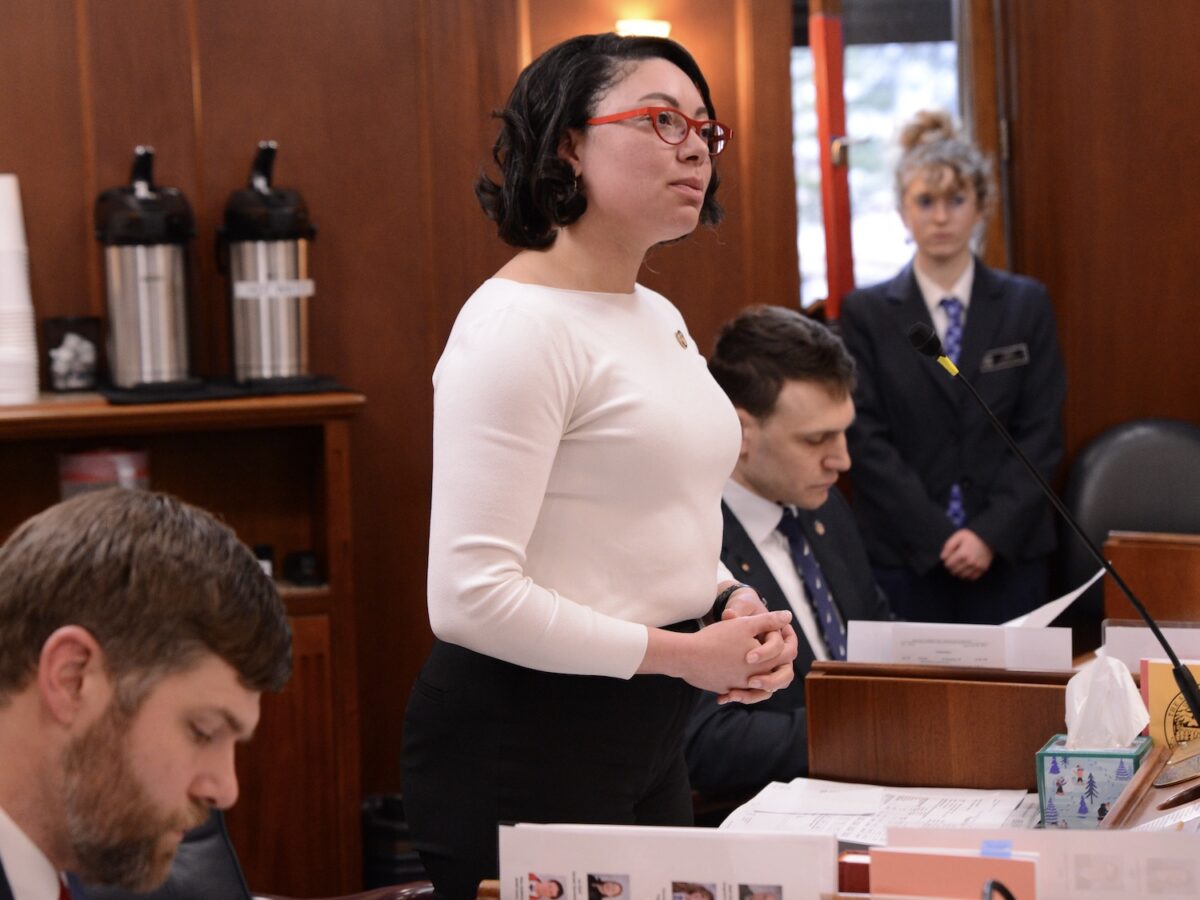
Sen. Loki Tobin, D-Anchorage, speaks in the Alaska Senate on Monday, April 28, 2025. (Photo by James Brooks/Alaska Beacon)
By: Haley Lehman, Alaska Beacon
Sen. Loki Tobin, D-Anchorage, speaks in the Alaska Senate on Monday, April 28, 2025. (Photo by James Brooks/Alaska Beacon)
The Alaska Senate advanced a resolution Monday to preserve three work visas to support Alaska’s economic security.
Alaska relies on J-1 visas to fill teacher positions, H-1B visas for highly skilled workers and the H-2B program for temporary nonagricultural workers in tourism, health care and seafood processing industries and for teachers.
Sen. Löki Tobin, D-Anchorage, said that Senate Joint Resolution 28, “puts Alaska on the record in support of these programs to fill jobs here in our state.”
The Trump administration raised the fee for highly skilled worker visas from $5,000 to $100,000 in September 2025.
Tobin said Monday that school districts in Alaska cannot absorb those costs and utilize the H-1B visa program to hire international teachers.
The Alaska House of Representatives passed a resolution in March urging the Trump administration to waive the $100,000 visa fee for international teachers. It was sponsored by Rep. Alyse Galvin, I-Anchorage.
According to Jennifer Schmitz, director of the Alaska Educator Retention and Recruitment Center, 20 school districts in Alaska employed 232 educators with J-1 visas and 341 educators with H-1B visas in 2025.
Alaska’s senior U.S. Senator, Republican Lisa Murkowski, introduced legislation in March that would exempt teachers from non-processing related fees for H-1B visas. U.S. Republican U.S. Sen. Dan Sullivan is a cosponsor.
The visa programs support other jobs, too. Marilyn Usibelli, owner of Black Diamond Resort Co. in Healy, wrote to legislators in March that J-1 visa holders play an essential role in staffing seasonal jobs in Alaska with lawful, reliable temporary workers.
“Despite extensive local recruitment, the small year-round population in the Denali Borough simply cannot meet the seasonal demand. J-1 participants fill critical roles that allow us to maintain safe, high-quality operations, support other local businesses, and contribute to the broader Denali-area economy,” Usibelli wrote.
The resolution passed the Senate with 19 yes votes with Sen. Donny Olson, D-Golovin, absent