CBJ- The Municipal Clerk has certified the proposed Mill Rate Cap Charter Amendment Petition as sufficient under the requirements of the CBJ Charter. The petitioners’ committee submitted petition books containing 2,986 signatures, and after review and verification by the Clerk’s Office, the petition met the required threshold of 2,566 certified signatures.
The Certification of Petition has been issued and is available on the CBJ Elections webpage. Unlike initiative petitions, charter amendment petitions are not subject to Assembly action following certification. Pursuant to the CBJ Charter, the proposed Charter Amendment will be placed directly before the voters at the next regular election.
The Mill Rate Cap Charter Amendment will appear on the October 6, 2026 Municipal Election ballot.
For petition documents, certification materials, and the latest petition status updates, visit the CBJ Elections webpage or contact the Municipal Clerk’s Office at 907-586-5278 (Option 1).
NOTN- The city is weighing two proposed bonds and finalizing a budget that city leaders say will draw down nearly all available savings as they prepare for a difficult fiscal year.
Christine Woll, chair of the finance committee, said that the assembly has discussed placing two questions on the October ballot: a just under $10 million bond to bolster water and wastewater infrastructure and about a $16 million bond to fund roof and heating system repairs at several schools.
“We have, as a community, not been keeping up with with the long-term maintenance needs of our water and wastewater infrastructure, and so this would give that fund a bit of a boost so we can do some projects there, and ideally keep rates for utilities lower as a result.” Woll said, “Then the second bond we’re looking at would help make some needed repairs to some of our school infrastructure.”
The assembly has a short period of time to decide whether to present the measures to voters.
“We have about a month to finalize whether we’re going to put that on the ballot.” Woll said.
The final vote on the fiscal 2027 budget, which begins July 1, is scheduled for Monday night, which will also be the final opportunity for public testimony.
The draft budget already includes significant cuts and is expected to draw substantial community participation.
“The draft budget that we put together for this year does have some significant cuts, but it draws pretty much all of the money left in the city savings out to fund the next year.” Woll said, “So if things continue the way they are, we will be back here in about a year talking about even more cuts. Monday is a big milestone for getting this year’s budget done, but this conversation is going to have to continue if we want to balance the budget moving forward.”
The assembly’s decision will determine whether voters will be asked to fund the proposed bonds in October, and the outcome of Monday’s meeting will finalize next year’s fiscal path.
CBJ- The City and Borough of Juneau Assembly is nearing the end of the Fiscal Year 2027 budgeting process. Below is an update on the budget actions that took place last week, as well as the next steps required before the Assembly’s June 15 deadline to finalize the budget.
The Assembly reviewed, discussed and took action on 21 proposed expenditure reductions to get to a final budget for FY2027.
The nearly $4.7M in reductions includes a combination of one-time and recurring reductions to partner agency grants, capital projects and CBJ services and programming, including:
$770,000 in cuts to Partner Agency Grants
Reductions to Travel Juneau, Juneau Economic Development Council, the Alaska Committee and Alaska Heat Smart
$1M in cuts to Capital Projects
The Gastineau Avenue Widening & Turnaround project
$507,1000 in cuts to CBJ Services, Operations and Programming
Operational reductions to the City Museum, Parks & Recreation’s Landscaping division and Arboretum, and Administration.
$2.7M in cuts to the Restricted Budget Reserve
$247,000 added as a one-time subsidy to Gastineau Human Services through Bartlett Regional Hospital
These reductions are not final. They were included in the amended FY2027 budget and moved to the June 8 Assembly Meeting. The public can provide testimony at the June 8 meeting before the Assembly adopts the final budget.
The Assembly Finance Committee also took action on the following:
An ordinance establishing the Mill Levy (9.92 mills including debt service) for property taxes was moved to the June 8 Assembly Meeting for public hearing and adoption.
CBJ’s independent auditors will provide the FY25 Audit Presentation, including their findings and recommendations. The Assembly will also discuss the proposed sales tax ordinances and general obligation bonds on schools and utilities. There will be an update on the Cost Allocation Plan.
The Assembly will host its final public hearing on the FY 2027 budget. To testify, participants can come to the Assembly Chambers and sign-up. For remote participation, testifiers will need to call the Clerk’s Office at 907-586-5278 by 4 p.m. on the day of the meeting and indicate the topic they will speak on.
The Assembly will make any needed amendments and adopt a CBJ Budget Ordinance, Mill Levy Ordinance and Capital Improvement Project Resolution (as amended).
Juneau’s Assembly Finance Committee is staring down a major budget deficit for fiscal year 2027.
They inched their way through a long night of budget cutting at a work session last night, trimming around the edges while sparing some of the city’s most debated programs.
Finance Director Angie Flick warned the city cannot afford to end the year in the red.
“You should be projected to be at zero at worst case scenario,” Flick told the committee, “I think my predecessor and the prior city manager had some conversations with the assembly at the time and suggested $5 or $7 million as a fund balance, and that was based on the spending and the projects that the assembly liked to do. When I went back and looked over the last three years, I would, if I were making a recommendation based on your past to predict your future, I would say you would want $11 to $12 million in your fund balance. There were some significant general fund dollars that went to support the school district when it was in need, there’s been significant one-time dollars that have gone to flood fighting, and then there have been other community priorities that the body has decided to fund, and so you know, based on how the body has approached spending in the past, that would be the kind of fund balance that I would suggest. I think the real pressing concern that’s going to be hard to get around, would be flood fighting as we move forward, and that’s just going to be a tricky one to deal with.”
The current draft budget uses about $8 million in fund balance to cover operating costs, leaving Juneau projected at negative $1.7 million in unrestricted fund balance. Even if a package of fast‑tracked sales tax changes passes, that only improves the outlook modestly.
Members were split over strategy.
Some pushed for deeper cuts now and said they were aiming to leave roughly $5 million in fund balance. Others favored relying more on one‑time project cuts until they know whether new revenue measures or fall ballot initiatives will pass.
In terms of action taken, prior to the June 8 public hearing, members voted 5-4 to cut $75,000 a year from the city’s landscape budget.
Assembly member Neil Steininger was one of those who objected to the cuts saying, “I feel like when we just call this the landscaping budget, it’s kind of a misnomer, because so many other things fit in there. This is a parks maintenance budget, it’s not the flowers downtown, it is not beautification landscape, it is safety considerations, it is cleanliness, it is all of those things. I don’t think when people hear landscape budget they think about trail maintenance. I think it’s an important thing that we spend money on to keep Juneau safe.”
Supporters, said the cut will make residents more aware of what those services cost.
The Assembly also approved a $261,000 recurring cut to the Juneau City Museum, staff said this will mean two layoffs and reduced public access.
Members also voted 5-4 for a one‑time $300,000 cut to the city’s grant for the Juneau Economic Development Council.
A $300,000 cut to staff travel and training was rejected.
Assembly members rejected a deeper, one‑time $250,000 cut to the Affordable Housing Fund, but later agreed to a smaller $150,000 reduction. Several members argued this is the wrong time to pull back on housing dollars.
“It is very hard for me to look at our actions and look at our process and look at where we are trying to go, and the things that people have said no to for cuts, speaking to the importance of their value to the community, and then turn around and say that we can afford a cut like this to the affordable housing fund.” Said Assembly member Alicia Hughes-Skandijs, “It does not make sense to me that rationale.”
The Assembly also kept a subsidy in place for Bartlett Regional Hospital’s home health and hospice program, while directing Bartlett to cover a separate, one‑time $247,000 substance use treatment grant for Gastineau Human Services.
They also approved a $20,000 one‑time cut to the city’s accessory dwelling unit grant program and voted to eliminate general fund support for the Jensen‑Olson Arboretum.
The Assembly declined to reduce funding for the Juneau Arts and Humanities Council or the Small Business Development Center.
A proposal to lease out the Douglas Fire Station failed after the fire chief warned it would worsen the island’s insurance rating and emergency response.
Committee members repeatedly emphasized that none of the reductions are final.
“These are not final decisions, what we are trying to do tonight is come to a holistic budget that we can pass to the full Assembly so that the public can get one more opportunity to give us feedback on it.” Said Finance Director Christine Woll, “Nothing is set in stone until we vote as a full Assembly on June 8.”
A complete budget, including any service cuts and use of savings is expected to go to the full Assembly and the public for a final vote June 8.
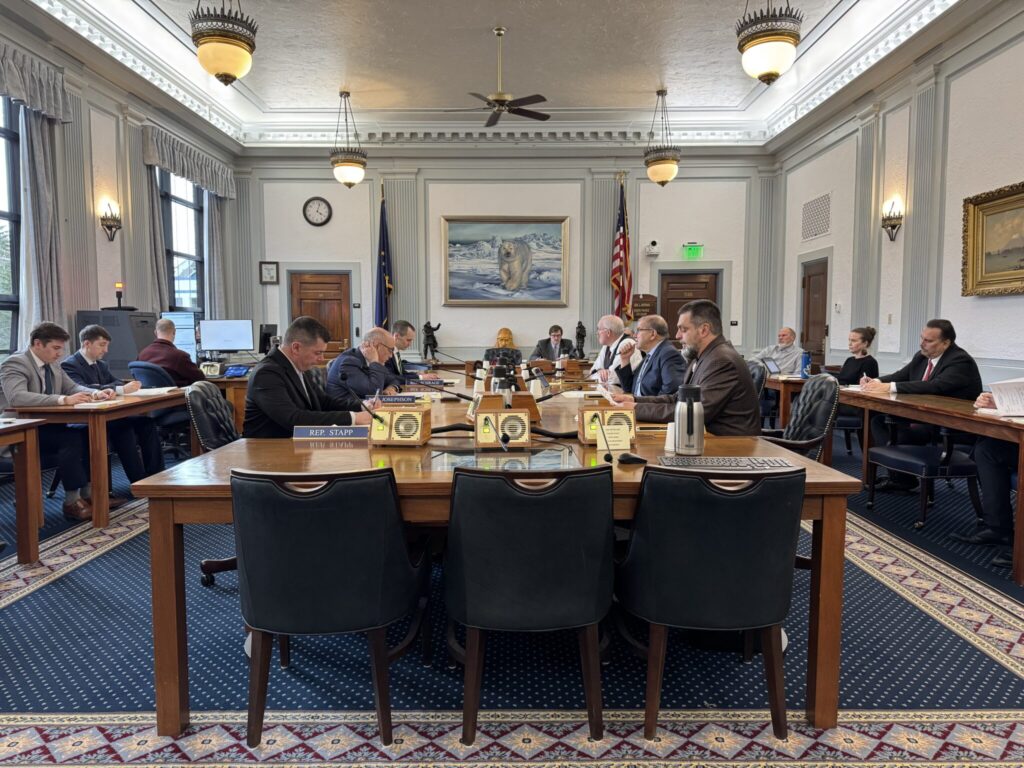
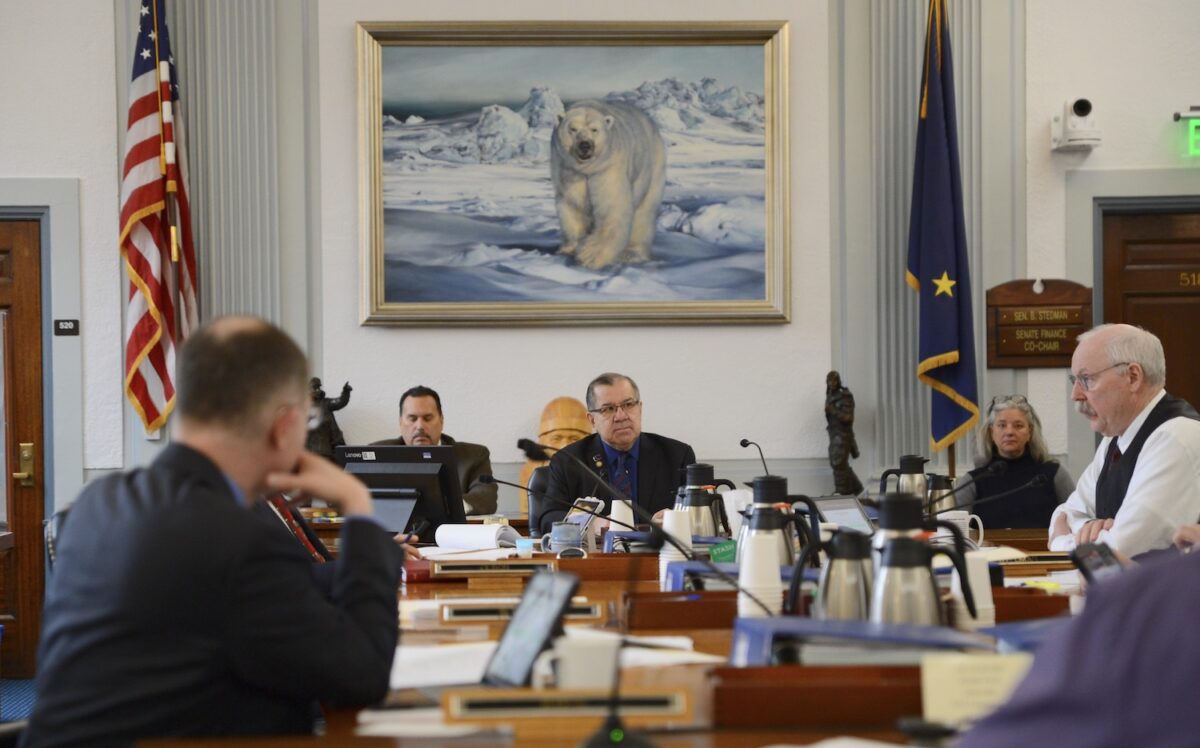
The Alaska Legislature's operating budget conference committee is seen on Monday, May 11, 2026. (James Brooks photo/Alaska Beacon)
By: James Brooks, Alaska Beacon
The Alaska Legislature’s operating budget conference committee is seen on Monday, May 11, 2026. (James Brooks photo/Alaska Beacon)
Alaska lawmakers are planning to vote on a $13.9 billion compromise state operating budget that includes a $1,000 Permanent Fund dividend and a $200 energy rebate.
In a 4-2 vote Sunday morning, a panel of House and Senate negotiators finalized a deal that combines two different versions of the budget — one passed by the Senate and the other by the House — preparing legislators for a final vote before the last regular day of the legislative session on Wednesday.
Once passed by the Legislature, the budget will go to Gov. Mike Dunleavy, who may sign it or use his line-item veto powers to eliminate or reduce specific items. The governor has never let a budget go into law without some vetoes.
Legislators convened in January with the expectation that they would be facing a massive deficit in fiscal year 2027, which starts July 1.
The Iran war, and the subsequent closure of the Strait of Hormuz, has sent oil prices soaring, resulting in hundreds of millions of dollars in extra revenue for the state.
That eliminated the projected deficit, but lawmakers don’t expect to have much left over for the Permanent Fund dividend.
While a payment formula from the 1980s remains in state law, legislators since 2016 have adopted a “surplus dividend” approach, paying the dividend with what’s left over after services are covered.
The final compromise version of the budget closely resembles the Senate plan, but the one-time bonus was slightly increased, to $200, in an amendment proposed over the weekend.
The final version of the budget also contains $144 million in one-time bonus payments for public schools across the state, including $29 million intended to offset the high cost of heating fuel.
The one-time bonus is less than the House proposed but higher than the Senate’s figure.
The budget also proposes to fund a heating assistance program for Alaskans, increase Medicaid reimbursements for medical providers, send additional money to cities and boroughs, and increase funding for wildfire response.
Altogether, the budget balances if Alaska North Slope oil prices average at least $75 per barrel in FY27. The average price since March is above $100 per barrel.
The operating budget advancing to a final vote is the last of four budget bills that lawmakers approve in an ordinary year.
The state’s supplemental budget — making changes to fiscal year 2026 — was adopted in March and signed by the governor in April. The $2.5 billion capital budget, which funds construction and renovation projects statewide, is awaiting a final vote in the Senate.
Alaska’s comprehensive mental health budget is moving in parallel to the operating budget and is expected to pass when the operating budget does.
NOTN- Juneau’s city officials are still weighing cuts to city services, new debt for infrastructure and a major change to sales tax rules as they work to close a nearly $12 million dollar budget deficit.
After a nearly five-hour finance committee meeting last night, officials began prioritizing a list of possible reductions. The work will shape the budget the Assembly expects to pass by the deadline on June 15.
Still under consideration are cuts to destination marketing through Travel Juneau, economic development funding for the Juneau Economic Development Council, potential closure of Mount Jumbo Gym, reduced hours or closure of the City Museum, and cuts to arts and culture funding through the Juneau Arts and Humanities Council.
Some of the most controversial ideas have been taken off the table for this year, including closing one of the city’s pools, the field house and the Treadwell arena. Those facilities will instead be supported with city savings which will be a short-term solution.
“Those were the ones that we had heard lots of public feedback on.” Said Finance Director Christine Woll, “Closure of the ice rink is no longer in consideration. I will say, everyone on the assembly acknowledged we can get away with not making those cuts this year, but that’s because we have a lot of money in savings, and so using our savings to fund those facilities will not work much for longer than a year.”
The Assembly is also considering up to two bond proposals for the ballot, Woll said, one for improvements to aging school facilities and another for water and wastewater infrastructure. She said general obligation bonds are appropriate only for capital projects and must be approved by voters.
“With approval from the taxpayers, the city does have a good amount of debt capacity and one piece I’ll add to that is, we would only use debt for Capital Projects, right? So the idea is you would borrow money so you can improve something or build something, and then pay it back over time, as opposed to taking on debt to operate something into the future.” Woll said, “So the Assembly is looking at putting up to two bond proposals on the ballot. We haven’t decided yet, but basically we’re looking at taking on debt for some improvements to our aging school facilities, as well as our water and wastewater infrastructure. So those in my opinion, good projects for debt.”
The Assembly plans a public hearing June 8, the same day many budget decisions are expected, and is accepting email comments at boroughassembly@juneau.gov. Woll urged residents to weigh in on the tax cap and potential service cuts as soon as possible.
NOTN- The City and Borough of Juneau Assembly will hold a public hearing tomorrow on its proposed fiscal year 2027 budget, including property taxes, school funding, a multi-year capital improvement plan, Eaglecrest and the Gondola Project.
The special Assembly meeting is scheduled for 5:30 p.m. and it will be followed by the Assembly Finance Committee. Residents may testify in person or via Zoom.
At the hearing, Assembly members will take testimony on several key ordinances, including a measure setting the 2026 property tax rate to fund the FY27 budget.
According to the agenda, officials will also consider a $551.2 million operating budget for city and borough services, along with a separate $97.2 million budget for the Juneau School District.
In addition, the Assembly will review a resolution adopting the city’s capital improvement program for fiscal years 2027 through 2032, which outlines infrastructure priorities and planned project spending.
Another resolution would set aside up to $2.3 million from the city’s restricted budget reserve to cover an anticipated operating deficit at Eaglecrest Ski Area.
Separately, the Assembly is expected to introduce an ordinance to begin terminating a revenue-sharing agreement with Goldbelt Inc. tied to the proposed gondola project at Eaglecrest. City officials say the project is no longer financially feasible after cost estimates rose to more than $37 million, up from initial projections of about $10 million.
This is still up in the air, but under this agreement Juneau would be required to repay Goldbelt’s $10 million investment plus interest if the deal is terminated. Repayment would include general funds and previously allocated project money.
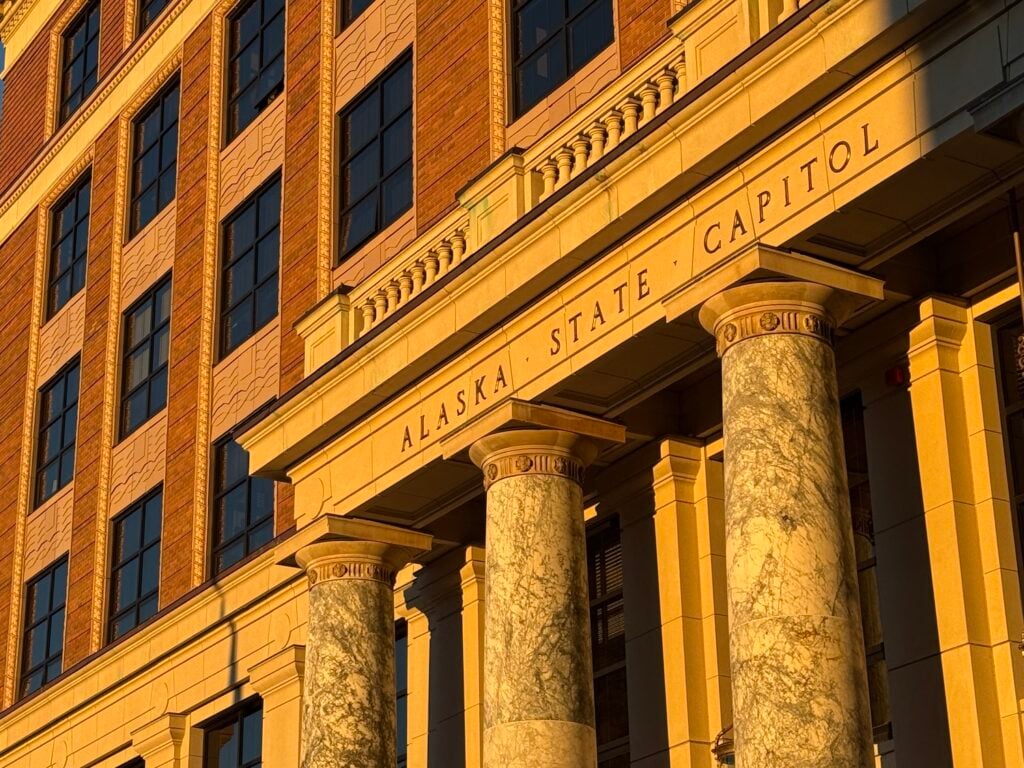
The Alaska State Capitol is illuminated by the rising sun on the morning of Friday, Jan. 23, 2026. (James Brooks photo/Alaska Beacon)
By: Corinne Smith, Alaska Beacon
The Alaska State Capitol is illuminated by the rising sun on the morning of Friday, Jan. 23, 2026. (James Brooks photo/Alaska Beacon)
The Senate Finance Committee on Wednesday proposed an operating budget for the next fiscal year, with a $1,000 Alaska Permanent Fund dividend plus $150 energy relief payment per eligible Alaskan.
The committee’s draft budget takes a more conservative approach to uncertainty around the state’s revenue forecast for next year — driven by rising oil prices due to the Iran war – than the proposed budget passed by the Alaska House passed earlier this month, and eliminates the deficit.
State forecasters have projected a $500 million boost in state revenues, and senators have expressed caution around state spending and a willingness to focus funds to tackle aging infrastructure and deferred maintenance, particularly upgrading school facilities.
“The most fundamental thing we have to remember is that the state doesn’t have the resources to do all the things we need to do and that Alaskans need us to do,” said Sen. Jesse Kiehl, D-Juneau, a member of the finance committee on Thursday. He said the greatest challenge for the Legislature is prioritizing.
“And so I think we did that effectively,” Kiehl said. “I think it makes a few really crucial, really targeted investments.”
The Senate’s draft budget removed the House’s proposed $158 million one-time education funding boost, and instead appropriates up to $100 million for K-12 schools subject to oil revenues averaging $95 per barrel for the rest of this fiscal year ending on June 30.
Alaska has no personal income or state sales tax, and so roughly 60% of state funds for the general purpose budget comes from the Alaska Permanent Fund, the state’s sovereign wealth fund currently valued at $86.3 billion, and roughly 30% comes from state oil revenues.
The draft Senate operating budget is based on an average of $73 per barrel for the next fiscal year starting in July, whereas the House draft budget is based on an average $75 per barrel projection.
The draft budget contains some changes to the House version and additions across departments. It would double funding for disaster relief to $48 million, and increase fire suppression funding from $47.5 million to nearly $61 million. It funds an additional $29 million for school districts and $20 million for communities to offset rising fuel and energy costs; $30 million for community assistance programs; $5.3 million toward a renewable energy fund; $3.5 million for the Alaska Marine Highway system’s ferry maintenance and staff salary increases. It also boosts funds for public employees retirement from $75 million to $106 million, and increases funds for teachers’ retirement system from $157 million to $164 million, among others.
The budget also contains $650,000 for a state audit of the Alaska Department of Corrections to evaluate cost drivers, as the department’s budget has ballooned in recent years.
Kiehl said while he’d like to see more investment in services like in the state’s foster care system, homelessness programs, energy and schools, he said the state can’t bank on unknown revenues.
“We have to be careful not to treat a temporary boost in the price of oil, which will probably last more than a year as though it were permanent, increase. That’s not responsible,” he said.
Senate Minority Leader Sen. Mike Cronk, R-Tok and a member of the finance committee, said he’d like to see a more conservative budget, but he also wants to avoid a large supplemental budget as seen this year. He said he supports the budget based on an average $73 per barrel estimate.
“I’m pretty comfortable with that number. I just don’t want to be back in that same position as we have this year, where we are $500 million upside down for supplemental,” he said.
Cronk said he supports targeted funding for renewable energy projects, education and deferred maintenance for schools, rather than expanding state department budgets. “I just think we should focus on making sure we have a fiscally responsible budget all around and not adding money to programs that continue in future budgets.”
The budget also includes a number of supplemental items, or costs incurred this year outside the budget. Those include $5.2 million for Alaska Pioneer Homes, $1.25 million for Village Public Safety Officer operations, $1.5 million for the Department of Law’s criminal division, $543,000 for court settlements and $4 million to defend a lawsuit challenging the state’s health care system for inmates in the corrections system.
Cronk said while he would like to see a maximum Permanent Fund dividend, it’s not possible within the state’s current financial picture.
“The whole PFD issue is very controversial, no matter which way we go on it,” he said. “We should be paying a full PFD, but the budget, the numbers, don’t allow that right now.”
The Senate’s draft budget overall cuts nearly $450 million from the operating budget, compared to the House draft version. However, the Senate’s proposal leaves $50 million of headroom for additional expenses next year, but that’s after accounting for a $360 million capital budget for state infrastructure projects. The Senate passed a nearly $250 million capital budget on Tuesday, which is now being debated in the House where likely additional projects will be added.
The proposed budget, unveiled as amendments to House Bill 263 will continue to be debated in the Senate Finance Committee and further amendments are due by Friday, before going before the full Senate for a vote.
NOTN- Juneau’s city manager is urging residents to stay engaged and, not to panic as the Assembly prepares to confront a multimillion-dollar budget shortfall that could reshape what services the city provides.
“I think the message I want for the public is definitely be engaged, because, you know, this is where some of the real conversations start to happen, but not the panic. Because the silver lining to this exercise is we, everyone from staff to the assembly, and hopefully the public is learning a lot more about what our city does and the valuable service we provide and who we provide them for. And we should be doing that level of deep dive in our budget process.” Katie Koester said.
Koester said the Assembly’s Finance Committee will meet today to review $2 million to $4 million in potential service reductions, part of a broader effort to address an estimated $12 million budget gap over the next two years.
“The estimated gap we have is $12 million but we don’t really know that, so the assembly is trying to take a measured approach, over two years. They know that there’s going to be some cuts that impact services, so individually, they came up with $2 -4 million in service productions, and they’re looking at that collated a list (this) evening, so it will be the first time some people see, their favorite services, or their favorite things on a list.” Koester said.
The Juneau Independent has published a story detailing some of those potential cuts which can be read here.
The list of possible cuts will be presented publicly tonight.
She also cautioned against alarm, saying the process has forced the city, the Assembly and hopefully the public to take a deeper look at what the city does, who it serves and what those services are worth.
Koester said the priority is to avoid ‘nickel-and-diming’ every program and ending up with a city that does many things poorly.
“I think what we can not afford to do, and I think the assembly sees this, is to do a lot of things really poorly, right? The assembly is really trying to take a look at what things should we be doing? What things should we not be doing? and making sure that the services that we do provide, we continue to provide well.” She said.
Alongside potential cuts, the Assembly will also examine foregone revenue, areas where the city may not be collecting as much as it could under current policy.
That includes a fresh look at some sales tax exemptions and other practices that may be limiting the city’s ability to raise money without new tax hikes.
“I certainly think the future is bright, with a lot of development, with the coming of the Coast Guard and all of those things, right? We have more people. We have more economic activity that provides more tax revenue for services, more dollars circulating in our economy.” She said, “Those are all good things, because another thing that the assembly is looking at on (today) is foregone revenue. They’re taking a fresh look at just how we do things and why we do things.”
Still, the immediate focus will be on the detailed, sometimes uncomfortable budget work now beginning in public.
The Assembly is expected to continue its budget work in the coming weeks, with more public discussion as members narrow down which services to preserve and where to look for new or previously overlooked revenue before the budget is due in June.
Sen. Lyman Hoffman, D-Bethel, is seen in the Senate Finance Committee on Tuesday, April 25, 2023. A co-chair of the Senate Finance Committee, Hoffman is in charge of the state's capital budget. (Photo by James Brooks/Alaska Beacon)
By: Corinne Smith, Alaska Beacon
Sen. Lyman Hoffman, D-Bethel, is seen in the Senate Finance Committee on Tuesday, April 25, 2023. A co-chair of the Senate Finance Committee, Hoffman is in charge of the state’s capital budget. (Photo by James Brooks/Alaska Beacon)
The Alaska Senate Finance committee advanced a draft capital budget on Tuesday that would put nearly $250 million toward state facilities and maintenance projects next year.
The draft budget adds $88 million to Gov. Mike Dunleavy’s proposed capital budget of $159 million, with the largest additions going toward K-12 schools and university facilities maintenance.
That was a focused effort by the finance committee, said co-chair Sen. Bert Stedman, R-Sitka, who called funding for education facilities maintenance a “heavy concentration” on Wednesday.
Earlier this year, students and school officials testified to lawmakers that decades of deferred maintenance has reached crisis levels — with many rural school districts in particular grappling with deteriorating facilities, failing water and sewer systems — which they say is degrading student and staff morale. Lawmakers have expressed support and increased funding in recent years, but point to Gov. Mike Dunleavy’s history of vetoes as a roadblock for funding education.
The Senate draft includes $57.8 million in additional funding toward K-12 school maintenance through the Alaska Department of Education and Early Development and $17 million toward the University of Alaska. It also includes $5.7 million for the Alaska Court System’s facilities and $8 million for community infrastructure and workforce development programs through the Alaska Department of Commerce, Community, and Economic Development.
The Legislature relies on state ranked lists to prioritize where to direct funding to capital projects for K-12 schools, the university system and the court system.
For K-12 schools, the state’s current major maintenance list totals over $400 million needed for 103 school projects and repairs. Stedman said he recognized this year’s capital budget will only fund a fraction of those.
“Hopefully we get a quarter of it done, or something like that, but it’d be nice to retire the entire list,” Stedman said.
The draft budget would fund the top 15 school projects on the list, plus funds for three other schools in need of emergency fuel tank repairs. The top projects range from roof and boiler replacements to septic systems, fire suppression and safety upgrades in schools from Fairbanks to the Aleutian Islands.
In order to distribute funds more widely, members of the finance committee reduced funding for one project in Galena, in the Western Interior of Alaska, from roughly $35 million to $5 million for renovations to the Sydney C. Huntington Elementary and High Schools. They also allocated $17 million towards rebuilding the school in Stebbins in Western Alaska, after it burned down in 2024.
Mt. Edgecumbe High School student housing in Sitka is seen on Oct. 6, 2025. (Photo by Corinne Smith/Alaska Beacon)
The Senate draft also adds nearly $14 million in funding for the state-run Mt. Edgecumbe High School, which has been the focus of public attention and concern after a quarter of students disenrolled this year. The additional facilities dollars include $10 million to remodel the dining hall, $3.1 million to replace dorm windows, $460,000 to replace dorm furniture, $50,000 to replace mattresses and $125,000 to replace aging laundry machines.
Finance members added $17 million to fund the top nine projects across the University of Alaska system — three projects each within the three major campuses.
Sen. Jesse Kiehl, D-Juneau, serves on the finance committee and his district includes University of Alaska Southeast. He described the proposed funds as a “nickel” compared to the “colossal” deferred maintenance needs of the university system.
“That’s been built by Legislatures and Boards of Regents for 40 years,” he said on Wednesday, adding that it is a shared responsibility to put funding towards repairs and upgrades.
“The Constitution makes them a separate body within the executive branch that puts a lot of responsibility on them, too, more than the general state government,” he said “So university major maintenance is its own huge problem.”
The draft budget also includes $5.7 million for upgrades to state court facilities, mostly targeted to Anchorage and Sitka. It contains nearly $10 million for workforce development programs geared at the construction and oil and gas sectors, including for the Fairbanks Pipeline Training Center and Alaska Vocational Technical Center in Seward.
An amendment to add $25 million to the draft budget for the Port of Anchorage, sponsored by Sen. Kelly Merrick, R-Eagle River, was voted down on Tuesday by a 5 to 2 vote.
Before voting against the proposal, finance co-chair Sen. Lyman Hoffman, D-Bethel, said during committee deliberations the priority this year is to fund as many school maintenance projects on the list as possible, saying “schools are falling apart” and must be maintained to prevent further deterioration.
“Students that are trying to learn deserve better,” Hoffman said. “And if we are not able to provide this major maintenance, we are going to see these schools continue to crumble, and the financial burden to the state of Alaska will be hundreds of millions of dollars to rebuild schools.”
More funding for school maintenance and other capital projects could be added by the Alaska House of Representatives, who will take up the draft budget bill after it’s approved by the Senate in the coming weeks.