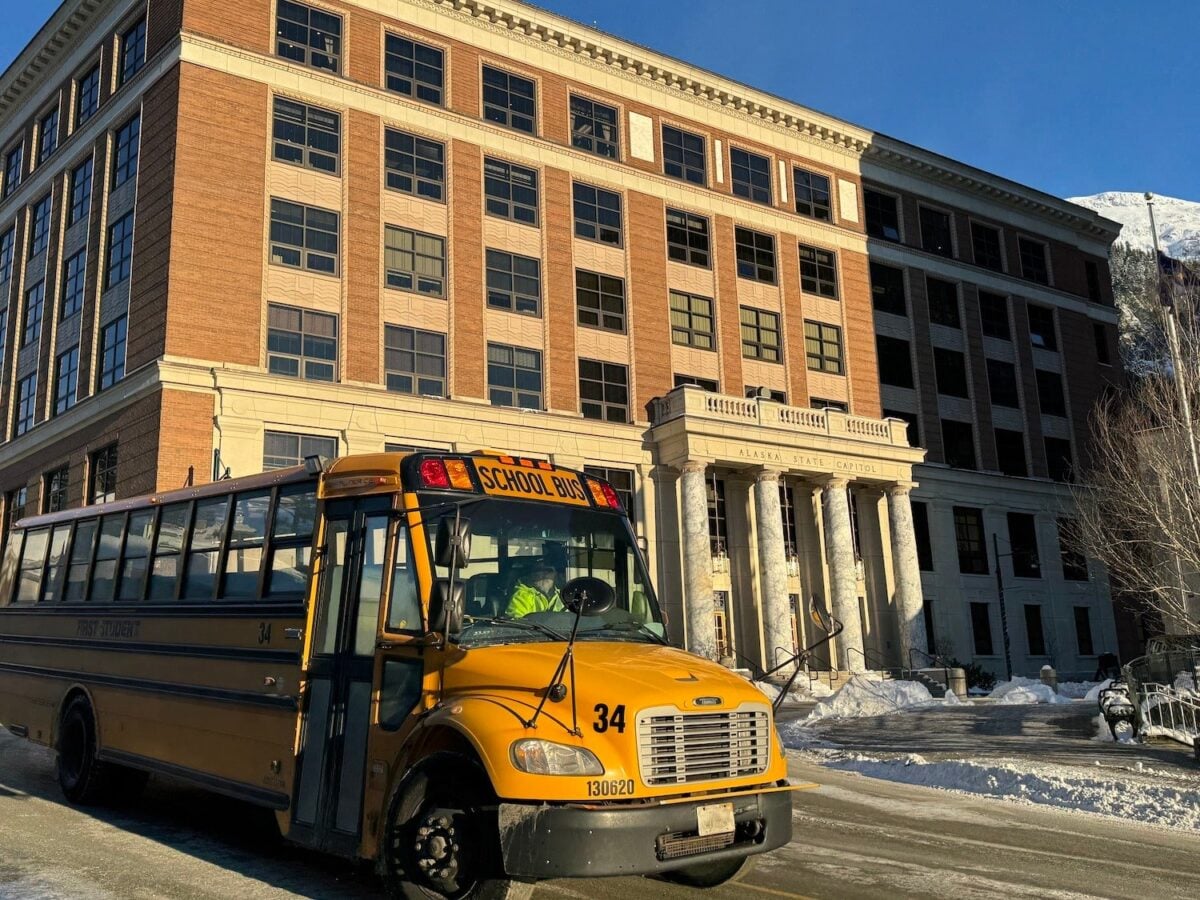
A school bus drives in front of the Alaska State Capitol on Monday, Feb. 3, 2025. (Photo by James Brooks/Alaska Beacon)
A school bus drives in front of the Alaska State Capitol on Monday, Feb. 3, 2025. (Photo by James Brooks/Alaska Beacon)
NOTN- The Juneau School District has begun work on a new five-year strategic plan aimed at guiding the district through academic, organizational and financial challenges ahead.
“Strategic planning is a really important process for school districts being able to plan for the future.” Said Board of Education member David Noon, “Everyone is focused on the direction and the vision, where a district wants to go.”
Superintendent Frank Hauser said the planning process comes as the district concludes its previous strategic plan, adopted in 2020. School district strategic plans are typically updated every five years.
The current planning process began last spring and has included focus groups, surveys and meetings with community members, staff and district stakeholders. The goal, Hauser said, is to define clear priorities and outcomes for the next phase of the district’s work.
Noon said the plan centers on several key areas, “There’s a couple of major areas that we are aiming to focus our attention on over the course of the next five years, obviously starting first with the students, the second couple of which deal with the organization itself, the district staff. How do we recruit talented teachers? How do we as an organization act in a responsible way that’s driven by integrity? And then there’s also the financial, fiscal and operational sort of security that we’re trying to guarantee.” Noon said, “So we definitely are using the experience of the consolidation and thinking about the atmosphere of education funding in Alaska and, of course, nationwide as we develop this plan for the next five years. We can’t predict the future, but we can create a structure that allows us to adapt to whatever happens over the next couple of years while not just reacting to it.”.
Hauser said the strategic plan will also play a critical role in guiding budget decisions based on community priorities.
“From a budget perspective, when the community comes together and develops that strategic plan and everyone gets behind that, the board, through the budgeting process, can identify what the primary goals are.” Hauser said.
The draft strategic plan is now in its final phase and is expected to be presented to the Board of Education for a first reading in January, followed by a second reading shortly after.
Public input remains part of the process. The draft plan is available on the Juneau School District website, and community members may provide feedback during regular board meetings, held on the second Tuesday of each month, or by contacting board members directly.
Hauser, who announced earlier this year that he will be leaving the superintendent position, said the strategic plan is intended to provide continuity as leadership transitions occur.
“We’ve done a lot of great work here, the Juneau school district staff are some of the best staff in the world.” Hauser said, “Consolidation was hard. Those were really tough decisions. But I think, in looking at the future, we’re on much better financial footing. There are still challenges with the budget, but I think coming together and putting together a fiscal plan that is more focused, and having opportunities for kids, and even through the consolidation, being able to maintain those opportunities for our students and still see growth, those are the things I’m really proud of.”
The trans-Alaska pipeline, seen on Oct. 8, 2008, threads over snow-covered terrain in the Brook Range foothills. A gryfalcon is perched on one of the pipeline’s thermosphyons in the lower center of the photo. (Photo by Craig McCaa/U.S. Bureau of Land Management)
Though the state of Alaska is anticipating more oil production in the fiscal year that starts July 1, money from oil continues to make up a dwindling share of general-purpose state revenue, according to a forecast published Wednesday by the Alaska Department of Revenue.
Altogether, the state expects to earn $6.2 billion in general-purpose dollars between July 1, 2026 and June 30, 2027, the next fiscal year. Officially known as “unrestricted general fund revenue,” it’s the section of the budget where lawmakers and governors focus most of their attention.
Federal money and money designated for specific programs can sometimes be shifted around to different priorities, but not easily. General-fund dollars can (and are) assigned to different priorities each year.
The forecast for next year’s unrestricted general fund revenue is higher by almost $260 million than the current year’s expectation, but most of that increase isn’t coming from oil.
Since 2018, an annual transfer from the Alaska Permanent Fund to the state treasury has been the No. 1 source of general-purpose dollars for services and the Permanent Fund dividend.
That’s more true than ever, according to the state forecast.
In the next fiscal year, just 23% of the state’s general-purpose revenue is expected to come from petroleum revenue — royalties, property taxes and production taxes.
The Permanent Fund transfer would account for almost 66% of the general-purpose money.
That difference comes despite an expectation that oil production will rise significantly between this fiscal year and next — from an average of 457,000 barrels of oil per day to 517,800 per day on average.
According to the Alaska Department of Natural Resources, that’s due to the startup of production in the Pikka oil field and other new production on the North Slope.
Despite that new production, oil revenue is expected to rise only slightly — from $1.43 billion to $1.44 billion.
That’s because the state is expecting North Slope oil prices to average just $62 per barrel during the next fiscal year, down from $65.48 in the current fiscal year.
At the same time, the Permanent Fund transfer is rising by almost $200 million, causing oil to become a still-smaller share of state revenue.
Even though revenue is expected to rise between the current fiscal year and the next one, the projected deficit in Dunleavy’s proposed spending plan stands at more than $1.8 billion.
If oil revenue alone were needed to fill that deficit, average North Slope prices would have to be near $100 per barrel, or the state would have to produce more than 1.2 million barrels of oil per day during the next fiscal year, an amount that is geologically, economically and mechanically unfeasible. The state hasn’t posted an annual average of over 1 million barrels of North Slope oil per day since the turn of the century.
Alaska Gov. Mike Dunleavy holds during a news conference on Thursday, Dec. 12, 2024, in Juneau, Alaska. (AP Photo/Becky Bohrer)
Alaska Gov. Mike Dunleavy is proposing to spend more than $1.8 billion from the state’s principal savings account to balance a first-draft spending plan that would cover Alaska’s response to recent disasters, the state’s annual expenses in the next fiscal year, and a 2026 Permanent Fund dividend worth about $3,800 per recipient.
The governor unveiled his plan Thursday, ahead of the Dec. 15 deadline to submit a first-draft state budget for the fiscal year that begins July 1, 2026.
The governor’s $7.75 billion draft budget is similar to what he proposed last year, but this year’s proposal also includes a substantial supplemental budget intended to compensate for unforeseen costs in the current state budget.
That supplemental budget includes a large amount of transportation spending caught in a dispute with the Alaska State Legislature, and an additional $40 million for the state’s disaster response fund, a figure that could rise if President Donald Trump fails to approve a 100% reimbursement rate for the Typhoon Halong disaster requested by the state.
Thursday’s proposals won’t become final unless approved by the Legislature, and legislators have revised each of Dunleavy’s prior budget proposals before they became law.
Alongside his annual budget proposal, the governor unveiled a draft 10-year plan that appears to call for billions of dollars in tax increases to avoid deficits in future years.
Alaska has no statewide personal income tax or sales tax; more than 60% of general-purpose revenue comes from an annual transfer from the Alaska Permanent Fund, and about 30% generally comes from oil.
The long-term plan published by the governor’s Office of Management and Budget is required by state law, and both Dunleavy and previous governors have used prior plans to demonstrate their ideas.
Dunleavy did not hold a news conference to answer questions about his plan on Thursday, but members of the governor’s administration said he intends to unveil his long-term approach in January, before state legislators open their regular session in Juneau.
“As many of you know,” the governor said in a prerecorded video released Thursday, “oil prices are down … that negatively impacts our budget, and so we will have to fund the budget from savings this year. We all understand that spending from savings and spending the PFD is not a sustainable way to support a budget.”
Dunleavy, who is term-limited and unable to run for governor again, is entering his final year in office. Elected in 2018, he has proposed a variety of ideas each year but has thus far been unable to garner sufficient legislative support for them.
Simultaneously, he has vetoed incremental legislation to address the state’s fiscal problems, most recently with a bill that would have shifted tax revenue from other states to Alaska.
On Thursday, legislators said they were skeptical but hopeful that 2026 might bring a different result to the perennial debates over how to balance the state’s budget in the long term. “It’s probably doubtful,” said Sen. Mike Cronk, R-Tok and a member of the Senate Finance Committee. “But I’m going to stay on the hopeful side, because I know that’s really where we need to be. I’m always going to think that other people will finally say, ‘enough’s enough.’”
In all but one year during his time in office, Dunleavy has proposed a dividend paid under a disregarded but still-on-the-books formula that dates from the 1980s.
In 2017, the Alaska Supreme Court ruled that lawmakers may ignore that formula because it is not in the state Constitution. Since then, legislators have typically reduced the dividend to what is payable without spending from savings.
Entering his last year in office, Dunleavy is proposing to spend $2.4 billion on the dividend. Divided among 624,000 recipients — the number of eligible Alaskans in recent years — that’s roughly $3,800 per person.
Dunleavy proposed a similar dividend last year; legislators ultimately approved a $1,000 PFD that could be paid without spending from savings.
Rep. Andy Josephson, D-Anchorage and co-chair of the House Finance Committee, said that at first glance, the governor’s proposal is “very much a status quo budget” when it comes to state services, albeit with some changes.
The governor plans funding for a separate Alaska Department of Agriculture, though the creation of that department has been challenged in court by the Legislature.
Funding for the Alaska Department of Corrections is up by 3%, while funding for the state’s Medicaid program is down. No money has been earmarked for the state program that pays for major maintenance and renovations at schools, and funding for public school operations is flat.
Dunleavy is proposing to refill the state’s higher education investment fund — used to pay for college scholarships — after it was drained last year during a budget dispute with the Legislature.
At the same time, the Alaska Department of Revenue is forecasting lower oil revenue due to a declining price forecast. The state Department of Natural Resources expects higher production in fiscal year 2027, but it isn’t enough to fully offset the lower prices.
To balance the budget despite the expected decrease in oil revenue, the governor is proposing to spend from the Constitutional Budget Reserve, which is the state’s principal savings account and contained about $3 billion as of Thursday.
Between supplemental spending and the upcoming fiscal year 2027 budget, Dunleavy is proposing to spend over $1.8 billion from the reserve.
Taking money from the reserve requires three-quarters of the House and three-quarters of the Senate to agree.
In previous years, that’s been a difficult task: The House and Senate are each controlled by coalitions that have taken a skeptical and at times critical view of many of the governor’s policies.
Sen. Lyman Hoffman, D-Bethel and co-chair of the Senate Finance Committee, said on Thursday that the Senate Majority’s position is that the reserve should never be used for recurring expenses.
One-time expenses, like refilling the disaster response fund and the higher education investment fund could be acceptable, he said.
House Minority Leader DeLena Johnson, R-Palmer, said it’s too early to say what members of the 19-person, all-Republican House Minority caucus might want in exchange for voting to spend from the budget reserve.
“That’s still unfolding,” she said.
She also cautioned that the governor’s proposal is just a first draft and that it could change significantly before lawmakers convene in January. If oil prices or production fall below what’s forecast, the state might need to spend more from savings.
If additional disasters occur, that might mean another draw from savings.
“We’re just looking at the very beginning, but it’s not going to get better,” she said. “It’s just going to get worse, most likely.”
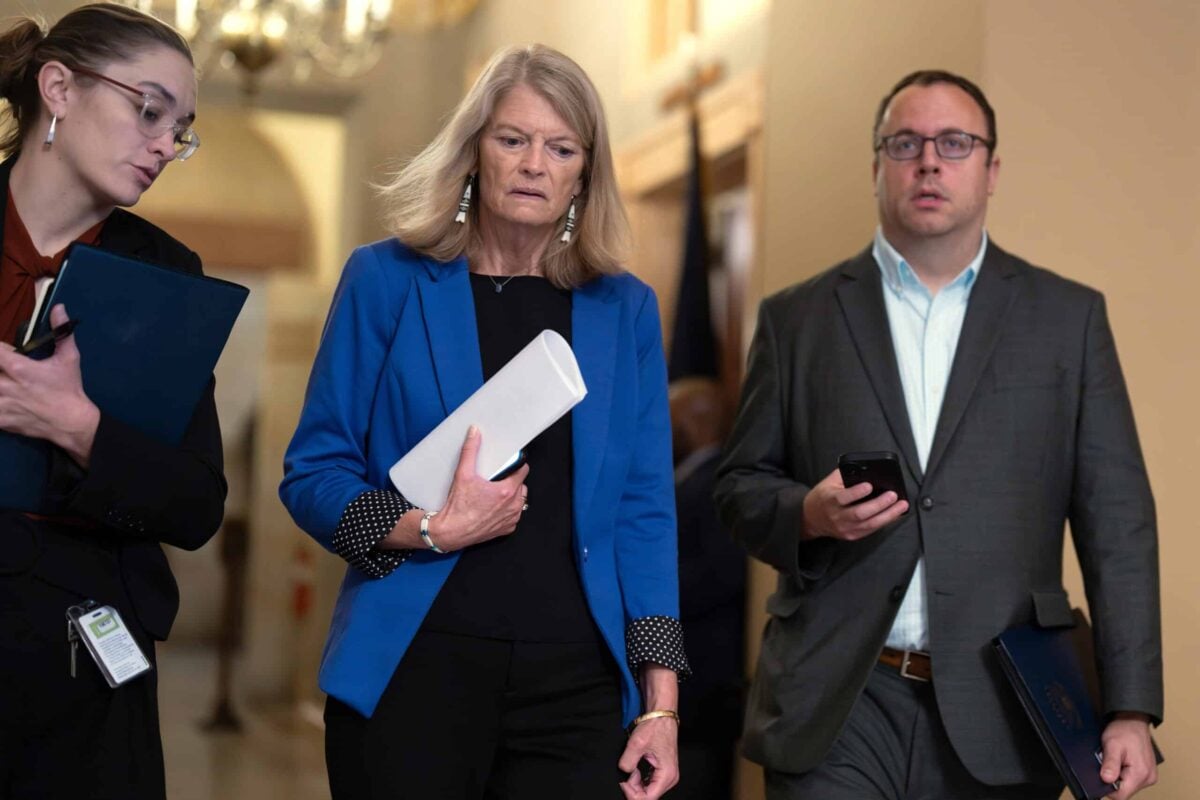
Sen. Lisa Murkowski, R-Alaska, center, a member of the Senate Appropriations Committee, arrives for a closed-door Republican meeting to advance President Donald Trump's sweeping domestic policy bill, at the Capitol in Washington, Friday, June 27, 2025. (AP Photo/J. Scott Applewhite)
By: Jennifer Shutt and Ariana Figueroa, States Newsroom
Sen. Lisa Murkowski, R-Alaska, center, a member of the Senate Appropriations Committee (AP Photo/J. Scott Applewhite)
This report has been updated.
WASHINGTON — The federal government started shutting down early Wednesday after Congress failed to approve a funding bill before the beginning of the new fiscal year — resulting in widespread ramifications for hundreds of programs and giving the Trump administration an avenue to fire federal workers en masse.
The U.S. Senate was unable to advance two short-term government funding bills Tuesday when Democrats and Republicans deadlocked for the second time this month, with just hours to go before the midnight Tuesday shutdown deadline.
Senators voted 55-45 on Republicans’ bill that would fund the government for seven weeks and 47-53 on a Democratic stopgap proposal that would keep the lights on for a month and included several health care provisions that they said were needed for their support. Neither had the 60 votes needed to advance.
Nevada Democratic Sen. Catherine Cortez Masto, Pennsylvania Democratic Sen. John Fetterman and Maine independent Sen. Angus King voted with GOP senators on their stopgap bill. Kentucky GOP Sen. Rand Paul voted against it.
White House Office of Management and Budget Director Russ Vought said in a memo to departments and agencies Tuesday night after the Senate vote that “affected agencies should now execute their plans for an orderly shutdown.” Vought said federal employees should report for their next regularly scheduled tour of duty to undertake shutdown activities.
The consequences of a shutdown will be sweeping in the nation’s capital and across the country, where states are bracing for the impact. About 750,000 federal workers could be furloughed, leading to a $400 million impact a day, the nonpartisan Congressional Budget Office reported. All federal employees would go unpaid until the shutdown is over.
Additionally, the Trump administration plans to lay off thousands of federal employees, which would reshape the federal workforce. President Donald Trump again vowed Tuesday to undertake layoffs and a major government employee union filed suit in federal court in advance of such a move.
More votes on GOP bill planned
Senate Majority Leader John Thune, R-S.D., said hours before the votes there wouldn’t be any talks with Democrats during a shutdown.
“The negotiation happens when the government is open. So let’s keep the government open and then we will have the negotiations,” Thune said.
“We’re happy to sit down and talk about these issues that they’re interested in,” he said. “But it should not have anything to do with whether or not for a seven-week period we keep the government open, so that this government can continue to do its work and that we can do our work through the regular appropriations process to fund the government.”
After the votes failed, Thune expressed his frustration with Democrats during a press conference.
“This is so unnecessary and uncalled for,” he said.
Thune said he plans to bring up a vote on the continuing resolution again. He said as soon as Wednesday the federal government can be funded if five Democrats voted with Republicans.
“Democrats may have chosen to shut down the government, but we can reopen it tomorrow,” Thune said.
Republican Whip John Barrasso of Wyoming said the “cracks in the Democrats are already showing,” noting that three Democrats voted with Republicans Tuesday night.
“There is bipartisan support for keeping the government open,” Barrasso said. “We’re happy to see that the Democrats are already starting to break from (Senate Democratic Leader Chuck Schumer) and we’re going to continue to offer a clean (continuing resolution) on the floor of the Senate to open the government for the next seven weeks.”
Health care tax credits at center of standoff
The disagreement isn’t entirely about GOP lawmakers writing their short-term funding bill behind closed doors and then expecting Democrats to help advance it in the Senate, where bipartisanship is required for major legislation.
Democratic leaders have raised concerns for weeks about the end-of-year sunset of enhanced tax credits for people who buy their health insurance on the Affordable Care Act Marketplace, arguing a solution is needed now ahead of the open enrollment period starting on Nov. 1.
Congressional Black Caucus Chair Yvette Clarke, a New York Democrat, speaks at a press conference outside the U.S. Capitol in Washington, D.C., on Sept. 30, 2025. (Photo by Shauneen Miranda/States Newsroom)
Democrats have also grown increasingly frustrated with the White House budget office’s unilateral actions on spending, arguing Vought is significantly eroding Congress’ constitutional power of the purse. Sen. Susan Collins of Maine, the Republican chairwoman of the U.S. Senate Appropriations Committee, said Tuesday the Government Accountability Office should sue the Trump administration over its efforts to freeze or unilaterally cancel spending approved by Congress.
Senate Minority Leader Chuck Schumer said Democrats need an agreement with Republicans to extend the enhanced tax credits.
Schumer said people will begin getting notices in October telling them how much the cost of their ACA plans will increase during the next year, which he expects will ratchet up pressure on Republican leaders to broker a bipartisan agreement.
“We’re going to be right there explaining to them it’s because the Republicans wouldn’t negotiate with us,” Schumer said, referring to consumers. “We’re ready to do it anytime. And there will be huge heat on (Republicans) on this issue.”
People who buy health insurance on the ACA marketplace and receive subsidies through enhanced ACA tax credits could expect to pay on average more than double for annual premiums in 2026 if the credits expire as scheduled at the end of this year, according to an analysis released Tuesday by the nonprofit health policy research organization KFF.
The analysis found premiums could increase from an average of $888 this year to $1,904 in 2026.
Claims about immigrants
Schumer also rebuffed GOP leaders saying that Democrats want to include people without legal immigration status in federal health care programs.
“They say that undocumented people are going to get these credits. That is absolutely false. That is one of the big lies they tell, so they don’t have to discuss the issues,” Schumer said. “The federal government by law that we passed does not fund health insurance for undocumented immigrants in Medicaid, nor the ACA nor Medicare. Undocumented immigrants do not get federal health insurance premiums.”
Immigrants in the country without legal authorization are not eligible for Medicaid, and neither are most immigrants with legal status, such as those with student visas or enrollment in the Deferred Action for Childhood Arrivals program, known as DACA.
Only immigrants with a “qualified status,” such as legal permanent residents, asylees and refugees, are able to get Medicaid benefits, and they usually have to wait five years before their coverage can even begin.
Democrats explain why they voted with GOP
Cortez Masto of Nevada wrote in a statement explaining her vote to advance the GOP stopgap bill that she could not support “a costly shutdown that would hurt Nevada families and hand even more power to this reckless administration.”
“We need a bipartisan solution to address this impending health care crisis, but we should not be swapping the pain of one group of Americans for another,” she added. “I remain focused on protecting health care for working families, and I call on my colleagues on both sides of the aisle to work together to tackle this problem.”
Pennsylvania’s Fetterman wrote in a statement of his own that his vote on the Republican bill “was for our country over my party.
“Together, we must find a better way forward.”
Collins said during a brief interview before the vote she is worried about the broad authority the White House holds during a shutdown and how the Office of Management and Budget has indicated it will use that power.
“I’m much more concerned about OMB sending signals that there should be mass firings of federal employees who have the misfortune to be designated as non-essential, when in fact they’re performing very essential work, they’re just not being paid,” Collins said.
North Dakota Republican Sen. John Hoeven, chairman of the Agriculture spending subcommittee, said lawmakers will have to sort through how various departments implement their contingency plans as well as the possibility of mass layoffs during a shutdown.
“We’ll have to work through those things and figure out how we do keep things going as best we can during this Democrat shutdown,” Hoeven said.
West Virginia Sen. Shelley Moore Capito said Republicans are “unified in the belief that this is an easy choice” to fund the government with a stopgap bill that doesn’t include any contentious or political provisions.
Capito — who chairs the Appropriations subcommittee that funds the departments of Education, Health and Human Services, and Labor — said there are several programs that will be “missed” during a shutdown.
“And that’s concerning. So I think the option is to keep the government open so we can avoid this pain,” Capito said.
‘I’m not optimistic that we’re going to get a path forward’
Missouri Republican Sen. Josh Hawley said he is worried about the possible impacts of a shutdown on his home state and that keeping the government open is the only way to avoid that.
“I’m sure the administration will do everything they can,” Hawley said. “But the solution is to not shut the government down. I mean, why would you punish working people because you’re not getting what you want on any issue, whatever it is.”
South Dakota Republican Sen. Mike Rounds said he doesn’t expect a shutdown will end until after Democrats have sent a message to their voters.
“I’m not optimistic that we’re going to get a path forward until they’ve had a shutdown,” he said.
Rounds, who negotiated a handshake agreement with the White House budget director this summer to preserve some funding for rural tribal radio stations after Congress eliminated funding for the Corporation for Public Broadcasting, said that deal could be affected by a shutdown.
“They’re putting the administration in a position where they can pick and choose what they’re going to do, and a shutdown is not going to be beneficial to these Native American radio stations,” Rounds said.
Democratic Sen. Elissa Slotkin of Michigan said she wants Democrats and Republicans to negotiate on health care provisions.
“I’ve been making the case constantly, that (it) is literally my obligation to try and fight for health care, and I’m willing to talk to anyone,” she said. “I’m willing to accept that I certainly will not get everything I want.”
Senate Minority Whip Dick Durbin of Illinois said that while Democrats agreed to help advance what’s known as a continuing resolution in March, they can’t now because of “what President Trump is doing to this country, particularly when it comes to health care costs for families.”
The shutdown will significantly affect the operations of the federal government as lawmakers have not passed any of the dozen full-year appropriations bills that finance agency operations. Oct. 1 is the beginning of the new fiscal year for the federal government.
Shutdown plan for national parks
Departments began releasing updated contingency plans this weekend, detailing how many of their employees would work during a government shutdown and how many would be furloughed.
The Interior Department, which includes the Bureau of Land Management, U.S. Fish and Wildlife Service and National Park Service, posted its updated plans late Tuesday.
The National Park Service plans to furlough 9,300 of its 14,500 workers.
The Trump administration will allow several activities necessary for the protection of life or property to continue, including fire suppression for active fires, permitting and monitoring First Amendment activities, border and coastal protection and surveillance, and law enforcement and emergency response.
The contingency plan says that roads, lookouts, trails, and open-air memorials will generally remain accessible to visitors,” but it adds that if “access becomes a safety, health or resource protection issue … the area must be closed.”
Union files suit
In anticipation of layoffs by the Trump administration, labor unions representing more than 1 million federal workers filed a lawsuit in the Northern District of California on Tuesday to block the Trump administration from carrying out mass firings. The suit argues that there is no statutory authority to fire federal employees during a government shutdown.
“These actions are contrary to law and arbitrary and capricious, and the cynical use of federal employees as a pawn in Congressional deliberations should be declared unlawful and enjoined by this Court,” according to the suit filed by the American Federation of Government Employees and the American Federation of State, County and Municipal Employees.
Ashley Murray and Shauneen Miranda contributed to this report.
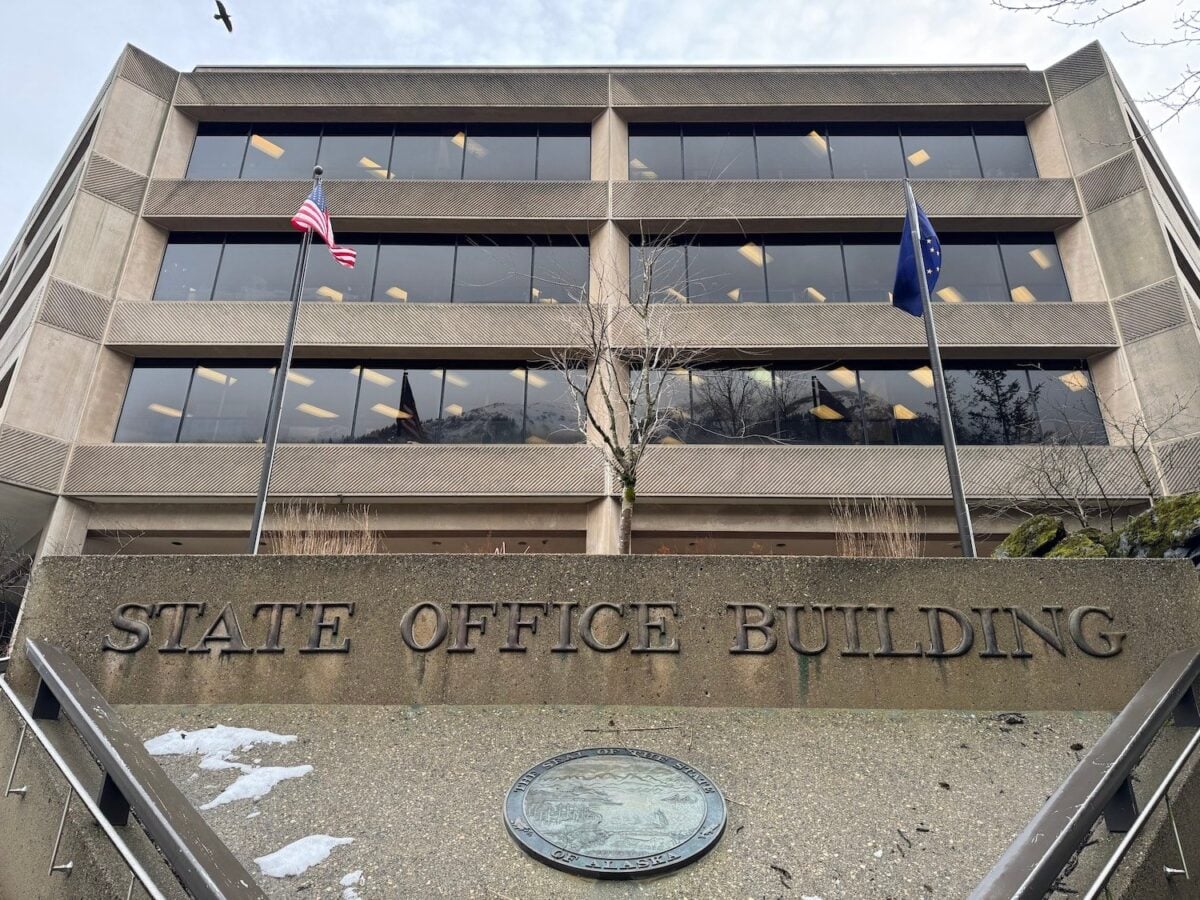
The State Office Building in Juneau is seen on Thursday, Feb. 20, 2025. (Photo by James Brooks/Alaska Beacon)
By: James Brooks, Alaska Beacon
The State Office Building in Juneau is seen on Thursday, Feb. 20, 2025. (Photo by James Brooks/Alaska Beacon)
In a new administrative action, Gov. Mike Dunleavy is ordering “efficiency reviews” of state agencies and asking departments to use artificial intelligence software as part of an effort to identify budget cuts.
The reviews will take place annually, according to Dunleavy’s new administrative order, published Monday, and would become part of the state’s annual budget process.
The reviews will initially focus on “grants to non-State of Alaska entities” and “accounts payable,” according to a copy of the text available online.
The reviews are intended to “identify potential savings” and “improve efficiency of operations” but also will include recommendations for the state to contract out services rather than performing them in-house.
“Alaskans expect their government to deliver essential services in the most efficient and responsible way possible,” Dunleavy said in a written statement announcing the administrative order. “This order ensures we prioritize critical needs, eliminate waste, and safeguard the state’s financial stability.”
Some prior outsourcing efforts by the Dunleavy administration have seen state services assigned to call centers outside Alaska, drawing opposition from union officials and legislators.
A second order, also released Monday, calls for the state to significantly reduce the number of regulations it has on the books.
Notably, the order says that the state should speed permitting for projects regulated by the Alaska Department of Natural Resources, Department of Environmental Conservation and Alaska Department of Fish and Game.
That could mean automatically approving projects even if their environmental review hasn’t been completed according to timelines required by the state, the order says.
Dunleavy leaves office on Dec. 6, 2026. The order says that the state should “reduce the number of regulatory requirements by 15% by Dec. 31, 2026, and 25% (cumulative) by Dec. 31, 2027.”
A liaison with each state department will be required to provide quarterly updates on that goal to the governor’s office.