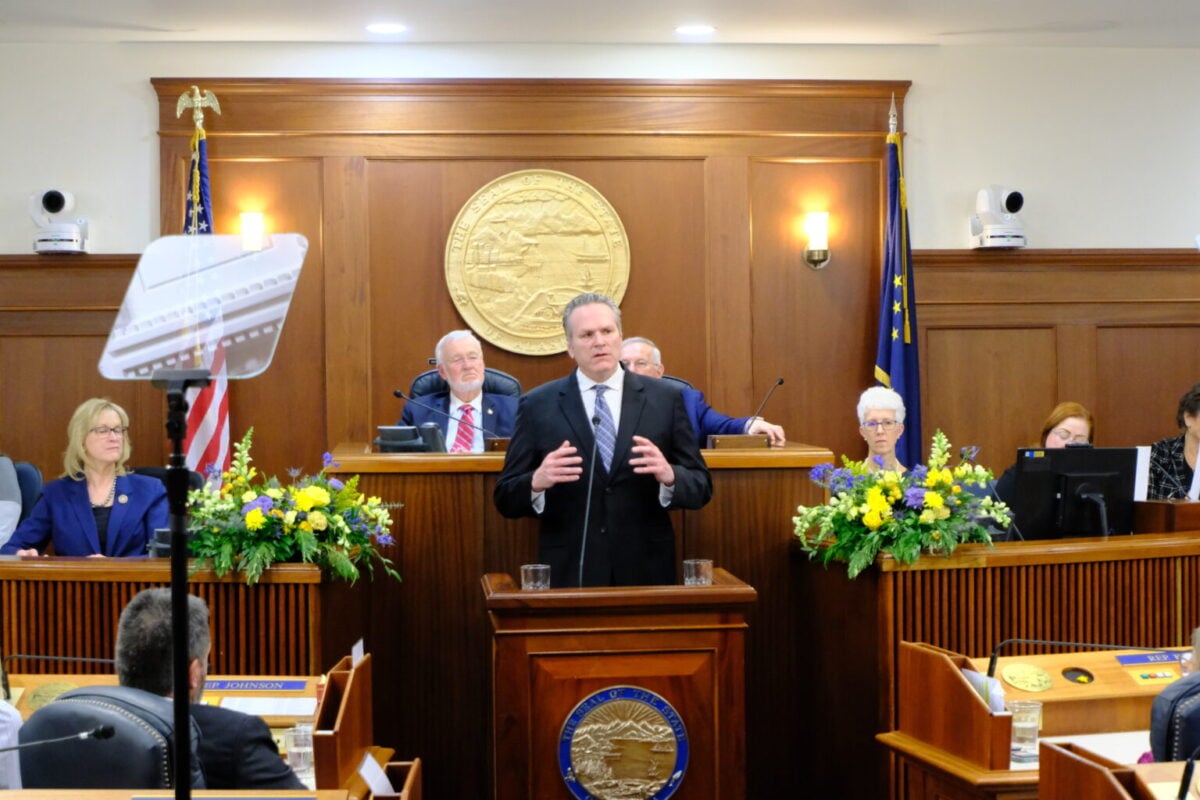
NOTN- Despite a proposal from Governor Mike Dunleavy calling for a $3,600 permanent fund dividend, Alaska lawmakers say the numbers do not support an increase without new revenue.
State Senator Jesse Kiehl said the governor’s dividend proposal is not mathematically feasible under the current budget framework.
“The math just can’t work. There’s no way.” He said, “So one of the questions is going to be whether we can do any new revenues this year just to stabilize the PFD. I cannot see it going up.”
Without additional revenue, lawmakers are weighing whether to maintain a dividend similar to last year’s payment of about $1,000 or reduce it to a range closer to $600.
The final dividend amount is likely to remain unresolved until late in the legislative session, potentially stretching into mid-May, as lawmakers balance competing priorities for state spending.
NOTN- Juneau officials are watching state decisions closely as local government prepares for what could be a difficult budget season.
Christine Woll, chair of the City and Borough of Juneau Assembly’s Finance Committee, said the committee is preparing for the upcoming budget process.
“We’ve been going line by line, through what we typically fund, and asking a lot of questions. And so last night, we invited some of our partner agencies in to talk to us, and did a deep dive into their budget.” She said.
Those groups included Travel Juneau, which handles tourism marketing for the city, and the Juneau Community Foundation, which administers grant programs supporting local social services. The city typically provides about $1.5 million annually to each organization, Woll said.
“Given that, we’ll likely be thinking about cutting some services over the next few months, we want to make sure we understand what they’re up to and the impact of the dollars that we put in.” Woll said.
The committee also heard from the Small Business Development Center, which receives a smaller amount of city funding but provides coaching and support to local small businesses.
The Juneau Assembly has not taken a formal position on the proposed Cascade Point ferry terminal project, which is being considered by state lawmakers today.
“The assembly has not taken a position on Cascade Point. We probably don’t all agree on it is part of the reason. Obviously it’ll have an impact on our city, so we’re interested to see what happens.” Said Woll, “Personally, I’m not convinced that it’s the best use of state resources, especially because we do have a struggling ferry system, but the assembly has basically said, we know this matters, but if we’re not all going to be unanimous in our decision, we’ll wait and see how things play out.”
Questions about state spending priorities extend to Gov. Mike Dunleavy’s proposed fiscal plan, which includes a statewide sales tax. Woll said the Assembly is still deciding whether to take a specific position on the proposal.
“We’re still deciding whether we want to take a specific stance on his fiscal proposal around sales tax. We have taken a position in the past that I think is going to be presented to the Legislature today. We are figuring out how we fund our state budget; it is going to require a broad-based tax of some sort, and so we are supportive of that.” Said Woll, “I know there are folks with some concerns about if it is a sales tax, as proposed by the Governor, because, of course, the city has a sales tax, and that’s usually about 50% of our general income. The challenge is, if the state also has a sales tax that takes away some of our local control, we wouldn’t be able to decide who gets exemptions.”
Woll mentioned the Governor’s proposed sales tax might also make it harder for voters to approve future municipal taxes.
“Voters have to approve our local city sales tax. So if the state puts a tax on top of that, it just makes it less likely that the voters will support a city tax. So that definitely makes me a little nervous.” She said.
The Assembly is expected to continue its budget discussions in the coming weeks.
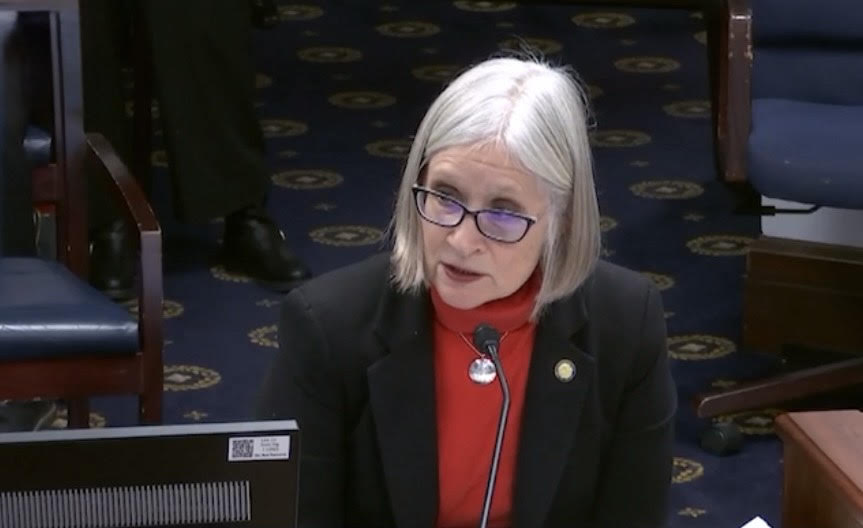
Representative Andi Story presenting to the House Education Committee, Screengrab courtesy of Gavel Alaska and KTOO
NOTN- A bill heard at 8 A.M this morning would overhaul how public schools are funded by changing how students are counted for state aid.
House Bill 261, rewrites large portions of the state’s public school funding statutes.
“We force school districts to budget in such an irrational way.” Said Representative Andi Story, “This backwards budgeting consumes a great deal of valuable time to reshuffle numbers, from personal experience this causes great pain in the community.”
In the full text of House Bill 261, available on The Alaska State Legislature Website, the measure is intended to stabilize school funding particularly through enrollment declines.
The biggest change in the bill is how Alaska calculates average daily membership, or ADM, which is the student count used to determine state education funding.
According to the Alaska Department of Education and Early Development, the ADM is a count of enrolled K-12 students taken for 20 days ending the last Friday in October of each year, the ADM is adjusted due to a few factors including school size, district cost, and special needs.
Under the bill, districts would generally receive funding based on the higher of their most recent student count or a three-year average.
“Alaska should create a 3 year averaging approach statewide to replace the current Hold Harmless Provision.” Story said during her presentation.
The Hold Harmless Provision currently protects school funding if their ADM drops by 5% or more each year, which allows the previous year’s student count to be used as a base to mitigate a drop in funding.
“It could also provide districts with greater stability and planning.” Story said, “As districts would not be so concerned about unexpected changes in enrollments at the October count period. About 19 states use an approach that either averages, combines or provides the better of multiple years of student counts.”
The bill also alters how districts are funded following school consolidations or closures, it would allow temporary offsets to soften funding losses over a period of several years.
The bill would also restrict districts from reopening schools too quickly after consolidation.
HB 261 also changes or revises how special education funding is calculated, particularly for students who require intensive services.
Using the above 3 year count, districts that identify additional students requiring intensive services midyear would be eligible for retroactive funding.
The bill applies to school districts statewide and does not directly increase the base student allocation, which is the per-student dollar amount set separately by the Legislature.
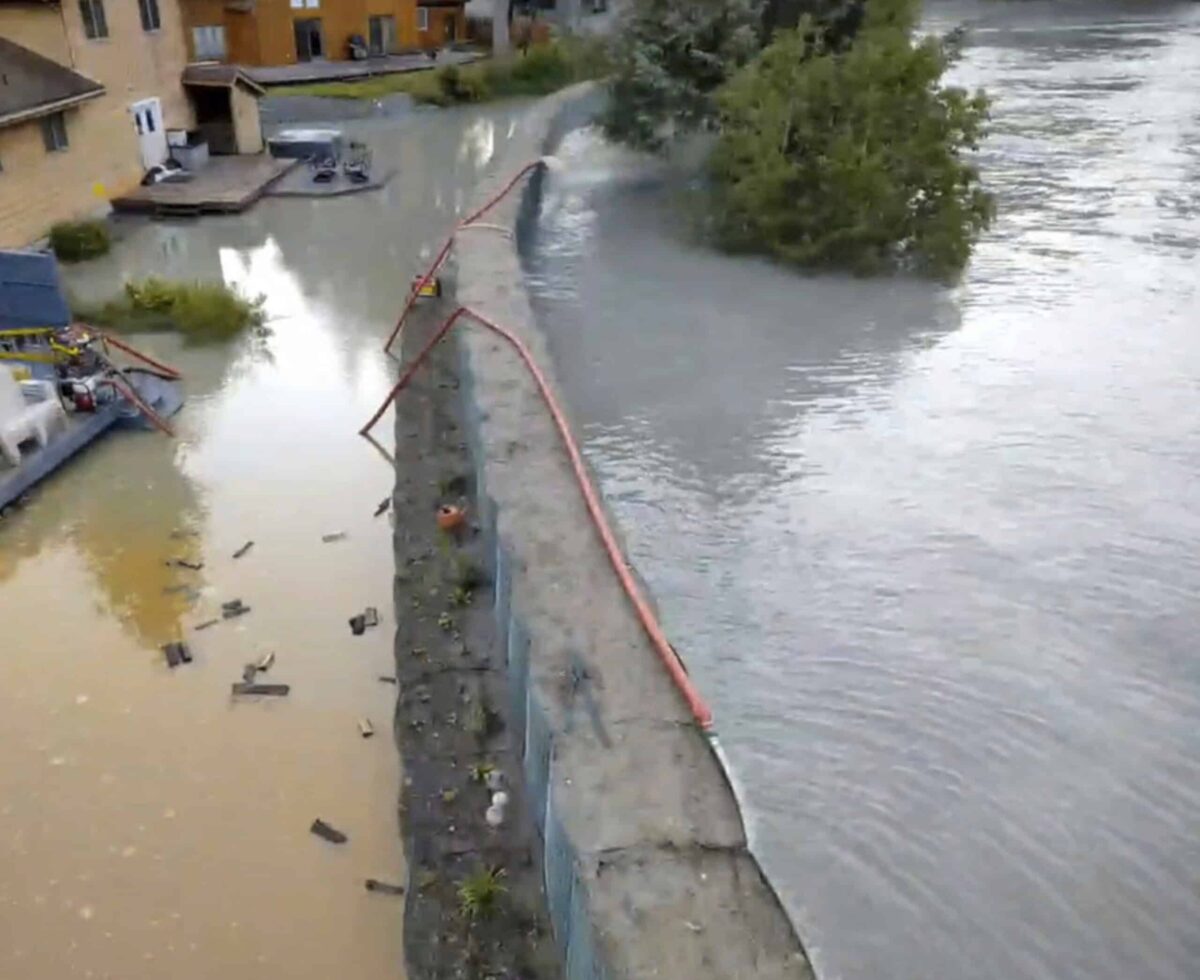
This drone image provided by the City and Borough of Juneau shows flooding from a release of water and snowmelt at Mendenhall Glacier covered some roads and threatened homes along the Mendenhall River in Juneau, Alaska on Wednesday, Aug. 13, 2025. (City and Borough of Juneau via AP)
This drone image provided by the City and Borough of Juneau shows flooding from a release of water and snowmelt at Mendenhall Glacier covered some roads and threatened homes along the Mendenhall River in Juneau, Alaska on Wednesday, Aug. 13, 2025. (City and Borough of Juneau via AP)
NOTN- City leaders are asking View Drive homeowners, the area hit hardest by glacial lake outburst flooding, to weigh in on whether they want to pursue a voluntary federal buyout program.
The City and Borough of Juneau is gauging interest in a potential buyout through the U.S. Department of Agriculture’s Natural Resources Conservation Service Emergency Watershed Protection program, (NRCS) which helps communities recover from natural disasters by purchasing at-risk properties and restoring the land.
Under the program, eligible properties would be acquired at fair market value, followed by environmental review, demolition and site restoration. NRCS would cover 75% of total project costs, but Juneau would be responsible for the remaining 25%.
The non-federal match is estimated at about $6 million if all 18 eligible structures on View Drive take part.
City Manager Katie Koester said the city wants to know whether homeowners would be willing to help assemble that non- federal match, either through their own resources or with help from nonprofits and other non-federal sources, asking owners through an informal ballot, to indicate whether they would be willing to participate if that cost share were required, though responses are not binding.
“The Assembly really hasn’t received any official communication from View Drive residents on whether or not they are even interested in participating in the program,” Koester said. “The first important step is sending them an informal ballot to gauge actual interest in participating.”
View Drive is considered one of the neighborhoods most vulnerable to annual flooding caused by glacial lake outburst floods, as it sits just outside the reach of the HESCO barriers.
Juneau officials have discussed buyouts as one possible option for residents, particularly as flooding frequency and severity increase, though Koester stressed that whether or not the city goes through with the buy-out program, officials are still committed to an enduring solution.
“I just want to make sure that the public knows that it is the number one priority for the City of Juneau, to find a permanent solution to the flooding, not just for View Drive, but for the entire valley.” She said.
Koester said the Assembly is seeking to understand whether enough property owners would participate to justify moving forward.
Participation in the program would be entirely voluntary, and Koester emphasized that not every property owner would need to opt in for the project to move forward.
“‘It’s totally feasible that four people want to participate, and we move forward, and the rest of the neighborhood does not participate.”
Property owners have until Feb. 16 to return their ballots to the city’s engineering division, those results from residents are expected to be presented at the assembly’s Committee of the Whole meeting on Feb. 23.
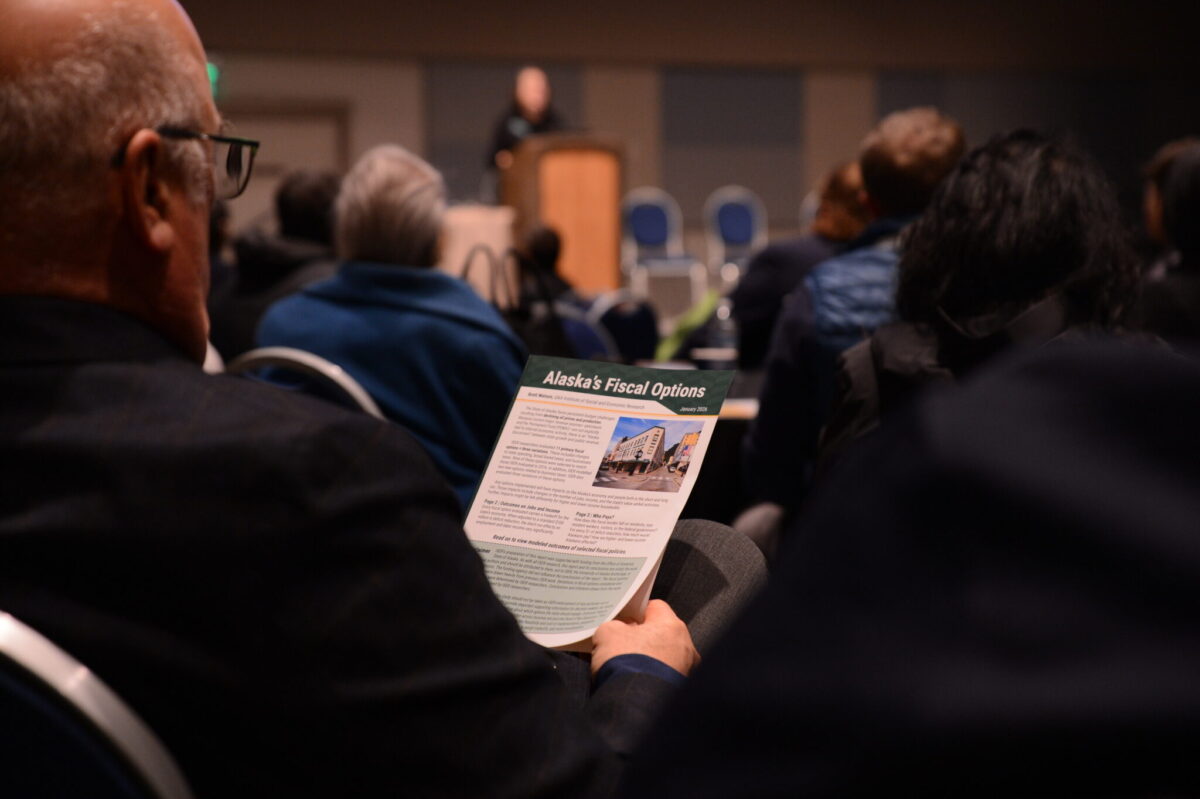
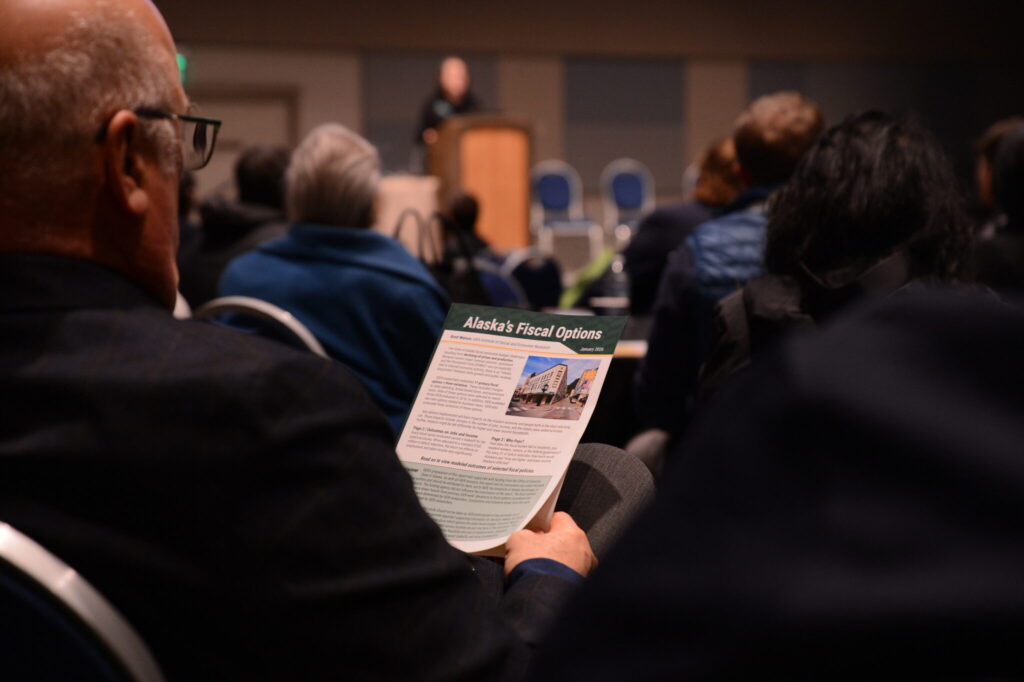
Rep. Kevin McCabe, R-Big Lake, reads a document entitled “Alaska’s Fiscal Options” while listening to a presentation by the Institute for Social and Economic Research of the University of Alaska Anchorage on Thursday, Jan. 29, 2026, at Centennial Hall in Juneau. (James Brooks photo/Alaska Beacon)
A new nonpartisan report by the Institute of Social and Economic Research at the University of Alaska Anchorage has concluded that raising oil and corporate taxes to balance Alaska’s budget likely has the lowest negative side effects for Alaskans’ jobs and income.
The report, eagerly anticipated by state lawmakers and experts, comes as legislators consider ways to balance Alaska’s expenses and revenue over multiple years.
Commissioned by the administration of Gov. Mike Dunleavy, the report was released days after the governor debuted a plan intended to bring Alaska’s expenses and revenue in line.
Since 2015, when oil prices plummeted, Alaska has struggled to balance its budget on an annual basis despite steep cuts to state services. At times, the tug-of-war between services and the Permanent Fund dividend has driven the state to the brink of a government shutdown.
Figures from the Legislative Finance Division, which advises the Legislature on fiscal issues, show state agencies have had their budgets cut by 16.6% when adjusted for inflation since Fiscal Year 2015.
During the same period, lawmakers have passed no significant revenue measures. Dunleavy, who opened his first year in office by proposing massive budget cuts, hasn’t proposed significant reductions in recent years and is now suggesting a statewide sales tax and other revenue measures are needed for the state to keep up with spending.
ISER’s analysis of the situation was keenly awaited by state legislators and other experts, who crowded into a ballroom at Juneau’s convention center on Thursday morning to hear its economists deliver their report.
A 2016 analysis by ISER remains widely consulted in the capitol and was a contributing factor to lawmakers’ decision to begin using the Alaska Permanent Fund as a trust fund two years later. Legislators installed an annual transfer from the fund to the treasury for dividends and services, and it’s now the No. 1 source of general-purpose state revenue for Alaska, accounting for almost two-thirds of the state’s flexible spending each year.
The report released Thursday concluded that Alaska’s unstable fiscal situation has created so much uncertainty that it’s lowered Alaska’s real gross domestic product growth by 2-3% over the past decade, the equivalent of billions of dollars, said Brett Watson, an economist with the Institute of Social and Economic Research and the lead author of the report.
Brett Watson of the Institute for Social and Economic Research of the University of Alaska Anchorage delivers a presentation about Alaska’s fiscal options on Thursday, Jan. 29, 2026, at Centennial Hall in Juneau. (James Brooks photo/Alaska Beacon)
Alaska’s GDP — the value of all goods and services in the state — is about $70 billion and ranks near the bottom of U.S. states in terms of growth over the past decade.
ISER examined 11 different options to balance the state budget, including spending cuts, cuts to the Permanent Fund dividend, income taxes, sales taxes and business taxes.
Raising business and oil taxes would have the lowest negative impact on jobs and income, while cuts to services would have the biggest negative effect on them, the report found.
Reducing the Permanent Fund dividend to balance the budget — which has been the existing legislative policy for the past several years — has similarly large negative effects on income, but smaller negative effects on employment. Poor Alaskans are affected more by a PFD reduction than rich Alaskans, making it the most regressive option.
Among statewide taxes, a progressive income tax would have the biggest negative impact on high-income Alaskans and the lowest negative impact on low-income residents.
Nonresidents would pay 27% of a statewide sales tax with many exclusions — food, utilities, and health care, for example — making it the option with the least direct impact on individual income among broad-based taxes.
Corporate and oil taxes have a lower impact overall, ISER concluded.
Making a sales tax higher in the summer and lower in the winter “shifts the burden toward visitors, reducing the impact on Alaska families by 2-5 percentage points per dollar raised,” ISER concluded.
Dunleavy’s fiscal plan includes a seasonal sales tax as one of its pillars.
ISER also concluded that its models suggest that it is possible to come up with “a budget neutral combination that stimulates growth.”
“For example,” its report states, “coupling a less distortionary revenue source (like property tax) with expansionary spending (like capital project investment) can result in a net increase in total employment.”
Alaska Gov. Mike Dunleavy opens a presentation by the Institute for Social and Economic Research of the University of Alaska Anchorage on Thursday, Jan. 29, 2026, at Centennial Hall in Juneau. (James Brooks photo/Alaska Beacon)
Imposing a statewide property tax and a broad corporate tax cut in combination, ISER suggested in a slide presented to lawmakers, would result in increased employment and personal income by 2050, it estimated.
The effect of each tax or cut was examined independently, Watson said, in $100 million chunks.
“You can think about these as items on a buffet, and you kind of scoop from them different serving sizes as you construct a plate that is a state fiscal plan,” he said.
ISER also considered things linearly — economists didn’t try to predict whether Alaskans would react differently if a sales tax went from 5% to 6% instead of from 0% to 1%.
“In reality, it is likely that there are certain important thresholds that if you turn that dial too far, consumers start reacting in more and more aggressive ways to it, but we assume that their reaction is the same, regardless of what the level set is,” he said.
Watson said there is a cost if lawmakers do nothing. In addition to the GDP penalty caused by uncertainty, the state remains vulnerable to what’s called the “Alaska disconnect.”
Imagine, he said, if “something crazy would happen and one of the Silicon Valley tech giants were to announce that they were going to create a Silicon Valley of the north somewhere in Alaska and that they would move 100,000 employees somewhere in Alaska and create this northern hub of tech.”
“It would be absolutely catastrophic from the standpoint of the state of Alaska budget,” he said. “There would be 100,000 new Permanent Fund dividends to pay, the children of 100,000 new employees to educate, more roads to maintain, more state services to provide, without any additional revenue collected for any of those individuals. And so there’s this disconnect now that’s growing between our private sector economy and what goes on in our public sector.”
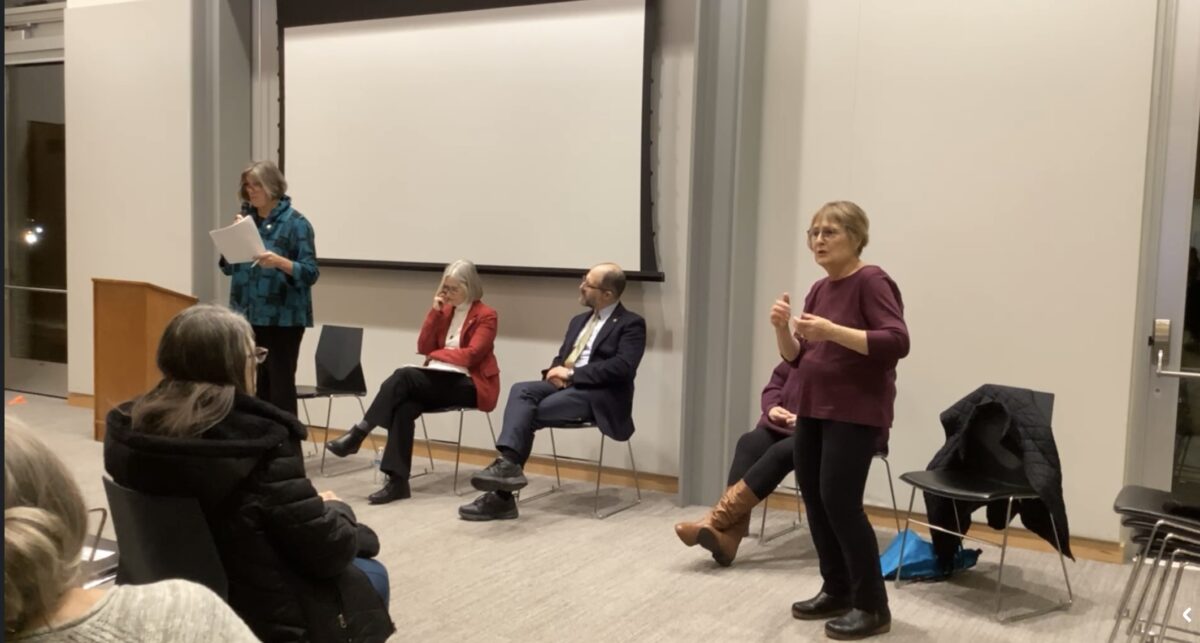
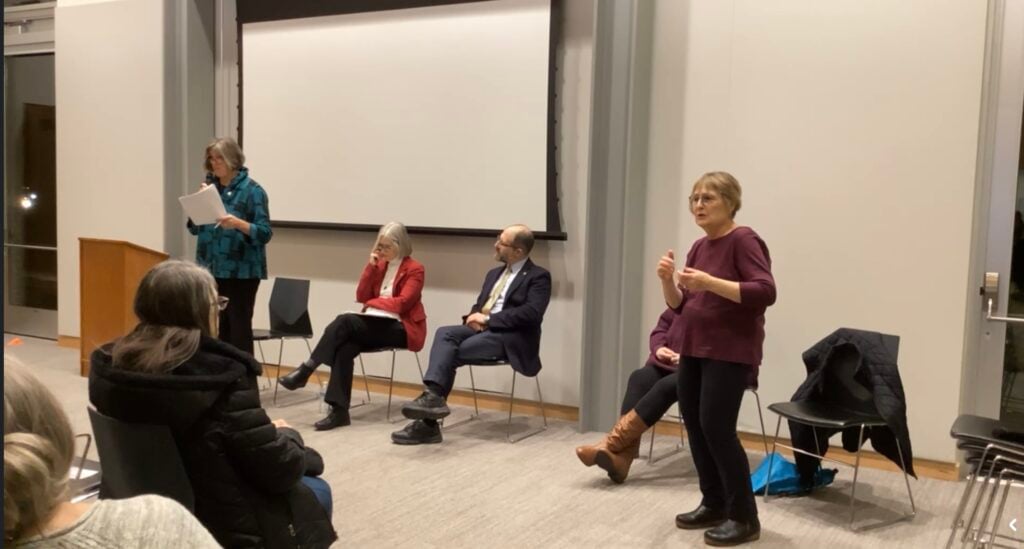
Representative Sara Hannan, Andi Story and Senator Jesse Kiehl (from left to right) at Thursday evening’s Town Hall.
NOTN- Juneau residents turned out Thursday evening for a legislative town hall at the Mendenhall Valley Library with Juneau’s delegation.
State Senator Jesse Kiehl and Representatives Sara Hannan and Andi Story met with constituents to share updates from the current legislative session and hear directly from the community.
“Mostly, the reason we’ll do this is to hear your questions or hear your comments. By golly, we need to hear from you. You’re who we work for.” Said Kiehl Thursday morning.
Attendees asked about a range of issues facing Juneau and the state including disaster response, Representative Andi Story assured constituents that the legislature is speaking with Alaskaa ‘s congressional delegation to come up with long-term mitigation plan for glacier lake outburst floods.
“Everyone’s living with a lot of stress, it’s emotionally draining when its your home.” Story said, “We know August is coming around, we’re trying to repair the HESCO barriers, we are trying to do what we can.”
Most prevalent was the budget, and more specifically, the Governor’s recently proposed fiscal plan, currently making its way through the legislature.
“What we have to do is have a balanced budget.” Story said, “We don’t have to pass any policy at all, but every year we have to come together to provide a balanced budget to meet our constitutional budget requirement.”
The Governor’s sweeping fiscal plan includes Alaska’s first statewide sales tax in more than four decades. The proposal would create a year-round sales tax, 4% in the summer and 2% in the winter, running through 2034.
“It would add on top of local sales tax, and it would override any local sales tax decisions.” Kiehl said, “So Juneau voters just voted to take sales tax off of food. This will put sales tax back on all food, that’s an issue.”
If adopted the tax could potentially raise over 800 million dollars a year by the early 2030s.
The plan also includes a constitutional amendment to set a “50-50” Permanent Fund Dividend, which would amount to roughly $3200 per recipient.
“What the governor used to propose, was just take more than we can sustain out of the earnings reserve. Great, big draw.” Kiehl said, “So I applaud the Governor for saying, okay, that old idea of his doesn’t work. His proposal takes that cap, and it says we’re going to draw 5% we’re going to split it 50-50, between public services and PFDs. but you can only do that if we spend even less on services than we do now.”
Kiehl said the Governor’s proposal could underfund schools and building maintenance.
“The state’s going to crumble and fall down if we do that, the math doesn’t work.” He said,”Could we protect a dividend? Yeah, but the simple fact is, we’re not gonna get the votes to raise taxes to increase the PFD from where it’s been. We should stabilize the PFD, but if we’re talking about adding taxes to Alaskans and Alaska businesses, we’re not going to do that to pay out a bigger check than we’ve been paying.”
Representative Hannan hinted at an opportunity for residents to publicly testify at a Senate Finance meeting next Thursday, this has yet to be confirmed on the Alaska State Legislature website.
The meeting took place in person and was live-streamed on Facebook.
Gov. Mike Dunleavy gestures during his State of the State address on Jan. 22, 2026. (Photo by Corinne Smith/Alaska Beacon)
Gov. Mike Dunleavy has proposed a 4% statewide summer sales tax, effective through 2034, as part of his plan to bring Alaska’s state revenue and expenses in line for the long term.
If adopted, the sales tax would be Alaska’s first statewide, general-purpose levy since state legislators abolished Alaska’s income tax in 1980.
Alongside the tax bill, the governor has proposed a tighter state spending cap and a constitutional amendment that would guarantee a Permanent Fund dividend lower than scheduled by current law but above what legislators have approved in recent years.
“This comprehensive plan is designed to bridge the next seven years by stabilizing state finances, limiting spending growth, restoring a rules-based PFD, and sharing responsibility through targeted, time-limited revenue measures that support investment and predictability,” the governor wrote in a letter to state lawmakers.
Since 2015, persistently low oil prices and plateaued oil production from the North Slope have dogged state lawmakers who have struggled to balance Alaska’s need for services with the desire to pay large Permanent Fund dividends.
While most of Alaska’s general-purpose state revenue comes from the Alaska Permanent Fund, oil remains the No. 2 source of flexible spending money for the state, leaving the annual budget process subject to the vagaries of global markets.
Senate Bill 227, containing the bulk of the governor’s plan, was introduced on Monday and referred to the Senate Finance Committee for further discussion. An identical version will be introduced in the House on Wednesday.
The most fiscally consequential item in the bill is the sales tax, which would peak during the summer tourist season and drop to 2% between October and March.
That tax is expected to raise as much as $815 million per year for state services and the Permanent Fund dividend by Fiscal Year 2032.
Dunleavy’s proposed budget for the fiscal year that begins July 1 — fiscal year 2027 — is about $7.75 billion and has a deficit of almost $1.5 billion.
The Dunleavy administration expects that revenue from oil production and a proposed trans-Alaska natural gas pipeline will compensate for the phaseout of all the taxes in the long term.
Under SB 227, the state’s corporate income tax would fall to zero in 2031; the sales tax wouldn’t expire until 2034, leaving individual Alaskans paying higher tax rates than corporations for a period.
“Normally, sales tax is left to local governments. So I know it was a hot issue in Anchorage when the Mayor proposed that, so I think it is going to hit a lot of households,” said Sen. Lyman Hoffman, D-Bethel and co-chair of the Senate Finance Committee.
Sen. Bill Wielechowski, D-Anchorage, applauded Dunleavy on Monday for putting forward a fiscal proposal, even if he disagrees with some of the components.
“The governor’s putting out a bill. I commend him for that. He’s putting out, you know, he’s throwing out ideas. I give him credit for that,” he said.
Wielechowski and other legislators said they want to fully analyze what the governor is proposing before opining on it.
“There are a lot of parts to this bill, and the No. 1 thing for me — without a complete analysis — is it’s really unclear on how this is going to affect hard-working Alaskans,” said House Minority Leader DeLena Johnson, R-Palmer. “It is my No. 1 priority to make sure everyday Alaskans aren’t on the losing end of this.”
The Alaska Municipal League, which represents local governments across Alaska, is particularly interested in the governor’s proposal.
The League has previously said it would prefer a statewide income tax to a sales tax.
In almost every part of Alaska, except for Anchorage, sales taxes are a pillar of services.
Many cities and boroughs exempt certain things, like food and utilities. Under the Dunleavy proposal, the state would be in charge of collecting sales taxes and would remit money to cities and boroughs.
Local exemptions and sales tax caps could vanish in the process, with the state instead determining what is taxed and not.
“This is a 56-page bill that we are still going through. Sales tax is a major component of that, but sales tax shouldn’t be thought about independently from the other components,” said Nils Andreassen, director of the league.
In addition to the sales tax, SB 227 temporarily raises the state’s minimum oil tax, adds a surcharge of 15 cents per barrel of oil produced on the North Slope and adds part of the corporate sales tax update that Dunleavy vetoed last year.
Andreassen noted that regardless of its source, tax revenue flows into the state’s general fund for any number of uses.
“All taxes are connected at some level,” he said.
The governor’s plan for the Permanent Fund dividend, enclosed in a constitutional amendment proposal separate to SB 227, is similar to one he proposed in 2021.
Currently, the state’s No. 1 source of general-purpose revenue is an annual transfer from the Permanent Fund to the state treasury. In FY27, that transfer will be worth $4 billion.
The “50-50 dividend” proposed by the governor would reserve half of that transfer for dividends, or about $2 billion, if it were in place this year.
That amounts to roughly $3,200 per PFD recipient, based on the number of recipients in 2025.
Under a current, disused formula in place since the 1980s, the dividend would be about $3,800 per recipient.
That formula hasn’t been used since 2015, and lawmakers have instead set the amount by fiat, typically using a figure that can be paid with available revenue after services are covered.
Legislators can ignore formulas in state law because the state’s annual budget bill is a law, and when one law conflicts with another, the newer law takes precedence.
Putting a dividend formula in the constitution would bind future governors and legislatures, and put the dividend atop the annual budgetary priority list, alongside education and other constitutionally mandated functions.
Adopting a constitutional amendment requires two-thirds of the House, two-thirds of the Senate, and approval by voters in the next general election.
Alaskans have not adopted an amendment since 2004, and the Legislature hasn’t put one before voters since 2016.
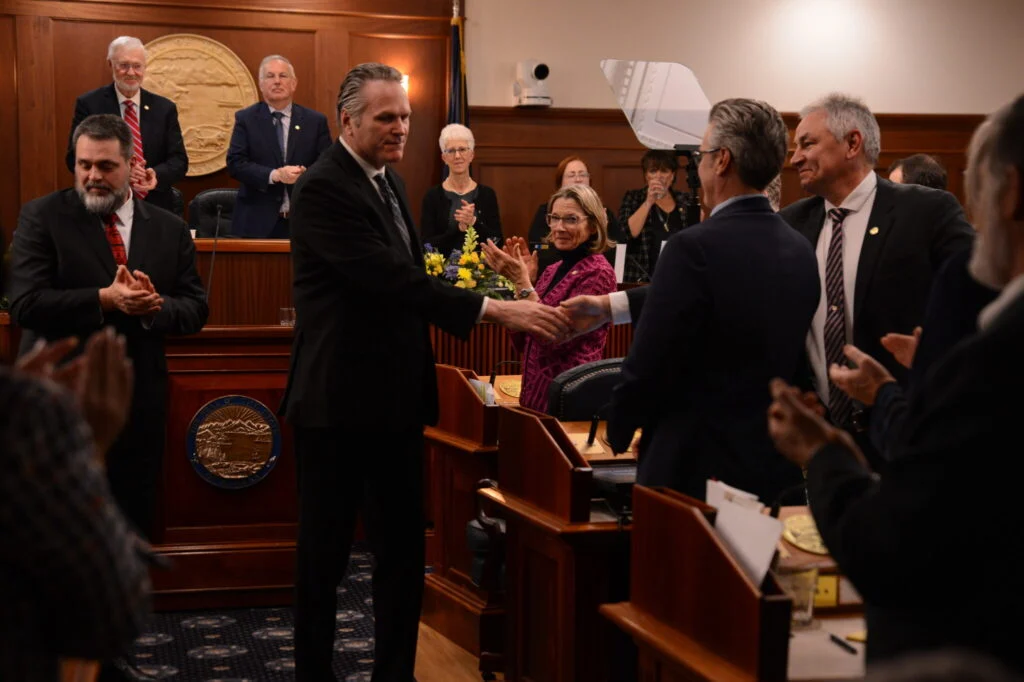
Gov. Mike Dunleavy shakes hands with Rep. Frank Tomaszewski, R-Fairbanks, as he exits the House chambers after his State of the State address on Jan. 23, 2026. (Photo by Claire Stremple/Alaska Beacon)
Alaska Gov. Mike Dunleavy delivered his eighth and final State of the State address on Thursday to a joint session of the Alaska State Legislature, touting the accomplishments of his term and promising continued momentum, particularly for large-scale resource development.
“Even though it’s my last year, there is no slowing down,” he said, and promised to work with legislators to advance policies in the spirit of Alaska’s independence and resilience.
In a nearly 80 minute speech, Dunleavy gave wide-ranging remarks on his administration’s initiatives over the last seven years, from reducing crime to improving reading scores. He touched on economic and workforce development, as well as the advancement of mining, oil and gas projects, like the proposed Alaska LNG gas pipeline project from the North Slope to Cook Inlet.
On Thursday, Dunleavy shared only a few details on a promised new state fiscal plan to help balance declining state oil revenues and pay for his proposed $7.75 billion draft budget this year. He said he plans to introduce a fiscal package in the next week, as well as bills focused on job training, child care and affordable housing.
Lawmakers with the House and Senate majorities expressed interest and some skepticism about his new fiscal plan after the speech, and concern around the lack of details for potential new tax proposals as the session gets underway.
“Honestly, that’s a tremendous amount of things he said he wants us to get through, so we have to do things properly and slowly and rightly and correctly,” said Senate President Gary Stevens, R-Kodiak. “And everything does take more time than you think, but we’re willing to work with the governor, and anxious to see what the specifics are of his fiscal plan.”
House Speaker Bryce Edgmon, I-Dillingham, said he is not optimistic for a fiscal plan this year.
“This is the eighth year that the governor has put a budget in front of the legislature with an over billion dollar deficit,” he said. “Yet to be contrasted this session with a fiscal plan that is going to be very controversial that none of us have seen yet.”
Dunleavy began the speech by applauding the state’s disaster relief efforts, most recently the response this fall in the devastating aftermath of ex-Typhoon Halong in Western Alaska. He noted the state has experienced 85 state and federal disaster declarations during his term, an average of one per month.
“We can’t control natural disasters. But we can control how we respond,” Dunleavy said. “I couldn’t be prouder of how we’ve responded to these events thanks to the brave men and women that I have the honor to serve as Governor.”
Dunleavy thanked the Trump administration throughout the speech, particularly for its focus on boosting Alaska resource development, which was outlined in the president’s executive order that promised to develop the state’s resources “to the fullest extent possible.”
He praised the Trump administration for re-opening offshore drilling and federal lands in the Arctic for oil and gas development, as well as for the millions promised for health care through the Rural Health Transformation Program.
“Alaska is benefitting greatly thanks to President Trump, and his administration. We need to do all we can to work with our federal partners over the next three years,” he said. “We may never get this opportunity again.”
Television cameras capture Gov. Mike Dunleavy’s State of the State speech on Jan. 22, 2026. (Photo by Corinne Smith/Alaska Beacon)
Dunleavy touted dropping crime rates and a declining unemployment rate, citing a growing economy and state population.
“I know there’s a feeling that things can be better, and of course they can, but our economy has been getting stronger and stronger every year of my administration,” he said.
Dunleavy said his administration will continue to work on reducing crime, in part by focusing on a new partnership with the municipality of Anchorage to combat crime there.
“Public safety has been my No. 1 priority and it will continue to be so until the end of my term,” he said.
Support of the proposed AK LNG pipeline featured prominently in his speech, though the financing and budget ask from the legislature remains uncertain. Dunleavy applauded the gas line developer, Glenfarne, a private energy developer that owns 75% of the project while the state of Alaska owns a 25% share.
Glenfarne Group CEO and founder Brendan Duval and Alaska LNG President Adam Prestidge stand while Gov. Mike Dunleavy recognizes their work in his State of the State address on Jan. 22, 2026. (Photo by Corinne Smith/Alaska Beacon)
Glenfarne executives were in the House chamber as Dunleavy praised the company’s most recent announcement: that they had signed new gas sales and contractor agreements and are headed into final investment negotiations to begin construction.
“This will be the single most transformative project in Alaska since the Trans-Alaska Pipeline,” he said.
While education was a major priority of the governor and legislature last year, Dunleavy only briefly touched on the topic. He said he would like to see legislators take action on bills he’s already introduced to expand charter schools, create open enrollment, address teacher retention and expand tribal compacting, which would allow schools to be run by local Alaska Native tribes.
Lawmakers react to the governor’s state of the state address
Republican lawmakers praised the speech and its scope.
“I thought it was a great address,” said Senate Minority Leader Mike Cronk, R-Tok, who was especially excited about movement towards a new gas pipeline. “He tried to cover everything that he possibly could, you know, still holding that optimism of getting things done that we need to get done.
“It was good to hear his overall enthusiasm going into his last year,” said House Minority Leader Rep. DeLena Johnson, R-Anchorage. “We do need to evaluate our revenue and our expenses and to really take a good look and be good stewards going forward. So I’m interested in seeing what he will promote.”
Members of the House and Senate majority caucuses echoed the interest in more details on the AK LNG pipeline proposal.
“I come from a district where people are not opposed to resource development, but we’re definitely skeptical,” said Rep. Ashley Carrick, D-Fairbanks. “We want to be practical, and we want to be critical, not to the point of stopping projects, but to the point of just understanding and having fair and reasonable oversight on projects.”
Senate President Gary Stevens, R-Kodiak, answers press questions following Gov. Mike Dunleavy’s State of the State address on Jan. 22, 2025, while Sen. Bill Wielechowski, D-Anchorage, Senate Majority Leader Cathy Giessel, R-Anchorage, and Bert Stedman, R-Sitka, look on. (Photo by Corinne Smith/Alaska Beacon)
Others, like Sen. Bill Wielechowski, D-Anchorage, were more skeptical about the project. “Do they have gas purchase agreements? Not that we’re aware. Do they have gas sales agreements? Not that we’re aware. Do they have financing for the project? Not that we’re aware,” he said. “So they’re talking a lot about the project, and it feels like progress, but do they have any firm commitments on any of those things? Not that I’m aware.”
“We applaud his efforts. We all want a gas line. We’re all excited that we’re as close as we are,” Edgmon said. “But there are other sorts of existential issues that we’re not dealing with here in the legislature.”
The speech failed to address fisheries for the second year in a row. Sen. Bert Stedman, R-Sitka, praised the governor’s optimism, especially around other resources, but noted the fisheries omission on Thursday.
“It is one of our largest employers in the state, and they’re still having significant problems after the turn down a couple years ago. So we’ll continue to have discussions with the administration and see what help we can put forward for the industry guys,” he said.
Rep. Calvin Schrage, I-Anchorage, said most of his constituents would like to see an improvement in the level or quality of state services. “The governor did a good job of highlighting some of the achievements from his administration, but I think in many cases, he missed the mark on the reality felt on the ground,” he said.
“With closing small businesses, we have a summer construction season that’s not funded — for the first time in state history. We have to address that,” said Rep. Zack Fields, D-Anchorage. “We have a stressed fishing industry. So just a big difference between a sort of a glossy speech and the much more challenging reality on the ground that we have to address.”
But Dunleavy noted in his speech that he’s still got some time to get work done — and he’s not running down the clock.
“Contrary to what you may have heard, my time is not up until noon on December 7th, 2026,” he said. “And our time here together in this last regular session isn’t up until midnight on May 20th.”
Alaska Gov. Mike Dunleavy speaks during a cabinet meeting on Wednesday, Jan. 21, 2026. (Photo byJames Brooks/Alaska Beacon)
Alaska Gov. Mike Dunleavy is expected this evening to detail his plans for a long-term plan to balance Alaska’s expenses and revenue.
“There will be a temporary, seasonal sales tax concept put forward for discussion with the legislature,” Dunleavy said Wednesday during a cabinet meeting open to reporters.
Will state lawmakers approve that idea?
“I don’t have the answer to that until we start having discussions,” he said.
Since 2015, Alaska’s annual budget process has frequently been snarled by low oil prices that have made it difficult for legislators and governors to balance the state’s books without spending from savings.
Alaska relies on oil revenue for almost a third of its general-purpose revenue, and for most of the past decade, the price of North Slope crude has been relatively low.
Alaska has never had a statewide sales tax, and it hasn’t had a statewide income tax since 1980.
Since 2018, the state’s No. 1 source of general-purpose revenue has been the proceeds of the Alaska Permanent Fund, followed by oil.
Dunleavy’s proposal will mark a major shift for the governor, who is term-limited and in the final year of his second term. For his first seven years in office, the governor has attempted to resolve the long-term imbalance in state finances by cutting services and spending.
On the rare occasions that legislators have passed new tax measures, Dunleavy has vetoed them, saying he will accept no tax bills that are not part of a complete fiscal solution.
The governor is expected to unveil his proposal for a complete solution on Thursday. He said he views any tax measures as a temporary “bridge” until the North Slope begins producing more oil and a proposed trans-Alaska natural gas pipeline comes to fruition.
“The proposal and the fiscal plan has multiple components, and basically what it is, it’s a road map to inject stability, especially over the next five years when revenue is not quite what will be in the out-years,” he said.
In addition to proposing a statewide sales tax, the governor is expected to propose bills changing oil taxes and the Permanent Fund dividend.
“There’s always room for negotiation, but there’s two sides. That (goes) both ways,” he said.
Dunleavy’s remarks came during a Wednesday cabinet meeting that saw the leaders of state departments praise Dunleavy and point to ways in which the state’s position has improved since he entered office.
Crime is down, commissioners said, statewide employment is expected to reach a new historic high this year, and the state’s gross domestic product is also up.
Alaska remains near the bottom of national rankings in educational performance and violent crime, but Dunleavy said he wanted to emphasize that many of the state’s problems are improving.
“We wanted to make sure that people in Alaska know that … there’s a lot happening. These people are working hard. State employees are working hard. There’s a lot going on,” Dunleavy said. “It is a safer place. Is it the safest place in the country? No. That’s a motivator to keep going. We are creating more jobs. Can we, should we, do better? Absolutely. Keep going.”
NOTN- The City and Borough of Juneau is asking residents to weigh in on what city services matter most as officials prepare for budget cuts in the coming fiscal year.
CBJ is asking Juneau residents to take the CBJ Community Compass Survey before mid-February. Community feedback collected through this survey will help inform the CBJ assembly’s budgeting process this spring.
“What we hope to achieve is basically gathering community input to have a deeper understanding and depth of knowledge of the community values and priorities.” Said Juneau Mayor Beth Weldon, “And the other thing that we’d like to do is just increase awareness of our budget process and how that all works.”
Following the passage of Proposition 2 , which expanded sales tax exemptions in the October 7, 2025 Regular Municipal Election, significant reductions in sales tax revenue are expected and will likely require service-level cuts to the city’s annual budget.
CBJ officials say they seek to better understand community funding priorities and values, including where residents are willing to make tradeoffs and which services are critical to quality of life.
This effort will include an online survey, in-person workshops, and Assembly listening sessions.
“We’re also looking for one broad community listening session where we’ll take public testimony on the budget.” Said Weldon, “That, in a nutshell, is what we’re trying to do for our public engagement through this process, trying to figure out what the public sees as important, and trying to figure out some kind of consensus on where the cuts are going to come from.”