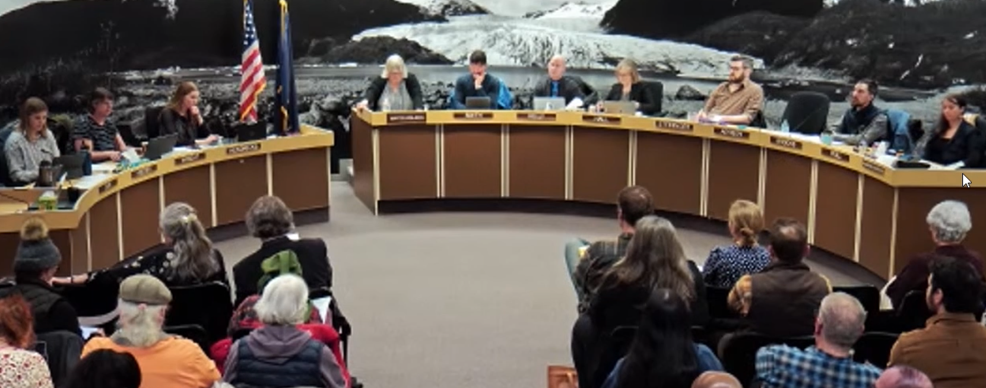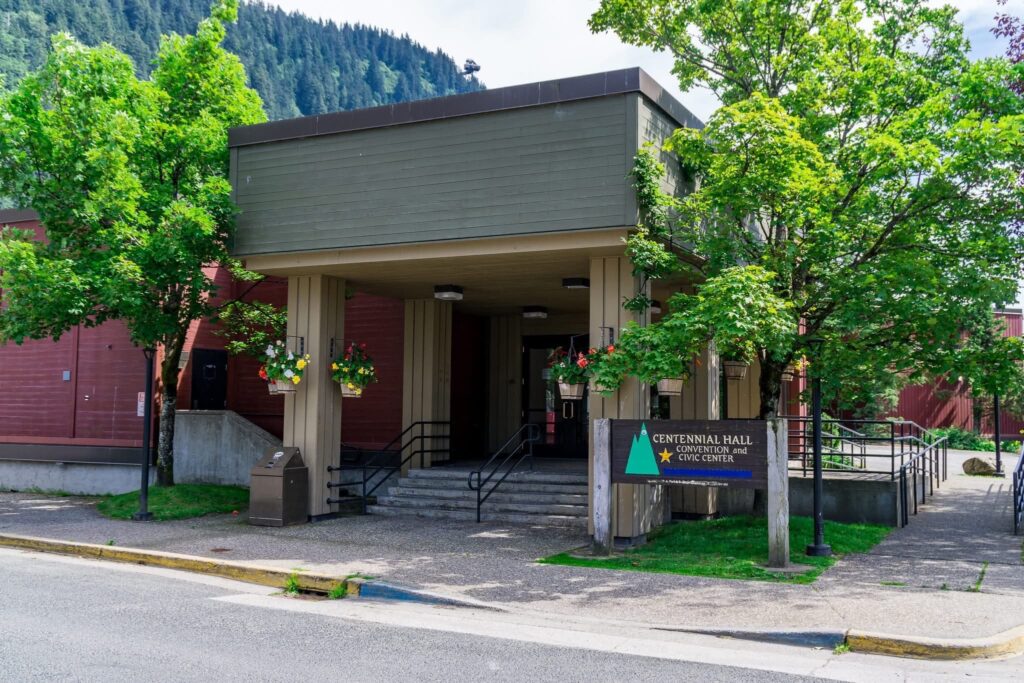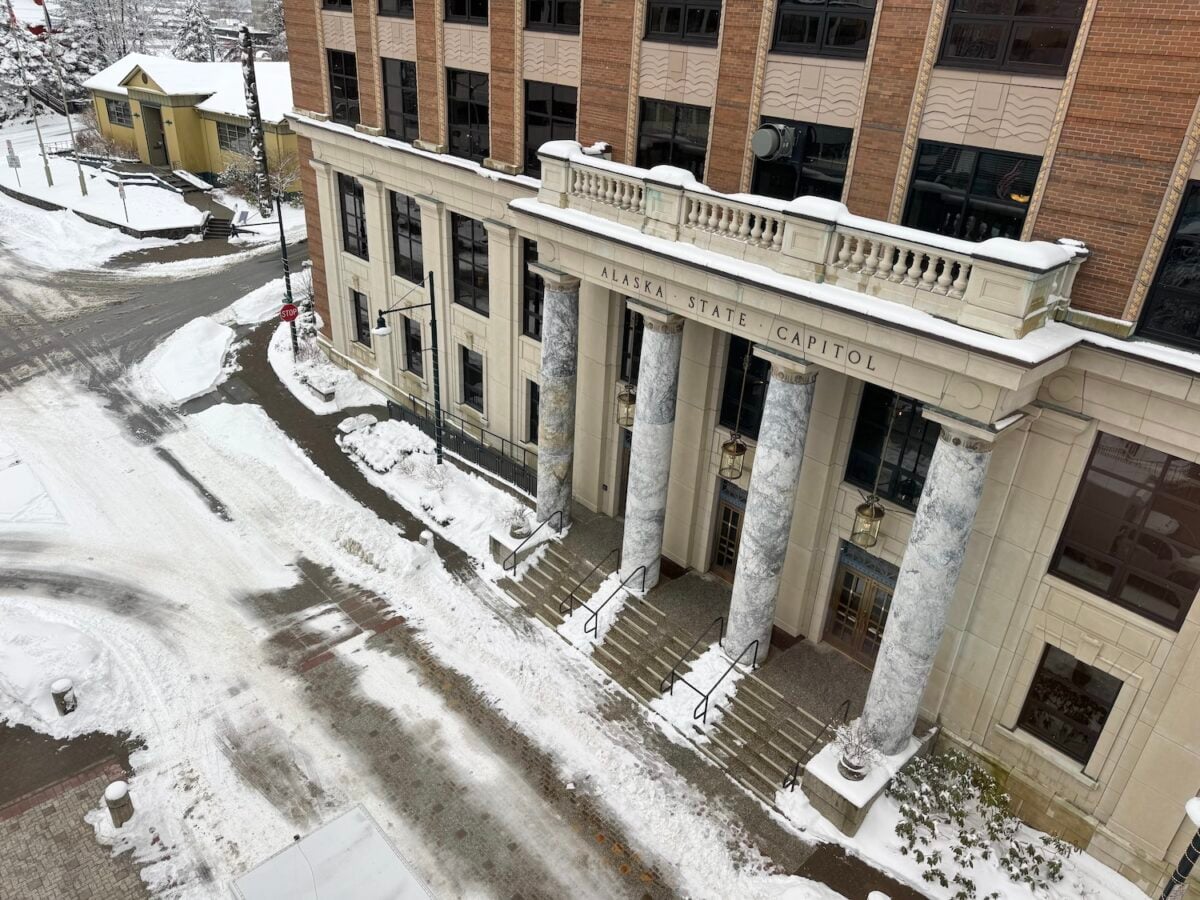
NOTN- Streets, schools and public safety topped the list of community priorities in the results of the recent city budget survey that, according to city leaders drew an unusually high level of public participation.
Mayor Beth Weldon said 4,400 residents responded to the survey.
“Which is quite unusual, and if you think about that, that’s half of what we usually have for voting on elections. So we did have a lot of people interested in telling us what they prioritize.” Weldon said.
According to Weldon, the number one priority identified by respondents was streets, roads and winter maintenance, followed by schools and public safety.
Rounding out the top 10 priorities were water and wastewater services, Bartlett Regional Hospital, recreation facilities, trails, the airport, national disaster response, libraries and museums.
Residents were also surveyed on areas they viewed as lower priorities or potential places to cut.
Tourism management ranked first among programs seen as candidates for reductions.
“The responses were mainly that they thought we should use more of the Marine Passenger fees to do that, rather than general fund fees.” Weldon said.
Other lower-ranked areas included climate and energy efficiency, economic development, housing development and land use planning, recreation facilities, homeless services, libraries and museums, trails, and the port and harbor.
“It was interesting seeing recreation facilities both on priority and where to cut but it totally was generational. The older you were, the less you prioritize recreational facilities.” Said Weldon.
The most popular option for raising or adjusting revenue was through property tax changes, Weldon said, with support “well into the 50%” range.
“It will be pretty tricky to do that, because one of the ballot measures capped our property tax, so we can’t do a lot there for another year or two.” Weldon said.
Weldon said the city is continuing to collect feedback through budget workshops, the final workshop takes place on March 4.
NOTN- Juneau officials are weighing whether to move forward with a federal buyout program for homes on flood‑prone View Drive, after most residents said they can’t afford the required local cost share.
The Natural Resources Conservation Service has identified View Drive as a candidate for its Emergency Watershed Protection buyout program. A preliminary estimate puts the total project cost at about $25 million.
Under the program, the federal government would cover 75% of eligible costs. The remaining 25% must come from non‑federal sources, such as the city, homeowners or other partners. Juneau asked NRCS to waive that local share, but the request was denied.
“After the assembly had some additional discussion at the Finance Committee meeting, they directed staff to to do an informal poll, so it was non-binding, just to get a sense from the residents who live on that road, if they would be willing and interested to participate in this program, if they had to pay the 25% non federal cost share, or if they would not be interested in participating in the program.” Said Director of Engineering Denise Koch.
The city conducted that informal poll of 18 properties on View Drive. 14 responded.
Koch said most homeowners indicated they would not participate if they had to pay the full 25% themselves. Only two said they were interested.
“Most of the respondents said that they would not be interested in participating under those circumstances. There was one property owner that I had listed as unclear, they selected yes and no, and they indicated that they would need more information in order to make an informed decision.” Koch said, “Of the two yeses, one is a property that has been subject to severe and repetitive flooding, the other is a property that is on the high side and has not flooded.”
Because the two interested homes are far apart, Koch said it’s likely NRCS would only approve a buyout for the repeatedly flooded property. That would create an unusual, one‑house project in a program that typically buys out a group of homes.
“A major theme was real disappointment that CBJ would require individual property owners to pay a 25% cost share.” Said Koch, summarizing several responses from the informal ballot and in person conversations, “Some people said that they didn’t have the ability to pay for that 25% cost share. Or if they had that amount of money, they might use it in other ways to protect their homes versus participating in a buyout program.”
On top of the 25% share, the city would also face tens of thousands of dollars per property in non‑reimbursable project management costs, including permitting and technical work. Kocher said the city is already stretched thin and facing a tight federal timeline; participating homeowners would need to be out of their homes before the 2026 glacial outburst flood season.
“What we’re looking for from a staff perspective is to understand from the Assembly, if there’s additional information that that you need in order to help make a decision as to whether CBJ should participate in this program or not. We do have this, essentially, time is of the essence problem again, if we’re going to proceed with this project, we have to get people out of their homes before August of 2026, and that’s really not that that far away.” Koch said.
Assembly members said View Drive residents have found the program details “incredibly confusing,” with multiple meetings, memos, and evolving information about eligibility and costs.
“One of the frustrating things I think about this project is there probably is a solution out there, you could bring partners together, you know, city homeowners, our community, the state nonprofits, there are lots of folks who may want to see this come to fruition, but we don’t have time.” Said Assembly member Christine Woll.
Kocher acknowledged that city staff are “learning as we go” while simultaneously working on other flood mitigation and long‑term enduring solution efforts, including the now‑uncertain lake tap alternative that, if built, was expected to protect all homes along View Drive.
For now, the Assembly has directed staff to hold another neighborhood meeting with View Drive residents, along with a small number of Assembly members. The goal is to explain the program more clearly, answer questions and find out whether there’s enough interest to justify moving ahead with the buyout option at all.
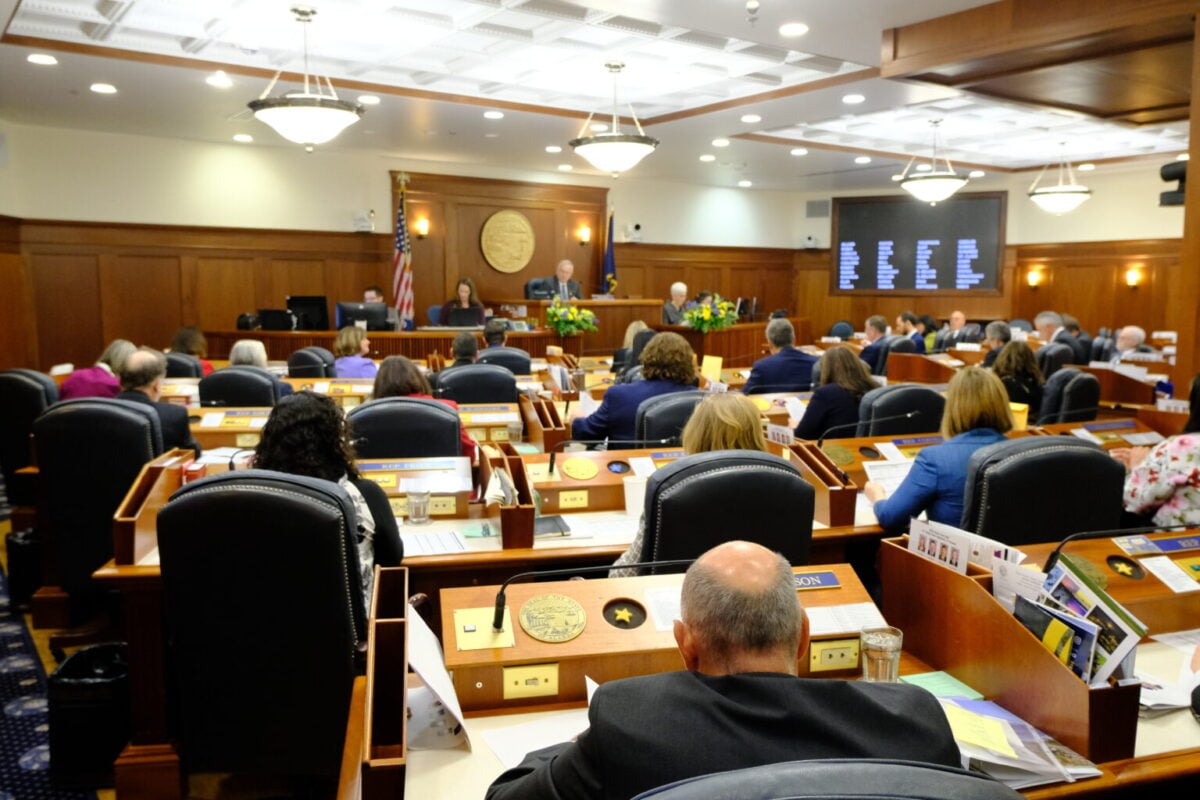
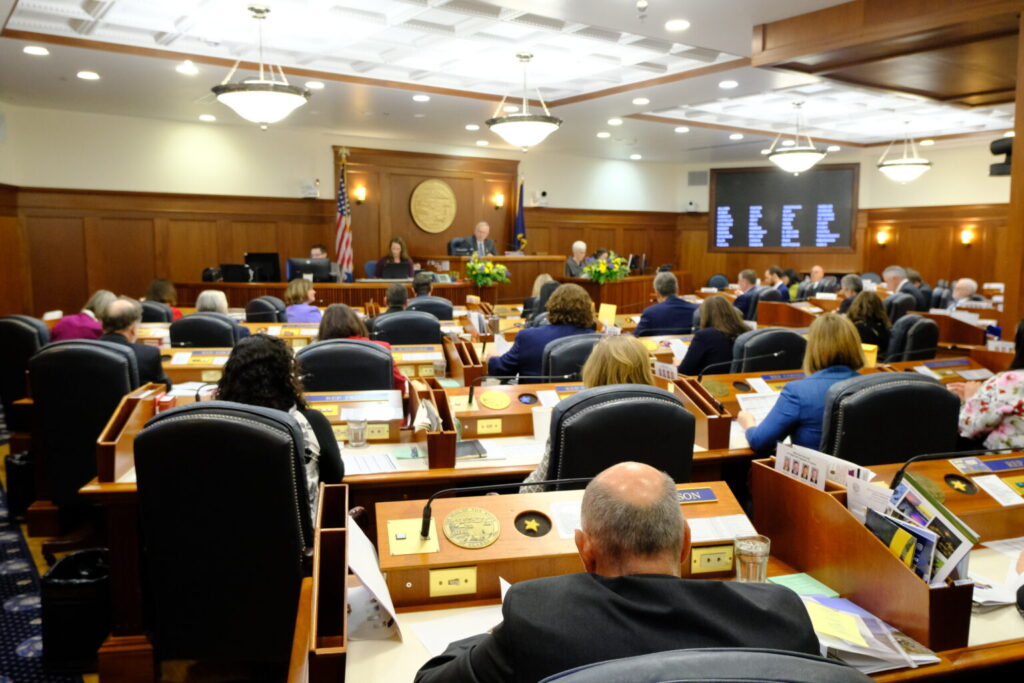
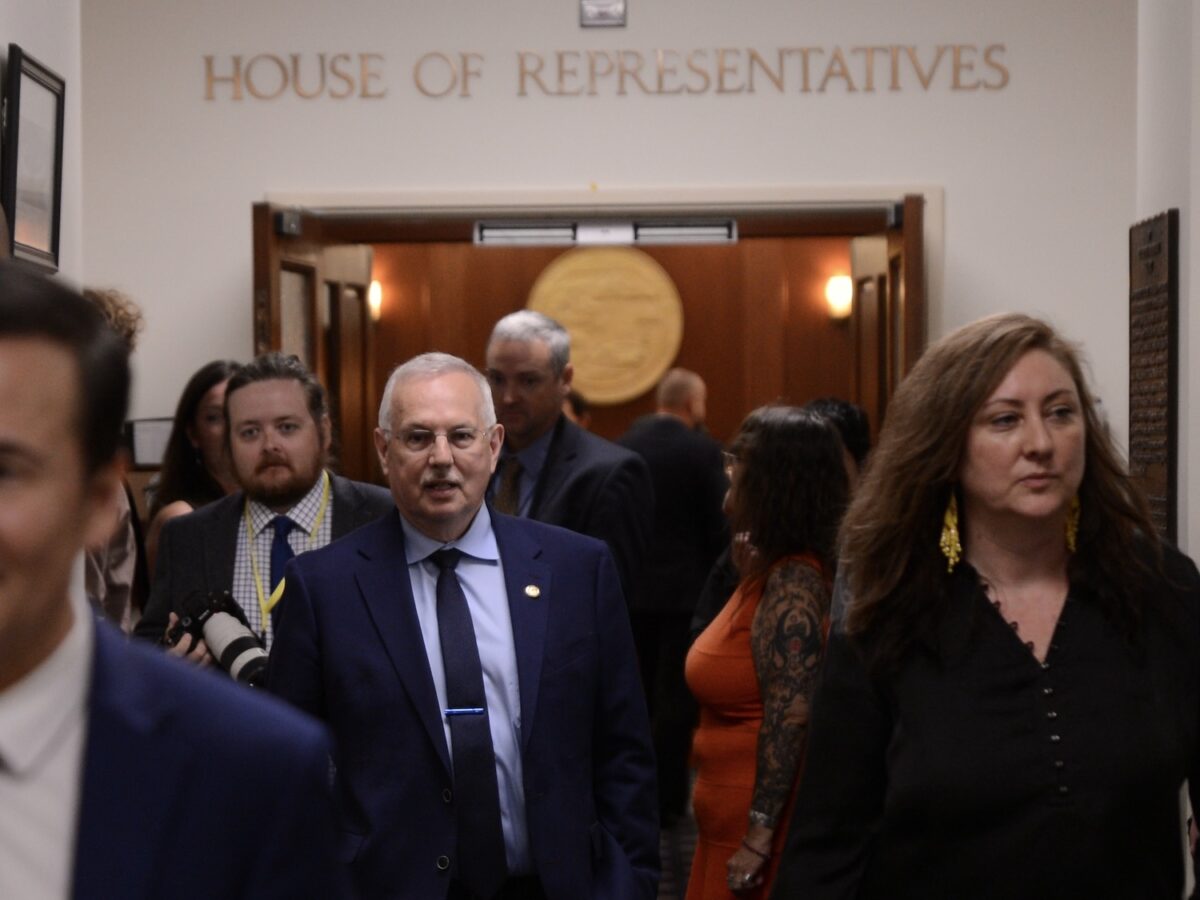
Members of the Alaska House of Representatives convene on the first day of the second session of the 34th Alaska State Legislature on Jan. 20, 2026 (Photo by Corinne Smith/Alaska Beacon)
The Alaska House of Representatives advanced a nearly $500 million supplemental budget bill to address the state’s budget deficit — one of the largest budget shortfalls to date — amid debate and scrutiny from Republicans who opposed drawing from a state savings account to pay for it, leaving the bill unfunded for now.
Lawmakers passed House Bill 289, known as the supplemental budget, by a 24 to 16 vote on Monday, which is largely a routine process to address budget shortfalls and fund state government services and programs through the fiscal year that ends on June 30.
Top line items include an additional $40 million for disaster relief, following the devastation of the remnants of Typhoon Halong on Western Alaska; $55 million for last year’s million-acre wildfire season in the Interior of Alaska; $70 million in transportation funding to unlock $630 million in federal matching funds; $130 million for the Higher Education Investment Fund; $20 million for the Alaska Department of Corrections; and millions for public assistance including Medicaid, the Supplemental Nutrition Assistance Program, housing vouchers and senior benefits.
But members of the Republican-led House Minority caucus raised concerns and frustration at the “fast tracked” budget bill, as well as expansion of spending and high costs for this year. While some members said a few items may be mandatory like funding disaster relief efforts and transportation, other spending items need further vetting and review.
Voicing opposition, Republican members voted against immediately funding the roughly $490 million budget bill through the state’s principal savings account, the Constitutional Budget Reserve – which failed by a 24 to 16 vote on Monday.
Unlocking the savings requires three quarters of the 40-person House, or 30 votes. Amid higher than expected state costs, and declining oil prices and state revenues, the Legislature must draw from the savings account to fund the state government.
The budget bill is expected to advance to the Senate for further debate and possible amendments. But on Monday, Rep. Mia Costello, R-Anchorage, a member of the minority caucus, requested a re-vote, expected on Wednesday, which may change the final vote tally but is not expected to delay the bill.
Historically, members of the minority have withheld support for the CBR vote until after the Senate approves the bill to maintain negotiating leverage.
Rep. DeLena Johnson, R-Palmer who serves as the House Minority Leader, raised objections to what she called a rushed process in the House.
“A rush through the budget without adequate scrutiny, in my opinion, without transparency, that’s not efficiency, that’s just courting failure, that’s just a rush to failure,” Johnson said. “And history has shown that rushed budgets often lead to unintended consequences.”
Members of the multipartisan House Majority caucus called for lawmakers to support the budget bill, as requested by Dunleavy, and pay the state’s bills now.
Rep. Andy Josephson, D-Anchorage speaks on the supplemental budget bill on the House floor on Feb. 24, 2026. (Photo by Corinne Smith/Alaska Beacon)
“These obligations must be paid,” said Rep. Andy Josephson, D-Anchorage, who chairs the House Finance Committee, speaking on the House floor on Monday. “There’s nothing unusual. The size is unusual, but the fact that they were requested and filed is not unusual. They are obligations of the state. They are effectively binding contracts that must be paid. And the question is, when.”
Dunleavy first introduced the supplemental budget in December, and requested additional items up to last week, including $35 million more for disaster relief if the state fails a federal appeal and is denied a request for the Federal Emergency Management Agency to fund 90% of costs for the first three months of the typhoon disaster in October.
Some items, like the $70 million federal transportation match, replace funds that Dunleavy vetoed last year — to the alarm of some lawmakers, union and construction industry groups because the money unlocks hundreds of millions of federal dollars. Lawmakers say it is time-sensitive to fund it in order to support the summer construction season.
“I would say these are actually precise invoices, not a blank check,” said Rep. Chuck Kopp, D-Anchorage. “They’re ones that were already on the books, and we’ve already taken the responsibility to pay.”
Some Republicans questioned departments spending over what the Legislature appropriated last year, particularly the Alaska Department of Corrections, calling for more thorough oversight and transparency.
“We have departments who have come with us, who actually spent like drunken sailors last year,” said Rep. Jamie Allard, R-Eagle River. “We need to make sure that they’re reined in.”
Other lawmakers pushed back against critics for holding up the budget bill process.
“I feel like I’m in the Twilight Zone,” said Rep. Andrew Gray, D-Anchorage, on the House floor on Monday, in response to Republicans’ criticisms of Dunleavy’s budget request and administration spending. “And what I’ll say is that sometimes we just have to put our differences behind us. We have to collaborate, cooperate, and do what’s best for Alaska.”
Following the House votes on Monday, House Speaker Rep. Bryce Edgmon, I-Dillingham, pointed out that the governor has not been involved in supporting the budget his administration has requested. “It’s quite interesting if this is a governor’s bill and the governor’s not involved at all in terms of promoting his own bill,” he said.
Rep. Jeremy Bynem, R-Ketchikan, a member of the minority, raised concerns on the House floor but ultimately voted to support the budget bill and the savings draw. “It was a difficult, challenging vote for me,” he said of voting against his caucus.
“I absolutely did not love the process we went through to get to where we were today. There are items in that (bill) I still have questions on,” he said. “The reality is that many of these items are things that we will have to take up and pay for.”
A spokesperson for Dunleavy’s office did not respond to a request for comment on the criticisms raised and lack of support from Republicans on the governor’s requested budget.
“The Alaska Constitution grants appropriation powers to the legislature, and that includes the CBR draw,” said Jeff Turner, communications director for Dunleavy. “The governor’s office is not part of any negotiations between the house caucuses.”
NOTN- The City and Borough of Juneau Assembly is set to tackle several hot button issues at tonight’s Committee of the Whole meeting, including flood mitigation efforts, redevelopment plans and new budget survey results.
According to a release from CBJ, the major focus of the meeting will be long-term solutions for glacial lake outburst flooding in the Mendenhall Valley.
City officials will present updates on a proposed Lake Tap which has been identified as the preferred engineering option following a recent planning session hosted by the U.S. Army Corps of Engineers.
Engineers estimate that without further mitigation, a future maximum flood event could impact more than 2,800 properties in the valley.
The Assembly will also receive updates on the second phase of the HESCO barrier flood project, and review results of an informal poll of View Drive residents about a voluntary federal buyout program.
City Manager Katie Koester said the buyout option would require a 25% non-federal match, estimated at roughly $6 million if all 18 eligible properties on View Drive participate.
Officials are seeking to determine whether homeowners are interested and whether they could help assemble the local share through private or nonprofit contributions.
City leaders emphasized participation would be voluntary, and the city would not move forward without sufficient interest.
Beyond flood response, the Assembly will hear results from a recent citywide budget priorities survey.
The meeting will also include discussion of next steps for a developer solicitation for Telephone Hill and updates on the ongoing Seawalk project.
City leaders are anticipating a late night tonight.
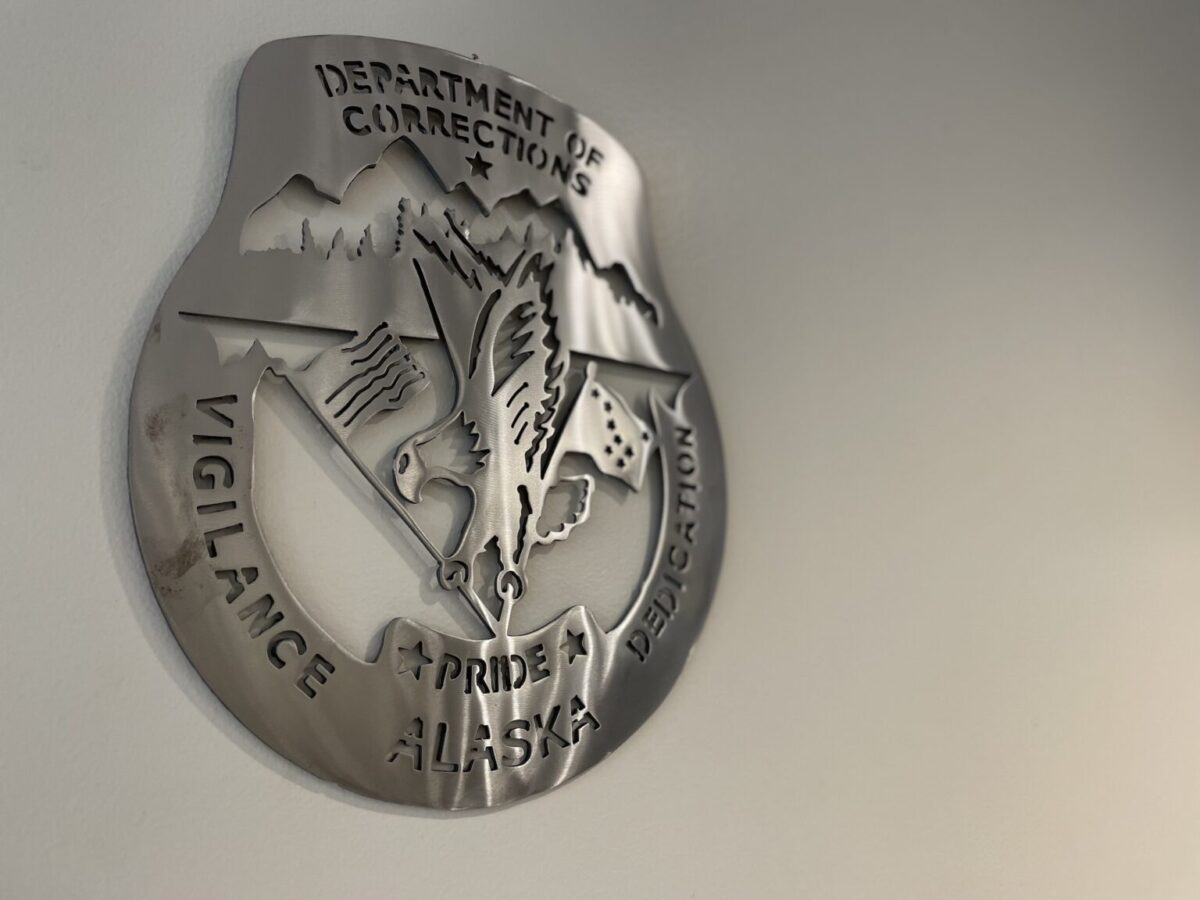
This symbol is inside of the Alaska Department of Corrections office on Sept. 7, 2022, in Douglas, Alaska. (Photo by Lisa Phu/Alaska Beacon)
The Alaska Department of Corrections spent over $24 million more than the budget approved by the Legislature last year, with a large portion for staff overtime, raising alarm from lawmakers.
DOC officials submitted their additional budget request to the Legislature earlier this month, part of a routine budget process to account for state spending over the past year — but this year’s price tag for the state’s prison system is at a historic high.
The department requested an additional $20 million for staffing and overtime for last year at the state’s 13 prison and jail facilities.
According to department data provided to the Senate Finance Committee on Thursday, there were 15 correctional staff that earned over $100,000 each in overtime pay last year, on top of salary and benefits.
Two correctional officers at the Anchorage Correctional Complex worked over 2,000 hours in overtime last year — one officer topped the list working 2,770 hours of overtime, to earn a total of over $225,000 last year.
DOC officials did not respond to questions about the department’s policies around overtime and mandatory overtime on Thursday, but a spokesperson said the department’s current vacancy rate is 11.5% statewide. In budget documents, DOC officials noted the additional funding was needed for minimal staffing requirements for “24/7 operational readiness.”
Sen. Bert Stedman, R-Sitka and co-chair of the Senate Finance Committee, said while the rising costs in DOC are well-known, going millions over budget is a problem as lawmakers grapple with declining state oil revenues and a growing list of state funding needs this year.
“Their budget has been growing exponentially,” he said Thursday. “It’s not fair, because those funds that are being channeled in that direction could go elsewhere.”
DOC’s budget has seen increases year-over-year throughout Gov. Mike Dunleavy’s term, unlike other agencies who have sustained cutbacks. Since 2019, the state budget for DOC has increased 46% to over $437 million last year, according to state data.
The $24 million in additional funds the agency requested also included $1.1 million for community residential treatment centers, or halfway houses, and $2.95 million in health care costs last year.
Sen. Mike Cronk, R-Tok, also serves on the Senate Finance Committee and expressed surprise and concern at the overtime hours presented to the committee on Thursday.
“That’s literally 100 hours a week. All year long,” he said, and questioned if people were running up overtime for a short time in order to retire or leave the department. “So it’s very concerning. You know, obviously I don’t blame anybody for it, but we have to figure out why this is happening, and we just have to do better. We have to be more efficient and make sure that we’re doing everything we possibly can to keep costs down.”
Stedman questioned the state’s contracts with the union representing correctional officers, the Alaska Correctional Officers Association, in accounting for the extensive overtime.
“My concern is maybe they ought to haggle a little bit better when they do their labor agreements, because this is definitely not appropriate for the public treasury to put up with, and it’s got to get corrected,” he said.
Representatives with the union did not immediately respond to emailed questions about lawmakers’ concerns on Thursday.
Last year, over 9,800 people entered DOC custody in institutions or on supervised release on probation or parole, according to state data.
NOTN- The City and Borough of Juneau survey seeking public input on how to address a projected $10 million budget gap has officially closed, but now the Assembly is preparing for a series of community workshops to further guide its decisions this tense budget season.
The survey, asked residents to weigh in on municipal services and identify what they value most as the Assembly begins work on the fiscal year 2027 budget.
Assembly Member Neil Steininger said the city faces a significant revenue shortfall following voter-approved ballot measures that eliminated sales tax on food and capped the local mill rate. The changes reduced revenue and left the Assembly with the task of determining how to maintain services with less funding.
“We got that message from the voters that, they wanted lower taxes. We need to figure out how to make that work and how to deliver city services, and we’re really looking for information from the voters to understand what their priorities are for what they see from government here in Juneau.” He said. “It is very difficult to make these decisions, which is something that we want to impress to people.”
Detailed reports from the survey are expected in the coming weeks.
“I think that’s just a really important thing for everyone to do, especially in a community like Juneau that’s so small and so closed, I think it’s important that people actively voice what they want prioritized in our city, so that the assembly can use that information to better inform their decision making.” Steininger said.
In addition to the survey, the city is hosting three in-person Community Compass workshops This month and early March. During the 60- to 90-minute sessions, participants will work through mock budgeting scenarios and discuss how to respond to unexpected financial changes.
“now it’s your turn to put yourself in an assembly member’s shoes and actively decide the city budget and then react to unforeseen circumstances that will ask you to reallocate certain pieces of the budget accordingly.” Steininger said.
Input gathered at the workshops will be shared with the Assembly as it moves deeper into the budgeting process this spring.
The workshops are scheduled for Feb. 18 at the Filipino Community Hall, Feb. 24 at Mendenhall Valley Public Library and March 3 at Douglas Public Library.
Speaker of the House Bryce Edgmon, I-Dillingham, leaves the House chambers before the start of a special legislative session on Saturday, Aug. 2, 2025, at the Alaska Capitol in Juneau. (Photo by James Brooks/Alaska Beacon)
By: James Brooks, Alaska Beacon
Speaker of the House Bryce Edgmon, I-Dillingham, leaves the House chambers before the start of a special legislative session on Saturday, Aug. 2, 2025, at the Alaska Capitol in Juneau. (Photo by James Brooks/Alaska Beacon)Speaker of the House Bryce Edgmon, I-Dillingham, leaves the House chambers before the start of a special legislative session on Saturday, Aug. 2, 2025, at the Alaska Capitol in Juneau. (Photo by James Brooks/Alaska Beacon)
Leading members of the Alaska House of Representatives said Friday that Gov. Mike Dunleavy’s ambitious long-term state fiscal plan has almost no support among legislators and is almost certainly dead on arrival.
House leaders spoke with reporters Friday morning, a day after members of the House Finance Committee heard two hours of public testimony on the governor’s proposed statewide sales tax, the cornerstone of his multi-part proposal to bring state expenses and revenue into line over the next five years.
Every Alaskan who testified — almost 30 in total — was against the tax.
“This is just pure speculation on my part, but what you hear folks in the hall say is, if there’s a vote today on the sales tax, it could be a zero to 60 vote,” said Rep. Neal Foster, D-Nome and co-chair of the House Finance Committee.
House Minority Leader DeLena Johnson, R-Palmer, said there might be a handful of legislators who would still support the governor’s plan, but it’s pretty clear that it lacks the support it needs to become law.
“From the testimony that was taken last night in House Finance — when everyone who called in spoke in opposition — it certainly makes it hard to think there’s a lot of people that aren’t very cautious about saying they’re for the governor’s plan,” she said.
The governor’s plan calls for a seasonal statewide sales tax, changes to the state’s oil and corporate taxes, a constitutionally guaranteed Permanent Fund dividend formula, changes to the structure of the Alaska Permanent Fund and a tighter spending cap in state law.
Those changes are being proposed because oil and investment revenue can’t keep up with demand for services and dividends, and lawmakers are unwilling to cut services any more than they already have.
Since 2015, legislators and governors have cut state agencies’ budgets by 16.6%, after accounting for inflation. The state’s capital budget, which pays for new construction and maintenance, has been cut by more than 80%.
Every year since 2016, the Permanent Fund dividend has been cut below the amount called for in state law.
Dunleavy’s proposal would be a way to stanch the fiscal bleeding. The new taxes are intended to be temporary because the Dunleavy administration expects North Slope oil production to rise, boosting state revenue, and it expects that a proposed trans-Alaska natural gas pipeline will be built and generate more money for the state.
Even before this week’s presentations and public testimony, many legislators were skeptical of the plan, and saw the new taxes as merely a way to pay a larger Permanent Fund dividend.
“I’m a logic person,” said Senate Minority Leader Mike Cronk, R-Tok, on Jan. 28, one day after the governor debuted his plan.“We’re going to tax those people that are productive so everybody gets a check? That don’t work for me. … That’s just not logical to me,” he said.
Lawmakers analyzed the sales tax first, in a series of hearings this week, but because it received such a negative reaction in public testimony, legislators are now wondering if it’s worth considering any other part of the governor’s fiscal plan, given that they are all viewed as one package.
Foster said it doesn’t look like the governor’s proposal could be amended and improved enough to get sufficient support in the Capitol.
“Sometimes, you could say, ‘We’re kind of close on things, and there’s a lot of great areas that we can work on,’ but this one just seems to be — folks are just really, really unhappy,” he said.
There are costs to inaction as well. The Institute of Social and Economic Research recently estimated that the state has missed out on 2-3% of its gross domestic product over the past 10 years because of the lack of a fiscal plan. Without a long-term structure, legislators have gotten dragged into annual debates over the size of the Permanent Fund dividend, which has prevented them from discussing other pressing issues.
Some lawmakers have concerns beyond the sales tax. Johnson thinks the governor’s proposal for a revised fiscal cap is inadequate. Because it would be in state law, rather than in the constitution, future legislators could ignore it just as they do the current Permanent Fund dividend formula.
That’s why she calls it a “spending beanie,” instead of a spending cap.
“I personally think it’s rather small, and it would be easily overcome,” she said. “And for that reason, I think of it as a spending beanie.”
Speaker of the House Bryce Edgmon, I-Dillingham, said he’s skeptical of this proposal’s chances after years of other attempts to enact a fiscal plan.
“I won’t regale you with tales from years past, but on the Finance Committee, we have spent weeks and weeks going through a lot of this stuff, and it never got a compromise when it came to the floor. So that’s the issue at hand here,” he said.
Rep. Calvin Schrage, I-Anchorage and another Finance co-chair, said that after hearing Thursday’s public testimony, he’s not sure the governor’s proposal can be successful either. “There is so much education that still needs to take place and studying that needs to be done for us to be able to move it forward in a way that would get broad support,” he said.
“I think folks are just kind of waiting until next year before we, you know, really take a serious stab at some of those things, like the income tax,” Foster said.
“I have higher hopes for next year than I do this year. You know, a new executive leadership branch and the leadership there,” he said.
Later in the day, in a one-on-one interview with the Alaska Beacon, Dunleavy said lawmakers are going to be disappointed if they think that negotiating with a new governor will be any easier.
Dunleavy is term-limited and leaves office in December.
“A governor who goes in there and puts out a plan like this in their first or second year, they’re going to get the same thing we’re getting now,” Dunleavy said. “And that doesn’t work.”
When an Alaskan flies to Seattle and looks out the airplane window, they’ll see construction cranes dotting the skyline, Dunleavy said.
“Washington is a state that does not have an income tax. It’s a sales tax. Washington’s economy is actually pretty good,” he said.
He referred to a fiscal analysis performed by the Institute of Social and Economic Research at the University of Alaska Anchorage, which found that a seasonal sales tax with large exemptions would fall more on nonresidents than an income tax would.
“The sales tax is the best thing we could come up with,” he said, referring to that analysis.
Reducing the PFD to balance the budget — the Legislature’s preferred policy since 2016 — is the most regressive option, harming poor Alaskans more than rich ones, ISER found.
“Taking the PFD is the worst thing you can do for the average person,” Dunleavy said.
He appeared frustrated by legislators’ actions and the lack of an alternative plan coming from the House or Senate.
“I’ve never seen a fiscal plan introduced,” Dunleavy said. “The closest I’ve ever seen was the first fiscal working group just a couple years ago.”
In 2017, the Alaska House of Representatives approved a state income tax as part of a three-part fiscal plan, but it did not become law.
“A tax is not a fiscal plan,” Dunleavy said when asked about that history.
He said that with 120 days in the legislative session, lawmakers have time to work on the issue and figure things out.
“Here you go: My last year, there’s no political skin in the game. I’m not going to lose anything because I’m not running for anything. And here’s an opportunity for these guys, and out of the gate, they said, ‘There’s not enough time.’ So if there’s not enough time for this,” Dunleavy said, “What are they spending their time on?”
NOTN- Despite a proposal from Governor Mike Dunleavy calling for a $3,600 permanent fund dividend, Alaska lawmakers say the numbers do not support an increase without new revenue.
State Senator Jesse Kiehl said the governor’s dividend proposal is not mathematically feasible under the current budget framework.
“The math just can’t work. There’s no way.” He said, “So one of the questions is going to be whether we can do any new revenues this year just to stabilize the PFD. I cannot see it going up.”
Without additional revenue, lawmakers are weighing whether to maintain a dividend similar to last year’s payment of about $1,000 or reduce it to a range closer to $600.
The final dividend amount is likely to remain unresolved until late in the legislative session, potentially stretching into mid-May, as lawmakers balance competing priorities for state spending.
NOTN- Juneau officials are watching state decisions closely as local government prepares for what could be a difficult budget season.
Christine Woll, chair of the City and Borough of Juneau Assembly’s Finance Committee, said the committee is preparing for the upcoming budget process.
“We’ve been going line by line, through what we typically fund, and asking a lot of questions. And so last night, we invited some of our partner agencies in to talk to us, and did a deep dive into their budget.” She said.
Those groups included Travel Juneau, which handles tourism marketing for the city, and the Juneau Community Foundation, which administers grant programs supporting local social services. The city typically provides about $1.5 million annually to each organization, Woll said.
“Given that, we’ll likely be thinking about cutting some services over the next few months, we want to make sure we understand what they’re up to and the impact of the dollars that we put in.” Woll said.
The committee also heard from the Small Business Development Center, which receives a smaller amount of city funding but provides coaching and support to local small businesses.
The Juneau Assembly has not taken a formal position on the proposed Cascade Point ferry terminal project, which is being considered by state lawmakers today.
“The assembly has not taken a position on Cascade Point. We probably don’t all agree on it is part of the reason. Obviously it’ll have an impact on our city, so we’re interested to see what happens.” Said Woll, “Personally, I’m not convinced that it’s the best use of state resources, especially because we do have a struggling ferry system, but the assembly has basically said, we know this matters, but if we’re not all going to be unanimous in our decision, we’ll wait and see how things play out.”
Questions about state spending priorities extend to Gov. Mike Dunleavy’s proposed fiscal plan, which includes a statewide sales tax. Woll said the Assembly is still deciding whether to take a specific position on the proposal.
“We’re still deciding whether we want to take a specific stance on his fiscal proposal around sales tax. We have taken a position in the past that I think is going to be presented to the Legislature today. We are figuring out how we fund our state budget; it is going to require a broad-based tax of some sort, and so we are supportive of that.” Said Woll, “I know there are folks with some concerns about if it is a sales tax, as proposed by the Governor, because, of course, the city has a sales tax, and that’s usually about 50% of our general income. The challenge is, if the state also has a sales tax that takes away some of our local control, we wouldn’t be able to decide who gets exemptions.”
Woll mentioned the Governor’s proposed sales tax might also make it harder for voters to approve future municipal taxes.
“Voters have to approve our local city sales tax. So if the state puts a tax on top of that, it just makes it less likely that the voters will support a city tax. So that definitely makes me a little nervous.” She said.
The Assembly is expected to continue its budget discussions in the coming weeks.
Representative Andi Story presenting to the House Education Committee, Screengrab courtesy of Gavel Alaska and KTOO
NOTN- A bill heard at 8 A.M this morning would overhaul how public schools are funded by changing how students are counted for state aid.
House Bill 261, rewrites large portions of the state’s public school funding statutes.
“We force school districts to budget in such an irrational way.” Said Representative Andi Story, “This backwards budgeting consumes a great deal of valuable time to reshuffle numbers, from personal experience this causes great pain in the community.”
In the full text of House Bill 261, available on The Alaska State Legislature Website, the measure is intended to stabilize school funding particularly through enrollment declines.
The biggest change in the bill is how Alaska calculates average daily membership, or ADM, which is the student count used to determine state education funding.
According to the Alaska Department of Education and Early Development, the ADM is a count of enrolled K-12 students taken for 20 days ending the last Friday in October of each year, the ADM is adjusted due to a few factors including school size, district cost, and special needs.
Under the bill, districts would generally receive funding based on the higher of their most recent student count or a three-year average.
“Alaska should create a 3 year averaging approach statewide to replace the current Hold Harmless Provision.” Story said during her presentation.
The Hold Harmless Provision currently protects school funding if their ADM drops by 5% or more each year, which allows the previous year’s student count to be used as a base to mitigate a drop in funding.
“It could also provide districts with greater stability and planning.” Story said, “As districts would not be so concerned about unexpected changes in enrollments at the October count period. About 19 states use an approach that either averages, combines or provides the better of multiple years of student counts.”
The bill also alters how districts are funded following school consolidations or closures, it would allow temporary offsets to soften funding losses over a period of several years.
The bill would also restrict districts from reopening schools too quickly after consolidation.
HB 261 also changes or revises how special education funding is calculated, particularly for students who require intensive services.
Using the above 3 year count, districts that identify additional students requiring intensive services midyear would be eligible for retroactive funding.
The bill applies to school districts statewide and does not directly increase the base student allocation, which is the per-student dollar amount set separately by the Legislature.