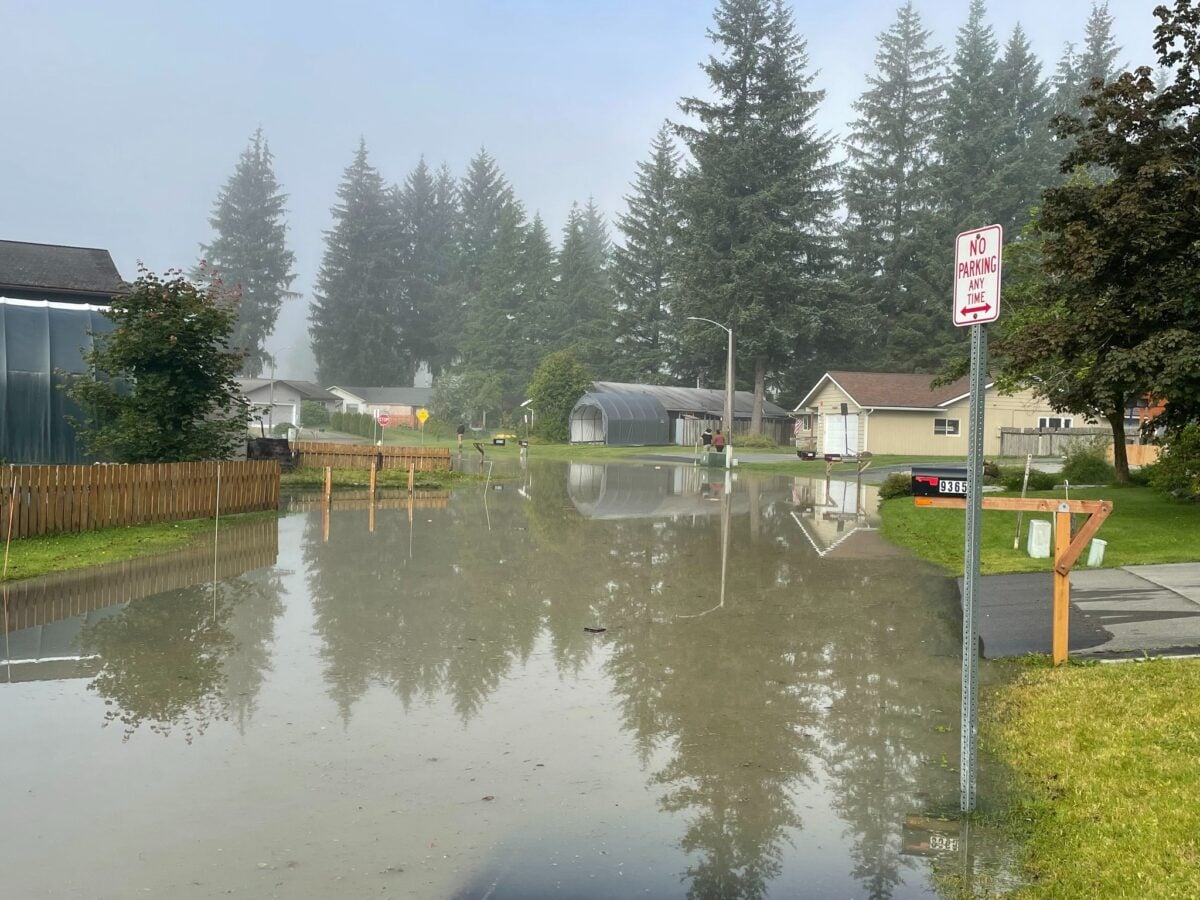
NOTN- After another glacial outburst flood on the Mendenhall River, Juneau officials are turning their focus to how the city will pay for long‑term protection of flood‑prone neighborhoods.
City Manager Katie Koester told the Assembly that the U.S. Army Corps of Engineers is moving ahead with an industry led solution, which could move on a faster time-line than one directed by the Army Corp.
The project would be designed to Suicide basin below 1,100 feet and hold future events to minor flood levels.
While final designs and costs are still unknown, Koester said the overall price tag could reach hundreds of millions of dollars, leaving Juneau responsible for an estimated $40 million to $100 million depending on the federal cost share, 10 to 25 percent.
According to Koester, after speaking with Alaska Senator Dan Sullivan’s office, Alaska’s congressional delegation is now working to change federal law so Juneau can receive the same 90-10 cost share available for Army Corps projects on tribal lands under the conventional process.
“I do think our state having some participation in the funding of an enduring solution is important… we have local government, federal government, tribal government, and state government all working together.” Koester said.
The city has already spent nearly $10 million in local funds on HESCO barriers and related work over recent flood seasons, and staff time has been pulled away from other core capital projects such as water, wastewater and facilities maintenance. Koester said engineering, public works and emergency management have been “absorbing” much of the response workload, and warned that can’t continue indefinitely without tradeoffs or added staff.
“We have spent a little under $10 million of CBJ taxpayer money, and that is thanks to grants and partnerships. Army Corps has spent significantly more more than that.” Koester said, “There will be maintenance responsibilities that we’ll be in charge of, including inspection, unfortunately protecting against vandalism. We’ve already seen the barrier slashed. We’ve already seen warming fires being built right up against the barriers.”
Assembly members are weighing a mix of options, including a special service area tax for roughly 1,800 homes in and around the flood zone currently protected by HESCOs, bonds backed by area‑wide taxpayers, and potential contributions from the state. A one‑mill levy in a HESCO service area would likely raise less than $1 million a year, meaning the general fund would still play a major role.
The Assembly is also debating whether to compensate homeowners who host HESCO barriers on their land through temporary easements, and whether to limit new development in the flood corridor while it asks voters to help finance a permanent solution. A small Assembly “strike team” will work with staff to refine funding options before they return to the full body for public debate.
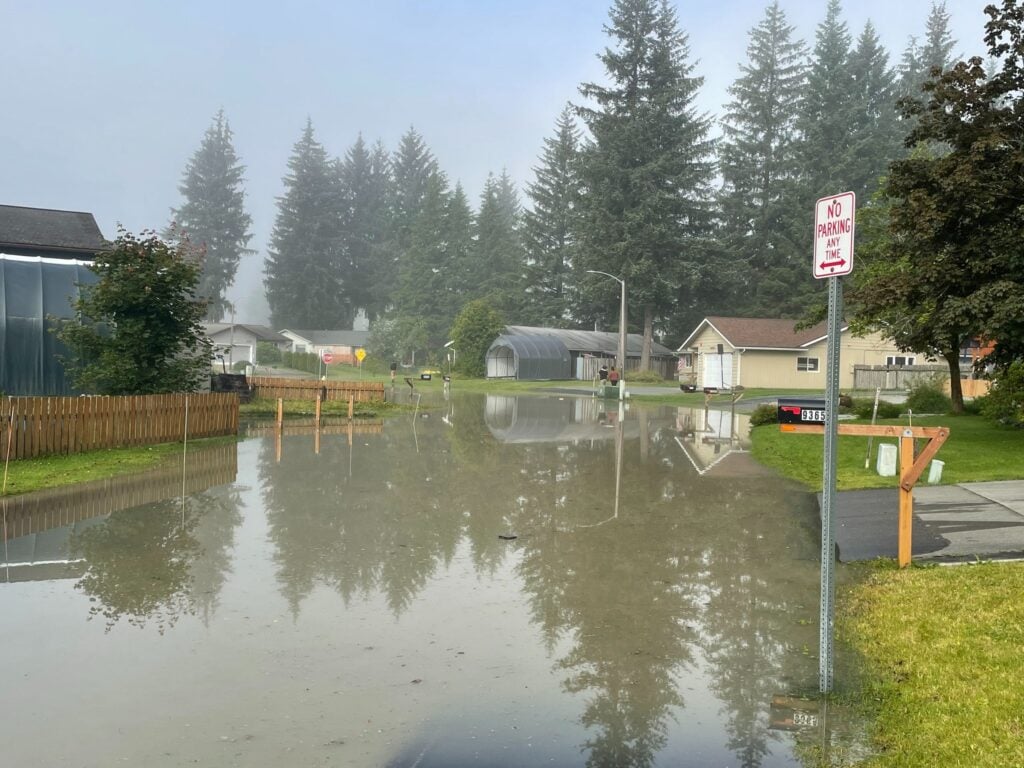
Photo courtesy of Susan Walker, Juneau Community Collective
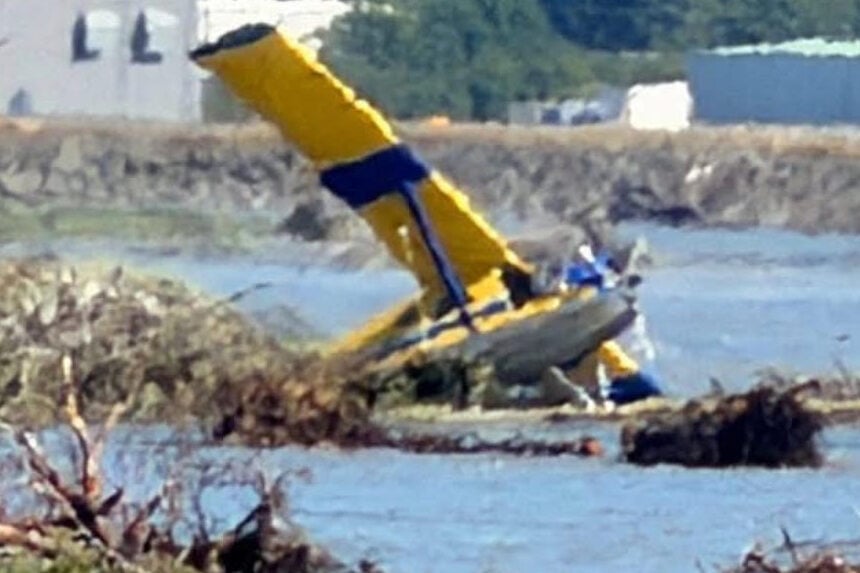
NOTN- An Alaska Seaplanes floatplane made an emergency landing in the Mendenhall River this morning, with no injuries reported.
The company says a de Havilland Beaver, tail number N777DH, made the emergency landing at about 11:17 a.m., shortly after taking off from the floatplane pond at Juneau International Airport.
According to a Facebook post, there was one pilot aboard and no passengers. The pilot was unharmed and is now with Alaska Seaplanes personnel.
The aircraft landed safely but later drifted into a floating root ball in the river. Alaska Seaplanes personnel are working to recover the plane.
The company says additional information will be provided as it becomes available.
NOTN- As Suicide Basin nears capacity, the City and Borough of Juneau is urging residents in the flood evacuation zone to finalize their emergency plans.
In an interview with CBJ Emergency Programs Manager Ryan O’Shaughnessy, he said residents are encouraged to know where they’ll go if an evacuation is ordered.
“The basin is is almost full, once the basin becomes full and gets to 1350 ft, folks can expect to get an alert on their phones.” O’Shaughnessy said, “That’ll that loud, sort of jarring alert, a sort of siren that comes out of your phone for just a minute. And that’ll let people know that the basin has become full. And in our Ready, Set, Go framework, we’ve moved from Ready into Set. That means it’s time for folks to have a bag packed, it’s time to make sure your phone is charged, there’s gas in the car, and that you’re ready to go when the basin begins to release.”
We’ve put together the CBJ approved evacuation routes, take note of what’s nearest to you if you are in the evacuation zone.
Residents north of Division Street, please travel north on Riverside Drive, toward Mendenhall (Back) Loop Road and out of the inundation area.
Residents south of Division Street, travel south on Riverside Drive, turn left on Stephen Richards Memorial Drive, towards Mendenhall Loop Road.
On Rivercourt Way, travel south on Riverside Drive, toward Egan Drive
On the west side of the Mendenhall River, travel west on Mendenhall (Back) Loop Road toward Auke Bay (avoid Back Loop Bridge).
West of Brotherhood Bridge, travel west on Glacier Highway toward Auke Bay
An emergency shelter will be available at Floyd Dryden Middle School, and limited space is available there for pets. Juneau Animal Rescue can also help coordinate temporary pet sheltering.
People in the evacuation zone are also being asked to register their vehicles in advance if they plan to use the city’s temporary flood parking areas, which are located at St. Brendan’s Episcopal Church 4207 Mendenhall Loop Road, Shepherd of the Valley Lutheran Church 8198 Keegan Street, Christ Lutheran Church 10300 Glacier Hwy, Juneau Christian Center 8001 Glacier Hwy.
“We’re optimistic, and we have a tremendous amount of confidence in the HESCO barriers, but it’s not something to bet your life on. That’s why we’re really encouraging folks who live in the hazard area to evacuate and go ahead and heed that evacuation advisory when that’s issued.” O’Shaughnessy said.
Officials recommend preparing homes now by moving valuables, as well as items such as oils, paints and cleaning products, into secure waterproof containers at higher elevations.
Residents should also have a go-bag packed and ready in case an evacuation order is issued.
Officials remind residents not to drive or walk through floodwaters and to wait for an official all-clear before returning home after the event. The City and Borough of Juneau has also activated a flood information hotline for non-emergency questions. The hotline currently operates weekdays, with expanded weekend and around-the-clock hours planned once the basin fills and, if necessary, when a flood begins. United Way of Southeast Alaska is also coordinating volunteers and assistance for residents who may need help before or after the flood.
Flood waters are rising at a rate of about 3 feet per day but more information about flood preparedness is available through the City and Borough of Juneau’s flood readiness resources, the National Weather Service or by calling the flood hotline.
A drone image shows widespread flooding in the Mendenhall Valley. (Image courtesy of Rich Ross)
A drone image shows widespread flooding in the Mendenhall Valley in 2024. (Image courtesy of Rich Ross)
NOTN- City officials and U.S. Army Corps of Engineers representatives outlined ongoing and proposed flood-mitigation work last night.
The Committee of the Whole work session focused on HESCO barriers and river armoring installed after the series of glacial lake outburst floods in recent years.
Mike Records, the Technical Lead for the Army Corp of Engineers, outlined the hydrology of the system, how the flood water moves.
His presentation estimated flood risk. those estimations will be used to design short, medium and long-term protections.
Engineers discussed “Annual Exceedance Probability” or AEP, which was once referred to as “100 Year Flood.”
This means the chance that a flood of a certain size will happen in any given year. For example, a “1% AEP” flood has a 1% chance of happening each year.
But according to officials, those odds add up over time. Even a rare flood becomes much more likely if you look over many years. A flood with a 1% yearly chance has about a 40% chance of happening at least once over 50 years.
“A 1% annual exceedance probability event would be the equivalent of a 100-year event, there is a low chance of that happening, but over time, those chances compound.” Records said, “The annual exceedance probability events that we developed are peak discharge events that we then used in hydraulic modeling to inform decision making on design. You’ll see that a lot of these events are significantly larger in magnitude than anything that’s been experienced at this point.”
In most places, engineers rely on decades of historical data to estimate flood risk, but in this case, there are only about three years of major data available.
“There’s flooding all over the country, it’s rare that it develops so suddenly like this.” Records said, “So normally, you might have like a 60 year period of record of flood events that you could use to develop your AEPS. In this case, there’s basically three years of full drainage events.”
Because of limited data and a changing environment, there is a lot of uncertainty in these estimates, so engineers are planning for the worst-case scenario.
According to officials, Suicide Basin is expanding. This is because the glacier is melting and retreating, which opens up more space for water to collect. Ice is breaking off (calving), melting, and adding to the lake, so overall the basin can hold more water than it used to. On the other side, the spillway,, the pathway where water drains out beneath or around the glacier, is also changing. As the glacier thins and melts, the outlet is getting lower, which can allow water to start draining sooner.
Cubic-feet-per-second or CFS, is the rate at which water flows. Last year’s flood reached about 50,000 CFS. Officials said work aims to reach a 63,500 CFS flood scenario threshold by mid-July.
Assembly Member Nano Brooks asked Records about the service life of the HESCO barriers, to which Records responded, “They have a warranty of five years. I think that’s primarily for fabric degradation. Of course, those parts can be replaced, but that is kind of the maximum expectation without significant ongoing maintenance.”
Three options were presented for the coming season: the status-quo-plus build, upgrades to protect to 63,500 CFS (the staff recommendation), or a larger, more costly build to protect to 90,000 CFS. According to officials, that type of flood has an 18% chance of occurring in the next 10 years.
Officials said the 63,500-CFS option would leave an estimated $3 million funding gap and the 90,000-CFS option about $8 million short of current funding.
The city is pursuing State Revolving Fund assistance that would forgive half the loan and could cover much of the cost if approved.
Ultimately The City and Borough Assembly voted 7-2 to authorize work to reinforce and raise HESCO flood barriers to protect against a 63,500 CFS event ahead of the 2026 flood season .
An ordinance to formalize the appropriation is expected for introduction May 18.
NOTN- Juneau officials are weighing whether to move forward with a federal buyout program for homes on flood‑prone View Drive, after most residents said they can’t afford the required local cost share.
The Natural Resources Conservation Service has identified View Drive as a candidate for its Emergency Watershed Protection buyout program. A preliminary estimate puts the total project cost at about $25 million.
Under the program, the federal government would cover 75% of eligible costs. The remaining 25% must come from non‑federal sources, such as the city, homeowners or other partners. Juneau asked NRCS to waive that local share, but the request was denied.
“After the assembly had some additional discussion at the Finance Committee meeting, they directed staff to to do an informal poll, so it was non-binding, just to get a sense from the residents who live on that road, if they would be willing and interested to participate in this program, if they had to pay the 25% non federal cost share, or if they would not be interested in participating in the program.” Said Director of Engineering Denise Koch.
The city conducted that informal poll of 18 properties on View Drive. 14 responded.
Koch said most homeowners indicated they would not participate if they had to pay the full 25% themselves. Only two said they were interested.
“Most of the respondents said that they would not be interested in participating under those circumstances. There was one property owner that I had listed as unclear, they selected yes and no, and they indicated that they would need more information in order to make an informed decision.” Koch said, “Of the two yeses, one is a property that has been subject to severe and repetitive flooding, the other is a property that is on the high side and has not flooded.”
Because the two interested homes are far apart, Koch said it’s likely NRCS would only approve a buyout for the repeatedly flooded property. That would create an unusual, one‑house project in a program that typically buys out a group of homes.
“A major theme was real disappointment that CBJ would require individual property owners to pay a 25% cost share.” Said Koch, summarizing several responses from the informal ballot and in person conversations, “Some people said that they didn’t have the ability to pay for that 25% cost share. Or if they had that amount of money, they might use it in other ways to protect their homes versus participating in a buyout program.”
On top of the 25% share, the city would also face tens of thousands of dollars per property in non‑reimbursable project management costs, including permitting and technical work. Kocher said the city is already stretched thin and facing a tight federal timeline; participating homeowners would need to be out of their homes before the 2026 glacial outburst flood season.
“What we’re looking for from a staff perspective is to understand from the Assembly, if there’s additional information that that you need in order to help make a decision as to whether CBJ should participate in this program or not. We do have this, essentially, time is of the essence problem again, if we’re going to proceed with this project, we have to get people out of their homes before August of 2026, and that’s really not that that far away.” Koch said.
Assembly members said View Drive residents have found the program details “incredibly confusing,” with multiple meetings, memos, and evolving information about eligibility and costs.
“One of the frustrating things I think about this project is there probably is a solution out there, you could bring partners together, you know, city homeowners, our community, the state nonprofits, there are lots of folks who may want to see this come to fruition, but we don’t have time.” Said Assembly member Christine Woll.
Kocher acknowledged that city staff are “learning as we go” while simultaneously working on other flood mitigation and long‑term enduring solution efforts, including the now‑uncertain lake tap alternative that, if built, was expected to protect all homes along View Drive.
For now, the Assembly has directed staff to hold another neighborhood meeting with View Drive residents, along with a small number of Assembly members. The goal is to explain the program more clearly, answer questions and find out whether there’s enough interest to justify moving ahead with the buyout option at all.
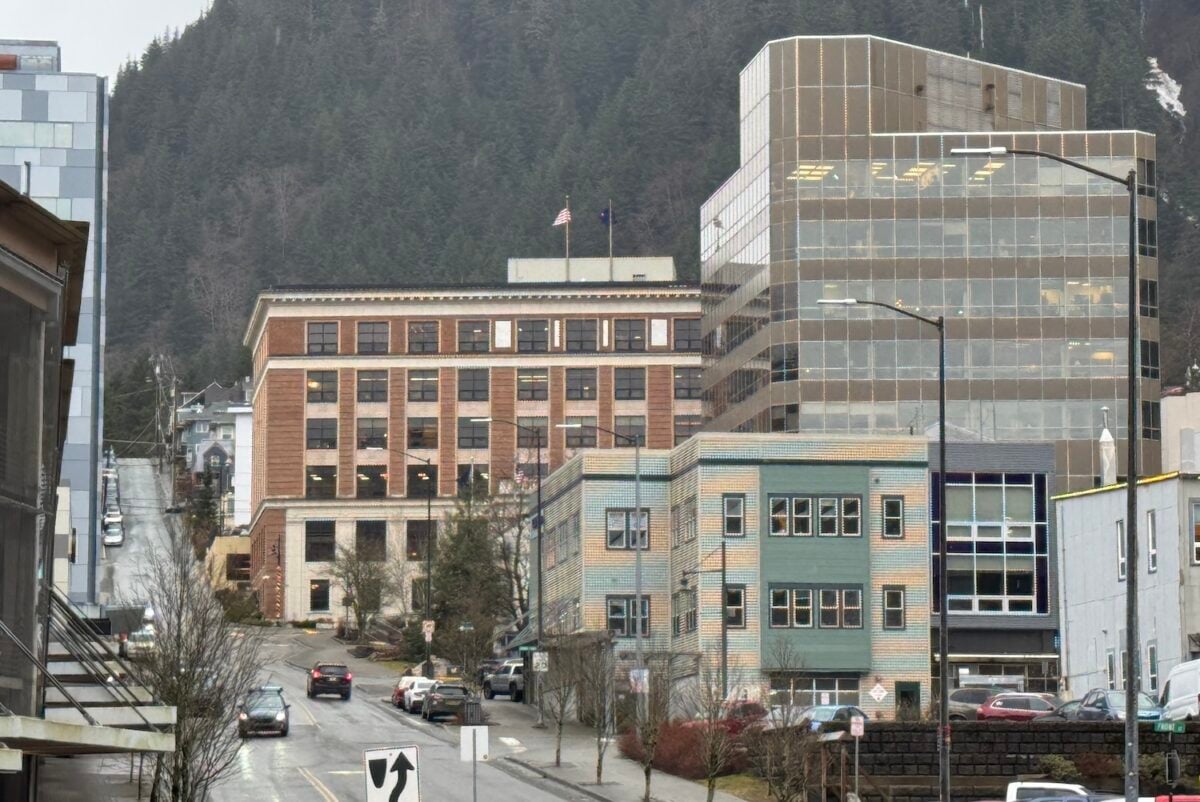
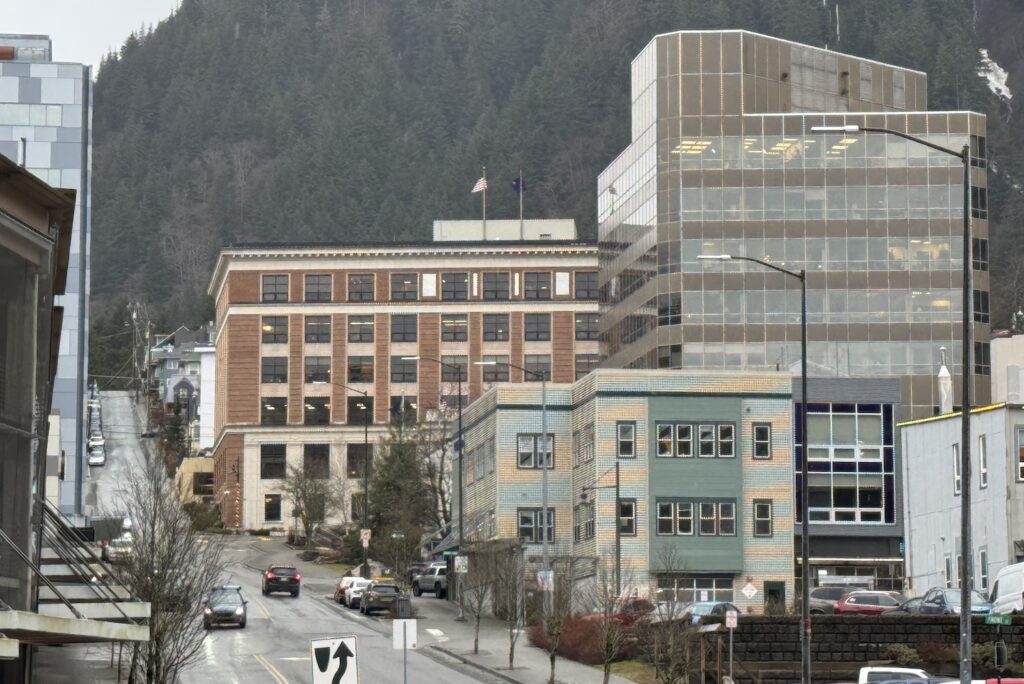
The Alaska State Capitol is seen behind other buildings on Tuesday, Feb. 10, 2026, in downtown Juneau. (James Brooks photo/Alaska Beacon)
By: James Brooks, Alaska Beacon
The Alaska State Capitol is seen behind other buildings on Tuesday, Feb. 10, 2026, in downtown Juneau. (James Brooks photo/Alaska Beacon)
The Alaska Legislature on Wednesday approved a 30-day extension for the state of disaster covering the fall 2025 storms that battered the state’s west coast.
The extension allows the state to continue spending money from its disaster response fund as it continues cleanup and repair efforts from two storms in October. Hundreds of Alaskans were displaced by the disasters, which devastated coastal communities.
The Alaska Senate approved the extension in a 19-0 vote on Monday, but the extension nearly failed in the Alaska House after members of the House’s Republican minority caucus raised procedural issues on Wednesday and said members of the majority were not following state law.
The extension was included in Senate Concurrent Resolution 12, which retroactively approves extensions issued since October and allows the governor to spend more from the state’s disaster response fund.
“Doing this as a resolution is dangerous, I think it’s a mistake, and I’m not even certain that it’s legal,” said House Minority Leader DeLena Johnson, R-Palmer.
Johnson and other Republicans said that under their interpretation of state law, legislators would need to approve the spending via a bill, not a resolution.
A legislative attorney, writing in a Feb. 2 memo to Speaker of the House Bryce Edgmon, I-Dillingham, said, “when the legislature means to take action having a binding effect on those outside the legislature, including extending a disaster declaration, the legislature must enact a bill in a special or regular session rather than using the less formal resolution process.”
Johnson was rebutted by House Rules Chair Louise Stutes, R-Kodiak and a member of the House’s majority coalition.
“This is not new money,” she said. “This is money that has been (in the fund) and is being allowed to be appropriated out. … it’s been agreed upon that maybe this wasn’t the optimum way. Nothing’s perfect. We’re moving forward. We are trying to do the best we can as quickly as we can. Time is of the essence, so I ask you to ask yourself: Do you want to be right in how it is done, or do you want to do the right thing when there’s a question?”
The House vote was 22-18, with Rep. Will Stapp, R-Fairbanks, joining the 21 members of the House’s coalition majority in support. All other members of the House Republican minority voted against the resolution.
As debate opened, Rep. Nellie Unangiq Jimmie, D-Toksook Bay, became choked up as she described the disaster, which devastated her district and resulted in the largest peacetime evacuation in state history.
“Today, months later, 340 of our neighbors remain without permanent houses. Mr. Speaker, we are Yup’ik. Our people have lived in this delta for thousands of years. We know storms. We know water. We know loss,” she said. “We have lived on this coast for thousands of years, and we’ve survived ice ages, epidemics, colonization. We’ve survived by adapting, sharing, by refusing to abandon our homes, but you can’t really live when your home floats 10 miles out to sea, when your fuel tanks that heat your home in winter are submerged in salt water.”
On Jan. 28, Gov. Mike Dunleavy requested permission to spend $20.5 million from the disaster response fund, up $5.5 million from a prior request.
When federal money is added to that tally, the total amount is $39.25 million.
More spending is expected.
Last week, the director of the Alaska Division of Homeland Security and Emergency Management said that the Federal Emergency Management Agency has estimated at least $125 million in state and federal costs related to the storm disaster.
“The declaration allows state agencies to continue their emergency response and to extend state funds as needed,” said Rep. Andy Josephson, D-Anchorage and co-chair of the House Finance Committee.
Rep. Justin Ruffridge, R-Soldotna, took issue with the fact that after Dunleavy declared a state of disaster in October, the Speaker of the House and Senate President approved subsequent 30-day extensions without consulting legislators.
“I think we should have called ourselves in (to special session), or the third floor should have called us in (to special session) to take up this very important issue,” Ruffridge said.
“What precedent does this set for the presiding officers to make the decisions before us on our behalf?” he asked. “What power do we give the executive by allowing disaster declarations to continue without (the House) or the (Senate) taking up that order of business?”
Rep. Dan Saddler, R-Eagle River, said he worries that failing to follow proper procedure could leave disaster relief vulnerable to legal challenge.
“We put the reliability of that relief at question if this is not done right,” he said.
The day after the vote, Ruffridge said members of the minority have drafted a bill that would fix the problems they see, and that bill is being reviewed by legislative attorneys.
House Majority Leader Chuck Kopp, R-Anchorage, said legislative attorneys have reviewed the majority’s plan.
“We have had our legal department tell us that this passes muster,” he said during the debate.
After the vote, Kopp’s office was unable to provide a legal memo to that effect but said he had received verbal advice.
Josephson, wrapping up debate, said the majority was working in good faith with Dunleavy to get the money out the door quickly.
“Given the urgency of the matter, we’re trying to cooperate with the executive branch,” he said.
NOTN- City officials issued a high-risk avalanche evacuation advisory today as worsening weather conditions raised the likelihood of avalanches across all known slide paths.
The advisory, updated at 10:30 a.m., urges residents in at-risk areas to evacuate as increased snowfall, warmer temperatures and several inches of rain forecast at higher elevations are significantly heightening avalanche danger.
Officials stressed that the situation is rapidly evolving and could escalate further as weather conditions deteriorate.
Emergency response crews are staged and prepared to respond in the event of an avalanche at Thane road where DOT was scheduled to close the road at the avalanche gates at noon.
An emergency shelter is available at Centennial Hall, where the American Red Cross is prepared to provide mass care services, including meals, once formally activated. City officials said resources are in place to support evacuees should conditions worsen.
Pet sheltering is also available at Centennial Hall. Juneau Animal Rescue is offering additional emergency pet sheltering through its Safe-Keeping Program, and JAR and KTOO have created resources to help pet owners prepare for emergencies.
“‘It’s a substantial portion of downtown.” Said Deputy City Manager Robert Barr, “Downtown is the area that that we’ve been able to map. That doesn’t mean avalanche doesn’t exist elsewhere. folks should just be aware.”
Authorities urged residents to take precautions during the period of elevated avalanche risk, including avoiding travel beneath known avalanche paths, following all road and trail closures, and not stopping in avalanche runout zones. Residents were also advised to closely monitor official alerts and updates.
After storms or avalanche activity, officials warned people to stay clear of debris piles and runout areas and to wait for official reopening notices before resuming normal travel. Any observed avalanche activity should be reported to authorities.
The deadly landslide that crashed through the outskirts of Wrangell on the night of Nov. 20, 2023, is seen from the air on the following day. The landslide killed six people and blocked a major road, the Zimovia Highway. The slide was triggered by heavy rain carried north by an atmospheric river. (Photo provided by Alaska Department of Transportation and Public Facilities)
Future assessments of U.S. landslide hazards could include the study of risks posed by atmospheric rivers, which caused extreme precipitation that was linked to recent deadly slides in Southeast Alaska.
The added focus on atmospheric rivers is one of the main updates in a bill that would reauthorize the National Landslide Preparedness Act. The bill, sponsored by U.S. Sen. Lisa Murkowski, R-Alaska, passed the U.S. Senate on Monday and is now to be considered by the U.S. House.
Atmospheric rivers are long and transitory bands of moisture and heat, likened to rivers in the sky. They carry that moisture northward from more southern latitudes, and they can dump vast amounts of rain for several hours or even days.
“You can very rapidly saturate soils in the right conditions,” said Rick Thoman, a scientist with the Alaska Center for Climate Assessment and Preparedness at the University of Alaska Fairbanks.
When such large amounts of warm southern moisture hit the steep mountainous regions of Southeast Alaska, they can cause sudden downhill flows, Thoman said.
“It’s really that intense amount of rain that atmospheric rivers deliver that’s the link to landslides,” he said.
Numerous landslides in the United States have been triggered by atmospheric rivers’ extreme precipitation. Those events include the 2023 slide in Wrangell that killed six people, the 2020 slide in Haines that killed two people and the 2015 slide in Sitka that killed three people.
Extreme precipitation events from atmospheric rivers are tied to shallow-seated landslides such as the deadly events that struck Southeast Alaska in recent years. Other types of Alaska landslides are caused by more deep-seated slope failures triggered by glacial retreat, permafrost thaw or a combination of those forces.
Also passed on Monday by unanimous consent in the Senate was another Murkowski-sponsored and disaster-focused bill, the National Earthquake Hazards Reduction Program Reauthorization Act. That bill, co-sponsored by U.S. Sen. Alex Padilla, D-California, supports the federal program that maintains earthquake measurement resources and equipment and equipment and early warning systems.
“Earthquakes and landslides are active threats that have taken lives and damaged property across Alaska in recent years,” Murkowski said in a statement issued Tuesday. “Our passage of these bills puts us on track to ensure that federal agencies have the resources they need to help keep communities safe both back home and around the country. I thank my colleagues for working cooperatively to pass these measures and urge the House to take them up and send them to the President as soon as possible.”
CBJ- New snowfall, warming temperatures and high winds in the forecast are elevating avalanche risk in all known slide paths (see map).
This is not an evacuation advisory; however, conditions can change quickly and with little warning. CBJ will send out an emergency alert if an evacuation advisory is called. CBJ is prepositioning resources to prepare for potential emergency sheltering (Centennial Hall) as well as additional response resources should they be required.
DOT&PF reminds drivers to use caution while travelling on Thane Road and not to stop in the known avalanche zone.
CBJ will continue issue alerts like these if conditions worsen or major changes are observed. You can find current hazard levels at bit.ly/CBJavalanche.
This is not an evacuation advisory. Residents should know their risk, remain alert, have a go-bag ready, prepare household evacuation plans and stay signed up for emergency alerts.
For questions contact emergencyresponse@juneau.gov.
Rayann Martin, a 10-year-old displaced from the village of Kipnuk by ex-Typhoon Halong, left, talks with new classmate Lilly Loewen, 10, right, as they work in the Yup’ik language at College Gate Elementary, Thursday, Oct. 30, 2025, in Anchorage, Alaska. (AP Photo/Lindsey Wasson)
AP- Rayann Martin sat in a classroom hundreds of miles from her devastated Alaska Native village and held up 10 fingers when the teacher asked the pupils how old they were.
“Ten — how do you say 10 in Yup’ik?” the teacher asked.
“Qula!” the students answered in unison.
Martin and her family were among hundreds of people airlifted to Anchorage, the state’s largest city, after the remnants of Typhoon Halong inundated their small coastal villages along the Bering Sea last month, dislodging dozens of homes and floating them away — many with people inside. The floods left nearly 700 homes destroyed or heavily damaged. One person died, two remain missing.
As the residents grapple with uprooted lives very different from the traditional ones they left, some of the children are finding a measure of familiarity in a school-based immersion program that focuses on their Yup’ik language and culture — one of two such programs in the state.
“I’m learning more Yup’ik,” said Martin, who added that she’s using the language to communicate with her mother, teachers and classmates. “I usually speak more Yup’ik in villages, but mostly more English in cities.”
There are more than 100 languages spoken in the homes of Anchorage School District students. Yup’ik, which is spoken by about 10,000 people in the state, is the fifth most common. The district adopted its first language immersion program — Japanese — in 1989, and subsequently added Spanish, Mandarin Chinese, German, French and Russian.
After many requests from parents, the district obtained a federal grant and added a K-12 Yup’ik immersion program about nine years ago. The students in the first class are now eighth-graders. The program is based at College Gate Elementary and Wendler Middle School.
A principal’s connection makes a difference
The principal at College Gate Elementary, Darrell Berntsen, is himself Alaska Native — Sugpiaq, from Kodiak Island, south of Anchorage. His mother was 12 years old in 1964 when the magnitude-9.2 Great Alaska Earthquake and an ensuing tsunami devastated her village of Old Harbor. He recalls her stories of joining other villagers at high ground and watching as the surge of water carried homes out to sea.
His mother and her family evacuated to a shelter in Anchorage, but returned to Kodiak Island when Old Harbor was rebuilt. Berntsen grew up living a subsistence life — “the greatest time of my life was being able to go out duck hunting, go out deer hunting,” he said — and he understands what the evacuees from Kipnuk, Kwigillingok and other damaged villages have left behind.
He has also long had an interest in preserving Alaska Native culture and languages. His ex-wife’s grandmother, Marie Smith Jones, was the last fluent speaker of Eyak, an indigenous language from south-central Alaska, when she died in 2008. His uncles had their hands slapped when they spoke their indigenous Alutiiq language at school.
As the evacuees arrived in Anchorage in the days after last month’s flooding, Berntsen greeted them at an arena where the Red Cross had set up a shelter. He invited families to enroll their children in the Yup’ik immersion program. Many of the parents showed him photos of the duck, goose, moose, seal or other traditional foods they had saved for the winter — stockpiles that washed away or spoiled in the flood.
“Listening is a big part of our culture — hearing their stories, letting them know that, ‘Hey, I live here in Anchorage, I’m running one of my schools, the Yup’ik immersion program, you guys are welcome at our school,’” Berntsen said. “Do everything we can to make them feel comfortable in the most uncomfortable situation that they’ve ever been through.”
Displaced students join Yup’ik immersion classes
Some 170 evacuated children have enrolled in the Anchorage School District — 71 of them in the Yup’ik immersion program. Once the smallest immersion program in the district, it’s now “booming,” said Brandon Locke, the district’s world language director.
At College Gate, pupils receive instruction in Yup’ik for half the day, including Yup’ik literacy and language as well as science and social studies. The other half is in English, which includes language arts and math classes.
Among the program’s new students is Ellyne Aliralria, a 10-year-old from Kipnuk. During the surge of floodwater the weekend of Oct. 11, she and her family were in a home that floated upriver. The high water also washed away her sister’s grave, she said.
Aliralria likes the immersion program and learning more phrases, even though the Yup’ik dialect being spoken is a bit different from the one she knows.
“I like to do all of them, but some of them are hard,” the fifth-grader said.
Also difficult is adjusting to living in a motel room in a city nearly 500 miles (800 km) from their village on the southwest coast.
“We’re homesick,” she said.
Lilly Loewen, 10, is one of many non-Yup’iks in the program. She said her parents wanted her to participate because “they thought it was really cool.”
“It is just really amazing to get to talk to people in another language other than just what I speak mostly at home,” Loewen said.
Bridging the gap between generations
Berntsen is planning to help the new students acclimate by holding activities such as gym nights or Olympic-style events, featuring activities that mimic Alaska Native hunting and fishing techniques. One example: the seal hop, in which participants assume a plank position and shuffle across the floor to emulate how hunters sneak up on seals napping on the ice.
The Yup’ik immersion program is helping undo some of the damage Western culture did to Alaska Native language and traditions, he said. It’s also bridging the gap of two lost generations: In some cases, the children’s parents or grandparents never learned Yup’ik, but the students can now speak with their great-grandparents, Locke said.
“I took this as a great opportunity for us to give back some of what the trauma had taken from our Indigenous people,” Berntsen said.