







Categories
Featured Juneau News Juneau Local Juneau Local Ketchikan Local News Feeds Sitka Local

Trump administration denies full disaster funding for Western Alaska storms, state files appeal

By: Corinne Smith, Alaska Beacon
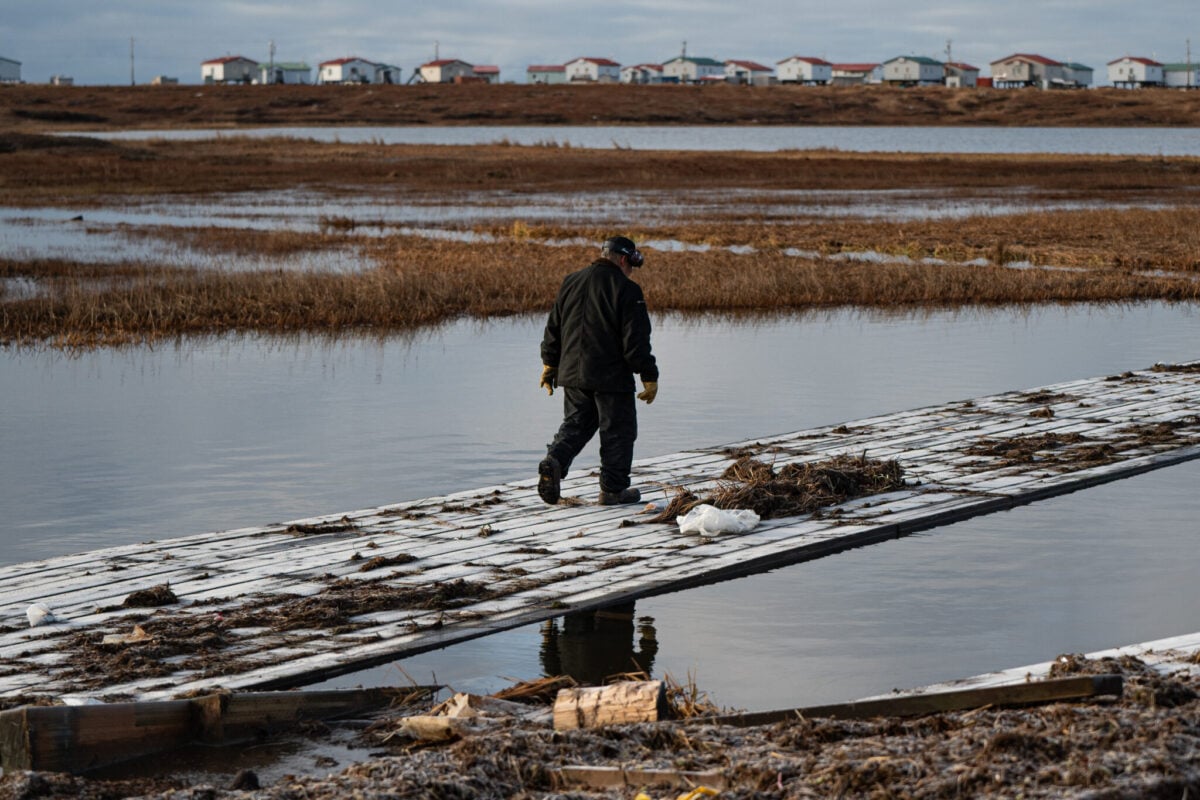
Eric Phillip, the boardwalk foreman for Kongiganak, Alaska, surveys infrastructure damage caused by Typhoon Halong, Oct. 18, 2025. The Alaska Organized Militia continues coordinated response operations in support of the State Emergency Operation Center following the 2025 West Coast Storm as the mission focus, pursuant to Governor Dunleavy’s declaration of disaster, shifts from lifesaving to life sustainment and stabilization of communities and survivors. (Alaska National Guard photo by Staff Sgt. Joseph Moon)


The Trump administration has denied Alaska’s request for full reimbursement for disaster relief efforts immediately following last October’s devastating Western Alaska storms, despite the Dunleavy administration’s claim that the federal disaster declaration meant the state would be fully reimbursed.

Gov. Mike Dunleavy arrives in Bethel after visiting the storm-damaged villages of Kipnuk and Kwigillingok. (Photo by Eric Stone/Alaska Public Media)
Gov. Mike Dunleavy arrives in Bethel after visiting the storm-damaged villages of Kipnuk and Kwigillingok on Oct. 17, 2025. (Photo by Eric Stone/Alaska Public Media)

That leaves the state on the hook for millions of dollars for disaster recovery, however the full amount is still unknown. 

The state’s request for federal support for 100% of disaster relief efforts in the first 90 days after the storms hit was denied on Dec. 20, according to a spokesperson for the Alaska Division of Homeland Security and Emergency Management on Thursday. 

The state appealed the denial on Jan. 15, and asked for a 90% federal cost reimbursement, but has not yet gotten a response from the Federal Emergency Management Agency. 

“We have not heard back from FEMA on approval or denial and there is no timeframe requirement,” said Jeremy Zidek, public information officer for the division, by email. 

A spokesperson for Dunleavy’s office did not respond to a list of questions, but confirmed the appeal on Friday. “An appeal has been filed and the administration will await the federal government’s decision,” said Jeff Turner, Dunleavy’s communications director. 

In the meantime, the federal government is reimbursing Alaska’s disaster recovery efforts at roughly 75%, leaving the state to cover 25% of its costs, with some exceptions for certain relief programs, Zidek said. 

Following the West Coast storm disaster in October, Dunleavy quickly declared a state disaster emergency. On Oct. 22, his office announced that the Trump administration approved the state’s request for a federal disaster declaration, and the state’s full costs would be covered immediately following the storms.

“President Trump was deeply concerned with the wellbeing of Alaskans who lost their homes and livelihoods to this historic storm,” Dunleavy said in a statement along with the announcement. “I want to thank him and his administration for approving the disaster declaration because now Alaskan families have local, state and federal support for rebuilding their lives in the months ahead.”

“The federal disaster declaration authorizes a 100 percent federal cost share for all categories of relief assistance for the next 90 days,” the statement said. 

Dunleavy’s office did not respond to questions about his previous statement or whether his office had communication from the Trump administration about why the request was denied. 

Alaska’s Republican U.S. congressional delegation applauded the federal disaster declaration and Trump’s support for the Western Alaska disaster response last year. All three members said through spokespeople Friday that they support the state’s appeal. 

U.S. Sen. Lisa Murkowski has been actively engaged with FEMA and state officials throughout the disaster relief efforts, said her communications director, Joe Plesha, in a statement on Friday. “Alaska’s vast geography and many rural communities make disaster response more challenging and recovery efforts significantly more costly,” he said. “She supports the state’s appeal and will work to secure the maximum amount of federal support available to Alaskans who have suffered so much from this devastating storm.”

A spokesperson for U.S. Sen. Dan Sullivan, Amanda Coyne, said the senator has advocated for the 100% federal cost share, as well as organized a delegation of FEMA and other Trump administration officials to visit Western Alaska. 

“Given the severity of the storm and its devastating impacts on communities in Western Alaska, Senator Sullivan believes an increased federal cost share is warranted,” Coyne said. “He will continue strongly advocating with FEMA and other senior officials in the Trump Administration for an increased federal cost share as the state’s appeal goes through the process.”

A spokesperson for Alaska’s lone U.S. Representative, Nick Begich III, said on Friday that he supports the appeal and will continue to advocate for those impacted by Typhoon Halong at the Congressional level. “Our office is in communication with the Administration to ensure recovery efforts in Western Alaska remain a priority,” spokesperson Silver Prout wrote.

Western Alaska storm recovery is ongoing

The Western Alaska storms and particularly ex-Typhoon Halong brought record-breaking winds and flooding — damaging thousands of structures, roads, boardwalks, airports and other critical infrastructure. It prompted the state’s largest mass evacuation of residents from their homes to other villages, Bethel and Anchorage.

Evacuees of Kipnuk and Kwigillingok wait to board an evacuation flight from Bethel to Anchorage on Oct. 15, 2025 (Photo by Corinne Smith/Alaska Beacon)

While some Western Alaska residents are continuing to rebuild through the winter, other residents who evacuated to Anchorage are living in temporary housing. As of Thursday, the Alaska Division of Homeland Security and Emergency Management reports that 471 residents are still sheltering in hotels in Anchorage. 

The state is administering public assistance programs, which reimburse costs of repairing public infrastructure and utilities, as well as provide individual disaster assistance, in partnership with other agencies, including FEMA.

FEMA has awarded $31.2 million in individual assistance to date, Zidek said. 

More than 2,000 residents have been awarded state individual assistance, and 1,794 households have registered for federal assistance from FEMA.

Those applications for state and federal assistance are still open until Feb. 20. 

State disaster relief funding under debate

The state’s disaster relief funding is a point of ongoing debate among lawmakers and the governor, as they kick off discussion of Dunleavy’s proposed $7.75 million budget and its $1.5 billion deficit. 

Last year, legislators approved $23.3 million in state disaster relief funds, but Dunleavy vetoed $10.3 million of that sum last summer, leaving $13 million in the budget. In November, following the federal government shutdown, Dunleavy announced a state disaster to help provide food aid, transferring $10 million to the state’s disaster relief funding from the Department of Environmental Conservation’s Village Safe Water and Wastewater Infrastructure program. 

This year, the governor has requested an additional $40 million in the state’s supplemental budget, which is a routine ask for additional money to pay the state’s bills for the previous year. 

Sen. Bert Stedman, R-Sitka, a co-chair of the Senate Finance Committee, didn’t mince words about the governor’s back and forth with disaster spending. “Ill-advised and foolish,” he said. “It makes no sense what he did to me, frankly, and it’s embarrassing for him, his veto.”

But Stedman said he hopes the state’s federal appeal is approved, and expects legislators to pass the governor’s request for the additional $40 million. “Obviously, 100% is better than 90 and 90 is better than 75,” Stedman said of the federal cost share. “So that’s pretty much a given there. But we will fund the disaster request as the governor puts it on the table, through next week’s amendments.”

Sen. Jesse Kiehl, D-Juneau, also a member of the Senate Finance Committee, commended the governor for his record on disaster response, and echoed hope for the appeal to move forward. “There’s no question in my mind that this is exactly what the federal disaster relief programs exist for. So I think the governor’s request was the right thing, and if it came back at less than full funding from the feds, that’s the wrong call,” Kiehl said.

Kiehl described the state’s fiscal picture, with rising costs and ongoing debates on how to raise more revenues, as “bleak.” “So there isn’t cash just sitting around for disaster assistance,” he said. “We have to step up for western Alaska financially. That’s going to stink, but we have to do it, as far as I’m concerned.”

A typical cost share between the federal government and a state for disaster relief efforts is a 75% federal and 25% state cost split. 

“We have dozens of federal declared disasters we are currently working on that have the 75/25 cost share structure,” said Zidek, with agency. “Large disasters are occasionally given a modified cost share structure adjustment, but it is not guaranteed. When we have a large disaster, we ask for modification to reduce the amount of state funding needed because as managers of state funds it is the responsible thing to do.”

Categories
Featured Juneau News Juneau Local Ketchikan Local News Feeds Sitka Local

An uncommon program helps children displaced by flooding that devastated Alaska villages

Rayann Martin, a 10-year-old displaced from the village of Kipnuk by ex-Typhoon Halong, left, talks with new classmate Lilly Loewen, 10, right, as they work in the Yup’ik language at College Gate Elementary, Thursday, Oct. 30, 2025, in Anchorage, Alaska. (AP Photo/Lindsey Wasson)

 AP- Rayann Martin sat in a classroom hundreds of miles from her devastated Alaska Native village and held up 10 fingers when the teacher asked the pupils how old they were.

“Ten — how do you say 10 in Yup’ik?” the teacher asked.

“Qula!” the students answered in unison.

Martin and her family were among hundreds of people airlifted to Anchorage, the state’s largest city, after the remnants of Typhoon Halong inundated their small coastal villages along the Bering Sea last month, dislodging dozens of homes and floating them away — many with people inside. The floods left nearly 700 homes destroyed or heavily damaged. One person died, two remain missing.

As the residents grapple with uprooted lives very different from the traditional ones they left, some of the children are finding a measure of familiarity in a school-based immersion program that focuses on their Yup’ik language and culture — one of two such programs in the state.

“I’m learning more Yup’ik,” said Martin, who added that she’s using the language to communicate with her mother, teachers and classmates. “I usually speak more Yup’ik in villages, but mostly more English in cities.”

There are more than 100 languages spoken in the homes of Anchorage School District students. Yup’ik, which is spoken by about 10,000 people in the state, is the fifth most common. The district adopted its first language immersion program — Japanese — in 1989, and subsequently added Spanish, Mandarin Chinese, German, French and Russian.

After many requests from parents, the district obtained a federal grant and added a K-12 Yup’ik immersion program about nine years ago. The students in the first class are now eighth-graders. The program is based at College Gate Elementary and Wendler Middle School.

A principal’s connection makes a difference

The principal at College Gate Elementary, Darrell Berntsen, is himself Alaska Native — Sugpiaq, from Kodiak Island, south of Anchorage. His mother was 12 years old in 1964 when the magnitude-9.2 Great Alaska Earthquake and an ensuing tsunami devastated her village of Old Harbor. He recalls her stories of joining other villagers at high ground and watching as the surge of water carried homes out to sea.

His mother and her family evacuated to a shelter in Anchorage, but returned to Kodiak Island when Old Harbor was rebuilt. Berntsen grew up living a subsistence life — “the greatest time of my life was being able to go out duck hunting, go out deer hunting,” he said — and he understands what the evacuees from Kipnuk, Kwigillingok and other damaged villages have left behind.

He has also long had an interest in preserving Alaska Native culture and languages. His ex-wife’s grandmother, Marie Smith Jones, was the last fluent speaker of Eyak, an indigenous language from south-central Alaska, when she died in 2008. His uncles had their hands slapped when they spoke their indigenous Alutiiq language at school.

As the evacuees arrived in Anchorage in the days after last month’s flooding, Berntsen greeted them at an arena where the Red Cross had set up a shelter. He invited families to enroll their children in the Yup’ik immersion program. Many of the parents showed him photos of the duck, goose, moose, seal or other traditional foods they had saved for the winter — stockpiles that washed away or spoiled in the flood.

“Listening is a big part of our culture — hearing their stories, letting them know that, ‘Hey, I live here in Anchorage, I’m running one of my schools, the Yup’ik immersion program, you guys are welcome at our school,’” Berntsen said. “Do everything we can to make them feel comfortable in the most uncomfortable situation that they’ve ever been through.”

Displaced students join Yup’ik immersion classes

Some 170 evacuated children have enrolled in the Anchorage School District — 71 of them in the Yup’ik immersion program. Once the smallest immersion program in the district, it’s now “booming,” said Brandon Locke, the district’s world language director.

At College Gate, pupils receive instruction in Yup’ik for half the day, including Yup’ik literacy and language as well as science and social studies. The other half is in English, which includes language arts and math classes.

Among the program’s new students is Ellyne Aliralria, a 10-year-old from Kipnuk. During the surge of floodwater the weekend of Oct. 11, she and her family were in a home that floated upriver. The high water also washed away her sister’s grave, she said.

Aliralria likes the immersion program and learning more phrases, even though the Yup’ik dialect being spoken is a bit different from the one she knows.

“I like to do all of them, but some of them are hard,” the fifth-grader said.

Also difficult is adjusting to living in a motel room in a city nearly 500 miles (800 km) from their village on the southwest coast.

“We’re homesick,” she said.

Lilly Loewen, 10, is one of many non-Yup’iks in the program. She said her parents wanted her to participate because “they thought it was really cool.”

“It is just really amazing to get to talk to people in another language other than just what I speak mostly at home,” Loewen said.

Bridging the gap between generations

Berntsen is planning to help the new students acclimate by holding activities such as gym nights or Olympic-style events, featuring activities that mimic Alaska Native hunting and fishing techniques. One example: the seal hop, in which participants assume a plank position and shuffle across the floor to emulate how hunters sneak up on seals napping on the ice.

The Yup’ik immersion program is helping undo some of the damage Western culture did to Alaska Native language and traditions, he said. It’s also bridging the gap of two lost generations: In some cases, the children’s parents or grandparents never learned Yup’ik, but the students can now speak with their great-grandparents, Locke said.

“I took this as a great opportunity for us to give back some of what the trauma had taken from our Indigenous people,” Berntsen said.

Categories
Featured Juneau News Juneau Local Ketchikan Local News Feeds Sitka Local

A man took videos as his home floated away with him inside in Alaska’s storms

AP- The remnant storms of Typhoon Halong tore into western Alaska with such ferocity that they pulled Steven Anaver’s home from its foundation and buoyed it across choppy water — with him inside.

Videos he shared Monday with The Associated Press convey the desperate scene as the waters rose inside his home and the flooding raged outside.

The storms’ blistering winds and record-high water levels laid waste to several small communities Oct. 12, displacing more than 2,000 people and requiring one of the most significant airlift operations in Alaska history.

At least one person is dead, and two others are missing.

The water started rising quickly Saturday night in Anaver’s village of Kwigillingok. It’s one of two Yup’ik communities that were hit hardest.

Anaver looked out through his window into pitch-black darkness. The power had long since been out.

The storm was the worst he’d seen. At around 3:00 a.m. on Sunday, the water level jumped, rising to his knees in about 10 minutes.

Shortly after, the home teetered, tilted and started floating.

Plastic bags, boxes of blankets, a leather boot and furniture cushions floated in videos Anaver took from inside. The walls swayed like a ship’s.

Outside, the dark waters lapped the house just a few feet from the window as the home drifted away. Anaver heard loud booms, and frigid wind rushed through a hole that opened in one wall.

“This was a big challenge for my anxiety,” he said. “I kept calling my family.”

More booms shook the home as the waves crashed it into other structures.

“Oh God,” he wrote in a Facebook post around 5:30 a.m.

Anaver tried to take pictures to orient where he was — the camera could see better than his eyes in the darkness — but it was futile until the moon came out later that morning.

He could see a house he recognized. He’d floated for roughly a mile.

A small hill with a board sticking out of it had stopped Anaver’s home just feet from the river, which had dragged other houses much farther away.

After 7 a.m., when the water had receded enough, two neighbors in waders came over and helped him out.

Three days later, Anaver posted a video on Facebook of the hours drifting in his own home.

“I was inches away from death,” he wrote. “I escaped.”

Categories
Featured Juneau News Juneau Local Ketchikan Local News Feeds Sitka Local

Coastal storm damage so bad many evacuees won’t go home for at least 18 months, governor says

In this photo provided by the Alaska Army National, Guard Sgt. Mary Miller, a helicopter crew chief, passes a bottle of water to a child while evacuating displaced people from Kwigillingok, Alaska, during recovery operations on Thursday, Oct. 16, 2025. (Joseph Moon/Alaska National Guard via AP)

AP-Damage to remote Alaska villages hammered by flooding last weekend is so extreme that many of the more than 2,000 people displaced won’t be able to return to their homes for at least 18 months, Gov. Mike Dunleavy said in a request to the White House for a major disaster declaration.

In one of the hardest hit villages, Kipnuk, an initial assessment showed that 121 homes — or 90% of the total — have been destroyed, Dunleavy wrote. In Kwigillingok, where three dozen homes floated away, slightly more than one-third of the residences are uninhabitable.

The remnants of Typhoon Halong struck the area with the ferocity of a Category 2 hurricane, Dunleavy said, sending a surge of high surf into the low-lying region. One person was killed, two remain missing, and rescue crews plucked dozens of people from their homes as they floated away.

Officials have been scrambling to airlift people from the inundated Alaska Native villages. More than 2,000 people across the region have taken shelter — in schools in their villages, in larger communities in southwest Alaska or have been evacuated by military planes to Anchorage, the state’s largest city.

Anchorage leaders said Friday they expect as many as 1,600 evacuees to arrive. So far about 575 have been airlifted to the city by the Alaska National Guard, and have been staying at a sports arena or a convention center. Additional flights were expected Friday and Saturday.

Officials are working on figuring out how to move people out of shelters and into short-term accommodations, such as hotels, and then longer-term housing.

“Due to the time, space, distance, geography, and weather in the affected areas, it is likely that many survivors will be unable to return to their communities this winter,” Dunleavy said. “Agencies are prioritizing rapid repairs … but it is likely that some damaged communities will not be viable to support winter occupancy, in America’s harshest climate in the U.S. Arctic.”

The federal government already has been assisting with search and rescue, damage assessments, environmental response and evacuation support. A major disaster declaration by President Donald Trump could provide federal assistance programs for individuals and public infrastructure, including money for emergency and permanent work.

The three members of Alaska’s congressional delegation on Friday sent a letter to Trump, urging swift approval.

The storm surge pummeled a sparsely populated region off the state’s main road system where communities are reachable only by air or water this time of year. The villages typically have just a few hundred residents, who hunt and fish for much of their food, and relocating to the state’s major cities will bring a vastly different lifestyle.

Alexie Stone, of Kipnuk, arrived in Anchorage in a military jet with his brothers, children and mom, after his home was struck by the flooding. They’ve been staying at the Alaska Airlines Center at the University of Alaska, where the Red Cross provided evacuees with cots, blankets and hygiene supplies.

At least for the foreseeable future, he thinks he might try to find a job at a grocery store; he used to work in one in Bethel.

“It’s going to be, try to look for a place and find a job,” Stone said Friday. “We’re starting a new life here in Anchorage.”

Anchorage officials and business leaders said Friday they were eager to help the evacuees.

“Our neighbors in western Alaska have experienced tremendous loss, devastation and grief,” Mayor Suzanne LaFrance said at a meeting of the Anchorage Assembly. “We will do everything we can here in Anchorage to welcome our neighbors and help them through these difficult times.”

State Rep. Nellie Unangiq Jimmie, of Toksook Bay, on an island northwest of Kipnuk, described for the assembly how she rode out the storm’s 100 mph (161 kmh) winds with her daughter and niece.

“We had no choice but to sit in our home and wait to see if our house is going to come off the foundation or if debris is going to bust open our windows,” she said.

It didn’t, but others weren’t as fortunate. She thanked Anchorage for welcoming the evacuees.

“You are showing my people, my relatives, my constituents, even if they are far from home, this is still Alaska land and they’re amongst families,” Jimmie said.

Categories
Featured Juneau News Juneau Local Ketchikan Local News Feeds Sitka Local

The other Alaska airlift: Volunteers save dogs from a flooded Alaska village, 1 tiny plane at a time

 AP- The special delivery arrived in a plastic storage box after a chartered flight in bouncy single-propeller plane. Veterinarian Susan Shaffer Sookram snipped the zip ties securing the lid and greeted the cargo: four dogs, one with a gray collar bearing its name, Happy.

“What a scary ride!” she said. “You made it!”

As officials in Alaska work around the clock on one of the most significant airlift operations in state history — evacuating more than 1,000 people from remote, flood-battered villages on the coast of the Bering Sea — another rescue operation is playing out: getting the dogs left behind to safety, in hopes of later reuniting them with their owners.

The pet shelters closest to the devastated villages are in Bethel, a regional hub around 90 miles (150 kilometers) away by boat or plane.

When Bethel Friends of Canines, a nonprofit that helps rehome animals, learned that 50 to 100 dogs might be abandoned in one of the villages, Kipnuk, it scrambled to charter a plane to evacuate them.

“It costs us $3,000 to do this so and we don’t know how many times we’re gonna have to do it,” organizer Jesslyn Elliott said by phone Wednesday. “We’ve never had a natural disaster to this, like, magnitude. So this is all very, very foreign and new to us. So we’re just kind of winging it.”

The first flight arrived in Bethel on Wednesday night, and more happened Thursday. Dozens of dogs have passed through her kennel since the floods began. The nonprofit had raised more than $22,000 after pleading on Facebook for donations.

The flooding, caused by remnants of Typhoon Halong, has damaged homes in 11 small rural communities, with no more than a few hundred residents, according to FEMA. Many homes cannot be repaired until next summer as winter temperatures and snow are forecast for this month.

State officials began airlifting people to Anchorage on Wednesday, as local leaders in Kipnuk and Kwigillingok, near the Bering Sea, asked to evacuate residents and as shelters in Bethel neared capacity. At least one resident of Kwigillingok was confirmed dead, and the search for two others was called off after their how was swept away.

Pets were not allowed on the military evacuation flights. State officials have said that the evacuation of people is the priority.

Bethel Friends of Canines received dogs throughout the week as people fleeing their homes arrived by boat and by plane. There are no roads connecting towns in the area.

Many of the pets owners want them back soon, but need time to prepare temporary lodgings in cities like Anchorage and Nome, which are more than 250 miles (400 kilometers) away.

Before the devastating floods, Bethel Friends of Canines typically held 15 to 20 dogs at any one time. Now as many as 15 dogs have arrived on a single flight. Elliott expects most of the additional dogs to stay in Bethel temporarily before being reunited with their owners or extended family that can foster them.

At least eight dogs had been reunited with owners in Anchorage as of Thursday morning, she said.

Homes in affected villages are so damaged that they many not be livable in the winter, emergency management officials said Wednesday, and forecasters said rain and snow could arrive this weekend.

With the human population in Kipnuk shrinking each day, the animal caretakers in Bethel realized they had to act fast, before everyone who knew the dogs was gone.

“There’s going to be nobody left there,” said Sookram, the veterinarian, in a phone interview. “We’re having to kind of accelerate how the animals are going to be leaving places only accessible by, at first, helicopter and now small planes,”

Some of the last people to stay behind and serve the community are teachers. Schools in flooded towns have served as emergency shelters and meeting places through the relief effort.

Back in Kipnuk, the dog with the gray collar, Happy, was found waiting on its owner’s clothes, refusing to move or eat, by teacher Jacqui Lang. She said in a text message that the dog has since been reunited with its family.

She’s one of two or three teachers who helped wrangle the pets to be loaded at the airstrip, according to Lower Kuskokwim School District Superintendent Andrew ‘Hannibal’ Anderson.

When Bethel Friends of Canines worker Matthew Morgan landed in Kipnuk on Wednesday, the teachers had fed the dogs, coaxed them into crates and labeled them with tags listing their owners.

“You’ve got some heroes out in Kipnuk. They’re like the last people left there,” Morgan said. Without them, “it would have been chasing dogs all night in the mud.”

Categories
Featured Juneau News Juneau Local Ketchikan Local News Feeds Sitka Local

Alaska airlifting hundreds from storm-devastated coastal villages

In this photo provided by the Defense Visual Information Distribution Service, Alaska Air National Guard rescue personnel conduct a search and rescue mission in Kipnuk, Alaska, on Monday, Oct. 13, 2025. (Defense Visual Information Distribution Service via AP)

AP- One of the most significant airlifts in Alaska history was underway Wednesday to move hundreds of people from coastal villages ravaged by high surf and strong winds from the remnants of Typhoon Halong last weekend, officials said.

The storm brought record water levels to two low-lying communities and washed away homes — some with people inside. At least one person was killed and two are missing. Makeshift shelters were quickly established and swelled to about 1,500 people, an extraordinary number in a sparsely populated region where communities are reachable by air or water.

The remoteness and the scale of the destruction created challenges for getting resources in place. Damage assessments have been trickling in as responders have shifted from initial search-and-rescue operations to trying to stabilize or restore basic services.

The communities of Kipnuk and Kwigillingok near the Bering Sea saw water levels more than 6 feet (1.8 meters) above the highest normal tide line. Leaders asked the state to evacuate the more than 1,000 residents in those villages, said Jeremy Zidek, a spokesperson with the state emergency management office.

Some homes cannot be reoccupied, even with emergency repairs, and others may not be livable by winter, said emergency management officials. Forecasters say rain and snow is possible in the region this weekend, with average temperatures soon below freezing.

Mark Roberts, the incident commander with the state emergency management agency, said the immediate focus was on “making sure people are safe, warm and cared for while we work with our partners to restore essential services.”

Meantime, restrooms were again working at the school in Kwigillingok, where about 350 people had sheltered overnight Tuesday, according to a state emergency management statement. “Damage to many homes is severe, and the community leadership is instructing residents not to reenter homes due to safety concerns,” it said.

About 300 evacuees were being brought to Anchorage on Wednesday, about 500 miles (805 kilometers) east of the battered coastline villages, according to the state Department of Military and Veterans Affairs. They were going to the Alaska Airlines Center, a sports and events complex with capacity for about 400, Zidek said.

Shelter space closer to home — in the southwest Alaska regional hub of Bethel — had been reaching capacity, officials said.

Zidek did not know how long the evacuation process would take and said authorities were looking for additional sheltering locations. The aim is to get people from congregate shelters into hotel rooms or dormitories, he said.

The crisis unfolding in southwest Alaska has drawn attention to Trump administration cuts to grants aimed at helping small, mostly Indigenous villages prepare for storms or mitigate disaster risks.

For example, a $20 million U.S. Environmental Protection Agency grant to Kipnuk, which was inundated by floodwaters, was terminated by the Trump administration, a move challenged by environmental groups. The grant was intended to protect to protect the boardwalk residents use to get around the community as well as 1,400 feet (430 meters) of river from erosion, according to a federal website that tracks government spending.

There was limited work on the project before the grant was ended. The village had purchased a bulldozer for shipment and briefly hired a bookkeeper, according to Public Rights Project, which represents Kipnuk.

The group said no single project was likely to prevent the recent flood. But work to remove abandoned fuel tanks and other material to prevent it from falling into the river might have been feasible during the 2025 construction season.

“What’s happening in Kipnuk shows the real cost of pulling back support that was already promised to front line communities,” said Jill Habig, CEO of Public Rights Project. “These grants were designed to help local governments prepare for and adapt to the growing effects of climate change. When that commitment is broken, it puts people’s safety, homes and futures at risk.”

Categories
Featured Juneau News Juneau Local Ketchikan Local News Feeds Sitka Local

In photos: Mass evacuation of Kipnuk and Kwigillingok residents begins from western Alaska

By: Corinne Smith, Alaska Beacon

Residents of Kipnuk and Kwigillingok wait in the Alaska Army National Guard Readiness Center’s hanger in Bethel for an evacuation flight to Anchorage on Oct 15, 2025 (Photo by Corinne Smith/Alaska Beacon)

Residents of Kipnuk and Kwigillingok began evacuating en masse on Wednesday, flying in military aircraft from their western Alaska communities which were devastated by ex-Typhoon Halong.

On Wednesday evening, the first 300 evacuees embarked on a C-17 military transport plane from Bethel to make the one-hour journey to Anchorage and emergency shelter there.

“Just devastated, feeling heartbroken, displaced,” said Jody Agimuk of Kipnuk, standing with his wife Kristin, and their five young children, waiting in line to board in the Alaska Army National Guard hangar.

Jody and Kristin Agimuk and their five young children evacuated from the community of Kipnuk after ex-Typhoon Halong. They landed in Bethel on Wednesday and were on the first large evacuation flight to Anchorage on Oct. 15, 2025 (Photo by Corinne Smith/Alaska Beacon)

“I hope we find a place,” he said of arriving in Anchorage. “It’s hard to explain, I hope we won’t have a hard time finding a place.”

He said since the storm hit Sunday, they sheltered at their grandmother’s and one night at the local school, and evacuated on Wednesday. “It’s just hard — leaving families at home, separating with families that we were close to. People we’ve seen, people we knew, people we used to talk to, all the close relatives, it’s heartbreaking seeing people separating.” 

The rest of the village of Kipnuk is scheduled to be evacuated on Thursday, and Kwigillingok by Friday, said Lieutenant Colonel Brendan Holbrook, commander of the 207th Aviation Troop Command with the Alaska Army National Guard. 

He said roughly 500 people had been evacuated to Bethel so far out of those two villages by members of the Alaska Army National Guard and Alaska Air National Guard. The C-17 plane can only transport 300 people, so the rest would shelter in Bethel overnight and more flights would be available out to Anchorage on Thursday morning. 

“I have five aircraft, four UH-60s and CH-47 in support operations, doing evac. And we’ve been running basically 12 to 14-hour operations every day getting these people to safety,” he said.

Evacuees depart on the first C-17 military flight from Bethel to Anchorage on Oct. 15, 2025 (Photo by Corinne Smith/Alaska Beacon)

In the Alaska Army National Guard Readiness Center in Bethel, evacuees waited, some resting on cots, as officers read lists of names and groups of 30 people at a time boarded the plane. 

Holbrook said evacuation was self-organized by community members, with families with children and elders prioritized. 

“So it was primarily Kipnuk today, if the call comes back, we can do Kwig (Kwigillingok) tomorrow,” he said “But prioritization was just who was available and ready to go. So we would go to both and whoever got on got on. Kipnuk just happened to be, they had already established a marshaling plan, so as soon as we landed, they were ready with people to just start loading.”

Those who did not get on the Wednesday evening flight were sheltering in Bethel, some in an emergency shelter across the road from the Readiness Center hanger, administered by the Yukon-Kuskokwim Health Corporation with the support from the American Red Cross. Cots, showers and meals were provided there.

Holbrook added that there is a misconception that evacuees must go to Anchorage. He said once in Bethel, regional tribal organizations like the Yukon-Kuskokwim Health Corporation are providing support for people to travel wherever they like. “If you have a place to go, another village, family, somewhere else, Y-K will help you get to where you need to go,” he said. 

Evacuees board from Kipnuk and Kwigillingok board a C17 military transport plane in Bethel on Oct. 15, 2025 (Photo by Corinne Smith/Alaska Beacon)

Evacuees board from Kipnuk and Kwigillingok board a C17 military transport plane in Bethel on Oct. 15, 2025 (Photo by Corinne Smith/Alaska Beacon)

Members of the Alaska Army National Guard and Alaska Air National Guard are assisting with the evacuation of residents, seen in Bethel on Oct. 15, 2025 (Photo by Corinne Smith/Alaska Beacon)

Members of the Alaska Army National Guard and Alaska Air National Guard are assisting with the evacuation of residents, seen in Bethel on Oct. 15, 2025 (Photo by Corinne Smith/Alaska Beacon)

Members of the Members of the Alaska Army National Guard read a list of names of evacuees to board the first flight from Bethel to Anchorage on Oct. 15, 2025 (Photo by Corinne Smith/Alaska Beacon)

Members of the Members of the Alaska Army National Guard read a list of names of evacuees to board the first flight from Bethel to Anchorage on Oct. 15, 2025 (Photo by Corinne Smith/Alaska Beacon)

Jody and Kristin Agimuk and their five young children evacuated from the community of Kipnuk after ex-Typhoon Halong. They landed in Bethel on Wednesday and were on the first large evacuation flight to Anchorage on Oct. 15, 2025 (Photo by Corinne Smith/Alaska Beacon)

Jody and Kristin Agimuk and their five young children evacuated from the community of Kipnuk after ex-Typhoon Halong. They landed in Bethel on Wednesday and were on the first large evacuation flight to Anchorage on Oct. 15, 2025 (Photo by Corinne Smith/Alaska Beacon)

Cots set up at the shelter at the Alaska Army National Guard Readiness Center in Bethel for evacuees of ex-Typhoon Halong provided by the American Red Cross on Oct. 15, 2025 (Photo by Corinne Smith/Alaska Beacon)

Cots set up at the shelter at the Alaska Army National Guard Readiness Center in Bethel for evacuees of ex-Typhoon Halong provided by the American Red Cross on Oct. 15, 2025 (Photo by Corinne Smith/Alaska Beacon)

Evacuees from Kipnuk and Kwigillingok rest and eat dinner on Oct. 15, 2025 at an emergency shelter at the Alaska National Guard Readiness Center in Bethel (Photo by Corinne Smith/Alaska Beacon)

Evacuees from Kipnuk and Kwigillingok rest and eat dinner on Oct. 15, 2025 at an emergency shelter at the Alaska National Guard Readiness Center in Bethel (Photo by Corinne Smith/Alaska Beacon)

Evacuees wait in line to board the first evacuation flight from Bethel to Anchorage at the Alaska Army National Guard Readiness Center in Bethel, on Oct. 15, 2025 (Photo by Corinne Smith/Alaska Beacon)

Evacuees wait in line to board the first evacuation flight from Bethel to Anchorage at the Alaska Army National Guard Readiness Center in Bethel, on Oct. 15, 2025 (Photo by Corinne Smith/Alaska Beacon)

Evacuees seen stepping out on to the runway in Bethel to board the first evacuation flight to Anchorage on Oct. 15, 2025 (Photo by Corinne Smith/Alaska Beacon)

A family is seen stepping out on to the runway in Bethel to board the first evacuation flight to Anchorage on Oct. 15, 2025 (Photo by Corinne Smith/Alaska Beacon)

Evacuees from Kipnuk and Kwigillingok were allowed to bring one bag of personal items to evacuate after ex-Typhoon Halong, seen stacked in the Alaska Army National Guard Readiness Center in Bethel, awaiting transport to Anchorage on Oct. 15, 2025 (Photo by Corinne Smith/Alaska Beacon)

Evacuees from Kipnuk and Kwigillingok were allowed to bring one bag of personal items to evacuate after ex-Typhoon Halong, seen stacked in the Alaska Army National Guard Readiness Center in Bethel, awaiting transport to Anchorage on Oct. 15, 2025 (Photo by Corinne Smith/Alaska Beacon)

Evacuees wait for their name to be called by members of the Alaska National Guard, for a flight from Bethel to Anchorage on Oct. 15, 2025 (Photo by Corinne Smith/Alaska Beacon)

Evacuees wait for their name to be called by members of the Alaska National Guard, for a flight from Bethel to Anchorage on Oct. 15, 2025 (Photo by Corinne Smith/Alaska Beacon)

A Blackhawk helicopter used to evacuate residents from storm devastated communities of Kipnuk and Kwigillingok fuels up in Bethel on Oct. 15, 2025 (Photo by Corinne Smith/Alaska Beacon)

A Blackhawk helicopter used to evacuate residents from storm devastated communities of Kipnuk and Kwigillingok fuels up in Bethel on Oct. 15, 2025 (Photo by Corinne Smith/Alaska Beacon)

Alaska Army National Guard Readiness Center in Bethel hosted an evacuation shelter for ex-Typhoon Halong storm evacuees on Oct. 15, 2025 (Photo by Corinne Smith/Alaska Beacon)

Alaska Army National Guard Readiness Center in Bethel hosted an evacuation shelter for ex-Typhoon Halong storm evacuees on Oct. 15, 2025 (Photo by Corinne Smith/Alaska Beacon)

Residents who evacuated from Kipnuk and Kwigillingok wait to board an evacuation flight in Bethel on Oct. 15, 2025 (Photo by Corinne Smith/Alaska Beacon)

Residents who evacuated from Kipnuk and Kwigillingok wait to board an evacuation flight in Bethel on Oct. 15, 2025 (Photo by Corinne Smith/Alaska Beacon)

Categories
Featured Juneau News Juneau Local Ketchikan Local News Feeds Sitka Local

One dead, dozens rescued and roughly 1,000 displaced in western Alaska communities hit by ex-typhoon

By: Corinne Smith, Alaska Beacon

U.S. Coast Guard MH-60 Jayhawk helicopter aircrews conduct overflights of Kipnuk, Alaska, after coastal flooding impacted several western Alaska communities, Oct. 12, 2025. (U.S. Coast Guard photo courtesy of Air Station Kodiak)

Search and rescue efforts continued into Monday in the Kuskokwim River delta in the aftermath of devastating storm surge and hurricane-force winds brought by the remnants of Typhoon Halong. The storm tore homes from their foundations and sent them floating away. 

One woman was found dead in Kwigillingok on Monday, according to Alaska State Troopers.

U.S. Coast Guard MH-60 Jayhawk helicopter aircrews conduct overflights of Kipnuk, Alaska, after coastal flooding impacted several western Alaska communities, Oct. 12, 2025. (U.S. Coast Guard photo courtesy of Air Station Kodiak)

The search for two more people unaccounted for in that community will continue, by boat and air, the state troopers said on a Facebook post. Search and rescue is being conducted by the U.S. Coast Guard, Alaska Army National Guard and Alaska Air National Guard, as well as state troopers. 

The storm damaged boats, roads, airports, and power and sewer infrastructure over a vast region, and damage assessments were not immediately available as emergency rescue efforts entered a second day. 

“We’re moving quickly. We’re moving as fast as we can,” said Gov. Mike Dunleavy at a news conference in Anchorage on Monday with state officials and the congressional delegation. 

Fifty-one people and two dogs were rescued in Kwigillingok and Kipnuk on Sunday, Troopers said, located on the Bering Sea coast. Those predominantly Alaska Native coastal communities saw the most severe impacts of the storm, with a storm surge of up to 6.6 feet above normal and high winds that inundated communities.

“Preservation of life is our top priority,” said Capt. Christopher Culpepper, commander of U.S. Coast Guard Sector Western Alaska and U.S. Arctic. 

“Several of these villages have been completely devastated,” Culpepper said. “Absolutely flooded, several feet deep, and so this took homes off of foundations. This put people in peril, where folks were swimming, floating, trying to find debris to hold on to in the cover of darkness, at nighttime.”

U.S. Coast Guard Sector Western Alaska and U.S. Arctic Commanding Officer Captain Christopher Culpepper speaks at an Oct. 13, 2025, news conference about rescue work and the response to Typhoon Halong damages in Western Alaska. Behind him and also participating in the news conference held in Gov. Mike Dunleavy's Anchorage office, is David Kramer, a meterologist with the National Weather Service. (Photo by Yereth Rosen/Alaska Beacon)
U.S. Coast Guard Sector Western Alaska and U.S. Arctic Commanding Officer Captain Christopher Culpepper speaks at an Oct. 13, 2025, news conference about rescue work and the response to Typhoon Halong damages in Western Alaska. Behind him and also participating in the news conference held in Gov. Mike Dunleavy’s Anchorage office, is David Kramer, a meterologist with the National Weather Service. (Photo by Yereth Rosen/Alaska Beacon)

“And so as the sun broke on the first day, devastation became more and more apparent,” Culpepper said, referring to Sunday as the storm lifted. “Coast Guard helicopter crews, along with Army National Guard and Air National crews, particularly two pairs of rescue jumpers that also assisted … picked people up off their homes,” he said, and were taken to higher ground. Several people were medically evacuated to Bethel.

Some people trapped in floating homes early Sunday used their cellphones to call for help. Some of those calls reached the State Emergency Operations Center, said incident commander Mark Roberts. 

“The folks that were in houses that were floating and didn’t know where they were, was one of the most tragic things our folks in the state EOC have ever faced,” Roberts said. “And some of them called into the state EOC, and we just stayed on the phone with them to talk.” 

Members of the Alaska National Guard and Alaska State Defense Forces living in western Alaska, up to 80 personnel, have been activated, said Maj. Gen. Torrence Saxe, commissioner of the Alaska Department of Military and Veterans Affairs, which oversees the Alaska National Guard.

“This may end up being the largest off-the-road-system response for the National Guard in about 45 years,” Saxe said. 

Over 50 airports were impacted by the storm but largely cleared as of Monday to allow planes to land with emergency supplies and personnel. The coastal communities throughout the region are only accessible by small plane or boat. “There also have been numerous reports to us of roadway damage, boardwalk damage – boardwalks are the roads in this region – and then also the various power outages and lighting problems throughout the region,” said Ryan Anderson, commissioner of the Alaska Department of Transportation. 

More than 1,000 people were displaced from their homes across the region, according to estimates from the Yukon-Kuskokwim Health Corporation, the region’s largest healthcare provider. 

Roughly 400 people are sheltering in the local school in Kwigillingok, and 680 people in Kipnuk are at the school there, they said. Thirty seven homes in Kwigillingok were destroyed. 

Emergency supplies, including water, food, hygiene products, baby formula and bedding are being flown into coastal communities, according to a statement on Monday by YKHC.  “The need is great,” they said. The response effort is coordinated between YKHC, Alaska Native Tribal Health Consortium (ANTHC), the Association of Village Council Presidents and the state of Alaska, to assess and respond to community needs. 

Medical providers and prescription medications were being sent to Kwigillingok, Kipnuk, Tuntutuliak and Chefornak, they said, and plans were underway to evacuate about 40 people, including elders and pregnant women, to Bethel. 

Alaska State Sen. Lyman Hoffman, D-Bethel, said over 1,000 emergency meals had been delivered already to coastal villages, but those supplies would run out.

State Sen. Lyman Hoffman, D-Bethel, speaks at an Oct. 13, 2015, news conference about the impacts of Typhoon Halong's to Western Alaska. Behind him and also speaking at the news conference, which was held at Gov. Mike Dunleavy's Anchorage office, are National Weather Service meteorologist David Kreamer, U.S. Coast Guard Sector Western Alaska and U.S. Arctic Commanding Officer Captain Christopher Culpepper and Ryan Anderson, commissioner of the Alaska Department of Transportation and Public Facilities. (Photo by Yereth Rosen/Alaska Beacon)
State Sen. Lyman Hoffman, D-Bethel, speaks at an Oct. 13, 2015, news conference about the impacts of Typhoon Halong’s to Western Alaska. Behind him and also speaking at the news conference, which was held at Gov. Mike Dunleavy’s Anchorage office, are National Weather Service meteorologist David Kreamer, U.S. Coast Guard Sector Western Alaska and U.S. Arctic Commanding Officer Captain Christopher Culpepper and Ryan Anderson, commissioner of the Alaska Department of Transportation and Public Facilities. (Photo by Yereth Rosen/Alaska Beacon)

“They need additional food supplies, and it’s difficult to get people out there,” he said.

He said Kipnuk’s runway was still damaged, and planes could not land there. Power is still out there as well. “There has to be a short-term assessment done of those homes that are out there, whether they are livable or not livable … and needs to be made as quickly as possible,” Hoffman said. “Winter is coming.”

The state of Alaska has activated a multi-agency emergency response, and with the governor’s extended disaster relief declaration, residents and communities are eligible for recovery assistance, including temporary housing assistance. 

“We’ve had a few injuries; we’re moving into a higher-level care as needed, and then we’re moving right on in to support sheltering, and then right on into the next to support the ability for people to live in a safe, warm place through the winter,” Roberts said.

The Alaska Community Foundation has set up a fundraising effort, the Western Alaska Disaster 2025 Relief Fund, for affected communities.

U.S. Sen. Dan Sullivan, R-Alaska, said he was communicating with officials with the Federal Emergency Management Agency, who would provide assistance. 

“FEMA right now is in direct contact with our state and local officials and has an incident management team on the ground and a FEMA search and rescue group pre-positioned on standby,” Sullivan said. “As we move into the recovery phase – and we’re not there yet – the federal agencies need to act very quickly. We’re going to be seeing freeze-up and very cold weather, probably quite soon. So they have committed to being very ready to move into that phase of operations once we get there.” 

Sen. Lisa Murkowski, R-Alaska, underscored the trauma residents are experiencing from this disaster. “When the waters subside, when the analysis is complete — we have many, many families (and) we have communities that are in trauma, that will be in shock over the loss and so, making sure that we have trauma specialists, if you will, that are culturally in tune with the region and with the people there is something that I think we all need to be challenged to think about,” she said. 

While the Trump administration has recently cut or frozen significant amounts of federal funding for rural Alaska, like for infrastructure and climate resilience initiatives, Murkowski said she will continue to push officials for federal support. 

“I think this disaster that we are seeing is yet one more reason why the delegation needs to lean in and make sure that the administration fully understands the value of what it means to to have a level of preparedness, to have a level of resilience in an area that is so exposed on our western flank,” she said. 

This week’s disaster came as the remnants of Typhoon Halong battered the region Saturday night into Sunday, sweeping north across the western Alaska coast. The National Weather Service reported hurricane-force winds up to 107 mph in the Kusilvak Census Area, 100 mph in Toksook Bay and 98 mph in the island of St. George in the Bering Sea.

The storm has now weakened over Canada and is moving east, said meteorologist David Kramer, but flood warnings are still in effect for the Kuskokwim Delta and western and northwest Arctic coasts through Tuesday.

Another storm is forecasted for the Kuskokwim River delta region early on Wednesday morning, with winds gusting up to 40 mph from the southeast, and water levels from one to three feet. 

“From the records that we set recently, over six feet, this is significantly less impact,” Kramer said. “The main concerns are high water levels, rough surf and the potential for some coastal erosion.”