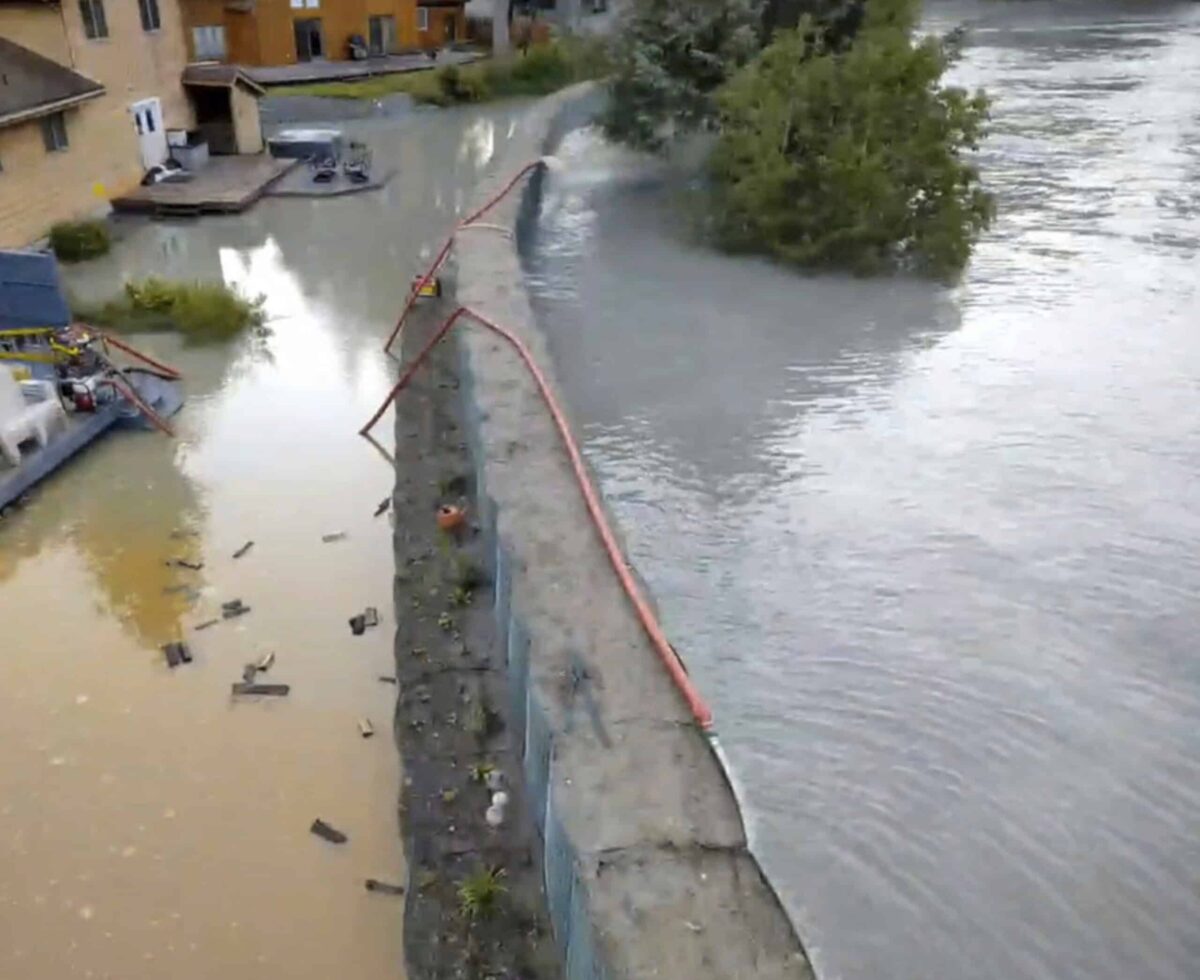
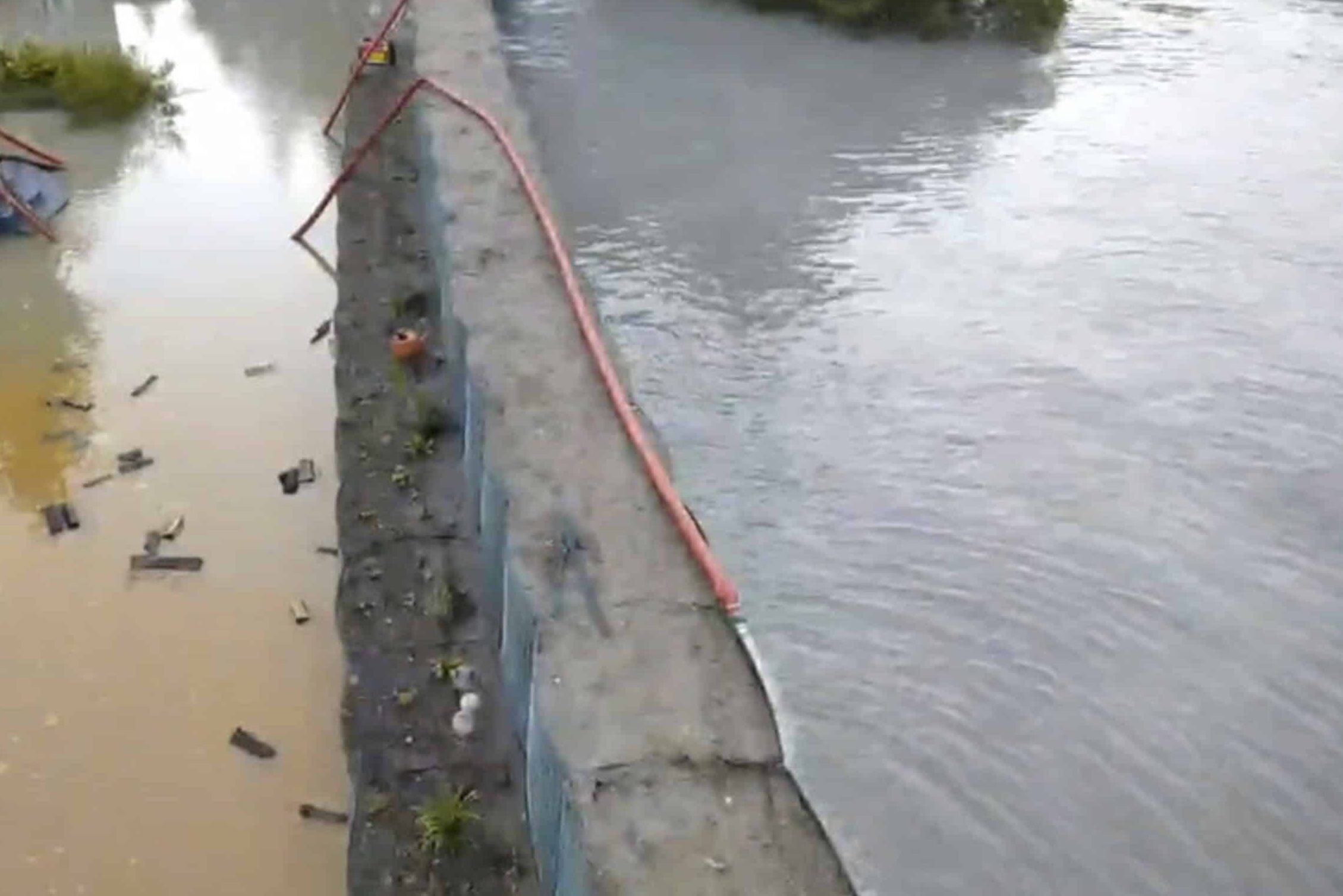
NOTN- A secondary release of Suicide Basin is occurring.
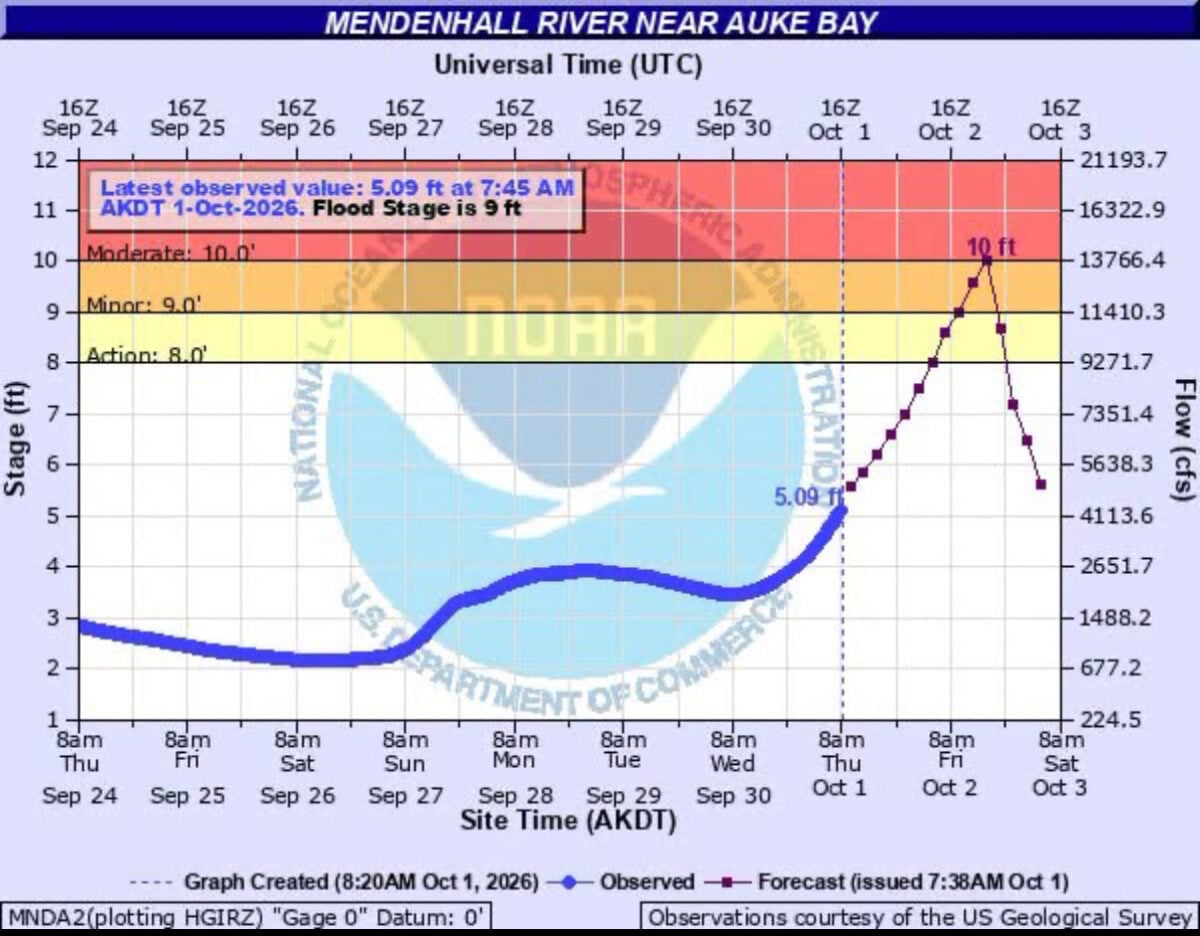
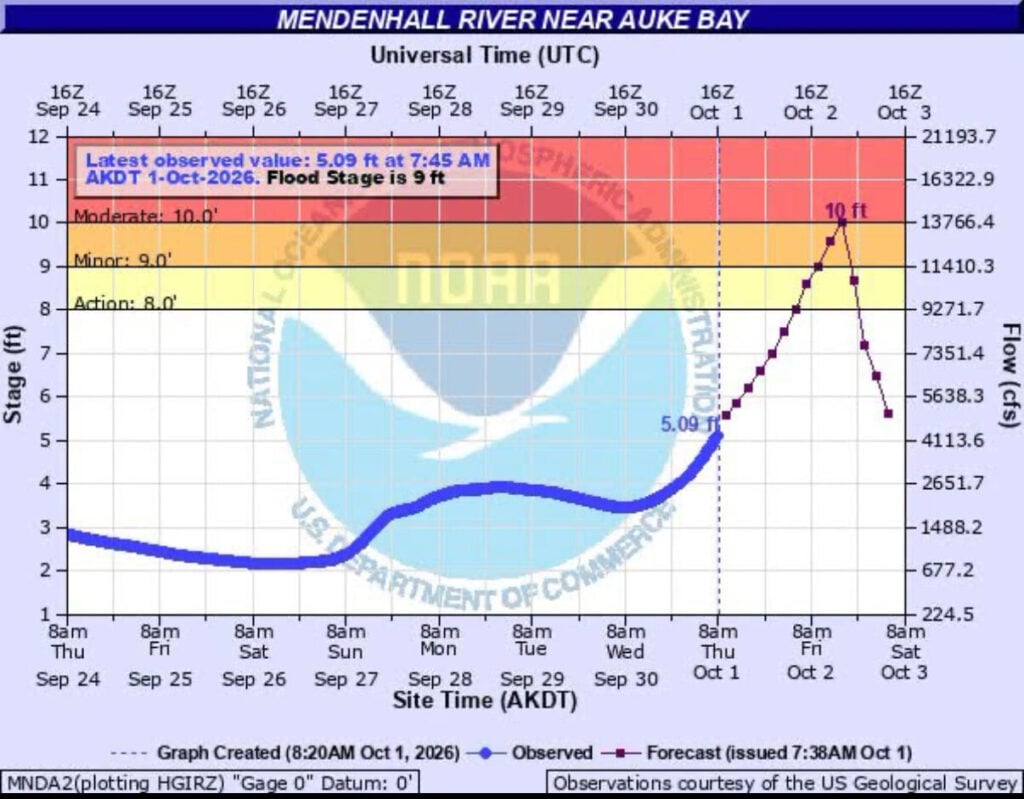
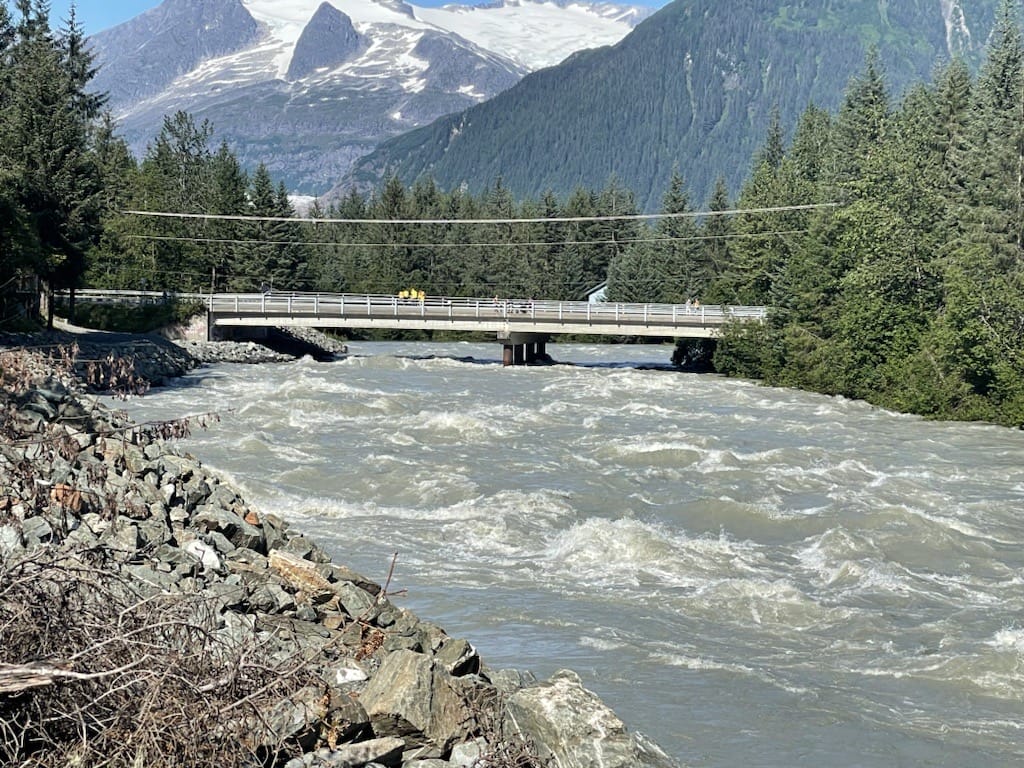
The National Weather Service Juneau’s current forecast indicates Mendenhall Lake cresting near 9.8 to 10.3 feet sometime between 2 pm and 6 pm on Friday, October 2.
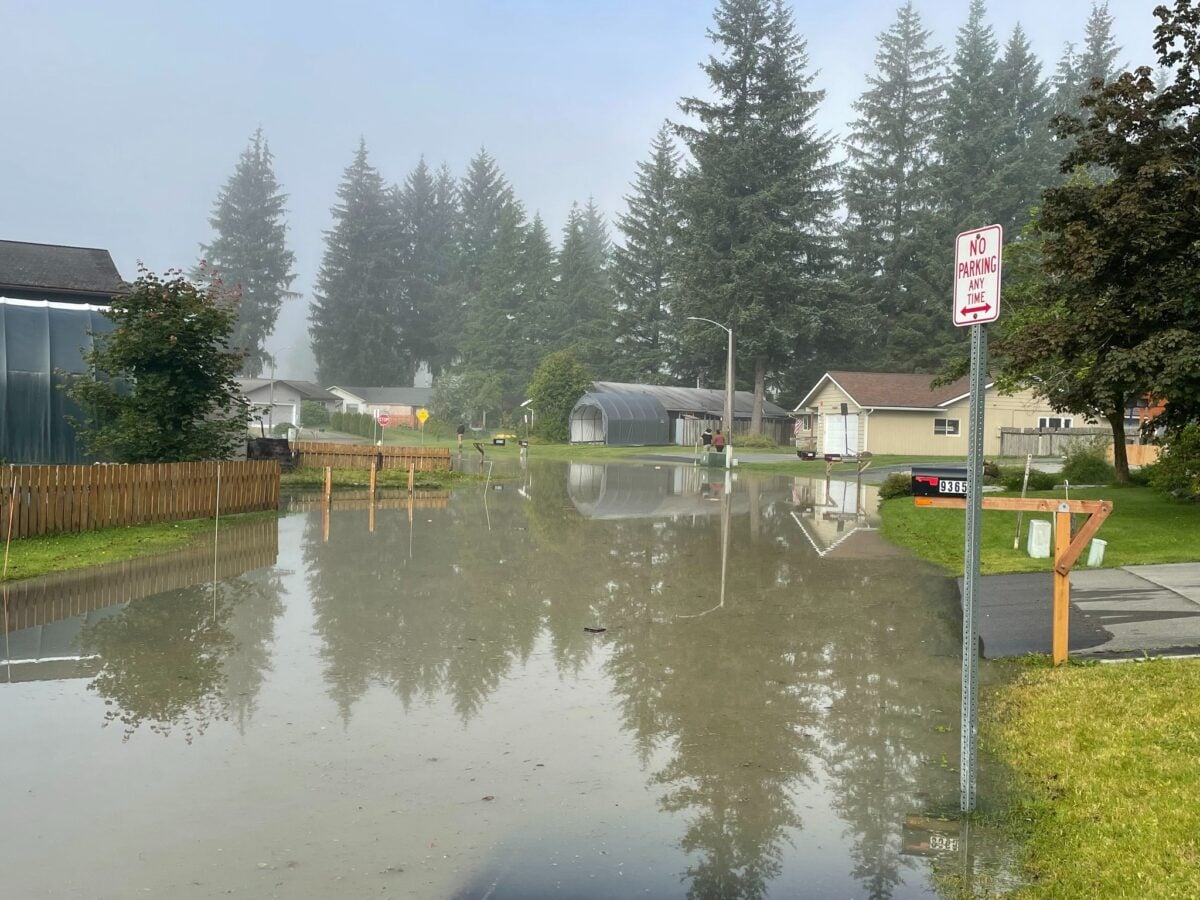
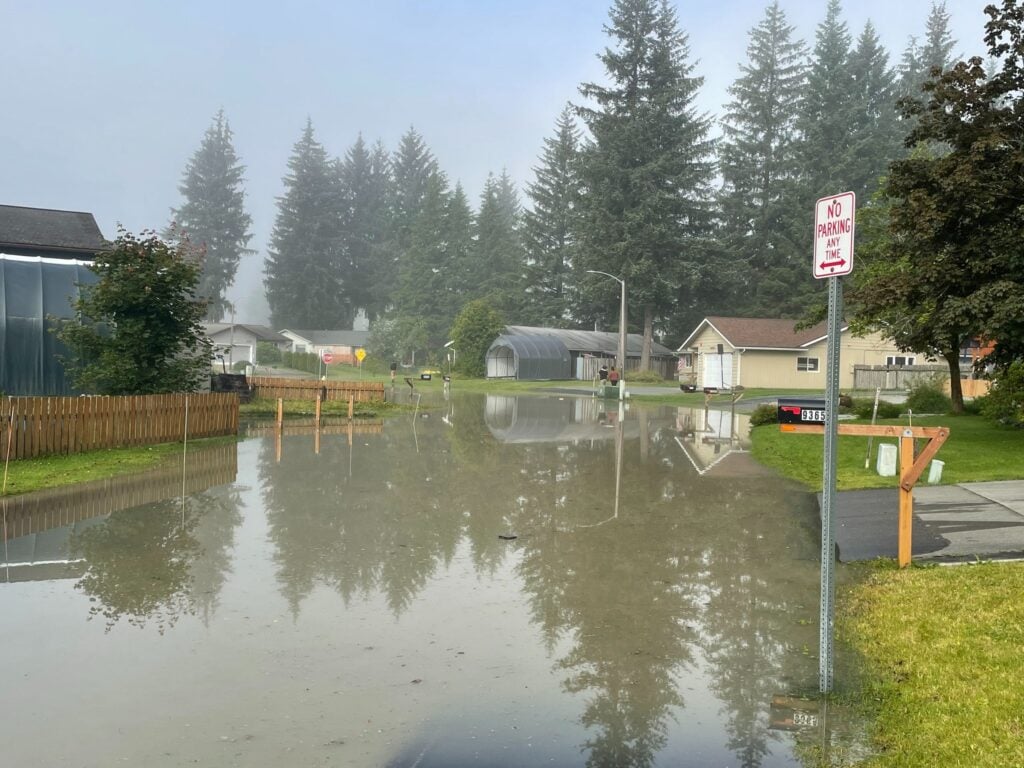
Ten feet is considered moderate flood stage. Flooding should be expected around the Mendenhall Campground, Skaters Cabin Road, some flooding in the View Drive area, between 1 and 3 feet.
The Weather Service says to expect closures of pedestrian paths near the Mendenhall River.
NOTN- After another glacial outburst flood on the Mendenhall River, Juneau officials are turning their focus to how the city will pay for long‑term protection of flood‑prone neighborhoods.
City Manager Katie Koester told the Assembly that the U.S. Army Corps of Engineers is moving ahead with an industry led solution, which could move on a faster time-line than one directed by the Army Corp.
The project would be designed to Suicide basin below 1,100 feet and hold future events to minor flood levels.
While final designs and costs are still unknown, Koester said the overall price tag could reach hundreds of millions of dollars, leaving Juneau responsible for an estimated $40 million to $100 million depending on the federal cost share, 10 to 25 percent.
According to Koester, after speaking with Alaska Senator Dan Sullivan’s office, Alaska’s congressional delegation is now working to change federal law so Juneau can receive the same 90-10 cost share available for Army Corps projects on tribal lands under the conventional process.
“I do think our state having some participation in the funding of an enduring solution is important… we have local government, federal government, tribal government, and state government all working together.” Koester said.
The city has already spent nearly $10 million in local funds on HESCO barriers and related work over recent flood seasons, and staff time has been pulled away from other core capital projects such as water, wastewater and facilities maintenance. Koester said engineering, public works and emergency management have been “absorbing” much of the response workload, and warned that can’t continue indefinitely without tradeoffs or added staff.
“We have spent a little under $10 million of CBJ taxpayer money, and that is thanks to grants and partnerships. Army Corps has spent significantly more more than that.” Koester said, “There will be maintenance responsibilities that we’ll be in charge of, including inspection, unfortunately protecting against vandalism. We’ve already seen the barrier slashed. We’ve already seen warming fires being built right up against the barriers.”
Assembly members are weighing a mix of options, including a special service area tax for roughly 1,800 homes in and around the flood zone currently protected by HESCOs, bonds backed by area‑wide taxpayers, and potential contributions from the state. A one‑mill levy in a HESCO service area would likely raise less than $1 million a year, meaning the general fund would still play a major role.
The Assembly is also debating whether to compensate homeowners who host HESCO barriers on their land through temporary easements, and whether to limit new development in the flood corridor while it asks voters to help finance a permanent solution. A small Assembly “strike team” will work with staff to refine funding options before they return to the full body for public debate.
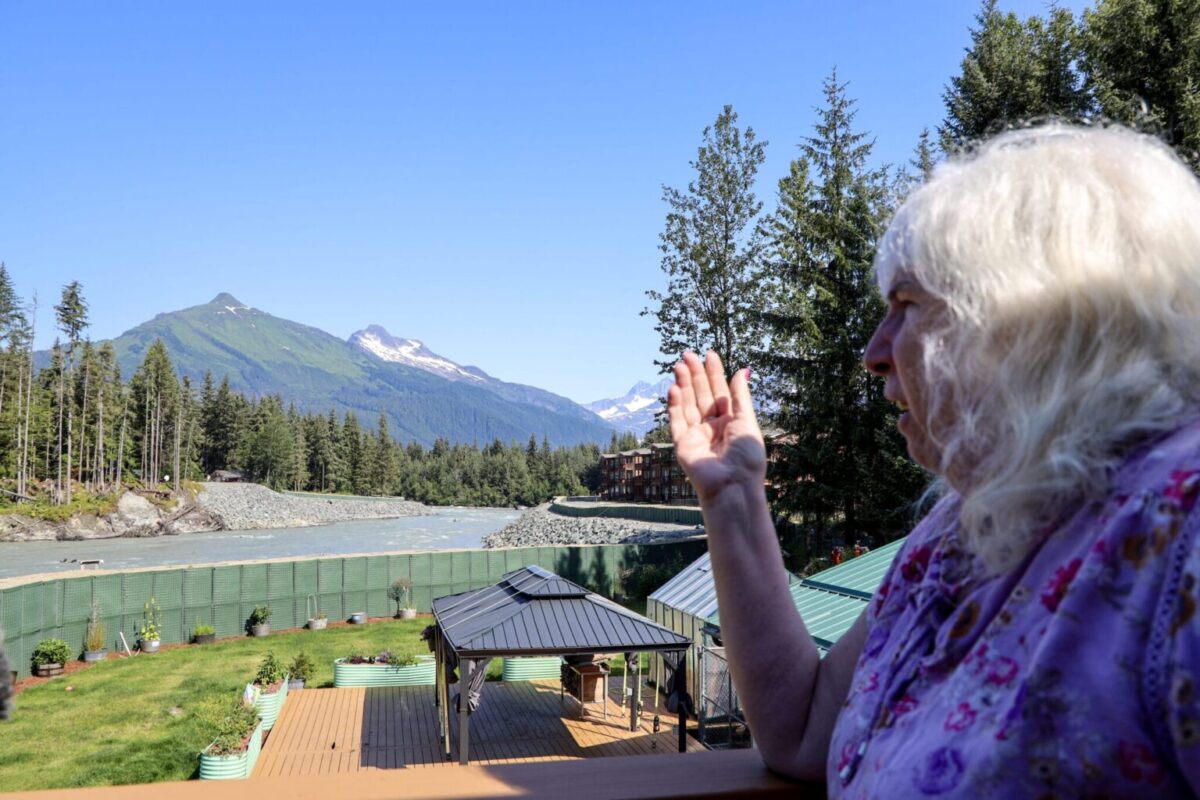
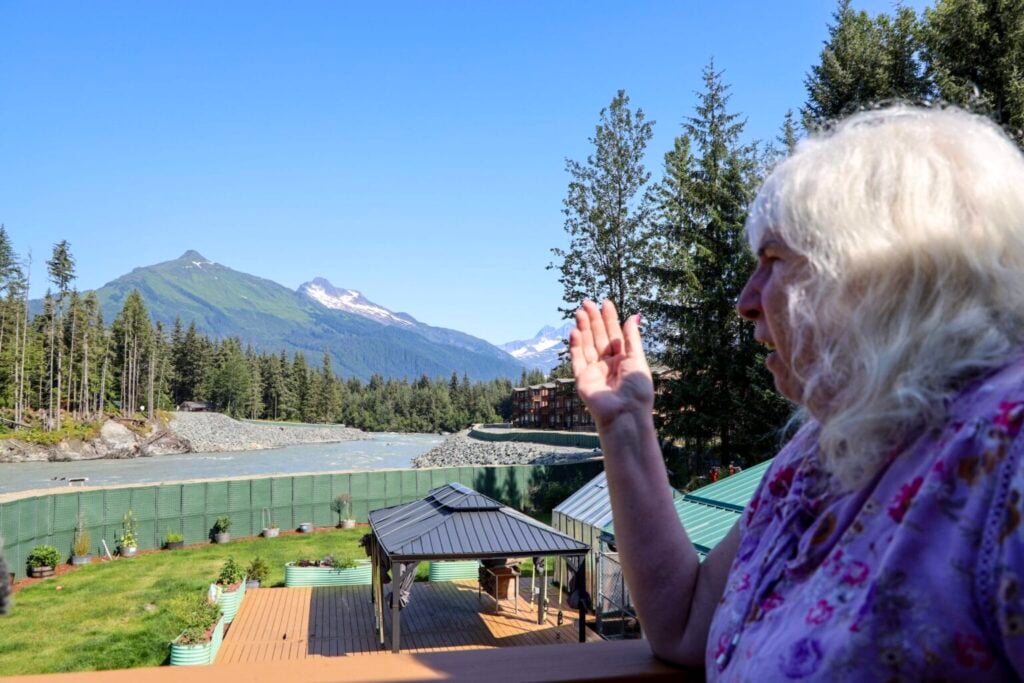
nn Lind looks out from her balcony on Marion Drive at the Mendenhall River as it rises on Wednesday, Aug. 12, 2026. (Clarise Larson/KTOO)
As the Mendenhall River swells with glacial outburst floodwater, hundreds of people living in the suburban valley below spent Tuesday night and Wednesday preparing to evacuate or hunker down. The National Weather Service predicts the flood will crest Thursday.
On Marion Drive, Ann Lind plans to watch the flood from her second-story balcony overlooking the Mendenhall River.
“I got lawn chairs up there, and we’ll just be sitting there, and that’s where I’ve been every year,” she said.
Lind said her crawl space flooded last year when water leaked through the HESCO barriers and a drainage pipe failed. She said she’s staying again this year to protect the property.
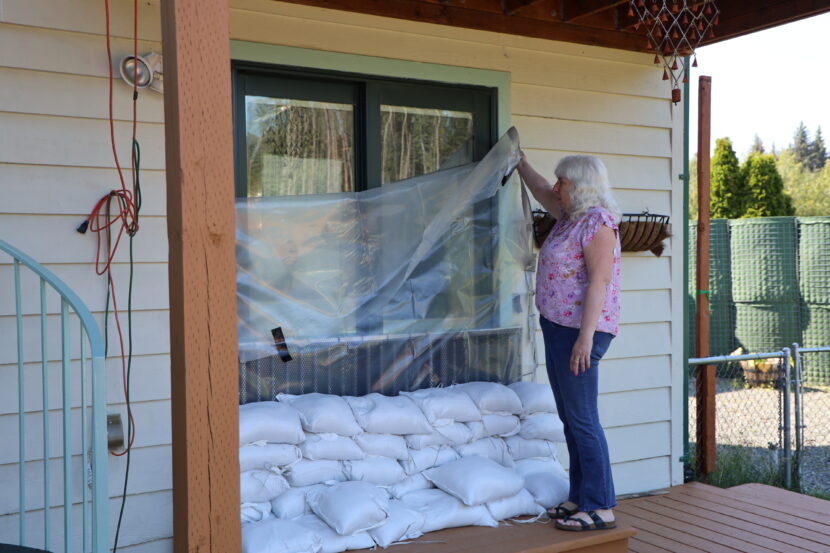
Ann Lind secures sandbags at her house on Marion Drive on Wednesday, Aug. 12, 2026. (Clarise Larson/KTOO)
“Because if I wouldn’t have stayed last year, I never would have known that I was flooding back there, and the flooding would have been way worse,” she said. “Within 30 minutes of me calling for help, I had nine guys and five pumps back there.”
She said she’s more confident her home won’t flood this time after the U.S. Army Corps of Engineers placed an industrial-sized pump just beyond her lawn to send water that leaks through the flood wall back into the river.
Although she plans to stay behind with her 17-year-old daughter, she said her other kids and pets will evacuate – heeding official advice.
Downstream from Lind’s place, on Meander Way, Locke Brown said he and his wife are optimistic about flood protection this year. Last year, the pair’s crawl space and garage flooded.
“If we had these pumps on the roads sitting here last year, I think we probably wouldn’t have had any water in the house,” he said.
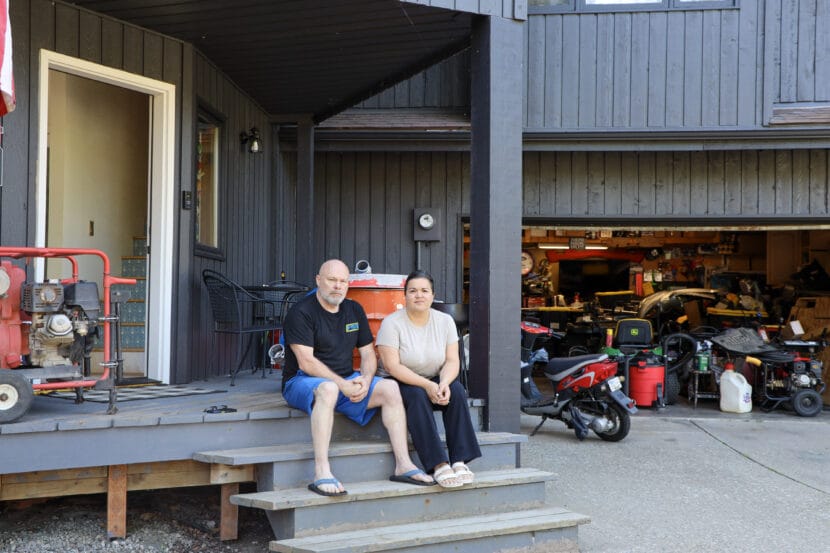
Locke and Melissa Brown sit on their porch at their home on Meander Way as the Mendenhall River rises on Wednesday, Aug. 12, 2026. (Clarise Larson/KTOO)
They said they’re grateful for the pumps and bolstered flood wall provided by the Army Corps this year — but they’re not taking any chances. They said that once the water rises high up on the barriers, they plan to evacuate to a camper they have set up outside of the flood zone.
Locke is retired from the U.S. Coast Guard and his wife still works for the Coast Guard.
“We’ve made our living saving people when they know they should have left,” he said.
Locke said the prudent thing is to leave since there’s a possibility the barriers could fail.
“It’s one of those unknowns. You just — what do they say? — Prepare for the worst and hope for the best,” he said. “We just feel like, at this point, we’re just driftwood. Whatever happens is gonna happen, and we’re just gonna have to deal with it when it’s over.”
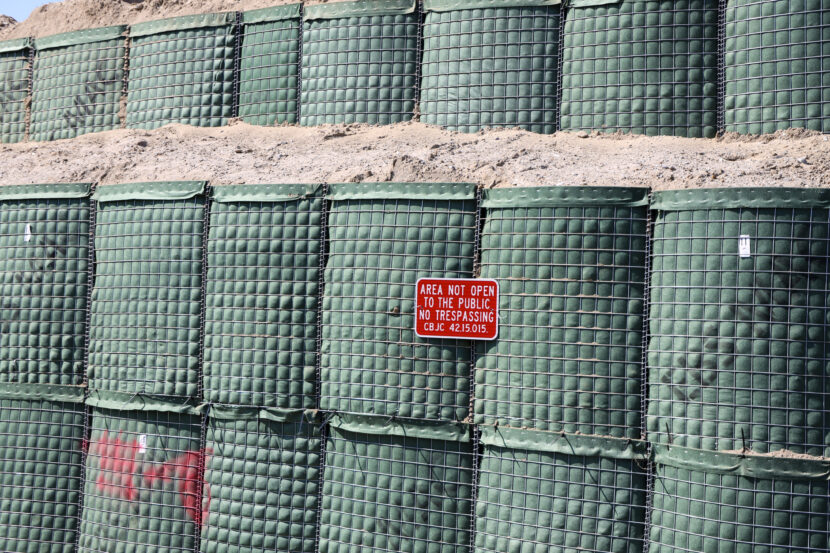
HESCO barriers installed along the Mendenhall River on Wednesday, Aug. 12, 2026. (Clarise Larson/KTOO)
Just a few blocks over, on Gee Street, Benson Bullock said he’s not too worried. He’s patching a pair of waders in his garage, but not for walking through floodwaters.
“Hopefully, if it’s not too crazy, I’ll be going fishing,” he said.
Bullock had a few inches of water in his garage during the catastrophic flood in 2024, but his house has never flooded. Bullock says he plans to put sandbags in front of the garage before the flood crests.
“We have stuff moved and cleaned up,” he said. “We moved my boat, we’ll move my wife’s truck, and we’ll just have my truck here in case we decide to leave.”
On View Drive, many residents say they’re planning to stay to try to protect their property and look out for their neighbors.
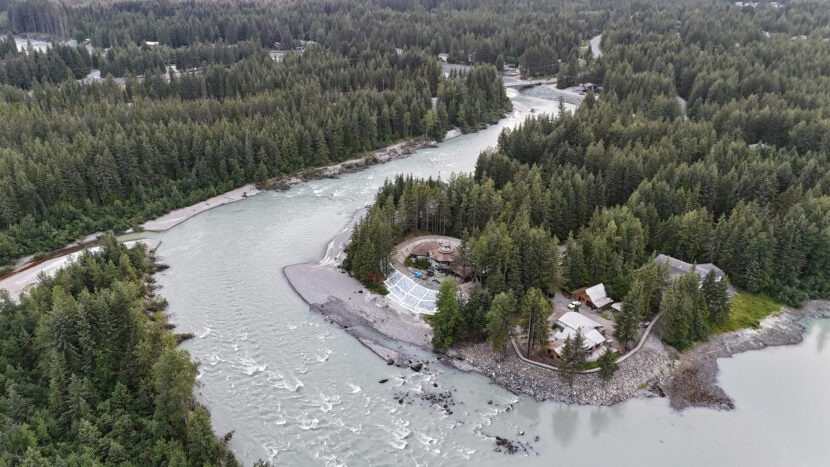
View Drive is a forested cul-de-sac that forms a peninsula jutting into the Mendenhall River. It’s been hit the hardest by past floods. For a second year in a row, the street has been left without the protection of the flood wall constructed by the City and Borough of Juneau and the Army Corps. Officials have said in the past that the street has porous soil and have doubts that the homes could be protected.
The Mendenhall River surrounds homes on View Drive in the Mendenhall Valley on Tuesday, Aug. 11, 2026. (Clarise Larson/KTOO)
Mandy Mallott lives at the end of the cul-de-sac. She bought the house from a family she babysat for when she was growing up in Juneau. It looks out over Stroller White Mountain, where her father died in 2005.
“It’s a very spiritual place to us,” she said. “It’s a private place, and we’ll do what we can to protect it.”
She and her family spent Tuesday evening moving their belongings up onto shelves in their garage. Last year, she worked with her neighbors to have contractors put up their own HESCO barriers around a few properties, and she said her home didn’t flood.
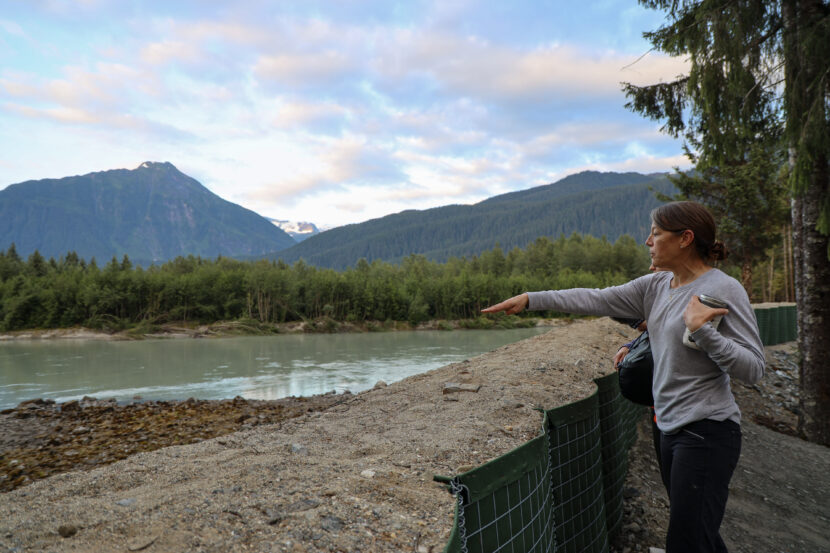
Mandy Mallott points over HESCO barriers to the Mendenhall River from her home on View Drive on Tuesday, Aug. 11, 2026. (Clarise Larson/KTOO)
Although a federally sponsored buyout for her home and others on View Drive might be on the table — Mallott said she’s emotionally tied to the place, and sees a long-term solution designed by the Army Corps as her best option.
“That emergency tunnel fix gives us all a lot of hope,” she said.
Mallott and her family are tribal citizens, and she said she’s grateful for the dozens of sandbags that the Central Council of the Tlingit and Haida Indian Tribes of Alaska dropped off on Tuesday.
Residents of the Riverview Senior Living facility were about 50-50 split on whether to evacuate on Wednesday afternoon, said its Executive Director René Bryant. This year, new HESCO barriers are now standing between the Mendenhall River and the two-story assisted living and memory care facility.
She said the roughly 70 residents have a choice whether to stay or evacuate, and they are providing transportation to a nearby emergency shelter at St. Paul’s Catholic Church after an early dinner on Wednesday evening. Bryant said additional transportation to evacuate will be provided Thursday if needed.
“We are respecting everybody’s rights, while contacting family members to make these decisions as well,” Bryant said.
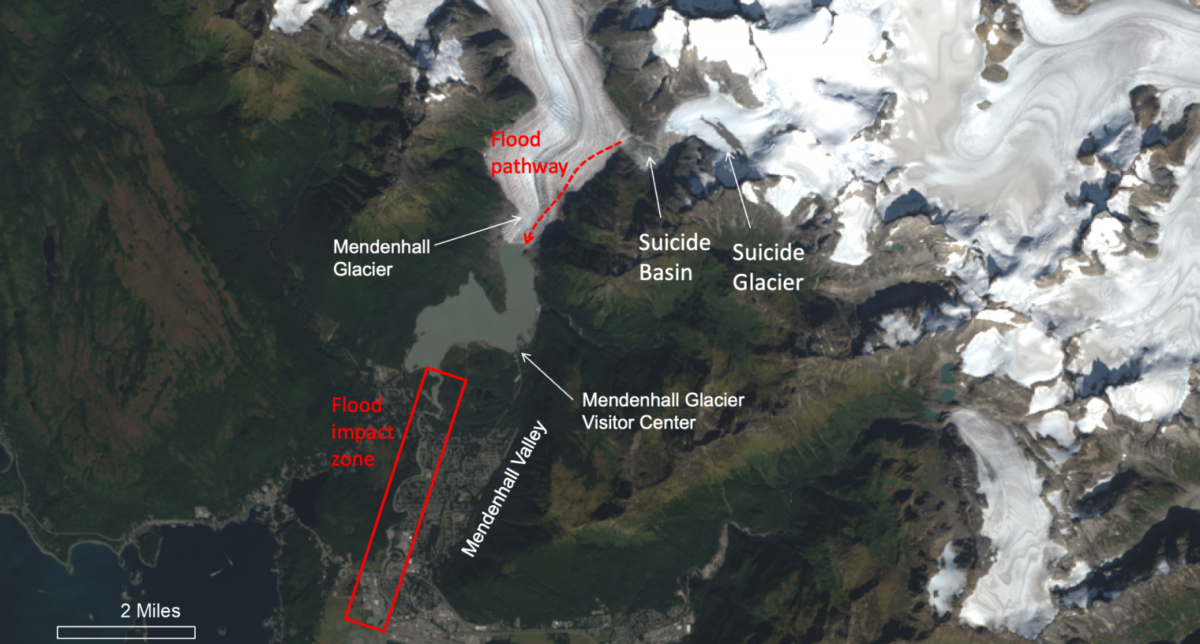
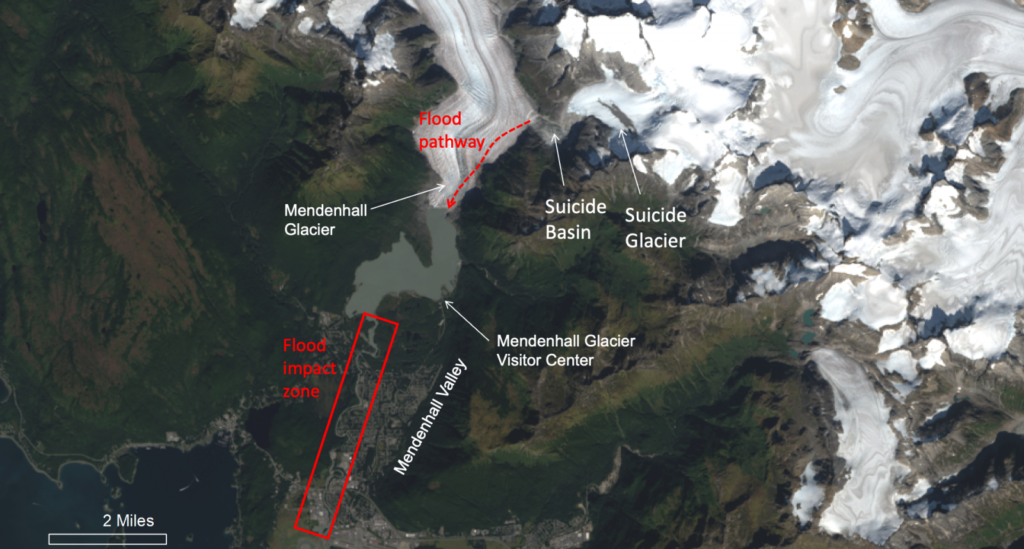
Mendenhall overview from the National Weather Service
NOTN- The city of Juneau has entered a heightened state of readiness after officials confirmed just this morning that Suicide Basin is full, meaning the anticipated Glacial Lake Outburst Flood in the Capitol city could happen at any time.
“We call this the set phase, where people should be prepared to evacuate.” Said Mayor Beth Weldon, “But it could still be days, if any. We’re all getting used to this. It could be within 24 hours, or even as much as five or six days until the basin releases.”
Weldon said the timing of any potential outburst flood remains uncertain. The City is in the “Set” phase of it’s ‘Ready, Set, Go’ framework, which means residents affected by the GLOF should stay vigilant and continue to check in with emergency officials, have a go bag packed and be ready to activate a plan of safety.
According to the National Weather Service, in the past it has taken up to 6 days for the main event to start after the basin is full.
City officials urged residents to closely follow evacuation notices and stay away from flood control structures, particularly the Hesco barriers along vulnerable stretches of riverbank.
“Please do not climb up on the Hesco barriers,” Weldon said. “If they fail, it’s going to be catastrophic, and they could fail in a moment’s notice. You will not have time to run or move.”
if you have any questions, you can call the flood hotline at 907-500-0890 for information and updates.
“Everybody, try and be safe, and please abide by the evacuation notice,” Weldon said. “Again, everybody stay safe.”
NOTN- Federal officials say they are preparing both short- and long-term defenses as another glacial outburst flood is expected to hit Juneau’s Mendenhall River in the coming days, continuing a pattern of annual summer flooding that has put homes and lives at risk.
In a briefing Thursday, U.S. Sen. Dan Sullivan and Assistant Secretary of the Army for Civil Works Adam Telle said the U.S. Army Corps of Engineers has strengthened temporary protections ahead of the anticipated 2026 glacial outburst flood, and they’ve been gearing up to launch an unprecedented effort to drain water from Suicide Basin, the source of the destructive floods.
Sullivan said the Corps and local partners have invested about $45 million to make Hesco barrier floodwalls along the Mendenhall River taller and wider, and deployed roughly 40% of the Corps’ global pump inventory to Juneau as a backup if the river overtops or breaches the barriers.
“The fact that one of America’s capital cities in our country floods every summer at the risk of not only property but lives, you know, these floods are very risky for not just the safety of our own citizens, it’s a huge, unique challenge.” Sullivan said.” “The Corps of Engineers now has deployed 40% of all the pumps in the Corps of Engineers inventory for the world… in Juneau, just in case.”
Telle said the Corps will move quickly after this year’s flood to seek private-sector proposals for a faster, less costly way to evacuate water from Suicide Basin.
“We believe that evacuating water from Suicide Basin is fundamentally the best way to prevent this from happening in the future,” Telle said, ““We have a phenomenon here in Juneau that’s unlike any other in our entire portfolio.”
According to stories by both KTOO and the Juneau Independent, a local mining executive presented ideas that could cut the cost in half of teh proposed Lake Tap solution in half, groups like Juneau Flood Solutions have supported this effort.
Officials warned the public not to be complacent even with higher barriers in place, saying debris impacts remain a major threat and urging residents to treat the coming flood as a serious safety risk.
NOTN- As Suicide Basin nears capacity, the City and Borough of Juneau is urging residents in the flood evacuation zone to finalize their emergency plans.
In an interview with CBJ Emergency Programs Manager Ryan O’Shaughnessy, he said residents are encouraged to know where they’ll go if an evacuation is ordered.
“The basin is is almost full, once the basin becomes full and gets to 1350 ft, folks can expect to get an alert on their phones.” O’Shaughnessy said, “That’ll that loud, sort of jarring alert, a sort of siren that comes out of your phone for just a minute. And that’ll let people know that the basin has become full. And in our Ready, Set, Go framework, we’ve moved from Ready into Set. That means it’s time for folks to have a bag packed, it’s time to make sure your phone is charged, there’s gas in the car, and that you’re ready to go when the basin begins to release.”
We’ve put together the CBJ approved evacuation routes, take note of what’s nearest to you if you are in the evacuation zone.
Residents north of Division Street, please travel north on Riverside Drive, toward Mendenhall (Back) Loop Road and out of the inundation area.
Residents south of Division Street, travel south on Riverside Drive, turn left on Stephen Richards Memorial Drive, towards Mendenhall Loop Road.
On Rivercourt Way, travel south on Riverside Drive, toward Egan Drive
On the west side of the Mendenhall River, travel west on Mendenhall (Back) Loop Road toward Auke Bay (avoid Back Loop Bridge).
West of Brotherhood Bridge, travel west on Glacier Highway toward Auke Bay
An emergency shelter will be available at Floyd Dryden Middle School, and limited space is available there for pets. Juneau Animal Rescue can also help coordinate temporary pet sheltering.
People in the evacuation zone are also being asked to register their vehicles in advance if they plan to use the city’s temporary flood parking areas, which are located at St. Brendan’s Episcopal Church 4207 Mendenhall Loop Road, Shepherd of the Valley Lutheran Church 8198 Keegan Street, Christ Lutheran Church 10300 Glacier Hwy, Juneau Christian Center 8001 Glacier Hwy.
“We’re optimistic, and we have a tremendous amount of confidence in the HESCO barriers, but it’s not something to bet your life on. That’s why we’re really encouraging folks who live in the hazard area to evacuate and go ahead and heed that evacuation advisory when that’s issued.” O’Shaughnessy said.
Officials recommend preparing homes now by moving valuables, as well as items such as oils, paints and cleaning products, into secure waterproof containers at higher elevations.
Residents should also have a go-bag packed and ready in case an evacuation order is issued.
Officials remind residents not to drive or walk through floodwaters and to wait for an official all-clear before returning home after the event. The City and Borough of Juneau has also activated a flood information hotline for non-emergency questions. The hotline currently operates weekdays, with expanded weekend and around-the-clock hours planned once the basin fills and, if necessary, when a flood begins. United Way of Southeast Alaska is also coordinating volunteers and assistance for residents who may need help before or after the flood.
Flood waters are rising at a rate of about 3 feet per day but more information about flood preparedness is available through the City and Borough of Juneau’s flood readiness resources, the National Weather Service or by calling the flood hotline.
NOTN- State transportation officials say that the Back Loop Bridge will be closed to all traffic during the anticipated Glacier Lake outburst flood also known as GLOF, while Brotherhood Bridge will remain open to vehicles but closed to pedestrians for safety.
“Much like last year, we’re going to close the bridge that’s on Back Loop when the gauge level on Mendenhall Lake hits 12 feet, or at 8:30 at night if it’s predicted to go over 12 feet overnight.” Said Department of Transportation Incident Commander Travis Eckhoff, “Folks will remember last year during the flood we had some damage to an approach that totally washed the approach out on the east side of the bridge. And so, just for everyone’s safety, we’re going to go ahead and close that bridge once it hits 12 feet, and we’ll open it back up once our engineers have had a chance to go and inspect the bridge to make sure everything’s okay.”
Engineers will inspect the bridge before reopening it once water levels subside.
Eckhoff urged residents to heed evacuation boundaries, avoid driving through floodwater and sign up for alerts at 511alaska.gov and with the City and Borough of Juneau.
Drone flights will also monitor infrastructure during the event.
“When the basin releases we’ll be putting out a temporary flight restriction for a specific area. So we advise you don’t fly your drones in that area. We’ll be posting that on our socials. There will be drones in the sky, monitoring important infrastructure and HESCO barriers.” Echkoff said.
CBJ- The City and Borough of Juneau Flood Information Hotline is now available during weekdays. Residents can call the hotline with non-emergency questions and concerns related to the 2026 glacial lake outburst flood. The hotline is available at 907-500-0890 on Mondays through Fridays from 9 a.m. to 4 p.m.
Once Suicide Basin is filled, the hotline will extend operating hours to include Saturdays and Sundays from 9 a.m. to 4 p.m. Once release has begun – and a wireless emergency alert text message goes out – the hotline will move to 24/7 operations through the event.
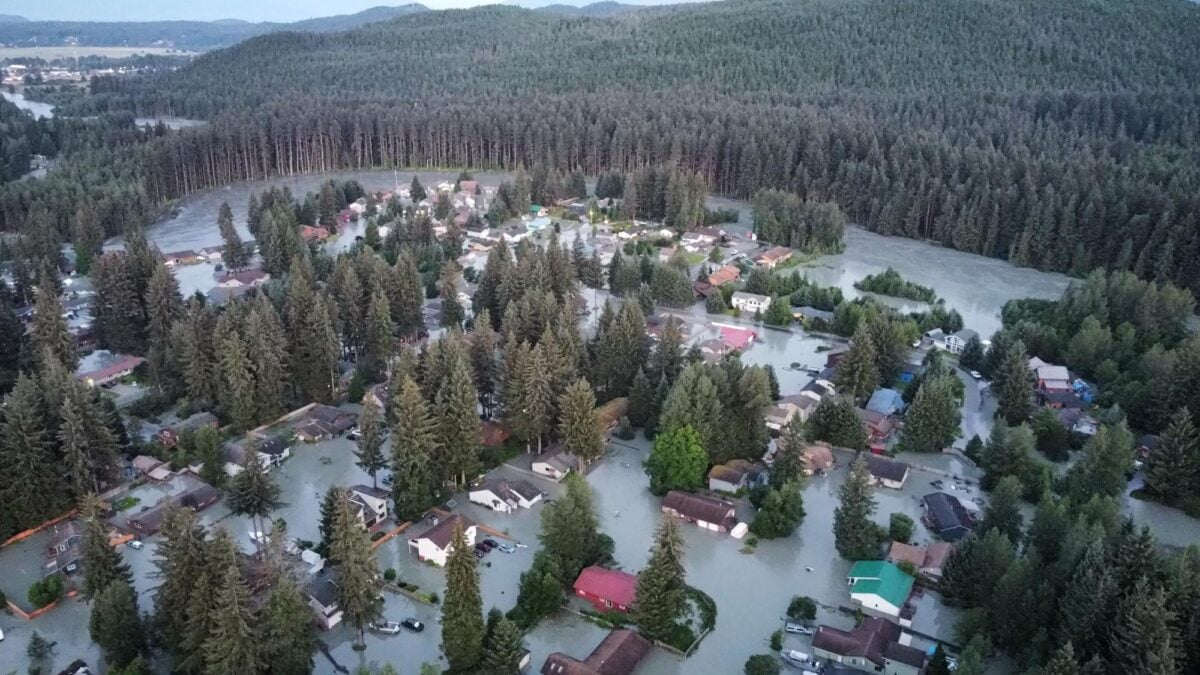
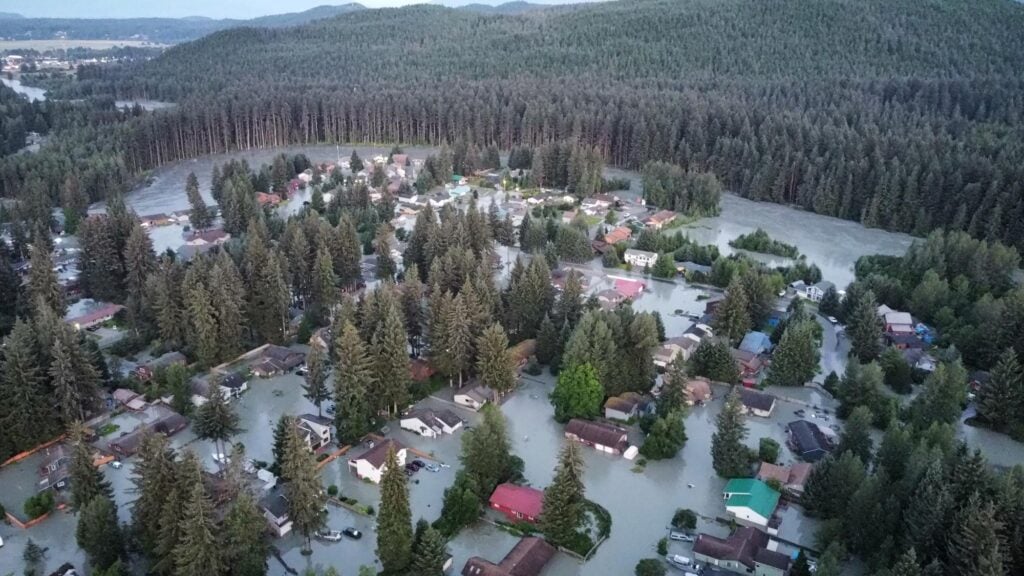
This drone image provided by the City and Borough of Juneau shows flooding from a release of water and snowmelt at Mendenhall Glacier covered some roads and threatened homes along the Mendenhall River in Juneau, Alaska on Wednesday, Aug. 13, 2025. (City and Borough of Juneau via AP)
This drone image provided by the City and Borough of Juneau shows flooding from a release of water and snowmelt at Mendenhall Glacier covered some roads and threatened homes along the Mendenhall River in Juneau, Alaska on Wednesday, Aug. 13, 2025. (City and Borough of Juneau via AP)
CBJ- The City and Borough of Juneau (CBJ) Assembly Committee of the Whole (COW) Worksession scheduled for Monday, July 20 at the Andrew Hope Building has been cancelled for both topical and timing reasons. CBJ will move the planned agenda topics to a future COW worksession after the 2026 glacial lake outburst flood (GLOF).
The Special COW meeting was originally scheduled to provide updates and allow for assembly discussion on topics related to the annual threat of glacial lake outburst flooding events. The meeting included an update from the U.S. Army Corps of Engineers, a discussion of flood protection costs and potential funding mechanisms, and flood preparedness updates from the CBJ Emergency Management and Tlingit & Haida Public Safety offices.
“With a 2026 GLOF just days to weeks away, all three of our agencies (USACE, Tlingit & Haida and CBJ) are talking with residents daily about mitigation, preparation and how they can stay safe,” shared City Manager, Katie Koester. “We understand that our flood vulnerable neighbors are dedicating their focus and time to the flood just ahead of us, and realized there was nothing in the planned meeting agenda that couldn’t wait until after the waters have receded and residents have more capacity to tune in and share their input.”
The July 20 COW was scheduled to take place in the Council Chambers of the Central Council of the Tlingit & Haida Indian Tribes of Alaska in the Andrew Hope Building.
“We are honored that President Peterson and the Central Council invited the Assembly to conduct our meeting in their Executive Council Chambers showcasing the strong spirit of collaboration between our two governments,” said CBJ Deputy Mayor Greg Smith. “We are already looking for the next opportunity to meet and discuss these critical issues that impact Juneau’s residents, including tribal citizens in their Chambers.”
Updates regarding GLOF mitigation solutions and flood preparedness are regularly shared on the CBJ, USACE and Tlingit & Haida social media pages. Flood planning resources, including evacuation maps, are available at bit.ly/juneaufloodready. CBJ is also hosting sandbag distribution events tomorrow (July 18) and on all subsequent Saturdays until the 2026 GLOF.
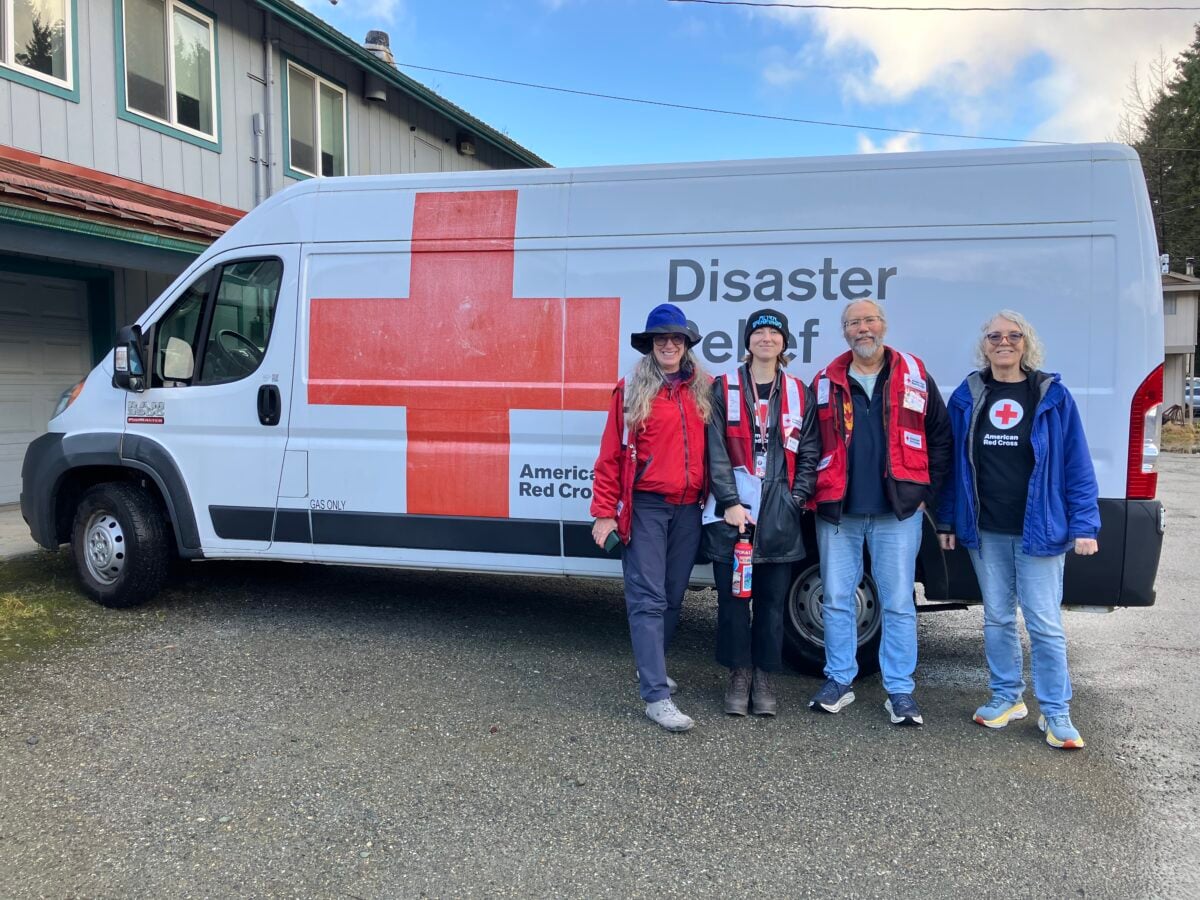
CBJ-The American Red Cross will host a free workshop and resource fair on Sunday, July 19 at the Mendenhall Valley Library. The event is designed to help older adults, individuals with access or functional needs, and medically fragile persons prepare for emergencies.
The event begins at 12 p.m. with a presentation, available both in-person and online, followed by a planning workshop and resource fair from 1 to 3 p.m.
Attendees will have the opportunity to build an individualized disaster plan, complete an emergency contact card, learn how and where to safely store important documents and more.
Registration is free and available online at bit.ly/4vZJlPL. Information for virtual attendance will be provided upon registration