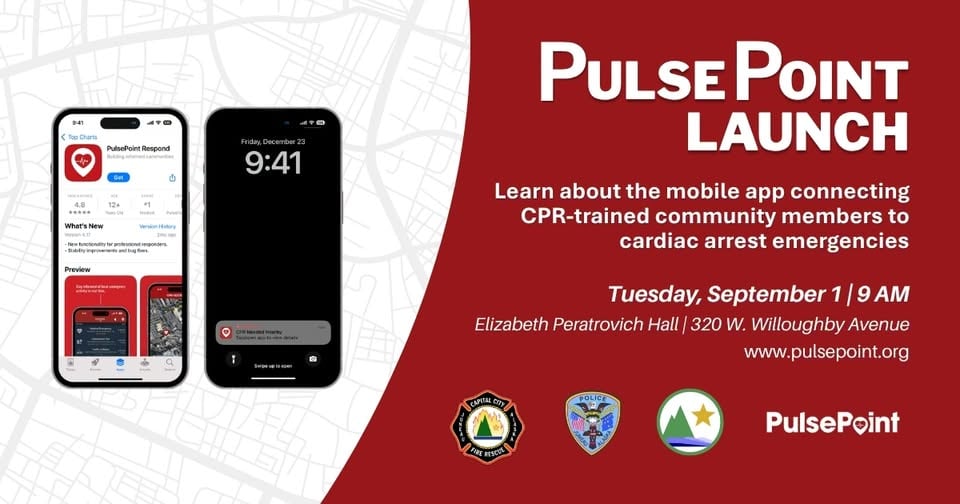
CBJ- Capital City Fire Rescue and the Juneau Police Department are launching a new app designed to connect CPR-trained residents with people experiencing cardiac arrest.
The Capital City Fire Rescue and Juneau Police Department Communications Center is launching PulsePoint Respond in Juneau on Tuesday, September 1.
PulsePoint is a free mobile application designed to connect CPR-trained community members with people experiencing cardiac arrest before professional responders arrive on the scene.
“Our firefighters and paramedics are trained and equipped to provide advanced care, but there is an unavoidable period between the 9-1-1 call and our arrival,” said Andrew Pantiskas, Division Chief of Emergency Medical Services for Capital City Fire Rescue. “While our crews are responding, a nearby citizen can make a tremendous difference.”
Media and members of the public are invited to learn more about PulsePoint Respond at the launch event on Tuesday, September 1 at 9 a.m. in the Elizabeth Peratrovich Hall.
Implementation of PulsePoint Respond in Juneau is funded through Marine Passenger Fees.
How PulsePoint Works
PulsePoint Respond alerts registered CPR-trained users when a cardiac arrest is reported near the user’s location. Users who receive an alert can:
- Recognize that a cardiac arrest is occurring nearby.
- Respond to the location when it is safe to do so.
- Begin CPR until professional responders arrive.
- Locate and retrieve a nearby automated external defibrillator (AED).
- Provide potentially lifesaving assistance during the critical first minutes of a cardiac arrest.
PulsePoint does not replace calling 9-1-1 or professional emergency medical services. Members of the public should still call 9-1-1 and follow the instructions of the public safety dispatcher.
Why Bystander CPR Matters
Nationally, hundreds of thousands of out-of-hospital cardiac arrests occur each year. While less than 50% of cardiac arrest victims get help before emergency responders arrive, immediate bystander CPR can significantly improve a person’s chance of survival.
Pantiskas advises that the most important thing that can be done during a cardiac arrest is to start CPR and get a defibrillator to the patient as quickly as possible.
For Juneau, PulsePoint is another tool to help close the gap between the moment a cardiac arrest occurs and the arrival of professional responders.
How to Participate
Residents who are CPR-trained and willing to assist can download PulsePoint Respond through the Apple App Store or Google Play, follow their local emergency response agency (“Capital City FR” in Juneau), and indicate that they are CPR-trained and willing to respond to nearby cardiac arrest alerts.
Community members can also use the PulsePoint Foundation AED NEAR Registry to help identify AEDs throughout Juneau.
Learn more about PulsePoint Respond at the PulsePoint website.