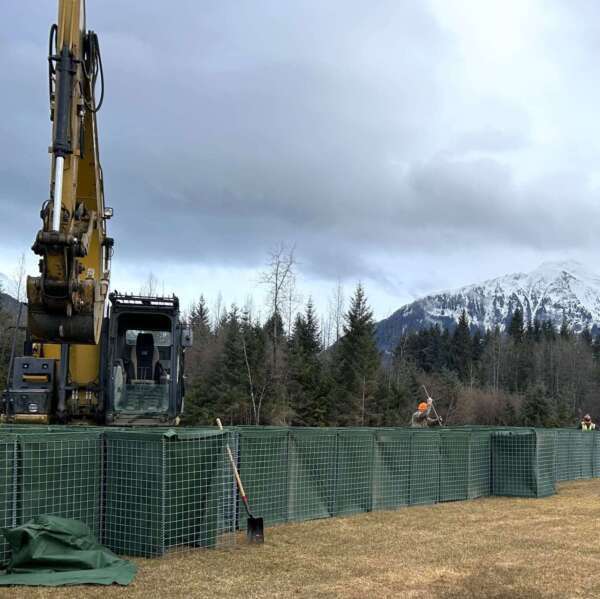
NOTN- City officials said they are nearing completion of armoring HESCO barriers as they race to protect low-lying neighborhoods from the annual glacier‑lake outburst flood season.
City Manager Katie Koester said the work, led by the city and the U.S. Army Corps of Engineers, is being expedited ahead of an early‑August release window the National Weather Service is monitoring.
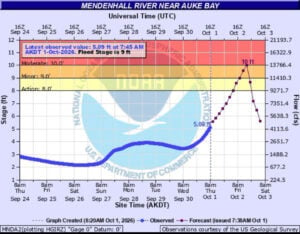
“It was divided into two projects, and we’re nearing completion of that project, because we’re really racing towards that early August deadline. National Weather Service anticipates an early August release. They’re of course, constantly monitoring this, and you can go to their website.” Koester said, “They’re anticipating something around the release of last year, so the basin is filling out a little bit more quickly than it was last year, but about on pace for the previous years.”
Contractors and engineers have been working around the clock to meet the deadline.
Koester said the barriers are designed to withstand flows of about 63,000 cubic feet per second which is significantly higher than last year’s roughly 49,000 CFS event, and that the Corps used modeling to shape additional protections, including an earthen berm on the Back Loop Bridge that officials say is more efficient for extreme floods than HESCO barriers.
“The Army Corps analyzed it and decided the HESCO barriers would be more expensive and less efficient than doing an earthen berm. The Army Corps did do modeling to make sure that the earthen berm would not adversely effect other properties.” Koester said.
The city remains under a continuing state of emergency that allows crews access to private property to place barriers.
“We really are operating in a continuing emergency because of the unique annual nature of this event, and this is important not just for the city, but also for the Army Corps of Engineers, and the assistance that they’re able to provide under advanced measures. Basically, they’re able to provide this federal assistance because we have this imminent threat of flooding every single year, and it’s unique because most communities have a flood threat that may or may not happen; we have this very, very unique annual event.” Said Koester.
A special committee meeting on July 20 will feature Army Corps presentations on phase two and long‑term options, including a proposed basin tunnel concept.