James Brooks, Alaska Beacon
Democratic governor candidates Jonathan Kreiss-Tomkins and Tom Begich, and Republican candidates Bernadette Wilson and Dave Bronson led in early vote counting for Alaska’s Tuesday primary election for governor.
Seventeen people, including two Democrats, 12 Republicans and three independents, are seeking to replace Gov. Mike Dunleavy, who is term-limited and unable to run again this year.
As of 2 a.m. Wednesday, with 378 of 402 precincts reporting results from election day, Kreiss-Tomkins had 21.7% of the vote, Begich had 20.1%, Wilson had 10.5% and Bronson had 8.4%.
The first candidate outside the top four was Republican Treg Taylor, with 7.5%, followed by Republican Click Bishop, with 7.1%.
Ballot-counting is expected to continue through Aug. 28, the deadline for mailed absentee ballots to reach the Alaska Division of Elections.
Candidates who finish in the top four have until Aug. 31 to decide whether they will remain in the race or withdraw. In 2022 and 2024, several high-finishing candidates have withdrawn from statewide races in order to consolidate party support, and the leading governor candidates have said that they are considering their options.
Kreiss-Tomkins, 37, would be the youngest governor in Alaska history if elected in November and has campaigned as a progressive Democrat.
“Today, Alaskans took the first huge step in choosing a new direction for our state,” he said in a written statement Tuesday night.
Begich, a former state senator, has likewise run as a progressive Democrat. He is the son of former Democratic U.S. Rep. Nick Begich, brother of former Democratic U.S. Sen. Mark Begich and the uncle of current Republican U.S. Rep. Nick Begich III.
Wilson, a businesswoman from Anchorage, has been active in statewide Republican politics for decades but never before as a candidate. An opponent of the state’s existing open-primary/ranked-choice general election system, she has offered a platform similar to that of incumbent Gov. Dunleavy.
Bronson is a former mayor of Anchorage whose sole term was marred by repeated controversies and scandals before he was voted out of office. He has likewise offered a platform similar to Dunleavy.
While the two Democratic candidates are almost certain to finish with the highest vote tally in the primary, success in the primary doesn’t always signify a win in November.
Two years ago, incumbent Democratic Rep. Mary Peltola earned almost 51% of the vote during that year’s pick-one primary for U.S. House, outpacing all Republican candidates combined. In the general election, the result flipped and Republican challenger Nick Begich III defeated Peltola.
On Tuesday, the combined vote total of Begich and Kreiss-Tomkins appeared on track to be less than 50% of all votes cast.
Voter turnout appeared to be high; with only 60% of precincts reporting results, participation was already above the 2024 primary and inching toward the near-record turnout of 2022, when the primary coincided with a special election to fill out the term of U.S. Rep. Don Young, who had died in the spring.
As of Tuesday morning, voters had returned only 47% of the 21,266 absentee ballots that were sent out, indicating that thousands more ballots are likely to be added to the tally in coming days.
In the 2024 primary, 86% of absentee ballots were returned, and in the 2022 primary, almost 98% were returned.
Ahead of the election, President Donald Trump had sought to ban states from counting absentee ballots received after election day.
The Dunleavy administration did not oppose the Trump order in court, but other states did, and the U.S. Supreme Court has blocked the president’s move for now.
In addition to the absentee ballots, there were 25,407 early votes, cast in person at 10 locations on the Railbelt, in Juneau and in Nome, between Aug. 3 and Aug. 17.
Only early votes cast through Aug. 13 were included in the election day count; ballots cast during the final five days of early voting are sequestered by the division to prevent double voting.
While the number of Alaskans casting ballots at early voting centers set a primary-election record, most votes this year came on election day, at more than 400 polling places spread across the state.
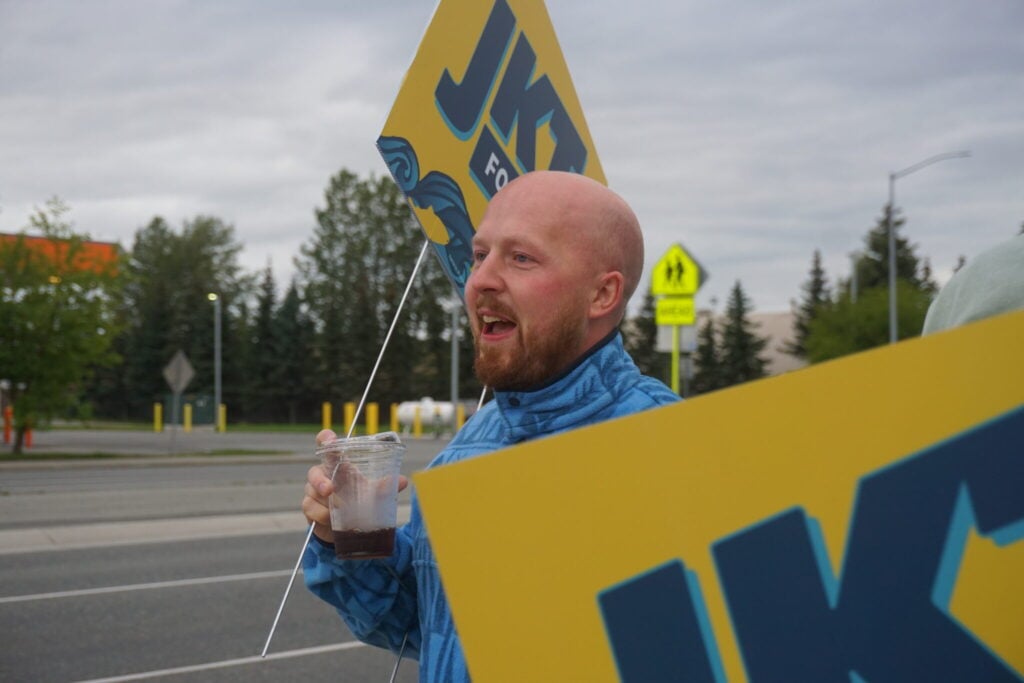
In Anchorage, candidates stood on street corners, waving signs alongside supporters — and competed for space with their opponents.
At one point, Begich — a Democrat — stood on a corner opposite from U.S. Rep. Nick Begich III, his nephew and a Republican.