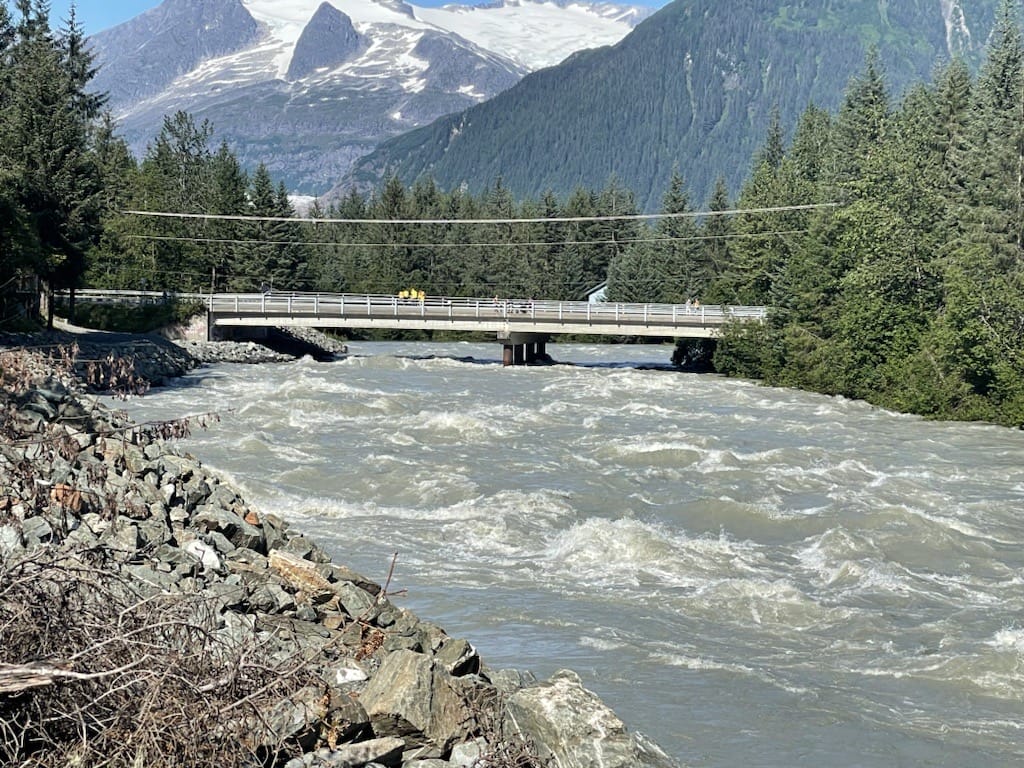
NOTN- State transportation officials say that the Back Loop Bridge will be closed to all traffic during the anticipated Glacier Lake outburst flood also known as GLOF, while Brotherhood Bridge will remain open to vehicles but closed to pedestrians for safety.
“Much like last year, we’re going to close the bridge that’s on Back Loop when the gauge level on Mendenhall Lake hits 12 feet, or at 8:30 at night if it’s predicted to go over 12 feet overnight.” Said Department of Transportation Incident Commander Travis Eckhoff, “Folks will remember last year during the flood we had some damage to an approach that totally washed the approach out on the east side of the bridge. And so, just for everyone’s safety, we’re going to go ahead and close that bridge once it hits 12 feet, and we’ll open it back up once our engineers have had a chance to go and inspect the bridge to make sure everything’s okay.”
Engineers will inspect the bridge before reopening it once water levels subside.
Eckhoff urged residents to heed evacuation boundaries, avoid driving through floodwater and sign up for alerts at 511alaska.gov and with the City and Borough of Juneau.
Drone flights will also monitor infrastructure during the event.
“When the basin releases we’ll be putting out a temporary flight restriction for a specific area. So we advise you don’t fly your drones in that area. We’ll be posting that on our socials. There will be drones in the sky, monitoring important infrastructure and HESCO barriers.” Echkoff said.
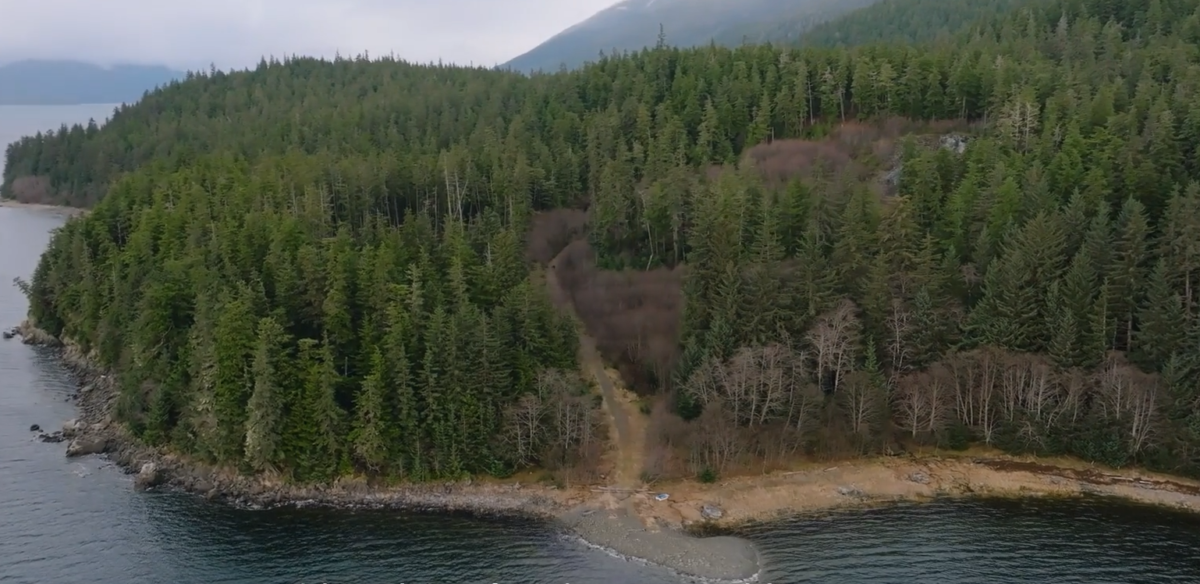
NOTN- A proposed ferry terminal at Cascade Point near Juneau is drawing increasing criticism from Alaska lawmakers and the public alike, who are question its cost, planning and long-term benefit to the state’s struggling ferry system.
“I’m really struggling when we talk about the Cascade Point project and a few of these other proposed items, to understand how, from that statewide perspective, we’re investing the amount of money we’re investing into these projects.” Said Representative Ashley Carrick, “Why this? I’d like this money to stay in Southeast and be reinvested back into the Marine highway system in some way. But when you talk about there being controversy and welcoming the dialog, it doesn’t seem to jive with the fact that the dollars are already dedicated towards this project. So the discussion seems to be sort of moot and after the fact.”
Ryan Anderson, Commissioner for the Department of Transportation and Public Facilities said, “When we are looking at that balance between the cost of a ferry, I view it as the time of a person, so if you can reduce the time you have to be on the ferry by hours, I see that as a value. We’re constantly looking for ways for operational efficiency.”
The Department of Transportation has already begun spending money on the project despite what lawmakers call unresolved issues, including plans for fresh water, sewage handling and access for walk-on passengers.
“They have a sort of big concept of a plan,” Kiehl said. “You shouldn’t start spending money before you’ve worked that stuff out.”
An economic analysis completed earlier this year concluded the project would not pay for itself within a reasonable time frame, Kiehl said. Lawmakers are also concerned that the terminal would not reduce operating costs for the Alaska Marine Highway System, which has faced years of service cuts and budget challenges.
“The other thing that’s super weird is, We really use a lot fewer of Alaskans dollars if we put the projects through the federal process, 9 national dollars for every 1 Alaska dollar.” He said, “I want to be able to promise you that I’m using your money as efficiently as I can. Well DOT has decided to do this with 100% Alaska dollars, no federal money in it.”
The Marine Highway Operations Board has formally opposed the project, and Kiehl said many legislators share those concerns.
“I have a huge number of colleagues who are just saying, this is crazy.” Kiehl said, “When I talk to DOT, and I say, show me the homework, and I get the dreaming stage, that’s tough defense to play.”
Supporters of a proposed ferry terminal at Cascade Point point to a partnership with Goldbelt Inc. as a key advantage, but Alaska lawmakers say the collaboration has not resolved broader concerns about the project.
“I guess most folks in the legislature are really questioning, is a second ferry terminal in Juneau, the way to go? Does it save us money long term? Does it make the ferry system more efficient long term?” Kiehl said.
The Cold Bay dock is seen in 2021 during a visit by the ferry Tustumena. (Photo by Sean Maguire/contributed image)
The Alaska Department of Transportation and Public Facilities is planning a new dock at Cold Bay, one of the most remote stops on the state ferry system’s route map.
More than 600 miles southwest of Anchorage, on the Alaska Peninsula, the town of just 56 people is the gateway to the Izembek National Wildlife Refuge and home to a 10,000-foot runway used as an emergency stop for trans-Pacific flights.
Cold Bay is a stop on the ferry route between Kodiak and Dutch Harbor, but the dock serves more than ferries — it connects the town with ships that supply groceries, water and almost everything else it needs.
State surveys have found that the existing dock “is nearing the end of its serviceable life and is at risk of failing.”
Most of the funding for the new dock is expected to come from the federal government; the Infrastructure Investment and Jobs Act passed by Congress during the Biden administration included $43.4 million for the dock, and the state will contribute another $8.7 million in matching funds.
The final cost of the dock may be higher than that; inflation has driven the cost of all construction projects higher than they were in 2023, when the federal government awarded a construction grant.
Under DOT’s timeline, the project will go out to bid in spring 2027, with construction beginning the following year, and projected to be completed in 2029.
The new dock is expected to be large enough to support the planned replacement for the ferry Tustumena.
One public meeting about the project has already taken place; a second is planned for Tuesday evening, Dec. 16, by Zoom.