Categories
Featured Juneau News juneau Juneau Local Juneau Local Ketchikan Local News Feeds Sitka Local

Procedural objections almost stop Alaska Legislature from extending disaster declaration

By: James Brooks, Alaska Beacon

The Alaska State Capitol is seen behind other buildings on Tuesday, Feb. 10, 2026, in downtown Juneau. (James Brooks photo/Alaska Beacon)

The Alaska Legislature on Wednesday approved a 30-day extension for the state of disaster covering the fall 2025 storms that battered the state’s west coast.

The extension allows the state to continue spending money from its disaster response fund as it continues cleanup and repair efforts from two storms in October. Hundreds of Alaskans were displaced by the disasters, which devastated coastal communities.

The Alaska Senate approved the extension in a 19-0 vote on Monday, but the extension nearly failed in the Alaska House after members of the House’s Republican minority caucus raised procedural issues on Wednesday and said members of the majority were not following state law.

The extension was included in Senate Concurrent Resolution 12, which retroactively approves extensions issued since October and allows the governor to spend more from the state’s disaster response fund. 

“Doing this as a resolution is dangerous, I think it’s a mistake, and I’m not even certain that it’s legal,” said House Minority Leader DeLena Johnson, R-Palmer. 

Johnson and other Republicans said that under their interpretation of state law, legislators would need to approve the spending via a bill, not a resolution.

A legislative attorney, writing in a Feb. 2 memo to Speaker of the House Bryce Edgmon, I-Dillingham, said, “when the legislature means to take action having a binding effect on those outside the legislature, including extending a disaster declaration, the legislature must enact a bill in a special or regular session rather than using the less formal resolution process.”

Johnson was rebutted by House Rules Chair Louise Stutes, R-Kodiak and a member of the House’s majority coalition.

“This is not new money,” she said. “This is money that has been (in the fund) and is being allowed to be appropriated out. … it’s been agreed upon that maybe this wasn’t the optimum way. Nothing’s perfect. We’re moving forward. We are trying to do the best we can as quickly as we can. Time is of the essence, so I ask you to ask yourself: Do you want to be right in how it is done, or do you want to do the right thing when there’s a question?”

The House vote was 22-18, with Rep. Will Stapp, R-Fairbanks, joining the 21 members of the House’s coalition majority in support. All other members of the House Republican minority voted against the resolution.

As debate opened, Rep. Nellie Unangiq Jimmie, D-Toksook Bay, became choked up as she described the disaster, which devastated her district and resulted in the largest peacetime evacuation in state history.

“Today, months later, 340 of our neighbors remain without permanent houses. Mr. Speaker, we are Yup’ik. Our people have lived in this delta for thousands of years. We know storms. We know water. We know loss,” she said. “We have lived on this coast for thousands of years, and we’ve survived ice ages, epidemics, colonization. We’ve survived by adapting, sharing, by refusing to abandon our homes, but you can’t really live when your home floats 10 miles out to sea, when your fuel tanks that heat your home in winter are submerged in salt water.”

On Jan. 28, Gov. Mike Dunleavy requested permission to spend $20.5 million from the disaster response fund, up $5.5 million from a prior request.

When federal money is added to that tally, the total amount is $39.25 million.

More spending is expected. 

Last week, the director of the Alaska Division of Homeland Security and Emergency Management said that the Federal Emergency Management Agency has estimated at least $125 million in state and federal costs related to the storm disaster.

“The declaration allows state agencies to continue their emergency response and to extend state funds as needed,” said Rep. Andy Josephson, D-Anchorage and co-chair of the House Finance Committee.

Rep. Justin Ruffridge, R-Soldotna, took issue with the fact that after Dunleavy declared a state of disaster in October, the Speaker of the House and Senate President approved subsequent 30-day extensions without consulting legislators.

“I think we should have called ourselves in (to special session), or the third floor should have called us in (to special session) to take up this very important issue,” Ruffridge said.

“What precedent does this set for the presiding officers to make the decisions before us on our behalf?” he asked. “What power do we give the executive by allowing disaster declarations to continue without (the House) or the (Senate) taking up that order of business?”

Rep. Dan Saddler, R-Eagle River, said he worries that failing to follow proper procedure could leave disaster relief vulnerable to legal challenge.

“We put the reliability of that relief at question if this is not done right,” he said. 

The day after the vote, Ruffridge said members of the minority have drafted a bill that would fix the problems they see, and that bill is being reviewed by legislative attorneys.

House Majority Leader Chuck Kopp, R-Anchorage, said legislative attorneys have reviewed the majority’s plan.

“We have had our legal department tell us that this passes muster,” he said during the debate.

After the vote, Kopp’s office was unable to provide a legal memo to that effect but said he had received verbal advice.

Josephson, wrapping up debate, said the majority was working in good faith with Dunleavy to get the money out the door quickly.

“Given the urgency of the matter, we’re trying to cooperate with the executive branch,” he said.

Categories
Featured Juneau News Juneau Local Juneau Local Ketchikan Local News Feeds Sitka Local

Trump administration denies full disaster funding for Western Alaska storms, state files appeal

By: Corinne Smith, Alaska Beacon

Eric Phillip, the boardwalk foreman for Kongiganak, Alaska, surveys infrastructure damage caused by Typhoon Halong, Oct. 18, 2025. The Alaska Organized Militia continues coordinated response operations in support of the State Emergency Operation Center following the 2025 West Coast Storm as the mission focus, pursuant to Governor Dunleavy’s declaration of disaster, shifts from lifesaving to life sustainment and stabilization of communities and survivors. (Alaska National Guard photo by Staff Sgt. Joseph Moon)


The Trump administration has denied Alaska’s request for full reimbursement for disaster relief efforts immediately following last October’s devastating Western Alaska storms, despite the Dunleavy administration’s claim that the federal disaster declaration meant the state would be fully reimbursed.

Gov. Mike Dunleavy arrives in Bethel after visiting the storm-damaged villages of Kipnuk and Kwigillingok. (Photo by Eric Stone/Alaska Public Media)
Gov. Mike Dunleavy arrives in Bethel after visiting the storm-damaged villages of Kipnuk and Kwigillingok on Oct. 17, 2025. (Photo by Eric Stone/Alaska Public Media)

That leaves the state on the hook for millions of dollars for disaster recovery, however the full amount is still unknown. 

The state’s request for federal support for 100% of disaster relief efforts in the first 90 days after the storms hit was denied on Dec. 20, according to a spokesperson for the Alaska Division of Homeland Security and Emergency Management on Thursday. 

The state appealed the denial on Jan. 15, and asked for a 90% federal cost reimbursement, but has not yet gotten a response from the Federal Emergency Management Agency. 

“We have not heard back from FEMA on approval or denial and there is no timeframe requirement,” said Jeremy Zidek, public information officer for the division, by email. 

A spokesperson for Dunleavy’s office did not respond to a list of questions, but confirmed the appeal on Friday. “An appeal has been filed and the administration will await the federal government’s decision,” said Jeff Turner, Dunleavy’s communications director. 

In the meantime, the federal government is reimbursing Alaska’s disaster recovery efforts at roughly 75%, leaving the state to cover 25% of its costs, with some exceptions for certain relief programs, Zidek said. 

Following the West Coast storm disaster in October, Dunleavy quickly declared a state disaster emergency. On Oct. 22, his office announced that the Trump administration approved the state’s request for a federal disaster declaration, and the state’s full costs would be covered immediately following the storms.

“President Trump was deeply concerned with the wellbeing of Alaskans who lost their homes and livelihoods to this historic storm,” Dunleavy said in a statement along with the announcement. “I want to thank him and his administration for approving the disaster declaration because now Alaskan families have local, state and federal support for rebuilding their lives in the months ahead.”

“The federal disaster declaration authorizes a 100 percent federal cost share for all categories of relief assistance for the next 90 days,” the statement said. 

Dunleavy’s office did not respond to questions about his previous statement or whether his office had communication from the Trump administration about why the request was denied. 

Alaska’s Republican U.S. congressional delegation applauded the federal disaster declaration and Trump’s support for the Western Alaska disaster response last year. All three members said through spokespeople Friday that they support the state’s appeal. 

U.S. Sen. Lisa Murkowski has been actively engaged with FEMA and state officials throughout the disaster relief efforts, said her communications director, Joe Plesha, in a statement on Friday. “Alaska’s vast geography and many rural communities make disaster response more challenging and recovery efforts significantly more costly,” he said. “She supports the state’s appeal and will work to secure the maximum amount of federal support available to Alaskans who have suffered so much from this devastating storm.”

A spokesperson for U.S. Sen. Dan Sullivan, Amanda Coyne, said the senator has advocated for the 100% federal cost share, as well as organized a delegation of FEMA and other Trump administration officials to visit Western Alaska. 

“Given the severity of the storm and its devastating impacts on communities in Western Alaska, Senator Sullivan believes an increased federal cost share is warranted,” Coyne said. “He will continue strongly advocating with FEMA and other senior officials in the Trump Administration for an increased federal cost share as the state’s appeal goes through the process.”

A spokesperson for Alaska’s lone U.S. Representative, Nick Begich III, said on Friday that he supports the appeal and will continue to advocate for those impacted by Typhoon Halong at the Congressional level. “Our office is in communication with the Administration to ensure recovery efforts in Western Alaska remain a priority,” spokesperson Silver Prout wrote.

Western Alaska storm recovery is ongoing

The Western Alaska storms and particularly ex-Typhoon Halong brought record-breaking winds and flooding — damaging thousands of structures, roads, boardwalks, airports and other critical infrastructure. It prompted the state’s largest mass evacuation of residents from their homes to other villages, Bethel and Anchorage.

Evacuees of Kipnuk and Kwigillingok wait to board an evacuation flight from Bethel to Anchorage on Oct. 15, 2025 (Photo by Corinne Smith/Alaska Beacon)

While some Western Alaska residents are continuing to rebuild through the winter, other residents who evacuated to Anchorage are living in temporary housing. As of Thursday, the Alaska Division of Homeland Security and Emergency Management reports that 471 residents are still sheltering in hotels in Anchorage. 

The state is administering public assistance programs, which reimburse costs of repairing public infrastructure and utilities, as well as provide individual disaster assistance, in partnership with other agencies, including FEMA.

FEMA has awarded $31.2 million in individual assistance to date, Zidek said. 

More than 2,000 residents have been awarded state individual assistance, and 1,794 households have registered for federal assistance from FEMA.

Those applications for state and federal assistance are still open until Feb. 20. 

State disaster relief funding under debate

The state’s disaster relief funding is a point of ongoing debate among lawmakers and the governor, as they kick off discussion of Dunleavy’s proposed $7.75 million budget and its $1.5 billion deficit. 

Last year, legislators approved $23.3 million in state disaster relief funds, but Dunleavy vetoed $10.3 million of that sum last summer, leaving $13 million in the budget. In November, following the federal government shutdown, Dunleavy announced a state disaster to help provide food aid, transferring $10 million to the state’s disaster relief funding from the Department of Environmental Conservation’s Village Safe Water and Wastewater Infrastructure program. 

This year, the governor has requested an additional $40 million in the state’s supplemental budget, which is a routine ask for additional money to pay the state’s bills for the previous year. 

Sen. Bert Stedman, R-Sitka, a co-chair of the Senate Finance Committee, didn’t mince words about the governor’s back and forth with disaster spending. “Ill-advised and foolish,” he said. “It makes no sense what he did to me, frankly, and it’s embarrassing for him, his veto.”

But Stedman said he hopes the state’s federal appeal is approved, and expects legislators to pass the governor’s request for the additional $40 million. “Obviously, 100% is better than 90 and 90 is better than 75,” Stedman said of the federal cost share. “So that’s pretty much a given there. But we will fund the disaster request as the governor puts it on the table, through next week’s amendments.”

Sen. Jesse Kiehl, D-Juneau, also a member of the Senate Finance Committee, commended the governor for his record on disaster response, and echoed hope for the appeal to move forward. “There’s no question in my mind that this is exactly what the federal disaster relief programs exist for. So I think the governor’s request was the right thing, and if it came back at less than full funding from the feds, that’s the wrong call,” Kiehl said.

Kiehl described the state’s fiscal picture, with rising costs and ongoing debates on how to raise more revenues, as “bleak.” “So there isn’t cash just sitting around for disaster assistance,” he said. “We have to step up for western Alaska financially. That’s going to stink, but we have to do it, as far as I’m concerned.”

A typical cost share between the federal government and a state for disaster relief efforts is a 75% federal and 25% state cost split. 

“We have dozens of federal declared disasters we are currently working on that have the 75/25 cost share structure,” said Zidek, with agency. “Large disasters are occasionally given a modified cost share structure adjustment, but it is not guaranteed. When we have a large disaster, we ask for modification to reduce the amount of state funding needed because as managers of state funds it is the responsible thing to do.”

Categories
Featured Juneau News Juneau Local Juneau Local Ketchikan Local News Feeds Sitka Local

View Drive residents asked to gauge interest in federal buyout program

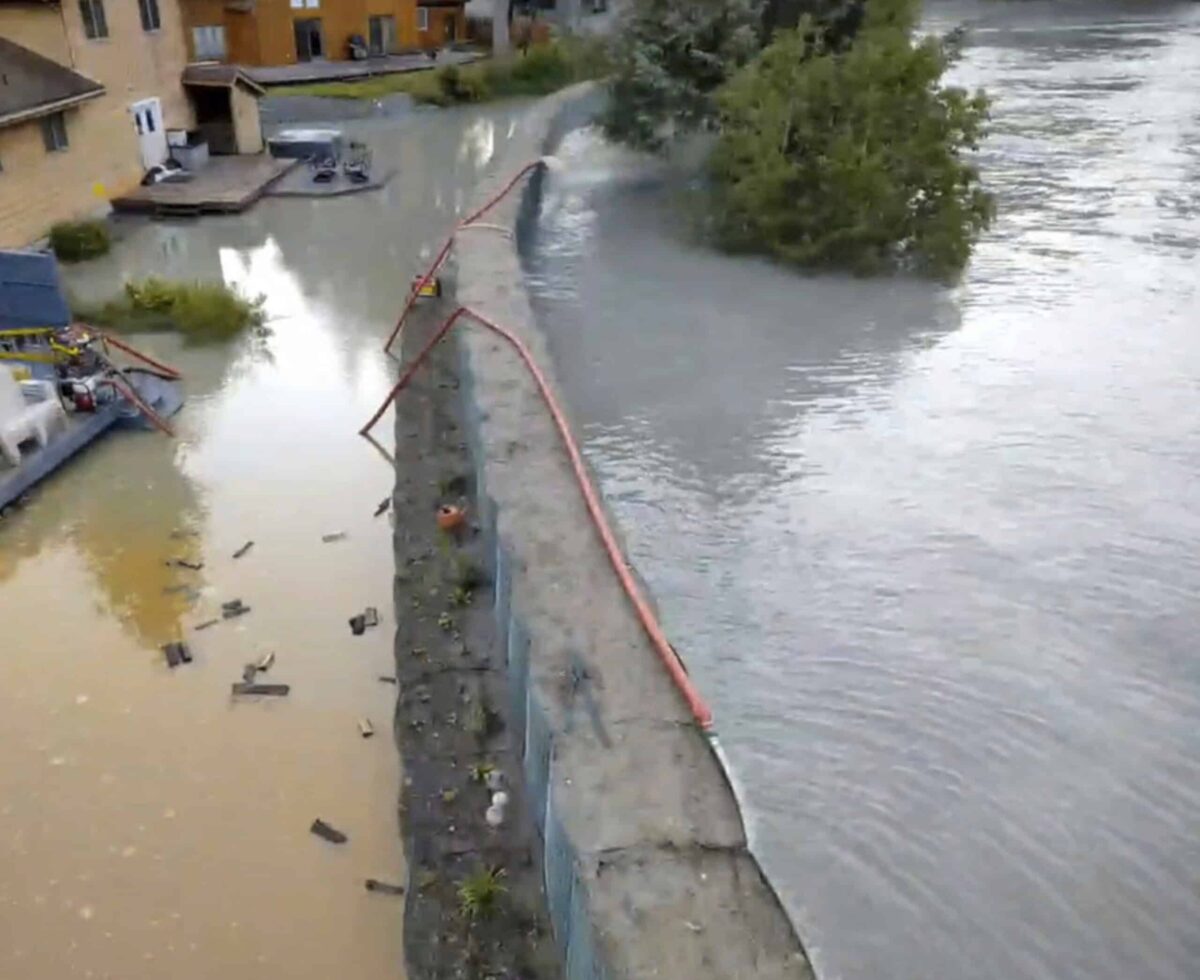
This drone image provided by the City and Borough of Juneau shows flooding from a release of water and snowmelt at Mendenhall Glacier covered some roads and threatened homes along the Mendenhall River in Juneau, Alaska on Wednesday, Aug. 13, 2025. (City and Borough of Juneau via AP)

NOTN- City leaders are asking View Drive homeowners, the area hit hardest by glacial lake outburst flooding, to weigh in on whether they want to pursue a voluntary federal buyout program.

The City and Borough of Juneau is gauging interest in a potential buyout through the U.S. Department of Agriculture’s Natural Resources Conservation Service Emergency Watershed Protection program, (NRCS) which helps communities recover from natural disasters by purchasing at-risk properties and restoring the land.

Under the program, eligible properties would be acquired at fair market value, followed by environmental review, demolition and site restoration. NRCS would cover 75% of total project costs, but Juneau would be responsible for the remaining 25%.

The non-federal match is estimated at about $6 million if all 18 eligible structures on View Drive take part.

City Manager Katie Koester said the city wants to know whether homeowners would be willing to help assemble that non- federal match, either through their own resources or with help from nonprofits and other non-federal sources, asking owners through an informal ballot, to indicate whether they would be willing to participate if that cost share were required, though responses are not binding.

“The Assembly really hasn’t received any official communication from View Drive residents on whether or not they are even interested in participating in the program,” Koester said. “The first important step is sending them an informal ballot to gauge actual interest in participating.”

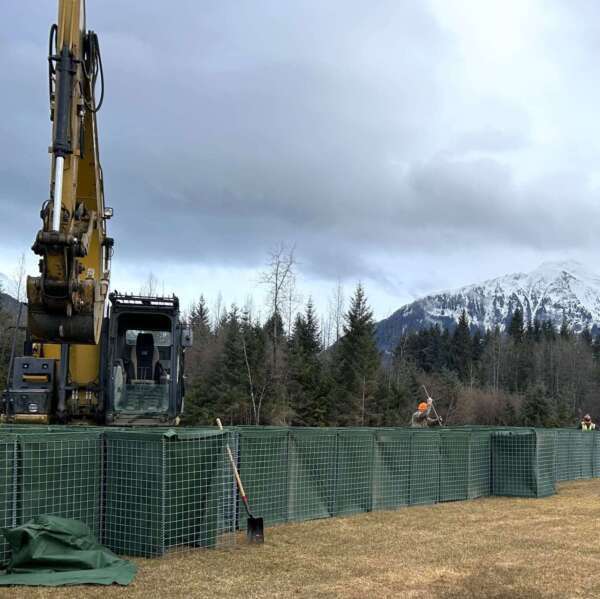
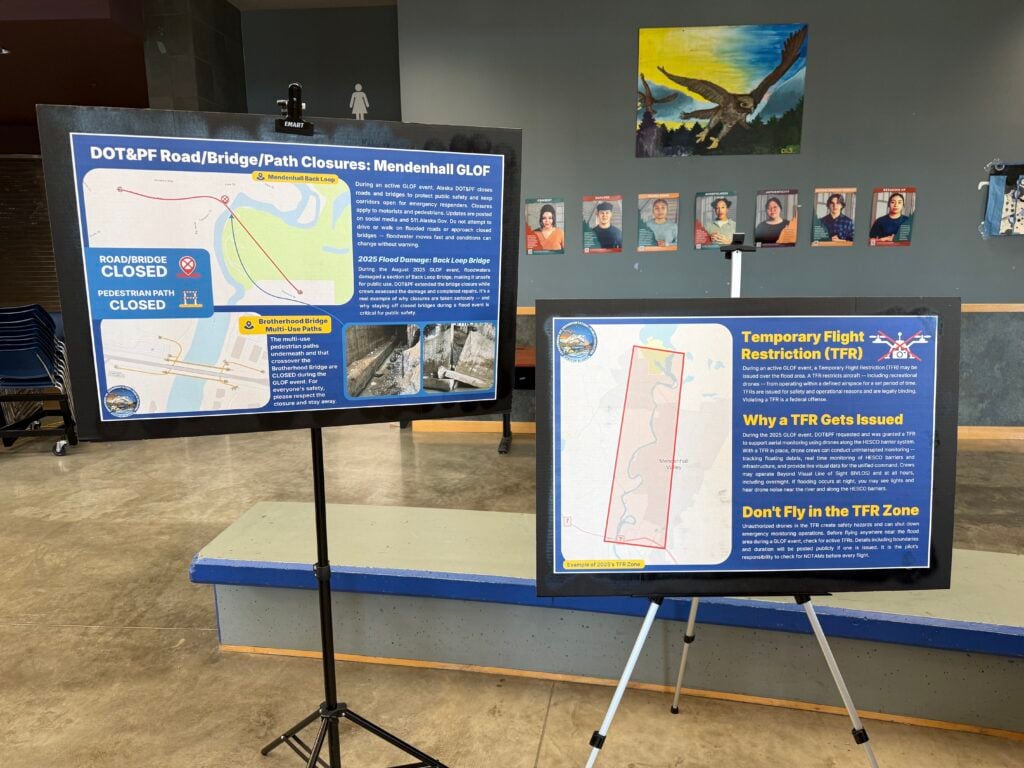
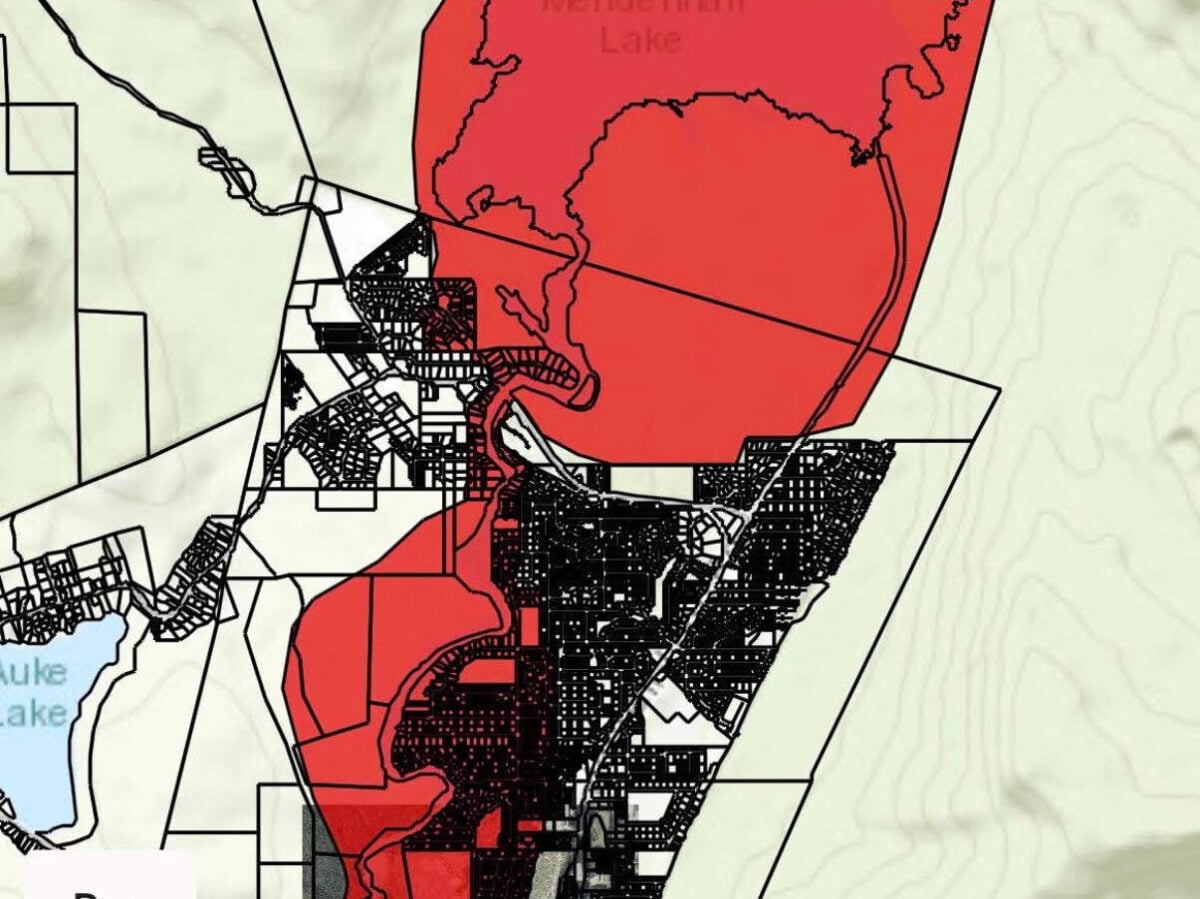
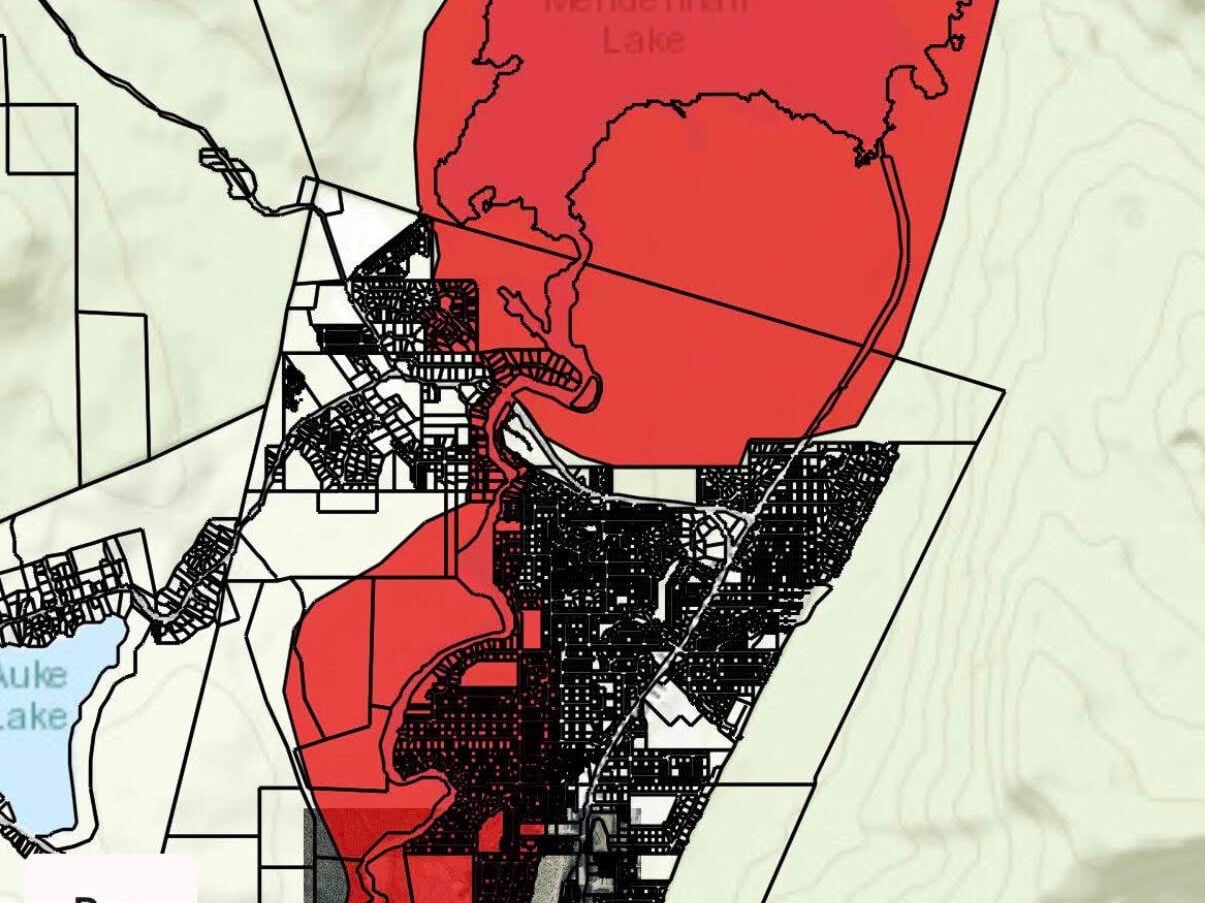
View Drive is considered one of the neighborhoods most vulnerable to annual flooding caused by glacial lake outburst floods, as it sits just outside the reach of the HESCO barriers.

Juneau officials have discussed buyouts as one possible option for residents, particularly as flooding frequency and severity increase, though Koester stressed that whether or not the city goes through with the buy-out program, officials are still committed to an enduring solution.

“I just want to make sure that the public knows that it is the number one priority for the City of Juneau, to find a permanent solution to the flooding, not just for View Drive, but for the entire valley.” She said.

Koester said the Assembly is seeking to understand whether enough property owners would participate to justify moving forward.

Participation in the program would be entirely voluntary, and Koester emphasized that not every property owner would need to opt in for the project to move forward.

“‘It’s totally feasible that four people want to participate, and we move forward, and the rest of the neighborhood does not participate.”

Property owners have until Feb. 16 to return their ballots to the city’s engineering division, those results from residents are expected to be presented at the assembly’s Committee of the Whole meeting on Feb. 23.

Categories
Featured Juneau News Juneau Local Ketchikan Local News Feeds Sitka Local

Avalanche advisory prompts Thane road closure, schools closed as atmospheric river moves into the region

Photo Courtesy of CBJ

NOTN- All Juneau School District (JSD) schools will be closed today January 9, due to the weather.

A statement was released by JSD yesterday evening saying that for the safety of students, staff and families all classes, meetings and activities are cancelled.

City and Borough of Juneau engineers are continuing to monitor the roofs at CBJ facilities during the closures.

Thane Road will be closed at the avalanche gates beginning at noon today due to a high risk of avalanches. An avalanche advisory for all known slide paths also went into effect yesterday evening, and officials warn that hazardous conditions are expected to intensify over the coming days.

The Alaska Department of Transportation and Public Facilities announced the emergency closure for Thane Road, the closure is scheduled to be re-evaluated at 8 a.m. Saturday.

“The avalanche hazard is expected to remain high over the next few days,” DOT said in their social media post, “If a natural avalanche reaches the roadway, it is unlikely DOT&PF will be able to safely remove the avalanche debris until the hazard can be minimized from mitigation work or once the hazard has decreased naturally.”

At the same time, the City and Borough of Juneau warned that avalanche risk across the Mount Juneau slide paths remains high and is expected to significantly increase over the next few days.

An atmospheric system bringing warmer air and precipitation has raised concerns about destabilizing the deep snowpack that has built up over weeks of heavy snowfall. While the situation does not currently warrant an evacuation advisory, city officials said preparations are underway.

Officials said an emergency alert would be issued if an evacuation advisory is called.

Authorities are continuing to monitor avalanche conditions closely and emphasized that public safety remains the priority.

The city is bracing for heavy rain and potential the for more flooding of roadways and storm drains as an atmospheric river is expected to impact much Southeast Alaska into the weekend, weather officials are saying Juneau will see a transition to rain later today.

Categories
Featured Juneau News Juneau Local Ketchikan Local News Feeds Sitka Local

Juneau mayor heads to Washington seeking funding for long-term flood solution

Mendenhall Glacier

NOTN- Juneau Mayor Beth Weldon is travelling to Washington, D.C., this week to press federal officials and Alaska’s congressional delegation for funding and coordination on the city’s long-term solution to recurring flood risk from Suicide Basin, even as the capital city grapples with ongoing winter weather.

“Hopefully we get more money, and we’ll work with some of the agencies to coordinate our enduring solution.” Weldon Said, “So first we’ll talk to our delegation, Representative Begich, Senator Sullivan and Senator Murkowski.”

Weldon said she plans to meet with Alaska’s Delegation to seek immediate geotechnical funding through congressional spending, while also pursuing longer-term financial support through federal agencies, including the Department of Housing and Urban Development and the Federal Emergency Management Agency.

“We’re actually going to talk to the Principal Deputy Assistant Secretary of the Army, and that’s the Civil Works branch, just to make sure that the Secretary and the Army Corps of Engineers are aligned with our project, and we are also talking with the Forest Service and the Office of Budget Management to make sure our path forward is aligned.” Said Weldon.

City leaders and project partners have unanimously selected the Lake Tap option as Juneau’s enduring solution to flooding concerns, Weldon said. The approach was chosen because it is the fastest to implement, the least environmentally disruptive and the most cost effective among the alternatives considered.

“It’s cheapest, as in under a billion dollars, not by much, but all the rest of them were way over a billion dollars.” Said Weldon, referring to other options considered, like an enclosed dike, “And now, even though it’s snowing like crazy, we have to look at our flood, our next big event, which is flooding.”

Categories
Featured Juneau News Juneau Local Ketchikan Local News Feeds Sitka Local

CBJ, Tlingit & Haida, USFS align on ‘Lake Tap’ as an enduring solution for glacial lake outburst flooding

This drone image provided by the City and Borough of Juneau shows flooding from a release of water and snowmelt at Mendenhall Glacier covered some roads and threatened homes along the Mendenhall River in Juneau, Alaska on Wednesday, Aug. 13, 2025. (City and Borough of Juneau via AP)

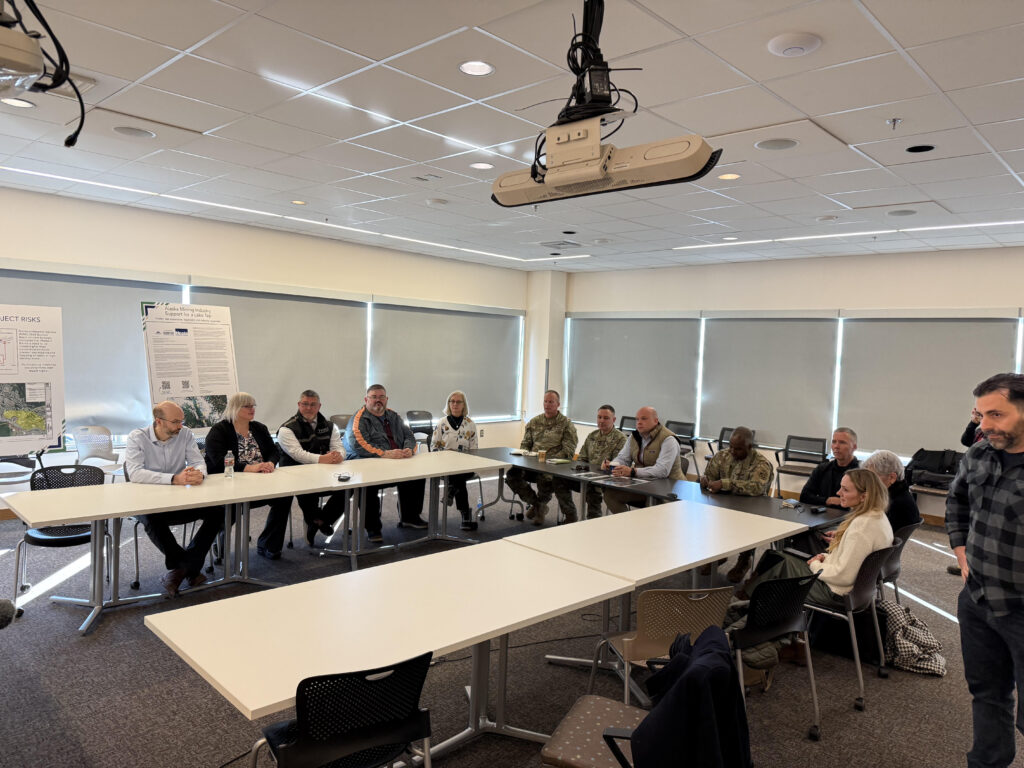
CBJ- Representatives from the City and Borough of Juneau (CBJ), Tlingit & Haida (T&H), and the USDA Forest Service (USFS) this week joined the U.S. Army Corp of Engineers (USACE) and technical experts from relevant agencies to review and evaluate enduring flood-control alternatives for the Glacial Lake Outburst Flooding in the Mendenhall Valley. 

Following three days of technical analysis of the safety, feasibility, constructability, cost and timeline of the five proposed alternatives, T&H, CBJ and USFS united on their shared support for the Lake Tap alternative.

All three agencies encourage USACE to move forward with this option as the focus of the Technical Report.“From the perspective of safety and protection of the community, construction timeline and impact to the area, a lake tap option quickly rose to the top as an enduring solution,” explains Denise Koch, CBJ Director of Engineering & Public Works. “We greatly appreciate the recognition of urgency by the USACE and the contributions of the dozens of technical experts convened to tackle this ongoing threat to our community on accelerated timeline.”

The five alternatives reviewed over the three-day charrette included flood-control dam(s), levees or floodwalls, Suicide Basin lake tap, relocation, and a hybrid option. Experts from USACE and their partners presented a high level of technical data and risk analysis; however, there was wide acknowledgement that future geotechnical studies would be central to the implementation of any solution. Participants also reviewed the public input provided via the 30-day public comment period in November 2025.

“Tlingit & Haida went into this week with the purpose of reviewing all options with a single priority: identify an approach that best safeguards citizens, protects cultural resources, and supports the wellbeing of the broader Juneau community,” said Tlingit & Haida Public Safety Manager Sabrina Grubritz. “The lake tap option appears to best meet those goals with the data currently available.”

Tlingit & Haida and CBJ are the community partners for this critical USACE report. As the impacted land manager, the USFS will also play important role in an enduring solution.

The purpose of the charrette was to determine the focus for the USACE technical report, which will inform the next steps in pursuing an enduring solution to the annual glacial lake outburst flooding (GLOF) events in the Mendenhall Valley. USACE plans to release the technical report in May 2026, with a public comment period to follow. While the completion of a technical report is an important step, it does not guarantee funding for a project construction.  CBJ, Tlingit & Haida and USFS are committed to their joint pursuit of a completed solution as quickly as possible.

“Time is of the essence,” emphasized Koch. “It is going to take close collaboration across government agencies at all levels to get us to an enduring solution. We truly value our strong partnership with Tlingit & Haida, the U.S. Forest Service and USACE, as well as the ongoing advocacy and involvement of our residents and representatives.”

Information regarding the USACE Mendenhall Glacial Lake Outburst Flooding Technical Report is available at the project website.

Categories
Featured Juneau News Juneau Local Ketchikan Local Music News Feeds Sitka Local

Congress approves measure to overturn Biden-era management plan for Alaska petroleum reserve

FILE – In this undated photo provided by the United States Geological Survey, permafrost forms a grid-like pattern in the National Petroleum Reserve-Alaska, managed by the Bureau of Land Management on Alaska’s North Slope. (David W. Houseknecht/United States Geological Survey via AP, File)

AP- Congress has passed a measure to overturn a plan enacted during the Biden administration that put off limits to oil and gas leasing nearly half a vast petroleum reserve in Alaska. Critics see the vote as political meddling that creates confusion over the future management of the National Petroleum Reserve-Alaska.

Tuesday’s House vote followed passage by the Senate during the government shutdown of the resolution disapproving a management plan for the reserve that was finalized in 2022 under then-President Joe Biden. The offices of Alaska’s Republican congressional delegation members have said the resolution “fulfills the objectives” of an Alaska-specific executive order signed by President Donald Trump earlier this year. The executive order called for reinstating a plan dating to the first Trump administration that sought to make available for leasing about 80% of the reserve.

The measure next goes to Trump for consideration.

There has been outsized attention on Alaska since Trump’s return to office, with moves to expand development of oil and gas and other resources cheered by state political leaders who had considered the Biden administration overly restrictive in its approach.

The votes are among the latest taken under the Congressional Review Act that are aimed at nullifying land management plans adopted under Biden. A statement from the congressional delegation last month said the review act provides an expedited way to overturn certain federal rules and forbids an agency from issuing another substantially similar rule unless it’s authorized by law.

But Alex Cohen, director of government affairs for the Alaska Wilderness League, called use of the act a “super, super blunt instrument.” Regulatory policy instead requires “very careful, considered stakeholder engagement, scientific analysis,” he said.

The approach taken by Congress also raises questions about what constitutes a substantially similar rule, Cohen said, adding there is a lack of clarity around what happens when a plan is overturned.

A bill passed earlier this year calls for oil and gas lease sales in the petroleum reserve, for which the last sale was held in 2019, and in the Arctic National Wildlife Refuge.

Major companies sat out the first two lease sales held for the Arctic National Wildlife Refuge; the first was at the end of Trump’s first term and the second near the end of Biden’s.

Categories
Featured Juneau News Juneau Local Ketchikan Local News Feeds Sitka Local

An uncommon program helps children displaced by flooding that devastated Alaska villages

Rayann Martin, a 10-year-old displaced from the village of Kipnuk by ex-Typhoon Halong, left, talks with new classmate Lilly Loewen, 10, right, as they work in the Yup’ik language at College Gate Elementary, Thursday, Oct. 30, 2025, in Anchorage, Alaska. (AP Photo/Lindsey Wasson)

 AP- Rayann Martin sat in a classroom hundreds of miles from her devastated Alaska Native village and held up 10 fingers when the teacher asked the pupils how old they were.

“Ten — how do you say 10 in Yup’ik?” the teacher asked.

“Qula!” the students answered in unison.

Martin and her family were among hundreds of people airlifted to Anchorage, the state’s largest city, after the remnants of Typhoon Halong inundated their small coastal villages along the Bering Sea last month, dislodging dozens of homes and floating them away — many with people inside. The floods left nearly 700 homes destroyed or heavily damaged. One person died, two remain missing.

As the residents grapple with uprooted lives very different from the traditional ones they left, some of the children are finding a measure of familiarity in a school-based immersion program that focuses on their Yup’ik language and culture — one of two such programs in the state.

“I’m learning more Yup’ik,” said Martin, who added that she’s using the language to communicate with her mother, teachers and classmates. “I usually speak more Yup’ik in villages, but mostly more English in cities.”

There are more than 100 languages spoken in the homes of Anchorage School District students. Yup’ik, which is spoken by about 10,000 people in the state, is the fifth most common. The district adopted its first language immersion program — Japanese — in 1989, and subsequently added Spanish, Mandarin Chinese, German, French and Russian.

After many requests from parents, the district obtained a federal grant and added a K-12 Yup’ik immersion program about nine years ago. The students in the first class are now eighth-graders. The program is based at College Gate Elementary and Wendler Middle School.

A principal’s connection makes a difference

The principal at College Gate Elementary, Darrell Berntsen, is himself Alaska Native — Sugpiaq, from Kodiak Island, south of Anchorage. His mother was 12 years old in 1964 when the magnitude-9.2 Great Alaska Earthquake and an ensuing tsunami devastated her village of Old Harbor. He recalls her stories of joining other villagers at high ground and watching as the surge of water carried homes out to sea.

His mother and her family evacuated to a shelter in Anchorage, but returned to Kodiak Island when Old Harbor was rebuilt. Berntsen grew up living a subsistence life — “the greatest time of my life was being able to go out duck hunting, go out deer hunting,” he said — and he understands what the evacuees from Kipnuk, Kwigillingok and other damaged villages have left behind.

He has also long had an interest in preserving Alaska Native culture and languages. His ex-wife’s grandmother, Marie Smith Jones, was the last fluent speaker of Eyak, an indigenous language from south-central Alaska, when she died in 2008. His uncles had their hands slapped when they spoke their indigenous Alutiiq language at school.

As the evacuees arrived in Anchorage in the days after last month’s flooding, Berntsen greeted them at an arena where the Red Cross had set up a shelter. He invited families to enroll their children in the Yup’ik immersion program. Many of the parents showed him photos of the duck, goose, moose, seal or other traditional foods they had saved for the winter — stockpiles that washed away or spoiled in the flood.

“Listening is a big part of our culture — hearing their stories, letting them know that, ‘Hey, I live here in Anchorage, I’m running one of my schools, the Yup’ik immersion program, you guys are welcome at our school,’” Berntsen said. “Do everything we can to make them feel comfortable in the most uncomfortable situation that they’ve ever been through.”

Displaced students join Yup’ik immersion classes

Some 170 evacuated children have enrolled in the Anchorage School District — 71 of them in the Yup’ik immersion program. Once the smallest immersion program in the district, it’s now “booming,” said Brandon Locke, the district’s world language director.

At College Gate, pupils receive instruction in Yup’ik for half the day, including Yup’ik literacy and language as well as science and social studies. The other half is in English, which includes language arts and math classes.

Among the program’s new students is Ellyne Aliralria, a 10-year-old from Kipnuk. During the surge of floodwater the weekend of Oct. 11, she and her family were in a home that floated upriver. The high water also washed away her sister’s grave, she said.

Aliralria likes the immersion program and learning more phrases, even though the Yup’ik dialect being spoken is a bit different from the one she knows.

“I like to do all of them, but some of them are hard,” the fifth-grader said.

Also difficult is adjusting to living in a motel room in a city nearly 500 miles (800 km) from their village on the southwest coast.

“We’re homesick,” she said.

Lilly Loewen, 10, is one of many non-Yup’iks in the program. She said her parents wanted her to participate because “they thought it was really cool.”

“It is just really amazing to get to talk to people in another language other than just what I speak mostly at home,” Loewen said.

Bridging the gap between generations

Berntsen is planning to help the new students acclimate by holding activities such as gym nights or Olympic-style events, featuring activities that mimic Alaska Native hunting and fishing techniques. One example: the seal hop, in which participants assume a plank position and shuffle across the floor to emulate how hunters sneak up on seals napping on the ice.

The Yup’ik immersion program is helping undo some of the damage Western culture did to Alaska Native language and traditions, he said. It’s also bridging the gap of two lost generations: In some cases, the children’s parents or grandparents never learned Yup’ik, but the students can now speak with their great-grandparents, Locke said.

“I took this as a great opportunity for us to give back some of what the trauma had taken from our Indigenous people,” Berntsen said.

Categories
Featured Juneau News Juneau Local Ketchikan Local News Feeds Sitka Local

Army Corps of Engineers to pay for phase 2 HESCO barriers, helping to find enduring solution

NOTN- The City and Borough of Juneau formally accepted Advance Measures Assistance from the U.S. Army Corps of Engineers, to begin Phase 2 of the temporary flood barrier project along the Mendenhall River, city officials announced Thursday.

This marks the next major step in the city’s ongoing effort to protect homes and infrastructure from recurring glacial outburst floods or GLOFs originating from Suicide Basin.

“The Army Corp has committed to helping, really, really substantially with phase two of our short-term mitigation efforts.” Said Deputy City Manager Robert Barr, “And also, to really pursue a quite ambitious timeline for an enduring solution, solutions that would mitigate GLOFS, in such a way that we won’t be seeing these massive 15, 16 plus flood events. So thats really, really good news.”

The Army Corps will provide 100% federally funded assistance to install new riverbank armoring and temporary flood barriers along unprotected sections of the Mendenhall River. The agency will also offer technical support and repairs to the existing flood barrier system completed earlier this year under Phase 1.

“The Phase 2 project is almost three times the size of the first,” said Mayor Beth Weldon.

Construction could begin as early as next spring, Weldon said.

Thursday night’s briefing also featured presentations from scientists and engineers with the University of Alaska Southeast and the National Weather Service.

“The science presentations we received from the university and the weather service were just phenomenal. They’ve been such impressive partners and so important in this work.” Said Barr, “It’s hard to imagine where we would be were it not for the work, it’s really guided and advised us and everyone that’s been working in emergency response and policy management. So really huge kudos to the university and the geological service and the weather service.”

The Army Corps, and the Natural Resources Conservation Service also presented. The NRCS discussed its Emergency Watershed Protection Program, which could provide funding for potential buyouts of flood-prone properties on View Drive.

Phase 2 of the temporary flood barrier would extend protection to remaining populated areas along the river not covered in the first phase.

Categories
Featured Juneau News Juneau Local Ketchikan Local News Feeds Sitka Local

CBJ to host special Glacial Lake Outburst Flood Committee of the Whole Meeting Tonight

CBJ- Several Glacial Lake Outburst Flood (GLOF) mitigation topics will be presented by local experts and federal agencies during a Special GLOF Assembly Committee of the Whole Meeting on Thursday, Oct. 30.

The meeting agenda, presentations and meeting materials are now available at juneauak.portal.civicclerk.com.

The special meeting agenda includes presentations on recent key studies and understanding of the science of Suicide Basin from University of Alaska Southeast and the National Weather Service. Representatives from two branches within the United States Army Corps of Engineers (USACE) will be present to walk through next steps for their respective programs, including both short-term mitigation and progress toward identification of an enduring solution.

The Natural Resources Conservation Service (NRCS) will present on the Emergency Watershed Protection Program and the potential buyout program for View Drive.

Thursday’s meeting will begin at 6 p.m. in City Hall Assembly Chambers and online at the link below. As is standard with Committee of the Whole meetings, public testimony is not included in the agenda, however, members of the public are invited to share questions and comments on the topic at boroughassembly@juneau.gov and emergencyresponse@juneau.gov.