







Categories
Featured Juneau News juneau Juneau Local Juneau Local Ketchikan Local News Feeds Sitka Local

Alaska to replace Black Veterans Memorial Bridge, saving part as tribute to Alaska Highway builders

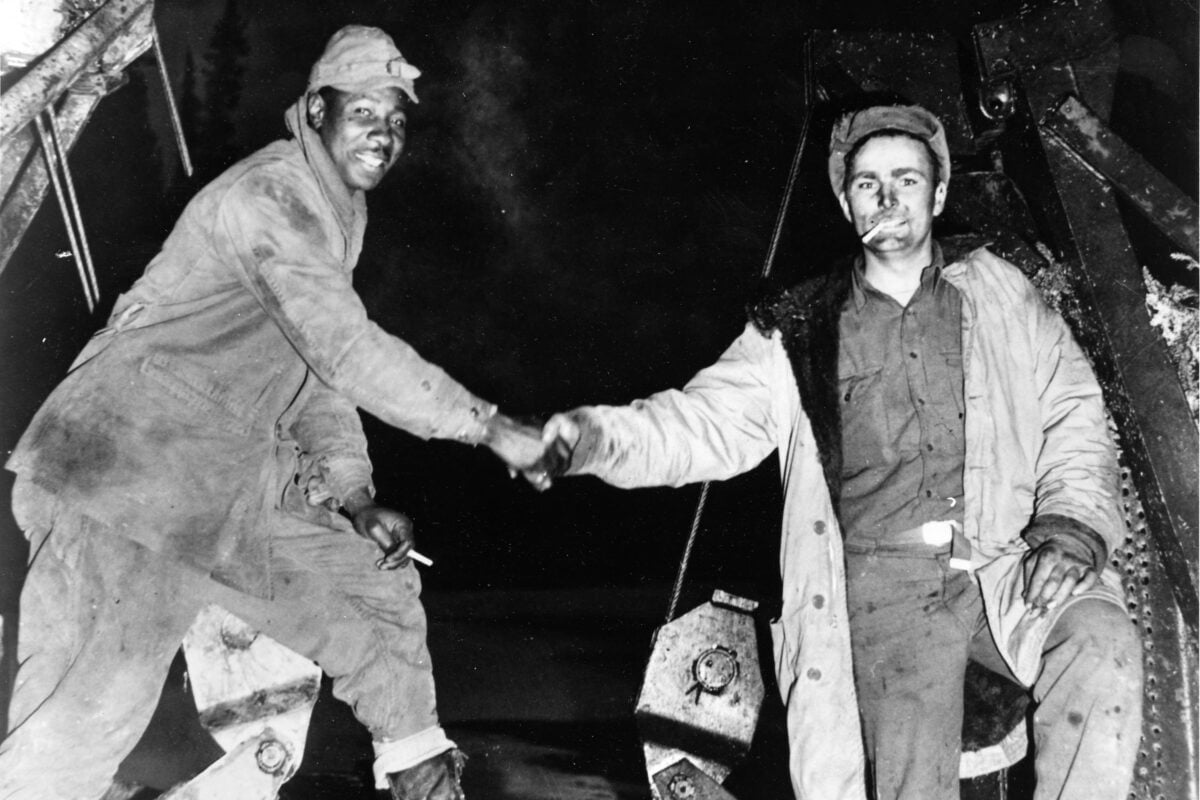
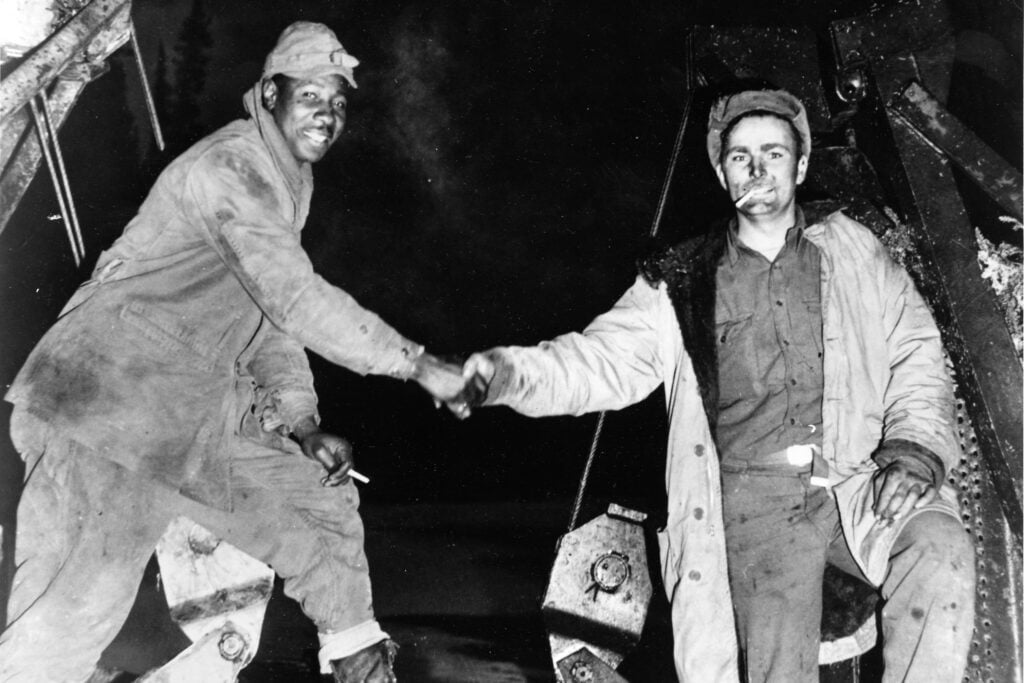
FILE – This Oct. 25, 1942, photo provided by the U.S. Army Corps of Engineers Office of History, shows Corporal Refines Slims, Jr., left, and Private Alfred Jalufka shaking hands at the, “Meeting of Bulldozers,” for the ALCAN Highway in the Yukon Territory in Beaver Creek, Alaska. (U.S. Army Corps of Engineers Office of History via AP, File)

AP-Thousands of Black soldiers performed the backbreaking work of transforming rough-hewn wilderness in extreme weather swings during World War II to help build the first road link between Alaska and the Lower 48.

The work of the segregated Black soldiers is credited with bringing changes to military discrimination policies. The state of Alaska honored them by naming a bridge for them near the end point of the famed Alaska Highway.

Now, eight decades later, the aging bridge needs to be replaced. Instead of tearing it down, the state of Alaska intends to keep two of the bridge’s nine trestles in place as a refashioned memorial. The others will be given away.

Two spans will become the memorial

The state of Alaska will replace the 1,885-foot (575-meter) bridge that spans the Gerstle River near Delta Junction, the end point of the Alaska Highway about 100 miles (161 kilometers) south of Fairbanks.

Seven of the bridge’s trestles are being offered for free to states, local governments or private entities who will maintain them for their historical features and public use.

The two remaining spans from the old bridge, renamed the Black Veterans Memorial Bridge in 1993, will honor the 4,000 or so Black soldiers who built the first wooden bridge over the river while completing the Alaska Highway.

These two sections, the first trestles on either end, will retain the name of the memorial bridge. The new Gerstle River Bridge will unofficially carry the memorial name unless the Legislature also makes it official. The old bridge will remain in place until the new one opens in 2031.

Former mayor wants proper memorial

Mary Leith, a former Delta Junction mayor and member of the historical society, said she’s pleased some of the history will be saved, but she wants the state to have proper signage and a highway pullout area near the historic bridge to allow people to walk on it.

“I would hope that if they’re going to save it, then they save it properly,” she said.

The Black Veterans Memorial Bridge sign will remain and the two sections will be visible from the new bridge, but both will be blocked off to prevent people from climbing or vandalizing them, said Angelica Stabs, a spokesperson for the state transportation department. No pullout is planned.

The new bridge will parallel the existing bridge to the east, leaving about 50 feet of space between it and the old bridge’s location, Stab said.

Soldiers’ work helped integrate the U.S. Army

The project to build a supply route between Alaska and Canada used 11,000 troops from the U.S. Army Corps of Engineers divided by race, working under a backdrop of segregation and discrimination. Besides transforming the rugged terrain, the soldiers had to deal with mosquitoes, boggy land, permafrost and temperatures ranging from 90 degrees F (32 degrees C) to minus 70 F (minus 56 C).

“Though conditions were harsh for all, they were nearly unbearable for black soldiers. From the Deep South, most of these soldiers had never encountered anything approaching the severe conditions of the far north. Moreover, since black troops were not typically permitted to use heavy machinery, they made do with picks, shovels, and axes. In addition, they were prohibited from entering towns and were confined to wilderness assignments,” according to a historical account by the National Park Service.

It took Black soldiers working from the north just over eight months to meet up with white soldiers coming from the south to connect the 1,500-mile (2,400-kilometer) gravel road, then called the Alcan Highway, from Dawson Creek, British Columbia, to Delta Junction Oct. 25, 1942.

“In light of their impressive performance, many of the black soldiers who worked on the Alcan were subsequently decorated and sometimes deployed in combat. Indeed, the U.S. Army eventually became the first government agency to integrate in 1948, a move that is largely credited in part to the laudable work of the soldiers who built the Alcan,” the National Park Service says.

Road expedited after Japanese attacks

Alaska was still a territory, and officials long wanted such a road to the Lower 48. However, battles over routes and its necessity led to delays.

Japanese attacks on Pearl Harbor in Hawaii and Dutch Harbor in Alaska, along with the Japanese invasions of the Alaska islands Kiska and Attu signaled urgency for the road since the ocean shipping lanes to the West Coast could be vulnerable.

Black soldiers working near Delta Junction built a temporary bridge over the Gerstle River in 1942. Contractors finished the steel structure two years later.

Free bridge comes with caveats

The Alaska transportation department is accepting proposals until March 6 for the seven trestles, but you don’t have to take them all. The state will consider all proposals, even those seeking one or two trestles for uses such as a walkway over a creek in a public park.

Winners will have to abide by certain restrictions including not allowing vehicular traffic, paying for removal, transportation and lead abatement, and maintaining the features that make the bridge historically significant.

Categories
Featured Juneau News Juneau Local Ketchikan Local News Feeds Sitka Local

Archaeological site in Alaska that casts light on early Yup’ik life ravaged by ex-Typhoon Halong

The shore of Kuskokwim Bay on the Bering Sea is seen Monday, Oct. 27, 2025, near Kongiganak, Alaska. (AP Photo/Lindsey Wasson)

AP-A fragment of a mask that was preserved for hundreds of years in permafrost sat in the muck of a low tide in the western Alaska community of Quinhagak. Wooden spoons, toys, a fishing lure and other artifacts were strewn, in some cases for miles, along the beach.

The Yup’ik community near the edge of the Bering Sea was spared the widespread devastation wrought by the remnants of Typhoon Halong on its neighbors further west earlier this month. But it suffered a different kind of blow: The lashing winds and storm surge devoured dozens of feet of shoreline, disrupting a culturally significant archaeological site and washing away possibly thousands of unearthed artifacts.

About 1,000 pieces, including wooden masks and tools, were recovered in Quinhagak after the storm ravaged parts of southwest Alaska on Oct. 11 and 12. But many more pieces — perhaps up to 100,000 — were left scattered, said Rick Knecht, an archaeologist who has worked on the Nunalleq, or old village, project for 17 years. That’s roughly the number of pieces previously recovered from the archaeological site.

Meanwhile, freezing temperatures and ice have settled into the region, stalling immediate efforts to find and recover more displaced artifacts on searches done by four-wheeler and foot.

Knecht called what happened a major loss. The site has yielded the world’s largest collection of pre-contact Yup’ik artifacts. Much of what’s known about Yup’ik life before outsiders arrived stems from the project, said Knecht, an emeritus senior lecturer in archaeology at the University of Aberdeen in Scotland.

“When there are holes or disturbances in the site, it’s like trying to read a book with holes in the pages. You’re going to miss a few things,” he said. “And the bigger those holes are, the weaker the story gets. There’s a few holes in the book right now.”

While the name of the original village isn’t known, it was attacked by another village and burned around 1650, he said. Knecht has worked with elders and others in Quinhagak to combine their traditional knowledge with the technology and techniques used by the archaeology teams to study the past together.

Quinhagak has about 800 residents, and subsistence food gathering is critically important to them.

The storm dispersed artifacts from a site long preserved by permafrost, Knecht said. A longstanding concern has been the threat that climate change — melting permafrost, coastal erosion, the potential for more frequent or stronger storms — has posed to the site, he said.

It poses risks to the community itself. Erosion threatens major infrastructure in Quinhagak, including a sewage lagoon, homes and fish camps. Thawing permafrost is also unsettling and undermining buildings, according to a 2024 report from the Alaska Native Tribal Health Consortium.

The excavation project itself began after artifacts began appearing on the beach around 2007. Part of the site that washed out had been excavated previously.

“There was a big chunk where we’d only gone about halfway down and left it for later because we prioritized parts of the site that were most at risk from marine erosion,” Knecht said.

When he left in July, there was a roughly 30-foot buffer to the sea. The storm took out the buffer and another 30 feet of the site, he said. It also left what Knecht described as piano-sized clumps of tundra on the tidal flats.

Knecht didn’t recognize the site at first after Halong.

“I just drove right by it because all the landmarks I’m used to on the beach and at the site were gone or changed,” he said.

Work to preserve the rescued artifacts has included soaking the marine salts from the wood and placing the pieces in special chemicals that will help them hold together when they dry out, he said. If one were to just take one of the wooden artifacts off the beach and let them dry, they’d “crack to pieces, sometimes in a matter of hours.”

There is a lab at the museum in Quinhagak where the artifacts are kept.

Archaeologists hope to return to the site next spring for a “rescue excavation” of layers exposed by the storm, he said. In some ways, it feels like when teams saw the site in 2009: “We’ve got this raw site with artifacts popping off in every way,” he said. “So we’re starting from scratch again.”