Categories
Alaska News Featured Juneau News juneau Juneau Local Juneau Local Ketchikan Local News Feeds Sitka Local

Pipeline-for-pension deal falls apart as the Alaska Legislature’s regular session nears end

By: James Brooks, Alaska Beacon

At left, House Majority Leader Chuck Kopp, R-Anchorage, talks with experts on the proposed trans-Alaska natural gas pipeline during a break in debates Monday, May 18, 2026. To Kopp’s immediate right is Joelle Hall of the Alaska AFL-CIO. At center, gesturing, is former U.S. Sen. Mark Begich, now an adviser to Gov. Mike Dunleavy. (James Brooks photo/Alaska Beacon)

A high-stakes quid pro quo deal fell apart in the Alaska Capitol on Monday as legislators failed to approve a tax break for the proposed trans-Alaska natural gas pipeline and Gov. Mike Dunleavy vetoed a bill that would have restored public pensions in the state.

The failure leaves public employees with a 401(k)-like retirement system and legislators likely to head into a special session for further work on a gas pipeline bill.

Rep. Chuck Kopp, R-Anchorage and the Legislature’s lead negotiator on the planned deal, said on Monday night that “the pension was a good vehicle to help get people there and be more conciliatory towards this gasline legislation than they otherwise would have been. Now that the governor has vetoed the pension, I expect the conciliatory attitudes will suffer.”

Monday was the deadline for Dunleavy to enact or veto House Bill 78, which would have created a new pension plan for Alaska’s public employees. Alaska has not offered a pension since 2006, when lawmakers closed the pension plan to new employees after an actuarial error led to significant underfunding. 

Days ahead of Monday’s veto deadline, Dunleavy offered a deal to legislators — pass a tax break for the proposed gas pipeline, and he would allow the pension bill to become law.

“We said we wanted the gasline bill passed in an acceptable form to the governor’s desk before the deadline on the (defined benefit) bill,” said Jeff Turner, the governor’s communications director. “At that point, he could allow a (defined benefit) bill to go into law.”

Dunleavy told reporters at a news conference earlier this month that the gas pipeline bill should be the Legislature’s top priority.

In March, he introduced two identical bills, one in the House and one in the Senate, with his ideas. Legislators have since held dozens of hearings on those ideas.

If enacted, the governor’s proposal would largely exempt the gas pipeline and supporting infrastructure from state and local property taxes levied on petroleum property. In place of the property tax, the state would levy a tax on gas transported by the pipeline.

The pipeline’s lead developer, multinational firm Glenfarne, has said the change is necessary for it to successfully obtain financing needed to build the pipeline project.

Alaska LNG, as it is known, would ship gas through an 800-mile pipeline, from the North Slope to Southcentral Alaska. As currently planned, the first phase of the project would deliver gas to Alaskans in 2029 and the second phase would allow foreign exports by 2031.

While state legislators generally support the idea of a pipeline, they have balked at the governor’s planned tax breaks, particularly because Glenfarne has thus far declined to provide new estimates for the cost of construction or its expected cost of gas when the pipeline is complete.

That has made it impossible for them to determine whether the proposed tax break is too large, too small, or just right. 

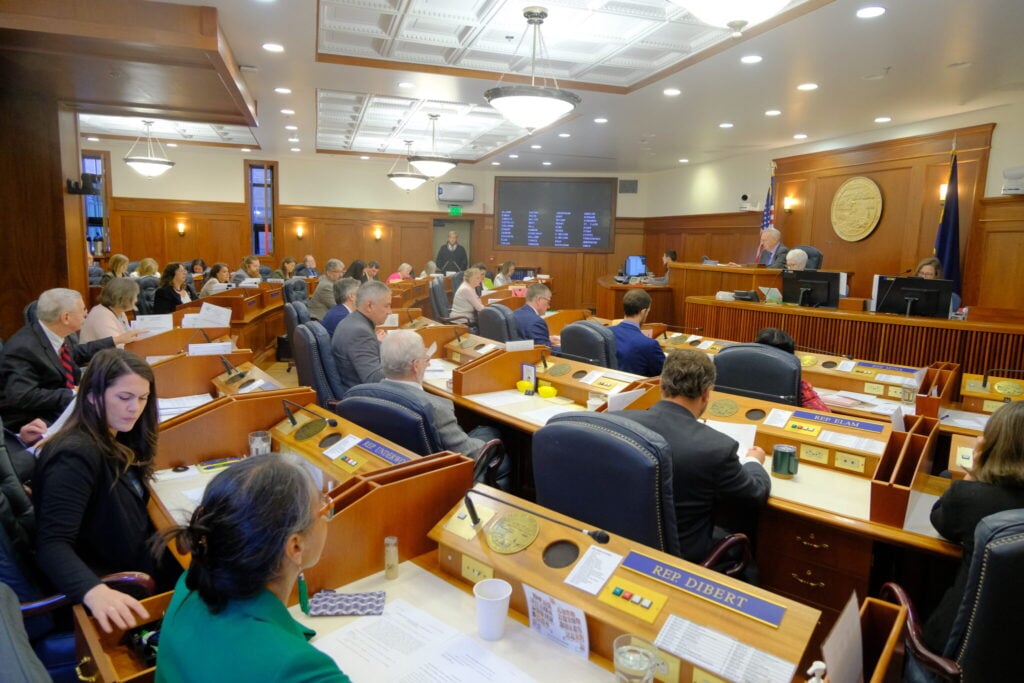
Rep. Chuck Kopp, R-Anchorage, speaks Monday, May 18, 2026, on the floor of the Alaska House of Representatives. (James Brooks photo/Alaska Beacon)

House and Senate each took the governor’s ideas and amended them. Both increased the proposed gas tax — formally known as an “alternative volumetric tax” — mandated construction of a spur line to Fairbanks and required Glenfarne provide early payments to communities affected by pipeline construction.

Senators went further, proposing price controls on gas shipped through the pipeline to Alaskans, an end to a tax exemption that would benefit Glenfarne, and small increases to the state’s oil taxes.

With both bills far from completion, Kopp began negotiating with the governor’s office on a possible compromise.

Kopp has been supporting a pension revival for a decade, and sought a deal that would accomplish two personal goals that also are among the legislative majorities’ top priorities.

On Monday, after days of work, he introduced a compromise gas pipeline proposal as an amendment to Senate Bill 180. That bill was originally written as a one-sentence change to state law pertaining to liquefied natural gas import terminals.

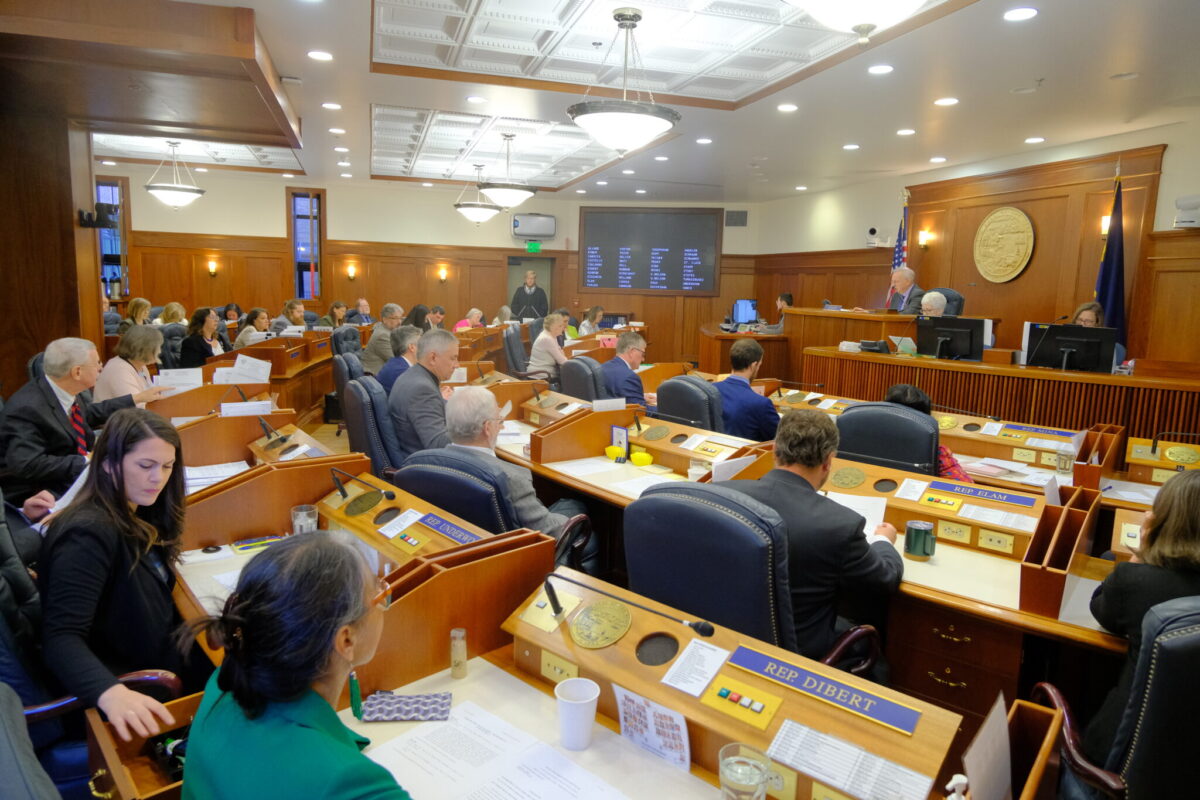
Kopp’s amendment, 22 pages long, was adopted, and House lawmakers began debating, one after another, hours of amendments to Kopp’s amendment. 

In the back of the House chambers, advisers to the governor — who have been working closely with Glenfarne — provided feedback on whether each amendment was acceptable. 

From left to right, Reps. Jeremy Bynum, R-Ketchikan, Neal Foster, D-Nome, and Robyn Niayuq Frier, D-Utqiagvik, talk about an amendment to the gas pipeline bill on Monday, May 18, 2026. (James Brooks photo/Alaska Beacon)

One amendment from Rep. Robyn Niayuq Frier, D-Utqiagvik, derailed that process. Adopted on a 21-19 vote by the House, it would allow the North Slope Borough to negotiate directly with Glenfarne on taxes.

Frier represents the North Slope Borough, and because the project’s large gas treatment plant would be located there, the borough would lose a disproportionate amount of tax revenue with a switch from property taxes to the alternative volumetric tax.

“The amendment was completely necessary,” Frier said afterward, explaining that the borough had been asking for it.

The Kenai Peninsula Borough, planned site of the export terminal, accepted the alternative tax, and lawmakers from that region did not propose amendments similar to Frier’s.

Frier said North Slope officials talked with all of the stakeholders, with the governor’s office and Glenfarne.

“We always knew this was going to be an issue, and I don’t understand why this is such a big deal. They could have been negotiating. They should have been negotiating,” she said. 

Frier said that rather than try to push through a major bill in a single day, she would like to see lawmakers focus on House Bill 381, the House’s gasline bill, in a 30-day special session.

“We need to do the proper vetting, we need the modeling, we need it to go through the Department of Revenue. … We need people to weigh in, not trying to shove this in at the last minute. This is not good process,” she said.

Lawmakers in favor of Kopp’s compromise were unable to quickly reverse Frier’s amendment, and the Senate adjourned shortly after 10 p.m., leaving no avenue for Kopp’s amendment to pass through the Capitol on Monday.

Kopp said afterward that he had negotiated a deal to sidestep Frier’s amendment, but with the Senate adjourned until after the window to veto the pension bill, he said the governor was uninterested. 

“He feels like the outcome has to be 100% controlled. … The House was in position to send over a good gasline bill. The governor simply did not care, because he had to have it in the bag. To me, that’s disappointing, and to me that was very shortsighted,” Kopp said.

With the deal dead, the House adjourned for the day just after 10:30 p.m. The governor’s veto message arrived in the House clerk’s office shortly afterward, at 10:39 p.m.

Alaska Gov. Mike Dunleavy’s legislative director, Jordan Shilling (left) and his deputy legislative director, Forrest Wolfe, watch as assistant legislative director Victoria Schoenheit delivers the veto message for House Bill 78 to the House clerk on Monday, May 18, 2026. (James Brooks photo/Alaska Beacon)

“I share the Legislature’s goal of strengthening recruitment and retention for Alaska’s public workforce,” the governor said in his veto message. “However, House Bill 78 contains unresolved legal, tax, administrative, and fiscal issues that create uncertainty for the State, employers, employees, and the retirement systems themselves.”

Kopp, visibly frustrated, sat in his office after the House’s adjournment.

“He has no allies in the Senate that can help him on the gasline. I was his No. 1 ally in the entire Legislature,” Kopp said, “and he killed the pension bill that I carried. That was his thank you to me. So, I’ll remember that.”

Categories
Alaska News Featured Juneau News juneau Juneau Local Juneau Local Ketchikan Local News Feeds Sitka Local

In Alaska Legislature’s last days, a key question: How much to subsidize the gas pipeline?

By: James Brooks, Alaska Beacon

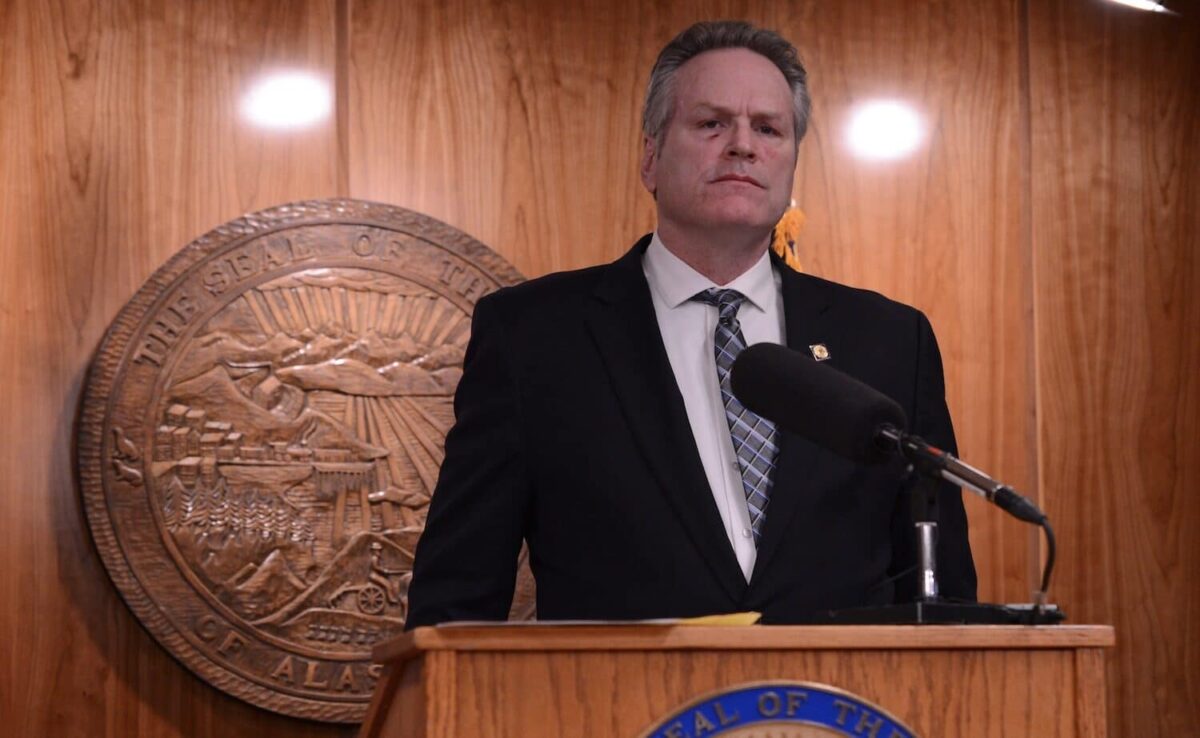
Gov. Mike Dunleavy speaks about at a May 4, 2026, news conference about his property tax bill intended to help draw investment in a massive natural gas pipeline. The news conference was held in his Anchorage office. (Photo by Yereth Rosen/Alaska Beacon)

Alaska Gov. Mike Dunleavy is urging state lawmakers to act on his proposal to cut state taxes by $7.2 billion over the next 36 years to subsidize construction of the proposed trans-Alaska natural gas pipeline.

Failing to act, he said, could keep the pipeline from being built at all. 

“This bill is too important. This concept is too important,” Dunleavy said. “This is not setting up a tax for the lemonade stand down here in the corner by the hot dog stand. This is the biggest (natural gas) project on the planet.”

But some state lawmakers are skeptical about the size of the governor’s proposed subsidy. Two alternatives — one in the House and the other in the Senate — are advancing through committees in the final weeks of the session.

Other legislators believe the pipeline already makes financial sense and no change is needed.

As a result, four different paths await state legislators in their last weeks, and it isn’t clear which one they’ll take — or whether the governor will call legislators into special session on the issue.

There’s also been no agreement with cities and boroughs affected by the proposed tax cut. There’s also no public agreement with North Slope gas producers or the state’s labor unions.

At the core of the problem facing lawmakers is how much — if any — subsidy is needed in order to attract investors who would pay for building the pipeline project in two stages. 

The first stage would involve a pipeline from the North Slope to Cook Inlet for in-state use. The second stage would construct processing plants at the north and south ends of the pipeline, allowing larger volumes of gas to be exported overseas.

If both phases of the project are built, Department of Revenue economist Dan Stickel told legislators on Tuesday, the result would be cheaper natural gas than currently available from Cook Inlet.

“If the full project goes forward, it’s a significant reduction in cost to Alaskans,” he said.

Rep. Zack Fields, D-Anchorage, noted that Alaskans could be locked into high natural gas prices if the second phase is never built or if both phases are built but no exports take place.

For a hearing last week, the Department of Revenue estimated that under that scenario, prices in Anchorage would exceed $27 per thousand cubic feet by 2033, more than double current prices.

It’s unclear how likely that worst-case scenario is.

The larger the subsidy, the greater the chance that the project is built in full and the lower the price of gas for Alaskans, project proponents say.

“Our objective is to have the lowest cost gas for Alaskans and have certainty on the project,” said Adam Prestidge, president of Glenfarne Alaska, the project’s developer.  

A problem, some legislators say, is that they’re working without information. Glenfarne, an international firm that last year bought 75% of the project and became its developer, has not shared its latest estimate for how much the pipeline will cost.

“I think it’s important for us to have starting points on what the actual numbers are, because if it needs tax relief, let’s figure out what the relief is,” said Sen. Bill Wielechowski, D-Anchorage.

Legislators also don’t know how much North Slope gas producers will charge for the gas, or what international buyers will pay for it. 

Some of that information is impossible to know — legislators are trying to anticipate the price of natural gas in 2033 and beyond, once the pipeline is up and running. 

Other information is being kept confidential until a final investment decision or when proposed prices are submitted to state regulators, something that’s months away at the earliest.

Legislators are being asked to take action within weeks.

“We’re not really competitive in the global market if the (cost) overrun is 40%,” said Rep. Julie Coulombe, R-Anchorage, on Tuesday.

The gas pipeline’s publicly stated cost on Tuesday was $46 billion, but most legislators believe the true figure is higher.

“I think it’s really $57 billion … if not higher,” said Sen. Bill Wielechowski, D-Anchorage, relying on a prior statement from former U.S. Sen. Mark Begich.

Begich, a Democrat, lost to Gov. Mike Dunleavy in the 2018 governor’s election. Now, Begich is a paid adviser, hired by Dunleavy’s administration on a $100,000 contract.

In a Tuesday hearing, Begich said lower taxes would not increase profits for investors or developers and would simply lower the end cost of gas for consumers.

“If you lower the tax, it does not go to the return or the profit or anything of this project,” he said. 

“I am just telling you right now, every dollar you save consumers is a dollar in their pocket in an economy that is struggling,” Begich said.

Under his calculations, Wielechowski said, the average Southcentral Alaska family would save $55 per year if the pipeline is built and produces gas according to the latest available cost analysis from the Department of Revenue. 

The subsidy needed to create that savings amounts to a loss of $500 per Alaskan per year, he said, money that could be used for the Permanent Fund dividend or state services.

“That’s not a good deal,” he said of the exchange.

The latest available version of the Senate proposal shows an increase in revenue to the state, rather than a subsidy. Instead of earning $27.9 billion through 2062, the state would earn $42.1 billion.

“I would describe that as very burdensome for the project and potentially prohibitively so,” Prestidge said. 

“I will characterize that tax at that level as something that would require some real reconsideration of the drawing board of how the project is structured and taken forward,” he said.

In the House, discussions have been less acrimonious. The House Resources Committee on Tuesday morning discussed a proposed a subsidy of less than $5.9 billion, smaller than the governor’s concept but similar in other regards. 

“It would be a tax reduction but a smaller tax reduction than proposed by the governor,” Stickel said of the House proposal.

On Tuesday afternoon, the committee worked methodically through a long series of amendments to its plan, frequently consulting Prestidge and Begich about how each might affect financial negotiations.

The House and Senate bills are each in an early stage of development. If passed by the resources committees, each would have to pass through their respective finance committee before advancing to a floor vote and on to the other half of the Legislature.

Categories
Featured Juneau News Juneau Local Juneau Local Ketchikan Local News Feeds Sitka Local

Trump administration set to take bids in federal oil and gas lease sale in Alaska’s Cook Inlet

By: Yereth Rosen, Alaska Beacon

Augustine Volcano looms on Oct. 22, 2025, behind mist hanging over Lower Cook Inlet. The U.S. Bureau of Ocean Energy Management is soliciting bids for exploration rights in federal waters of Cook Inlet in the first of six scheduled federal lease sales to be held through 2032. (Photo by Yereth Rosen/Alaska Beacon)

The Trump administration is soliciting bids for what it intends to be the first in an annual series of oil and gas lease sales in federal waters of Southcentral Alaska’s Cook Inlet.

The upcoming sale will offer about 1 million acres in Cook Inlet, with bids to be opened on March 4, the U.S. Bureau of Ocean Energy Management said on Friday.

The auction has been named the “One Big Beautiful Bill Act Lease Sale 1” because it is the first of six lease sales mandated under the sweeping tax and budget bill passed by Congress and signed by President Donald Trump last summer. The six sales are to be held by 2032, under the bill.

“Regular and predictable federal leasing is the minimum standard for maintaining domestic energy production,” BOEM Acting Director Matt Giacona said in a statement. “Energy security is national security, and this sale reflects a clear, congressionally mandated path forward for Cook Inlet leasing. By offering predictable terms and a transparent process, we are supporting Alaska’s role in meeting America’s energy needs, strengthening national readiness and creating opportunities for investment and jobs.”

Environmentalists criticized the planned sales.

“The relentless push for more oil drilling in Cook Inlet won’t solve Alaska’s energy problems but it will bring a massive risk to this already stressed and polluted waterway,” Cooper Freeman, Alaska director at the Center for Biological Diversity, said in a statement. “The federal government is required to protect our oceans and the fish and wildlife that call them home, but Trump is ignoring that responsibility. From critically endangered Cook Inlet belugas to salmon and razor clams, this sale puts so many species in the crosshairs of a devastating oil spill,” the statement said.

The federal lease sale coincides with the Alaska Division of Oil and Gas’ scheduled annual lease sale for state territory in the Cook Inlet basin. Results of the state lease sale, which is offering 2.9 million offshore and onshore acres, will also be released on March 4.

The planned “One Big Beautiful Bill Act” Cook Inlet lease sales are in addition to several sales that the administration has proposed for nearly all areas of federal waters off Alaska, from the High Arctic to the Gulf of Alaska waters south of the Kodiak Archipelago and the Aleutian chain. The proposed lease sales are listed in a new five-year draft plan released by BOEM in November.

Cook Inlet oil and gas lease sales, whether conducted by the state or federal government, have drawn little interest in recent years. The state’s 2025 lease sale drew five bids, and the most recent federal sale, held at the end of 2022, drew only one bid.

Categories
Featured Juneau News Juneau Local Ketchikan Local News Feeds Sitka Local

Alaska revenue forecast predicts more oil, but its importance to the state budget is declining

By: James Brooks, Alaska Beacon

The trans-Alaska pipeline, seen on Oct. 8, 2008, threads over snow-covered terrain in the Brook Range foothills. A gryfalcon is perched on one of the pipeline’s thermosphyons in the lower center of the photo. (Photo by Craig McCaa/U.S. Bureau of Land Management)

Though the state of Alaska is anticipating more oil production in the fiscal year that starts July 1, money from oil continues to make up a dwindling share of general-purpose state revenue, according to a forecast published Wednesday by the Alaska Department of Revenue.

The projection, one of two per year published by the department, was released in conjunction with Gov. Mike Dunleavy’s draft budget for fiscal year 2027

Altogether, the state expects to earn $6.2 billion in general-purpose dollars between July 1, 2026 and June 30, 2027, the next fiscal year. Officially known as “unrestricted general fund revenue,” it’s the section of the budget where lawmakers and governors focus most of their attention. 

Federal money and money designated for specific programs can sometimes be shifted around to different priorities, but not easily. General-fund dollars can (and are) assigned to different priorities each year. 

The forecast for next year’s unrestricted general fund revenue is higher by almost $260 million than the current year’s expectation, but most of that increase isn’t coming from oil.

Since 2018, an annual transfer from the Alaska Permanent Fund to the state treasury has been the No. 1 source of general-purpose dollars for services and the Permanent Fund dividend. 

That’s more true than ever, according to the state forecast. 

In the next fiscal year, just 23% of the state’s general-purpose revenue is expected to come from petroleum revenue — royalties, property taxes and production taxes.

The Permanent Fund transfer would account for almost 66% of the general-purpose money. 

That difference comes despite an expectation that oil production will rise significantly between this fiscal year and next — from an average of 457,000 barrels of oil per day to 517,800 per day on average.

According to the Alaska Department of Natural Resources, that’s due to the startup of production in the Pikka oil field and other new production on the North Slope.

Despite that new production, oil revenue is expected to rise only slightly — from $1.43 billion to $1.44 billion.

That’s because the state is expecting North Slope oil prices to average just $62 per barrel during the next fiscal year, down from $65.48 in the current fiscal year.

At the same time, the Permanent Fund transfer is rising by almost $200 million, causing oil to become a still-smaller share of state revenue.

Even though revenue is expected to rise between the current fiscal year and the next one, the projected deficit in Dunleavy’s proposed spending plan stands at more than $1.8 billion.

If oil revenue alone were needed to fill that deficit, average North Slope prices would have to be near $100 per barrel, or the state would have to produce more than 1.2 million barrels of oil per day during the next fiscal year, an amount that is geologically, economically and mechanically unfeasible. The state hasn’t posted an annual average of over 1 million barrels of North Slope oil per day since the turn of the century.

Categories
Featured Juneau News Juneau Local Ketchikan Local News Feeds Sitka Local

Alaska regulators order Hilcorp to pay nearly $700,000 for gas injections at North Slope field

By: Yereth Rosen, Alaska Beacon

The Alaska headquarters of Prudhoe Bay operator Hilcorp in Midtown Anchorage is seen on Feb. 7, 2024. The Alaska Oil and Gas Conservation Commission assessed a fine of $695,900 against the company for activities at a Prudhoe Bay satellite field. Hilcorp has the right to appeal the fine. (Photo by Yereth Rosen/Alaska Beacon)

Alaska regulators have assessed a $695,900 fine against Hilcorp for violations at two wells in a North Slope oil field that is a satellite of the giant Prudhoe Bay field.

Hilcorp violated regulations for up to two years when it injected enriched gas into the reservoir at the Polaris Oil Pool, which is part of the Greater Prudhoe Bay Unit, the Alaska Oil and Gas Conservation Commission said in a Nov. 24 decision and order.

Hilcorp is a Texas-based private company that now operates the state’s largest oil field. It is the second-biggest fine for the company ever proposed by the AOGCC.

The highest proposed fine was $720,000, which the commission initially assessed against the company in late 2015 for violations that led to an accident earlier that year that nearly killed three workers at the Milne Point oil field.

Ultimately, the AOGCC in 2017 reduced the fine to $200,000, though the commission assessed other fines at about the same time for other violations at Milne Point. Those fines ranged from $20,000 to $80,000.

In its new enforcement action, the AOGCC said the fine for the Polaris field violations is justified by the company’s pattern of violations.

“Hilcorp’s repeated failure to comply with fundamental injection authorization raises the potential for similar behavior with more serious consequences. Hilcorp’s repeated failure to comply with AOGCC rules and regulations combined with ineffective corrective actions, warrant increased civil penalties to deter similar behavior,” the order said.

Also influencing the fine size is the duration of the offenses. At one well, the unauthorized injection continued for 759 days, the AOGCC said. At the other well, the unauthorized injection went on for 480 days.

Enriched gas is sometimes injected into oil fields to boost oil recovery.

The enforcement action has been in the works for several months.

The AOGCC said that in February, it formally notified Hilcorp that it was investigating the use of enriched gas at the two wells. Hilcorp then conducted an internal investigation, responding to the AOGCC in March with an analysis of the root cause and actions to correct the problem and prevent a recurrence.

Because of that response earlier in the year, the AOGCC said it is not requiring Hilcorp to submit any further written explanation.

Hilcorp has the right to appeal the $695,900 fine. If it does not appeal, Hilcorp must pay within 30 days of the decision, the order said.

A company spokesperson said Hilcorp itself brought the violation to light and that it did not result in any safety or environmental problems.

“This issue involved a highly specific and previously unrecognized authorization gap that neither Hilcorp nor prior Prudhoe Bay operators had identified. We discovered it through an internal review informed by recent AOGCC findings, and we immediately notified the Commission and self-reported all details,” Hilcorp spokesperson Matt Shuckerow said by email.

Shuckerow said the use of enriched gas is safe and permitted on many neighboring wells “as part of an effort to increase resource recovery, which results in increased royalty and revenue to the State of Alaska,” he continued.

“It caused no safety risks, environmental harm or impacts to resource conservation. We have completed a comprehensive review of all wells to ensure no similar gaps exist and will continue working transparently with AOGCC to uphold the highest standards of safety, conservation, and regulatory compliance,” he said.

Shuckerow did not address the question of appealing the fine.

Hilcorp entered Alaska in 2011, focusing first on the Cook Inlet basin, where it is now the dominant operator, before expanding to the North Slope in 2014. In 2020, when BP Exploration (Alaska) Inc. sold its remaining Alaska assets to Hilcorp and ended its activities in the state, Hilcorp became the operator of the Prudhoe Bay unit. Prudhoe Bay is now co-owned by oil companies ConocoPhillipsExxonMobil and Hilcorp.

Since it began operating in Alaska in 2011, Hilcorp has been the subject of 20 AOGCC enforcement orders, including the latest order, according to the commission’s website. Eleven concerned violations on the North Slope and nine concerned violations at Cook Inlet sites, according to the website.

Five of those orders were issued in 2024, including one that assessed a $452,100 fine for unauthorized injections at Prudhoe Bay of a type of gas used to enhance oil recovery.

Different type of enhanced recovery technique gets OK

Although the AOGCC faulted Hilcorp for its unauthorized use of enriched gas at Polaris, it has approved Hilcorp’s plan to try out a different type of enhanced recovery at the field.

The commission on Nov. 25 gave the go-ahead for Hilcorp to use polymer flooding at a different Polaris well for a 12-month test period.

The approval is unrelated to the Nov. 24 order and decision on the enhanced gas violation.

Polymers are natural or synthetic materials, such as cellulose and nylon, that consist of chains of molecules arrayed in a repeated pattern.

Polymer flooding in oil fields injects water-soluble polymers into reservoirs to increase oil recovery. The injected polymers blend with water to better sweep out oil. Polymer flooding is considered an effective technique to boost oil production, but it does not work in all types of reservoirs, according to scientists. The technique is most appropriate for enhanced recovery of heavier oils, according to the U.S. Department of Energy.

Hilcorp pioneered the use of polymer flooding on the North Slope, starting in 2018 with a test project conducted at Milne Point in collaboration with the University of Alaska Fairbanks and the U.S. Department of Energy.

The pilot project was deemed successful, and Hilcorp now uses the technique more widely at Milne Point, where polymer flooding has allowed for much better recovery of the thicker oil that is within that field.

With the help of polymer flooding and other actions, Hilcorp has increased Milne Point production from about 18,400 barrels per day in late 2014 to about 50,000 barrels per day now.

Hilcorp in 2014 acquired 50% ownership in Milne Point from BP and became the operator that year. Hilcorp took full ownership in 2020, after the acquisition from BP was completed.

The company has for years considered expanding some of the practices that have improved production at Milne Point to the parts of the Greater Prudhoe Bay Unit, which also holds some heavier oil. The now-authorized 12-month test at the Polaris well is part of that strategy.

Categories
Featured Juneau News Juneau Local Ketchikan Local News Feeds Sitka Local

Lawsuits challenge land exchange aimed at allowing a road to be built in an Alaska wildlife refuge

Research biologists pause among the wetlands of the Arctic National Wildlife Refuge coastal plain, with the Brooks Range in the background. (Photo by Lisa Hupp/USFWS)

AP- Alaska Native tribes and conservation groups sued the federal government Wednesday, seeking in at least three separate lawsuits to overturn a land exchange aimed at allowing a road to be built through a national wildlife refuge.

Legal challenges to the land exchange agreement reached last month between Interior Secretary Doug Burgum and an Alaska Native village corporation include claims that it was not properly analyzed, that it poses risks to sensitive habitats and that it could threaten migratory birds that some Alaska Natives rely on for food.

King Cove, a community of about 870 people near the Izembek National Wildlife Refuge, has for years pushed to have a road built through the refuge for access to an all-weather airport at Cold Bay, about 18 miles (29 kilometers) away.

Alaska’s governor and congressional delegation have supported the cause, calling it a life and safety issue that would allow for emergency medical evacuations. The delegation has said King Cove’s airstrip can frequently be closed for bad weather, and that high seas can make travel by water between King Cove and Cold Bay challenging.

Terms of the agreement include conveyance by the government of about 490 acres (199 hectares) to King Cove Corp. for a potential road corridor, while the corporation would convey about 1,739 acres (703.7 hectares) to the refuge and relinquish selection rights to additional land. A decision document, signed by Burgum, says the proposed road would be about 19 miles, much of which would be within the refuge. It says it would be up to the corporation to obtain the necessary permits and funding for a road.

Elizabeth Peace, an Interior Department spokesperson, said by email Wednesday that the department doesn’t comment on litigation.

One of the lawsuits was filed by the Native Village of Hooper Bay, Native Village of Paimiut, Chevak Native Village and the Center for Biological Diversity, a conservation group. The tribal governments are hundreds of miles north of King Cove but have expressed concern that a road could impact migratory birds they rely on that stop along the way at the refuge.

Angutekaraq Estelle Thomson, traditional council president of the Native Village of Paimiut, in a statement called the refuge’s eelgrass wetlands “a lifeline for emperor geese, black brant and other birds that feed our families and connect us to Indigenous relatives across the Pacific.”

“We are joining this lawsuit because defending Izembek is inseparable from defending our subsistence rights, our food security and our ability to remain Yup’ik on our own lands,” she said.

Lawsuits also were filed by a coalition of conservation groups, represented by Trustees for Alaska, and by Defenders of Wildlife.

Categories
Featured Juneau News Juneau Local Ketchikan Local News Feeds Sitka Local

Trump administration sets terms for upcoming oil and gas lease sale in Alaska’s Cook Inlet

By: Yereth Rosen, Alaska Beacon

Low clouds hang over Cook Inlet north of Anchor Point on Oct. 23, 2025. The Trump administration is planning an oil and gas lease sale in federal territory of the inlet. It is set to be the first of at six Cook Inlet lease sales that Congress has mandated by held between now and 2032. (Photo by Yereth Rosen/Alaska Beacon)

The Trump administration on Monday outlined its plans to auction 1 million acres of federal offshore territory in what it has called the “Big Beautiful Cook Inlet Oil and Gas Lease Sale.”

The lease sale, to be held early next year under terms detailed in a notice published Monday in the Federal Register, is to be the first of at least six mandated for Cook Inlet through 2032 under the sweeping budget bill that Congress passed this summer. The bill also mandated 30 lease sales through 2040 in federal waters of the Gulf of Mexico.

“President Trump’s signing of the One Big Beautiful Bill Act marked the beginning of a new chapter for oil and gas development in the Gulf of America and Alaska’s Cook Inlet,” Matt Giacona, acting director of the Bureau of Ocean Energy Management, said in a news release issued Friday. “BOEM is now moving forward with a predictable, congressionally mandated leasing schedule that will support offshore oil and gas development for decades to come.”

In the statement, the agency, which is the Department of the Interior division that oversees offshore oil and gas drilling in federal waters, touted the 12.5% royalty offered in the lease sale as an incentive to bidders. The agency statement noted that 12.5% is the lowest royalty rate allowed for offshore oil and gas production in federal territory.

Lease sale bids are to be opened on March 4.

Cook Inlet lease sales held in recent years, whether in federal or state territory, have drawn little industry interest. That is despite the use of some incentives, such as royalty-free terms.

There are only eight active leases in federal waters of Cook Inlet, all held by Hilcorp, the inlet’s dominant operator. One of those leases was acquired in a sale held at the end of 2022 under a requirement inserted into the Inflation Reduction Act; Hilcorp’s bid was the only one in that lease sale.

Hilcorp also was the sole bidder in a 2017 federal Cook Inlet lease sale, when it acquired 14 leases. Last year, it relinquished seven of those leases.

A map shows the planning area for the federal Cook Inlet oil and gas lease sale scheduled for early 2026. The lease sale is the first of six mandated under the budget bill passed by Congress and signed by President Donald Trump in July. (Map provided by the U.S. Bureau of Ocean Energy Management)

There is no pending exploration plan for Hilcorp’s eight federal Cook Inlet leases, according to the BOEM website.

Muted industry interest in past sales

Annual areawide Cook Inlet lease sales held by the Alaska Division of Oil and Gas, for both offshore and onshore state territory, have also produced few bids in recent years.

The 2025 state sale drew five bids, according to results released by the division in June. The 2024 sale drew three bids. The 2023 state sale drew six bids. Each sale offered more than 700 tracts spread over about 3 million acres, and in two of those lease sales, Hilcorp was the sole bidder.

For the upcoming federal lease Cook Inlet lease sale, rules used in the 2017 federal sale will apply, BOEM said.

The agency’s Federal Register notice kicked off a 60-day comment period — but only for Alaska’s governor and for local governments. It is unclear whether tribal governments or any other organizations are included among those invited to comment; a question posed to the Department of the Interior press office was not answered by Monday afternoon.

An automatic emailed message from BOEM spokesperson Jennifer Russo said she could not respond to questions on Monday because of the federal government shutdown.

One environmental group that opposes the lease sale plans to submit public comments nonetheless.

“They’re not asking for comments from the public. But we are still planning to make sure that the people who live in Cook Inlet and Alaska and around the country, their voices will be heard,” said Cooper Freeman, Alaska director of the Center for Biological Diversity.

There appears to be no prohibition on public comments, Freeman noted.

Even though recent Cook Inlet lease sales have drawn little industry interest, he said the center has worries about future leasing.

“We hope that there’s no bids, but we’re taking it very seriously,” he said. “All it takes is one drill rig, one pipeline to burst, and it would be over for the inlet.”

The upcoming Cook Inlet lease sale process is separate from a court-mandated review of the 2022 lease sale.

A lawsuit filed by the Center for Biological Diversity and other organizations resulted in a federal court ruling last year that found the presale analysis to be flawed. U.S. District Court Judge Sharon Gleason ordered BOEM to conduct further analysis of leasing impacts to endangered Cook Inlet beluga whales and other natural resources.

BOEM, in a Federal Register notice published in September, said it plans to complete the supplemental impact statement by the end of the year.

The agency said that it will not release the draft study for public comment and will hold no public hearings on the draft, a departure from procedures followed in past environmental studies.

The lack of public comment opportunities or planned public hearings has angered some Cook Inlet area organizations.

Cook Inletkeeper, an environmental group, has launched a petition drive calling for the normal public process to be reinstated.

Categories
Featured Juneau News Juneau Local Ketchikan Local News Feeds Sitka Local

Interior Dept. advances Ambler mining road, King Cove road and ANWR drilling in signing ceremony

By: James Brooks and Corinne Smith, Alaska Beacon

US Department of Interior Sec. Doug Burgum at a news conference with Gov. Mike Dunleavy, Alaska’s congressional delegation US Sen. Lisa Murkowski, Rep. Nick Begich, and Sen. Dan Sullivan, announcing several actions advancing resource development projects in Alaska on Oct. 23, 2025 (Screenshot)

The federal government is proceeding with efforts to expand drilling in the Arctic National Wildlife Refuge, mining in northwest Alaska, and construction of a road between King Cove and Cold Bay on the Alaska Peninsula, US Interior Secretary Doug Burgum announced Thursday.

At an event in Washington, D.C. that was dubbed “Alaska Day” by the federal department, Burgum signed a series of documents pertaining to all three projects as well as an ongoing effort by the federal government to give land to the families of Alaska Native Vietnam War veterans.

“This is our first, this won’t be our last, Alaska Day. We have a lot more things to accomplish, a lot more things to celebrate going forward,” said Burgum, flanked by Gov. Mike Dunleavy and all three members of the state’s congressional delegation.

“I told the president, it’s like Christmas every morning,” said Dunleavy. “I wake up, I go to look at what’s under the proverbial Christmas tree to see what’s happening. And here’s another example of more presents for not just Alaska, but for this country.”

Tribal and environmental groups opposed to the three development projects saw Thursday’s action differently, with Defenders of Wildlife, a national group, dubbing the event “Alaska Sellout Day.”

“Today’s announcements are the latest step in Donald Trump’s plan to sell out our wildest landscape and natural heritage to corporate polluters,” said Dan Ritzman, director of conservation for the Sierra Club. 

What was done on Thursday

Burgum signed previously announced permits for the 211-mile Ambler Road, which is intended to connect the Dalton Highway with a series of potential mine sites in the Brooks Range of northern Alaska.

He also signed a record of decision for the federal government’s oil and gas drilling program in the coastal plain of the Arctic National Wildlife Refuge of northeast Alaska. 

That re-establishes a program that had been in place during the first term of President Donald Trump but which was subsequently reversed by President Joe Biden.

Burgum also reversed the Biden administration’s decision to suspend oil and gas leases issued by the federal government in 2020 to the Alaska Industrial Development and Export Authority.

Barring further litigation, that move clears the way for AIDEA — Alaska’s state-owned development bank — to begin seismic surveys that could reveal the amount of oil available within parts of the Arctic refuge’s coastal plain.

While the Ambler and ANWR actions effectively took the projects back to where they stood in 2020, the King Cove road is now closer to construction at any point in its decades-long development process.

Envisioned as a gravel road between King Cove and an all-weather airport at Cold Bay, the road would pass through the Izembek National Wildlife Refuge, a nationally important bird sanctuary.

Eleven miles of new road are needed to link existing roads to the two towns, but those 11 miles would pass through a wilderness area. 

On Thursday, Burgum signed documents that complete a land exchange between King Cove Corp., the local Alaska Native corporation, and the federal government. King Cove Corp. gives up about 31,200 acres to expand the refuge, and in return, it receives the 490 acres of refuge land needed to complete the road.

In a move with more limited statewide impact, Burgum signed paperwork awarding three Alaska Native Vietnam War veterans with 160-acre plots of land under a federal allotment program. As of March, 453 veterans and their families had requested plots authorized under legislation authored by Alaska Sens. Lisa Murkowski and Dan Sullivan.

For King Cove, a medevac-avoiding road moves forward

King Cove’s airport is frequently closed by bad weather, and since 2014, there have been more than 100 Coast Guard medevacs from the community because regular air ambulance service was unavailable. 

Murkowski, who has previously vowed to complete the road, noted that this is the third time that the federal government has embarked on a land exchange for the road, with the prior two attempts blocked and reversed by litigation.

“We’ve reached a point with the King Cove exchange that we haven’t yet before, and that’s actually the official patent being issued to KCC, so we’re one step further. I think that’s important,” she said.

The road, though supported by local residents, is opposed by some Yukon-Kuskokwim river delta tribal leaders and subsistence bird hunters who fear its effects on wildlife.

“Surely, the people of King Cove can see the value of leaving the habitat for so many species intact would be far more valuable than any road could be,” said  Angutekaraq Estelle Thomson, Traditional Council President of the Native Village of Paimiut, one of several communities that have supported lawsuits seeking to prevent road construction.

Rebecca Noblin, an attorney with the Center for Biological Diversity who has fought the road on behalf of several area villages, said Thursday that “we have significant questions about the legality of the exchange. We, along with the Native Villages of Hooper Bay and Paimiut, expect to bring those issues to court soon. Road construction will also require additional permits, including an Army Corps 404 permit and Endangered Species Act consultation, so this is far from a done deal.”

With Ambler and ANWR, a triumph of economics over environment

On the first day of his second term in office, Trump issued an executive order seeking to encourage oil and gas development, mining and logging in Alaska.

US Rep. Nick Begich, R-Alaska, US Dept. of Interior Sec. Doug Burgum, and Alaska Gov. Mike Dunleavy pose for a photo at a news conference announcing advancements to several resource projects, including oil drilling in the Arctic National Wildlife Refuge on Oct. 23, 2025 (Screenshot)

Elected officials said they see Thursday’s actions in line with that decision. 

Alaska Republican Rep. Nick Begich said projects like the Ambler Road and ANWR drilling matter because they create jobs.

“We need the jobs. We need high-paying, good jobs, and these resource industry jobs fit that bill completely. And so whether it’s mining, timber, oil and gas development or other resources, these are necessary for the functioning of Alaska’s economy,” he said.

The coastal plain of the Arctic National Wildlife Refuge is believed to contain billions of barrels of recoverable oil that could be sold on global markets. 

Sullivan noted that previous North Slope oil development has been good for the region’s residents. 

“The life expectancy, mostly of the Native people in our state, has increased in the North Slope and the Northwest Arctic Borough and by dramatic numbers … and a lot of that is due to the benefits that come from responsible resource development: jobs, revenues, water and sewer, gymnasiums, health clinics. So it’s a real life and death issue,” he said.

The predominantly Alaska Native town of Kaktovik is located on Barter Island, within the refuge.

“Developing ANWR’s Coastal Plain is vital for Kaktovik’s future,” said the town’s mayor, Nathan Gordon Jr., in a written statement. “Taxation of development infrastructure in our region funds essential services across the North Slope, including water and sewer systems to clinics, roads, and first responders. Today’s actions by the federal government create the conditions for these services to remain available and for continued progress for our communities.”

To date, no oil companies have shown interest in drilling within the refuge, leaving only Alaska’s state-owned development bank, which won leases in a 2020 sale, to work there.

So far, no actual work has taken place because of repeated lawsuits seeking to overturn the sale.

The bank, which has filed several lawsuits over federal restrictions on drilling within the refuge, did not respond to a request for comment on Thursday.

Several legal challenges to the 2020 ANWR plan of development — which was restored Thursday — are still pending in federal court. 

Some of those challenges revolve around the possible effects that ANWR development and the burning of those fossil fuels will have on climate change.

Thursday’s announcement came just a week after the remnants of Typhoon Halong devastated coastal communities in southwestern Alaska. Experts say that storm was worsened by climate change.

Murkowski said she does not shy away “from the fact that the impact of that typhoon was made more fierce and more destructive because it was able to travel over a large body of what is now warmer, open ocean with lack of ice. I get that, and I call it climate change.”

At the same time, people worldwide are continuing to consume fossil fuels. Murkowski said that for her, the choice is straightforward: Will they get those fossil fuels from Alaska or some place with worse environmental standards?

“I’d much rather be producing in Alaska, than just across the Bering Strait there, over in Russia, where I don’t think that they respect the same level of environmental standards and safeguards,” she said. “So is it complicated? Yes. But am I proud of how Alaska has led in terms of meeting environmental standards that are amongst the highest in the world? I am.” 

What comes next for Ambler, King Cove and ANWR?

All three development projects boosted by the federal government on Thursday are a long way from construction, both supporters and detractors say.

In all three cases, proponents need to obtain additional federal permits and will have to cope with lawsuits brought by opponents.

The environmental law firm Earthjustice has repeatedly been involved in lawsuits against the federal government over the issue of arctic refuge drilling.

“Interior has re-adopted the maximally destructive plan from President Trump’s first term,” said Earthjustice attorney Erik Grafe, by email on Thursday. “That plan was unlawful in 2020 and is still unlawful today. The bedrock environmental laws that protect the Arctic Refuge’s irreplaceable natural resources remain despite Congress passing reconciliation bills on leasing in the refuge.” 

The Gwich’in Steering Committee, represented by attorneys from Trustees for Alaska, is among the organizations that have repeatedly sued to block drilling in ANWR. 

The committee is concerned about the effect that refuge development would have on local caribou herds used by subsistence hunters. In a statement, the committee’s executive director, Kristen Moreland, implied that further litigation will come.

“This action by the Trump administration is a direct attack on the Gwich’in, who have for decades been a voice for the caribou and stood against the destruction of the Arctic Refuge. A leasing program that would open the entire Coastal Plain completely ignores the impacts that oil and gas development would have on the land, on wildlife, and on our communities,” she said.

“We condemn these efforts by the Trump administration to exploit the calving grounds of the Porcupine Caribou herd for short-term gain, and we know that we are not alone. We will continue to raise our voices and fight for the protection of this sacred land and for our way of life.”

The Arctic National WIldlife Refuge coastal plain at the outflow of the Hulahula River, is seen on July 8, 2019. (Photo by Danielle Brigida/U.S. Fish and Wildlife Service)
Categories
Featured Juneau News Juneau Local Ketchikan Local News Feeds Sitka Local

Trump administration moves toward an Arctic Alaska oil lease sale despite the government shutdown

Yereth Rosen, Alaska Beacon

Along the trans-Alaska oil pipeline, pictured here, runs a smaller-diameter natural gas line used to fuel the oil pipeline's pumps. That small-diameter line could be a source of fuel for a new Bitcoin mining operation on the North Slope. (Arthur T. LaBar/Flickr under Creative Commons License)
Along the trans-Alaska oil pipeline, pictured here, runs a smaller-diameter natural gas line used to fuel the oil pipeline’s pumps. That small-diameter line could be a source of fuel for a new Bitcoin mining operation on the North Slope. (Arthur T. LaBar/Flickr under Creative Commons License)

Despite the federal government shutdown, the Trump administration is proceeding with new oil leasing on Alaska’s North Slope.

The U.S. Bureau of Land management said Tuesday it will be accepting nominations for areas to auction in an upcoming oil and gas lease sale in the National Petroleum Reserve in Alaska. The call for nominations is the first step in the leasing process; comments on suggested leasing areas will be taken for 30 days, the BLM said.

The information is in a Federal Register notice scheduled to be published on Wednesday.

The pending lease sale is in accordance with the sweeping budget bill, signed by President Donald Trump on July 5, that he and his supporters call “The One Big Beautiful Bill.” The bill requires the BLM to hold at least five lease sales, each offering at least 4 million acres, over the next 10 years.

“Congress directed a program of expeditious leasing and development in the NPR-A to support America’s energy independence, and that is more important today than ever,” Kevin Pendergast, Alaska state director for the BLM, said in a statement. “This lease sale gets us back on track toward further exploration and development in the reserve, as Congress envisioned.”

The upcoming lease sale is intended to be under new Trump-era rules that remove protections enacted by the Biden administration, the Obama administration and earlier administrations, dating back to former President Ronald Reagan’s term.

A female caribou runs near Teshekpuk Lake in the National Petroleum Reserve in Alaska on June 12, 2022. The Teshekpuk Caribou Herd gives birth to its calves in the land around the vast lake, the largest on the North Slope. (Photo by Ashley Sabatino/ U.S. Bureau of Land Management)
A female caribou runs near Teshekpuk Lake in the National Petroleum Reserve in Alaska on June 12, 2022. The Teshekpuk caribou herd gives birth to its calves in the land around the vast lake, the largest on the North Slope. Under the Trump administration, long-protected areas and around the lake will be opened to oil development. (Photo by Ashley Sabatino/ U.S. Bureau of Land Management)

Under the Trump rules, more than 18.5 million of the reserve’s 23 million acres are designated as available for leasing. That includes the ecologically sensitive Teshekpuk Lake, the largest lake on the North Slope, which is important habitat for migratory birds and which is adjacent to the calving grounds for the Teshekpuk caribou herd.

Lease sales in the reserve were held about every two years from 1999 to 2010 and annually from 2011 through 2019, but with protections for certain areas, including Teshekpuk Lake.

The Obama administration had a policy of coordinating those federal auctions with the annual areawide North Slope, Beaufort Sea and Brooks Range Foothills sales held by the Alaska Division of Oil and Gas. Coordinated timing on those enhanced industry interest and convenience, agency officials said at the time.

No lease sales have been held since the 2019 auction held under the first Trump administration. After that, that administration shifted its focus to the Arctic National Wildlife Refuge. Two lease sales were held in the refuge, in January 2021 and January 2025. The first of those sales drew few bids, none of them from major oil companies, and the 2025 sale drew no bids.

Environmentalists criticized the move toward a sale during a government shutdown.

“The Trump administration’s outrageous announcement shows a sad truth in our country today: The government is open for resource extraction corporations and closed for the people,” Andy Moderow, senior director of policy at Alaska Wilderness League, said in a statement. “At a time when our government is shut down and essential public workers aren’t getting paid, it’s outrageous that federal leaders are prioritizing oil and gas sales over getting the country back on its feet.”

Red-necked phalaropes forage in the wetlands found in the northeastern section of the National Petroleum Reserve in Alaska. (Photo by Bob Wick/U.S. Bureau of Land Management)
Red-necked phalaropes forage in the wetlands found in the northeastern section of the National Petroleum Reserve in Alaska. Teshekpuk Lake and the wetlands around it comprise one of the top habitats for migratory birds anywhere in the Arctic. The Trump administration has opened those wetlands to oil development; they had been off-limits for decades. (Photo by Bob Wick/U.S. Bureau of Land Management)

Cooper Freeman, Alaska director at the Center for Biological Diversity, echoed that sentiment in a different statement.

“The Trump government clearly isn’t shut down for the oil industry, with millions upon millions of Alaska’s western Arctic recklessly open for exploitation and desecration,” he said.“We can’t let this administration destroy key habitat for cherished wildlife like caribou, polar bears and millions of migratory birds for nothing more than stuffing oil barons’ pockets.”

A Department of the Interior spokesperson said certain BLM employees remain on duty to handle energy issues, a subject that Trump has said needs emergency action.

“Activities necessary to address the President’s declaration of a national energy emergency are continuing during the lapse in appropriations. The Bureau of Land Management has staff working in both exempt and excepted status to carry out essential energy-related responsibilities, including review of nominations for the National Petroleum Reserve–Alaska lease sale,” said Alice Sharpe, senior public affairs specialist with the department, in an email.

Unlike the Arctic refuge, which is on the eastern side of the North Slope, the National Petroleum Reserve on the western side of the North Slope has drawn industry interest. The reserve is underlain by an oil-rich formation called Nanushuk that has yielded significant discoveries on both federal and state land.

Some of those discoveries have resulted in producing oil fields, and more are expected. ConocoPhillips’ huge Willow project, which the company has said will produce up to 180,000 barrels a day from reserves totaling about 600 million barrels, is located in the reserve and is set to become the North Slope’s westernmost producing oil field.

Categories
Featured Juneau News Juneau Local Ketchikan Local News Feeds Sitka Local

No public comment or hearings on environmental review of oil leasing in Alaska’s Cook Inlet

By: Yereth Rosen, Alaska Beacon

 Cook Inlet waves roll onto the beach at Kenai on Aug. 14, 2018. The U.S. Bureau of Ocean Energy Management is preparing a supplemental environmental impact statement to address legal deficiencies in a 2022 lease sale. (Photo by Yereth Rosen/Alaska Beacon)

Federal regulators will accept no public comments on a pending environmental study of oil leasing in Alaska’s Cook Inlet, a U.S. Department of the Interior agency announced through a Federal Register notice published Thursday.

There will be no public comment period and no public hearing on a draft supplemental environmental impact statement for a Cook Inlet lease sale that was held in 2022 but found to be legally flawed, said U.S. Bureau of Ocean Energy Management, which manages oil and gas development in federal offshore areas.

The rejection of public comments is in accordance with Trump administration changes to the National Environmental Policy Act, the 55-year-old law that guides federal decisions about activities that may have environmental impacts. The changes are aimed at speeding up environmental reviews and developing infrastructure projects.

BOEM is following the administration’s updated NEPA regulations and a new department handbook on the law, which went into effect on July 3, said Elizabeth Pearce, a U.S. Department of the Interior senior public affairs specialist.

“This Supplemental Environmental Impact Statement is narrowly focused on addressing the court’s concerns, without a separate public-comment round – streamlining what is typically a protracted, multi-year process down to a few months.” Pearce said by email on Thursday.

Although no public comments will be accepted, the public will be able to read the new environmental impact statement when it is finished, Pearce added. “The completed Supplemental EIS will be posted online so Alaskans and other stakeholders can see exactly how we addressed the court’s limited concerns,” she said.

The Cook Inlet environmental study stems from a federal lease sale that was held on Dec. 30, 2022. It drew only one bid.

Earlier in the year, the Biden administration had planned to cancel the sale because of lack of industry interest. But at the urging of former Sen. Joe Manchin of West Virginia, the Inflation Reduction Act that narrowly passed Congress that year included a mandate for the sale to take place. Hilcorp Inc., the dominant oil and gas operator in Cook Inlet, submitted the only bid.

In response to a lawsuit filed by environmental groups days before the lease sale was held, U.S. District Court Judge Sharon Gleason ruled in 2024 that the lease sale had been held without adequate study of impacts to endangered Cook Inlet beluga whales. Her ruling put the lease sale results on hold, and she ordered BOEM to conduct a new review addressing impacts to the belugas.

BOEM’s announcement about the lack of public comment opportunities was blasted by environmental plaintiffs in the case.

“BOEM’s decision to exclude the public from its supplemental environmental statement is unacceptable. Public participation is not a box to check — it is the heart of NEPA,” Loren Barrett, co-executive director the water conservation non-profit Cook Inletkeeper, said in an emailed statement.

BOEM’s earlier lapses concerning Cook Inlet belugas were “not minor oversights; they are serious errors that must be corrected with rigor and transparency and a proper review that allows the time for public input,” Barrett added.

Kristen Monsell, oceans legal director for the Center for Biological Diversity, also cited risks to the endangered beluga population, which is estimated to number a little over 300.

“This secrecy around exploiting public waters for fossil fuels is completely unacceptable. It would only take one oil spill to devastate Cook Inlet and its beluga whales, which is why the law requires transparency for these dangerous sales,” Monsell said in a statement. “The court found that federal officials failed to look at several important factors that could harm endangered belugas, including vessel noise. If the agency hides its analysis, we won’t know whether these critical issues have been addressed to better protect the belugas.” 

Hilcorp currently holds eight federal leases in Cook Inlet, including the sole lease acquired in the disputed 2022 sale. The company relinquished seven other federal leases in Cook Inlet. The BOEM website does not list any Hilcorp plans for exploring its remaining leases in the inlet.