Categories
Alaska News Featured Juneau News juneau Juneau Local Juneau Local Ketchikan Local News Feeds Sitka Local

Pipeline-for-pension deal falls apart as the Alaska Legislature’s regular session nears end

By: James Brooks, Alaska Beacon
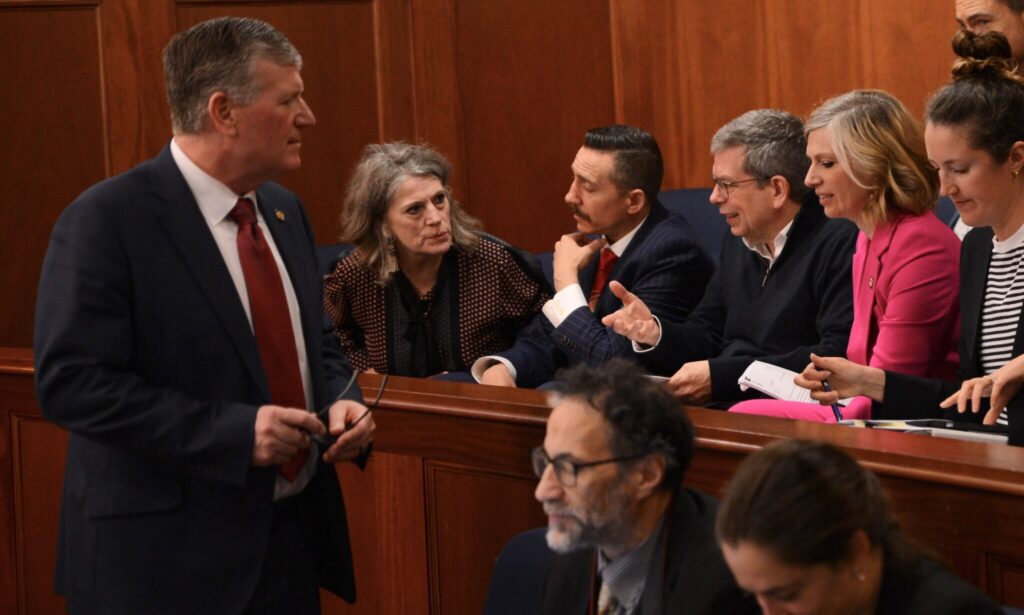
At left, House Majority Leader Chuck Kopp, R-Anchorage, talks with experts on the proposed trans-Alaska natural gas pipeline during a break in debates Monday, May 18, 2026. To Kopp’s immediate right is Joelle Hall of the Alaska AFL-CIO. At center, gesturing, is former U.S. Sen. Mark Begich, now an adviser to Gov. Mike Dunleavy. (James Brooks photo/Alaska Beacon)

A high-stakes quid pro quo deal fell apart in the Alaska Capitol on Monday as legislators failed to approve a tax break for the proposed trans-Alaska natural gas pipeline and Gov. Mike Dunleavy vetoed a bill that would have restored public pensions in the state.

The failure leaves public employees with a 401(k)-like retirement system and legislators likely to head into a special session for further work on a gas pipeline bill.

Rep. Chuck Kopp, R-Anchorage and the Legislature’s lead negotiator on the planned deal, said on Monday night that “the pension was a good vehicle to help get people there and be more conciliatory towards this gasline legislation than they otherwise would have been. Now that the governor has vetoed the pension, I expect the conciliatory attitudes will suffer.”

Monday was the deadline for Dunleavy to enact or veto House Bill 78, which would have created a new pension plan for Alaska’s public employees. Alaska has not offered a pension since 2006, when lawmakers closed the pension plan to new employees after an actuarial error led to significant underfunding. 

Days ahead of Monday’s veto deadline, Dunleavy offered a deal to legislators — pass a tax break for the proposed gas pipeline, and he would allow the pension bill to become law.

“We said we wanted the gasline bill passed in an acceptable form to the governor’s desk before the deadline on the (defined benefit) bill,” said Jeff Turner, the governor’s communications director. “At that point, he could allow a (defined benefit) bill to go into law.”

Dunleavy told reporters at a news conference earlier this month that the gas pipeline bill should be the Legislature’s top priority.

In March, he introduced two identical bills, one in the House and one in the Senate, with his ideas. Legislators have since held dozens of hearings on those ideas.

If enacted, the governor’s proposal would largely exempt the gas pipeline and supporting infrastructure from state and local property taxes levied on petroleum property. In place of the property tax, the state would levy a tax on gas transported by the pipeline.

The pipeline’s lead developer, multinational firm Glenfarne, has said the change is necessary for it to successfully obtain financing needed to build the pipeline project.

Alaska LNG, as it is known, would ship gas through an 800-mile pipeline, from the North Slope to Southcentral Alaska. As currently planned, the first phase of the project would deliver gas to Alaskans in 2029 and the second phase would allow foreign exports by 2031.

While state legislators generally support the idea of a pipeline, they have balked at the governor’s planned tax breaks, particularly because Glenfarne has thus far declined to provide new estimates for the cost of construction or its expected cost of gas when the pipeline is complete.

That has made it impossible for them to determine whether the proposed tax break is too large, too small, or just right. 

Rep. Chuck Kopp, R-Anchorage, speaks Monday, May 18, 2026, on the floor of the Alaska House of Representatives. (James Brooks photo/Alaska Beacon)

House and Senate each took the governor’s ideas and amended them. Both increased the proposed gas tax — formally known as an “alternative volumetric tax” — mandated construction of a spur line to Fairbanks and required Glenfarne provide early payments to communities affected by pipeline construction.

Senators went further, proposing price controls on gas shipped through the pipeline to Alaskans, an end to a tax exemption that would benefit Glenfarne, and small increases to the state’s oil taxes.

With both bills far from completion, Kopp began negotiating with the governor’s office on a possible compromise.

Kopp has been supporting a pension revival for a decade, and sought a deal that would accomplish two personal goals that also are among the legislative majorities’ top priorities.

On Monday, after days of work, he introduced a compromise gas pipeline proposal as an amendment to Senate Bill 180. That bill was originally written as a one-sentence change to state law pertaining to liquefied natural gas import terminals.

Kopp’s amendment, 22 pages long, was adopted, and House lawmakers began debating, one after another, hours of amendments to Kopp’s amendment. 

In the back of the House chambers, advisers to the governor — who have been working closely with Glenfarne — provided feedback on whether each amendment was acceptable. 

From left to right, Reps. Jeremy Bynum, R-Ketchikan, Neal Foster, D-Nome, and Robyn Niayuq Frier, D-Utqiagvik, talk about an amendment to the gas pipeline bill on Monday, May 18, 2026. (James Brooks photo/Alaska Beacon)

One amendment from Rep. Robyn Niayuq Frier, D-Utqiagvik, derailed that process. Adopted on a 21-19 vote by the House, it would allow the North Slope Borough to negotiate directly with Glenfarne on taxes.

Frier represents the North Slope Borough, and because the project’s large gas treatment plant would be located there, the borough would lose a disproportionate amount of tax revenue with a switch from property taxes to the alternative volumetric tax.

“The amendment was completely necessary,” Frier said afterward, explaining that the borough had been asking for it.

The Kenai Peninsula Borough, planned site of the export terminal, accepted the alternative tax, and lawmakers from that region did not propose amendments similar to Frier’s.

Frier said North Slope officials talked with all of the stakeholders, with the governor’s office and Glenfarne.

“We always knew this was going to be an issue, and I don’t understand why this is such a big deal. They could have been negotiating. They should have been negotiating,” she said. 

Frier said that rather than try to push through a major bill in a single day, she would like to see lawmakers focus on House Bill 381, the House’s gasline bill, in a 30-day special session.

“We need to do the proper vetting, we need the modeling, we need it to go through the Department of Revenue. … We need people to weigh in, not trying to shove this in at the last minute. This is not good process,” she said.

Lawmakers in favor of Kopp’s compromise were unable to quickly reverse Frier’s amendment, and the Senate adjourned shortly after 10 p.m., leaving no avenue for Kopp’s amendment to pass through the Capitol on Monday.

Kopp said afterward that he had negotiated a deal to sidestep Frier’s amendment, but with the Senate adjourned until after the window to veto the pension bill, he said the governor was uninterested. 

“He feels like the outcome has to be 100% controlled. … The House was in position to send over a good gasline bill. The governor simply did not care, because he had to have it in the bag. To me, that’s disappointing, and to me that was very shortsighted,” Kopp said.

With the deal dead, the House adjourned for the day just after 10:30 p.m. The governor’s veto message arrived in the House clerk’s office shortly afterward, at 10:39 p.m.

Alaska Gov. Mike Dunleavy’s legislative director, Jordan Shilling (left) and his deputy legislative director, Forrest Wolfe, watch as assistant legislative director Victoria Schoenheit delivers the veto message for House Bill 78 to the House clerk on Monday, May 18, 2026. (James Brooks photo/Alaska Beacon)

“I share the Legislature’s goal of strengthening recruitment and retention for Alaska’s public workforce,” the governor said in his veto message. “However, House Bill 78 contains unresolved legal, tax, administrative, and fiscal issues that create uncertainty for the State, employers, employees, and the retirement systems themselves.”

Kopp, visibly frustrated, sat in his office after the House’s adjournment.

“He has no allies in the Senate that can help him on the gasline. I was his No. 1 ally in the entire Legislature,” Kopp said, “and he killed the pension bill that I carried. That was his thank you to me. So, I’ll remember that.”
Categories
Alaska News Featured Juneau News juneau Juneau Local Juneau Local Ketchikan Local News Feeds Sitka Local

Alaska Legislature approves bill to revive public pension system, now headed to Dunleavy’s desk

Corinne Smith, Alaska Beacon

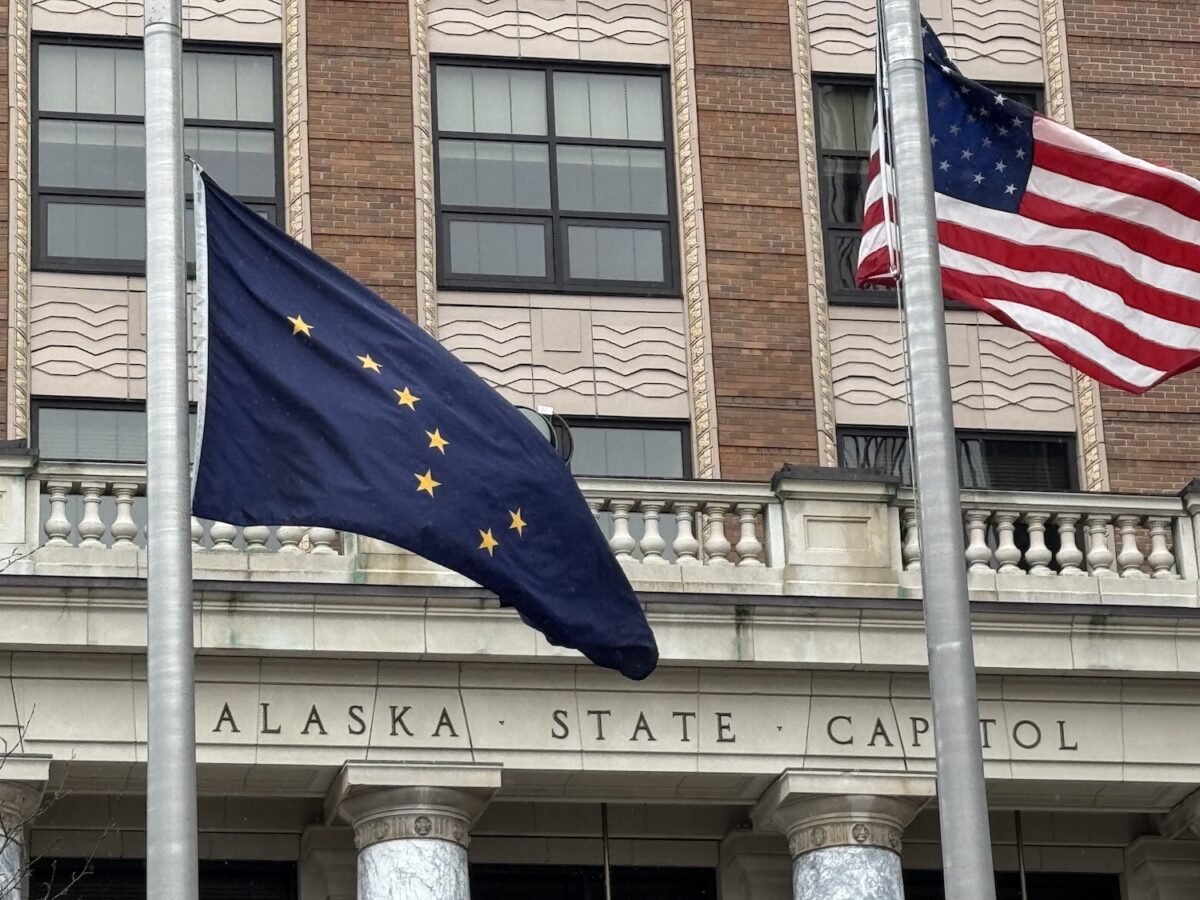
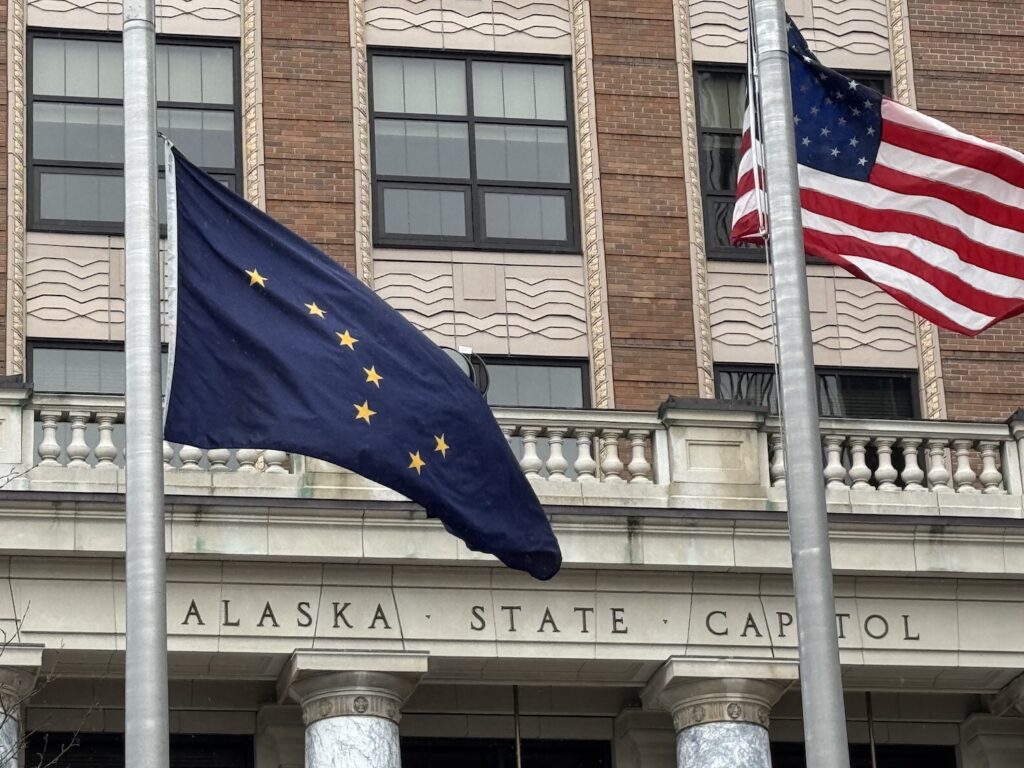
The Alaska and American flags fly in front of the Alaska State Capitol on Tuesday, April 22, 2025. (Photo by James Brooks/Alaska Beacon)

The Alaska House of Representatives voted to approve a revised bill to reinstate a pension system for all Alaska public sector employees, following passage by the Senate on Tuesday. The bill now heads to Gov. Mike Dunleavy’s desk for consideration.

With just 21 days to go in the second year of the 34th Legislature, the governor has 15 days, excluding Sundays, to approve or veto the bill, or allow it to become law without his signature.

A spokesperson with Dunleavy’s office declined to comment on the governor’s position on lawmakers’ pension plan on Wednesday. 

If enacted, the bill would revive the state’s defined benefit retirement system that was eliminated in 2006, a top priority of both the multipartisan Senate Majority and House Majority caucuses. 

The proposed defined benefit system would be open to all state employees, including teachers, public safety workers and public employees of cities and boroughs statewide. Those municipal employers have six months to decide whether to participate in the program or opt out beginning in January, and the new program would be launched in July 2027. 

Within the new plan, retirement for teachers and public employees would be possible at age 60 or any age after 30 years of service. For public safety officers, including police and firefighters, it would be age 50 with 25 years of service, or age 55 with 20 years of service. 

The House narrowly passed the bill along caucus lines by a vote of 21 to 19 on Wednesday. The Senate passed the bill with significant revisions the day before, by a vote of 12 to 8. 

Sen. Cathy Giessel, R-Anchorage, a longtime proponent of reviving the plan, said it took two decades of work in the Legislature and praised the House vote at a news conference on Wednesday.

Sen. Cathy Giessel, R-Anchorage, smiles at the news that the House concurred with the Senate's bill and approved a new state pension plan at a news conference on Apr. 29, 2026. (Photo by Corinne Smith/Alaska Beacon)
Sen. Cathy Giessel, R-Anchorage, smiles at the news that the House concurred with the Senate’s bill and approved a new state pension plan at a news conference on Apr. 29, 2026. (Photo by Corinne Smith/Alaska Beacon)

“We are pleased that it was successful. And it was designed to be a modest, and yet secure, pension for retirement. And it had some amendments made on the floor that kind of made it a little bit more moderated. Choice was put in for employers, which is a big deal,” she said.

But she pointed out that the governor has yet to weigh in: “We still have one more stop, though. We have the big red pen potentially. So we’ll see what happens.”

House Majority Leader Rep. Chuck Kopp, R-Anchorage, carried House Bill 78, and told the Anchorage Daily News that he’s discussed the proposed plan with Dunleavy and members of his staff and is “encouraged” by those conversations.

House Majority Leader Rep. Chuck Kopp, R-Anchorage, speaks in support of a state pension plan on Apr. 29, 2026. (Photo by Corinne Smith/Alaska Beacon)

Kopp, speaking on the House floor Wednesday, said the new plan is entirely separate from the old plan, and has been revised with safeguards to prevent future unfunded liabilities. 

“Do we want to continue down this path, with high turnover, constant vacancies and a growing strain on public services?” he added. “Or do we want to move forward with the plan that’s been vetted, improved and supported by both chambers, a plan that’s involved a lot of collaboration and compromise, and a plan that reflects Alaska’s long term interests.”

State lawmakers voted to axe the state’s defined benefit contribution plan in 2006, after the system accrued a multi-billion dollar shortfall that was misreported by a state actuary. Alaska sued the actuary, Mercer, for $1.8 billion in damages for miscalculating liabilities and settled in 2010 for $500 million. But, opponents of the bill noted, the state still owes billions of dollars on the old system and is on track to pay it off in 2039. 

Proponents of the bill say the new pension system is structured differently to avoid repeating the same mistakes —  it includes mechanisms to adjust contributions up and down, safeguards in the form of three actuaries checking each other’s work and no healthcare insurance benefits — to prevent the pension system from going underfunded.

Health insurance benefits, a major driver of ballooning costs of the old pension system, isn’t included in the new proposal. Under the new plan, employers would pay into a health reimbursement fund of up to 3% of teachers salaries and 4% of public sector workers’ salaries to supplement Medicare for those over age 65. 

On Wednesday, members of the all-Republican House minority put up a potential technical hurdle by voting against the effective date clause of the bill, which needed a two-thirds majority vote to pass. That sets up a potential conflict between the effective date written in the bill and the Alaska Constitution, which says that the bill would be enacted within 90 days after the governor’s signature without a two-thirds majority vote to do otherwise.

Categories
Featured Juneau News Juneau Local Ketchikan Local News Feeds Sitka Local

Actuarial review finds State pension plan would improve retention despite higher initial cost

The Alaska State Capitol in downtown Juneau. (Photo by Greg Knight/News of the North)

A recent actuarial analysis presented to the Alaska House Finance Committee has renewed focus on legislation to restore a defined benefit pension for public employees, the analysis shows the plan could help retain workers despite a higher upfront price tag.

For years, efforts to reinstate pensions for state workers have faced a hurdle in Alaska law, which requires an actuarial review of any retirement legislation before it can advance to a floor vote. These reviews are often expensive and time-consuming, delaying legislative progress.

But advocates argue these studies are critical to ensuring any proposed pension system is fiscally sound.

This year, the state’s actuary delivered its report on House Bill 78 to lawmakers, outlining costs and potential long-term benefits of shifting from a defined contribution system similar to a 401(k), back to a traditional pension plan. The analysis found that defined benefit pensions provide more value to employees and improve workforce retention, which in turn raises overall payroll and long-term staffing stability.

“The actuary said That’s going to, almost single-handedly solve your retention problem.” Said Juneau Senator Jessie Kiehl.

The fiscal note for HB 78 estimates the pension plan would cost the state about $40 million in the first year, with expenses growing as more vacant state jobs are filled and employees remain longer.

But Kiehl says the predicted $76 million annual savings and increased revenues for public employers far outweighs the price tag up front.

“In the end, we save money. ” Kiehl said. “The state of Alaska is actually going to come out ahead, not only by having better trained, more effective public workers, but by having a more efficient government.”

Kiehl also specifically noted Juneau Police Department, who face poaching from Washington State Patrol, “when police officers at JPD have a pension, they don’t get poached by Washington State Patrol who come up here just about every summer, take our JPD officers to dinner and say, Hey, come on down. We’ll hire you, bring your experience and all the training the taxpayers of Juneau paid for, and by the way, you can earn a Washington state pension.”

The legislature is expected to take up the measure during the 2026 legislative session.