By: Corinne Smith, Alaska Beacon
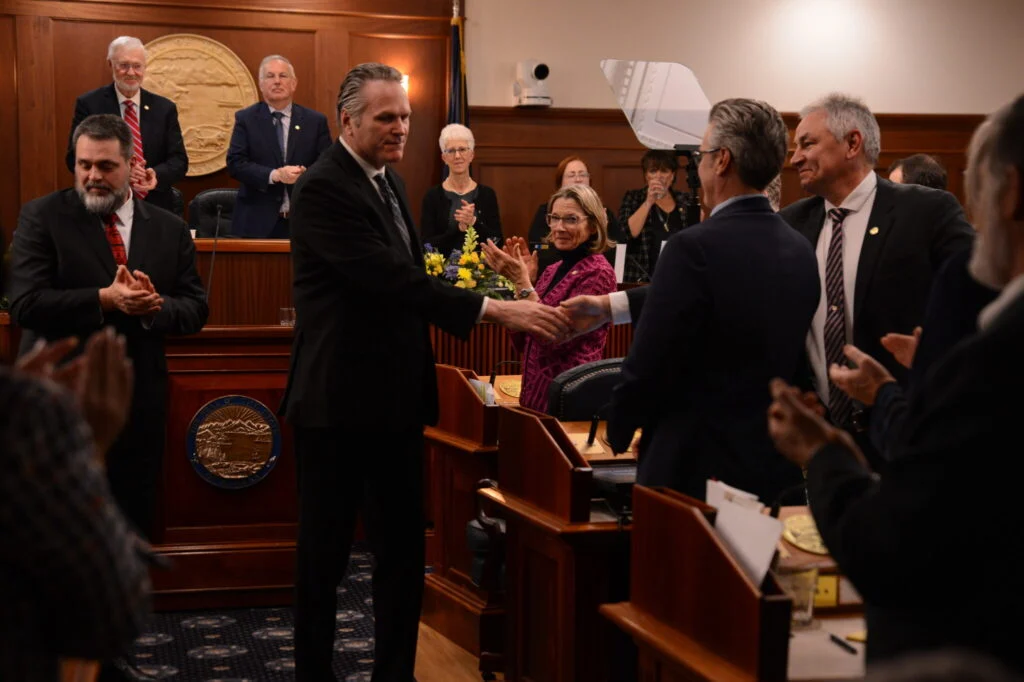
Alaska Gov. Mike Dunleavy delivered his eighth and final State of the State address on Thursday to a joint session of the Alaska State Legislature, touting the accomplishments of his term and promising continued momentum, particularly for large-scale resource development.
“Even though it’s my last year, there is no slowing down,” he said, and promised to work with legislators to advance policies in the spirit of Alaska’s independence and resilience.
In a nearly 80 minute speech, Dunleavy gave wide-ranging remarks on his administration’s initiatives over the last seven years, from reducing crime to improving reading scores. He touched on economic and workforce development, as well as the advancement of mining, oil and gas projects, like the proposed Alaska LNG gas pipeline project from the North Slope to Cook Inlet.
On Thursday, Dunleavy shared only a few details on a promised new state fiscal plan to help balance declining state oil revenues and pay for his proposed $7.75 billion draft budget this year. He said he plans to introduce a fiscal package in the next week, as well as bills focused on job training, child care and affordable housing.
Dunleavy did not mention a seasonal sales tax proposal, as promised in a cabinet meeting on Wednesday.
Lawmakers with the House and Senate majorities expressed interest and some skepticism about his new fiscal plan after the speech, and concern around the lack of details for potential new tax proposals as the session gets underway.
“Honestly, that’s a tremendous amount of things he said he wants us to get through, so we have to do things properly and slowly and rightly and correctly,” said Senate President Gary Stevens, R-Kodiak. “And everything does take more time than you think, but we’re willing to work with the governor, and anxious to see what the specifics are of his fiscal plan.”
House Speaker Bryce Edgmon, I-Dillingham, said he is not optimistic for a fiscal plan this year.
“This is the eighth year that the governor has put a budget in front of the legislature with an over billion dollar deficit,” he said. “Yet to be contrasted this session with a fiscal plan that is going to be very controversial that none of us have seen yet.”
Dunleavy began the speech by applauding the state’s disaster relief efforts, most recently the response this fall in the devastating aftermath of ex-Typhoon Halong in Western Alaska. He noted the state has experienced 85 state and federal disaster declarations during his term, an average of one per month.
“We can’t control natural disasters. But we can control how we respond,” Dunleavy said. “I couldn’t be prouder of how we’ve responded to these events thanks to the brave men and women that I have the honor to serve as Governor.”
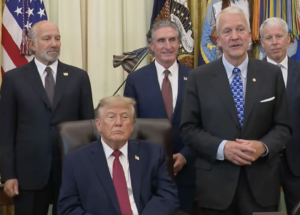
Dunleavy thanked the Trump administration throughout the speech, particularly for its focus on boosting Alaska resource development, which was outlined in the president’s executive order that promised to develop the state’s resources “to the fullest extent possible.”
He praised the Trump administration for re-opening offshore drilling and federal lands in the Arctic for oil and gas development, as well as for the millions promised for health care through the Rural Health Transformation Program.
“Alaska is benefitting greatly thanks to President Trump, and his administration. We need to do all we can to work with our federal partners over the next three years,” he said. “We may never get this opportunity again.”

Dunleavy touted dropping crime rates and a declining unemployment rate, citing a growing economy and state population.
“I know there’s a feeling that things can be better, and of course they can, but our economy has been getting stronger and stronger every year of my administration,” he said.
Dunleavy said his administration will continue to work on reducing crime, in part by focusing on a new partnership with the municipality of Anchorage to combat crime there.
“Public safety has been my No. 1 priority and it will continue to be so until the end of my term,” he said.
Support of the proposed AK LNG pipeline featured prominently in his speech, though the financing and budget ask from the legislature remains uncertain. Dunleavy applauded the gas line developer, Glenfarne, a private energy developer that owns 75% of the project while the state of Alaska owns a 25% share.

Glenfarne executives were in the House chamber as Dunleavy praised the company’s most recent announcement: that they had signed new gas sales and contractor agreements and are headed into final investment negotiations to begin construction.
“This will be the single most transformative project in Alaska since the Trans-Alaska Pipeline,” he said.
While education was a major priority of the governor and legislature last year, Dunleavy only briefly touched on the topic. He said he would like to see legislators take action on bills he’s already introduced to expand charter schools, create open enrollment, address teacher retention and expand tribal compacting, which would allow schools to be run by local Alaska Native tribes.
Lawmakers react to the governor’s state of the state address
Republican lawmakers praised the speech and its scope.
“I thought it was a great address,” said Senate Minority Leader Mike Cronk, R-Tok, who was especially excited about movement towards a new gas pipeline. “He tried to cover everything that he possibly could, you know, still holding that optimism of getting things done that we need to get done.
“It was good to hear his overall enthusiasm going into his last year,” said House Minority Leader Rep. DeLena Johnson, R-Anchorage. “We do need to evaluate our revenue and our expenses and to really take a good look and be good stewards going forward. So I’m interested in seeing what he will promote.”
Members of the House and Senate majority caucuses echoed the interest in more details on the AK LNG pipeline proposal.
“I come from a district where people are not opposed to resource development, but we’re definitely skeptical,” said Rep. Ashley Carrick, D-Fairbanks. “We want to be practical, and we want to be critical, not to the point of stopping projects, but to the point of just understanding and having fair and reasonable oversight on projects.”

Others, like Sen. Bill Wielechowski, D-Anchorage, were more skeptical about the project. “Do they have gas purchase agreements? Not that we’re aware. Do they have gas sales agreements? Not that we’re aware. Do they have financing for the project? Not that we’re aware,” he said. “So they’re talking a lot about the project, and it feels like progress, but do they have any firm commitments on any of those things? Not that I’m aware.”
“We applaud his efforts. We all want a gas line. We’re all excited that we’re as close as we are,” Edgmon said. “But there are other sorts of existential issues that we’re not dealing with here in the legislature.”
The speech failed to address fisheries for the second year in a row. Sen. Bert Stedman, R-Sitka, praised the governor’s optimism, especially around other resources, but noted the fisheries omission on Thursday.
“It is one of our largest employers in the state, and they’re still having significant problems after the turn down a couple years ago. So we’ll continue to have discussions with the administration and see what help we can put forward for the industry guys,” he said.
Rep. Calvin Schrage, I-Anchorage, said most of his constituents would like to see an improvement in the level or quality of state services. “The governor did a good job of highlighting some of the achievements from his administration, but I think in many cases, he missed the mark on the reality felt on the ground,” he said.
“With closing small businesses, we have a summer construction season that’s not funded — for the first time in state history. We have to address that,” said Rep. Zack Fields, D-Anchorage. “We have a stressed fishing industry. So just a big difference between a sort of a glossy speech and the much more challenging reality on the ground that we have to address.”
But Dunleavy noted in his speech that he’s still got some time to get work done — and he’s not running down the clock.
“Contrary to what you may have heard, my time is not up until noon on December 7th, 2026,” he said. “And our time here together in this last regular session isn’t up until midnight on May 20th.”
Claire Stremple contributed to this story.