Preschoolers play in the snowmelt at Hillcrest Children’s Center in Anchorage on April 18, 2024. (Photo by Claire Stremple/Alaska Beacon)
Alaska childcare providers, families and employers are under intense strain with the lack of childcare availability and funding, according to advocates. They are calling for major state investment in the childcare industry and seeking policy changes under the next governor and Alaska State Legislature.
Leaders with several non-profit groups held an online webinar Wednesday focused on barriers and potential solutions to what they called “Alaska’s childcare desert,” which included advocates with the Alaska Children’s Trust, Southeast Childhood Collective and thread, a statewide resource and referral organization.
Advocates described a patchwork funding system of federal, state and some local municipal grants for childcare providers, which has resulted in a lack of childcare spaces to meet demand, long waitlists, high costs for families and a lack of qualified childcare providers, who also work for low pay.
“It’s a battle right now,” said Candice Vialpando, marketing and communications director with thread. “But every little bit helps, and every bucket of money that we are getting, we’re just putting out into the field to try and help, and keep programs open.”
Alaska has seen a wave of childcare centers close in recent years. Last year, one of Anchorage’s largest childcare facilities, Bright Beginnings Learning Center, closed due to rising costs and a shortage of workers, displacing 125 children and 35 staff. Since 2019, 25% of childcare facilities have closed, according to thread.
The organization estimates 50% of Alaskan families cannot fully participate in the workforce because they lack access to childcare. They estimate the average cost Alaska parents pay is nearly $14,000 per year per child.
Advocates are pushing legislators and state political candidates to make childcare a priority in this election.
“Alaska is a childcare desert,” said Blue Shibler, executive director of the Southeast Childhood Collective, which provides resource, funding and workforce development support throughout Southeast Alaska. “The good news is, advocates like us on here have been working for years on this issue, and there is quite a bit of framework systems development that could turn all of that around pretty quickly.”
She said that the state could make big changes quickly if a new executive branch and motivated legislators were open to their policy and funding ideas.
Shibler said childcare providers are struggling to recruit childcare workers and pay liveable wages, which can result in long wait lists for care.
“Childcare providers cannot charge families enough money to pay competitive wages in this labor market, and so they’re limited at how many kids they can take based on that,” she said. “So we’re working to improve that.”
This year, the Legislature approved $6.4 million to help boost pay and retain childcare workers, but Gov. Mike Dunleavy vetoed it.
“That really hurt us,” Vialpando said.
Dunleavy also vetoed Legislature-approved increases of $355,000 to the family support program Parents as Teachers, a $3.7 million increase for Head Start programs and a $3 million increase for infant learning programs to support children with developmental delays or disabilities.
A spokesperson for the Dunleavy administration, Jeff Turner, said by email Thursday that “substantial funding was provided,” for childcare. He pointed to the governor’s approvals in this year’s budget for $13 million in Head Start grants, $475,000 for Parents as Teachers and $12.3 million for early intervention and infant learning programs.
“Governor Dunleavy also proposed legislation for funding and opportunities to expand workforce training, unfortunately the legislature chose not to pass his legislation,” Turner said, referring to a bill that would have expanded the unemployment insurance trust fund.
State assistance grants, licensing and economic impacts
For state childcare assistance grants that are paid out to providers and families, Vialpando described issues with delayed payments, which can cause children to lose their spots.
Vialpando said one issue is if families miss renewal dates, they have to reapply for assistance all over again. “It’s not just a quick renewal. It’s like a whole new application period, which takes a very long time,” she said.
“And during that application period, they’re not getting assistance, so their childcare provider is not getting paid, so they don’t have care for their child during that time. And it’s like, does this person care for the kid without getting paid? Does the child stay home?” she said. “It’s a really bad effect that is happening, so I think that needs to be addressed: prompt payment.”
Officials with the Alaska Department of Health did not respond to a request for comment on state assistance delays on Thursday.
Nonprofit groups are working to boost childcare worker support and professional development opportunities, including apprenticeship programs, and helping new providers with licensing and regulatory standards for new childcare programs.
Shibler and others said providers continue to struggle with licensing issues and regulatory hurdles, and the Department of Health could do more to ease the strain.
“A lot of the licensing regulations are just really old and outdated. They just need a review,” she said. “To figure out how many of these are really important to maintain health, safety, and quality, and which ones are just sort of extra that we don’t need to be dealing with and putting on providers.”
With support from an Anchorage initiative directing marijuana tax revenue to the Anchorage Child Care and Early Education Fund, Vialpando said thread is able to provide grants to childcare providers for supplies, equipment upgrades, rent and other operational costs. The organization is also using a mix of state and federal grants to provide health care benefits to childcare workers statewide. “Which is huge in a sector where people do not have healthcare,” she said.
Teresa Wrobel, director of policy and advocacy, Alaska Children’s Trust noted childcare is becoming a priority issue for employers, as there’s a loss of hours as employees need to tend to childcare needs. She and others acknowledged lack of childcare is a major factor in some families leaving Alaska.
Wrobel emphasized the Alaska Children’s Trust – which is focused on reducing child abuse and neglect — is advocating to address childcare issues to help alleviate stress on families. “Neglect happens with families when there is stress in the family, and we just know that childcare is one of those methods that can reduce stress on the family,” she said.
Shibler and others expressed hope that future state leaders will address the state’s growing childcare gap.
“So there’s all these little band-aids out there, you know, trying to fix the problem because nobody wants to take off the big bite, which is we really need to invest $50 million into a compensation system in Alaska,” Shibler said.
“Childcare is a public good: it needs a public subsidy,” she said. “We subsidize public goods all the time. We’re just not doing it for childcare for some reason.”
Correction: This story has been updated to clarify thread is a statewide resource and referral organization, and to clarify state and federal funding, not ACCE funding, is supporting childcare workers’ healthcare benefits.
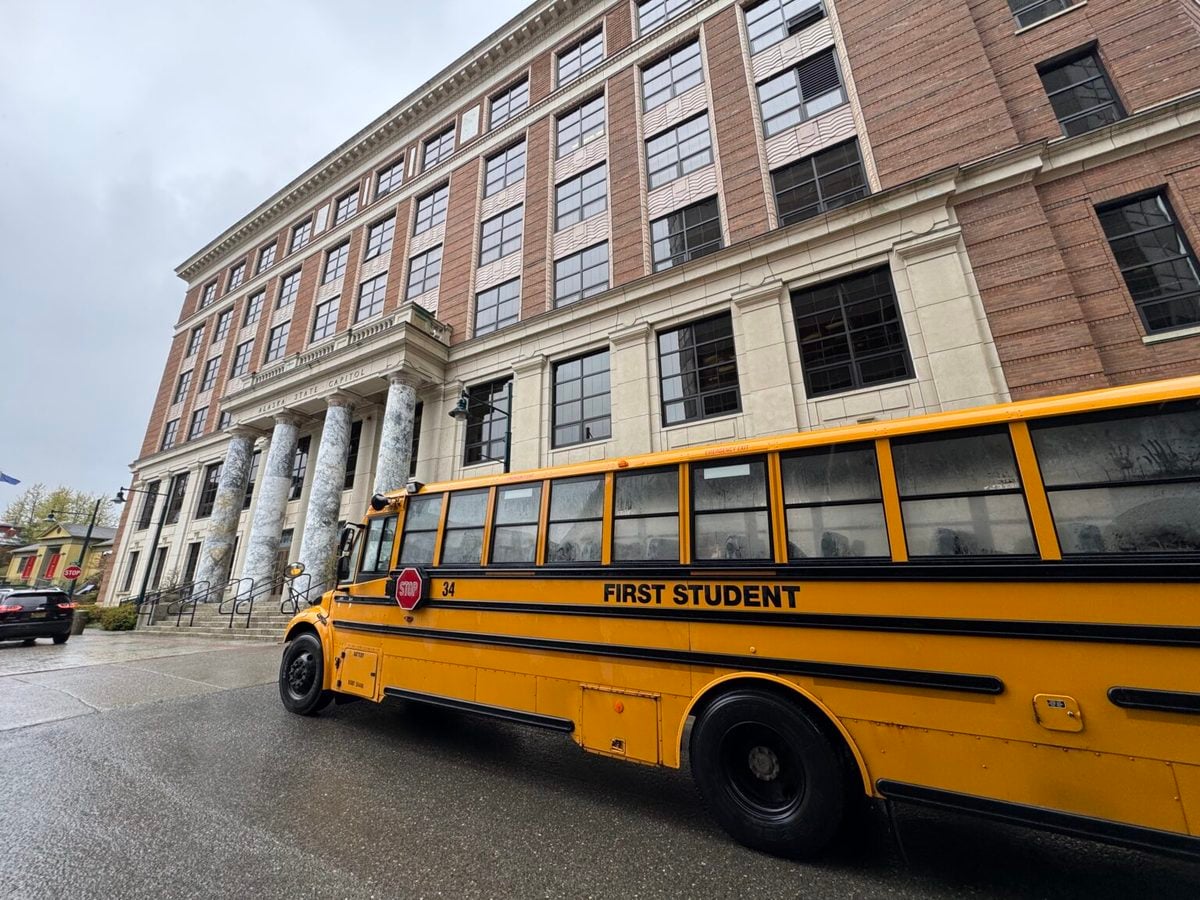
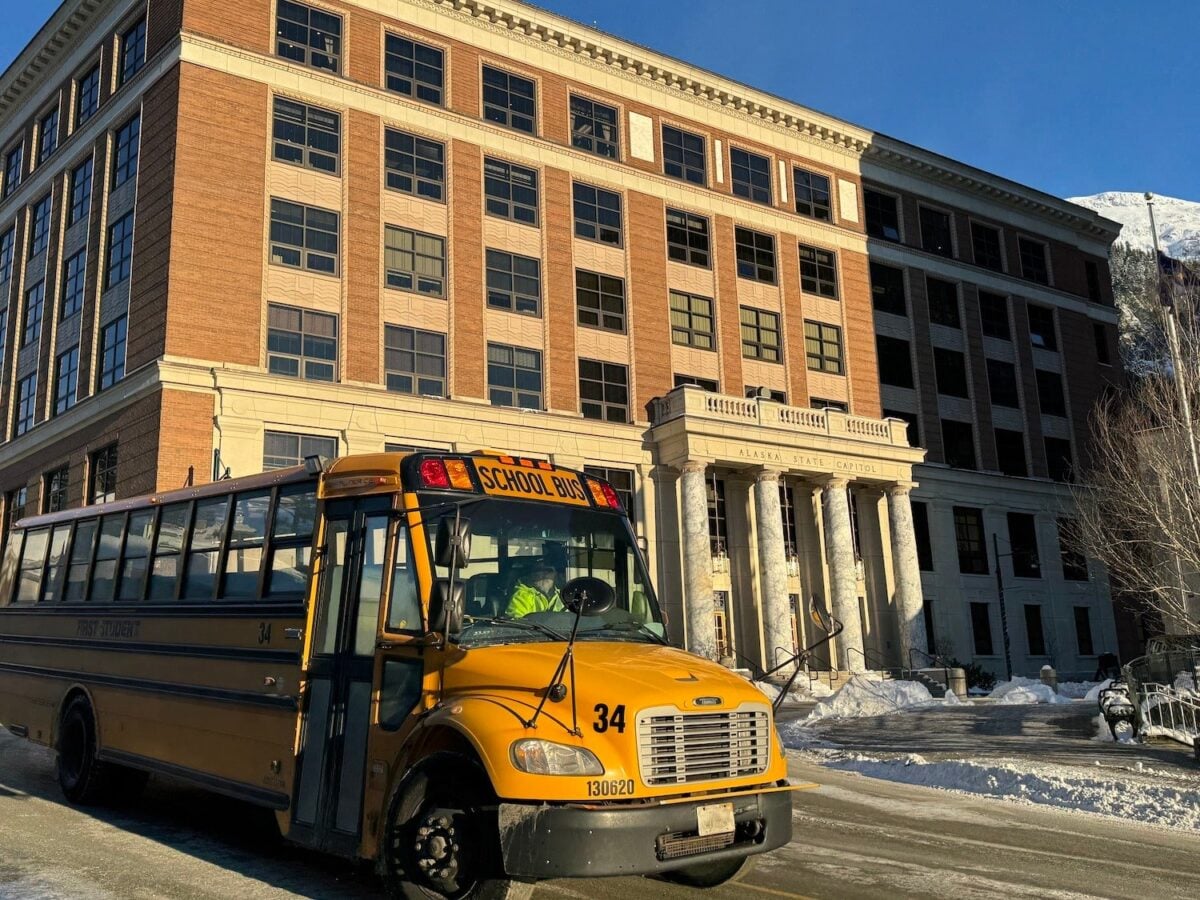
A school bus passes in front of the Alaska State Capitol on Wednesday, May 20, 2026. (James Brooks photo/Alaska Beacon)
The Alaska Department of Revenue announced on Monday that Alaska’s K-12 public schools will receive an additional $115 million in state funding this year, prompted by a boost in oil revenues driven by the U.S. war on Iran.
Legislators earmarked the additional oil revenue for schools as part of the state budget approved by Gov. Mike Dunleavy in June.
The additional funding is a relief to school districts statewide. Many districts have faced severe budget shortfalls in recent years due to funding not keeping pace with rising costs. This year, a record 12 elementary and middle schools closed across the state.
Following the announcement, Luke Meinert, superintendent of the Fairbanks North Star Borough School District — the state’s third-largest district by student count — welcomed the news, and said the district is appreciative of the Legislature for making it a priority.
“(We’re) very excited that the projected numbers came through and that we will see a sizable increase in funding for our school district through the one-time funds that are being allocated,” he said in an interview Tuesday.
Officials with the Department of Revenue announced the state had collected sufficient revenue funds to meet the special appropriation of nearly $600 million.
Lawmakers designated funding for four priorities areas, in sequential order: nearly $128 million to the Permanent Fund to allocate one-time energy relief payments of $200 per eligible Alaskan along with dividend checks; $115 million to K-12 schools through the Alaska Department of Education and Early Development; $15 million to the bulk fuel loan program; and $341 million to the state’s budget reserve account.
According to the announcement, the Monday revenue estimates are expected to be revised and finalized this fall. The revenue amounts are expected to “change slightly,” impacting the exact amount that will land in the budget reserve fund, the state’s savings account, officials said.
The $115 million will be distributed to school districts according to the state’s education funding formula, which is based on student enrollment counts in October.
For Fairbanks, that’s estimated to be roughly $10.2 million this year. Meinert said the district designed its budget this year anticipating about half of that amount, and the additional funding will go toward teachers and staff, as the district is currently in union contract negotiations are ongoing, and other areas. “So that will help us in our negotiation discussions for this school year,” he said.
“Student activities have been an area that’s been cut pretty hard over the past several years,” he continued. “So potentially adding some funding there to ensure that families aren’t having to pick up a bigger burden of paying for student activities. And then, additionally, I think there may be some smaller investments for teacher mentoring, teacher coaching, and possibly some funding in our nutrition services department.”
School board members with Fairbanks and Anchorage called on the state in June to release estimates earlier, ahead of the school year — “the earliest practical information available,” they wrote in an op-ed for the Anchorage Daily News. They asked the state to announce whether “funding is likely, unlikely or still uncertain,” to help districts plan, particularly for hiring teachers.
But the Department of Revenue did not change its scheduled announcement.
Lisa Parady, executive director of the Alaska Council of School Administrators, said they were “elated” and “grateful” at the announcement. But she said it underscores Alaska schools’ needs for prior notice and consistent state funding.
“We do have to get to the place where we have predictable, reliable funds in advance of needing to extend contracts. That’s the biggest issue,” she said Tuesday.
“Because we’re in the greatest education shortage in the history of Alaska and in the nation, it allows for the recruitment and retention of quality educators and that ability to lock in those contracts sooner,” she said.
Among the state’s largest districts, the Anchorage School District is expected to get $32 million. The Matanuska Susitna Borough School District is expecting $16.1 million, the Kenai Peninsula School District is expecting $7.6 million. Both districts closed schools this year.
Parady said it’s difficult to say if the additional funding earlier in the year would have prevented school closures.
Districts cited surging costs of operations, as well as declining enrollment as more families opting for homeschool programs or leaving the state.
“Each school district is in their own unique place in terms of overall education funding in their budgets,” Parady said. “Having a long term fiscal plan that allows for timely, reliable, and predictable revenue for schools … is the only way that school boards and our school district leaders can have the tools they need to make the best decisions as they’re managing their budgets. And school closures are obviously a piece of that, and so I can’t say for sure that it could have changed an outcome, but it’s certainly possible.”
Anchorage Democrat Sen. Löki Tobin, who chairs the Senate Education Committee expressed her reaction Tuesday as “mixed.” “We know that our schools are in desperate need of resources,” she said.
“We have nonpartisan financial memos from our Division of Legislative Finance that says to adequately address the years that inflation has eroded the purchasing power of our base in funding, we need to appropriate significant financial resources per student to our schools, and while $115 million is a significant amount of dollars, it’s clearly not enough. And one-time funds do not create stability nor predictability.”
Tobin also acknowledged the moral dilemma of the upswing of Alaska oil revenues and state funding driven by the U.S. war on Iran.
“It is gut-wrenching to know the reason that Alaska has been able to receive these resources,” Tobin said. “It is not without contemplation or thought that I have been thinking about the children that were bombed in these recent years in a place that is very far away from us, but is no less important and nor no less critical for the health and well-being of all of our kids, and how those choices are driving the record increases in the price of a per barrel of oil.”
With the boost in state revenues, Tobin also credited the efforts of lawmakers across political divides in designating funding for schools. “Folks who work to get this funding into our budget not only crossed the aisle but also were bicameral in nature, and that is absolutely critical,” she said.
Lawmakers allocated roughly $144 million in one-time additional funding for K-12 schools, plus $148 million for school repairs and construction this year to address an extensive maintenance backlog. They approved $29 million to offset districts’ rising energy costs beginning in 2028 and subject to future lawmakers approving the funding.
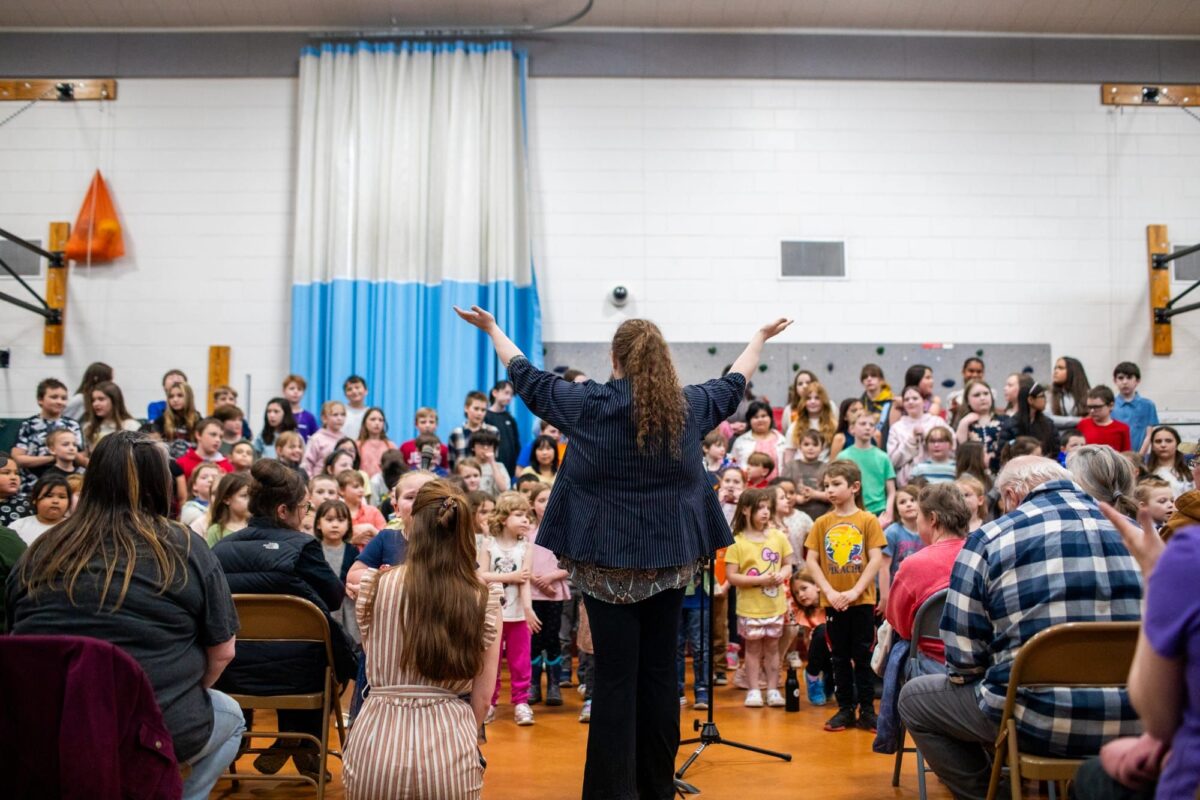
Students perform during a final spring concert on May 13, 2026 at Meadow Lakes Elementary, one of three schools closed by the Matanuska-Susitna Borough School District this year to address a budget deficit. (Photo by Elise Giordano/Mat-Su Sentinel)
Alaska saw an unprecedented wave of school closures this year. District officials grappling with severe budget shortfalls have opted to close 12 elementary and middle schools across the state — in Anchorage, Wasilla, Sutton, Seward, Sterling, Soldotna, Kasilof and Ketchikan.
With those closures, hundreds of students and staff will bus or commute to new schools next year, class sizes will grow as grades are combined and districts across the state are cutting programs, teachers, health aides, custodians, sports, library services and extracurriculars like music.
Officials in four districts say the closures were incredibly complex and difficult decisions but necessary to combat millions in budget shortfalls and years of state funding not meeting districts’ surging costs to operate schools.
“It was an incredibly trying time,” said Randy Trani, superintendent of the Matanuska-Susitna Borough School District that closed three elementary schools this year to address a $28 million budget shortfall. “Non-winnable… we did this to save teaching positions,” he said.
“This is devastating to everyone,” said Kylie Wilcox, a Soldotna mother of five. Her middle and high schoolers attended River City Academy, one of four schools closed on the Kenai Peninsula. “The district does not want to do this, the administration doesn’t want to do this, we just, it’s the reality of what we’re working with.”
At the same time, superintendents said it’s still unclear whether the closures and cuts have balanced district budgets because Gov. Mike Dunleavy has yet to sign off on next year’s increased budget for education funding. Last year, lawmakers flew back to Juneau for a special session, overruled Dunleavy’s veto and restored an education funding increase in a historic override vote in August, just weeks ahead of the first day of school.
This year, the Alaska Legislature approved one-time additional funding of $144 million for K-12 schools, including $29 million to offset rising energy costs, to total $1.8 billion approved for education next year. Lawmakers passed a budget with higher-than-expected state oil revenues driven by the Iran war, which is now before Dunleavy for his consideration.
Education Commissioner Deena Bishop said that the state has seen declining enrollment for more than 15 years, and as a result districts close schools due to what she called “excess capacity.” Bishop has served as commissioner under the Dunleavy administration since August 2023.
Deena Bishop, commissioner of the Alaska Department of Education and Early Development, speaks at a news conference Friday, March 15, 2024, with Gov. Mike Dunleavy. (Photo by James Brooks/Alaska Beacon)
“We’ve had several schools at 50% capacity, 55% capacity, that were within two miles of each other. And understanding that you want to use the majority of your money, you don’t want to put into facilities — the majority of your money you want to put into classrooms,” she said. “And so decisions, you know, things were weighed, and districts, hopefully working with their parents and communities, made decisions that they felt were the correct ones.”
Bishop said more families are opting for homeschool programs, and districts need to figure out how to provide education services for families that want choices for more flexibility.
Nearly one in six Alaska students were homeschooled last year, totaling an estimated 23,600 students, according to data compiled by the Association of Alaska School Boards.
“So we can’t really be upset that, you know, ‘Oh no, they’re not going to our schools,’” Bishop said. “Obviously they’re going to a school that their needs are met, if they’ve chosen that, so how do we work with it? You know, what does education look like, and what does it look like in serving a community? And more and more we’ll find that one size doesn’t fit all that schools really want to offer, and districts are starting to offer different programs.”
Alaska students have the option to enroll in homeschool or correspondence programs across the state, not necessarily with the district where they reside. While district officials say they are working to adapt and provide homeschool education services, districts receive less state funding per homeschool student which is contributing to district-wide deficits.
Matanuska-Susitna Borough School District closes three schools
The Matanuska-Susitna Borough School District, the state’s second largest district with almost 20,000 students, faced a $28 million budget deficit this year, prompting cuts across the district.
The school board closed Meadow Lakes and Larson elementary schools in Wasilla and Glacier View School in Sutton, affecting roughly 415 students and dozens of staff.
That comes after the district cut roughly 160 staff positions last year, said Superintendent Randy Trani. He said the district would have had to cut an additional 225 positions this year, which was unworkable.
“The very last thing that we wanted to do was lay off teachers, and the second last thing we wanted to do was close schools, but we’re to the point where if we didn’t close schools, it was only going to result in more teacher layoffs,” he said.
Trani said the district went through a process of evaluating schools based on a number of metrics, including number of students, costs to maintain and opportunities to bus students to schools nearby, in order to decide which schools to close. “The schools that we were forced to shut down were fantastic schools. This wasn’t a decision on academic merit. This was a decision about logistics and being forced into a really impossible choice,” he said.
Trani said closing the three schools wasn’t even enough to make up for the budget shortfall and the district had to cut deeper.
The school board considered various scenarios from cutting sports programs to transitioning to a four-day school week, Trani said, which were rejected by the school board. “These are all horrible choices,” he said.
While the Matanuska-Susitna Borough continues to have the fastest growing population in the state, Trani said declining birth rates combined with an ongoing wave of families opting to homeschool is leaving the district with declining enrollment of full-time students and reduced funding for the district. Roughly 3,200 students, or 16% of the district’s students, were enrolled in Mat-Su correspondence programs this year.
Trani said another cost driver had been double digit increases to healthcare insurance costs resulting in roughly $6 million more to the deficit, bumping it to $28 million.
But he emphasized the largest driver of the deficit was insufficient state funding. “State funding has not kept up with inflationary pressures, and it is by far the biggest driver,” he said. “Unless there is a long term fix to how K-12 education is funded this problem is going to continue.”
Ketchikan closes two of four elementary schools, with more cuts to come
Ketchikan serves roughly 1,800 students in the Southeast Alaska island community that is only accessible by plane or boat. This year, the district enacted major cuts, including 76 staff positions across the district to address a $3 million budget shortfall, plus $5 million in debt to the local borough. It closed two of the four elementary schools.
Point Higgins Elementary School was one of the two elementary schools closed this year in Ketchikan due to budget cuts. Staff and volunteers helped move out the school in early June 2026. (Photo by Niki Suomala)
The district closed Point Higgins and Fawn Mountain elementary schools, leaving one elementary, one middle and one high school in the community.
Niki Suomala, a third generation Ketchikan resident, attended Point Higgins elementary school, located 15 miles north of town. She said it was a special experience for her two children to go there — until the closure.
Her kids will be in the second and sixth grades next year, and they plan to commute into town for school. She said there were some tears at the news, but she said her children are adapting. She said she’s disappointed overall, but feels compassion for the district.
“It’s like, gosh, couldn’t we see this? Couldn’t we have seen this coming, and couldn’t we have tried to do something different?” she said. “But I also feel compassion, because I don’t know the answer to that question.”
Sheri Boehlert, the interim superintendent of Ketchikan Gateway Borough School District, also served as the principal of Point Higgins, spoke by phone after a full week of packing up and clearing out the schools. She said the reaction to the closures has been mixed: while there’s some in the community who want to see deeper cuts to balance budgets, there’s also a lot of grief in saying goodbye to neighborhood schools.
“It’s hard to dismantle something that was a big part of your career,” she said. “But on the flip side of that, the staff and community has really, by and large, been overwhelmingly supportive. We have tons of volunteers that are helping teachers pack and move, and they’re going to make something great at the next school for students, and there’s optimism out there.”
Class sizes will be effectively doubling in Ketchikan, Boehlert said, from about 15 students to class numbers in the twenties for elementary school and thirty students or more in the middle and high schools.
Boelert said the district has seen rising costs to operate, including for fuel, utilities and special education services. She said in particular the cost of staff health insurance is up 112% this year. Previous cost overruns for health insurance discovered last year created the over $5 million debt to the borough which the district will pay over over the next several years. “That is a unique situation,” Boehlert said. “They need their money back.”
Boehlert said with essentially flat state funding not meeting cost increases, the district cut roughly 26% of staff this year: “So it’s teachers, it’s principals, it’s custodians, health aides, like maintenance staff. No work group was unaffected.”
Even so, with the debt repayment, and this year’s state budgets still uncertain, Boehlert said Ketchikan faces more cuts across the district — unless there’s a significant population increase.
“We have a difficult road ahead of us in Ketchikan,” she said.
Four schools closed across the Kenai Peninsula
In the Kenai Peninsula Borough, the state’s third largest school district stretches across roughly 25,000 square miles — an area about the size of West Virginia — and serves nearly 8,400 students.
This year, the district faced an $8.5 million budget shortfall, after an $17 million deficit last year. The district is still in the midst of budget negotiations and determining cuts. An additional $3.3 million from the local borough and yet-to-be-determined one-time state funding this year may restore some programs, but officials opted to close four schools.
The district closed River City Academy in Soldotna, Tustumena Elementary School in Kasilof and Sterling Elementary School, sending students to other schools in Soldotna and Kenai. On the eastern side, the district closed Seward Middle School where classes will be consolidated into the elementary and high schools.
“The response was overwhelmingly that parents do not want these schools to close down. Communities did not want the schools to close down,” said Kari Dendurent, assistant superintendent of the Kenai Peninsula School District.
One of those parents is Kylie Wilcox, a mother of five living in Soldotna. Two of her children attended River City Academy, which was a standards-based school serving grades seven through 12. She said they liked the supportive environment and had hoped to continue through high school there.
River City Academy, a standards-based school serving grades 7 through 12 in Soldotna, was one of four schools closed by the Kenai Peninsula School District in May 2026. (Photo courtesy of Kylie Wilcox)
“They were starting to make friends at River City, and so they were really sad, like ‘I’ve got to start over again.’” she said. “And they were angry. They talked a lot about, you know, ‘why can’t they just give money to schools? Don’t they think that we’re worth it?’ My oldest was upset enough that they were willing to testify in the district meeting as well. I was really, really proud of them for doing that.”
Dendurent, the assistant superintendent, said the district worked through a transition plan to help students and families plan where to attend schools next year. She said some teachers from River City Academy transferred to Skyview and will be in homerooms with former students. She said it’s a difficult process with cuts across the district, including reading programs, library aides, English language learning programs, swimming pools and others.
“It’s very, very difficult, and it impacts everybody, and the other part that also makes it difficult is we are in contract negotiations right now with our certified and our classified employees as well,” she said.
Dendurent said the district has seen more students and families opt for homeschool programs, resulting in less state funding for the district. “It’s a borough issue, it’s a state issue, and it’s a national issue with declining enrollment,” she said.
She said rising health care costs is also a major factor for the district budget, as well as fuel and utilities costs. Even with the school closures, Dendurent said the district’s financial picture is still uncertain. “Predictable, sustainable funding is what I think all of us are looking for,” she said.
Wilcox said she has empathy for district officials and they handled the process fairly well, but wishes there was more support from the Kenai Peninsula Borough and from state leaders. She said her family is still evaluating options, but will likely homeschool her two middle and high school age students, with her 10th grader also pursuing classes at the Kenai Peninsula College.
“Honestly it feels sometimes like there are people in our state government that would rather see public schools fail, and rather see more homeschool and private school options happen for kids. And I feel like that’s not going to serve all of Alaska’s kids,” she said.
“Like, homeschool is a great option for a lot of people. I am a homeschool graduate,” she added. “But I know that there are families where that’s just simply not an option, and they deserve the support of the state for their child’s education, that’s one of our rights.”
Anchorage closes three elementary schools, with deep cuts across the district
In the state’s urban center, the Anchorage School District made severe cuts this year to address a $90 million deficit and opted to close three elementary schools. It is the largest school district that serves nearly 42,000 students.
The closures were at Fire Lake, Lake Otis and Campbell STEM elementary schools. A parent group filed a lawsuit challenging the district’s decision to close Campbell STEM, which is still under dispute. It’s the only one of the three schools without plans to move a charter school into the building.
Andy Ratliff, the district’s financial officer, said closing the three schools accounted for just a fraction of the deficit, and cuts were made across the district — including almost 500 staff positions, or about 10% of the district’s staff.
“We reduced millions of dollars in administrative costs. We’ve increased our class sizes by four. We reduced a lot of our IT positions, maintenance, everything,” he said. “Mental health, our teaching and learning department was cut by like 45 or 55%. Yeah, I mean it’s just kind of all across the board, even into our special education realm.”
Ratliff said the district has spent down its savings, and the small increase in state funding last year didn’t meet the district’s rising costs. He said health insurance rose in the double digits and now is about 20% of the total budget. “It’s really just this inconsistent funding that’s really just kind of dictated by the state that has put us in this position,” he said.
Ratliff noted the state’s energy relief funds are contingent on oil revenues and likely won’t reach districts until September. He said the uncertainty of funding this late in the year is challenging for staffing and determining what cuts if any can be restored.
“They did approve money, but we don’t have it yet,” he said. “So it’s hard for districts to do any sort of restoring of the cuts that they’ve made at this point.”
State legislature approves $144M in one-time next year, but funding still uncertain
District officials said the Legislature’s boost of $700 per student in the state’s funding formula last year was welcome, but did not significantly affect districts’ overall financial challenges.
A school bus drives by the Alaska State Capitol on Jan. 21, 2026. (Photo by James Brooks/Alaska Beacon)
The 12 school closures this year comes after five schools were closed last year in Kodiak, the Kenai Peninsula Borough and Fairbanks.
Many district officials, education advocates and lawmakers have emphasized that state funding has not kept pace for years with school districts’ needs and costs for providing public education.
But Bishop, education commissioner for the Dunleavy administration, rejected the notion that school funding has been flat.
“Over time in our state, because of the fluctuations of how we get resources to provide to schools, I think that’s exactly why money is either in the formula or out of the formula, but over time you will see that generally there’s been an increase in funds every year,” she said.
She acknowledged the rising costs of school districts, and said at the same time the governor and Legislature have competing priorities for the state budget. “Everybody in the state has to look at the picture as a whole,” she said.
“Hopefully when we can create new revenue, continue to really thrive in schools and innovate programs to match needs that families are seeking, that we’ll be able to move into the future,” she said.
This year, lawmakers seemed to have less appetite for taking on another education funding battle with Dunleavy, particularly among competing priorities of election reform and reviving the state’s pension system. Both initiatives were vetoed by Dunleavy and a legislative veto override effort failed for both. Citing increased oil revenues due to the Iran war, the Legislature passed $144 million in additional one-time funding and nearly $150 million for K-12 school maintenance and repairs.
Rep. Rebecca Himschoot, I-Sitka, speaks in favor of a veto override on House Bill 69 on Tuesday, April 22, 2025. (Photo by James Brooks/Alaska Beacon)
Rep. Rebecca Himschoot, I-Sitka, is a former teacher and vocal proponent of increasing education funding. She co-chairs the bipartisan task force on education funding launched last year.
“Closing a school feels like a death, and it is,” Himschoot said.
Himschoot pointed to budget problems, loss of enrollment and the shift to homeschool, but said the state, in her view, is not funding education as it should.
Himschoot said the task force is investigating short and long term funding solutions. The state approved an adequacy study this year to determine how much funding is needed to support schools, to be completed in the next few years. Another bill to allow districts to budget based on a three year average of student counts, failed in the Legislature this year, but Himschoot said the policy is likely to be revived next year to allow districts to set budgets earlier in the year. “It would take some of the uncertainty out and I think that’s going to have an impact on outcomes,” she said.
She said the task force is continuing its work looking at the problems and funding mechanisms, gathering input and evaluating solutions to address issues in the funding formula, major maintenance and rising costs like health care. Recommendations are due next January.
“The pain is felt by the students. That’s a straight line from state funding to what students get or don’t get,” she said. “It keeps me awake at night.”
Speaker of the House Bryce Edgmon, I-Dillingham, presides over the Alaska House of Representatives on Monday, May 18, 2026. (James Brooks photo/Alaska Beacon)
Civics education would be included among graduation requirements for all Alaska high schoolers, under a bill passed by the Alaska Legislature in the final hours of the legislative session last week.
The new requirement aims to bolster Alaska students’ knowledge and understanding of the U.S. government and civic responsibilities. It comes amid declining public trust in government, the bill’s sponsor, Senate President Gary Stevens, R-Kodiak, told the Alaska Beacon last month.
Senate President Gary Stevens, R-Kodiak, is seen ahead of a vote on the operating budget on May 7, 2026. (Photo by Corinne Smith/Alaska Beacon)
Students would have three options to choose from to complete the requirement: complete and pass a semester of civics curriculum, pass a civics exam or complete a civics project-based assessment.
Lawmakers passed Senate Bill 23 by a combined vote of 57 to 3. The bill now goes before Gov. Mike Dunleavy to sign, veto or allow it to pass into law without his signature.
Under the proposal, school districts would be able to develop civics curriculums based on open-access, no cost resources provided by the Alaska Department of Education and Early Development across 14 areas of government and public affairs:
the founding history of the United States, including foundational documents and the principles of government of the United States; federalism, including the role and operations of local, state and national governments;
the institutions of the United States government, including the responsibilities of the executive, legislative and judicial branches;
the rights and responsibilities of United States citizenship;
civil liberties and civil rights;
the Constitution of the State of Alaska and the Constitution of the United States;
political parties and interest groups;
campaigns and elections;
the United States Congress;
domestic policy;
foreign policy;
comparative systems of governments used globally and by Alaska Native people;
international relations; and
major issues facing local, state and the United States governments.
The initiative comes at a time when the United States is seeing a growing public distrust in government and deepening political polarization. A survey last year by the non-partisan Pew Research Center found public distrust is at one of its lowest points in the nation’s history, with just 17% of respondents saying they trust the federal government to “do what is right.”
Stevens declined to comment on the bill passing the Legislature when asked at the Capitol on Wednesday. He said he would wait to comment after the governor’s decision on the bill. Lawmakers have passed 114 bills in this two-year legislative term. But Dunleavy has vetoed 12 bills so far and will consider dozens more in the next few weeks.
Lawmakers are in a high-stakes 30-day special session called by Dunleavy to discuss potential state property tax relief for the proposed Alaska LNG gas line project. The special session is expected to go to June 21.
NOTN- The City and Borough of Juneau Assembly will hold a public hearing tomorrow on its proposed fiscal year 2027 budget, including property taxes, school funding, a multi-year capital improvement plan, Eaglecrest and the Gondola Project.
The special Assembly meeting is scheduled for 5:30 p.m. and it will be followed by the Assembly Finance Committee. Residents may testify in person or via Zoom.
At the hearing, Assembly members will take testimony on several key ordinances, including a measure setting the 2026 property tax rate to fund the FY27 budget.
According to the agenda, officials will also consider a $551.2 million operating budget for city and borough services, along with a separate $97.2 million budget for the Juneau School District.
In addition, the Assembly will review a resolution adopting the city’s capital improvement program for fiscal years 2027 through 2032, which outlines infrastructure priorities and planned project spending.
Another resolution would set aside up to $2.3 million from the city’s restricted budget reserve to cover an anticipated operating deficit at Eaglecrest Ski Area.
Separately, the Assembly is expected to introduce an ordinance to begin terminating a revenue-sharing agreement with Goldbelt Inc. tied to the proposed gondola project at Eaglecrest. City officials say the project is no longer financially feasible after cost estimates rose to more than $37 million, up from initial projections of about $10 million.
This is still up in the air, but under this agreement Juneau would be required to repay Goldbelt’s $10 million investment plus interest if the deal is terminated. Repayment would include general funds and previously allocated project money.
The Juneau School District office in downtown Juneau.
(Photo courtesy City & Borough of Juneau)
The Juneau School District office in downtown Juneau. (Photo courtesy City & Borough of Juneau)
NOTN- The Juneau School District is seeking public input as it begins its search for a new superintendent, asking parents, staff, students and community members to weigh in on priorities and desired leadership qualities.
First reported by the Juneau Independent, the district released an online feedback survey Wednesday, designed to guide the Board of Education as it recruits candidates to lead the district.
Participants are asked to describe strengths of the Juneau community and school district that prospective superintendents should know, as well as the most significant challenges facing the district.
The survey also asks respondents to identify the qualities, skills and characteristics they believe are necessary for the next superintendent to be successful.
In addition, respondents are asked to rate the importance of various areas of experience, including prior superintendent experience, work as a classroom teacher, familiarity with Alaska’s public education system, knowledge of school finance and facilities, and understanding of the district’s culture and community.
District officials say the feedback will help inform the board’s decision-making as it evaluates candidates and determines what leadership qualities best align with the district’s needs.
Current Superintendent Frank Hauser will be stepping down June 30, he said this when asked what he was most proud of in his tenure as Superintendent, “I think that we’ve done a lot of great work here, the Juneau school district staff, are some of the best staff in the world. Consolidation was hard, those are really tough decisions. But I think looking at the future, we’re on much better financial footing.” He said, “There are still challenges with the budget, but I think putting together a fiscal plan that is more focused, and having opportunities for kids, and even through the consolidation, being able to maintain those opportunities for our students and still see growth, those are the things I’m really proud of. We made it through, and we’re in a better position than we were going in.”
What will Superintendent Hauser do next? He says he’s not sure yet, but he hopes it will continue to include advocacy for education in the state.
“I have spent the last 28 years in public education, advocating for public education, I’m Alaska educated, and I will continue to advocate for public education. I don’t know in what capacity that will be right now, but it is something that I believe in.”
Students begin their first day of school at the Tlingit Culture, Language and Literacy program at Harborview Elementary School in Juneau on Aug. 15, 2025 (Photo by Corinne Smith/Alaska Beacon)
It was a difficult and consequential year for Alaska schools, educators and students.
While Alaska lawmakers passed the first significant education funding increase since 2011, the state rode a federal funding rollercoaster as funds were frozen, released, disputed and appealed.
Western Alaska students and families also endured the devastating storm disaster of Typhoon Halong. Hundreds of students, as well as teachers, were displaced from their homes and forced to move and adapt to new schools across the state.
Here are some of the top stories of the year:
A state education funding fight culminated when the Alaska State Legislature passed a historic override of a veto by Gov. Dunleavy to enact a boost to per student funding for K-12 schools in a one-day special session in August.
Education was the top priority of the Legislature and Gov. Dunleavy this year, and an embattled topic throughout the legislative session, with an ongoing dispute around funding for schools and education policy changes sought by the governor to address lagging school performance and test scores.
Gov. Dunleavy vetoed two education funding bills during the session, citing a lack of policy changes he favored to boost homeschool and charter school options, and address test scores. In April, he vetoed a bill increasing the BSA by $1,000, calling it a “joke” and insisting that policy changes be included. Legislators introduced and passed another bill increasing funding by $700 per student in late April. In an effort to compromise, they included many of the governor’s priority items, including charter school changes, incentives for reading programs, and establishing an education task force to recommend further education policy changes.
Sen. Loki Tobin, D-Anchorage, holds her hand to her chest on Saturday, Aug. 2, 2025, after the close vote on overriding Gov. Mike Dunleavy’s veto of education funding. (James Brooks photo/Alaska Beacon)
Dunleavy vetoed the education funding increase out of the final budget in June. The legislature came back in August to override the veto. It was the first time since 1987 that Alaska lawmakers have overridden an appropriations veto by a sitting governor.
School officials said the additional $50.3 million in per student funding, known as the base student allocation, is essential to help maintain class sizes, hire and retain teachers, and create stability for students.
“We’re extremely excited. A lot of our administrators were texting and very excited about getting it overturned today, so that made Valdez very happy,” said that city’s school superintendent, Jason Weber, in August after the veto override vote.
The Trump administration froze millions in funding for Alaska schools, later releasing some funds. But Alaska is also embroiled in an ongoing dispute with the U.S. Department of Education around impact aid, which could cost the state $80 million
Over the summer, as school districts grappled with uncertainty around a state funding increase, the Trump administration announced a freeze of over $46 million in funds for Alaska schools, including for instruction and migrant education programs, which support students who miss class due to seasonal work like fishing. The Anchorage, Fairbanks North Star Borough, and the Kuspuk school districts joined a nationwide lawsuit challenging the withholding of congressionally approved funds as unlawful.
“These are not extras. These are the programs that give our students a chance,” said Kuspuk School Superintendent Madeline Aguillard. “When the federal government walks away from its obligation, it is not a delay. It is denial. Denial of access. Denial of progress. Denial of the futures our students have a right to pursue.”
The empty playground at Pearl Creek Elementary School is seen on June 3, 2025. The Fairbanks North Star Borough School District decided to close the school at the end of the academic year. (Photo by Yereth Rosen/Alaska Beacon)
In late July, the federal government released $5 billion of the $6.8 billion in K-12 funding.
The state is involved in an ongoing dispute with the U.S. Department of Education, which claims the state has failed a disparity test – allowing no more than a 25% gap between the highest and lowest funded schools. The state has appealed the finding, with over $80 million in federal impact aid at stake. A decision is expected in 2026.
The Trump administration also froze more than $6 billion in congressionally-approved funding for adult education and workforce development funding in July. In Alaska, it prompted immediate cuts to programs and staff layoffs. The state had been awarded over $1.1 million in grants last year, and the frozen funds in July were a shock to programs and students that included GED classes, literacy and civic education, English language classes and workforce development.
Hundreds of students, as well as teachers, were displaced by the devastation of Typhoon Halong from Western Alaska and relocated to schools around the state.
The devastation of Typhoon Halong forced an estimated 2,000 residents to evacuate Western Alaska communities in the largest mass evacuation in state history, and education officials across districts worked quickly to re-enroll students and provide support services at schools across the state.
More than one hundred students relocated to Bethel, remaining in the regional hub of Western Alaska and the Lower Kuskokwim School District. An estimated 140 students enrolled in the Anchorage School District, which worked to keep storm displaced students together, including enrolling a number of students at the Yup’ik immersion program at College Gate Elementary School. ASD also provided transportation from emergency shelters, health services, meals and translation services for Yup’ik speaking families.
“They’re going through trauma and it’s going to take a lot of work. But we’re going to put that in, because these kids are worth it,” said Anchorage Superintendent Jharrett Bryantt at an Oct. 21 school board meeting. “And they deserve a wonderful education that we want to offer them, in ASD, for as long as they’d like to be here.”
Other students re-enrolled in schools where they relocated across the state, including in Nenana and Fairbanks areas, the Kenai Peninsula, Matanuska-Susitna Valley Borough, as well as boarding schools like Mt Edgecumbe High School. Teachers and staff displaced by the storm also were re-assigned, with the majority staying in the Lower Kuskokwim School District, according to the superintendent.
Many of the district’s 22 village schools also served emergency shelter to residents as Typhoon Halong hit, and as relief centers in the days and weeks after the storm as the recovery effort got underway.
An Alaska Air National Guard C-17 Globemaster III, assigned to the 176th Wing, arrives at Joint Base Elmendorf-Richardson, Alaska, with approximately 300 evacuated residents from western Alaska, Oct. 15, 2025. (Alaska National Guard photo by Alejandro Peña)
A school bus drives in front of the Alaska State Capitol on Monday, Feb. 3, 2025. (Photo by James Brooks/Alaska Beacon)
A school bus drives in front of the Alaska State Capitol on Monday, Feb. 3, 2025. (Photo by James Brooks/Alaska Beacon)
NOTN- The Juneau School District has begun work on a new five-year strategic plan aimed at guiding the district through academic, organizational and financial challenges ahead.
“Strategic planning is a really important process for school districts being able to plan for the future.” Said Board of Education member David Noon, “Everyone is focused on the direction and the vision, where a district wants to go.”
Superintendent Frank Hauser said the planning process comes as the district concludes its previous strategic plan, adopted in 2020. School district strategic plans are typically updated every five years.
The current planning process began last spring and has included focus groups, surveys and meetings with community members, staff and district stakeholders. The goal, Hauser said, is to define clear priorities and outcomes for the next phase of the district’s work.
Noon said the plan centers on several key areas, “There’s a couple of major areas that we are aiming to focus our attention on over the course of the next five years, obviously starting first with the students, the second couple of which deal with the organization itself, the district staff. How do we recruit talented teachers? How do we as an organization act in a responsible way that’s driven by integrity? And then there’s also the financial, fiscal and operational sort of security that we’re trying to guarantee.” Noon said, “So we definitely are using the experience of the consolidation and thinking about the atmosphere of education funding in Alaska and, of course, nationwide as we develop this plan for the next five years. We can’t predict the future, but we can create a structure that allows us to adapt to whatever happens over the next couple of years while not just reacting to it.”.
Hauser said the strategic plan will also play a critical role in guiding budget decisions based on community priorities.
“From a budget perspective, when the community comes together and develops that strategic plan and everyone gets behind that, the board, through the budgeting process, can identify what the primary goals are.” Hauser said.
The draft strategic plan is now in its final phase and is expected to be presented to the Board of Education for a first reading in January, followed by a second reading shortly after.
Public input remains part of the process. The draft plan is available on the Juneau School District website, and community members may provide feedback during regular board meetings, held on the second Tuesday of each month, or by contacting board members directly.
Hauser, who announced earlier this year that he will be leaving the superintendent position, said the strategic plan is intended to provide continuity as leadership transitions occur.
“We’ve done a lot of great work here, the Juneau school district staff are some of the best staff in the world.” Hauser said, “Consolidation was hard. Those were really tough decisions. But I think, in looking at the future, we’re on much better financial footing. There are still challenges with the budget, but I think coming together and putting together a fiscal plan that is more focused, and having opportunities for kids, and even through the consolidation, being able to maintain those opportunities for our students and still see growth, those are the things I’m really proud of.”
CBJ- Tlingit & Haida and the City and Borough of Juneau (CBJ) are pleased to announce a new partnership to expand early childhood education and youth development opportunities in Juneau. Through a recently finalized lease agreement, Tlingit & Haida will utilize classroom space at Floyd Dryden to bring three Head Start classrooms, LEARN and youth programs under one roof.
Construction and remodeling of the new space are currently underway and are scheduled for completion by January 2026. Once finished, the updated facility will provide a welcoming, child-centered environment designed to support high-quality education and holistic youth programming for Juneau’s families.
“This partnership represents a shared commitment to Tribal citizen children and their futures,” said Tlingit & Haida President Chalyee Éesh Richard Peterson. “We are grateful to the City and Borough of Juneau for working collaboratively with us to create a unified space for learning and growth. When we invest in our youth, we invest in the strength and resilience of our community. This project brings together education, culture, and care in one place—helping our youngest learners and future leaders thrive.”
Mayor Beth Weldon emphasized the importance of community partnerships in expanding access to education and youth resources. “The City and Borough of Juneau is proud to partner with Tlingit & Haida on this project,” said Weldon. “Providing quality early education and youth programming is a shared goal that benefits the entire community. By working together, we’re ensuring that families have access to the resources and support their children need to succeed.”
The lease agreement ensures that Floyd Dryden Middle School continues to be an active and valuable part of the community. The building is far from sitting empty—it will soon be home to Tlingit & Haida’s early education and youth services while maintaining community access to shared spaces. The gymnasium is not part of the lease and will remain available for scheduled programming and public use through CBJ Parks and Recreation’s regular scheduling process.
A Central Hub for Tlingit & Haida Youth and Family Services The Floyd Dryden site will be the home to a growing number of Tlingit & Haida’s youth services and will serve as a central hub for:
Three Head Start classroomspromoting school readiness at no cost to families for any eligible child age 3 to 5 years (Head Start Pre-School) and 18 months to 3 years (Early Head Start)
Little Eagles and Raven’s Nest, a licensedchildcare center that provides year-round, full day care and early learning for any child age 0 to 6 years.
Haa Yoo X̲’atángi Kúdi, a pre-kindergarten Lingít language immersion nest program that serves tribal citizen children age 3 to 5 years.
The future Native Boys & Girls Club, which will expand after-school, cultural, and family engagement opportunities for youth age 6-18 and the broader Juneau community.
“Wayfinders, Wellness, and the Native Boys & Girls Club all work toward the same goal—helping our youth discover their strengths and lead with confidence,” said Tlingit & Haida Youth Engagement Manager Jasmine James. “We’re investing in the next generation of leaders who will carry forward our values, culture, and community pride.”
Bringing early education and youth programs together under one roof strengthens Tlingit & Haida’s ability to support children and families from early learning through adolescence. The project reflects both partners’ long-term vision of fostering education, wellness, and community connection.
A guided tour of the facilities is scheduled for today, November 18 at 1 PM.
A community open house is planned for early 2026 to celebrate the completion of the space and to recognize the collaboration that made the project possible.
About the City and Borough of Juneau The City and Borough of Juneau (CBJ) is the capital city of Alaska and serves as the hub of government, education, and culture for the region. CBJ is committed to partnerships that support thriving families and strong educational foundations for all residents.
About Tlingit & Haida The Central Council of the Tlingit & Haida Indian Tribes of Alaska is a sovereign tribal government representing over 38,000 citizens worldwide. The Tribe provides a wide range of services and programs to support the well-being of its citizens and strengthen communities across Southeast Alaska.
NOTN- University of Alaska President Pat Pitney formally announced her retirement.
She was appointed the University system’s 17th president in 2022 and served as interim president in 2020.
Previously Pitney served as the state’s Director of the Division of Legislative Finance. She was the former Vice Chancellor of Administration, University of Alaska Fairbanks and worked at UA Statewide for 17 years. In all, Pitney spent 23 years with the University of Alaska before leaving to serve as the State Budget Director in the administration of former Governor Bill Walker.
Pitney moved to Fairbanks in 1987 from Billings, Montana. She earned her MBA from UAF and an engineering physics degree from Murray State University (Kentucky). She has three adult children and four grandchildren. All three of her children are UA graduates, with degrees from UAF, UAA and UAS.
Before moving to Alaska, she was a member of the 1984 U.S. Olympic Team and won a gold medal in women’s air rifle.
Below is the email announcing Pitney’s retirement;
Dear UA Community – It has been my honor and privilege to serve as University of Alaska president for the past five years. When the Board hired me in 2020, I wasn’t seeking either the interim or permanent president position, but I felt my skill set would be an asset to UA and our mission. I committed initially to two years of service, and more than five years later, I’m proud of how far we’ve come and excited about the opportunities ahead. There’s much to celebrate, but it is time for me and the UA system to be looking toward the next chapter. Several months ago, I informed the Board of Regents that I plan to retire after their May 2026 board meeting. I’m confident that the University of Alaska will continue to thrive long after I step away. As an alum, and the parent of alums from each of our three universities, it’s been one of the greatest honors of my life to serve all of you and the people of Alaska. Since 2020, we’ve made some incredible progress.
We’ve reversed enrollment declines and grown student headcount for three straight years.
We’ve stabilized our budget after a period of uncertainty compounded by a once-in-a-century pandemic.
We’ve substantially increased our competitive research position.
And we’ve reminded Alaskans of UA’s vital role in empowering our workforce, economy, and communities.
There’s still work to do, but the future is strong. The Board’s recent focus on student recruitment, retention, and graduation, along with expanded scholarships and financial aid, is already paying off and positioning UA for success. Retirement will be bittersweet. I’m looking forward to spending more time with my kids, my grandkids, and my mom, and exploring the state I love so deeply. But until May, I’ll remain full-speed ahead: advocating for our budget priorities in Juneau, and working closely with the Board to ensure a seamless leadership transition in my role and at the Universities.
In the weeks ahead, the Board will share more about the presidential search and how you can take part in shaping UA’s next chapter. I hope you’ll stay engaged in that process. For over three decades, I’ve seen how the University of Alaska empowers this state. Our education, research, and partnerships make a difference in every community. Serving as your president has been the honor of my career. I look forward to finishing this chapter strong and cheering you on as you continue UA’s work to empower Alaska. Thanks for all you do for our students and our state.