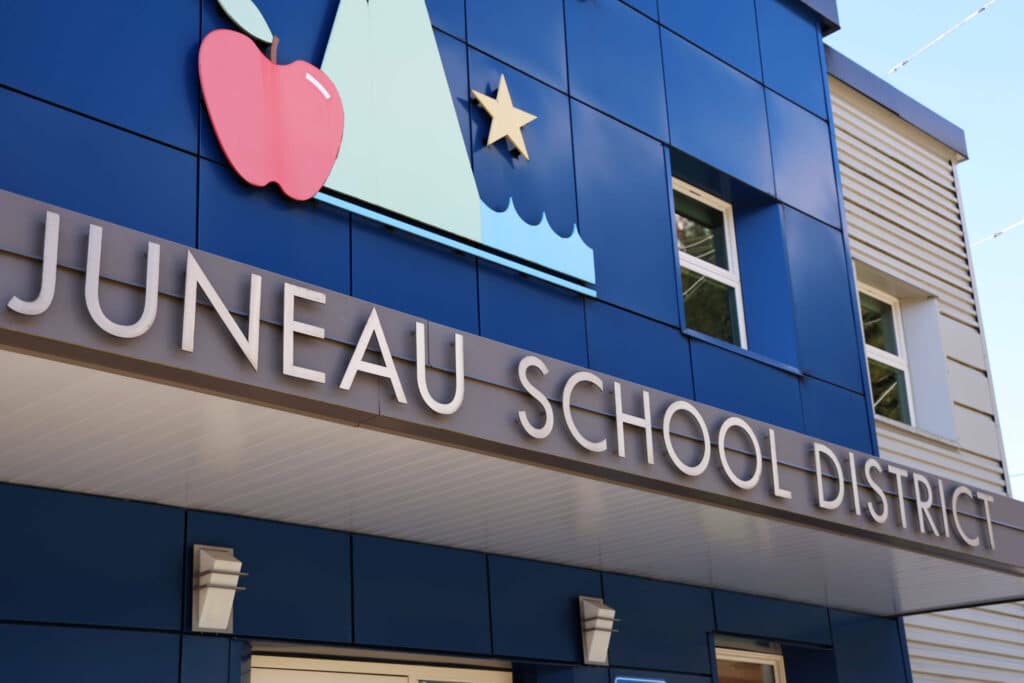
NOTN- The Juneau School District has launched a “Buy a Brick” campaign to help fund playground equipment at the Dzantik’i Heeni campus, where several of the city’s programs were relocated after school consolidation.
“Through the consolidation the year before last at the Juneau School District, our optional programs were moved to the Dzantik’i Heeni campus, which had previously been a middle school.” Said Juneau school district Director of Operations Kristy Germain, so we now have Montessori Borealis, which has pre-K and kindergarten through eighth grade, and we also have the Juneau Community Charter School, which is kindergarten through eighth grade, and additionally our Yaakoosge Daakahidi alternative high school, but the playground is primarily for our elementary program.”
While the playground will primarily serve elementary students, it will also be open to children in the surrounding Lemon Creek and Switzer neighborhoods, Germain says the school district partnered with the city engineering department for public design and safety concerns.
“The cost is substantial,” Germain said “We have received funding from the City Assembly, they authorized an ordinance to put $735,000 specifically toward the site preparation and the concrete base and the safety surfacing for the playground, and that’s just the safety surfacing. So the equipment is an additional cost. So the Juneau school district is taking the lead on fundraising for the actual playground equipment.”
The Buy a Brick fundraiser allows residents and businesses to purchase engraved bricks that will be installed at the site.
“We are partnering with Brick Markers, and they’re a company that has worked with other organizations in Juneau, I think notably, Rotary Park and the 911 Memorial use the same company.” Germain said, “Those bricks are holding up, so that’s a good testament to them. But we have established various levels so that individuals and community members are able to purchase a brick, and we’re also looking to our business community to support this endeavor.”
Proceeds will go toward the cost of equipment, which Germain said could push the project’s total cost beyond $1 million once installation, shipping, and materials are factored in.
The district plans to launch an online portal for the fundraiser within the week, with brick sales running through December. Officials hope to purchase and receive equipment in time for installation next summer.
“We are running into some timelines for purchasing the equipment in time for it to arrive to be installed this summer. So that is why we have a tight timeline.” Said Germain.
Community support has already begun. Juneau’s Rotary clubs recently donated $30,000 toward musical play equipment and are organizing volunteer work parties to help install it.
For those unable to buy a brick, Germain said there will be other ways to contribute, including volunteering at fundraising booths or helping with community outreach.
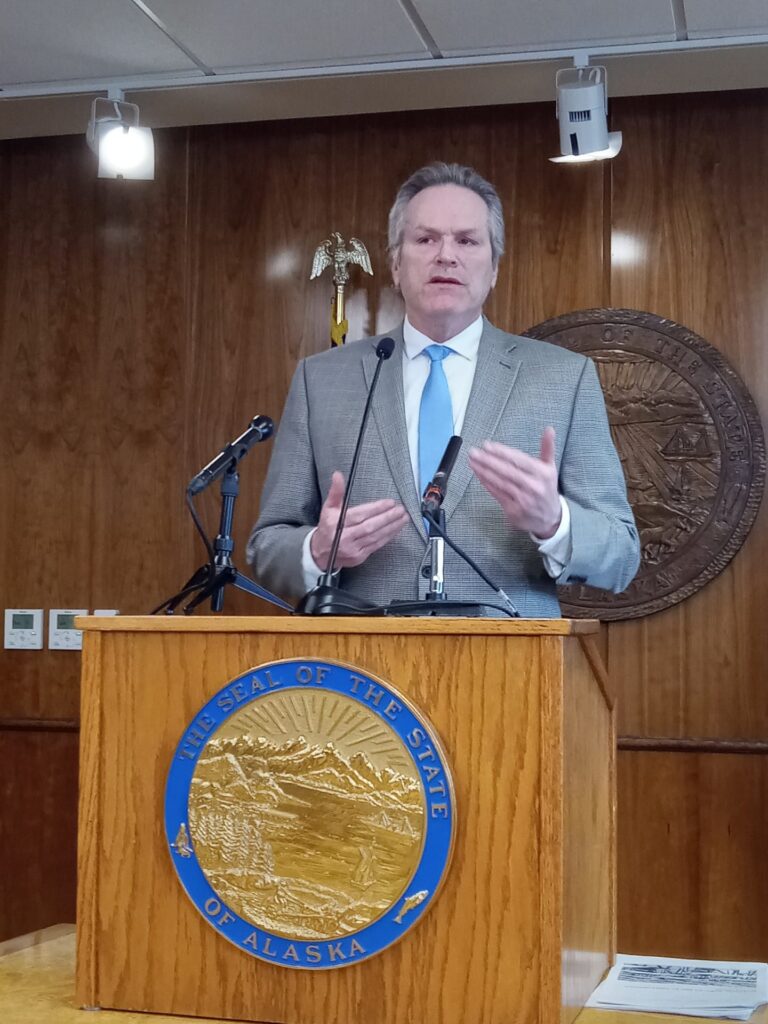
Alaska Gov. Mike Dunleavy shakes hands with Rep. Andrew Gray, D-Anchorage, following the annual State of the State address on Tuesday, Jan. 28, 2025, in the Alaska Capitol. (Photo by James Brooks/Alaska Beacon)
Senate Bill 113, passed by the Alaska House and Senate in May by a combined vote of 42-18, would have required internet companies to pay corporate income taxes based on the location of their sales, not the location of their server farms or offices.
That shift, already enacted by 36 other states, would have required companies like Netflix and Hulu, which do not have any in-state business presence, to pay corporate taxes based on sales to Alaskans. That shift was expected to generate between $25 million and $65 million per year for the state treasury once fully implemented.
In House Bill 57, which increased the state’s per-student public school funding formula, lawmakers included provisions that directed much of that money to vocational and technical instruction, as well as grants intended to help elementary school students improve their reading.
Without SB 113, those programs will not receive additional money.
In 2022, Dunleavy and the Legislature collaborated on the Alaska Reads Act, legislation intended to boost the reading skills of young Alaskans. Initial results have shown some benefits, and funding in SB 113 was intended to expand upon that effort.
But in a message accompanying Monday’s veto, Dunleavy said he will not approve any tax measures unless they are part of a larger plan intended to bring state income and expenses into line over the long term.
Dunleavy said he wants to see a “truly durable fiscal plan” that includes “not only revenues but also clear guardrails: spending limits, statutory and regulatory reviews, and policies that make Alaska the most competitive state in the nation for investment and new business growth.”
Dunleavy called SB 113 “a simple tax bill that does not consider the comprehensive fiscal approach outlined above.”
The Legislature could override Dunleavy’s veto of SB 113, which would require 45 votes when lawmakers reconvene for the regular session in January, but that’s a level of support larger than the bill received when it originally passed.
Sen. Robert Yundt, R-Wasilla, sponsored the amendment that would have diverted SB 113 funding to education. He did not answer a phone call seeking comment on Monday afternoon.
Sen. Bill Wielechowski, D-Anchorage, sponsored SB 113 in the Senate and lambasted the governor’s decision in a written statement.
“SB 113 was a common-sense, bipartisan solution to help close our revenue gap without costing Alaskans or Alaska businesses a penny,” Wielechowski said. “The Governor had the opportunity to stand with Alaska families, students, and communities – but instead, he chose to side with tech corporations that profit from Alaskans and utilize our infrastructure, while paying nothing back to our state.”
Wielechowski said that the bill would have modernized Alaska’s corporate tax structure using reforms already adopted by other states.
“Every Alaskan knows Alaska is facing a revenue crisis, and that our education system needs critical resources. This bill would have been a step towards closing those gaps without taxing Alaskans while asking these corporations to contribute to the state that they use for their business ventures,” Wielechowski said. “The Governor’s veto sends the message that outside corporations come before Alaska’s schools, Alaska’s workforce, and Alaska’s future.”
Asked whether the governor had a comment about the veto’s effects on education funding, his communications director responded by email.
“Governor Dunleavy continues to encourage lawmakers, as he has done for the past several years, to work with him on a durable and comprehensive fiscal plan,” said Jeff Turner, the communications director. “Passing more taxes without spending limits and policies that give existing businesses the confidence they need to expand and new businesses the confidence they need to invest in Alaska will make our state less competitive.”
SB 113 was the last bill awaiting gubernatorial action this year. Of 33 bills passed by the House and Senate this year, Dunleavy vetoed nine, or 27%, the highest proportion since statehood. Legislators overrode two of Dunleavy’s vetoes during a special session in August.
The campus of the University of Alaska Fairbanks is seen from the air on Sept. 20, 2022. (Photo by James Brooks/Alaska Beacon)
Officials at the University of Alaska said this week that previously announced cuts to federally funded programs for Alaska Native and Native Hawaiian students will be worse than initially thought.
At the University of Alaska Fairbanks, the canceled funding will amount to an estimated $8.8 million, and University of Alaska Southeast programs will also be affected but to a lesser degree.
“It was quite a shock, because there was no forewarning to this,” said Bryan Uher, interim vice chancellor for rural, community and Native education at UAF in a phone interview Wednesday.
Uher said the elimination of the grant funding for the University of Alaska Fairbanks affects programs at the Bristol Bay campus in Dillingham and in Fairbanks at the Community and Technical College focused on career training and workforce development, as well as student services.
In total, for the five-year grant programs, Uher said the cancellation is estimated at $8.8 million of $12.9 million in grant funding previously awarded.
“This award funding is unique in that it funds faculty for new program development, and then it also funds staff for student support — so advisors, outreach, individual wellness coordinators, admissions, graduation – student services, essentially,” he said.
Uher said new programs in development that will be impacted — for students in person or through distance education — include American Sign Language, information technology technician training and private pilot ground school, helping students train for their pilot’s license.
Uher said those programs will continue through this academic year, and then the university will evaluate whether or how to continue them. University officials say they were given one year to close out grant-funded programs.
UAF includes campuses in Fairbanks, Dillingham, Bethel, Nome and Kotzebue. Uher said while these programs must have at least 20% Native students to be eligible for the funding, they serve a wider student population, especially student services at rural campuses that serve wider regions of rural Alaska.
“They provide follow-ups, financial aid support like, how do you apply for financial aid? Are there scholarships out there?” Uher said. “They provide financial literacy to students. So it really is a comprehensive service that we provide to these students who are not living in or located in urban centers like Fairbanks or Anchorage.”
An estimated 17% of the University of Alaska student population identified as Alaska Native in 2024, or 3,254 students statewide, and roughly 1.3% or 266 students identified as Native Hawaiian.
UAA and UAS expect less impact
University of Alaska Anchorage has grant-funded programs for Native students, but officials say they are not expecting them to be affected.
University of Alaska Southeast Chancellor Aparna Palmer said in a university-wide email Monday that a grant-funded program on its Sitka campus to support student services is already set to end this month, and the university is authorized to continue to spend remaining funds for another year.
“I want to assure you that we will continue to support the many ways in which we are rooted in Alaska Native culture, history, language, and arts,” Palmer said, adding emphasis by underlining her statement.
Palmer said programs and courses in Indigenous studies, as well as support for Indigenous students, will continue. “Our programs and courses in Indigenous Studies at UAS are strong and will continue to thrive and grow. The UA President, Pat Pitney, and I are fully aligned on this,” she said. “Our Native and Rural Student Center will continue to be a space that provides support for Alaska Native students while welcoming all students.”
Faculty union president Jill Dumesnill, professor of mathematics at UAS, said by email on Monday that the announcement also disrupts future programs, faculty positions and student services.
“Writing these grant applications takes an enormous amount of faculty time and effort, and the Sitka proposal would have provided two additional faculty on the Sitka campus. That loss is significant because there are currently no Alaskan Native faculty members on the Sitka campus,” she said. “You don’t make campuses welcoming simply by calling them welcoming.”
Alaska’s U.S. Senators say they’re working to fund higher education
U.S. Sen Lisa Murkowski, R-Alaska, said in a statement Wednesday that the funds are already legally authorized by Congress, and support students as well as address workforce shortages in the state.
Alaska Republican U.S. Sens. Lisa Murkowski and Dan Sullivan (Alaska Beacon file photos)
“I am working with my colleagues to reinforce to the administration that these are statutory grant programs authorized and appropriated by Congress that align with the President’s goal of providing career technical education to the next generation for high-impact workforce needs such as fisheries, healthcare, skilled trades, and energy,” Murksowski said.
“As Alaska partners with this administration on several large-scale and exciting projects that can help transform our state, we need a local workforce trained to meet this moment,” she said. “Cancelling these funds takes us further away from that objective.”
A spokesperson for U.S. Sen. Dan Sullivan, R-Alaska, also repeated the impact on career training and workforce development education.
“Senator Sullivan and his team are in touch with the Department of Education regarding these grants. The University of Alaska serves thousands of students across the state, including Alaska Natives, and provides critical programs, such as job training and technical education, that build up Alaska’s trained workforce. President Trump’s Day 1 executive order to ‘Unleash Alaska’s Extraordinary Resource Potential’ makes it clear we must be training the next generation to power projects like the Alaska LNG pipeline and keep these good-paying jobs in Alaska,” said spokesperson Amanda Coyne by email on Tuesday.
“Senator Sullivan will continue to work with the administration to fund secondary education and job training to continue building up Alaska’s economy and workforce,” she said.
Alaska’s U.S. House Representative Nick Begich did not respond to a request for comment on Wednesday.
The announcement follows the Trump administration’s move to cancel $350 million in congressionally approved grant funding for minority-serving institutions last week, saying the funds will be allocated elsewhere.
There are an estimated 5 million students enrolled in 800 minority-serving institutions nationwide. The grant funding is aimed at supporting students of color and from low-income backgrounds to pursue and complete higher education.
NBC Sports will spotlight Juneau as part of a documentary on what football means to communities, Juneau-Douglas High School football coach Rich Sjoroos announced on Facebook.
The network has chosen a handful of cities nationwide to feature.
Juneau, home to the Crimson Bears, was selected from among more than 15,000 high school football programs in the United States.
A production crew will travel to the capital city this weekend to film Saturday’s game against Anchorage’s Dimond High School, scheduled for 3 p.m.
According to Sjoroos’ post, NBC will also interview players, parents and fans.
The footage is set to air as part of NBC’s Super Bowl pregame programming on Feb. 8, 2026.
Sjoroos encouraged residents to attend and “show all of America how much football means to Juneau.”
NOTN- The University of Alaska Southeast says its textbook affordability program has saved students more than $1 million since it began in 2016.
According to national surveys and studies on the affordability of course materials, about 65% of college students did not buy their textbooks because they were too expensive and 77% of students delayed purchasing their textbooks due to high cost. Students who face food insecurity are often the most heavily impacted, having to make a choice between buying meals and purchasing textbooks.
The initiative, encourages faculty to use low-cost or zero-cost course materials in place of traditional commercial textbooks. According to the university, more than 200 faculty have offered 889 “Zero Textbook Cost” courses, saving students an average of $225,000 each semester.
“Offering affordable access to an excellent education is our #1 priority at UAS.” Chancellor Aparna Palmer said in a statement. “Thanks to the leadership of the Egan Library and the hard work of our faculty and staff, we help ensure that our students can learn more deeply, finish their degrees, and achieve their dreams.”
The effort is part of a national shift toward using open educational resources (OER), which are free, adaptable, and often more up-to-date than traditional textbooks.
According to UAS these open educational resources enable both students and faculty to benefit, because the materials can be adapted to fit the needs of today’s students, they also help strengthen student participation.
UAS began marking “Zero Textbook Cost” courses in 2022, allowing students to easily search for affordable options when registering for classes.
By the end of the spring 2025 semester, the university estimates more than 10,000 students have benefited from the program.
The Juneau School District office in downtown Juneau.
(Photo courtesy City & Borough of Juneau)
The Juneau School District office in downtown Juneau.
(Photo courtesy City & Borough of Juneau)
NOTN- The Juneau School District has canceled all classes for Thursday, Aug. 14, citing ongoing flood warnings for the Mendenhall River and the need to assess damage in the Mendenhall Valley area.
JSD released a statement this morning, The district said it will continue to monitor the situation and notify families of any changes through automated calls, emails, texts, its mobile app and its website. “The safety of our staff and students is always our number one priority.”
The National Weather Service’s flood warning remains in effect until 8 a.m. Thursday. Three district schools are located in the affected area. Officials said the delay will allow Unified Command and safety crews to evaluate conditions before students return.
Classes for grades 1–12 are scheduled to begin Friday, Aug. 15, while the first day of kindergarten will be Monday, Aug. 19.
NOTN-Juneau’s Unified Command is preparing residents for the anticipated , Suicide Basin release that could cause flooding along the Mendenhall River.
Once water begins to spill from the basin, the National Weather Service will issue a flood warning, and the Unified Command will send evacuation advisories through multiple channels.
City and school district officials are preparing for possible closures affecting all Juneau schools, even though only three are located along the river. The district said closures could last as long as the evacuation advisory remains in effect.
Juneau Mayor Beth Weldon says they are moving through the evacuation as if the HESCO Barriers – which are placed along Mendenhall river – aren’t there.
“We’re assuming that they will work.” Said Mayor Weldon “We did this all with the Army Corps of Engineers, they were quite excited about them working, and we’re hopeful that things will be much better than last year. But again, it’s still a flood area, so we are asking people evacuate.”
If the advisory is issued before the school day begins, classes will be canceled. If flooding is expected during the day, at-risk schools may release students early or relocate them to safe sites for parent reunification. Guardians and emergency contacts must provide photo ID to pick up students.
In some cases, bus riders who live in the evacuation area but attend schools elsewhere may be taken to a central pickup point outside the flood zone rather than back into affected neighborhoods.
Governor Mike Dunleavy speaks during a press conference on Thursday, April 17 in Juneau. (Photo by Greg Knight/NOTN)
Governor Mike Dunleavy speaks during a press conference on Thursday, April 17 in Juneau. (Photo by Greg Knight/NOTN)
NOTN- Gov. Mike Dunleavy on Monday released the full policy agenda for a special session of the Alaska Legislature, scheduled to begin Saturday, Aug. 2. The session, first announced earlier this month, will focus on a sweeping package of education reforms the Governor says are aimed at improving student outcomes and securing long-term funding for public schools.
“This is an opportunity to address Alaska’s performance issues and funding issues in K-12 education well into the future.” Dunleavy said in the press release. “By addressing this now, school districts, students, parents, teachers, and policymakers will have certainty and will not have to debate this issue during the regular session that begins in January,”
The Governor’s office outlined their key priorities for the session, those include
Executive order creating a Department of Agriculture
Tribal Compacting between the state Department of education and select tribes
Expansion of corporate tax credit program for education.
Authorize the Department of Education as a charter school authorizer in addition to local districts
Open enrollment allowing public school students to enroll in any public school that has room including outside of a student’s resident district.
Grants for reading improvement and for a new after school reading tutoring program
Recruitment retention payments to classroom teachers to reduce turnover
Long-term certainty in funding for K-12 schools if agreement is reached on policy.
Education Commissioner Dr. Deena Bishop, a former teacher and superintendent, said the proposals are evidence-based and modeled after successful policies in other states.
Bill introductions are scheduled for the session’s opening day, with hearings requested to begin Sunday, Aug. 3.
However many lawmakers plan to override Gov. Mike Dunleavy’s decision to veto millions of dollars in public school funding from this year’s state operating budget.
according to the Alaska Beacon, It takes 45 votes to override an Alaska governor’s budget veto, and of the 46 legislators who voted this spring to override the governor’s veto of the education funding formula, all but a handful have committed to supporting a budget veto override as well.
That formula is subject to the state’s annual budget process, and Dunleavy chose to only partially fund it, causing a wave of cuts to services at public schools across the state. Dunleavy had said he would not agree to the full funding increase without the Legislature adopting other policies he’s proposed.
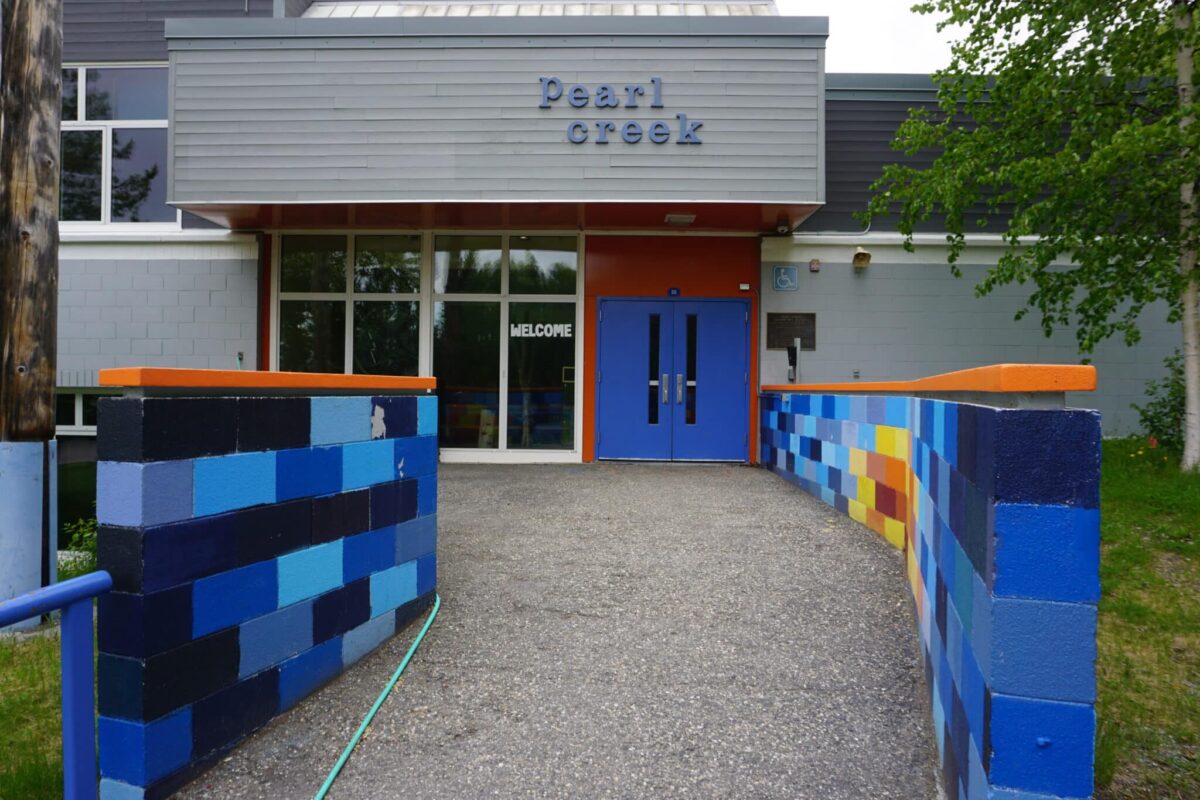
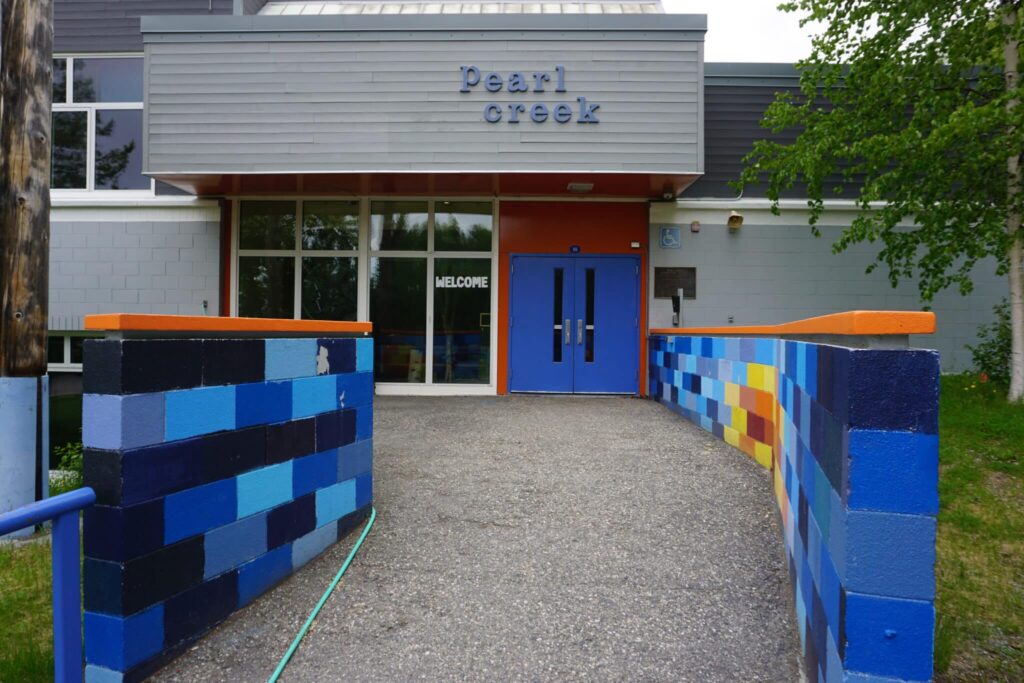
Pearl Creek Elementary School is seen on June 3, 2025. The Fairbanks North Star Borough School District decided to close the school at the end of the academic year due to budget cuts. (Photo by Yereth Rosen/Alaska Beacon)
Three Alaska school districts have joined a coalition from across the country — including school districts, teachers unions, parents and advocacy groups — suing the Trump administration for blocking $6.8 billion in congressionally approved education funding.
The Anchorage, Fairbanks North Star Borough, and the Kuspuk school districts joined the lawsuit filed Monday in federal court. The suit challenges the withholding of funds as unlawful and unreasonable, as well as violating Congress’ authority and the separation of powers.
“The lawless and last-minute withholding of federal education funds is not just a bureaucratic failure—it is a direct attack on our most vulnerable students. Less than a month before school starts, we’ve been forced to plan for cuts instead of preparing to serve children,” said Fairbanks Superintendent Luke Meinert in a statement announcing the lawsuit.
The Trump administration has said it’s withholding the funds pending a review of the grant programs to ensure they align with the Republican president’s priorities, and to “prevent them from promoting a ‘left-wing’ agenda,” according to the lawsuit.
For Alaska, an estimated $46.4 million was allocated across five grant programs, according to the Alaska Department of Education and Early Development. That includes funding to support migrant education, academic enrichment, English language learning, and other types of instruction, as well as teachers’ professional development. In addition, an estimated $1.1 million was withheld for adult education programs.
According to the lawsuit, school districts nationwide are facing millions in budget shortfalls, and have had to “cancel orders for new curriculum, delay critical teacher training, pause contracts for services for English language learners, or take other actions to avoid incurring expenses that they cannot afford to pay without the money normally provided by the Formula Grant Programs.”
The Fairbanks North Star Borough School District serves more than 12,000 students across 33 schools, and has seen over $2.57 million frozen, according to the lawsuit.
“Without these Title program funds, nearly 200 education jobs are in jeopardy,” Meinert said. “Our classrooms will be less supported, and students will be left behind. This isn’t just fiscal irresponsibility—it’s a moral failure that jeopardizes the future of the very students federal law is meant to protect.”
The Kuspuk School District serves 320 students in nine schools across 12,000 square miles in Western Alaska — and has received national attention for its deteriorating school buildings and severe maintenance needs. It is facing over $180,000 in frozen funds.
Students attend class in a Kuspuk elementary school. (Photo provided by the Kuspuk School District)
Among the grants frozen was funding to support teacher training, school supplies, enrichment programs and English language learning, including for over 130 staff. “Because English is not the first language for more than 60% of the district’s teaching staff, sustained … training has been critical to ensuring educators can effectively support English Learners across subjects and grade levels,” according to the lawsuit.
Superintendent Madeline Aguillard said in a statement the programs are “not line items, they are lifelines” for students.
“These are not extras. These are the programs that give our students a chance,” she said. “When funding is blocked, it does not just stall services. It dismantles the systems we have built to reach those most in need. When the federal government walks away from its obligation, it is not a delay. It is denial. Denial of access. Denial of progress. Denial of the futures our students have a right to pursue.”
For Anchorage, the state’s largest district by population at more than 43,000 students in 94 schools, the frozen funds are estimated at $11.8 million.
In an interview last week on the district’s budget challenges ahead of the lawsuit, Superintendent Jharrett Bryantt said the funding freeze on July 1, at the start of the fiscal year was “severe,” particularly having just signed new contracts for teachers and staff. “If you offer somebody a role and no longer have the funds for it — it’s so unprecedented that the federal government would not essentially pay its bills on time because these monies were appropriated. This is not a budget reduction conversation. This is a executing the will of the Congress of conversation,” he said.
Anchorage Superintendent Jharrett Bryantt (Photo provided by the Anchorage School District)
The freeze comes amid an ongoing state education funding debate with the Alaska State Legislature meeting for a special session on Aug. 2, as well as a dispute over local contributions to school funding. School officials said this combination of issues is devastating to public education in Alaska. Earlier this year, the Anchorage School District reported it had to lay off 42 staff positions, and cut more than $30 million in salaries, benefits and services.
Bryantt said the district had to immediately lay off five staff members following the funding freeze announcement, and transfer about a dozen more to alternate roles. “We can make sure that folks are employed. That’s my top priority, in addition to the continuity of our students’ learning,” he said, and recruiting and hiring teachers is an ongoing challenge.
“Teachers are a national commodity,” he added.
The lawsuit, filed in a federal court in Rhode Island, names the U.S. Office of Management and Budget, its director Russ Vought, the U.S. Department of Education and Secretary of Education Linda McMahon. It asks a judge to compel the department to release the funds.
Alaska U.S. Sen. Lisa Murkowski joined nine other Republican senators in a letter to the Office of Management and Budget urging the department to release K-12 funds, as well as over $700 million for adult education programs.
Last week, the U.S. Department of Education announced it will release some of the withheld grants, an estimated $1.3 billion that goes to support after-school care and summer school programs, though it’s unclear when those funds will be received by districts.
Deena Bishop, commissioner of the Alaska Department of Education and Early Development, at a news conference with Gov. Mike Dunleavy on education funding on Friday, Jan. 31, 2025. (Photo by Corinne Smith/Alaska Beacon)
The state of Alaska has filed an appeal with the U.S. Department of Education after federal officials said the state failed a test measuring the differences in funding between school districts, which put more than $80.8 million in federal aid at risk.
Each year, the state receives federal funding called “impact aid” intended to compensate districts with federally owned lands, which reduce the tax base to support schools. The state can put that funding toward its own funding for schools — which the state has done in the past — but only if it can pass what’s known as a disparity test.
Federal law requires there to be no more than a 25% gap between per-student revenue in districts near the highest in funding and districts near the lowest. The department found Alaska’s disparity to be 26.88%, given the state’s complex funding formula.
But Alaska has rejected the finding, filing a formal appeal on July 14 and submitting districts’ finance data to argue their expenditures meet the standard. The test puts federal funding at stake, according to the state, which this year amounts to an estimated $80.8 million.
Deena Bishop, commissioner of the Alaska Department of Education and Early Development, said in an interview last week that she feels good about the state’s accounting and a successful appeal.
“I’m confident that we did meet it,” Bishop said of the requirements. “If I base it off of the last appeal and how Alaska was able to share how transportation costs are truly that disparate, then I think we will do fine.”
The state failed the same disparity test in 2021, based on 2019 state data, and successfully appealed. This time, the state submitted 2024 data for evaluation.
“So a little bit of it is a huge math problem at the beginning,” Bishop said of the appeal process. “We wrapped our arms around it and figured that out, and then made an argument on … why we did it that way, given the background of those costs in Alaska.”
Bishop said Alaska sees high costs in rural school districts — especially for transportation, but also basic supplies and operating costs.
“The cost to do business is highly diverse in Alaska. If you just took the cost of a head of lettuce or a gallon of milk, you know, in Anchorage, as compared to Teller, it’s not just three times (higher in Teller). It could be up to five times. And really building and construction materials, supplies, all of those are such a significant increase due to the way you can only get in by barge or plane. So it’s just … again, understanding why we pay such large differences in different places in Alaska.”
The U.S. Department of Education notified the state that it failed the test on May 16, as first reported by KTOO. Bishop said it will take time to resolve. The 2021 appeal was resolved at the end of that fiscal year, in 2022.
“It is a long process, because I think they’re very careful at it,” she said. “You want to spend the time on it. They did spend the time to understand Alaska.”
In the meantime, the federal impact aid payments will continue to school districts.
DEED spokesperson Bryan Zadalis said by email those funds will continue through the appeal process. “School districts will continue to receive Impact Aid funding directly from US-ED through their regular processes of application approval and funding availability,” he said.
Added uncertainty for education funding
The results of the disparity tests add uncertainty for the state, and for Alaska schools.
That’s based on the state’s complex funding formula for schools – which includes federal, state and local contributions.
Alexei Painter, who directs the division of state government that analyzes the budget for the Legislature, said the Legislature passed a budget that funds whatever the state’s portion is in that funding formula. If the state passes the disparity test, it allows the state to deduct the federal impact aid dollars from the state school funding.
But if the state fails the test, Painter said, “that money doesn’t go away. It just goes directly to those districts.”
If the federal impact aid isn’t flowing through the state government, it no longer is distributed based on the state funding formula. That’s potentially a big problem for the state.
“If we fail, we can’t make that deduction,” Painter said in an interview Wednesday. “The result of that is that what the state would owe to pay the full formula would go up by $80 million.”
That’s because the state would still be required to distribute the remaining state aid according to formula, but it would have less revenue to do it.
Painter explained that the issue is further complicated by Gov. Mike Dunleavy’s budget veto of $50 million for the state’s education funding this year.
Under the original budget bill passed by the Legislature, the state had an open-ended commitment to provide school funding according to the formula. But in issuing the veto, Dunleavy crossed out the language, replacing it with a dollar amount.
“The governor vetoed that appropriation from an open-ended one to a fixed dollar amount,” Painter said. That means that if the state fails the disparity test, “that cost goes up by $80 million, and now the veto impact is $130 million.”
The Legislature is set to take a vote on whether to override Dunleavy’s veto of school funding during a special session, scheduled for Aug. 2.
Painter said that if the Legislature votes to override the veto, it would fund the education formula – including the $80.8 million.
Depending on the override vote and the appeal, the impacts to school districts could vary widely across the state, he said. The division issued a memo in June on the potential impacts.
Some districts that receive the federal impact aid because they include federal lands, like the Lower Kuskokwim or Fairbanks school districts, could see millions more. But others, like the Matanuska-Susitna or Anchorage districts could see millions less, as the state would not have enough money to fully balance its part in the funding formula.
“I would just assume the Legislature will address this in some way,” Painter said. A veto override would be one way to address it. Another way would be to provide more money for school districts after the Legislature reconvenes for its next regular session, in January, in a supplemental budget bill.
If the state loses its appeal and the Legislature doesn’t act, it could be a problem for districts.
“Otherwise there’s just a lot of uncertainty for districts,” Painter said. “Even if the department’s ultimately successful, in the meantime, it just adds uncertainty for districts.”
Sen. Löki Tobin, D-Anchorage and chair of the Senate Education Committee, said in a phone interview that she was glad the state has appealed. But she argued that the disparity is being driven by a lack of funding on the state’s part for public schools.
“That is ultimately on the shoulders of our state and also of our local communities, and with a decade of flat funding, it is clear why our school districts’ budgets are getting tighter, the deficits are getting larger,” and the disparity is growing, Tobin said.
Zadalis said no date has been set yet for a hearing on the appeal.