







Categories
Featured Juneau News juneau Juneau Local Juneau Local Ketchikan Local News Feeds Sitka Local

University of Alaska requesting more funding for employee compensation and mental health services

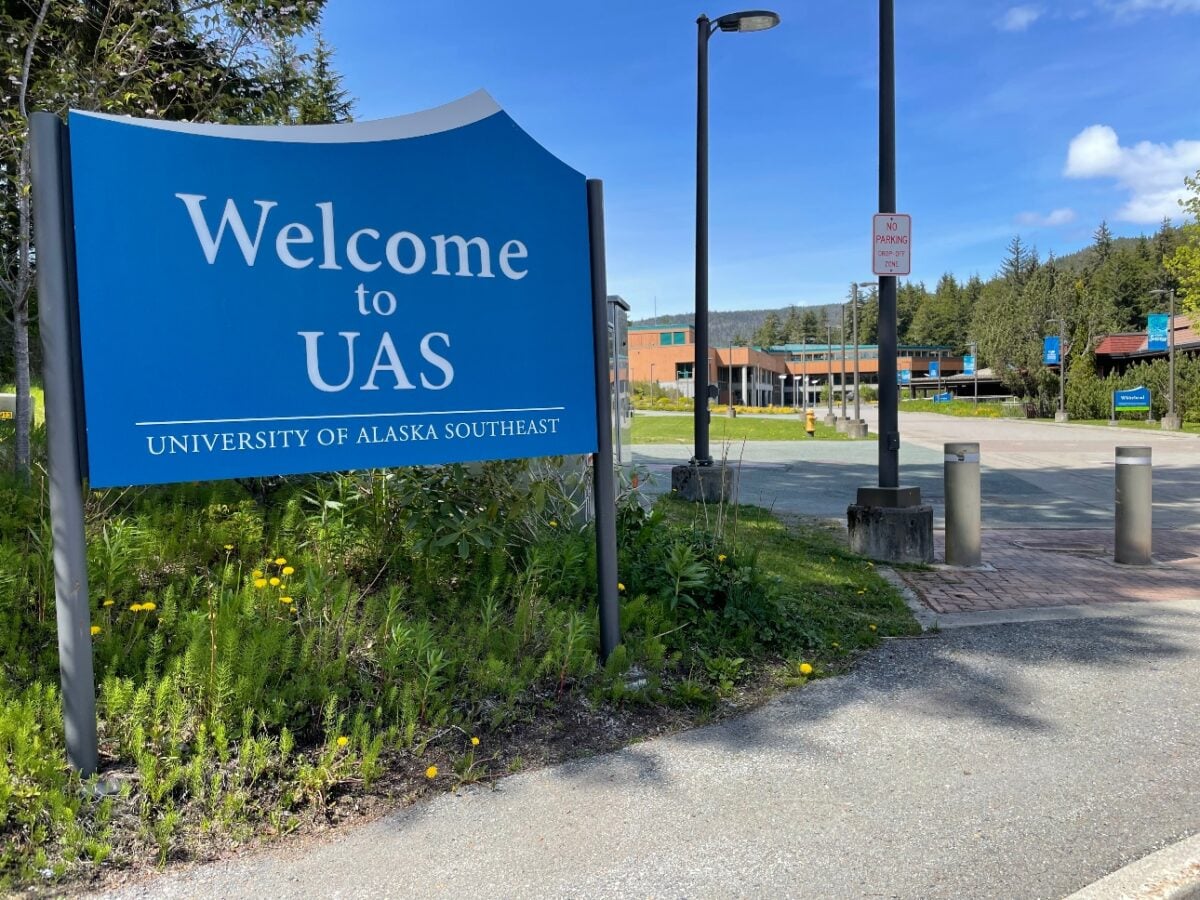
The University of Alaska Southeast campus in Juneau as seen on May 25, 2022. (Photo by Lisa Phu/Alaska Beacon)

NOTN- The University of Alaska is asking state lawmakers for millions in additional funding next year, saying the money is needed to stabilize operations, cover rising costs and address campus safety and student mental health needs.

University officials outlined their fiscal year 2027 budget request Monday to the Alaska House Finance Subcommittee.

The university’s highest priority for FY27 is a $15.2 million increase in unrestricted general funds for employee compensation.

University officials said the request would fund a 3% raise for union and nonunion employees under negotiated agreements, that’s about 1,100 faculty members, 640 adjunct faculty and roughly 420 graduate employees covered under union contracts. Another approximately 2,700 nonunion staff would also receive a 3% increase

“President Pitney has always tried to ensure that we have a very disciplined negotiation, and we want to respect the legislative process. we’re presenting numbers that are viable in the grand scheme of things, knowing the budget pressures that exist within the state.” Said University Liaison Chad Hutchison.

Officials said 53% of the university’s operating budget goes toward employee compensation, with much of the remainder paying for contracted services like food and custodial work.

The compensation request also includes funding to address rising health care costs. The university estimates $4.8 million in increased costs for health coverage, while the governor’s proposed budget includes $3 million so far.

Beyond pay raises, the university is seeking money for public safety across campuses. At the Anchorage campus, officials said the university police department is significantly understaffed.

“To put this in context, last year, we had about 500 police reports that resulted in cases that required a lot of police officer time.” Said Ryan Buchholdt, the Vice Chancellor for University of Alaska Anchorage, “When we look at Department of Justice statistics we should be in the realm of about 30 police officers minimum, if we start thinking about leaves and training and injuries we should probably be closer to the 44 realm. We have 15 police officers.”

The university is also requesting $900,000 for student mental health services.

“This committee will remember that the students had brought that to many of your members when they visited the capital, it is my expectation based on conversations we’ve been having with the students that they’ll probably bring those requests again, mental health services are a very high need when it comes to our students across all three campuses.” Said Hutchison.

The university reports about 20,500 students statewide, describing itself as a primary workforce provider for Alaska’s economy.

Categories
Featured Juneau News Juneau Local Juneau Local Ketchikan Local News Feeds Sitka Local

‘Schools are being asked to do more with less’ Testifiers call for more school funding

Student, Maddie Bass and school board member Steve Whitney testifying before the Joint Education Committee. Photo courtesy of Gavel Alaska.

By: Grace Dumas, News of the North

District leaders and student advocates from across Alaska testified this morning at a joint Education Committee hearing with both the House and the Senate.

One thing all districts had in common, despite the unique challenges facing schools from Fairbanks to Yakutat, was a call for reliable school funding.

Public schools are funded through Average Daily Membership or ADM, this is the count of enrolled students each year, it can take months to fully process, with an accurate count generally unavailable during budget making.

Testifiers say school funding is a “guessing game.” With districts often creating their budgets with no concrete data.

Some schools have classes that span multiple age groups, bloated class sizes that spread teachers thin, and testifiers say it’s, “costing the state excellence.”

Another commonality between all districts was concern for teacher turnover.

Testifiers said teachers are not compensated fairly to adjust for the rising cost of living in the state, and they are not provided an adequate retirement package which creates an incentive to stay in Alaska.

“I don’t know where the state is going to save all kinds of money by not giving our children the education they need.” said testifier Strong from Chatham school district.

15-year old Maddie Bass from Juneau described growing up in what she called an “underfunded district” where teachers routinely sent home lists of supplies so students could fully participate in class.

“I have never had the opportunity to learn in a classroom that was funded enough to have materials for everyone.” she said, “even with recent consolidations in my district, which caused the firing of multiple teachers, the cutting of programs and more, there is not enough.”

Bass, whose father taught in Alaska schools, said she has watched educators in her district work multiple jobs, struggle to secure adequate health care and has watched her father go to school sick because there were not enough substitute teachers.

She added that, as a teenager, she should not be missing class to “testify in front of legislators” to ask for funding so her teachers can afford to live and students can receive a full education.

“So I’m asking you, please do as much as you can for me, for my teachers, and so my little sister will not have to stand up here and testify when she goes to high school in four years,” she said.

Testifiers thanked legislators for the increase in the Base Student Allocation, but that recognition came with a plea for more stability moving forward.

Categories
Featured Juneau News Juneau Local Ketchikan Local News Feeds Sitka Local

Alaska Gov. Dunleavy vetoes corporate tax bill intended to fund public education programs

Alaska Gov. Mike Dunleavy shakes hands with Rep. Andrew Gray, D-Anchorage, following the annual State of the State address on Tuesday, Jan. 28, 2025, in the Alaska Capitol. (Photo by James Brooks/Alaska Beacon)

Alaska Gov. Mike Dunleavy on Monday vetoed his ninth bill of the year, canceling Alaska lawmakers’ efforts to fund public schools by rewriting a portion of the state’s corporate tax code.

Senate Bill 113, passed by the Alaska House and Senate in May by a combined vote of 42-18, would have required internet companies to pay corporate income taxes based on the location of their sales, not the location of their server farms or offices. 

That shift, already enacted by 36 other states, would have required companies like Netflix and Hulu, which do not have any in-state business presence, to pay corporate taxes based on sales to Alaskans. That shift was expected to generate between $25 million and $65 million per year for the state treasury once fully implemented.

In House Bill 57, which increased the state’s per-student public school funding formula, lawmakers included provisions that directed much of that money to vocational and technical instruction, as well as grants intended to help elementary school students improve their reading.

Without SB 113, those programs will not receive additional money.

In 2022, Dunleavy and the Legislature collaborated on the Alaska Reads Act, legislation intended to boost the reading skills of young Alaskans. Initial results have shown some benefits, and funding in SB 113 was intended to expand upon that effort. 

But in a message accompanying Monday’s veto, Dunleavy said he will not approve any tax measures unless they are part of a larger plan intended to bring state income and expenses into line over the long term.

Dunleavy said he wants to see a “truly durable fiscal plan” that includes “not only revenues but also clear guardrails: spending limits, statutory and regulatory reviews, and policies that make Alaska the most competitive state in the nation for investment and new business growth.”

Dunleavy called SB 113 “a simple tax bill that does not consider the comprehensive fiscal approach outlined above.”

The Legislature could override Dunleavy’s veto of SB 113, which would require 45 votes when lawmakers reconvene for the regular session in January, but that’s a level of support larger than the bill received when it originally passed.

Sen. Robert Yundt, R-Wasilla, sponsored the amendment that would have diverted SB 113 funding to education. He did not answer a phone call seeking comment on Monday afternoon. 

Sen. Bill Wielechowski, D-Anchorage, sponsored SB 113 in the Senate and lambasted the governor’s decision in a written statement. 

“SB 113 was a common-sense, bipartisan solution to help close our revenue gap without costing Alaskans or Alaska businesses a penny,” Wielechowski said. “The Governor had the opportunity to stand with Alaska families, students, and communities – but instead, he chose to side with tech corporations that profit from Alaskans and utilize our infrastructure, while paying nothing back to our state.”

Wielechowski said that the bill would have modernized Alaska’s corporate tax structure using reforms already adopted by other states.

“Every Alaskan knows Alaska is facing a revenue crisis, and that our education system needs critical resources. This bill would have been a step towards closing those gaps without taxing Alaskans while asking these corporations to contribute to the state that they use for their business ventures,” Wielechowski said. “The Governor’s veto sends the message that outside corporations come before Alaska’s schools, Alaska’s workforce, and Alaska’s future.”

Asked whether the governor had a comment about the veto’s effects on education funding, his communications director responded by email.

“Governor Dunleavy continues to encourage lawmakers, as he has done for the past several years, to work with him on a durable and comprehensive fiscal plan,” said Jeff Turner, the communications director. “Passing more taxes without spending limits and policies that give existing businesses the confidence they need to expand and new businesses the confidence they need to invest in Alaska will make our state less competitive.”

SB 113 was the last bill awaiting gubernatorial action this year. Of 33 bills passed by the House and Senate this year, Dunleavy vetoed nine, or 27%, the highest proportion since statehood. Legislators overrode two of Dunleavy’s vetoes during a special session in August.