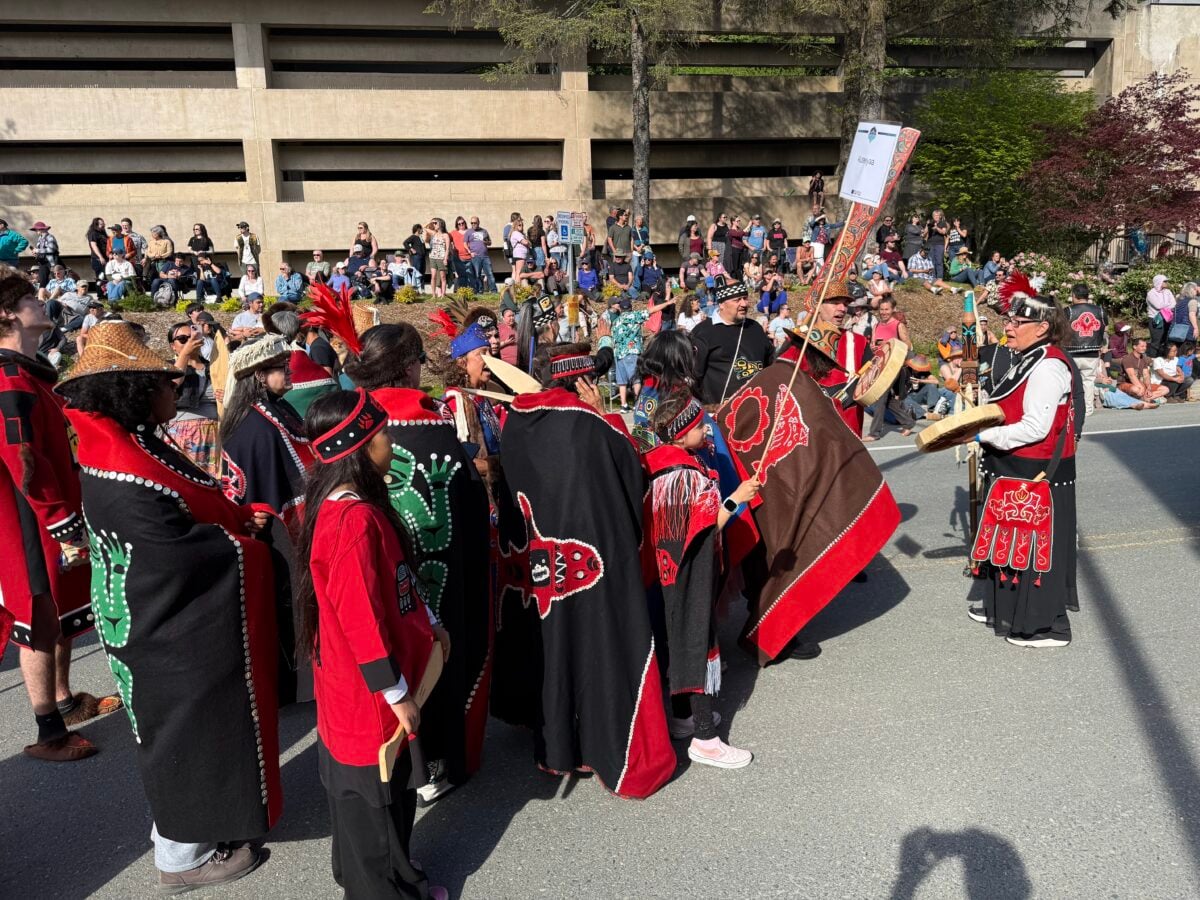
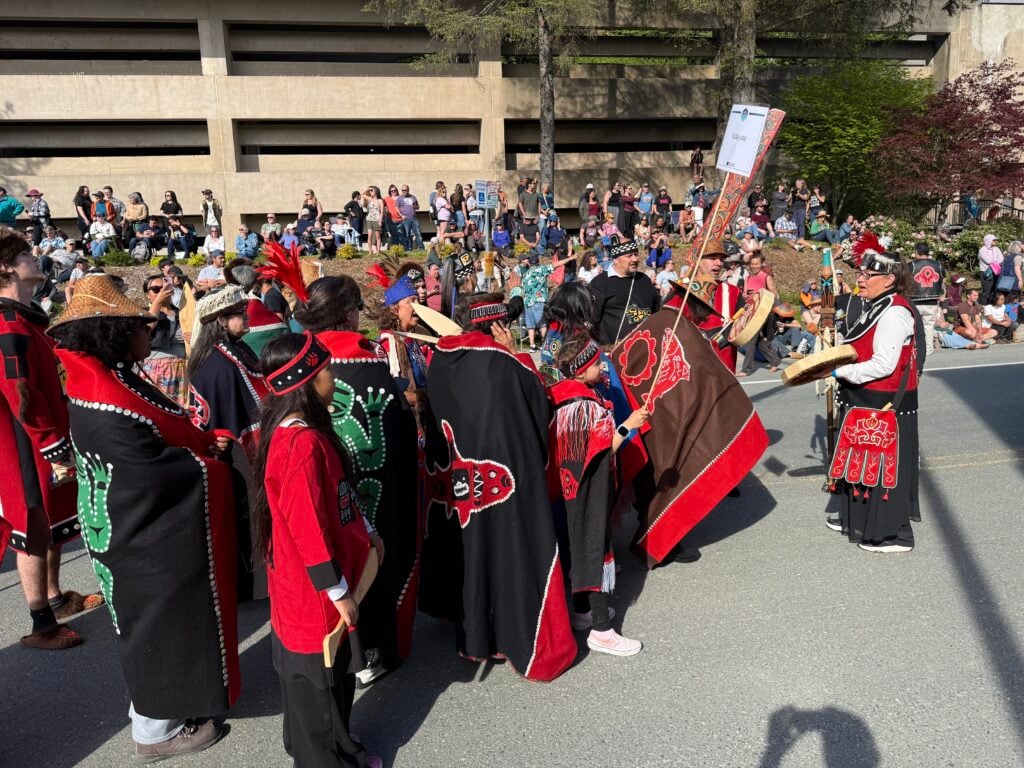
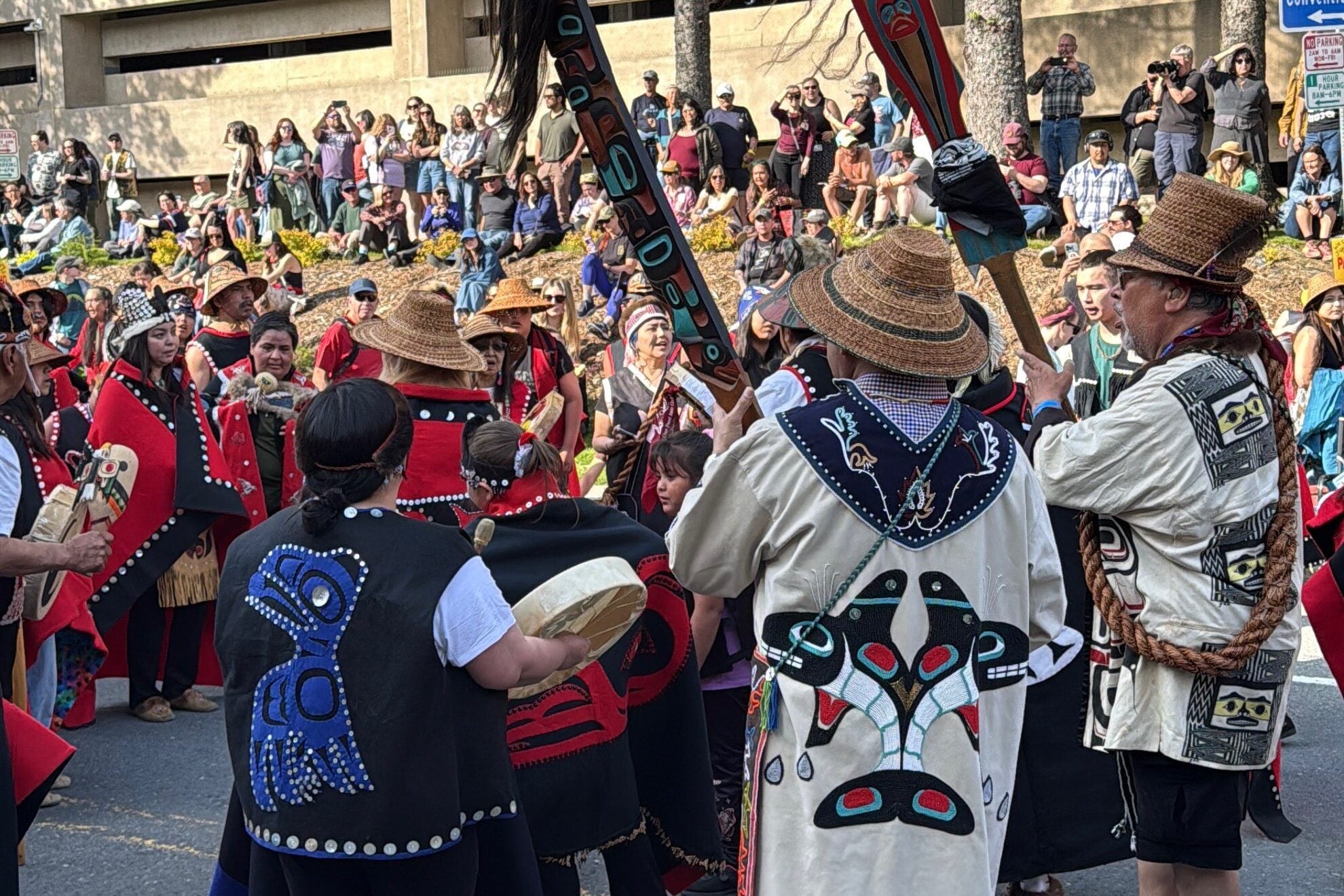
NOTN- One of Alaska’s largest cultural gatherings is officially underway this evening as Celebration 2026 opens in Juneau.
Organized by Sealaska Heritage Institute, this event brings together more than 1,800 dancers from 34 dance groups and is one of the largest gatherings of Tlingit, Haida and Tsimshian peoples in the world.
This year’s theme is “Enduring Strength,” honoring the resilience and cultural survival of Indigenous peoples throughout Southeast Alaska.
The Grand Entrance took place 5 p.m. downtown, kicking off four days of traditional dance, art exhibits, Native foods, cultural demonstrations and community events.
Celebration continues through Saturday with a final parade, and will be broadcast statewide with KTOO public Television, and streamed live online by SHI. So even if you can’t be here for Celebration, you can still participate in the event.
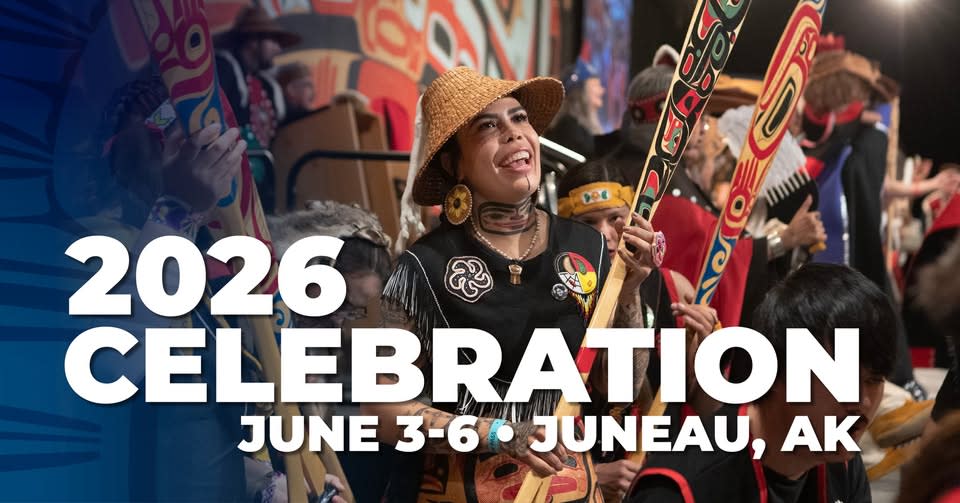
Photo Capture from Sealaska’s Youtube livestream
Celebration began in 1982 and remains a powerful expression of culture, heritage and community.
NOTN- Juneau’s got a busy few weeks ahead as the city prepares for the arrival of the 2026 Canoe Journey and continues discussions on the Fiscal Year 2027 budget.
The Central Council of the Tlingit and Haida will welcome canoes ashore Tuesday, June 2, during the 2026 Canoe Journey Landing in Juneau ahead of Celebration.
Community members, families and visitors are invited to gather for the event.
One landing is scheduled for 1 p.m. at the Áak’w Kwáan Landing at the Auke Village Recreation Area. Parking at Auke Rec is limited, and shuttle service will run from the University of Alaska Southeast between 11 a.m. and 3 p.m.
A second landing is planned for 2 p.m. at the Huna Totem Corp. lot at Egan Drive and Whittier Street downtown.
Celebration begins June 3-6, held by Sealaska Heritage Institute, the theme this year is “Enduring Strength.”
Several city meetings are also scheduled Wednesday, June 3.
The Juneau Commission on Sustainability will hold a regular meeting at noon via Zoom. The Eaglecrest Board Sales and Communications Committee also meets at noon by Zoom.
Later in the day, The Assembly Finance Committee will meet at 5:30 p.m. in Assembly Chambers, with participation also available through Zoom and YouTube livestream, this is ahead of the June 8 Assembly meeting, which city officials say is the final opportunity for public input on the proposed Fiscal Year 2027 budget before adoption.
On May 20, the Assembly Finance Committee adopted nearly $4.7 million in proposed reductions to the budget. The reductions included cuts to partner agency grants, capital projects, city services and the restricted budget reserve.
The Assembly also introduced four ordinances May 27 that would amend the city’s Sales Tax code and generate additional tax revenue.
Those ordinances will also be discussed during the June 8 meeting.
The Assembly must adopt a final budget by June 15.
AP- Indigenous peoples across North America are gathering this month to raise awareness about the disproportionate violence in their communities while demanding sustained response from authorities.
Today, May 5th is recognized as the day of awareness in the Missing and Murdered Indigenous Peoples movement but events have already started and will carry on throughout the month. In Canada, it’s referred to as Red Dress Day after Métis artist Jaime Black used the garments as a symbol of what Black said is gendered and racialized violence.
Events include prayer walks, art exhibits, self-defense classes, film screenings, 5k runs, healing circles, and marches and speeches at U.S. state capitols to plead for better cooperation among law enforcement agencies.
U.S. Justice Department data shows Indigenous women are more than twice as likely to be homicide victims than the national average and advocates say many cases recieve little to no media coverage.
Many people wear red and paint their faces with red handprints while vowing to speak for those who have been silenced.
The Central Council of Tlingit and Haida Indian Tribes of Alaska will hold a march to Elizabeth Peratrovich Hall this evening at 5 p.m.
The tundra surrounding Bethel, Alaska turns red and gold in the fall. October 10, 2023. (Photo by Claire Stremple/Alaska Beacon)
A national support line for Native survivors of domestic violence and sexual assault has begun work to launch an Alaska-specific service.
Strong Hearts Native Helpline is a Native-led nonprofit that offers 24-hour, seven-day-a-week support for anonymous and confidential calls from people who have experienced domestic violence or sexual assault.
The line is staffed by Native advocates, but Strong Hearts Deputy Executive Officer Rachel Carr-Shunk said there are not yet any Alaska Native people answering phone calls.
That is set to change soon.
“Even though we’re a Native organization and all of our advocates are American Indian, we do recognize that there is a difference for our Alaska Native relatives who experience violence in that context, whether they live in a rural village or they just live in Alaska, which is a different experience,” she said.
Carr-Shunk expects the organization to launch the Alaska-specific line within the next calendar year, after building partnerships in the state.
“When Alaska Native survivors reach out, we want them to trust that they’re going to have someone who understands their experience as an Alaska Native person, or who understands that identity,” she said.
To that end, the organization has hired Anchorage-based Minnie Sneddy, who is originally from Hooper Bay. Sneddy is tasked with explaining Alaska’s regional differences and specific needs to the organization, as well as helping create a database of Alaska resources.
Sneddy has years of experience in behavioral health work and said that her career and life experience have shown her the lack of resources for people who face domestic violence and sexual assault — and how many of those people need mental health support.
“The years I lived in Hooper Bay, and here in Anchorage and Alaska, there’s so many (people) that need help and want help, but they feel like if they do come forward and get help, they get in trouble — not only with their families, but with OCS, Office of Children’s Services,” she said. “I feel like Strong Hearts Native Helpline can help at least allow a person to be heard, because the majority of time, people want to be heard. Everyone just wants to feel seen and be heard.”
Sneddy said she is reaching out to resources that already exist in the state, and Strong Hearts is working with the Alaska Native Women’s Resource Center to build out its state-specific service.
“We don’t have a voice, really, in the villages,” Sneddy said, adding that when abuse happens: “There’s no help for an individual. And if a woman decides to do something about it, she’s seen as a bad person.”
The Strong Hearts Native Helpline is available now for Alaskans, even though there are not yet Alaska Native advocates on the other end of the line. A full list of Alaska shelters and victim’s services providers can be found in the state directory at law.alaska.gov.
Britt’Nee Brower of Utqiagvik peers through hanging jewelry at her table at the Alaska Federation of Natives convention on Oct. 16, 2025. Brower creates works of art out of a variety of media. Among her skills is carving, sewing, beading, etching, fashion design and poetry. She is among the artists listed in the Alaska Native Arts Directory. (Photo by Yereth Rosen/Alaska Beacon)
A new online statewide directory has been launched to showcase and connect Alaska Native artists across disciplines.
The Alaska Native Arts Directory is the work of the nonprofit Alaska Native Arts Foundation. Listing is free. The directory went live last week, timing that coincided with the Alaska Federation of Natives annual convention in Anchorage.
As of Monday, about 200 artists were listed, most of them with photos and biographical information. The Alaska Native Arts Foundation said it is seeking to expand that number to more than 1,000 by next year.
The Anchorage-based foundation said it also has a goal of holding a first-ever Alaska Native Arts Economic Summit next year, bringing together artists, policymakers and other partners to work on building the Indigenous creative economy.
There are other artists’ directories in Alaska, some of them with a focus on Indigenous artists. One, the Collective49 Marketplace, enables member artists to promote and sell their work online. And there are numerous local artists directories, such as those in Ketchikan and Homer.
The Alaska Natives Art Directory, however, is intended to be more comprehensive. Along with being statewide, the directory includes writers, musicians and other performing artists along with those who create carvings, paintings and other physical works of art. It includes contemporary art forms as well as traditional Indigenous arts.
“The Alaska Native Arts Directory celebrates the full spectrum of Alaska Native creativity, visual and written arts, performance, design, and traditional practices, reflecting the diversity and vitality of Alaska’s Indigenous cultures,” Gail Schubert, chair of the Alaska Native Arts Foundation, said in a statement.
Launch of the Alaska Native Arts Directory represents a renaissance of sorts for the Alaska Native Arts Foundation.
The foundation was created in 2002 and for several years operated an ecommerce site and a gallery in Anchorage. But it shut down those operatioons in 2016 after losing state funding and encountering other financial problems.
The directory project and other new activities now have a variety of funding sources, according to the foundation’s statement. The effort is backed by grants and other support from organizations that include the Rasmuson Foundation, the U.S. Small Business Administration, the office of U.S. Sen. Lisa Murkowski, R-Alaska, the Alaska State Council on the Arts and the Municipality of Anchorage, among others, according to the statement.
Britt’Nee Brower of Utqiagvik helps a custmoer at her table at the Alaska Federation of Natives convention on Oct. 16, 2025. Some of her earrings and prints are in the foreground. Brower creates works of art out of a variety of media. She is among the artists listed in the Alaska Native Arts directory. (Photo by Yereth Rosen/Alaska Beacon)
Members of the Tlingit, Haida and Tsimshian group Aanchich’x Kwaan perform on Oct. 18, 2025, at the Alaska Federation of Natives convention in Anchorage. The dance and singing group has members of all age groups, from young children to elders. The group was among several that performed traditional dances at the convention. (Photo by Yereth Rosen/Alaska Beacon)
The Alaska Federation of Natives convention in Anchorage, while it featured the usual cultural celebrations, socializing and discussions of state and federal policies, had a strong focus this year on a particular subject: the ravages on the Yukon-Kuskokwim Delta of ex-Typhoon Halong.
Natasha Singh poses for photos in the hallway of the Dena’ina Civic and Convention Center, site of the Alaska Federation of Natives annual convention. Singh, who is president of the Alaska Native Tribal Health Consortium, had just delivered her keynote speech on the opening morning of the convention. (Photo by Yereth Rosen/Alaska Beacon)
Speaker after speaker at the convention, the largest annual convention of any kind in Alaska and one of the largest Indigenous gatherings in the nation, referenced the storm. It has displaced more than 1,500 people, killed at least one person and dislodged houses from their foundations. Residents of stricken villages have been airlifted away, with hundreds getting temporary residency in Anchorage. The state’s largest city is about 490 miles east of the evacuees’ home villages, and vastly different in culture and character from the highly rural Indigenous communities.
“My heart with everyone impacted by the recent coastal storms,” Natasha Singh, the president of the Alaska Native Tribal Health Consortium and the keynote speaker on the first day of the convention, said at the start of her address.
“While the damage is so vast, the love for our people is even greater. And even as we feel the pain and the loss, I also feel a sense of inspiration to see so many people reach out to help,” she continued.
Volunteers work on Oct. 18, 2025, to sort donated items being collected in a room in the Dena’ina Civic and Coonvention Center, site of the Alaska Federation of Natives annual convention. Donations of diapers, clothing, hygiene products, bottled water, shelf-stable food and other items were being collected for Yukon-Kuskokwim Delta residents displaced by the remnants of Typhoon Halong. (Photo by Yereth Rosen/Alaska Beacon)
A special feature of the convention was a second-floor room at the Dena’ina Civic and Convention Center that was set aside to collect donations headed to the storm victims. Over two days, as convention proceedings unfolded in the third-floor ballroom, the collection room became filled with boxes of diapers, toiletries, clothing items, shelf-stable food and other necessities that were sorted by volunteers.
On Saturday, the final day, delegates passed a resolution seeking an immediate national disaster declaration, and investment by the federal government in better infrastructure in rural Alaska to protect against future disasters.
The ravages of the remnants ofTyphoon Halong demand more than an emergency response, the resolution said. The disaster “has continued to expose vulnerabilities in infrastructure, housing, and emergency preparedness for rural Alaska/extreme remote America, and highlights the need for stronger tribal-state-federal collaboration,” it said.
Alaska Federation of Natives convention attendees from the Yukon-Kuskokwim region listen on Oct. 16, 2025, to the keynote address delivered by Natasha Singh, president of the Alaska Native Tribal Health Consortium. (Photo by Yereth Rosen/Alaska Beacon)
The call for a national disaster declaration and the aid that would come with it was among a packet of resolutions passed on Saturday. Many of the resolutions concerned food security and efforts to ensure that Alaska Natives can safely practice their traditional fishing and hunting practices.
One highly anticipated convention speaker was former U.S. Rep. Mary Peltola, D-Alaska, who is considered a possible candidate for governor or U.S. Senate.
But Peltola made no campaign announcement.
“I want to preface everything I’m saying with: This is going to be very anticlimactic for everybody, I think,” she said at the start of her speech. “No big announcements, no big declarations.”
Former U.S. Rep. Mary Peltola, D-Alaska, speaks at the Alaska Federation of Natives convention on Oct. 17, 2025, about subsistence food gathering. Peltola is Yup’ik and from Bethel. (Photo by Yereth Rosen/Alaska Beacon)
Instead, she discussed subsistence – the traditional harvests of wild foods and arts materials – and the legal and environmental threats to its continued practice.
State legislators sit onstage at the Alaska Federation of Natives convention on Oct. 17, 2025, as House Speaker Bryce Edgmon, I-Dillingham, addresses the audience. Lawmakers pictured are, from the left, Rep. Neal Foster, D-Nome; Rep. Maxine Dibert, D-Fairbanks; Rep. Andrew Gray, D-Anchorage; Rep. Zack Fields, D-Anchorage; Rep. Robyn Burke, D-Utqiagvik; Rep. Louise Stutes, R-Kodiak; Sen. Donny Olson, D-Golovin; and Rep. Nellie Jimmie, D-Toksook Bay. (Photo by Yereth Rosen/Alaska Beacon)
She spoke about the way subsistence ties Alaska Natives to their home regions.
“Those spots, the places that we hunt and fish, they’re like another personality to us,” Peltola said.
She referred to a close friend who recently died. When she was on her deathbed, her family gathered around, Peltola said. “And at one point, they just talked about places. They just said the names of the places where they pick berries, or get whitefish, gather greens. And it was one of the most beautiful moments I’ve ever experienced, just reciting names.”
Kendra Berlin mans a pro-voting table at the Alaska Federation of Natives convention on Oct. 16, 2025. Berlin, originally from Bethel but now living in Palmer, was distributing T-shirt and buttons promoting the Natives Vote cause. (Phot by Yereth Rosen/Alaska Beacon)
NOTN- Sealaska Heritage Institute held a public ceremony yesterday to officially open new Indigenous Science Building and dedicate a newly carved totem pole that will take its place on Juneau’s waterfront.
The event, held on Indigenous People’s Day included the formal naming of the facility, the dedication of a Sukteeneidí kootéeyaa (totem pole), and cultural performances at Heritage Plaza next to the Walter Soboleff Building.
SHI President Rosita Worl said the four-story building will serve as a hub for education programs that center Indigenous knowledge, languages and values while incorporating modern science and technology.
“The Indigenous Science Building will offer learning experiences that showcase the traditional knowledge of Tlingit, Haida and Tsimshian peoples that has existed for thousands of years. By bringing Indigenous knowledge that integrates Western science into the classroom, we will empower youth and community members with critical thinking skills that will strengthen regional economies and deepen our knowledge of the environment,” Worl Said.
The building will feature a traditional foods kitchen, digital media lab, Indigenous science research lab, and fabrication and makerspace facilities. It will host K–12 and community programs, after-school and weekend classes, and summer workshops for students from Alaska and beyond.
The façade features a monumental art installation based on an original piece by the renowned Haida artist Robert Davidson, whose work also inspired the facades of the institute’s Walter Soboleff Building and Atnané Hít, the Sealaska Heritage Arts Campus building, which SHI opened in 2015 and 2022 respectively. During the ceremony, the facility will officially be given the name Indigenous Science Building.
During Monday’s ceremony, the new totem pole was dedicated as part of SHI’s Kootéeyaa Deiyí (Totem Pole Trail) project in downtown Juneau. The pole was carved in Ketchikan by Haida artist Lee Wallace and five apprentices.
The Graphite One mine work camp, located on the Seward Peninusla coast about 35 miles north of Nome, is seen in this undated photo. (Photo provided by Graphite One Inc.)
This story was originally published by Grist and Alaska Public Media. Sign up for Grist’s weekly newsletter here.
The Kigluaik Mountains stretch across the Seward Peninsula of western Alaska like a spine, their jagged ridges keeping a record of time. The Inupiaq have long read these ridges and valleys as a living story: Fire and fracture have marked the rock, and glaciers’ slow grind polished it. The talus slopes gleam in the low fall sun, meltwater from the snowfields spilling into streams that thread across the map of caribou trails on the tundra below.
Hidden beneath these remote valleys lies one of the world’s largest known graphite deposits. Over millions of years, carbon deep within the earth was subjected to immense heat and pressure, forming crystalline sheets black and soft as pencil lead. Canadian company Graphite One plans to mine the valuable material for batteries and strategic minerals — despite many residents’ objections, and so far, without the federally required tribal consultation with the nearby communities of Teller, Brevig Mission, and Mary’s Igloo.
The area slated for development drains into Imuruk Basin, an estuary fed by four rivers that create one of the continent’s most biodiverse ecosystems. This vital hunting and fishing area is essential to residents’ food security and the traditions that tie them to the land. As Lucy Oquilluk, president of Mary’s Igloo Traditional Council, told the federal government, sidelining her community denied it “the opportunity to have our voice heard on issues that directly impact our communities and ways of life.”
After President Trump invoked emergency powers to produce critical minerals this spring, the federal government fast-tracked the mine’s permitting. Three of the four local tribes have vehemently opposed the project, and say the public review process has been short-changed. (The fourth, Nome Eskimo Community, has not joined the opposition, and did not respond to an interview request.)
In June, Graphite One became the first Alaskan mine — and among the first in the country — to qualify for FAST-41, a process that expedites federal approval of critical infrastructure. This hastens environmental reviews to as little as 30 days. The complex choreography of federal permits — spanning the Army Corps of Engineers, the Bureau of Land Management, and the Fish and Wildlife Service — is now moving with unprecedented speed.
The company, which did not respond to requests for comment, envisions carving a sprawling operation into the Kigluaik: To access the remote site, it will need to use 30 miles of public road and lay 17 miles of new road, cutting across salmon streams and archaeological sites. It plans to truck the ore year-round over public roads to a temporary holding facility in Nome until a deep-water port can be built. From there, the material will make its way to Ohio, where the company plans to build a processing facility on a brownfield once used by the Department of Defense.
Graphite supply is vital to both the battery industry and national defense, and China dominates the global market. Company CEO Anthony Huston said the site “is the perfect home for the second link in our strategy to build a 100-percent U.S.-based advanced graphite supply chain.” Yet the company plans to rely on a Chinese manufacturer, Hunan Chenyu Fuji New Energy Technology Co., for design, construction, and operations — underscoring how even “domestic” supply chains remain tied to global networks and exposed to geopolitical risks.
On the strength of its promises to reduce reliance on overseas sources, the venture has received significant subsidies. In 2019, Republican Governor Mike Dunleavy nominated it as a high-priority infrastructure project, streamlining permitting. Four years later, Graphite One secured pivotal support from the U.S. Department of Defense. With funds from the Inflation Reduction Act, the company received a $37.5 million grant to expedite its feasibility study. Framed as a national security measure under the Defense Production Act, the funding aimed to develop domestic supplies of critical minerals. The resulting analysis estimated the mine could generate $43 billion in revenue for the Canadian company. In 2023, Graphite One received an additional $4.7 million from the Defense Department to develop a foam fire suppressant. Earlier this month, the company received $570 million from the Export-Import Bank of the United States, the official credit agency of the federal government.
This kind of governmental support has helped fuel a surge in mining across Alaska, where state officials are encouraging rapid development. Dunleavy recently decreed that if a state agency misses a permitting deadline, the project gains automatic approval — raising concerns of a regulatory free-for-all. Earlier this month, for example, the state approved a United States Antimony Corporation operation near Fairbanks, just three months after the company acquired the mine, saying it met permitting exemptions under state law.
In Graphite One’s case, fast-tracking has pushed tribal input to the margins. In September 2023, the tribal governments of three Inupiaq communities sent letters to the U.S. Department of Defense, protesting the fact they had not been consulted as legally required before the agency funded the project’s feasibility study. It did not respond until the White House intervened. “After the fact doesn’t count,” said Austin Ahmasuk, a Nome Eskimo Community tribal member.
During a Zoom meeting more than a year later, the department finally acknowledged the oversight, but the tribes report they never received the promised meeting notes or any follow up. The feasibility study the company produced with that federal funding explicitly tries to exclude tribes as “cooperating agencies,” limiting their ability to influence project planning and environmental assessments. (The U.S. Army Corps told Grist this was incorrect, and that relevant tribal entities have been invited into the FAST-41 process.) All of this “violates free, prior, and informed consent,” Ahmasuk said, referring to a requirement under the U.N. Declaration on the Rights of Indigenous Peoples, or UNDRIP, that tribes be consulted and involved in any decisions affecting their lands.
A similar pattern is emerging with the U.S. Army Corps of Engineers. It initially estimated an environmental review would take over two years, but after a 2023 Supreme Court decision narrowed the definition of “waters of the United States,” the agency reduced the review’s scope, despite the company’s plans to expand the size of the mine, and accelerated its timeline. Tribes have insisted on the required consultation before this permit is issued, and while the Corps has agreed in principle, Graphite One submitted an application in August, while a meeting has not yet been confirmed. These expedited reviews, said Hal Shepherd, a consultant who works with tribes on water policy, turn consultation from a meaningful process into a bureaucratic checkbox. “Even if consultation does take place, the tribes are in an uphill battle to have any meaningful input for this project,” Shepherd said.
Such consultation is more than a courtesy — it is a legal and ethical requirement. Multiple federal laws and statutes require agencies to engage with tribes on projects that affect their lands. Yet across the country, critical mineral projects are pressing ahead with minimal input from the Indigenous peoples whose lands and resources they affect. In Nevada, the Thacker Pass lithium mine moved forward in February without free, prior, and informed consent. In Minnesota, tribes report being sidelined as the Department of Defense funds mineral projects, while in Arizona, a transfer of federal lands to a copper mining company was just greenlit despite a lawsuit from the Apache Stronghold.
Canada also has moved to require meaningful Indigenous consultation. Although Canadian regulations generally don’t extend to operations abroad, British Columbia, where Graphite One is based, became the first jurisdiction in Canada to enshrine Indigenous rights under UNDRIP in 2019. In 2021, Canada’s Parliament followed, requiring federal laws to align with the U.N. declaration.
Amid these broader Indigenous rights debates, Alaska Native communities are voicing their concerns: Tribal leaders from around the Kigluaik Mountains gathered September 20 to oppose Graphite One. They discussed its “irreversible damage,” the potential violence against women that often accompanies the arrival of a large workforce in remote locations, and the generational impacts to the landscape. Tribal leaders also brought up the Trump administration’s executive order eliminating federal diversity and anti-discrimination policies, which they worry will undermine potential job opportunities at the mine for community members.
Although some Nome residents support the mine for its potential economic benefits, others are upset that the Bering Straits Native Corporation, a regional for-profit entity where many tribal members are enrolled as shareholders, invested $2 million in the project without a shareholder vote. “The tribe has the treaty responsibility and the right to government-to-government consultation,” said Nome Eskimo Community tribal member Addy Ahmasuk, who is Austin’s daughter. “But the corporation has taken up a lot of power as the owner of the subsurface rights.” When corporate interests exploit divisions within Native communities, she said, sovereignty debates can turn into conflicts over profit rather than a community’s well-being.
These divisions are compounded by accelerated reviews, which Austin Ahmasuk worries means environmental risks will be overlooked. “Even now, at the exploration stage, there’s a very noticeable change in the landscape,” he said, including the construction of roads, which he said will likely damage cultural sites. “You simply cannot avoid the archeological history. You essentially stumble across it everywhere,” he said.
On a recent afternoon, he tried to imagine what his hometown would look like once the mine was built. The company plans to build a facility almost as large as the town itself to store its ore. The public road the trucks would rumble down crosses numerous salmon streams, where families go to put away fish for the winter. “This mine needs so much infrastructure,” he said. “That’s a significant change to the community.” New sections of road risk disturbing wildlife habitat and may prevent access to hunting grounds and fishing sites generations have depended on. Without these lands, he said, families risk losing their main sources of food. Oversight of the mine, he added, will fall largely on the community “to even understand potential violations,” noting that state and federal regulators are rarely present in the region, and in his experience, provide only minimal monitoring. “People who really care about this area, we feel sort of hopeless,” he said.
Addy Ahmasuk, meanwhile, fears the toxic tailing ponds mining creates will pollute Imuruk Basin, which sustains the surrounding communities. Graphite One plans to mill and burn the ore to concentrate it prior to shipping, releasing graphite into the wind near a lagoon many families depend on for potable water, especially communities like Teller that lack running water. “Graphite dust makes water undrinkable,” she said. The ground naturally contains sulfides that, when disturbed by mining, will create a significant risk of acid drainage that will require long-term management. “Pretty much every mine that’s mining in sulfide material has some sort of water quality impact,” said Dave Chambers, founder of The Center for Science in Public Participation. The nonprofit provides technical support on mining and has been following the project closely.
He notes faster permitting has historically led to mining projects that go awry, pointing to the Rock Creek Mine, an open-pit gold mine near Nome that benefited from accelerated oversight. “Not only did the mine not even open because their engineering was so sloppy, but they killed a couple people,” Chambers said. “That’s a really good example of what happens when you try to grease the skids and get a project through as fast as possible.”
For Addy Ahmasuk, the lesson isn’t just to slow down, it’s to rethink what activism can look like. This land is central to her tribe’s creation myths. She’s launched a grassroots organization, Sacred Kigluait, aimed at restoring and sharing the stories that colonization and boarding schools sought to erase. In doing so, she hopes to protect more than just the land under threat from Graphite One — she’s fighting for the living traditions rooted in it. “The center point isn’t stopping a mine,” she said. “The center point is coming together to remember our creation stories and start telling them again.”
The campus of the University of Alaska Fairbanks is seen from the air on Sept. 20, 2022. (Photo by James Brooks/Alaska Beacon)
Officials at the University of Alaska said this week that previously announced cuts to federally funded programs for Alaska Native and Native Hawaiian students will be worse than initially thought.
At the University of Alaska Fairbanks, the canceled funding will amount to an estimated $8.8 million, and University of Alaska Southeast programs will also be affected but to a lesser degree.
“It was quite a shock, because there was no forewarning to this,” said Bryan Uher, interim vice chancellor for rural, community and Native education at UAF in a phone interview Wednesday.
Uher said the elimination of the grant funding for the University of Alaska Fairbanks affects programs at the Bristol Bay campus in Dillingham and in Fairbanks at the Community and Technical College focused on career training and workforce development, as well as student services.
In total, for the five-year grant programs, Uher said the cancellation is estimated at $8.8 million of $12.9 million in grant funding previously awarded.
“This award funding is unique in that it funds faculty for new program development, and then it also funds staff for student support — so advisors, outreach, individual wellness coordinators, admissions, graduation – student services, essentially,” he said.
Uher said new programs in development that will be impacted — for students in person or through distance education — include American Sign Language, information technology technician training and private pilot ground school, helping students train for their pilot’s license.
Uher said those programs will continue through this academic year, and then the university will evaluate whether or how to continue them. University officials say they were given one year to close out grant-funded programs.
UAF includes campuses in Fairbanks, Dillingham, Bethel, Nome and Kotzebue. Uher said while these programs must have at least 20% Native students to be eligible for the funding, they serve a wider student population, especially student services at rural campuses that serve wider regions of rural Alaska.
“They provide follow-ups, financial aid support like, how do you apply for financial aid? Are there scholarships out there?” Uher said. “They provide financial literacy to students. So it really is a comprehensive service that we provide to these students who are not living in or located in urban centers like Fairbanks or Anchorage.”
An estimated 17% of the University of Alaska student population identified as Alaska Native in 2024, or 3,254 students statewide, and roughly 1.3% or 266 students identified as Native Hawaiian.
UAA and UAS expect less impact
University of Alaska Anchorage has grant-funded programs for Native students, but officials say they are not expecting them to be affected.
University of Alaska Southeast Chancellor Aparna Palmer said in a university-wide email Monday that a grant-funded program on its Sitka campus to support student services is already set to end this month, and the university is authorized to continue to spend remaining funds for another year.
“I want to assure you that we will continue to support the many ways in which we are rooted in Alaska Native culture, history, language, and arts,” Palmer said, adding emphasis by underlining her statement.
Palmer said programs and courses in Indigenous studies, as well as support for Indigenous students, will continue. “Our programs and courses in Indigenous Studies at UAS are strong and will continue to thrive and grow. The UA President, Pat Pitney, and I are fully aligned on this,” she said. “Our Native and Rural Student Center will continue to be a space that provides support for Alaska Native students while welcoming all students.”
Faculty union president Jill Dumesnill, professor of mathematics at UAS, said by email on Monday that the announcement also disrupts future programs, faculty positions and student services.
“Writing these grant applications takes an enormous amount of faculty time and effort, and the Sitka proposal would have provided two additional faculty on the Sitka campus. That loss is significant because there are currently no Alaskan Native faculty members on the Sitka campus,” she said. “You don’t make campuses welcoming simply by calling them welcoming.”
Alaska’s U.S. Senators say they’re working to fund higher education
U.S. Sen Lisa Murkowski, R-Alaska, said in a statement Wednesday that the funds are already legally authorized by Congress, and support students as well as address workforce shortages in the state.
Alaska Republican U.S. Sens. Lisa Murkowski and Dan Sullivan (Alaska Beacon file photos)
“I am working with my colleagues to reinforce to the administration that these are statutory grant programs authorized and appropriated by Congress that align with the President’s goal of providing career technical education to the next generation for high-impact workforce needs such as fisheries, healthcare, skilled trades, and energy,” Murksowski said.
“As Alaska partners with this administration on several large-scale and exciting projects that can help transform our state, we need a local workforce trained to meet this moment,” she said. “Cancelling these funds takes us further away from that objective.”
A spokesperson for U.S. Sen. Dan Sullivan, R-Alaska, also repeated the impact on career training and workforce development education.
“Senator Sullivan and his team are in touch with the Department of Education regarding these grants. The University of Alaska serves thousands of students across the state, including Alaska Natives, and provides critical programs, such as job training and technical education, that build up Alaska’s trained workforce. President Trump’s Day 1 executive order to ‘Unleash Alaska’s Extraordinary Resource Potential’ makes it clear we must be training the next generation to power projects like the Alaska LNG pipeline and keep these good-paying jobs in Alaska,” said spokesperson Amanda Coyne by email on Tuesday.
“Senator Sullivan will continue to work with the administration to fund secondary education and job training to continue building up Alaska’s economy and workforce,” she said.
Alaska’s U.S. House Representative Nick Begich did not respond to a request for comment on Wednesday.
The announcement follows the Trump administration’s move to cancel $350 million in congressionally approved grant funding for minority-serving institutions last week, saying the funds will be allocated elsewhere.
There are an estimated 5 million students enrolled in 800 minority-serving institutions nationwide. The grant funding is aimed at supporting students of color and from low-income backgrounds to pursue and complete higher education.
NOTN- Goldbelt, Inc., Juneau’s urban Alaska Native corporation, has launched the permitting process for its new West Douglas cruise ship port, according to a news release from Goldbelt.
The site for Goldbelt Aaní, Tlingit for “land”, sits on the corporation’s Alaska Native Claims Settlement Act (ANCSA) lands on the west side of Douglas Island, approximately 12 minutes from downtown Juneau.
Goldbelt met with the City and Borough of Juneau’s Planning and Zoning Department to discuss the early requirements for what would be the municipality’s first cultural cruise destination.
Conceptual plans include a recreated 1800s-era Tlingit village, Indigenous art installations, local foods, and cultural attractions.
According to Goldbelt, infrastructure designs call for two single-berth cruise ship docks with tour boat access, piers connected to the shore by arching transfer spans, and a 32,000-square-foot welcome center. Additional amenities proposed in initial meetings include onsite housing for ship crew members and a childcare center.
“This is not a new plan—we’re activating a vision developed with the City and Borough of Juneau more than 25 years ago,” said Goldbelt President and CEO McHugh Pierre. “Goldbelt Aaní will strengthen infrastructure, disperse tourism in a balanced way, and create meaningful, lasting value for both Goldbelt shareholders and the community.”
City records show that planning efforts between the city and Goldbelt for West Douglas date back three decades. In 1999, the city allocated $600,000 to hire an engineering firm to design a master plan for the area. The current concept closely mirrors elements from that original plan, including a Tlingit cultural village, tour boat harbor with floatplane slips, a retail promenade called Goldbelt Way, a 28,000-square-foot restaurant, a spa, and waterfront lodging such as bungalows and elevated treehouses.
While the proposal does not directly address road development along Pioneer Road, it does incorporate plans for growth in utilities and supporting infrastructure.
Anchorage-based Solstice Environmental and Juneau-based Northwind Architects are leading the permitting and design process. Goldbelt plans to hold a series of public meetings to gather input from Juneau residents.