








NOTN- Sealaska Heritage Institute has released new renderings of a proposed $40 million mixed-use arts and cultural center planned for the current Juneau City Hall site.
The three-story facility would feature Northwest Coast art and cultural experiences, a glass-blowing studio, gallery space, community programming and a possible new home for the Juneau-Douglas City Museum, though no agreement has happened between SHI and the city as of now.
Institute officials say the project would strengthen downtown year-round, create jobs and expand Juneau’s cultural tourism economy. The proposal depends on the City and Borough of Juneau approving the sale of the City Hall property to Sealaska Heritage for $1.5 million.
The Juneau Assembly is scheduled to hold a public hearing on the proposal Aug. 17.
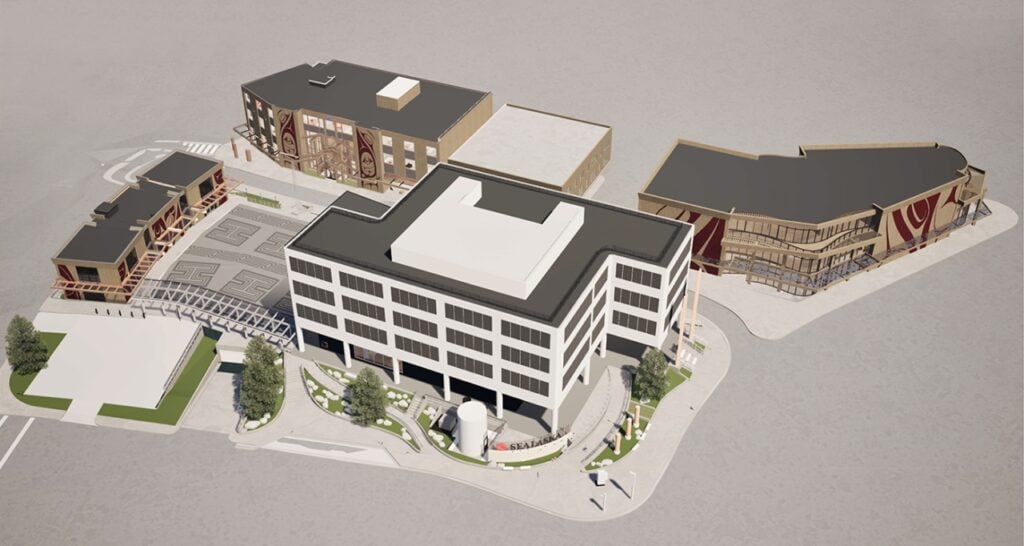
The full press release by SHI can be found below;
Sealaska Heritage Institute (SHI) has released schematics of its proposed arts building envisioned for the site of Juneau’s old city hall.
The crown-jewel, mixed-use facility would encompass multi-levels, feature stunning glass walls and be adorned in monumental red formline design — elements that mirror SHI’s Walter Soboleff Building, Atnané Hít (Sealaska Heritage Arts Campus) and its Indigenous Science Building in the city’s designated Heritage Square.
The space would provide authentic educational, cultural and art experiences for locals and visitors, include a Northwest Coast art glass studio and offer space to house the Juneau-Douglas City Museum.
The project is part of SHIs efforts to make Juneau the Northwest Coast arts capital of the world, said SHI President Rosita Worl.
“We are thrilled to unveil our latest proposal to bring more Northwest Coast arts, cultural experiences and economic diversity to Juneau and to further enhance the downtown corridor,” Worl said.
The project hinges on whether the city elects to put the project out to the highest bidder or sell to SHI for $1.5 million. If the institute did purchase the land, SHI would have to raze city hall because it’s contaminated with asbestos and other toxins inside and below the dilapidated facility. The city also has delayed maintenance on the building that would cost $13 million to address.
Demolishing the building and decontaminating the site would come with a steep price tag, said SHI Chief of Operations Lee Kadinger.
“The project would require demolition and removal at considerable cost to SHI. The demolition and highly regulated removal and disposal process is estimated to cost in excess of $1 million before construction of a new facility would be possible,” Kadinger said.
The new structure would span roughly 30,000 square feet and encompass three floors. If it were built using today’s prices, it would cost approximately $32 million. Assuming it will take four years to raise capital funds, the price would be closer to $40 million, as costs rise over time, Kadinger said.
SHI would install a nicely landscaped space onsite for locals and visitors while it’s raising capital funds to build the facility, similar to when it filled in the so-called “pit” downtown while the institute raised money to construct the Walter Soboleff Building.
The institute would give the city first right of refusal to relocate the Juneau-Douglas City Museum to the second floor of the building. This would move the museum closer to cruise ship docks.
Through community oriented year-round activities, the facility will help draw locals to the downtown corridor in off-tourism months — and help to revitalize downtown, which is a priority of the City and Borough of Juneau. The institute is also considering setting aside some space for apartments in recognition of the community’s housing needs, as well as its own employees.
Cultural Tourism
The new facility would launch SHI’s planned cultural tourism programming, where visitors and locals would get hands-on experiences in Northwest Coast arts.
The structure would include a glass studio, where the famed Tlingit glass artist Preston Singletary would help to establish the program and secure partners who would create an educational structure around glass blowing. This would become a creative space for the community of Juneau — one that could grow to create opportunities for visitors and locals to make their own glass pieces. Singletary would also help create a tiered program to develop skills from beginner to advanced, teaching students to create limited production pieces that could become a cottage industry over time.
The glass studio is based on the wildly successful model created by the Museum of Glass in Tacoma, Washington, which draws nearly 100,000 visitors annually, includes a Hot Shop that hosts more than 50 visiting artists each year and has engaged more than 250,000 students through educational programs to date.
The new facility would be across from the Juneau Seawalk and Marine Park and attract more tourists to the core of downtown. The glass studio and a retail gallery for high end art would add to SHI’s monumental art and cultural tours currently offered at the Arts Campus and Walter Soboleff Building.
Community Benefits
While SHI projects and services are structured for tribal members, many of the programs benefit or are available to the entire community. Teacher trainings, lectures, art classes, summer camps, visiting scholars, concerts, academic publications, live streams, traditional ceremonies, First Fridays, Totem Pole Trail tours and Indigenous science workshops are commonly available to the public.
As the glass program grows, the facility would be open to residents who want to learn about the art of making glass and glass blowing.
SHI’s three other buildings also have transformed and beautified Juneau, adding to the visual appeal of downtown, and the plaza has been open to the public for art performances and other activities. The institute’s hope is to retain the city hall site for additional community space.
Economic Benefits
The successful completion of previous SHI capital campaigns has led to significant benefits for Juneau. In addition to its construction projects and their associated employment and economic activity, SHI has provided direct monetary contributions to the Juneau School District and University of Alaska Southeast totaling more than $13,000,000 since 2015, according to a 2025 study by McKenley Research Group, and it plans to continue the educational investments.
Today, SHI employs more than 100 staff in Juneau. An economic impact study by the same firm in 2023 demonstrated that SHI generates more than $30,100,000 in direct and induced economic activity annually in Juneau.
Because SHI’s buildings are staffed and open year-round, they support area businesses as employees patronize nearby establishments. The new building’s employees would help offset the loss of city workers who will move to the area by the Juneau-Douglas Bridge.
As with SHI’s other buildings, the new facility is expected to provide an economic boon during construction, provide new jobs, boost labor income and generate millions of dollars in direct expenditures.
The city will hold a public hearing on Monday, Aug. 17, to take public testimony on the terms of the sale.
Sealaska Heritage Institute is a non-profit tribal organization founded in 1980 to perpetuate and enhance Tlingit, Haida and Tsimshian cultures of Southeast Alaska. Its goals are to promote cross-cultural understanding by educating the general public about the Indigenous cultures of Alaska. SHI also conducts scientific and public policy research that promotes Alaska Native arts, cultures, history and education statewide. The institute is governed by a Board of Trustees and guided by a Council of Traditional Scholars, a Native Artist Committee, a Southeast Regional Language Committee and an Education Committee.
CONTACT: Kathy Dye, SHI Communications and Publications Deputy Director, 907.321.4636, kathy.dye@sealaska.com.
Captions from top: The facade of the arts building. The structure as seen from Marine Way. Heritage Square, which currently includes SHI’s Atnané Hít (Sealaska Heritage Arts Campus), Walter Soboleff Building, its Indigenous Science Building and the Sealaska building. Schematics by MRV Architects, courtesy of Sealaska Heritage Institute. Note: Media outlets are welcome to use these photos for coverage of this story. For higher resolution images, contact kathy.dye@sealaskaheritage.com.
