Categories
Featured Juneau News Juneau Local Ketchikan Local News Feeds Sitka Local

Shutdown leaves a mark on an already-struggling economy, from lost paychecks to canceled flights

The Alaska and American flags fly in front of the Alaska State Capitol on Tuesday, April 22, 2025. (Photo by James Brooks/Alaska Beacon)

AP- The longest federal government shutdown in U.S. history appears to be nearing an end, but not without leaving a mark on an already-struggling economy.

About 1.25 million federal workers haven’t been paid since Oct. 1. Thousands of flights have been canceled, a trend that is expected to continue this week even as Congress moves toward reopening the government. Government contract awards have slowed and some food aid recipients have seen their benefits interrupted.

Most of the lost economic activity will be recovered when the government reopens, as federal workers will receive back pay. But some canceled flights won’t be retaken, missed restaurant meals won’t be made up, and some postponed purchases will end up not happening at all.

“Short-lived shutdowns are usually invisible in the data, but this one will leave a lasting mark,” Gregory Daco, chief economist at accounting giant EY said, “both because of its record length and the growing disruptions to welfare programs and travel.”

The Congressional Budget Office estimated that a six-week shutdown will reduce growth in this year’s fourth quarter by about 1.5 percentage points. That would cut growth by half from the third quarter. The reopening should boost first-quarter growth next year by 2.2 percentage points, the CBO projected, but about $11 billion in economic activity will be permanently lost.

The previous longest government shutdown, in 2018-2019, lasted 35 days but only partially shut the government because many agencies had been fully funded. It only nicked the economy by about 0.02% of GDP, the CBO said then.

The current shutdown is adding to the economy’s existing challenges, which include sluggish hiring, stubbornly elevated inflation, and President Donald Trump’s tariffs, which have caused uncertainty for many businesses. Still, few economists foresee a recession.

About 650,000 federal workers didn’t work during the shutdown, which will likely boost the unemployment rate by about 0.4 percentage points in October, or to 4.7% from 4.3% in August, when the last report was released. Those workers would all then be counted as employed once the government reopens.

Here are the ways the government closure is weighing on the economy:

Missed paychecks

All told, federal workers will have missed about $16 billion in wages by mid-November, the CBO estimates. That has meant less spending at stores, restaurants, and likely reduced holiday travel. Large purchases will probably be postponed, slowing the broader economy.

Trump had threatened during the shutdown to not provide back pay but the deal struck in Congress would replace those lost wages once the government reopens.

The shutdown has added to the Washington, D.C. area’s economic woes, where the unemployment rate was already 6% before the shutdown, after Trump’s cuts to the federal workforce this spring caused job losses. While the Washington, D.C. area — including the nearby suburbs in Virginia and Maryland — has the highest concentration of federal workers, most live and work outside of the nation’s capital.

Federal workers make up about 5.5% of Maryland’s workforce, according to the Bipartisan Policy Center. But they also comprise 2.9% of New Mexico’s workers, 2.6% of Oklahoma’s, and 3.8% of Alaska’s.

Then there are the federal contractors. Bernard Yaros, an economist at Oxford Economics, estimates they could total as many as 5.2 million, and they are not guaranteed back pay once the shutdown ends.

Flight disruptions

Airlines scrapped more than 2,000 flights by Monday evening after canceling 5,500 since Friday on orders from the Federal Aviation Administration, which is seeking to reduce the burden on overworked air traffic controllers, who have now missed two paychecks.

Even before the flight cancellations, Tourism Economics, an economic consulting firm, estimated that the shutdown would reduce travel spending by $63 million a day, which means a six-week standoff would cost the travel industry $2.6 billion.

The canceled flights also mean less business for hotels, restaurants, and taxi drivers. And federal employees have already pulled the plug on upcoming trips, according to Tourism Economics, which may not be able to be rescheduled even when the government does reopen.

Consumer sentiment

The shutdown has worsened Americans’ outlook on the broader economy. Declining consumer sentiment can over time reduce spending and slow growth, though in recent years Americans have kept shopping even when their outlooks turned grim.

Consumer sentiment dropped to a three-year low and close to the lowest point ever recorded in a survey by the University of Michigan, reported Friday, with pessimism over personal finances and anticipated business conditions weighing on Americans.

The November survey showed the index of consumer sentiment at 50.4, down a startling 6.2% from last month and a plunge of nearly 30% from a year ago.

Federal spending

While the shutdown hasn’t cut off all federal government spending, it has reduced purchases of equipment and has cut off the issuance of new contracts.

Yaros estimates that about $800 million in new contracts were at risk of not being awarded each day of the shutdown.

“The federal award spigot has all but turned off at the Department of Defense, NASA, and the Department of Homeland Security,” Yaros wrote.

SNAP benefits

The shutdown delayed the payment of $8 billion in monthly SNAP food aid to 42 million recipients in November, creating a significant financial disruption for many households that likely reduced spending. Some states have managed to pay full benefits for this month, though the Trump administration is still fighting over the issue in court.

The deal currently under consideration in Congress to reopen the government includes full funding of SNAP benefits.

Interest rate cuts

The government shutdown cut off the flow of economic data on unemployment, inflation, and retail spending that the Federal Reserve depends on to monitor the economy’s health. Even as the government reopens, some of that data will still be delayed. As a result, the Fed may not deliver a third interest rate cut at its December meeting, which was widely expected before the shutdown.

“What do you do if you’re driving in the fog? You slow down,” Fed Chair Jerome Powell said at a news conference late last month.

Powell said the Fed’s interest-rate setting committee is deeply divided over whether to reduce its key rate, partly because the economy’s health is unusually cloudy right now. The government has missed two monthly jobs reports and the October inflation data, scheduled to be published Thursday, will likely never be issued.

Powell said a rate cut in December was not a “foregone conclusion” and added that the lack of data could contribute to a decision by the Fed to skip a rate cut at its next meeting December 9-10. Fewer rate cuts could discourage borrowing and spending and weigh on the economy in the coming months.

Categories
Featured Juneau News Juneau Local Ketchikan Local News Feeds Sitka Local

US flight cancellations accelerate as airlines comply with government shutdown order

FILE – Alaska Airlines planes are shown parked at gates with Mount Rainier in the background on March 1, 2021, at Seattle-Tacoma International Airport in Seattle. (AP Photo/Ted S. Warren, File)

AP- U.S. airlines began canceling hundreds of flights Thursday due to the Federal Aviation Administration’s order to reduce traffic at the country’s busiest airports starting Friday because of the government shutdown.

Airports that will see cuts include Anchorage International and Seattle Tacoma, both directly affecting Alaskan travelers.

More than 500 flights scheduled for Friday were already cut nationwide, and the number of cancellations climbed steadily throughout Thursday, according to FlightAware, a website that tracks flight disruptions.

The FAA order to cut flights at 40 of the busiest airports across the U.S. includes New York, Los Angeles and Chicago, according to a list distributed to the airlines and obtained by The Associated Press. But the impact will disrupt travel at many smaller airports too.

The FAA seeks to reduce service by 10% across “high-volume” markets to maintain travel safety as air traffic controllers exhibit signs of strain during the shutdown. The move also comes as the Trump administration is ramping up pressure on Democrats in Congress to end the shutdown.

Airlines will phase in the 10% reduction in their flight schedules at the airports across more than two dozen states. Just hours before the reductions went into place, airlines were scrambling to figure out where to cut and some travelers began changing or canceling itineraries preemptively.

Travelers with plans for the weekend and beyond waited nervously to see if their flights would take off as scheduled.

The affected airports included busy connecting hubs and those in popular tourist destinations, such as Atlanta, Denver, Orlando, Miami and San Francisco. In some of the biggest cities — such as Dallas, Houston and Chicago — multiple airports will be affected.

Flight cuts will begin gradually

Airlines will phase in the cuts at the direction of the FAA, eliminating 4% of flights at the 40 airports on Friday and working up to 10%, according to three people familiar with the plans who were not authorized to discuss them publicly.

Delta Air Lines said it planned to cancel roughly 170 flights Friday. By late Thursday afternoon, United Airlines had called off 145 flights and American Airlines had canceled 32 for Friday, according to aviation analytics firm Cirium.

The FAA had not yet published an official order as of the afternoon.

Some airlines planned to focus on slashing routes to and from small and medium-size cities.

“This is going to have a noticeable impact across the U.S. air transportation system,” industry analyst Henry Harteveldt said.

The flight reductions just weeks before the busy holiday season prompted some travelers to change their plans or looking at other options.

Fallon Carter canceled her Friday flight from New York to Tampa, Florida, where she planned to spend the weekend at the beach. She was worried about making it back to Long Island to be a bridesmaid at her best friend’s wedding.

“I don’t know if I get there, will I get home?” Carter said.

The FAA is imposing the reductions to relieve pressure on air traffic controllers who are working without pay during the shutdown, which began Oct. 1, and have been increasingly taking sick days. Most controllers work mandatory overtime six days a week, leaving little time for side jobs to help cover bills unless they call out.

In recent weeks the FAA has delayed flights when airports or its other facilities are short on controllers.

Shuffling schedules

Airlines said they would try to minimize impact on customers, some of whom will see weekend travel plans disrupted with little notice.

United, Delta and American were among carriers that said they would offer refunds to passengers who opt not to fly, even if they purchased nonrefundable tickets.

The head of Frontier Airlines recommended that travelers buy backup tickets with another airline to avoid being stranded.

The cuts also could disrupt package deliveries because two airports with major distribution centers are on the list — FedEx operates at the airport in Memphis, Tennessee, and UPS in Louisville, Kentucky, the site of this week’s deadly cargo plane crash.

The cuts could affect as many as 1,800 flights, or upward of 268,000 passengers, per day, according to an estimate from Cirium.

Airlines are used to dealing with canceling thousands of flights on short notice during severe weather, but the difference now is that these cuts during the shutdown will last indefinitely until safety data improves.

Shutdown already straining travel

The shutdown is putting unnecessary strain on the system and damaging confidence in the U.S. air travel experience, said U.S. Travel Association President and CEO Geoff Freeman.

Kelly Matthews, who lives in Flat Rock, Michigan, and frequently flies for work, said she has canceled most of her upcoming trips and understands why federal airport employees have stopped showing up.

“You can’t expect people to go in to work when they’re not getting a paycheck for the continuation of over a month now,” she said. “I mean it’s not a matter of them not wanting to do the job — but you can’t afford to pay for gas, your day care and everything else.”

Controller staffing worsening

The past weekend brought some of the worst staffing issues since the start of the shutdown.

From Friday to Sunday evening, at least 39 air traffic control facilities reported potential staffing limits, according to an AP analysis of operations plans shared through the Air Traffic Control System Command Center system. The figure, which is likely an undercount, was well above the average for weekends before the shutdown.

Categories
Featured Juneau News Juneau Local Ketchikan Local News Feeds Sitka Local

Government shutdown drags on, funding lapses and healthcare costs rise

AP- Head Start programs for preschoolers are scrambling for federal funds. The federal agency tasked with overseeing the U.S. nuclear stockpile has begun furloughing its 1,400 employees. Thousands more federal workers are going without paychecks.

But as President Donald Trump welcomed Republican senators for lunch in the newly renovated Rose Garden Club — with the boom-boom of construction underway on the new White House ballroom — he portrayed a different vision of America, as a unified GOP refuses to yield to Democratic demands for health care funds, and the government shutdown drags on.

“We have the hottest country anywhere in the world, which tells you about leadership,” Trump said in opening remarks, extolling the renovations underway as senators took their seats in the newly paved over garden-turned-patio.

And while Trump said the shutdown must come to an end — and suggested maybe Smithsonian museums could reopen — he signaled no quick compromise with Democrats over the expiring health care funds.

Later at another White House event, Trump said he’s happy to talk with Democrats about health care once the shutdown is over. “The government has to be open,” he said.

Shutdown drags into record books

As the government shutdown enters its fourth week — on track to become one of the longest in U.S. history — millions of Americans are bracing for health care sticker shock, while others are feeling the financial impact. Economists have warned that the federal closure, with many of the nearly 2.3 million employees working without pay, will shave economic growth by 0.1 to 0.2 percentage points per week.

The Democratic leaders Sen. Chuck Schumer and Rep. Hakeem Jeffries had outreached to the White House on Tuesday, seeking a meeting with Trump before the president departs for his next overseas trip, to Asia.

“We said we’ll set up an appointment with him anytime, anyplace before he leaves,” Schumer said.

With Republicans in control of Congress, the Democrats have few options. They are planning to keep the Senate in session late into the night Wednesday in protest. The House has been closed for weeks.

The Republican senators, departing the White House lunch with gifts of Trump caps and medallions, said there is nothing to negotiate with Democrats over the health care funds until the government reopens.

“People keep saying ‘negotiate’ — negotiate what?” Senate Majority Leader John Thune said after the hour-long meeting. He said Republicans and the president are willing to consider discussions over health care, “but open up the government first.”

Missed paychecks and programs running out of money

While Capitol Hill remains at a standstill, the effects of the shutdown are worsening.

Federal workers are set to miss additional paychecks amid total uncertainty about when they might eventually get paid. Government services like the Special Supplemental Nutrition Program for Women, Infants and Children, known as WIC, and Head Start preschool programs that serve needy families are facing potential cutoffs in funding. On Monday, Energy Secretary Chris Wright said the National Nuclear Security Administration is furloughing its federal workers. The Federal Aviation Administration has reported air traffic controller shortages and flight delays in cities across the United States.

At the same time, economists, including Goldman Sachs and the nonpartisan CBO, have warned that the federal government’s closure will ripple through the economy. More recently, Oxford Economics said a shutdown reduces economic growth by 0.1 to 0.2 percentage points per week.

The U.S. Chamber of Commerce noted that the Small Business Administration supports loans totaling about $860 million a week for 1,600 small businesses. Those programs will close to new loans during the shutdown. The shutdown also has halted the issuance and renewal of flood insurance policies, delaying mortgage closings and real estate transactions.

Rising health care costs

And without action, future health costs are expected to skyrocket for millions of Americans as the enhanced federal subsidies that help people buy private insurance under the Affordable Care Act, come to an end.

Those subsidies, in the form of tax credits that were bolstered during the COVID-19 crisis, expire Dec. 31, and insurance companies are sending out information ahead of open enrollment periods about the new rates for the coming year.

Most U.S. adults are worried about health care becoming more expensive, according to a new Associated Press-NORC Center for Public Affairs Research poll, as they make decisions about next year’s health coverage.

Members of both parties acknowledge that time is running out to fix the looming health insurance price hikes, even as talks are quietly underway over possible extensions or changes to the ACA funding.

Democrats are focused on Nov. 1, when next year’s enrollment period for the ACA coverage begins and millions of people will sign up for their coverage without the expanded subsidy help. Once those sign-ups begin, they say, it would be much harder to restore the subsidies even if they did have a bipartisan compromise.

What about Trump?

Tuesday’s White House meeting offered a chance for Republican senators to engage with the president on the shutdown after he had been more involved in foreign policy and other issues.

But senators left the meeting, some saying it was more of a luncheon than a substantial conversation. They said they could hear, but not see, the ballroom construction nearby.

Trump had previously indicated early on during the shutdown that he may be willing to discuss the health care issue, and Democrats have been counting on turning the president’s attention their way. But the president later clarified that he would only do so once the government reopens.

Categories
Featured Juneau News Juneau Local Ketchikan Local Music News Feeds Sitka Local

Shutdown standoff in US Senate extends as thousands of federal workers are sent home

By:Ashley MurrayJennifer Shutt and Shauneen Miranda, States Newsroom

U.S. Senate Democrats and Republicans remained at a stalemate Wednesday as government offices closed and hundreds of thousands of federal workers faced furloughs on the first day of a government shutdown that showed no sign of ending.

Proposals from each side of the aisle to fund and reopen the government failed again during morning Senate votes, mirroring the same vote breakdowns as Tuesday evening, when lawmakers could not reach a deal hours before the government ran out of money.

The nonpartisan Congressional Budget Office projected up to 750,000 federal workers could be furloughed, leading to a $400 million per day impact on the economy.

Locked in their positions, Republicans failed to pick up enough Democrats to reach the 60 votes needed to advance their plan to fund the government until Nov. 21. 

Senators will break Thursday to observe Yom Kippur but will return Friday to again vote on the funding proposals.

Democratic Sens. Catherine Cortez Masto of Nevada and John Fetterman of Pennsylvania, along with independent Angus King of Maine, again joined Republicans in the 55-45 vote for the House-passed stopgap spending bill. GOP Sen. Rand Paul of Kentucky voted no.

Democrats also failed to find support to move forward their bill to fund the government through Oct. 31, roll back GOP cuts on Medicaid and permanently extend subsidies that tie the cost of Affordable  Care Act health insurance premiums to an enrollee’s income level. 

The Democrats failed to advance their plan in a party-line 47-53 vote. King, who caucuses with Democrats, voted in favor.

Shutdown tied to health care tax credits

Senate and House Democrats say they will not support a GOP path to reopen the government unless Republicans agree to negotiate on rising health care costs. 

House Minority Leader Hakeem Jeffries said at a press conference that Democrats are “ready to sit down with anyone at any time and at any place in order now to reopen the government, to enact a spending agreement that meets the needs of the American people and to address the devastating Republican health care crisis that has caused extraordinary harm on people all across the country.”

The New York Democrat pointed to harms in “rural America, working class America, urban America, small-town America, the heartland of America and Black and brown communities throughout America.” 

Democratic leaders blitzed Capitol Hill with their message on health care, holding press conferences and attending an evening rally Tuesday on the lawn outside the U.S. House. 

U.S. Senate Minority Leader Chuck Schumer, D-N.Y., speaks during a press conference inside the Capitol building in Washington, D.C., on Tuesday, Sept. 30, 2025. Also pictured from left are Washington Sen. Patty Murray, Minnesota Sen. Amy Klobuchar and Illinois Sen. Dick Durbin. (Photo by Jennifer Shutt/States Newsroom)

They pointed to new data published this week showing annual insurance premiums could double on average in 2026 if the subsidies expire at year’s end, according to an analysis from the nonprofit health policy research organization KFF. 

Open enrollment for next year’s ACA health insurance plans opens Nov. 1 in most states, and Oct. 15 in Idaho.

Uptake of ACA health insurance plans has more than doubled to over 24 million, up from 11 million, since the introduction of the subsidies in 2021, according to KFF. 

During their own budget reconciliation deal in 2022, Democrats extended the insurance premium tax credits until the end of 2025. The majority of ACA enrollees currently rely on the credits.

Democrats also want assurances that the White House and Senate Republicans will not cancel any more funds that have already been approved by Congress, as was the case this year when the administration and GOP lawmakers stripped funding for medical research, foreign aid and public broadcasting, among other areas.

‘This can all end today’

GOP leaders in the House and Senate continued to blame Senate Democrats for the government shutdown at the expense of furloughed federal workers and Americans who rely on their services. 

At a Wednesday morning press conference, House Speaker Mike Johnson said “troops and border patrol agents will have to go to work, but they’ll be working without pay.”

Johnson also claimed at the press conference that veterans benefits would stop. The claim is false, as Veterans Administration medical care will continue uninterrupted and vets will also continue to receive benefits, including compensation, pension, education and housing.

House Speaker Mike Johnson of Louisiana speaks at a press conference outside the U.S. Capitol on Oct. 1, 2025, in Washington D.C., alongside fellow GOP leadership in the U.S. House and U.S. Senate. (Photo by Shauneen Miranda/States Newsroom)
House Speaker Mike Johnson of Louisiana speaks at a press conference outside the U.S. Capitol on Oct. 1, 2025, in Washington, D.C., alongside fellow GOP leadership in the U.S. House and U.S. Senate. (Photo by Shauneen Miranda/States Newsroom)

“As we speak here this morning, there are hundreds of thousands of federal workers who are getting their furlough notices. Nearly half of our civilian workforce is being sent home — these are hard-working Americans who work for our federal government,” the Louisiana Republican said, flanked by fellow GOP leaders on the Upper West Terrace of the U.S. Capitol overlooking the National Mall. 

Johnson decided in late September the House will be out until Oct. 6, canceling this week’s votes. 

The speaker said he will bring House members back next week, even if the government is still shut down.

“They would be here this week, except that we did our work — we passed the bill almost two weeks ago out of the House, sent it to the Senate,” Johnson said. “The ball is literally in (Senate Minority Leader) Chuck Schumer’s court, so he determines that.” 

Senate Majority Leader John Thune said “this can all end today” and “needs to end today.”

The South Dakota Republican said the funding lapse can cease when Senate Democrats vote for the GOP’s “clean” short-term funding bill. 

“We will continue to work together with our House counterparts, with the president of the United States, to get this government open again on behalf of the American people,” Thune said. 

Bipartisan deal and Trump

Virginia Democratic Sen. Tim Kaine said later in the day that a bipartisan group huddled on the floor during votes to talk about a possible path forward on “health care fixes” and ensuring that if a bipartisan deal is brokered, the Trump administration will stick to it. 

Republican senators, he said, could give Democrats assurances they won’t vote for any more rescissions requests from the White House, which ask Congress to cancel already approved government spending. But other issues, like laying off federal workers by the hundreds or thousands, have to be a promise from the president. 

“If I find a deal, should Congress have to follow it? Yes. Should the president have to follow it? Yes. Well, what if the president won’t follow it? Oh, yeah, you got a problem,” Kaine said. “So you know, rescission, impoundment, those are Senate words. But a deal is a deal — people get that.”

Kaine also emphasized that it’s not a “clean” stopgap funding bill if the Trump administration unilaterally cancels some of the spending. 

“In the past, we voted for clean (continuing resolutions), but the president has shown that he’ll take the money back,” Kaine said, referring to the technical name for a short-term funding bill. “I mean, just in Virginia, canceling $400 million to our public health, $40 million economic projects just pulled off the table, firing more Virginians than any president. 

“So we just want you to agree, if we do a deal, then you’ll honor the deal,” Kaine said. “It’s not that much to ask.”

‘People are suffering’

North Carolina Republican Sen. Thom Tillis said he doesn’t expect the shutdown will have long-term ramifications for senators’ ability to negotiate bipartisan deals — a necessity in the upper chamber, which has a 60-vote threshold to advance legislation. 

“It’s all transactional,” Tillis said. “I think there’s going to be opportunities for some bipartisan work, but none of that happens, you can’t even really consider it when you’re in a shutdown posture.”

Cortez Masto, who voted to advance Republicans’ seven-week stopgap bill, said the GOP “created this crisis” on health care and “need to address it.”

“They have no moral standing — no moral standing —- to say that this is all on the Democrats. They are in control. They’ve created this crisis,” Cortez Masto said. “People are suffering and they need to come to the table.” 

Missouri Republican Sen. Josh Hawley, who was sworn in for the first time during the last shutdown, said he worries about longer-term effects. 

“My concern is it’s going to poison the well on negotiations going forward on a lot of things,” Hawley said. “I can’t speak for anybody but myself, but I would just say that these tactics are very destructive. And it’s destructive, not just for relationships, but for real people.”

Categories
Featured Juneau News Juneau Local Ketchikan Local News Feeds Sitka Local

Federal government shutdown begins, with no easy exit in sight

By: Jennifer Shutt and Ariana Figueroa, States Newsroom

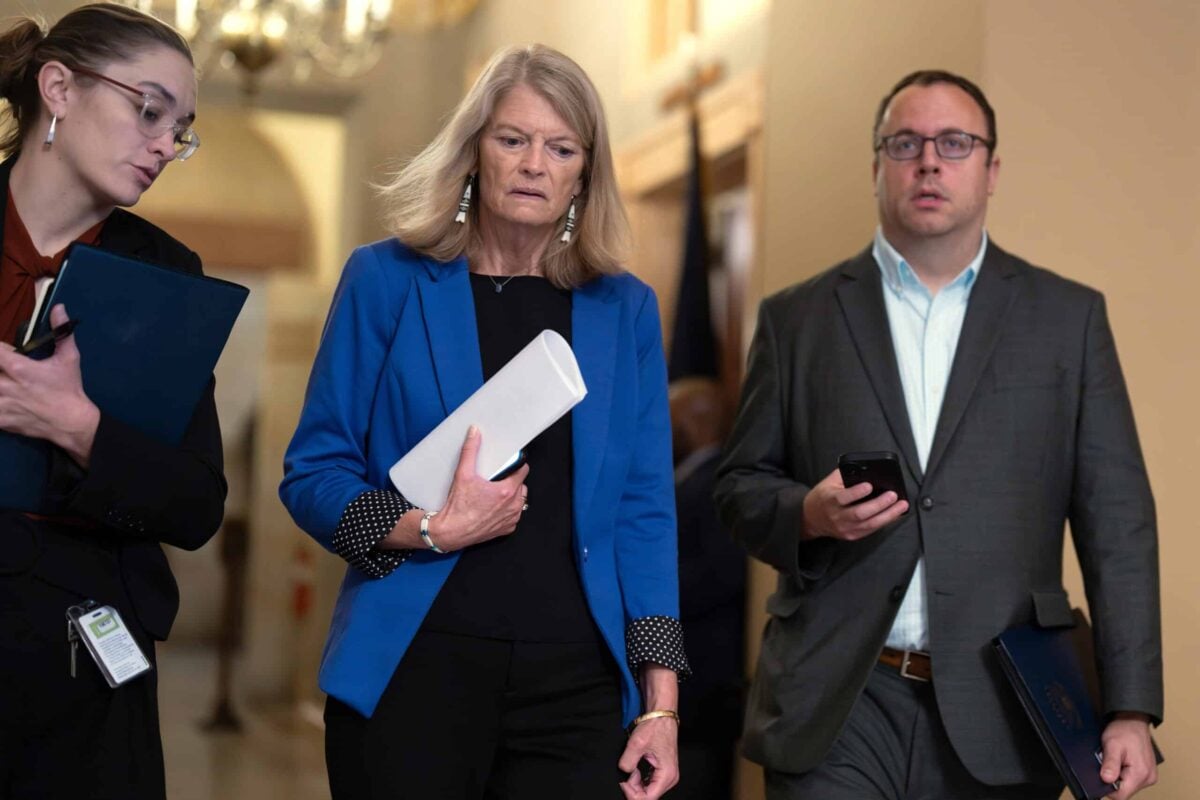
Sen. Lisa Murkowski, R-Alaska, center, a member of the Senate Appropriations Committee (AP Photo/J. Scott Applewhite)

This report has been updated.

WASHINGTON — The federal government started shutting down early Wednesday after Congress failed to approve a funding bill before the beginning of the new fiscal year — resulting in widespread ramifications for hundreds of programs and giving the Trump administration an avenue to fire federal workers en masse.

The U.S. Senate was unable to advance two short-term government funding bills Tuesday when Democrats and Republicans deadlocked for the second time this month, with just hours to go before the midnight Tuesday shutdown deadline.

Senators voted 55-45 on Republicans’ bill that would fund the government for seven weeks and 47-53 on a Democratic stopgap proposal that would keep the lights on for a month and included several health care provisions that they said were needed for their support. Neither had the 60 votes needed to advance. 

Nevada Democratic Sen. Catherine Cortez Masto, Pennsylvania Democratic Sen. John Fetterman and Maine independent Sen. Angus King voted with GOP senators on their stopgap bill. Kentucky GOP Sen. Rand Paul voted against it.

White House Office of Management and Budget Director Russ Vought said in a memo to departments and agencies Tuesday night after the Senate vote that “affected agencies should now execute their plans for an orderly shutdown.” Vought said federal employees should report for their next regularly scheduled tour of duty to undertake shutdown activities.

The consequences of a shutdown will be sweeping in the nation’s capital and across the country, where states are bracing for the impact. About 750,000 federal workers could be furloughed, leading to a $400 million impact a day, the nonpartisan Congressional Budget Office reported. All federal employees would go unpaid until the shutdown is over.

Additionally, the Trump administration plans to lay off thousands of federal employees, which would reshape the federal workforce. President Donald Trump again vowed Tuesday to undertake layoffs and a major government employee union filed suit in federal court in advance of such a move.

More votes on GOP bill planned

Senate Majority Leader John Thune, R-S.D., said hours before the votes there wouldn’t be any talks with Democrats during a shutdown. 

“The negotiation happens when the government is open. So let’s keep the government open and then we will have the negotiations,” Thune said. 

“We’re happy to sit down and talk about these issues that they’re interested in,” he said. “But it should not have anything to do with whether or not for a seven-week period we keep the government open, so that this government can continue to do its work and that we can do our work through the regular appropriations process to fund the government.” 

After the votes failed, Thune expressed his frustration with Democrats during a press conference. 

“This is so unnecessary and uncalled for,” he said. 

Thune said he plans to bring up a vote on the continuing resolution again. He said as soon as Wednesday the federal government can be funded if five Democrats voted with Republicans. 

“Democrats may have chosen to shut down the government, but we can reopen it tomorrow,” Thune said. 

Republican Whip John Barrasso of Wyoming said the “cracks in the Democrats are already showing,” noting that three Democrats voted with Republicans Tuesday night. 

“There is bipartisan support for keeping the government open,” Barrasso said. “We’re happy to see that the Democrats are already starting to break from (Senate Democratic Leader Chuck Schumer) and we’re going to continue to offer a clean (continuing resolution) on the floor of the Senate to open the government for the next seven weeks.”

Health care tax credits at center of standoff

The disagreement isn’t entirely about GOP lawmakers writing their short-term funding bill behind closed doors and then expecting Democrats to help advance it in the Senate, where bipartisanship is required for major legislation.

Democratic leaders have raised concerns for weeks about the end-of-year sunset of enhanced tax credits for people who buy their health insurance on the Affordable Care Act Marketplace, arguing a solution is needed now ahead of the open enrollment period starting on Nov. 1. 

Congressional Black Caucus Chair Yvette Clarke, a New York Democrat, speaks at a press conference outside the U.S. Capitol in Washington, D.C., on Sept. 30, 2025. (Photo by Shauneen Miranda/States Newsroom)

Democrats have also grown increasingly frustrated with the White House budget office’s unilateral actions on spending, arguing Vought is significantly eroding Congress’ constitutional power of the purse. Sen. Susan Collins of Maine, the Republican chairwoman of the U.S. Senate Appropriations Committee, said Tuesday the Government Accountability Office should sue the Trump administration over its efforts to freeze or unilaterally cancel spending approved by Congress. 

Senate Minority Leader Chuck Schumer said Democrats need an agreement with Republicans to extend the enhanced tax credits. 

Schumer said people will begin getting notices in October telling them how much the cost of their ACA plans will increase during the next year, which he expects will ratchet up pressure on Republican leaders to broker a bipartisan agreement. 

“We’re going to be right there explaining to them it’s because the Republicans wouldn’t negotiate with us,” Schumer said, referring to consumers. “We’re ready to do it anytime. And there will be huge heat on (Republicans) on this issue.”

People who buy health insurance on the ACA marketplace and receive subsidies through enhanced ACA tax credits could expect to pay on average more than double for annual premiums in 2026 if the credits expire as scheduled at the end of this year, according to an analysis released Tuesday by the nonprofit health policy research organization KFF. 

The analysis found premiums could increase from an average of $888 this year to $1,904 in 2026.

Claims about immigrants 

Schumer also rebuffed GOP leaders saying that Democrats want to include people without legal immigration status in federal health care programs. 

“They say that undocumented people are going to get these credits. That is absolutely false. That is one of the big lies they tell, so they don’t have to discuss the issues,” Schumer said. “The federal government by law that we passed does not fund health insurance for undocumented immigrants in Medicaid, nor the ACA nor Medicare. Undocumented immigrants do not get federal health insurance premiums.” 

Immigrants in the country without legal authorization are not eligible for Medicaid, and neither are most immigrants with legal status, such as those with student visas or enrollment in the Deferred Action for Childhood Arrivals program, known as DACA. 

Only immigrants with a “qualified status,” such as legal permanent residents, asylees and refugees, are able to get Medicaid benefits, and they usually have to wait five years before their coverage can even begin. 

Democrats explain why they voted with GOP 

Cortez Masto of Nevada wrote in a statement explaining her vote to advance the GOP stopgap bill that she could not support “a costly shutdown that would hurt Nevada families and hand even more power to this reckless administration.”

“We need a bipartisan solution to address this impending health care crisis, but we should not be swapping the pain of one group of Americans for another,” she added. “I remain focused on protecting health care for working families, and I call on my colleagues on both sides of the aisle to work together to tackle this problem.”

Pennsylvania’s Fetterman wrote in a statement of his own that his vote on the Republican bill “was for our country over my party.

“Together, we must find a better way forward.”

Collins said during a brief interview before the vote she is worried about the broad authority the White House holds during a shutdown and how the Office of Management and Budget has indicated it will use that power. 

“I’m much more concerned about OMB sending signals that there should be mass firings of federal employees who have the misfortune to be designated as non-essential, when in fact they’re performing very essential work, they’re just not being paid,” Collins said.  

North Dakota Republican Sen. John Hoeven, chairman of the Agriculture spending subcommittee, said lawmakers will have to sort through how various departments implement their contingency plans as well as the possibility of mass layoffs during a shutdown. 

“We’ll have to work through those things and figure out how we do keep things going as best we can during this Democrat shutdown,” Hoeven said.

West Virginia Sen. Shelley Moore Capito said Republicans are “unified in the belief that this is an easy choice” to fund the government with a stopgap bill that doesn’t include any contentious or political provisions. 

Capito — who chairs the Appropriations subcommittee that funds the departments of Education, Health and Human Services, and Labor — said there are several programs that will be “missed” during a shutdown. 

“And that’s concerning. So I think the option is to keep the government open so we can avoid this pain,” Capito said. 

‘I’m not optimistic that we’re going to get a path forward’

Missouri Republican Sen. Josh Hawley said he is worried about the possible impacts of a shutdown on his home state and that keeping the government open is the only way to avoid that.  

“I’m sure the administration will do everything they can,” Hawley said. “But the solution is to not shut the government down. I mean, why would you punish working people because you’re not getting what you want on any issue, whatever it is.”

South Dakota Republican Sen. Mike Rounds said he doesn’t expect a shutdown will end until after Democrats have sent a message to their voters. 

“I’m not optimistic that we’re going to get a path forward until they’ve had a shutdown,” he said. 

Rounds, who negotiated a handshake agreement with the White House budget director this summer to preserve some funding for rural tribal radio stations after Congress eliminated funding for the Corporation for Public Broadcasting, said that deal could be affected by a shutdown. 

“They’re putting the administration in a position where they can pick and choose what they’re going to do, and a shutdown is not going to be beneficial to these Native American radio stations,” Rounds said. 

Democratic Sen. Elissa Slotkin of Michigan said she wants Democrats and Republicans to negotiate on health care provisions.

“I’ve been making the case constantly, that (it) is literally my obligation to try and fight for health care, and I’m willing to talk to anyone,” she said. “I’m willing to accept that I certainly will not get everything I want.”

Senate Minority Whip Dick Durbin of Illinois said that while Democrats agreed to help advance what’s known as a continuing resolution in March, they can’t now because of “what President Trump is doing to this country, particularly when it comes to health care costs for families.”  

The shutdown will significantly affect the operations of the federal government as lawmakers have not passed any of the dozen full-year appropriations bills that finance agency operations. Oct. 1 is the beginning of the new fiscal year for the federal government.

Shutdown plan for national parks

Departments began releasing updated contingency plans this weekend, detailing how many of their employees would work during a government shutdown and how many would be furloughed.

The Interior Department, which includes the Bureau of Land Management, U.S. Fish and Wildlife Service and National Park Service, posted its updated plans late Tuesday. 

The National Park Service plans to furlough 9,300 of its 14,500 workers. 

The Trump administration will allow several activities necessary for the protection of life or property to continue, including fire suppression for active fires, permitting and monitoring First Amendment activities, border and coastal protection and surveillance, and law enforcement and emergency response.

The contingency plan says that roads, lookouts, trails, and open-air memorials will generally remain accessible to visitors,” but it adds that if “access becomes a safety, health or resource protection issue … the area must be closed.”

Union files suit

In anticipation of layoffs by the Trump administration, labor unions representing more than 1 million federal workers filed a lawsuit in the Northern District of California on Tuesday to block the Trump administration from carrying out mass firings. The suit argues that there is no statutory authority to fire federal employees during a government shutdown.

“These actions are contrary to law and arbitrary and capricious, and the cynical use of federal employees as a pawn in Congressional deliberations should be declared unlawful and enjoined by this Court,” according to the suit filed by the American Federation of Government Employees and the American Federation of State, County and Municipal Employees.

Ashley Murray and Shauneen Miranda contributed to this report.