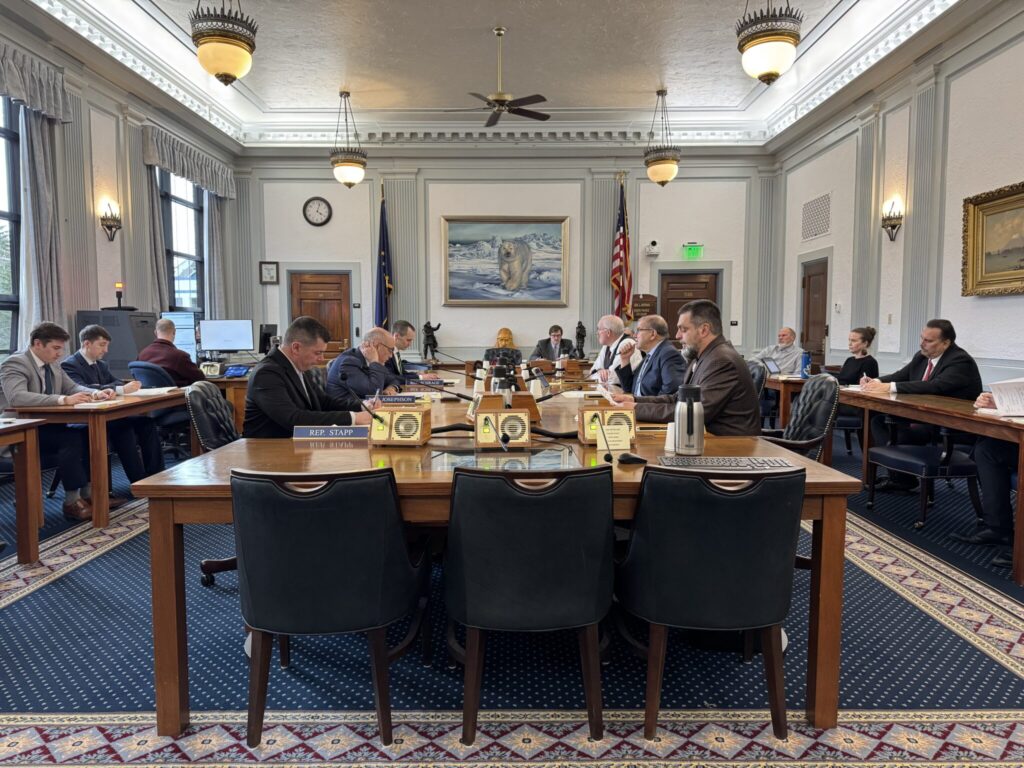
The Alaska Legislature's operating budget conference committee is seen on Monday, May 11, 2026. (James Brooks photo/Alaska Beacon)
By: James Brooks, Alaska Beacon
The Alaska Legislature’s operating budget conference committee is seen on Monday, May 11, 2026. (James Brooks photo/Alaska Beacon)
Alaska lawmakers are planning to vote on a $13.9 billion compromise state operating budget that includes a $1,000 Permanent Fund dividend and a $200 energy rebate.
In a 4-2 vote Sunday morning, a panel of House and Senate negotiators finalized a deal that combines two different versions of the budget — one passed by the Senate and the other by the House — preparing legislators for a final vote before the last regular day of the legislative session on Wednesday.
Once passed by the Legislature, the budget will go to Gov. Mike Dunleavy, who may sign it or use his line-item veto powers to eliminate or reduce specific items. The governor has never let a budget go into law without some vetoes.
Legislators convened in January with the expectation that they would be facing a massive deficit in fiscal year 2027, which starts July 1.
The Iran war, and the subsequent closure of the Strait of Hormuz, has sent oil prices soaring, resulting in hundreds of millions of dollars in extra revenue for the state.
That eliminated the projected deficit, but lawmakers don’t expect to have much left over for the Permanent Fund dividend.
While a payment formula from the 1980s remains in state law, legislators since 2016 have adopted a “surplus dividend” approach, paying the dividend with what’s left over after services are covered.
The final compromise version of the budget closely resembles the Senate plan, but the one-time bonus was slightly increased, to $200, in an amendment proposed over the weekend.
The final version of the budget also contains $144 million in one-time bonus payments for public schools across the state, including $29 million intended to offset the high cost of heating fuel.
The one-time bonus is less than the House proposed but higher than the Senate’s figure.
The budget also proposes to fund a heating assistance program for Alaskans, increase Medicaid reimbursements for medical providers, send additional money to cities and boroughs, and increase funding for wildfire response.
Altogether, the budget balances if Alaska North Slope oil prices average at least $75 per barrel in FY27. The average price since March is above $100 per barrel.
The operating budget advancing to a final vote is the last of four budget bills that lawmakers approve in an ordinary year.
The state’s supplemental budget — making changes to fiscal year 2026 — was adopted in March and signed by the governor in April. The $2.5 billion capital budget, which funds construction and renovation projects statewide, is awaiting a final vote in the Senate.
Alaska’s comprehensive mental health budget is moving in parallel to the operating budget and is expected to pass when the operating budget does.
Senate President Gary Stevens, R-Kodiak, announces the final vote passing the operating budget of 17 to 3 on May 7, 2026. (Photo by Corinne Smith/Alaska Beacon)
The Alaska Senate has finalized its draft of the state’s operating budget for the upcoming fiscal year, moving lawmakers closer to the end of their last regular session before the 2026 election.
In a 17-3 vote, Senators approved a $13.1 billion proposal that includes a $1,000 Permanent Fund dividend for 2026, plus a $150 “energy rebate” for PFD recipients.
The Senate plan conflicts with a different version drafted by the House. Legislators are expected to convene a committee to negotiate a compromise plan that will be sent to Gov. Mike Dunleavy, following standard policy.
After the budget leaves the Legislature, the governor may veto individual line items but cannot add or increase items.
The operating budget is one of four budget bills that pass through the Capitol in a typical year. One, the supplemental budget, has already become law. A second, the $2.5 billion capital budget, is being considered in the House. The third, the state’s mental health budget, is advancing in the Senate as well.
With lawmakers’ attention focused on legislation addressing a possible trans-Alaska natural gas pipeline, this is the first time in several years that the budget isn’t the top unresolved item in the Capitol.
Senate Minority Leader Mike Cronk, R-Tok, said legislators entered the year anticipating a $500 million deficit. High oil prices caused by the Iran war erased that gap and left lawmakers with more than enough expected revenue to balance the books.
“I think the Senate did a really good job of trying to stay fiscally responsible and keeping a balanced budget at a certain level,” Cronk said.
“When you do that, there’s a lot less to argue about in the end,” he said.
Sen. Lyman Hoffman, D-Bethel and co-chair of the Senate Finance Committee, was the lead drafter of the operating budget.
He said the war may have made things easier for his committee, but it has made things much harder for the people of Alaska, because of the price of oil.
“That gave us more money to spend, but it provided additional hardships to the people and the organizations of the state of Alaska,” Hoffman said of the war. “That’s why we tried to concentrate on using that one-time money to give some more money to the individuals, through the dividend energy relief, helping school districts out … and to double the amount for community assistance so those communities can get some relief from the high prices of oil.”
On Wednesday, the Alaska Division of Elections made an unusual last-day request — a $4.75 million increase to cover spending for the 2026 election.
Senators instead approved $650,000 on Thursday, including $100,000 intended to cover the cost of prepaid envelopes for absentee ballots. Until now, the state has required absentee voters to pay for their own postage.
“It’s very unusual,” Hoffman said about the last-minute request, “but I felt we couldn’t ignore it. We don’t want to be blamed for a dysfunctional election, so we added the money at the last minute, so hopefully it will result in a better election.”
Senate Majority Leader Cathy Giessel, R-Anchorage, is seen during an at ease on the Senate floor on May 7, 2026. (Photo by Corinne Smith/Alaska Beacon)
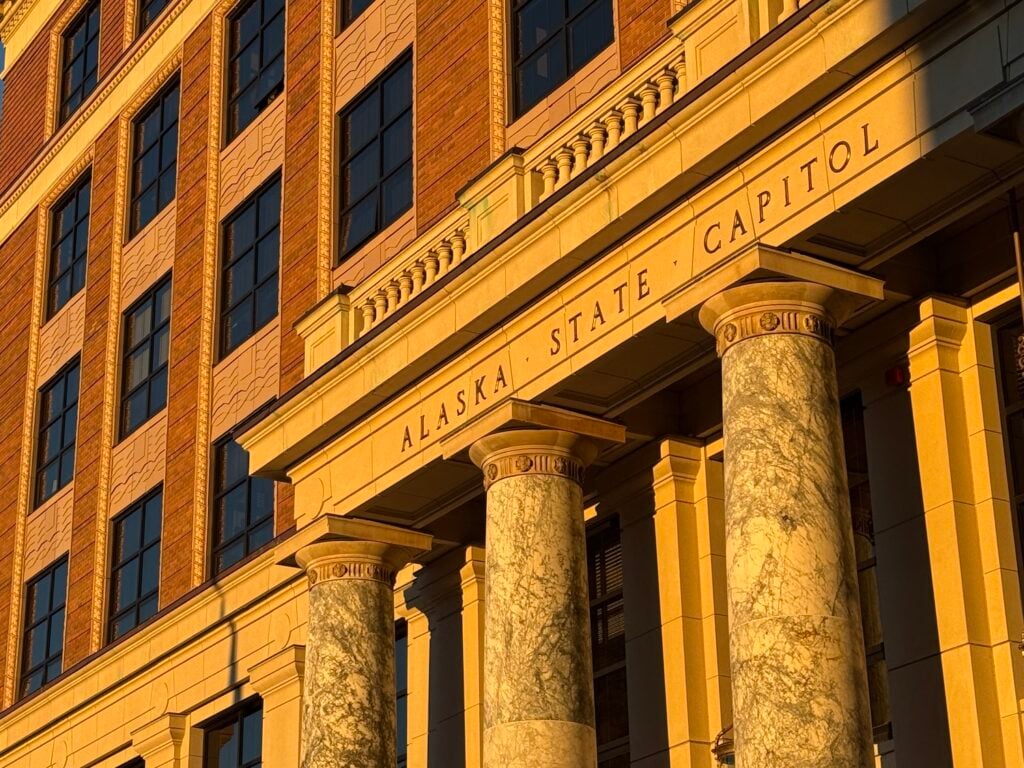
The Alaska State Capitol is illuminated by the rising sun on the morning of Friday, Jan. 23, 2026. (James Brooks photo/Alaska Beacon)
By: Corinne Smith, Alaska Beacon
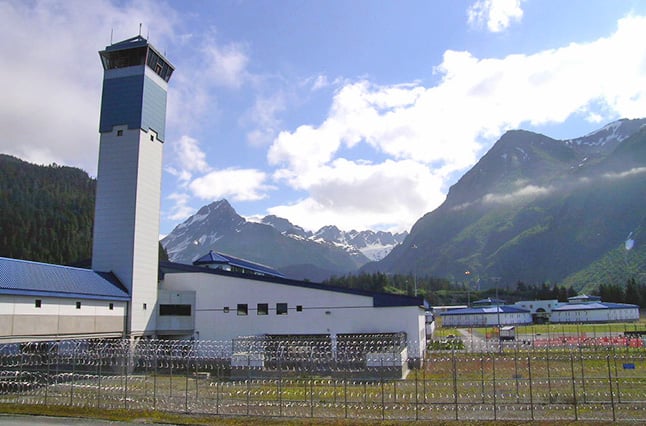
The Alaska State Capitol is illuminated by the rising sun on the morning of Friday, Jan. 23, 2026. (James Brooks photo/Alaska Beacon)
The Senate Finance Committee on Wednesday proposed an operating budget for the next fiscal year, with a $1,000 Alaska Permanent Fund dividend plus $150 energy relief payment per eligible Alaskan.
The committee’s draft budget takes a more conservative approach to uncertainty around the state’s revenue forecast for next year — driven by rising oil prices due to the Iran war – than the proposed budget passed by the Alaska House passed earlier this month, and eliminates the deficit.
State forecasters have projected a $500 million boost in state revenues, and senators have expressed caution around state spending and a willingness to focus funds to tackle aging infrastructure and deferred maintenance, particularly upgrading school facilities.
“The most fundamental thing we have to remember is that the state doesn’t have the resources to do all the things we need to do and that Alaskans need us to do,” said Sen. Jesse Kiehl, D-Juneau, a member of the finance committee on Thursday. He said the greatest challenge for the Legislature is prioritizing.
“And so I think we did that effectively,” Kiehl said. “I think it makes a few really crucial, really targeted investments.”
The Senate’s draft budget removed the House’s proposed $158 million one-time education funding boost, and instead appropriates up to $100 million for K-12 schools subject to oil revenues averaging $95 per barrel for the rest of this fiscal year ending on June 30.
Alaska has no personal income or state sales tax, and so roughly 60% of state funds for the general purpose budget comes from the Alaska Permanent Fund, the state’s sovereign wealth fund currently valued at $86.3 billion, and roughly 30% comes from state oil revenues.
The draft Senate operating budget is based on an average of $73 per barrel for the next fiscal year starting in July, whereas the House draft budget is based on an average $75 per barrel projection.
The draft budget contains some changes to the House version and additions across departments. It would double funding for disaster relief to $48 million, and increase fire suppression funding from $47.5 million to nearly $61 million. It funds an additional $29 million for school districts and $20 million for communities to offset rising fuel and energy costs; $30 million for community assistance programs; $5.3 million toward a renewable energy fund; $3.5 million for the Alaska Marine Highway system’s ferry maintenance and staff salary increases. It also boosts funds for public employees retirement from $75 million to $106 million, and increases funds for teachers’ retirement system from $157 million to $164 million, among others.
The budget also contains $650,000 for a state audit of the Alaska Department of Corrections to evaluate cost drivers, as the department’s budget has ballooned in recent years.
Kiehl said while he’d like to see more investment in services like in the state’s foster care system, homelessness programs, energy and schools, he said the state can’t bank on unknown revenues.
“We have to be careful not to treat a temporary boost in the price of oil, which will probably last more than a year as though it were permanent, increase. That’s not responsible,” he said.
Senate Minority Leader Sen. Mike Cronk, R-Tok and a member of the finance committee, said he’d like to see a more conservative budget, but he also wants to avoid a large supplemental budget as seen this year. He said he supports the budget based on an average $73 per barrel estimate.
“I’m pretty comfortable with that number. I just don’t want to be back in that same position as we have this year, where we are $500 million upside down for supplemental,” he said.
Cronk said he supports targeted funding for renewable energy projects, education and deferred maintenance for schools, rather than expanding state department budgets. “I just think we should focus on making sure we have a fiscally responsible budget all around and not adding money to programs that continue in future budgets.”
The budget also includes a number of supplemental items, or costs incurred this year outside the budget. Those include $5.2 million for Alaska Pioneer Homes, $1.25 million for Village Public Safety Officer operations, $1.5 million for the Department of Law’s criminal division, $543,000 for court settlements and $4 million to defend a lawsuit challenging the state’s health care system for inmates in the corrections system.
Cronk said while he would like to see a maximum Permanent Fund dividend, it’s not possible within the state’s current financial picture.
“The whole PFD issue is very controversial, no matter which way we go on it,” he said. “We should be paying a full PFD, but the budget, the numbers, don’t allow that right now.”
The Senate’s draft budget overall cuts nearly $450 million from the operating budget, compared to the House draft version. However, the Senate’s proposal leaves $50 million of headroom for additional expenses next year, but that’s after accounting for a $360 million capital budget for state infrastructure projects. The Senate passed a nearly $250 million capital budget on Tuesday, which is now being debated in the House where likely additional projects will be added.
The proposed budget, unveiled as amendments to House Bill 263 will continue to be debated in the Senate Finance Committee and further amendments are due by Friday, before going before the full Senate for a vote.
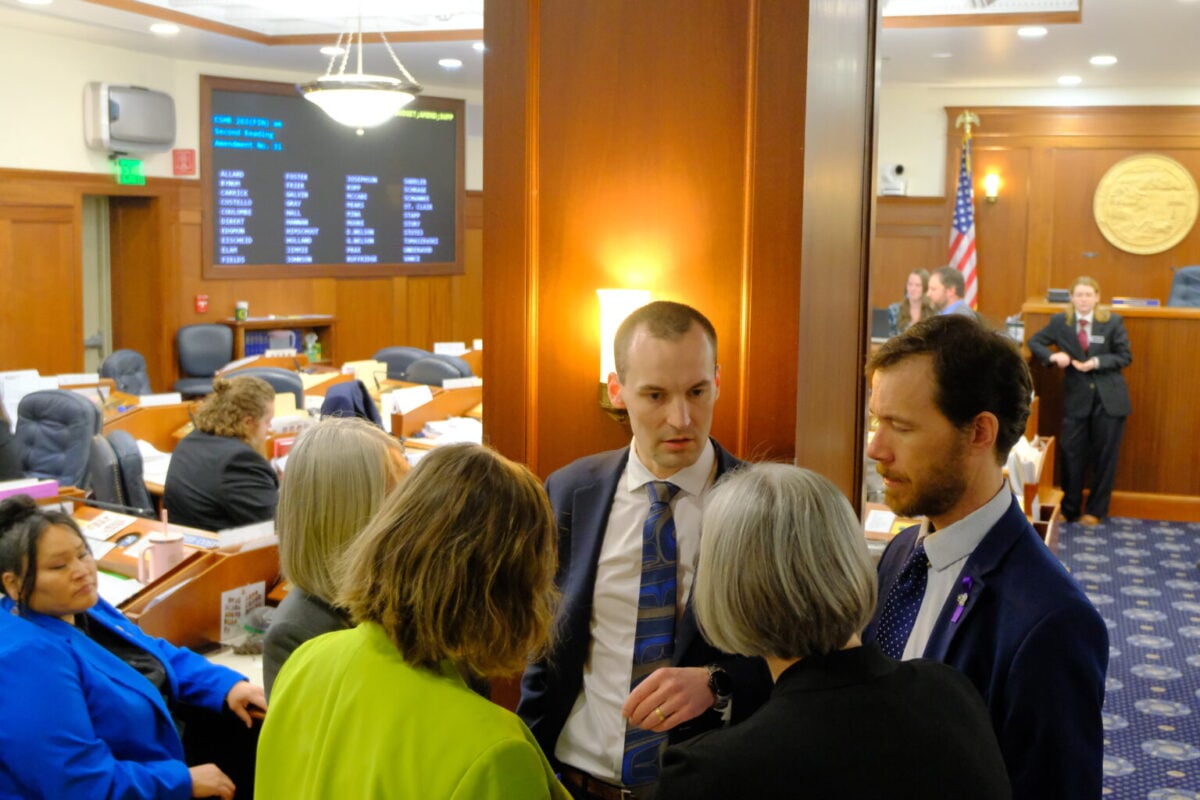
Reps. Calvin Schrage, I-Anchorage, Zack Fields, D-Anchorage huddle with members of the House majority caucus during a break in debates on the operating budget on Apr. 9, 2026. (Photo by Corinne Smith/Alaska Beacon)
The Alaska House of Representatives advanced a draft budget for the state’s operations next year, with a $1,500 Permanent Fund dividend for eligible Alaskans. It includes a nearly $158 million one-time funding boost for public schools and tens of millions for disaster relief, transportation and public assistance programs.
Members passed House Bill 263, the operating budget bill, along caucus lines by a 21 to 19 vote on Tuesday.
Lawmakers spent four days debating amendments — additions, cuts and reallocations to the draft budget — on the House floor, amid deep political divides around state priorities, war-driven oil revenues and how to balance paying for government services versus distributing cash to Alaskans through the dividend.
The draft budget now moves to the Senate for consideration, where it’s likely to be further revised.
“I feel relieved,” said Rep. Andy Josephson, D-Anchorage and co-chair of the House Finance Committee that drafted the budget, after the vote on Monday.
Rep. Andy Josephson, D-Anchorage and co-chair of the House Finance Committee which drafted the operating budget, speaks to what’s included in the budget on the House floor on Apr. 13, 2026. (Photo by Corinne Smith/Alaska Beacon)
“But the difficulty we’re in is that overall, the war in Iran, which is most unfortunate, is very helpful to budgeting,” he said. “But the Alaska people are hurting more, right, particularly when it comes to fuel prices. So that’s a problem as well.”
As Alaska has no personal income tax or state sales tax, more than 60% of funds for the general purpose budget comes from an annual draw from the Alaska Permanent Fund and roughly 30% comes from state oil revenues.
Lawmakers have been closely watching Alaska oil prices, as they surged in recent weeks due to the Trump administration’s war on Iran. State forecasters project a potential $500 million boost in state revenues next year, but lawmakers are divided on what that should mean for state spending.
The all-Republican House minority caucus advocated for putting money towards a statutory Permanent Fund dividend, but the multipartisan majority coalition pushed the balance towards spending on state services.
Members of the all-Republican minority caucus Reps. DeLena Johnson, R-Palmer, Justin Ruffridge, R-Soldotna, Dan Saddler, R-Eagle River, Frank Tomaszewski, R-Fairbanks are seen in the House during a break in the debate on the operating budget on Apr. 13, 2026. (Photo by Corinne Smith/Alaska Beacon)
The House draft operating budget made revisions to Gov. Mike Dunleavy’s proposed $7.75 billion budget unveiled in December, which included a $3,800 Permanent Fund dividend and a $1.8 billion draw from state savings.
The House draft opted not to tap into the state savings account. The House draft does include a deficit of roughly $180 million, but that total may change depending on revisions in the Senate.
Fairbanks Republican Will Stapp criticized the deficit as an “unfunded” budget. “It’s underwater,” he said Monday.
The draft budget contains increased funding across divisions: nearly $158 million in a one-time funding increase for public education, including nearly $11 million earmarked for student transportation; $33.3 million for Medicaid rate increases; nearly $55 million for fire suppression and $38 million for disaster relief; $17.5 million in heating assistance; $23 million for Alaska Department of Corrections staffing and tens of millions in transportation, public assistance programs like child care, infant learning programs, senior services, public health and public safety grants, among others.
House lawmakers rejected a roughly $3,800 Permanent Fund dividend proposed by the House Finance committee, which would have cost nearly $2.5 billion and was contingent on a draw from state savings, which requires approval of three-quarters of lawmakers.
House lawmakers instead approved a $1,500 Permanent Fund dividend that will cost the state $992 million.
Members of the multi-partisan House majority caucus expressed support for the draft budget that focused on public programs and services to enhance future benefits.
“Education, child care, parents-as-teachers, Head Start — moving upstream to try and give our youngest, our most precious resource in the state of Alaska, the best start that we can give them,” said Rep. Calvin Schrage, I-Anchorage, acknowledging that it is a balancing act for lawmakers.
Republican minority legislators also proposed spending increases, which included $2 million for the Alaska Department of Public Safety to establish a new Trooper post in Talkeetna, and $2 million for a sport fish hatchery in Fairbanks. Both failed along caucus lines by a 21 to 19 vote.
Minority Leader Rep. DeLena Johnson, R-Palmer, criticized the House draft budget in a statement following its initial approval on Monday.
House Minority Leader Rep. DeLena Johnson, R-Palmer, speaks on the House floor on Apr. 13, 2026. (Photo by Corinne Smith/Alaska Beacon)
“The budget passed by the Majority is a betrayal of the Alaskans we were sent here to represent,” said Johnson. “While Alaskans face one of the most unaffordable years of their lifetimes, this Majority has chosen to fund government agencies at record levels, while leaving families and communities behind.”
Minority lawmakers introduced nearly 50 amendments on the House floor over three days, which varied from cutting additional funding for education, funds for teacher recruitment and for community and regional jails, to cutting travel budgets and reallocating public employee salaries for vacant positions to add funding for school maintenance. Most of them failed along caucus lines.
The minority’s most strident call was for a maximum Permanent fund dividend.
“The removal of the statutory dividend that equates to removing $42.5 million dollars from the economy of my district,” said Rep. Sara Vance, R-Homer.
While lawmakers refer to the statutory dividend of roughly $3,800 per Alaskan, in 2017 the Alaska Supreme Court ruled lawmakers may ignore the formula since it’s not in the state Constitution. Since then, legislators have typically reduced the dividend to balance state expenses and avoid drawing from savings.
Boost to education funding
The House draft adds $158 million in one-time funding for Alaska schools, equivalent to an additional $630 per student.
That’s in the case that various education bills that provide a sustained increase to per student funding, through state’s formula boosting the base student allocation, fail to pass this year. Those bills are currently under consideration in education committees.
Lawmakers said they decided on the additional $630 per student after assessing the current deficits of the five largest school districts by student population. Many districts are grappling with decisions on school closures, staff cuts and increasing class sizes to address large budget shortfalls this month — including the potential closure of three schools in Anchorage, three schools in the Matanuska Susitna Borough, four schools on the Kenai Peninsula and two of the four elementary schools in Ketchikan.
Josephson said one-time funding this year for schools seems to be more viable than an attempt to permanently raise the per student funding formula, given the governor’s history of vetoing education funding increases — including three vetoes last year alone, one which the Legislature overrode in a special session last August.
Members of the House majority huddle with staff members in deliberations on the operating budget on Apr. 9, 2026. (Photo by Corinne Smith/Alaska Beacon)
“It’s far from a panacea, right? It’s far from anything that is the real solution. But I think if superintendents had it, they’d be delighted to have it,” he said.
Members of the House approved an amendment to earmark $10.9 million of that $158 million for school districts’ transportation for students, to help offset rising costs due to a war-driven rise in fuel prices.
Representatives from Northwest and Western Alaska objected to the transportation earmark, saying they were unsure if the funding would be allowed for student flights in their rural districts, which are off the road system. Rep. Jeremy Bynum, R-Ketchikan, sponsored the amendment, and said all districts would be eligible for their transportation of students, whether by road, air or ferry. It was approved by a 33 to 7 vote.
Lawmakers also debated earmarking an additional $10 million from the remaining one-time education funding for career and technical education grants for school districts, but the proposal narrowly failed by a 20 to 20 vote.
With a little over a month left in the legislative session, the House draft budget now goes to the Senate for consideration and likely further revisions.
On Monday, the Senate Finance Committee introduced a draft capital budget, a proposed $247 million for state facilities maintenance and construction projects, including for deferred maintenance of schools. The draft will go to the House for consideration in the coming weeks.
The legislative session is set to conclude on May 20.
House Minority Leader Rep. DeLena Johnson, R-Palmer discusses procedure with House Speaker Rep. Bryce Edgmon, I-Dillingham and House clerks during debate on the operating budget on Apr. 13, 2026. (Photo by Corinne Smith/Alaska Beacon)
Correction: A previous version of this story incorrectly stated the governor’s budget proposal, it was $7.75 billion not million.
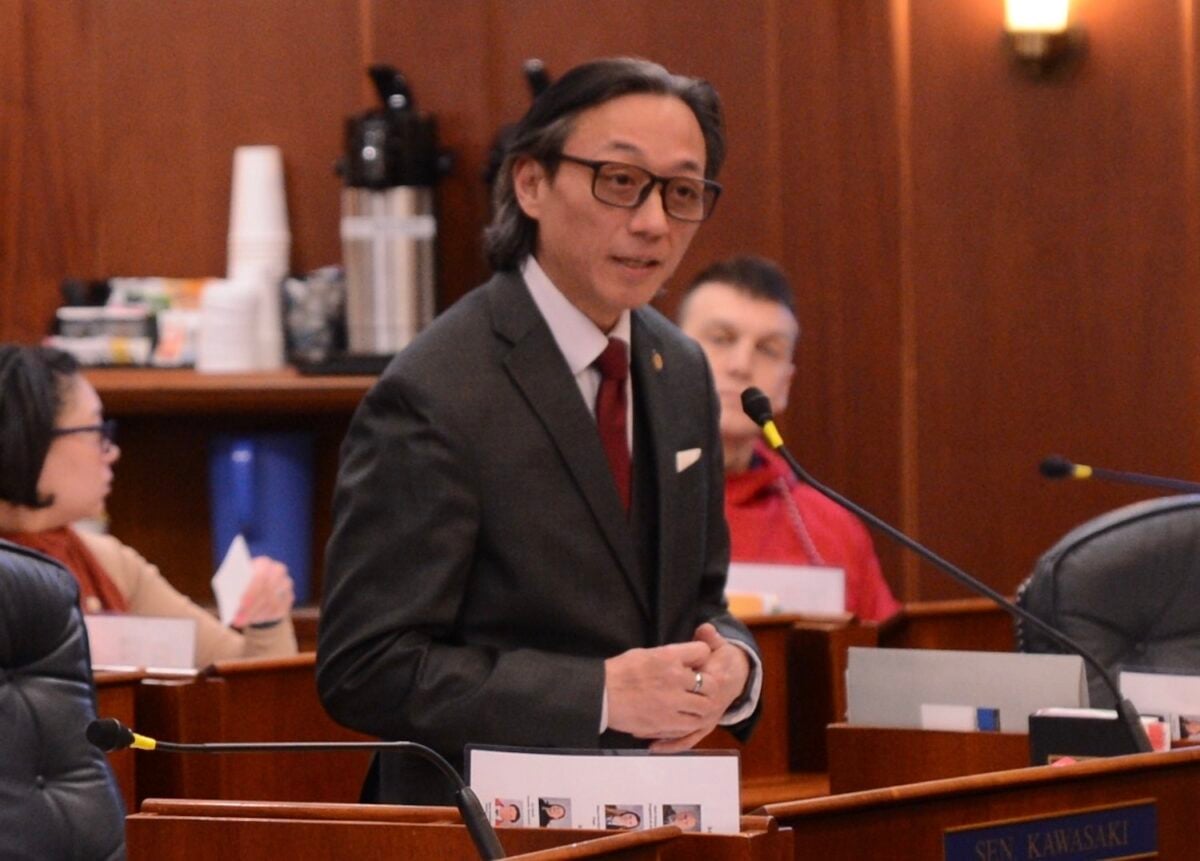
Sen. Scott Kawasaki, D-Fairbanks, speaks Friday, Feb. 7, 2025, on the floor of the Alaska Senate. (Photo by James Brooks/Alaska Beacon)
By: Haley Lehman, Alaska Beacon
Sen. Scott Kawasaki, D-Fairbanks, speaks Friday, Feb. 7, 2025, on the floor of the Alaska Senate. (Photo by James Brooks/Alaska Beacon)
The Alaska Senate unanimously passed a bill Monday that would grant back Permanent Fund dividends to Alaskans whose convictions are vacated, reversed or dismissed.
Under current Alaska law, people who were sentenced or incarcerated as a result of a felony conviction or certain combinations of multiple misdemeanors forfeit their dividends that year and any following years of incarceration. An amount equivalent to the incarcerated person’s dividend is deposited into a restorative justice account.
Sen. Scott Kawasaki, D-Fairbanks, the sponsor of Senate Bill 167, said Monday, “The state has a duty and obligation to rectify harm done to those who might have been wrongfully convicted and to those who have been exonerated of a crime.”
The bill would grant past dividends to people whose charges were later dismissed or if their conviction was vacated, their case was retried and they were acquitted. Individuals who qualify would have one year after their charges were reversed or dismissed to apply. Individuals whose charges were dropped as part of a plea agreement in another criminal case would not qualify for back payment of dividends.
When Kawasaki served in the House of Representatives, he sponsored a similar bill in 2017 that passed in that chamber 38-1.
Kawasaki told the Senate that this change would impact “very few people annually,” and would provide a “modest, essential source of income.”
The Department of Revenue was not able to determine the fiscal impact of the proposed legislation since the Permanent Fund Dividend Division does not know how many Alaskans with past vacated sentences will apply for a past year’s dividends. Funding for past PFDs comes from a reserve for prior years’ dividends in the budget.
The bill received support from Tanana Chiefs Conference and the nonprofit After Innocence.
Kawasaki estimated last year that Marvin Roberts, Eugene Vent, George Frese and Kevin Pease, known as the Fairbanks Four, would receive approximately $103,450 in back PFDs after they were wrongfully incarcerated in connection with the 1997 death of John Hartman.
Alaska Gov. Mike Dunleavy speaks to reporters on Thursday, April 17, 2025, with Deena Bishop, commissioner of the Alaska Department of Education and Early Development, looking on in the background. (Photo by James Brooks/Alaska Beacon)
By: Corinne Smith, Alaska Beacon
Alaska Gov. Mike Dunleavy speaks to reporters on Thursday, April 17, 2025. (Photo by James Brooks/Alaska Beacon)
Gov. Mike Dunleavy signed off on a supplemental budget bill that authorizes nearly $450 million in additional state spending this year.
The budget bill covers additional costs incurred by the state this fiscal year ending in June, including funds for disaster relief, education, corrections and transportation.
The bill was approved by the Alaska State Legislature two weeks ago. Dunleavy signed the budget on Apr. 2, and transmitted it back to the Legislature on Thursday.
“I appreciate the Legislature’s support of these proposals,” Dunleavy said in a letter announcing his signature on the bill. “The supplemental budget I have signed into law today enables the State to meet current fiscal year responsibilities and represents prudent and fiscally responsible investments in emergency and fire response, public safety and statewide transportation needs.”
The budget includes $75 million for disaster relief to address the response to the Western Alaska storms last fall, and nearly $100 million for fire suppression, particularly in Interior Alaska. It includes $20 million for the Alaska Department of Corrections overtime expenses, as well as $70 million in time-sensitive funding for transportation — sought by the construction industry to unlock a federal match of $630 million for state construction projects.
It also includes $130 million for the Alaska Higher Education Fund which provides grants and scholarships for students, as well as $34.4 million for Medicaid and $12.8 million for other public assistance programs through the Alaska Department of Health.
The governor’s office submitted an additional $11.6 million request, but it was submitted too late to include in the budget bill, and will be rolled into the proposal for next year’s budget.
Additionally, the state is waiting on an appeal decision after failing a federal disparity test for education funding, and could potentially be liable for $72 million in K-12 funding for next year, according to officials with the Legislative Finance Division.
Oil revenues still uncertain
In the Legislature, the bill was delayed this year amid ongoing debate in the House of Representatives on whether to pay for the larger than usual budget bill out of state savings — an act that requires the approval of three-quarters of legislators.
Members of the House Republican minority caucus objected to spending from a state savings account, the Constitutional Budget Reserve. After the Alaska Department of Revenue projected the state would see an additional $500 million in oil revenue due to a surge in oil prices driven by the Iran war, they argued the state would not need to pull from savings to pay its bills.
Members of the multipartisan House majority caucus objected to the uncertainty of revenue forecasts and future oil prices, and argued for a draw from state savings to fund the budget bill immediately.
If oil-driven state revenues from now until the end of the fiscal year are not sufficient to cover the $450 million supplemental budget, then lawmakers agreed to draw from state savings. That means oil prices must average approximately $82 per barrel of oil through June for state revenue to cover spending, according to officials with the Legislative Finance Division.
House Speaker Rep. Bryce Edgmon, I-Dillingham, was among legislators who supported the draw from savings several weeks ago, instead of banking on uncertain future oil revenues. On Friday, he said it seems revenues will cover the budget bill.
“As appears now, oil prices are continuing to move in an upward trajectory, which means that the bill at the very end could be fully funded,” Edgmon said. “But there’s still a fair amount of time in front of us for oil prices to, you know, continue to be volatile.”
Edgmon said barring a dive in oil prices, he doesn’t expect another vote on drawing from the state savings this session.
“That’s pending a dramatic drop in oil prices, of course, which doesn’t seem to be on the horizon.”
Rep. Andy Josephson, D-Anchorage, asks a question about Senate Bill 48, the carbon credits bill, on Tuesday, May 16, 2023, in the House Finance Committee. (Photo by James Brooks/Alaska Beacon)
By: Sean Maguire, Alaska Beacon
Rep. Andy Josephson, D-Anchorage, asks a question about Senate Bill 48, the carbon credits bill, on Tuesday, May 16, 2023, in the House Finance Committee. (Photo by James Brooks/Alaska Beacon)
The Alaska House Finance Committee on Wednesday advanced a draft operating budget with a roughly $3,800 Permanent Fund dividend.
For a decade, the annual PFD check has been part of the Legislature’s annual budget-making process. A $3,800 PFD would follow a formula from a 1982 statute.
Lawmakers on a budget panel adopted the full, statutory dividend in the evening after long debate. Anchorage Democratic Rep. Andy Josephson, co-chair of the House Finance Committee, cautioned legislators that the vote means Alaskans “will absolutely have the impression” that “a very liberal dividend” will be paid this year.
Republican Alaska Gov. Mike Dunleavy proposed a full PFD as part of his budget proposal in December. A $3,800 dividend check is estimated to cost roughly $2.47 billion, the largest single spending item in the budget.
Ketchikan independent Rep. Jeremy Bynum proposed that the PFD would come from two sources. Almost $1 billion would be drawn from the general fund of the state treasury. A simple majority of lawmakers is required to spend from that account.
However, close to $1.5 billion would come from the state’s main savings account, the $3 billion Constitutional Budget Reserve. Three-quarters of the House and Senate would need to support spending from that account.
If the three-quarter vote fails, the dividend paid to Alaskans in 2026 would drop to around $1,500. Some lawmakers cautioned that would still leave the state roughly $100 million in deficit.
The roughly $3,800 PFD was approved 6-5 by the House Finance Committee. All five minority House Republicans supported a check of that size, alongside Nome Democratic Rep. Neal Foster, co-chair of the House Finance Committee.
The remaining five members of the Democrat-dominated House majority voted no.
Supporters of a full PFD said that high oil prices justified a larger dividend this year. In 2022, Alaskans received a $3,284 dividend and energy relief check when Russia’s invasion of Ukraine sent oil prices skyrocketing.
Rep. Frank Tomaszewski, R-Fairbanks, said that the “people of Alaska are hurting right now” and are facing difficult circumstances from high energy bills.
The U.S.-Israel war in Iran has seen oil prices spike to well over $100 per barrel. The Alaska Department of Revenue projected last month that would see the state collect $1 billion more revenue than expected over the current fiscal year and the fiscal year that starts July 1.
Lawmakers have already earmarked a substantial portion of that additional revenue to pay Alaska’s outstanding bills.
The operating budget now advances to debate by the full Alaska House. Once approved in that chamber, it advances to the Alaska Senate for its consideration before heading to the governor’s desk.
U.S. Rep. Nick Begich III, R-Alaska, speaks to a joint session of the Alaska Legislature on Tuesday, March 10, 2026. (James Brooks photo/Alaska Beacon)
By: James Brooks, Alaska Beacon
U.S. Rep. Nick Begich III, R-Alaska, speaks to a joint session of the Alaska Legislature on Tuesday, March 10, 2026. (James Brooks photo/Alaska Beacon)
The filing deadline for this year’s Alaska Permanent Fund dividend is March 31, and if Rep. Nick Begich III has his way, this year’s dividend will be tax free.
On March 3, Alaska’s lone member of the U.S. House introduced a bill that would exempt the dividend from federal taxes.
When Begich mentioned it during his address to state lawmakers this week, it garnered a standing ovation in the state Capitol.
Begich said afterward that passing the bill into law “is going to be a lift,” but in his first year as a Representative, Begich has found an unusual amount of success. On the day he introduced the tax-free dividend measure, he had a sixth prime-sponsored bill pass the U.S. Senate and advance to President Donald Trump.
Those six bills include two Congressional Review Act resolutions that repealed regulations adopted by the administration of President Joe Biden.
When members of Alaska’s Congressional delegation speak to the Legislature, it’s usually a platform to talk about their recent accomplishments, and Begich had plenty to talk about this year.
The number of bills he passed through Congress in his first year is a record, his office said.
According to the Center for Effective Lawmaking, when Begich’s sixth bill becomes law, he will tie former Rep. Rick Renzi, R-Arizona, for the most bills that became law in a freshman term.
The 119th Congress still has several months to run, and if Begich manages a seventh, he would set the record.
“No other House freshman in our data (going back to 1973) had six or more,” said Colin Achilles, the center’s associate director, by email.
At least some of Begich’s success is attributable to groundwork laid by his immediate predecessors, Democratic Rep. Mary Peltola and Republican Rep. Don Young.
He’s also received help from Alaska’s two senators, Republicans Lisa Murkowski and Dan Sullivan, who have been able to guide his legislation through the Senate after passing the House.
Begich’s House-and-Senate passed bills to date include:
A legal change making it easier for disabled Alaska Natives to qualify for some federal aid programs;
A measure repealing Biden-era limits on oil and gas leasing within the Arctic National Wildlife Refuge;
A law that distributes extra land to Alaska Native village corporations by eliminating an inactive trust;
A bill granting land to the Alaska Native village corporation for Saxman, in Southeast Alaska;
And a bill extending the amount of time that Alaska Native Vietnam War veterans or their families have to pick grants of federal land.
While the measures repealing Biden-era actions advanced along party lines, taking advantage of Republican control of the House, Senate and Presidency, Begich’s other bills have gotten unanimous support in the House, from Democrats and Republicans alike.
Speaking to the Alaska Legislature, Begich said that “not every bill is a touchdown pass, but every bill puts (points) on the board. We are getting points on the board for the state of Alaska, and we will continue to look for opportunities to do that.”
After his speech, he acknowledged that the dividend bill is something closer to a deep pass than a short run down the middle, but it helps to be ready for an opportunity.
“You have to have these bills in existence in order for them to have an opportunity to pass. And sometimes a must-pass piece of legislation will show up, and you’ll have an opportunity to attach a priority for your district,” he said. “In our case … we wanted to make sure that we had this in the clip ready to go. When that opportunity arrives, sometimes it happens faster than you think it will. Sometimes it takes a while, but you have to have the legislative text ready to go for the moment that arrives, and that’s what we’re doing on that bill.”
The offices of the Alaska Permanent Fund Corp. are seen Monday, June 6, 2022 in Juneau, Alaska. (Photo by James Brooks/Alaska Beacon)
Craig Richards, a longtime member of the board in charge of the Alaska Permanent Fund Corporation, has been replaced.
On Monday afternoon, Gov. Mike Dunleavy announced he had selected Ralph Samuels, a former state legislator, businessman and tourism expert, to serve on the board in a public seat formerly occupied by Richards, whose term was slated to expire this year.
The board directs Alaska’s $85 billion Permanent Fund, whose investments are the source of more than 60% of the state’s general-purpose revenue. That money is used annually for services and the annual Permanent Fund dividend.
Richards had served on the board since 2015, first under then-Gov. Bill Walker, and then under Dunleavy, who appointed him to a four-year term as a public member of the board in 2021.
Richards did not immediately answer a message left on his cellphone. It was not immediately clear whether he had sought another term but was passed over by the governor.
Samuels also did not immediately answer a message left on his cellphone.
A statement announcing Samuels’ appointment did not include a comment from Richards or note his departure.
Of Samuels, the governor said, “He is a lifelong Alaskan with an innate understanding of our state’s business and political landscape. As a Trustee he will bring that experience and insight to managing Alaska’s sovereign wealth fund not only for today, but for future generations of Alaskans.”
Under Richards, who chaired the Board of Trustees from 2018 through 2022, the board launched a controversial in-state investment program that has yet to deliver positive results.
The board in recent years has also intensified its warnings about the threat that the fund may run out of spendable money in the coming years.
An analysis paper commissioned during Richards’ time on the board suggests that a constitutional amendment may be needed to change the Permanent Fund’s structure to firmly cap the amount of money that may be spent from the fund and to consolidate the fund’s current two-account structure.
A sign advertising the cashing of Alaska Permanent Fund Dividend, or PFD, checks hangs outside a business in Anchorage, Alaska, Tuesday, Sept. 23, 2025. (AP Photo/Mark Thiessen)
AP- The truck that arrived ahead of schedule at Allyssa Canoy’s home in Fairbanks brought enough heating fuel for the frigid winter months ahead — and a surprise bill for $2,600.
Canoy and her two sons have checks arriving that will cover that expense and leave some money for the boys, too. Starting Thursday, Alaska plans to begin distributing to residents their annual dividend derived from the state’s $83 billion oil wealth fund, a sort of bonus that Alaskans get for living in the state.
For some, it’s extra spending money for a new set of tires or a vacation to a sunnier clime during the long, dark winter. For others, it’s a vital supplement in a state where the cost for internet service, gas and groceries can be sky-high.
Here’s what to know about the Alaska Permanent Fund dividend:
This year’s payout is one of the lowest in 20 years
Alaskans are getting $1,000 per person — the lowest amount since 2020, when they each received $992. The payout has been below $1,000 only two other times since 2006.
There used to be a formula for calculating the amount, tied to the fund’s market performance. But lawmakers widely consider that formula unaffordable and within the last decade have abandoned it.
Politicians now set the amount. It’s often one of the last items settled during sensitive budget negotiations. Lawmakers must weigh the check’s size against other programs and public needs, including education, and in 2018 began using earnings from the fund — long used to pay dividends — to also help balance the budget.
This year, $1,000 is what lawmakers argued they could afford while also backing an increase in K-12 funding and trying to limit draws from savings.
Had the old formula been followed, residents would be getting about $3,800 each.
The Alaska Permanent Fund is nearly 50 years old
Voters created the fund in 1976, during the heady, early years of oil in the state. The goal was to save some of Alaska’s mineral wealth. The fund has grown through investments, and while the state constitution protects the fund’s principal, its earnings can be spent.
Dividends have been paid since 1982. Proponents saw them as a way to ensure Alaskans maintained a vested interest in the Alaska Permanent Fund.
More than 600,000 of Alaska’s roughly 740,000 residents are set to receive this year’s check. To qualify, one must meet residency and other requirements.
For some Alaskans, the check is a nice extra. Some put it into college funds or savings accounts or donate to charities. Others rely on it for necessities, such as heating oil, winter tires or snowmachines, which are critical modes of transportation in rural villages where residents rely on hunting or trapping.
Canoy, a single mom of two, is selling her home and downsizing. She had planned to fill her home’s fuel tank as a gift to the new buyers at closing, but the fuel truck came early while she was away. So instead of putting the $3,000 her family is receiving toward other projects, as she’d hoped, she’s using it to pay that bill. She plans to let her sons spend the remaining $400.
Canoy said she lives comfortably and sees the dividend as a blessing. Still, she wishes lawmakers would find a better way to set the amounts — “at least to just give Alaskans maybe a little peace of mind that, yeah, we’re actually doing everything that we can to make sure that you guys get the most out of the permanent fund dividend.”