







Categories
Alaska News Featured Juneau News juneau Juneau Local Juneau Local Ketchikan Local News Feeds Sitka Local

Alaska Rep. Nick Begich proposes federal tax exemption for Permanent Fund dividends

By: James Brooks, Alaska Beacon

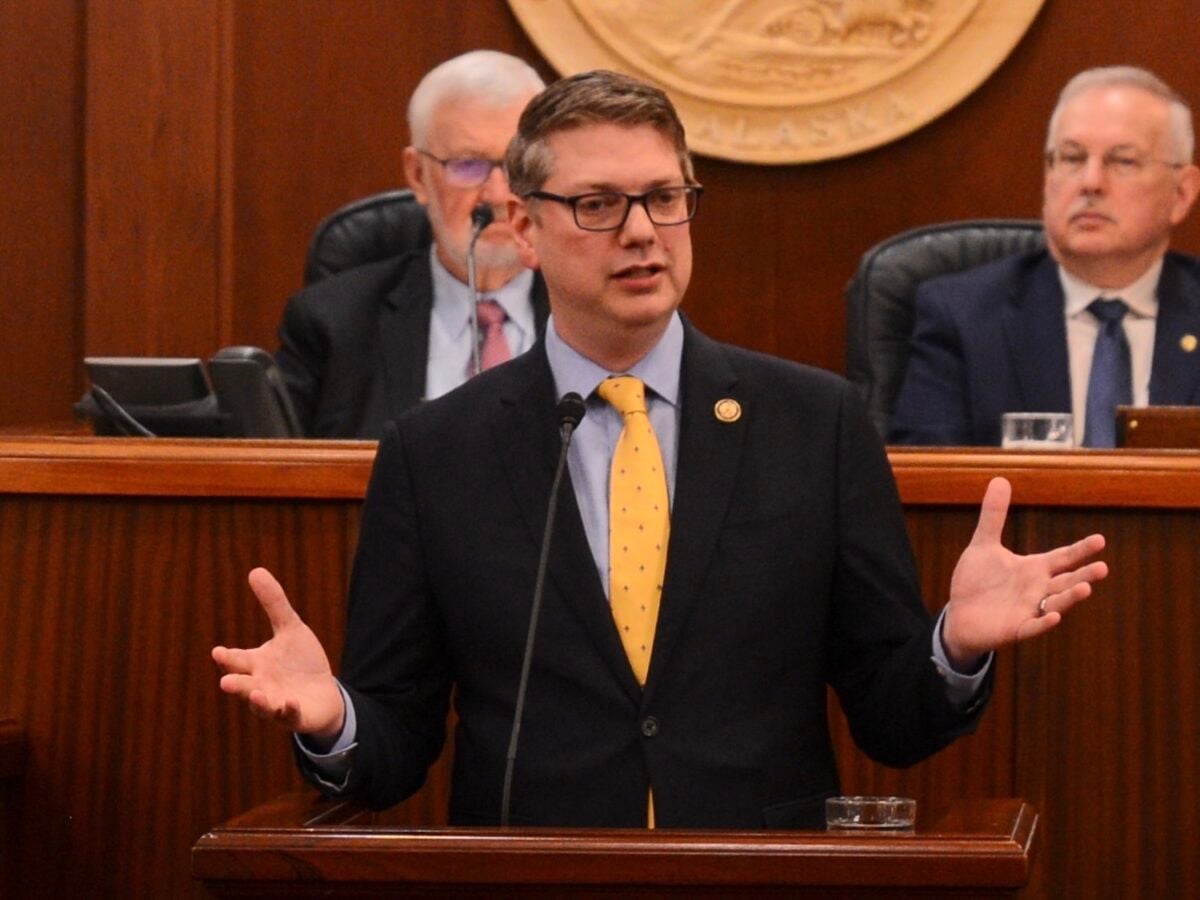
U.S. Rep. Nick Begich III, R-Alaska, speaks to a joint session of the Alaska Legislature on Tuesday, March 10, 2026. (James Brooks photo/Alaska Beacon)

The filing deadline for this year’s Alaska Permanent Fund dividend is March 31, and if Rep. Nick Begich III has his way, this year’s dividend will be tax free.

On March 3, Alaska’s lone member of the U.S. House introduced a bill that would exempt the dividend from federal taxes. 

When Begich mentioned it during his address to state lawmakers this week, it garnered a standing ovation in the state Capitol. 

Begich said afterward that passing the bill into law “is going to be a lift,” but in his first year as a Representative, Begich has found an unusual amount of success. On the day he introduced the tax-free dividend measure, he had a sixth prime-sponsored bill pass the U.S. Senate and advance to President Donald Trump. 

Those six bills include two Congressional Review Act resolutions that repealed regulations adopted by the administration of President Joe Biden.

When members of Alaska’s Congressional delegation speak to the Legislature, it’s usually a platform to talk about their recent accomplishments, and Begich had plenty to talk about this year.

The number of bills he passed through Congress in his first year is a record, his office said.

According to the Center for Effective Lawmaking, when Begich’s sixth bill becomes law, he will tie former Rep. Rick Renzi, R-Arizona, for the most bills that became law in a freshman term.

The 119th Congress still has several months to run, and if Begich manages a seventh, he would set the record.

“No other House freshman in our data (going back to 1973) had six or more,” said Colin Achilles, the center’s associate director, by email.  

At least some of Begich’s success is attributable to groundwork laid by his immediate predecessors, Democratic Rep. Mary Peltola and Republican Rep. Don Young.

His first two passed bills were handed over by Peltola after she lost to Begich in the 2024 elections. 

He’s also received help from Alaska’s two senators, Republicans Lisa Murkowski and Dan Sullivan, who have been able to guide his legislation through the Senate after passing the House.

Begich’s House-and-Senate passed bills to date include:

  • A legal change making it easier for disabled Alaska Natives to qualify for some federal aid programs;
  • measure repealing Biden-era limits on oil and gas leasing within the Arctic National Wildlife Refuge;
  • Another measure that repealed a Biden-era land-use plan for Interior Alaska;
  • A law that distributes extra land to Alaska Native village corporations by eliminating an inactive trust;
  • A bill granting land to the Alaska Native village corporation for Saxman, in Southeast Alaska;
  • And a bill extending the amount of time that Alaska Native Vietnam War veterans or their families have to pick grants of federal land.

While the measures repealing Biden-era actions advanced along party lines, taking advantage of Republican control of the House, Senate and Presidency, Begich’s other bills have gotten unanimous support in the House, from Democrats and Republicans alike.

Speaking to the Alaska Legislature, Begich said that “not every bill is a touchdown pass, but every bill puts (points) on the board. We are getting points on the board for the state of Alaska, and we will continue to look for opportunities to do that.”

After his speech, he acknowledged that the dividend bill is something closer to a deep pass than a short run down the middle, but it helps to be ready for an opportunity.

“You have to have these bills in existence in order for them to have an opportunity to pass. And sometimes a must-pass piece of legislation will show up, and you’ll have an opportunity to attach a priority for your district,” he said. “In our case … we wanted to make sure that we had this in the clip ready to go. When that opportunity arrives, sometimes it happens faster than you think it will. Sometimes it takes a while, but you have to have the legislative text ready to go for the moment that arrives, and that’s what we’re doing on that bill.”
Categories
Alaska News Featured Juneau News juneau Juneau Local Juneau Local Ketchikan Local News Feeds Sitka Local

Alaska legislators have few firm facts as they consider a proposed trans-Alaska natural gas pipeline

By: James Brooks, Alaska Beacon

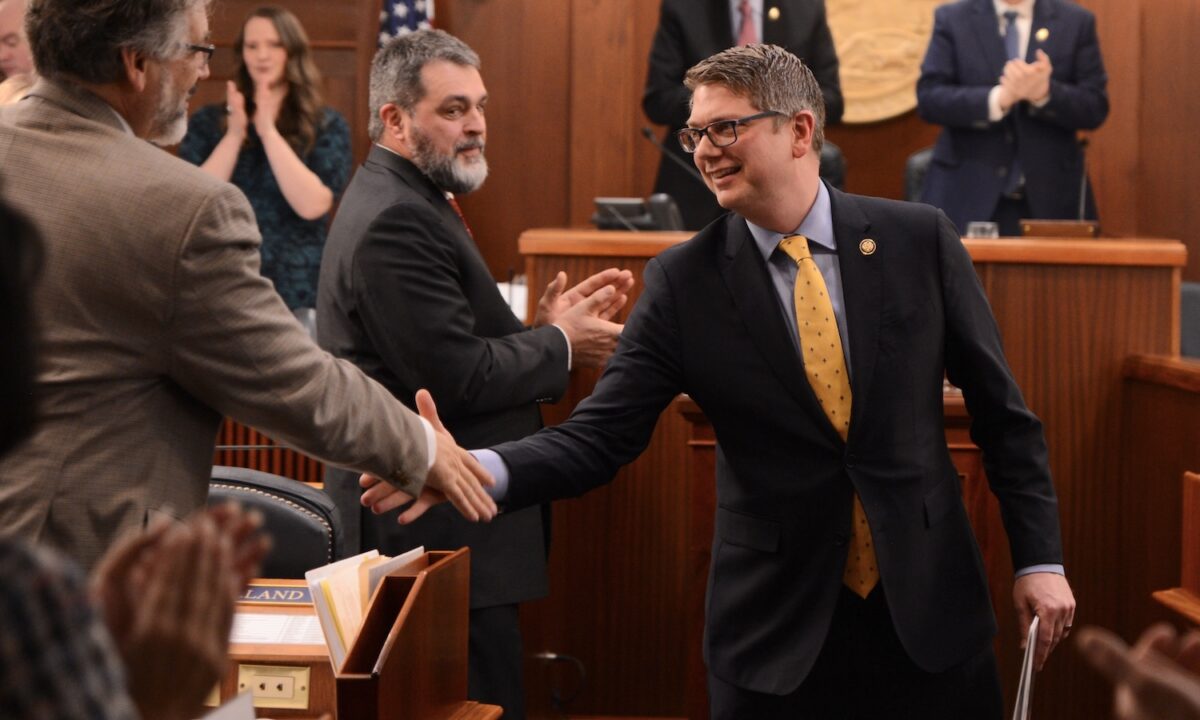
Rep. Nick Begich III, R-Alaska, shakes hands with state Rep. Ky Holland, I-Anchorage, as he leaves a joint session of the Alaska Legislature on Tuesday, March 10, 2026. (James Brooks photo/Alaska Beacon)

In a speech to the Alaska Legislature this week, Alaska Rep. Nick Begich III urged state lawmakers to boost the development of a proposed trans-Alaska natural gas pipeline.

“The federal path is largely cleared, but investors also need state level clarity, fiscal predictability and simplicity,” Begich said. “Scrutinize it carefully, model it thoroughly. But my request to you is not to become a roadblock.”

But legislators who are dealing with the pipeline on a daily basis say they don’t have answers to basic questions, including how much the pipeline will cost and whether the gas it carries will be affordable to Alaskans.

“I have not seen any figures,” said Sen. Cathy Giessel, R-Anchorage and chair of the Senate Resources Committee. 

Senate President Gary Stevens, R-Kodiak, said legislators are not going to be a roadblock.

“We’re not going to throw sand in the works. Everybody wants a pipeline. We all hope that it comes about, but it’s got to be done properly and make sure that we know what’s going on.”

Sen. Bill Wielechowski, D-Anchorage, said he has heard “from very credible sources” that the price of gas through the pipeline could be $50 per million cubic feet by 2046. 

The current cost of gas from Cook Inlet for Southcentral Alaska is about $10 per MCF. 

“Just imagine if you have utilities locked into 30-year contracts for gas at $50 an MCF. That would be catastrophic,” Wielechowski said. “That’s the sort of thing that we’re trying to protect Alaskan consumers all up and down the Railbelt from — an absolute catastrophe to our economic system.”

As currently proposed, the pipeline project consists of two phases. The first phase includes an 807-mile pipeline from the North Slope to the west side of Cook Inlet, with a tie-in to existing natural gas infrastructure around Anchorage.

The second phase would extend the pipeline to the Kenai Peninsula, where an export terminal would be built. The second phase would also include a processing plant on the North Slope.

One year ago, the state-owned Alaska Gasline Development Corporation sold 75% of the trans-Alaska natural gas pipeline project to Glenfarne, an international developer.

Since the acquisition, Glenfarne has signed a number of nonbinding agreements with potential gas purchasers and gas sellers, but it has not disclosed estimates for the project’s cost, and it hasn’t disclosed what it expects the cost of gas to be.

Last year, company officials said they expected to make an investment decision by the end of 2025. In a subsequent filing with the Federal Energy Regulatory Commission, they said they would make the decision in February. A new timeline hasn’t been made public.

The lack of data is particularly problematic because legislators are considering whether to offer a property tax break to pipeline developers.

Those taxes are significant. Because Alaska does not have a statewide income tax or sales tax, its state budget suffers when people move into the state. More people means more demand for things like schools, parks and roads, but no increased revenue to pay for those things.

Economists have called that the “Alaska disconnect.”

Alaska has a 2% property tax on oil and gas infrastructure. Most of that money is passed on to municipalities, which use it for local needs.

In December, Alaska Gov. Mike Dunleavy said he was considering a proposal to cap that property tax at 0.2% for the natural gas pipeline, creating a payment in lieu of taxes system.

“That bill should be next week,” Dunleavy said during a Thursday news conference with U.S. Interior Secretary Doug Burgum, confirming the 0.2% rate will be part of the new legislation.

“Last couple weeks, we’ve been working with municipalities, getting their input as to what this should look like before (we) put the bill out,” he said. “So look forward to probably next week on that PILT bill, so that we can look at the economics of this line and also ways to ensure that municipalities benefit from this directly.”

This week, Begich expressed some support for a lower property tax rate, saying it could encourage people to invest in the pipeline.

“The classic 2% tax burden that would apply, say, to a $50 billion asset, would be a billion dollars in cash flow early in the project’s life cycle,” Begich said. “If that cash flow coming out of the project lowers the rate of return for investors, they’re not going to show up and invest. And so we need to make sure that our tax policy is A, doing what’s right for Alaskans. B, is not impeding the ability for the project to move forward. And I think we can do both of those things with some creative thinking and conversations with the industry.”

While a lower tax rate would benefit pipeline developers, it has the potential to harm residents who live near the pipeline. 

If pipeline construction and operation mean more people moving to Alaska and municipalities are unable to raise revenue to meet the resulting demand for services, local governments could be forced to raise taxes or cut basic services in order to pay for the pipeline subsidy.

Last week, the Senate Resources Committee introduced Senate Bill 275, which imposes some transparency requirements on the pipeline project, eliminates a tax exemption relevant to the project, and imposes a new surcharge on gas processing plants. 

That bill was introduced just days before Begich urged lawmakers not to be a “roadblock.”

Giessel, who chairs the resources committee, said she didn’t think Begich’s comments were directed at her or her committee’s bill.

“We’re not being a roadblock. We’re doing exactly what we’re supposed to do according to our constitution,” she said.

Asked whether he was thinking of Giessel’s bill during his speech, Begich said, “It was not my direct intention. No, I think it’s always worth having the conversation about the tax structure, about the incentive structure, though that’s an ongoing discussion that happens at the state legislature in Alaska. I think it’s important that when we have those conversations, they’re done in a way that is going to encourage, rather than discourage, industry from coming in and saying, ‘Yes, this is a good place for us to invest in.’”

Speaking to reporters after his speech, Begich said the state would benefit by getting more information from Glenfarne.

“I welcome more information,” Begich said. “I recognize that they’ve got certain restraints on what they can share. But look, I’d like to see more information shared. I’d like to see more of the economics of the project shared so we can understand what the full potential is and what’s on the table. I believe that’s going to come with time, but more information is better.”

Categories
Featured Juneau News Juneau Local Ketchikan Local News Feeds Sitka Local

Anchorage pastor Matt Schultz to challenge Rep. Nick Begich in 2026 U.S. House race

By: James Brooks, Alaska Beacon

Democratic U.S. House candidate Matt Schultz is seen in an undated photo published on his campaign website. (Screenshot)

An Anchorage pastor announced Monday that he is running for Alaska’s lone U.S. House seat, challenging incumbent Republican Rep. Nick Begich. 

The Rev. Matt Schultz, of Anchorage’s First Presbyterian Church, is a registered Democrat with an extensive history of support for progressive policies and ideals. On Saturday, he spoke at Anchorage’s No Kings day rally.

In an interview on Tuesday, Schultz said he was motivated to run by his belief “that every person has a responsibility to use the many gifts and opportunities we have as a way to be of service to the world.”

Schultz said that what tipped him over into running was his sense that daily life has become too difficult. “The policies that our current legislators have put in place have made life unaffordable, just on the basics like food and rent and on the larger but just as important things such as health care.” 

Schultz was born and raised in rural New York state, which he described as “a place that had more cows than people.” 

He moved to Alaska with his wife in 1997. They have three children, two of whom are grown and one of whom attends high school in Anchorage.

Schultz and his wife left the state about four years after arriving in order to attend graduate school and returned in 2013 permanently.

Schultz’s father was a Catholic priest, his mother, a Catholic nun.

“They got married and excommunicated in the same moment,” he said, describing his family history.

“So I sort of inherited the family business, in a way, but I chose a different path slightly,” he said.

In regular opinion columns and letters submitted to the Anchorage Daily News, Schultz has espoused a progressive Christian viewpoint, with support for LGBTQ Alaskans, higher minimum wages and improved government-backed healthcare.

Begich, elected in 2024, has been a reliable vote for President Donald Trump, including on Trump’s signature budget proposal, which reduced federal services and increased federal tax breaks, particularly for wealthy Americans. 

The Congressional Budget Office expects the proposal to significantly increase the federal debt, something Begich doubts.

Schultz said he felt the budget “really just put the hammer on people who are working hard to get by,” and he hasn’t been happy with Begich’s decision to eschew town hall meetings to discuss his vote.

“I don’t know how it’s possible to be a representative that doesn’t show up for things like town halls and to listen to the people’s concerns, so I will definitely be doing that as much as possible,” Schultz said.

Officially, Schultz is the second Democrat in the race; Fairbanks Democrat John Williams signed up for the race in July but has not raised any money or conducted significant campaign events.

Williams is the only candidate to have officially registered with the Alaska Division of Elections. 

Schultz registered with the Federal Elections Commission on Monday, which allows him to begin fundraising and advertising. Williams and Begich have already registered, and according to the latest available FEC data, Begich had approximately $1.6 million available in his campaign account, discounting about $376,000 in debt.

More candidates may enter the race; the deadline to do so is June 1. The top four vote-getters in the August primary election will advance to the general election in November.