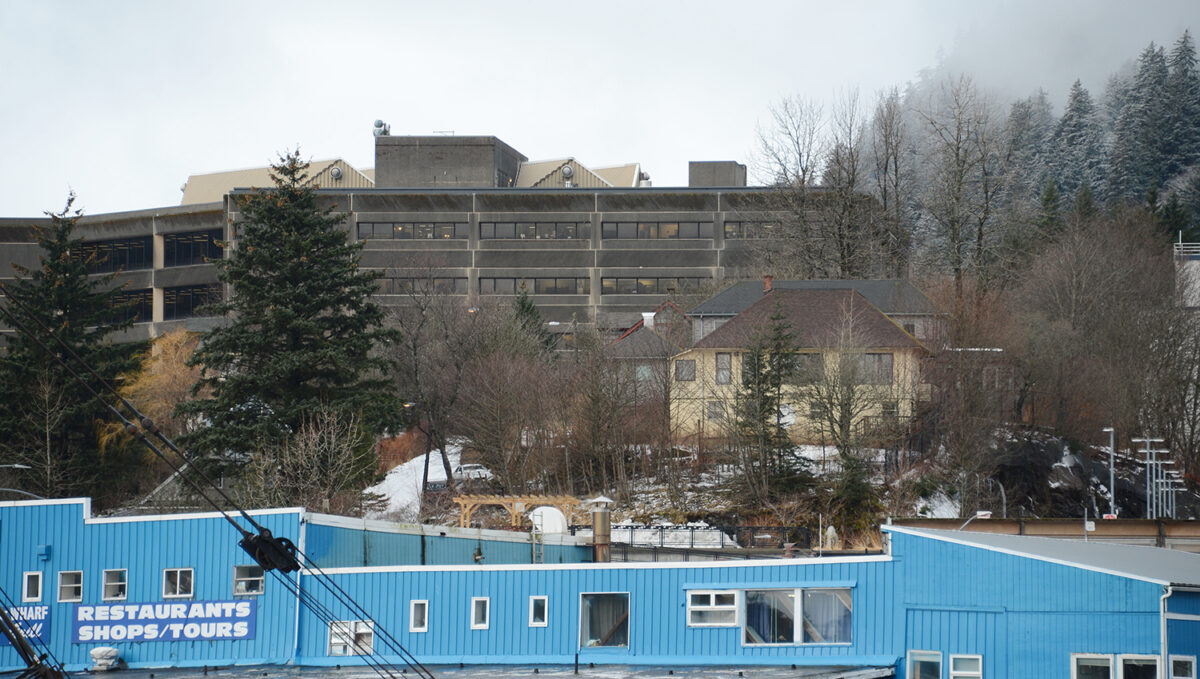
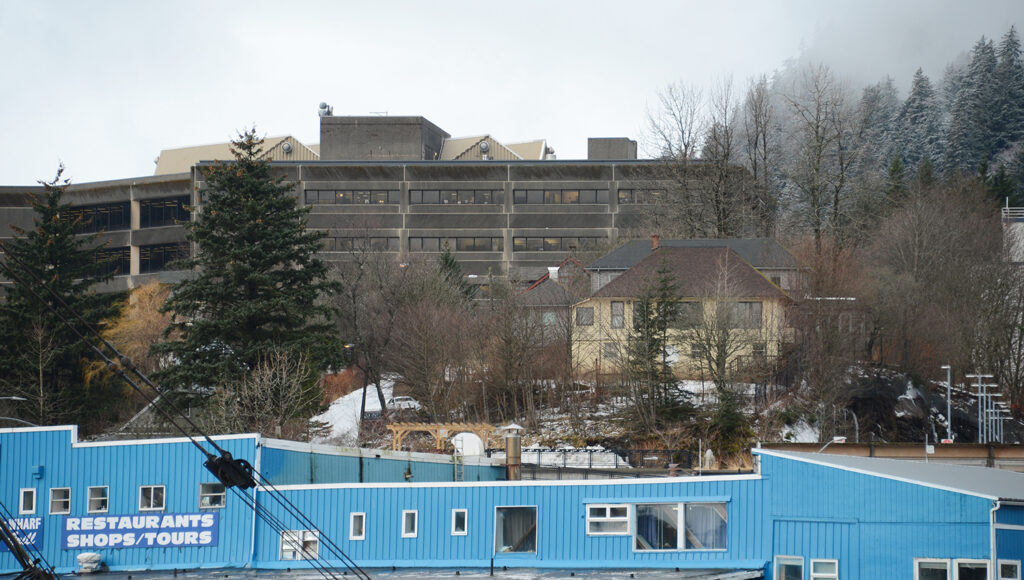
Juneau's Telephone Hill neighborhood is seen at center right, beneath the State Office Building, on Wednesday, Dec. 28, 2022. The neighborhood, owned by the state of Alaska, is being transferred to the City and Borough of Juneau. (Photo by James Brooks/Alaska Beacon)
Juneau’s Telephone Hill neighborhood is seen at center right, beneath the State Office Building, on Wednesday, Dec. 28, 2022. (Photo by James Brooks/Alaska Beacon)
NOTN- A Juneau judge heard arguments Tuesday in a lawsuit challenging the city’s plans to redevelop Telephone Hill.
Former residents are asking Superior Court Judge Amanda Browning to stop the city from demolishing seven residential structures and building higher-density housing on the site.
Browning said she will issue a ruling, but it may take over a week or two.
“What’s happening now is both attorneys put in motions to postpone.” Said Mayor Beth Weldon. The jury trial that had been scheduled for this week is now postponed while the judge considers the motions.
Juneau's Telephone Hill neighborhood is seen at center right, beneath the State Office Building, on Wednesday, Dec. 28, 2022. The neighborhood, owned by the state of Alaska, is being transferred to the City and Borough of Juneau. (Photo by James Brooks/Alaska Beacon)
Juneau’s Telephone Hill neighborhood is seen at center right, beneath the State Office Building. (Photo by James Brooks/Alaska Beacon)
NOTN- Juneau’s Assembly narrowly rejected a plan during last night’s Committee of the Whole work session, to carve up the city-owned Telephone Hill property and sell most of it “as is,” choosing instead to stay the course for the time being.
“So spending time with all of you, a lot lately with the budget, and spending a lot of time in the office with budget stuff and the flood coming upon us, and an election coming upon us, I think it’s nice to get Telephone Hill off our plate.” Mayor Beth Weldon said, “However, my main reason for doing this is just the public outcry not to spend any more money on Telephone Hill.”
On a 5–4 vote last night, members voted down Weldon’s proposal to divide Telephone Hill into three lots, reserve one for potential Coast Guard or workforce housing, and sell the other two with existing homes still standing.
The draft plan envisioned minimum bids of about $1 million and $2 million for the properties.
Members argued the change would undercut years of planning for higher-density housing in the downtown core at a time when the city faces a severe housing shortage and an influx of Coast Guard families. Several members said splitting up the property now could limit the city’s ability to pursue a cohesive, larger-scale project.
“I object to this. It’s funny, I object to this on so many levels that it’s hard to know where to start.” Said Assembly member Alicia Hughes-Skandijs,”I don’t want to put words in your mouth, but my read on the motion that passed at the last meeting was to bring this back and talk about, where are we going? Do we still feel good? How are we going to get there? And then we have this from the mayor, I will say crazy idea with love, I wouldn’t say that to anyone else. I don’t understand at the heart of this, the sponsor statement is that this is about not spending any more funding on this project, this seems to try to care for other issues, which is to leave some of that land back to where it might not turn into what our current plans are for it. It does preserve a small amount for our housing goals, but even that, I don’t see how that coincides with the goal of not spending any more money. I don’t see this, if that is indeed your intended goal, as the best way to move forward with that.”
In a separate 5–4 vote, the Assembly agreed not to award a roughly $2.3 million demolition contract until after it sees responses to a Request for Qualifications from potential developers, expected later this year.
“I understand and see where the mayor is trying to go.” Said Deputy Mayor Greg Smith, “This has been a challenge for us. I have an idea, I would move, or someone else could move, to not award the bill to demolish until after the results of the RFQ have been returned, to see what people think and hear and, you know, get real proposals on how to develop this, see what can be done. There is uncertainty now that will provide more, getting the RFQ back, because this could be a transformative project for downtown and for our housing crisis.”
The city is also defending a lawsuit filed by several Assembly members seeking to halt demolition; a jury trial is set for August, though no court order currently blocks the work.
Juneau's Telephone Hill neighborhood is seen at center right, beneath the State Office Building, on Wednesday, Dec. 28, 2022. The neighborhood, owned by the state of Alaska, is being transferred to the City and Borough of Juneau. (Photo by James Brooks/Alaska Beacon)
Juneau’s Telephone Hill neighborhood is seen at center right, beneath the State Office Building. (Photo by James Brooks/Alaska Beacon)
NOTN- The future of Juneau’s Telephone Hill redevelopment will get another look after the Assembly voted late last night to add the topic to an upcoming Committee of the Whole meeting.
Last night’s meeting was full of passionate testimony from Social Service providers, businesses and residents, and among that testimony were more calls to halt demolition of the historic neighbourhood.
“Juneau’s Historic Resources Advisory Committee members who you appoint because of their expertise have told you multiple times that the homes on Telephone Hill are a direct tangible connection to our history and should be preserved.” Said Larry Talley, “Please consider taking the advice of those you have selected for their expertise, even if you believe a housing project is worth more than the historic district, don’t demolish this historic district until you know that you can afford to put housing where your market analysis says is a very expensive place to develop.”
Assembly member Nano Brooks moved to place on the next Committee of the Whole agenda a discussion of “actions that could affect Telephone Hill development or the timeline,” including options for pausing the current demolition request for proposals until responses to a separate qualifications process are in hand, and exploring partial or full land disposal strategies.
Assembly members say this is a way to reassess timing and structure rather than to kill the project outright.
“My concerns is, since we last touched on it, there’s even been more public outcry.” Said Assembly Member Maureen Hall, “Could we modify the bid for partial demolition? This is really hard, but I don’t know that we’re ready to go full steam ahead.”
“we know the strain on the Treasury, we know the costs after getting the gondola cost. My risk tolerance and concern for moving forward without having better senses on the price has gone down.” Said Deputy Mayor Greg Smith, “That being said, there’s five votes to have this discussion. It’s a challenge, and I think staff has done a good job trying to make it as smooth as possible. But you know, all changes will have impacts to possible development, but I’ll support at least having the discussion.”
Some members pushed back, saying the body has already debated the issue repeatedly and that no new information had emerged.
“I do feel that we have voted on this and very similar issues many times at this point.” Said Assembly member Ella Adkison, “At this point, no new information has come forward that would change my calculations and I know that the COW (Committee of the Whole) has quite a bit on its plate, and I don’t really want to rehash old ground when we have other things we need to deal with.”
Mayor Beth Weldon however, agreed to put the item on a future agenda.
“While it kills me to do this, I would support the motion, because I have an idea that I need to run by everybody, so I’ll be bringing an idea.” She said.
The motion passed 6–2, set for more discussion at a Committee of the Whole session currently scheduled for April 13.
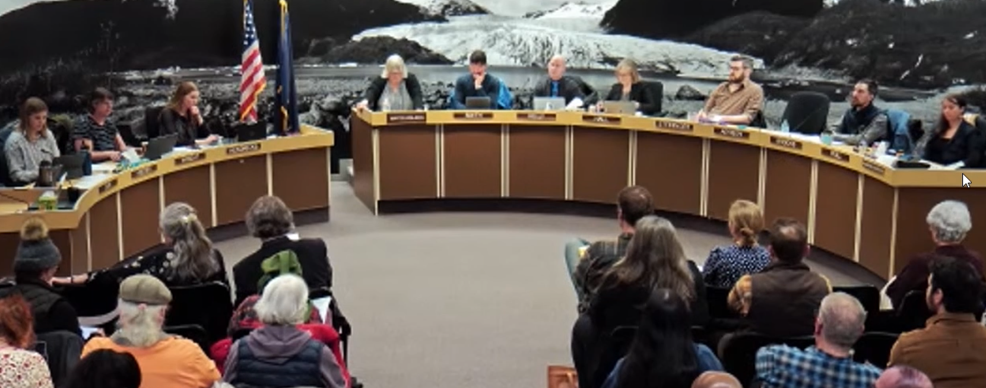
Monday night’s assembly meeting, as seen on CBJ’s livestream
NOTN- Packed public testimony at a Juneau Assembly meeting Monday showcased public tensions over the city’s budget, flooding, and looming cuts.
The public comment period stretched nearly 2 hours before the assembly could continue its regular agenda.
While much of the evenings testimony focused on budget pressures and big upcoming projects, one resident voiced their gratitude to the assembly for holding public comment saying, “I wanted to take the opportunity to say thank you to the assembly and to say that, you look at any scale of global events, down to national events, down to local events, there’s a lot to be fearful of and a lot to be anxious about. That being said, it’s too easy to displace that on, what you can yell at your local assembly.” Testifiers said social media can further exacerbate tensions, “Huge thanks to you guys, I know you have tons of stuff on your plate, and I know that it seems like you can’t catch a break, because I feel like, if it’s not one thing, it’s another.”
Multiple residents demanded the city halt or delay demolition of historic homes on city owned Telephone Hill, which the city hopes to redevelop for potentially, over 150 housing units.
“The CBJ is facing a $10 to $12 million budget shortfall. This will affect everyone in Juneau. It doesn’t make sense to spend $5.5 million on the discretionary demolition of Telephone Hill when there are so many pressing municipal needs.” Said Maureen Conerton, “Many Juneau residents have valid concerns and have testified against this project. including a former administrator, judge, an architect, a retired project manager, in addition to the more than 1000 Juneau residents who signed the Stop the Bulldozers Petition that was presented to you last fall.”
Juneau currently has a housing shortage. In an assembly meeting at the end of February, Finance Chair Christine Woll noted that demand is sure to rise with the arrival of Coast Guard personnel in the coming years.
Some speakers said they support building more housing in Juneau, especially downtown, but oppose the current Telephone Hill plan.
Others voiced concern for escalating cost estimates for the gondola project at Eaglecrest Ski Area, saying the price has ballooned far beyond early figures.
“I disagree with what’s been said about social media, I mean, that is the way a lot of people on short notice communicate.” Said Shannan Greene, she mentioned comments in articles by KTOO and the Juneau Independent and encouraged the Assembly to view them as public testimony as well, “This is an example of informal but honest public testimony from your everyday citizens. These are the people who are growing increasingly frustrated with your decisions.”
Residents spoke on flooding in the Mendenhall Valley and said the city has been too slow to address recurring flooding and erosion.
“Residents in the valley are left dealing with flooding, higher costs and the feeling that our concerns are always pushed down the list.” Said Amy Miller, “It isn’t frustrating, it’s driving people away. I’ll be honest with you, myself and many of my friends and neighbors are actively planning to leave Juneau as soon as we can, not because we don’t love this community we do, but because we no longer feel like the city is working for the people who live here, if the city continues to treat the valley’s flooding as a problem to study instead of a problem to solve.”
The Army Corps of Engineers recently, and without explicit reason, pulled back from pursuing the Lake Tap enduring solution, which had its own federal timeline.
The project was endorsed by Tlingit and Haida, the USDA Forest Service and Alaska’s Delegation, city leaders have been ‘Deeply concerned’ about the Army Corp’s shift in priorities.
City Manager Katie Koester said new federal discussions later this month could reshape the city’s strategy.
“We are very much committed to an enduring solution and committed to working on developing and furthering the lake tap.” She said, “We have received great news that Secretary Adam Telle and a large delegation of his high up staff will be traveling to Juneau at the end of this month, and as part of that, we anticipate new information and new strategy.”
Assembly Member Alicia Hughes-Skandijs said because Assembly rules limit speakers to two minutes and do not allow any back-and-forth, some of the most productive conversations happen informally. “You pour out your heart for two minutes, which is a very short time, or you’re trying to identify to someone you’re upset. When we’re in that process, we can ask clarifying questions, but we don’t engage. So the best follow up steps are the conversations that happen in the room, in between, on the breaks, things like that. So I was able to get some contact information and follow up with some folks and I think that happens pretty commonly, that it’s those one on one interactions.”
Concern also came from social service providers, who said potential cuts of up to 30% to city‑supported grants would shrink or shutter essential programs.
Leaders from the Southeast Alaska Food Bank, school counseling programs, the Glory Hall shelter and housing project, youth and senior services, mental health organizations and Alaska Legal Services all reported record demand and rising costs.
“I want to first off, take this opportunity to thank the assembly for the investment that they have made in our organization over the last couple of years. But with that in mind, I want remind you all that we work as social service organizations, many of which are present in the room tonight in partnership with the city. And we’re concerned to hear that the assembly is considering a reduction of investment in the social services block grant, what that would amount to is a reduction in services.” Said Dan Parks, speaking for the Southeast Alaska Food Bank, “I can only speak for our organization, but demand is at record highs. A couple of years ago, when I started with the food bank, we were serving about 300 individuals a week. Now we’re serving about 500 through our public pantry. We’re seeing more and more people slip from what used to be called the middle class into poverty. We also know that hunger doesn’t exist in a vacuum. It’s an indicator, a canary in the coal mine, if you will, of other social ills.”
They told the Assembly that fewer local dollars would mean fewer meals, beds, and legal and mental health services, pushing more people toward homelessness, emergency rooms and law enforcement.
Hughes-Skandijs said the Assembly welcomes the surge in civic participation, even when emotions run high.
“We welcome, public engagement. We always want more of that.” She said, “We want people to come and talk to their local officials, and we want to know how people are feeling. A room charged with emotion is sometimes going to be because there’s just so much happening. If someone’s brave enough, and we want them to be brave enough,this is where they should be. It’s their local government. And so we want them to get involved.”
This article has been edited to correct the spelling of Shannan Greene’s name and to adjust misleading language on Social Media in early testimony.
NOTN- The legal fight over the future of the historic Telephone Hill neighborhood will now proceed entirely in Superior Court, after district judge Kristen Swanson declined to rule on the city’s eviction cases tied to the planned redevelopment project.
City Attorney Emily Wright said Judge Swanson dismissed the eviction actions in District Court, to Superior Court Judge Daniel Browning of Sitka.
“Superior Court handles more complex matters than District Court, so Judge Swanson was only going to rule on the issue of, should we (CBJ) have possession of the houses, and should these tenants have to leave immediately?” Said Wright, “The tenants, plus a few others, have filed a civil lawsuit, and in that lawsuit are talking about the evictions, but they’re also talking about the larger questions of, what is the city doing on Telephone Hill? Should that continue? And so really, Judge Swanson’s not going to hear the small little piece. She’s going to send it over to the Superior Court to handle everything.”
The lawsuit alleges the city improperly evicted residents and violated state and federal historic preservation laws in its push to clear Telephone Hill for redevelopment.
Wright said the city accepts Swanson’s decision and plans to request an expedited hearing before Judge Browning.
“We are going to ask for expedited hearings on that case. Because even though, civil cases can take a very, very long time. The city is trying to move forward on the testing of the houses.” She said.
The city’s engineering department has already begun hazardous materials assessments on homes that are vacant. Three homes remain occupied.
“The city engineering department is working their way through doing the hazardous materials assessment, and we’re starting with the houses that are empty. We need to get to those other houses before this next step so we’re going to ask for expedited consideration in the Superior Court matter, which probably means a hearing, sometime after Thanksgiving.”
The city plans to redevelope Telephone Hill into higher-density housing and had issued Nov. 1 eviction notices.
NOTN -City officials provided an update Monday on the controversial Telephone Hill redevelopment project, as eviction notices for the final tenants took effect on Saturday Nov. 1.
Mayor Beth Weldon said four residents remained on the hill at the end of October, and according to Deputy Mayor Greg Smith the city believes a few residents remain, though one individual was granted an extension for medical reasons.
Weldon said city contractors will next assess the historic homes for asbestos and lead paint before demolition and take geotechnical samples to confirm the stability of the bedrock beneath the site.
“We do have a plan,” Weldon said. “It just might not be the plan that some people want us to have.”
“People had said, why not second and Franklin? or other properties in town, those are significantly smaller than Telephone Hill.” Said Deputy Mayor Smith.
Although other CBJ-owned properties, like 450 Whittier Street, are being evaluated for development, city officials say none have the same size or potential impact.
Demolition and environmental testing are expected to proceed through the winter.
Weldon also mentioned an FAQ on the project attached to the meeting packet, a summary can be found below.
Telephone hill is city-owned and an assessment found the homes ranged from fair to hazardous condition, with likely mold, lead, and asbestos. Officials said the buildings are unsafe and prohibitively expensive to rehabilitate.
The Assembly approved $5.5 million to fund demolition and site preparation, including hazardous materials disposal, grading, excavation, and utility trenching. Most of the funding comes from voter-approved 1% sales tax revenue and the Lands Special Revenue Fund, with $1 million coming from the general fund.
After demolition, site preparation will begin in 2026 to establish buildable lots, utilities, and new subdivisions. The city expects the site to be “ready for vertical construction” in 2027, with a developer partner selected in early 2026.
Plans call for up to 155 housing units across four new buildings, with 20% designated as affordable housing.
The remaining units would be market-rate. Officials said the redevelopment could double the number of affordable units previously available on the hill.
City leaders say the site, one of the largest undeveloped parcels in downtown Juneau , is already zoned for mixed use, with utilities and road access in place.
The Telephone Hill park, switchback trail, and adjacent parking garage will remain unchanged. Developers will be encouraged to include green spaces, pocket parks, and community gathering areas as part of redevelopment.
Officials said no additional parking is required due to the property’s location within Juneau’s downtown “zero-parking zone.”
NOTN- The deadline for Residents living in the historic Telephone Hill neighborhood passed Saturday, and the city will move forward with plans to demolish the houses in December.
“Most of it just comes down to trying to get housing downtown.” said Weldon, “So instead of 14 units, we’re looking for over 100 units, its a leap of faith.”
Opponents who have been testifying over the past few months and who have collected over 800 signatures opposing the redevelopment plan have criticized the plan’s cost and the displacement of current residents, highlighting that no developer has yet signed on.
“They have been very good with their testimony, very heartfelt, agonizing testimony.” Said the Mayor.
The city maintains that the redevelopment is necessary to address Juneau’s housing shortage.
“We do have a timeline. This is a tough topic for people, because we are doing evictions, but in the spirit of trying to get more housing downtown.” Weldon said.
The Juneau Assembly paused the eviction process in October after city officials said proper legal procedures weren’t followed, with at least one tenant not receiving proper notice of eviction.
“It was determined that our property manager had not taken appropriate evidence or proof of posting eviction notices.” Said Deputy Mayor Greg Smith, “Legally, and to make sure that was all correct, we extended that to November 1. Obviously, this is a very challenging situation.”
The Assembly has appropriated $5.5 million toward the redevelopment.
City leaders say the redevelopment plans remain on track and the Assembly will take up the issue again tomorrow night at 6 p.m. to discuss demolition timelines, developer options and more community concerns.
NOTN- Residents of Telephone Hill, who were set to be evicted this week, have been given a one-month reprieve.
Residents filled Centennial Hall last Monday to oppose a plan to redevelop Juneau’s Telephone Hill into higher-density housing.
About 30 people testified against the proposal, which calls for replacing about 14 existing units with more than 100 new units. Mayor Beth Weldon said the project is part of the city’s effort to expand downtown housing.
“Most of it just comes down to trying to get housing downtown.” said Weldon, “So instead of 14 units, we’re looking for over 100 units, its a leap of faith.”
Opponents who testified last week criticized the plan’s cost and the displacement of current residents. The city maintains that the redevelopment is necessary to address Juneau’s housing shortage.
“We do have a timeline. This is a tough topic for people, because we are doing evictions, but in the spirit of trying to get more housing downtown.” Weldon said.
The Juneau Assembly paused the process Monday night after city officials said proper legal procedures weren’t followed, with at least one tenant not receiving proper notice of eviction.
“It was determined that our property manager had not taken appropriate evidence or proof of posting eviction notices.” Said Deputy Mayor Greg Smith, “Legally, and to make sure that was all correct, we extended that to November 1, and so folks have a little more time, we’ll just make sure this is all done right. Obviously, this is a very challenging situation.”
New eviction notices will be issued, requiring residents to move out by November 1.
The Assembly has appropriated $5.5 million toward the redevelopment.
City leaders say the redevelopment plans remain on track despite the delay.
NOTN- Residents filled Centennial Hall on Monday to oppose a plan to redevelop Juneau’s Telephone Hill into higher-density housing.
About 30 people testified against the proposal, which calls for replacing 14 existing units with more than 100 new units. Mayor Beth Weldon said the project is part of the city’s effort to expand downtown housing.
The Assembly has appropriated $5.5 million toward the redevelopment, though Weldon said no decisions are final.
“Most of it just comes down to trying to get housing downtown.” said Weldon, “So instead of 14 units, we’re looking for over 100 units, its a leap of faith.”
Opponents who testified criticized the plan’s cost and the displacement of current residents. The city maintains the redevelopment is necessary to address Juneau’s housing shortage.
“We do have a timeline. This is a topic for people, because we are doing evictions, but in the spirit of trying to get more housing downtown.” Weldon said.
According to Mayor Weldon, the Assembly changed the format through resident testimony so that there was more conversation between the city and the individuals who showed up to testify.