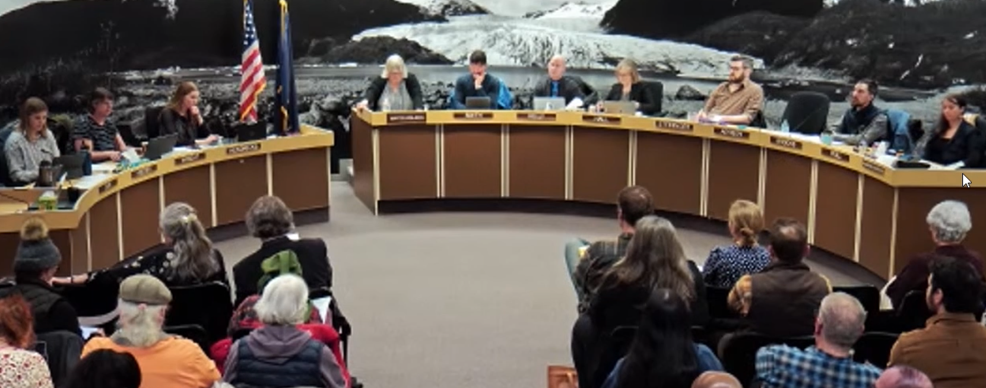
NOTN- Packed public testimony at a Juneau Assembly meeting Monday showcased public tensions over the city’s budget, flooding, and looming cuts.
The public comment period stretched nearly 2 hours before the assembly could continue its regular agenda.
While much of the evenings testimony focused on budget pressures and big upcoming projects, one resident voiced their gratitude to the assembly for holding public comment saying, “I wanted to take the opportunity to say thank you to the assembly and to say that, you look at any scale of global events, down to national events, down to local events, there’s a lot to be fearful of and a lot to be anxious about. That being said, it’s too easy to displace that on, what you can yell at your local assembly.” Testifiers said social media can further exacerbate tensions, “Huge thanks to you guys, I know you have tons of stuff on your plate, and I know that it seems like you can’t catch a break, because I feel like, if it’s not one thing, it’s another.”
Multiple residents demanded the city halt or delay demolition of historic homes on city owned Telephone Hill, which the city hopes to redevelop for potentially, over 150 housing units.
“The CBJ is facing a $10 to $12 million budget shortfall. This will affect everyone in Juneau. It doesn’t make sense to spend $5.5 million on the discretionary demolition of Telephone Hill when there are so many pressing municipal needs.” Said Maureen Conerton, “Many Juneau residents have valid concerns and have testified against this project. including a former administrator, judge, an architect, a retired project manager, in addition to the more than 1000 Juneau residents who signed the Stop the Bulldozers Petition that was presented to you last fall.”
Juneau currently has a housing shortage. In an assembly meeting at the end of February, Finance Chair Christine Woll noted that demand is sure to rise with the arrival of Coast Guard personnel in the coming years.
Some speakers said they support building more housing in Juneau, especially downtown, but oppose the current Telephone Hill plan.
Others voiced concern for escalating cost estimates for the gondola project at Eaglecrest Ski Area, saying the price has ballooned far beyond early figures.
“I disagree with what’s been said about social media, I mean, that is the way a lot of people on short notice communicate.” Said Shannan Greene, she mentioned comments in articles by KTOO and the Juneau Independent and encouraged the Assembly to view them as public testimony as well, “This is an example of informal but honest public testimony from your everyday citizens. These are the people who are growing increasingly frustrated with your decisions.”
Residents spoke on flooding in the Mendenhall Valley and said the city has been too slow to address recurring flooding and erosion.
“Residents in the valley are left dealing with flooding, higher costs and the feeling that our concerns are always pushed down the list.” Said Amy Miller, “It isn’t frustrating, it’s driving people away. I’ll be honest with you, myself and many of my friends and neighbors are actively planning to leave Juneau as soon as we can, not because we don’t love this community we do, but because we no longer feel like the city is working for the people who live here, if the city continues to treat the valley’s flooding as a problem to study instead of a problem to solve.”
The Army Corps of Engineers recently, and without explicit reason, pulled back from pursuing the Lake Tap enduring solution, which had its own federal timeline.
The project was endorsed by Tlingit and Haida, the USDA Forest Service and Alaska’s Delegation, city leaders have been ‘Deeply concerned’ about the Army Corp’s shift in priorities.
City Manager Katie Koester said new federal discussions later this month could reshape the city’s strategy.
“We are very much committed to an enduring solution and committed to working on developing and furthering the lake tap.” She said, “We have received great news that Secretary Adam Telle and a large delegation of his high up staff will be traveling to Juneau at the end of this month, and as part of that, we anticipate new information and new strategy.”
Assembly Member Alicia Hughes-Skandijs said because Assembly rules limit speakers to two minutes and do not allow any back-and-forth, some of the most productive conversations happen informally. “You pour out your heart for two minutes, which is a very short time, or you’re trying to identify to someone you’re upset. When we’re in that process, we can ask clarifying questions, but we don’t engage. So the best follow up steps are the conversations that happen in the room, in between, on the breaks, things like that. So I was able to get some contact information and follow up with some folks and I think that happens pretty commonly, that it’s those one on one interactions.”
Concern also came from social service providers, who said potential cuts of up to 30% to city‑supported grants would shrink or shutter essential programs.
Leaders from the Southeast Alaska Food Bank, school counseling programs, the Glory Hall shelter and housing project, youth and senior services, mental health organizations and Alaska Legal Services all reported record demand and rising costs.
“I want to first off, take this opportunity to thank the assembly for the investment that they have made in our organization over the last couple of years. But with that in mind, I want remind you all that we work as social service organizations, many of which are present in the room tonight in partnership with the city. And we’re concerned to hear that the assembly is considering a reduction of investment in the social services block grant, what that would amount to is a reduction in services.” Said Dan Parks, speaking for the Southeast Alaska Food Bank, “I can only speak for our organization, but demand is at record highs. A couple of years ago, when I started with the food bank, we were serving about 300 individuals a week. Now we’re serving about 500 through our public pantry. We’re seeing more and more people slip from what used to be called the middle class into poverty. We also know that hunger doesn’t exist in a vacuum. It’s an indicator, a canary in the coal mine, if you will, of other social ills.”
They told the Assembly that fewer local dollars would mean fewer meals, beds, and legal and mental health services, pushing more people toward homelessness, emergency rooms and law enforcement.
Hughes-Skandijs said the Assembly welcomes the surge in civic participation, even when emotions run high.
“We welcome, public engagement. We always want more of that.” She said, “We want people to come and talk to their local officials, and we want to know how people are feeling. A room charged with emotion is sometimes going to be because there’s just so much happening. If someone’s brave enough, and we want them to be brave enough,this is where they should be. It’s their local government. And so we want them to get involved.”
This article has been edited to correct the spelling of Shannan Greene’s name and to adjust misleading language on Social Media in early testimony.