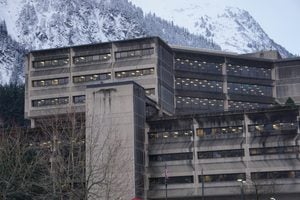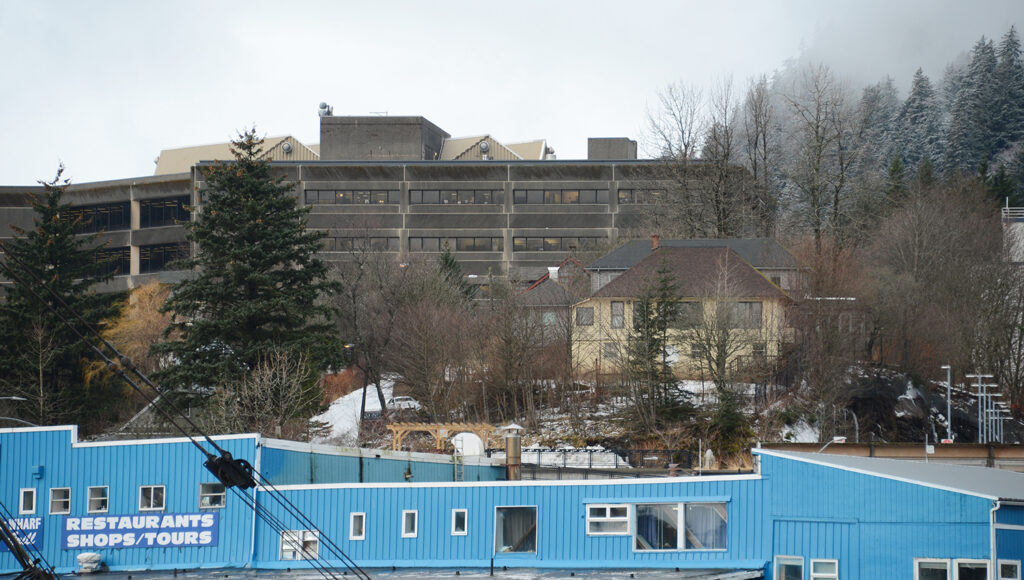
NOTN- Juneau’s Assembly narrowly rejected a plan during last night’s Committee of the Whole work session, to carve up the city-owned Telephone Hill property and sell most of it “as is,” choosing instead to stay the course for the time being.
“So spending time with all of you, a lot lately with the budget, and spending a lot of time in the office with budget stuff and the flood coming upon us, and an election coming upon us, I think it’s nice to get Telephone Hill off our plate.” Mayor Beth Weldon said, “However, my main reason for doing this is just the public outcry not to spend any more money on Telephone Hill.”
On a 5–4 vote last night, members voted down Weldon’s proposal to divide Telephone Hill into three lots, reserve one for potential Coast Guard or workforce housing, and sell the other two with existing homes still standing.
The draft plan envisioned minimum bids of about $1 million and $2 million for the properties.
Members argued the change would undercut years of planning for higher-density housing in the downtown core at a time when the city faces a severe housing shortage and an influx of Coast Guard families. Several members said splitting up the property now could limit the city’s ability to pursue a cohesive, larger-scale project.
“I object to this. It’s funny, I object to this on so many levels that it’s hard to know where to start.” Said Assembly member Alicia Hughes-Skandijs,”I don’t want to put words in your mouth, but my read on the motion that passed at the last meeting was to bring this back and talk about, where are we going? Do we still feel good? How are we going to get there? And then we have this from the mayor, I will say crazy idea with love, I wouldn’t say that to anyone else. I don’t understand at the heart of this, the sponsor statement is that this is about not spending any more funding on this project, this seems to try to care for other issues, which is to leave some of that land back to where it might not turn into what our current plans are for it. It does preserve a small amount for our housing goals, but even that, I don’t see how that coincides with the goal of not spending any more money. I don’t see this, if that is indeed your intended goal, as the best way to move forward with that.”
In a separate 5–4 vote, the Assembly agreed not to award a roughly $2.3 million demolition contract until after it sees responses to a Request for Qualifications from potential developers, expected later this year.
“I understand and see where the mayor is trying to go.” Said Deputy Mayor Greg Smith, “This has been a challenge for us. I have an idea, I would move, or someone else could move, to not award the bill to demolish until after the results of the RFQ have been returned, to see what people think and hear and, you know, get real proposals on how to develop this, see what can be done. There is uncertainty now that will provide more, getting the RFQ back, because this could be a transformative project for downtown and for our housing crisis.”
The city is also defending a lawsuit filed by several Assembly members seeking to halt demolition; a jury trial is set for August, though no court order currently blocks the work.