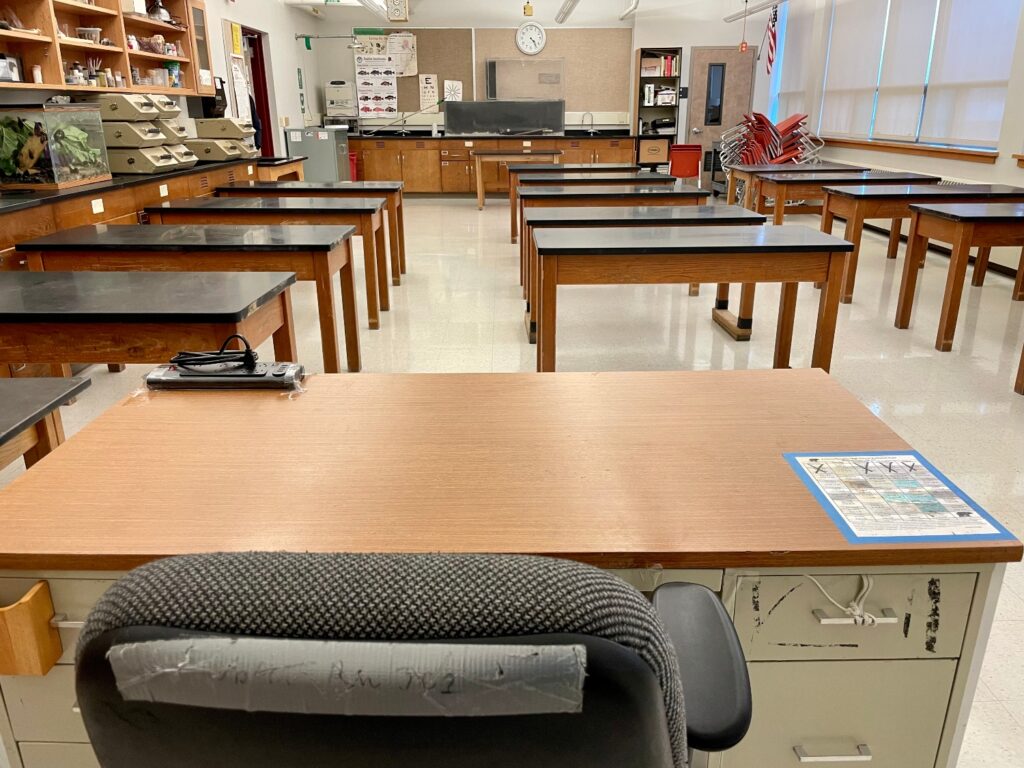
An empty classroom at Juneau-Douglas High School: Yadaa.at Kalé in Juneau, Alaska (Photo by Lisa Phu/Alaska Beacon)
A professor at Furman University told the Alaska Legislature Task Force on Education Funding Wednesday afternoon that standardized test results might not be the most appropriate set of data on which to base education policy decisions.
During a routine presentation on the National Assessment of Educational Progress, known as the Nation’s Report Card, Paul Thomas backed a principle that legislators should not make decisions about students and schools based on a single standardized test.
“The key to understanding test data in Alaska is the information on poverty,” Thomas said.
Alaska’s NAEP scores of fourth- and eighth- grade Alaskans ranked lower than the national public in mathematics and reading in 2024. According to the Nation’s Report Card, approximately 69% of students performing below the 25th percentile are economically disadvantaged while economically disadvantaged students make up 48% of Alaskan students.
“Education policy and socioeconomic policy are really strongly connected,” Thomas said. “Test scores are a reflection of the socioeconomic status of the students.”
State education officials led legislators through a practice test of the Alaska System of Academic Readiness, commonly referred to as the AK STAR. Each fall, winter, and spring, Alaskan students in grades 3-9 take the MAP Growth assessment and each spring, Alaskan students take the AK STAR.
Kelly Melin, who works for the Department of Education and Early Development’s Assessments and Standards Administration, said the state’s standardized tests are designed to satisfy federal requirements set forth in the Every Student Succeeds Act.
“We’ve taken the power of an interim assessment and the need for a summative assessment as was dictated through ESSA and connected those to come up with what we have as AK STAR,” Melin said.
Kelly Manning, the department’s Director of Innovation and Education Excellence, said that the purpose of assessments is to measure the state’s ability to close the achievement gap and measure students’ ability to read at grade level by the third grade.
Statewide, about 33% of students tested at or above grade level expectations in language arts and 32% in math in 2025. Students in ninth grade demonstrated the greatest need for support in language arts and math.
The esting window for Alaska students closes on May 1. AK STAR results will be available to school districts in July and statewide in the fall.
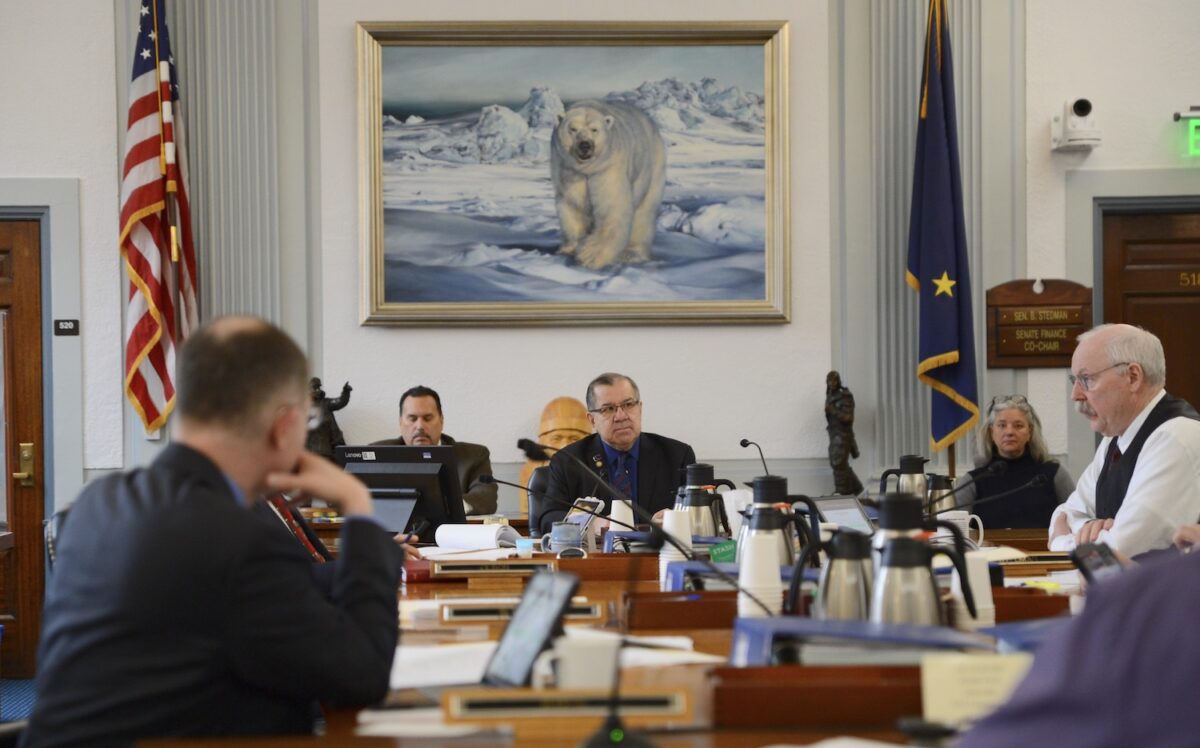
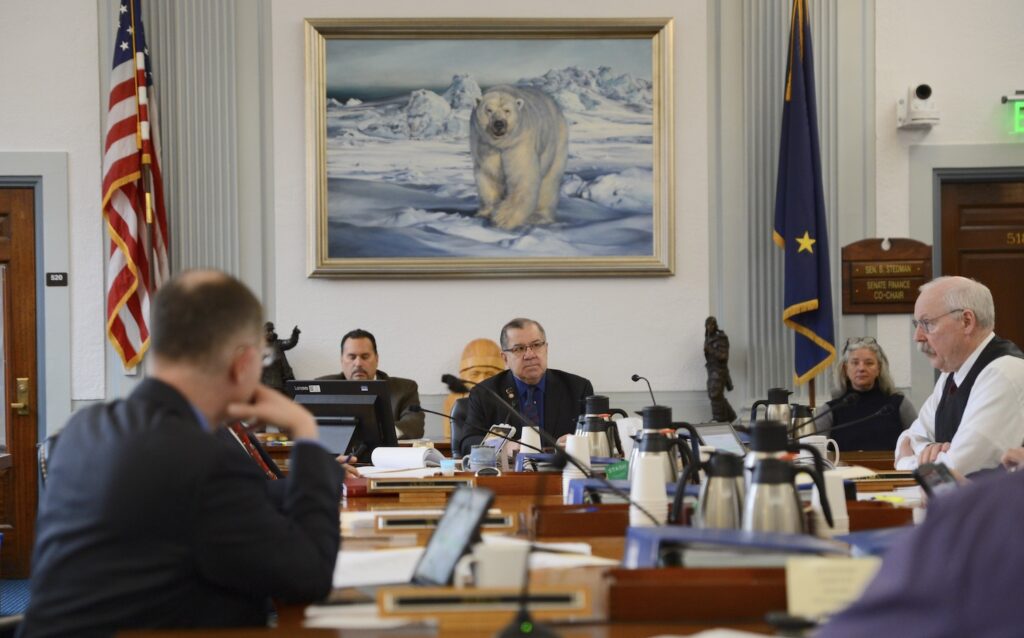
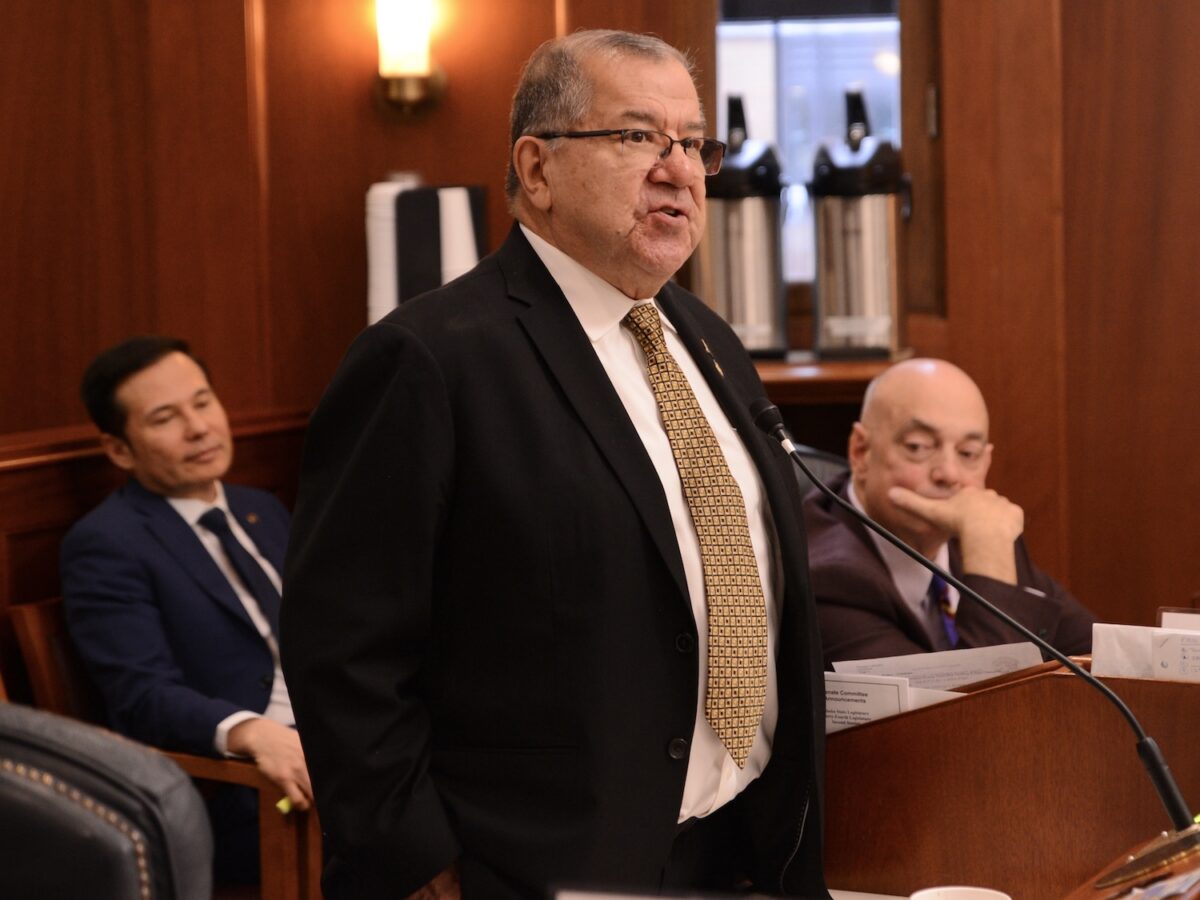
Sen. Lyman Hoffman, D-Bethel, is seen in the Senate Finance Committee on Tuesday, April 25, 2023. A co-chair of the Senate Finance Committee, Hoffman is in charge of the state's capital budget. (Photo by James Brooks/Alaska Beacon)
By: Corinne Smith, Alaska Beacon
Sen. Lyman Hoffman, D-Bethel, is seen in the Senate Finance Committee on Tuesday, April 25, 2023. A co-chair of the Senate Finance Committee, Hoffman is in charge of the state’s capital budget. (Photo by James Brooks/Alaska Beacon)
The Alaska Senate Finance committee advanced a draft capital budget on Tuesday that would put nearly $250 million toward state facilities and maintenance projects next year.
The draft budget adds $88 million to Gov. Mike Dunleavy’s proposed capital budget of $159 million, with the largest additions going toward K-12 schools and university facilities maintenance.
That was a focused effort by the finance committee, said co-chair Sen. Bert Stedman, R-Sitka, who called funding for education facilities maintenance a “heavy concentration” on Wednesday.
Earlier this year, students and school officials testified to lawmakers that decades of deferred maintenance has reached crisis levels — with many rural school districts in particular grappling with deteriorating facilities, failing water and sewer systems — which they say is degrading student and staff morale. Lawmakers have expressed support and increased funding in recent years, but point to Gov. Mike Dunleavy’s history of vetoes as a roadblock for funding education.
The Senate draft includes $57.8 million in additional funding toward K-12 school maintenance through the Alaska Department of Education and Early Development and $17 million toward the University of Alaska. It also includes $5.7 million for the Alaska Court System’s facilities and $8 million for community infrastructure and workforce development programs through the Alaska Department of Commerce, Community, and Economic Development.
The Legislature relies on state ranked lists to prioritize where to direct funding to capital projects for K-12 schools, the university system and the court system.
For K-12 schools, the state’s current major maintenance list totals over $400 million needed for 103 school projects and repairs. Stedman said he recognized this year’s capital budget will only fund a fraction of those.
“Hopefully we get a quarter of it done, or something like that, but it’d be nice to retire the entire list,” Stedman said.
The draft budget would fund the top 15 school projects on the list, plus funds for three other schools in need of emergency fuel tank repairs. The top projects range from roof and boiler replacements to septic systems, fire suppression and safety upgrades in schools from Fairbanks to the Aleutian Islands.
In order to distribute funds more widely, members of the finance committee reduced funding for one project in Galena, in the Western Interior of Alaska, from roughly $35 million to $5 million for renovations to the Sydney C. Huntington Elementary and High Schools. They also allocated $17 million towards rebuilding the school in Stebbins in Western Alaska, after it burned down in 2024.
Mt. Edgecumbe High School student housing in Sitka is seen on Oct. 6, 2025. (Photo by Corinne Smith/Alaska Beacon)
The Senate draft also adds nearly $14 million in funding for the state-run Mt. Edgecumbe High School, which has been the focus of public attention and concern after a quarter of students disenrolled this year. The additional facilities dollars include $10 million to remodel the dining hall, $3.1 million to replace dorm windows, $460,000 to replace dorm furniture, $50,000 to replace mattresses and $125,000 to replace aging laundry machines.
Finance members added $17 million to fund the top nine projects across the University of Alaska system — three projects each within the three major campuses.
Sen. Jesse Kiehl, D-Juneau, serves on the finance committee and his district includes University of Alaska Southeast. He described the proposed funds as a “nickel” compared to the “colossal” deferred maintenance needs of the university system.
“That’s been built by Legislatures and Boards of Regents for 40 years,” he said on Wednesday, adding that it is a shared responsibility to put funding towards repairs and upgrades.
“The Constitution makes them a separate body within the executive branch that puts a lot of responsibility on them, too, more than the general state government,” he said “So university major maintenance is its own huge problem.”
The draft budget also includes $5.7 million for upgrades to state court facilities, mostly targeted to Anchorage and Sitka. It contains nearly $10 million for workforce development programs geared at the construction and oil and gas sectors, including for the Fairbanks Pipeline Training Center and Alaska Vocational Technical Center in Seward.
An amendment to add $25 million to the draft budget for the Port of Anchorage, sponsored by Sen. Kelly Merrick, R-Eagle River, was voted down on Tuesday by a 5 to 2 vote.
Before voting against the proposal, finance co-chair Sen. Lyman Hoffman, D-Bethel, said during committee deliberations the priority this year is to fund as many school maintenance projects on the list as possible, saying “schools are falling apart” and must be maintained to prevent further deterioration.
“Students that are trying to learn deserve better,” Hoffman said. “And if we are not able to provide this major maintenance, we are going to see these schools continue to crumble, and the financial burden to the state of Alaska will be hundreds of millions of dollars to rebuild schools.”
More funding for school maintenance and other capital projects could be added by the Alaska House of Representatives, who will take up the draft budget bill after it’s approved by the Senate in the coming weeks.
Alaska Gov. Mike Dunleavy speaks to reporters on Thursday, April 17, 2025, with Deena Bishop, commissioner of the Alaska Department of Education and Early Development, looking on in the background. (Photo by James Brooks/Alaska Beacon)
By: Corinne Smith, Alaska Beacon
Alaska Gov. Mike Dunleavy speaks to reporters on Thursday, April 17, 2025. (Photo by James Brooks/Alaska Beacon)
Gov. Mike Dunleavy signed off on a supplemental budget bill that authorizes nearly $450 million in additional state spending this year.
The budget bill covers additional costs incurred by the state this fiscal year ending in June, including funds for disaster relief, education, corrections and transportation.
The bill was approved by the Alaska State Legislature two weeks ago. Dunleavy signed the budget on Apr. 2, and transmitted it back to the Legislature on Thursday.
“I appreciate the Legislature’s support of these proposals,” Dunleavy said in a letter announcing his signature on the bill. “The supplemental budget I have signed into law today enables the State to meet current fiscal year responsibilities and represents prudent and fiscally responsible investments in emergency and fire response, public safety and statewide transportation needs.”
The budget includes $75 million for disaster relief to address the response to the Western Alaska storms last fall, and nearly $100 million for fire suppression, particularly in Interior Alaska. It includes $20 million for the Alaska Department of Corrections overtime expenses, as well as $70 million in time-sensitive funding for transportation — sought by the construction industry to unlock a federal match of $630 million for state construction projects.
It also includes $130 million for the Alaska Higher Education Fund which provides grants and scholarships for students, as well as $34.4 million for Medicaid and $12.8 million for other public assistance programs through the Alaska Department of Health.
The governor’s office submitted an additional $11.6 million request, but it was submitted too late to include in the budget bill, and will be rolled into the proposal for next year’s budget.
Additionally, the state is waiting on an appeal decision after failing a federal disparity test for education funding, and could potentially be liable for $72 million in K-12 funding for next year, according to officials with the Legislative Finance Division.
Oil revenues still uncertain
In the Legislature, the bill was delayed this year amid ongoing debate in the House of Representatives on whether to pay for the larger than usual budget bill out of state savings — an act that requires the approval of three-quarters of legislators.
Members of the House Republican minority caucus objected to spending from a state savings account, the Constitutional Budget Reserve. After the Alaska Department of Revenue projected the state would see an additional $500 million in oil revenue due to a surge in oil prices driven by the Iran war, they argued the state would not need to pull from savings to pay its bills.
Members of the multipartisan House majority caucus objected to the uncertainty of revenue forecasts and future oil prices, and argued for a draw from state savings to fund the budget bill immediately.
If oil-driven state revenues from now until the end of the fiscal year are not sufficient to cover the $450 million supplemental budget, then lawmakers agreed to draw from state savings. That means oil prices must average approximately $82 per barrel of oil through June for state revenue to cover spending, according to officials with the Legislative Finance Division.
House Speaker Rep. Bryce Edgmon, I-Dillingham, was among legislators who supported the draw from savings several weeks ago, instead of banking on uncertain future oil revenues. On Friday, he said it seems revenues will cover the budget bill.
“As appears now, oil prices are continuing to move in an upward trajectory, which means that the bill at the very end could be fully funded,” Edgmon said. “But there’s still a fair amount of time in front of us for oil prices to, you know, continue to be volatile.”
Edgmon said barring a dive in oil prices, he doesn’t expect another vote on drawing from the state savings this session.
“That’s pending a dramatic drop in oil prices, of course, which doesn’t seem to be on the horizon.”
NOTN- An Alaska Senate committee on Wednesday advanced a resolution backing federal visa programs that lawmakers say are critical to the state’s seasonal workforce and public schools.
Senate Joint Resolution 28, heard in the Senate Labor and Commerce Committee, puts the Alaska Legislature on record in support of the J-1 and H-1B visa programs and urges the state’s congressional delegation to work with federal policymakers to preserve and strengthen them.
A similar resolution was heard in the Senate Education committee Wednesday as well, in support of H-1B international educators.
“Senate Joint Resolution 28 very simply, recognizes the important role that visa programs such as the J1 visa program, and the H-1B program, play to the economy and the education of children and young adults across Alaska.” Said legislative aide Mike Mason, “These international visa workers are vital to filling Alaska’s diverse workforce needs. If you travel around Alaska, especially this summer, you are going to see these visa workers filling very important jobs across the state. This resolution simply puts the Alaska legislature on record as supporting these visa programs.”
The measure also objects to a steep federal fee increase on certain H-1B petitions, from $5,000 to $100,000, which supporters say has effectively shut Alaska’s public schools out of the program.
“That fee effectively ended most employers ability to fill these open jobs through this program.” Mason said.
Lawmakers adopted an amendment, to explicitly include H-2B visas, which cover temporary nonagricultural workers.
Public testimony on the resolution was brief but supportive.
Jonathan Schaffer said his experience working with J-1 participants in seasonal jobs across the country showed clear benefits for both employers and workers.
“Having worked in seasonal employment across the United States with a number of J-1 enrollees, I can say that the program, in my opinion, benefits both employers and those enrolled in it. It is remarkable the opportunities that are provided for people in small communities to learn about the world around them from the people who travel there to serve visitors, who travel from all over the place. It is remarkable the benefit that those who enroll in the J-1 program have in gaining a more positive view of the United States, which they take back to their communities around the world.”
The committee voted without objection to move the resolution.
It now heads to further consideration in the Legislature.
Lisa Parady (left) director of the Alaska Council of School Administrators and Katie Parrot (right) president of the Alaska Association of School Business Officials testify to a joint session of the House and Senate Education Committees on Mar. 30, 2026. (Photo by Corinne Smith/Alaska Beacon)
Alaska superintendents, principals and school officials delivered sobering testimony to lawmakers at the Alaska State Capitol last week. They painted a picture of schools struggling to continue to support teachers and students amid budget shortfalls, cuts to programs, teacher shortages, rising costs and increased facility maintenance needs.
Lisa Parady, director of the Alaska Council of School Administrators, the non-profit advocacy and leadership organization that organized the annual fly-in event, said the group is concerned for all the state’s children.
“There’s no room for division,” she said, noting that there are often divides between the needs of urban and rural districts, or districts that are on the road system versus off the road system. “All those need to fall to the wayside when we’re talking about the best interest for our children in Alaska.”
School officials from across the state addressed a joint session of the House and Senate Education Committees on Mar. 30, and presented lawmakers with a list of legislative priorities and challenges for Alaska’s 53 districts and roughly 130,000 students.
Despite a historic raise in per student funding, known as the base student allocation, last year, officials say state funding still does not meet districts’ needs to hire and retain teachers, provide services and programs to students and keep up with maintaining aging school facilities.
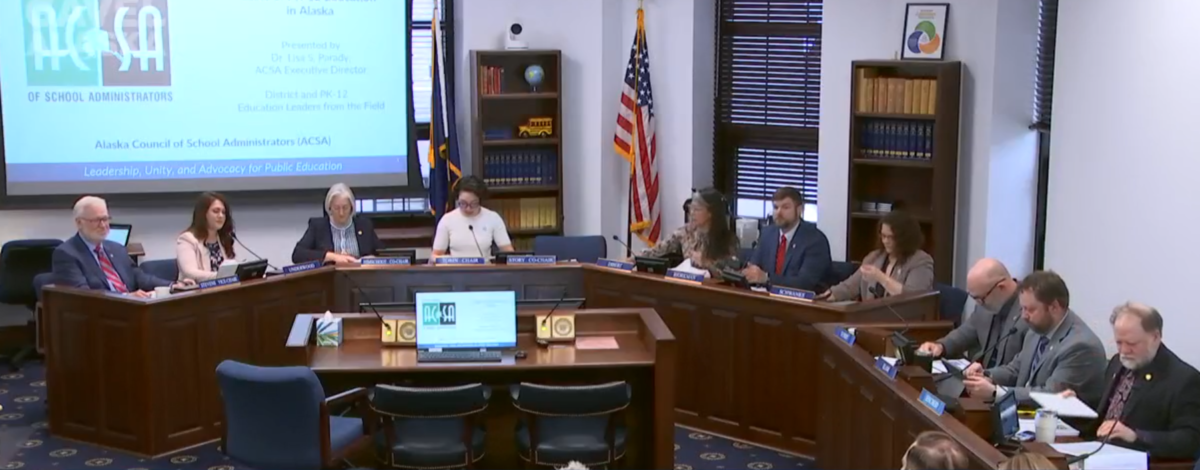
To match the pace of inflation since 2011, school administrators say it would require the state to increase funding by $1,283 to the BSA or $7,983 per student. (Screenshot of presentation by the Alaska Council of School Administrators)
To match the pace of inflation since 2011, school administrators said it would require the state to increase funding to the BSA by $1,283. Additionally, they highlighted student transportation costs have exceeded state funding by an estimated $65.5 million.
Several bills are currently being debated in the Legislature that would increase education funding, and a joint legislative task force on education funding is examining long term challenges with recommendations due in 2027.
High teacher turnover
School leaders’ presentation to lawmakers included research, data and testimony illustrating what the group described as converging crises faced by Alaska schools: teacher shortages, insufficient state funding and budget shortfalls and a growing number of students with disabilities needing special education services.
David Nogg, principal of Goldenview Middle School in Anchorage, highlighted how teacher shortages impact student achievement there.
“High teacher turnover is directly correlated with poor student achievement, and our children are suffering, unfortunately,” said Nogg, who is also president of the Alaska Association of Secondary School Principals, housed within ACSA.
Alaska teacher and principal turnover rates were high across urban and rural and remote districts in 2024, according to data from the the University of Alaska Anchorage Institute of Social and Economic Research. (Screenshot from presentation from the Alaska Council of School Administrators)
While teacher turnover has been historically high in rural and remote districts, teacher turnover was 30% in urban districts as well, according to 2024 data from the University of Alaska Anchorage’s Institute of Social and Economic Research.
Nogg pointed to ISER research that found that in the five districts with the lowest teacher turnover, average student proficiency in reading was roughly 85%, while among the five districts with the highest teacher turnover, the average number of students with reading proficiency was roughly 47%.
“An urgent response is needed to address the dire vacancy rates and the need for in-person educators and support personnel across Alaskan schools,” Nogg said.
Lisa Parady (left) director of the Alaska Council of School Administrators and David Nogg (right) principal of Goldenview Middle School in Anchorage testify to the teacher shortage impacting student performance to a joint session of the House and Senate Education Committees on Mar. 30, 2026. (Photo by Corinne Smith/Alaska Beacon)
Researchers estimated the average cost of teacher turnover was $27,000 per teacher, and approximately $75,000 per principal.
“Only one out of every four principals are in the same building after five years,” he said. “This high turnover rate of building principals is costly in dollars, time, relationships and most importantly, the impact on student learning.”
Nogg said his list of responsibilities has grown from managing students, staff and facilities to include additional duties like standing in as school nurse, an experience shared by principals across the state. He said many teachers and school leaders are stretched so thin they’re leaving the state.
According to a survey by ACSA of teachers on their reasons for leaving in Alaska, the No. 1 reason cited was the lack of a defined benefit retirement plan, followed by better job opportunities in other states, high cost of living in Alaska, and uncertainty of education funding.
The group said legislative action to establish and fund a public pension system, with competitive salary and benefits for educators would help retain teachers.
In the meantime, ACSA has created several programs to help districts, teachers and staff with training, professional development and mentorship throughout the state, including the Alaska Staff Development Network and the Alaska School Leadership Academy.
The Alaska Educator Recruitment and Retention Center, also a division of the ACSA, is continuing efforts to support hiring and retention of teachers, said director Jennifer Schmitz, like hosting in-person and virtual job fairs, and marketing campaigns. But there are serious challenges.
Lisa Parady (left) director of the Alaska Council of School Administrators and Jennifer Schmitz (right) director of the Alaska Educator Recruitment and Retention Center testify to a joint session of the House and Senate Education Committees on Mar. 30, 2026. (Photo by Corinne Smith/Alaska Beacon)
“Those are big turnover numbers that we’re looking at,” Schmitz said. “We had 345 positions that were not filled on the first day of school this year.”
There are nearly 600 international teachers working across Alaska districts this year. But with a steep visa fee for the H-1B visa program levied by the Trump administration this year, as well as new restrictions on J-1 visa placements, many districts can’t hire more international teachers, Schmitz said. “So that’s really out of reach for us right now, so we’re working through that with our immigration attorney and helping support districts and finding even finding international teachers who are already in the country, and trying to get them to Alaska.”
Schmitz noted that many international teachers are hired for their expertise in special education.
A ‘vacancy tax’ for special education
The number of students in need of special education services is growing, and school districts are struggling to meet the demand, lawmakers heard.
Melissa Matthews, director of student services for the Bering Strait School District and president of Alaska Council of Administrators of Special Education, said districts are hiring contract staff for special education services, at higher costs, which she called a “vacancy tax.”
“We are spending more on work arounds, travel, contracted itinerant staff and temporary staffing than we would on a stable, permanent workforce across Alaska. Districts are doing everything they can to uphold the civil rights of students with disabilities, but we are stretched thin,” she said.
“We need the tools to move forward from simply surviving to truly educating, because an Alaskan student’s civil rights should never depend on whether a district can find a teacher or budget constraints,” she said.
There are nearly 200 vacant special education positions across the state, according to ASCA data, Matthews said.
“These are not optional roles. They are federally required,” she said. “Within the state, we are starting to see schools without a resident special education teacher at all, relying on itinerant staff who fly or commute between sites to supervise and train paraprofessionals who will be providing the specialized services to the student. This increases costs and stretches staff to their limits.”
“It is not a model designed for student success. It is a survival strategy,” she added.
Matthews said since 2021, in the years since the COVID-19 pandemic, ASCA data shows Alaska has seen a 14% increase in the number of students with disabilities, requiring special education services.
She said that districts have to shoulder the legal obligation to meet those students’ needs, which can require increased staff because certain students’ needs require one-on-one settings.
Matthews said districts are also seeing an increase in students entering kindergarten with developmental delays, and urged the state to invest in infant learning programs and early education services to help address those delays and reduce the intensity of special education services required in later years.
Lawmakers passed increased funding for infant learning programs last year, but it was vetoed by Gov. Mike Dunleavy.
‘Budget slasher in chief’
Randy Trani is the superintendent of the Matanuska-Susitna Borough School District, which is facing a projected $23 million budget deficit and planning to close three elementary schools this year. He emphasized the state’s obligation under the Alaska Constitution to fund public education and said districts need predictable funding so educators can focus on student achievement.
He urged lawmakers to increase funding for the BSA and for deferred maintenance of school facilities, where the current statewide backlog is estimated at $535 million.
He said managing turnover and dwindling budgets is taking a toll on superintendents — where they would be focused on academics and school improvements, he said they’re now focused on budget cuts.
“Instead of being the academic leader in chief, we’re now the budget slasher in chief,” he said.
Trani showed lawmakers a slide of Alaska superintendents’ responses to the question of what keeps them up at night. The top three responses were budgets, school facilities, staff capacity, and “wrapping up my current job and preparing for the next job.”
“What’s on our mind, collectively, is budget and money, and you don’t see anything here about academic achievement, and that crushes people. It crushes our leaders,” he said.
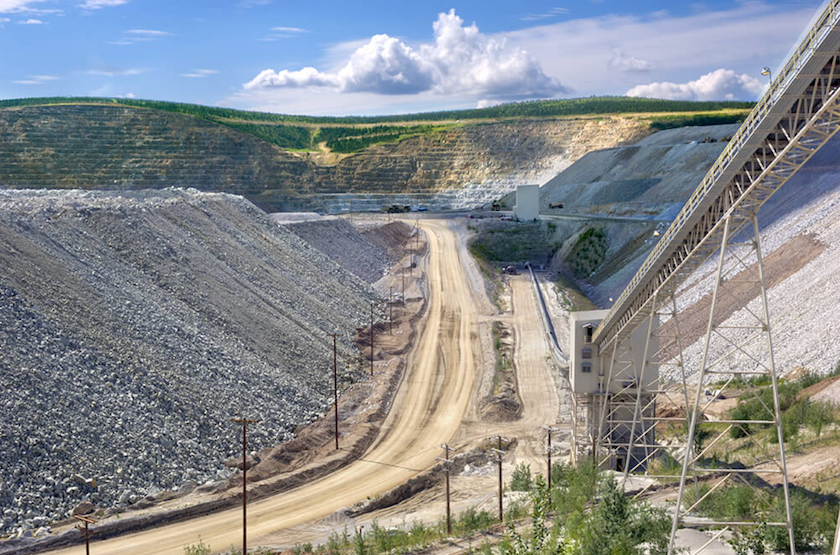
Kinross’s Fort Knox mine outside of Fairbanks in seen in this undated photo. Fort Knox produced 239,508 ounces of gold in 2024, according to the Alaska Department of Labor and Workforce Development, and it is one of the state’s six major mines. (Photo provided by Kinross Gold Corporation)
Metals mining has a prominent place in Alaska history. Today, it remains a prominent economic driver in the state.
Over the past decade, the metals mining sector has made up 3% to 4% of Alaska’s gross domestic product, and those mined metals rival Alaska seafood as top exports from the state, according to a state Department of Labor and Workforce Development analysis.
Metals such as zinc produced at the Red Dog mine in Northwest Alaska, silver produced by the Greens Creek Mine in Southeast Alaska and gold, lead and copper produced by various mines, now support an industry worth close to $3 billion a year, according to the analysis, published in the current issue of Alaska Economic Trends, the department’s monthly research magazine.
Alaska has six major metals mines, three of which produce more than one type of metal, and hundreds of small placer operations.
Among the mined products coming from Alaska is germanium, a byproduct of zinc that is classified as a critical mineral and used in electronics. In 2024, the Red Dog mine produced about 10 tons of germanium, according to the analysis, making it a critical source to the nation because China cut off deliveries of its germanium. That year, the Red Dog mine was the only U.S. mine producing germanium, though prior to 2023, a Tennessee mine was also producing the mineral, said Karinne Wiebold, the state economist who wrote the Alaska Economic Trends report.
Mining’s share of Alaska’s gross domestic product has grown considerably, as this graph shows. The graph includes values for metals mining and mining of coal, gravel and sand, but it does not include oil or gas production. Dollar figures are inflation-adjusted to 2024. (Graph provided by the Alaska Department of Labor and Workforce Development research and analysis section)
The value of Alaska’s mining sector, including coal, gravel and sand as well as metals, actually peaked in 2011 at nearly $3.5 million and close to 5% of the state’s gross domestic product. That peak reflected extremely high metals prices and the startup of the Kensington gold mine in Southeast Alaska.
Still, mining has been a strong economic factor in Alaska for the last two decades, after jumping in value in 2006. Every year since then, its total value to the state has generally been above $2 billion and usually accounted for 3% to 4% of Alaska’s gross domestic product.
Metals mining has also become a big employment driver as well, according to the analysis.
There were 3,533 metal mining and support jobs in Alaska in 2024, the most recent data available, and jobs in the sector grew by 37% over the past decade, compared to an overall state job growth rate of 0.3%, Wiebold’s analysis said.
The average metal mining job paid $135,000 in 2024, well above the state average of $71,000 that year and second only to the average pay for workers in the oil and gas sector, the analysis said.
But a large percentage of mine workers are not Alaska residents. Wiebold’s analysis puts resident hire at 56%. That puts the non-resident hire percentage in the metals mining sector well above the state average.
In 2024, the most recent year for which data is available, 22.9% of workers in the state were not Alaska residents, according to an annual report published by the Department of Labor and Workforce Development. That is the highest percentage since such records began in state average, which is the highest percentage since records started in the 1990s.
A visitor to the Donlin Gold mine site on June 23, 2025, touches core samples collected from exploration work. Donlin is one of the major Alaska projects that could be developed in the future. (Photo by Yereth Rosen/Alaska Beacon)
Wiebold noted that the nonresident hire in the mining sector is about the same as that in the oil and gas sector, which in 2024 was 40.5%, according to the state’s report.
Mining and oil and gas work in Alaska is conducive to nonresident employees because it is generally conducted at remote locations, typically with rotating schedules of two weeks on and two weeks off, she said.
“This combo means most folks don’t live near the mine and have to commute and stay at the worksite, and that there is not a significant time/cost/commute savings for living in the state,” she said by email. “As a result, miners from out of state can work in Alaska and live somewhere less expensive or more appealing to them.”
Another reason for the high percentage of nonresidents lies in Alaska’s demographics, she said. “In the last several years, with Alaska’s working age population fairly stagnant after a decade of significant declines, more jobs are being held by out of state workers,” she said.
The sector is poised for future growth, with projects like the Donlin gold mine in Southwestern Alaska, the Graphite One graphite mine in Northwestern Alaska and, potentially, the commercialization of the copper-rich but isolated Ambler Mining District in Northwestern Alaska.
But none of those proposed mines can be expected to be developed quickly, and development itself is uncertain, Wiebold’s article said.
“Mines take years to come to fruition — exploration, feasibility studies, environmental reviews, and permitting are expensive, and all have the potential to derail a project. Public concerns and controversy can also slow or stop development,” the article said.
One of the outdoor sculptures at the University of Alaska Anchorage campus is integrated into a fountain, pictured here on May 16, 2022. More than half of the University of Alaska system students attend UAA or one of its satellite campuses. (Photo by Yereth Rosen/Alaska Beacon)
University of Alaska staff announced a vote to form a union on Wednesday. The union would represent 2,300 permanent staff across the three universities and a dozen community campuses.
Staff voted to form the union Coalition of Alaska University Staff for Equity, or CAUSE, which would be part of the national United Auto Workers union, in a 1,106 to 610 vote, with 64% voting yes.
UA staff that would be represented by the union include student services staff, researchers, fiscal and administrative staff, development staff, science communicators, information systems specialists, library workers, athletics coaches and many others, according to a statement announcing the vote.
“Amid growing uncertainty around state and federal funding for the University, staff cited several reasons for forming a union: consistency and competitiveness in pay and benefits; greater transparency in promotion, career development, and retention; fair workload; and more,” the statement said.
“This is an exciting day for staff at UA,” said Mike DeLue, a researcher with the International Arctic Research Center at the University of Alaska Fairbanks, in the emailed statement.
“We did our research, discussed and debated, and overwhelmingly chose to unionize. As soon as the result is certified, we’re ready to sit down with the University and work constructively on addressing the issues that motivated us to form a union in the first place. Improving our working conditions will help us serve more students, enhance UA’s research capacity, and support Alaska communities,” he said.
The results of the union vote are expected to be certified on April 8, barring any objections or challenges filed by either of the parties, said Jonathon Taylor, director of UA public affairs, by email on Wednesday.
Taylor also cited financial uncertainty as one of the reasons the university opposed the union effort, which he said was communicated to employees ahead of the vote.
“The university opposed unionization because we believed it would reduce flexibility, slow decision-making, and limit our ability to respond to financial uncertainty,” he said. “That position was operational, not ideological.”
“UA respects the outcome and the right of staff to organize,” he said by email. “We’ll be bargaining in good faith with CAUSE-UAW in accordance with Alaska labor law.”
Taylor noted that existing wages and working conditions will remain in place while the contract is negotiated. He said initial contracts take roughly 400 days to negotiate. He said a 3% salary increase the university requested of the Alaska State Legislature in next year’s budget for all unionized and non-union staff will not apply to the new union members since they are in the process of forming the union and have not yet negotiated a new contract.
“Under Alaska labor law and case law, a contract with a bargaining unit must be in place for negotiated raises to be requested and approved by the legislature,” he said. Taylor said the issue was communicated to staff ahead of the union vote.
“Non-represented staff remain eligible for that increase,” he said.
But Charlie Banks, an organizer for the union effort and an academic advisor with the University of Alaska Anchorage, said Thursday that it is the university’s choice, and the new union members should be eligible.
“We believe that the university has the ability to issue the pay increases to us,” she said in a phone interview.
She said support for salary increases is also a show of support for retaining staff, which she says is a common goal of both the union and the university.
“We agree with university admins concerns about difficulties with recruitment and retention. One of the main reasons for this is that Alaska is not keeping up with its peers in maintaining competitive packages for workers,” she said. “Not surprisingly, our peer institutions that have staff unions have much stronger recruitment tools because their contracts are responsive to their needs.”
The new staff union follows the 2024 unionization of UA graduate workers to form the Alaska Graduate Workers Association within the United Auto Workers Local 1907. The union represents graduate teaching assistants, researchers and fellows. They bargained their first three-year contract within 96 days, which secured higher pay, an updated grievance process and a change from at-will to just-cause employment, according to reporting from the student-run newspaper The Northern Light.
The new staff union joins the national UAW union, which includes approximately 120,000 higher education workers across the country, including staff at the University of Washington and University of California.
Sen. Lyman Hoffman, D-Bethel, speaks during a joint session of the Alaska Legislature on Tuesday, March 10, 2026. (James Brooks photo/Alaska Beacon)
By: Sean Maguire, Alaska Beacon
Sen. Lyman Hoffman, D-Bethel, speaks during a joint session of the Alaska Legislature on Tuesday, March 10, 2026. (James Brooks photo/Alaska Beacon)
The Alaska Senate on Wednesday advanced a constitutional amendment that would establish a dedicated fund for public education.
If passed, lawmakers could design a new source of state revenue to go toward the fund that would be used specifically for schools. The resolution states that the Legislature could only appropriate money from the fund for public education.
The Alaska Constitution explicitly prohibits the dedication of funds in most cases. Supporters say that prohibition was intended to give the Legislature flexibility in budgeting, and avoid mandated funds.
Bethel Democratic Sen. Lyman Hoffman said before Wednesday’s vote that education is his No. 1 priority. A dedicated education fund could be a “tremendous tool” to improve schools in Alaska, he said. Hoffman co-chairs the Senate Finance Committee which sponsored the constitutional amendment.
The Legislature last year approved an historic increase in school funding through the state’s complex formula, overriding two separate vetoes by Republican Alaska Gov. Mike Dunleavy. Still, advocates say that substantially more school funding is needed with school districts facing sizable budget shortfalls and decades of deferred maintenance.
Two Alaska school districts in January sued the state, arguing that Alaska’s education funding levels violate a constitutional duty to fund schools adequately. School districts across Alaska have long complained about crumbling buildings that have reached crisis level.
Republican Sen. Bert Stedman represents Sitka, home of Mt. Edgecumbe High School, a state-run boarding school which has reported leaking roofs and buildings in disrepair. Stedman said Alaska is one of the nation’s richest states, but the condition of its schools is “kind of embarrassing.”
Surrounded by school children in the Senate’s public galleries, Stedman said that “we should be doing better for our kids.”
“Every generation needs to make a little step forward and this is our little step,” he said in support of the resolution before the final vote.
The Alaska Senate approved the resolution on a 17-3 vote. At least 14 of 20 senators are needed to support a constitutional amendment. Two-thirds of the Alaska House of Representatives would need to vote for the same resolution to put the proposal before voters at the November election.
All 14 members of the bipartisan Senate majority supported the constitutional amendment, alongside three minority Senate Republicans — Sens. Robert Yundt of Wasilla, Mike Cronk of Tok and James Kaufman of Anchorage.
Three minority Senate Republicans voted no: Sens. Robb Myers of North Pole, Cathy Tilton of Wasilla and George Rauscher of Sutton.
Myers said the drafters of the Alaska Constitution sought to block the proliferation of dedicated funds, which would consume the annual budget.
He said that establishing a dedicated fund for education “removed any sort of flexibility for the Legislature.” He said that avoiding annual debates about school funding was “not necessarily a good thing.” Education spending could effectively be “out of sight, out of mind,” he said.
Myers said the state has numerous other priorities such as health care and natural resource management, but they would not receive the same dedicated funds.
The resolution now advances to the House. If approved by 27 of 40 House members, it would then be placed before voters at the Nov. 3 election. A simple majority of voters is needed to approve an amendment to the Alaska Constitution.
A governor cannot block a constitutional amendment from appearing on the ballot with their veto pen. The Alaska Constitution was last amended in 2004.
Joint Education Committee Hearing, March 30 2026, courtesy of Gavel Alaska
Alaska education leaders told lawmakers Monday, that the state’s public schools are in a “crisis” due to rising vacancies, high teacher and principle turnover and growing student needs, all while enrollment declines.
Testifying before the joint education committee, meaning both the House and the Senate, superintendents, principals, special education directors and recruitment experts described the education system as strained by flat funding.
They stressed housing and visa barriers for teachers, and a growing share of students needing intensive support.
Jennifer Schmitz, director of the Alaska Educator Retention and Recruitment Center, said Alaska’s annual turnover has reached about 30% for teachers and 35% for principals.
“We are in a crisis time right now with teacher turnover and principal turnover,” Schmitz said.
Districts are also depending on hundreds of international teachers and emergency teaching certificates to staff classrooms.
In many districts, she said, international teachers have become deeply rooted in communities and students rely on them for stability.
But new federal visa costs and restrictions, including a potential $100,000 price tag for some H‑1B visas, threaten those positions, especially for rural schools.
“We are in an educational crisis, and we are doing harm to the children of Alaska. An urgent response is needed to address the dire vacancy rates and the need for in person educators and support personnel across Alaskan schools.” Said David Nogg, principle of Goldenview Middle school.
In a separate Senate Labor and Commerce Committee hearing, lawmakers heard similar testimony when discussing Senate Joint Resolution 28, warning that steep federal fee hikes and new placement limits on visa programs are not only worsening worker shortages in schools but tourism and other key industries across the state as well.
“Visa workers are vital to filling Alaska’s diverse workforce. Foreign worker visa programs are extremely useful for highly seasonal industries such as tourism. Alaska has the largest seasonal employment swing in the country, this is not a marginal fluctuation, it is a structural feature of our economy.” Said Mike Mason, legislative assistant to Senator Löki Tobin.
Education leaders also pointed the Base Student Allocation (BSA), saying, even after last year’s increase, inflation has eroded its value.
“All boats rise and fall on the same tide, and for Alaska school districts, that tide is the BSA,” Randy Trani, Superintendent of the Mat-Su district said, calling for “timely, reliable, predictable” funding so districts can plan and focus on academics instead of annual cuts.
School finance officials also stressed that most dollars already go directly to students and there are funding needs beyond the classroom that districts are struggling to meet.
Anchorage budget director and Alaska Association of School Business Officials president Katie Parrott said about 75% of districts’ operating spending in FY2025 went to instruction, while only 2% went to district-level administration and 5% to administrative support like payroll and HR.
“There are a lot of competing priorities eating into these slices of the pie.” She said, “It’s truly imperative that the state does increase and inflation proof funding for pupil transportation as one of the key strategies to address chronic absenteeism, make sure kids are getting to school that they have equitable access.”
Throughout the hearing, educators said they remain committed to students and to Alaska, but warned that constant uncertainty is pushing many out of the profession or out of the state, saying, “when you starve a system, you see the impacts of that.”
Photo Courtesy of UAS, from their Alaska Native Arts, Language and Studies program.
NOTN- The Central Council of the Tlingit & Haida Indian Tribes of Alaska and the University of Alaska Southeast are launching a collaborative effort to develop a School of Indigenous Studies in Southeast Alaska.
Leaders from both organizations signed a memorandum of understanding at the Andrew Hope Building in downtown Juneau this morning, marking what officials describe as an initial step toward building a new academic program grounded in Indigenous knowledge.
This is only the biggening of the collaboration.
The agreement signed, outlines a shared vision between Tlingit and Haida and UAS, of an education model that reflects Indigenous languages, traditions and values, that supports workforce development, research and economic opportunities.
“We are really excited to have a formal relationship with the tribe to create a school of Indigenous Studies at UAS.” Said UAS Chancellor Aparna Palmer, “This is one of the few times where a university has worked with a tribe to co-create a vision for this school, and the school is so important and transformative and amazing because it will honor the values of the tribe, while at the same time giving us a chance to bring together all of the disciplines that we already offer.”
As part of the effort, a working group, with representatives from both Tlingit & Haida and the university will be formed to develop a roadmap for the School of Indigenous Studies.
“We already offer classes on the language and the culture and the history of the indigenous peoples of Southeast Alaska, and now they will be housed at a school that is specific and integrated within UAS.”