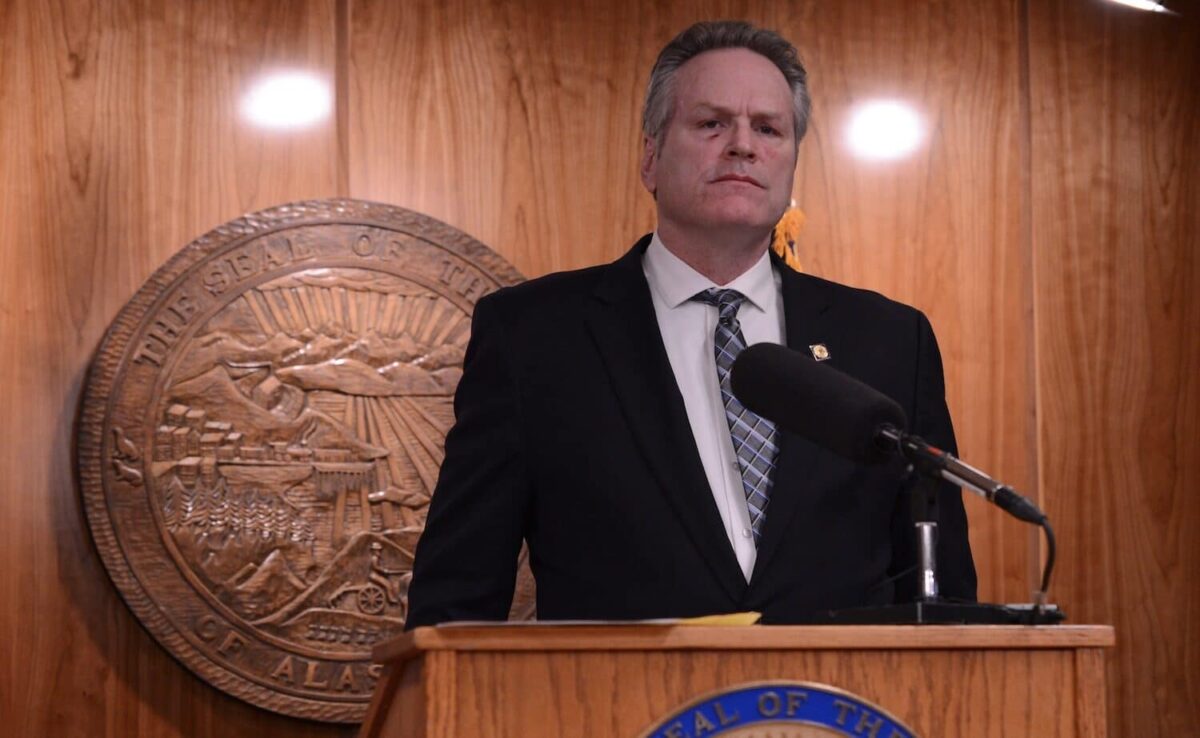
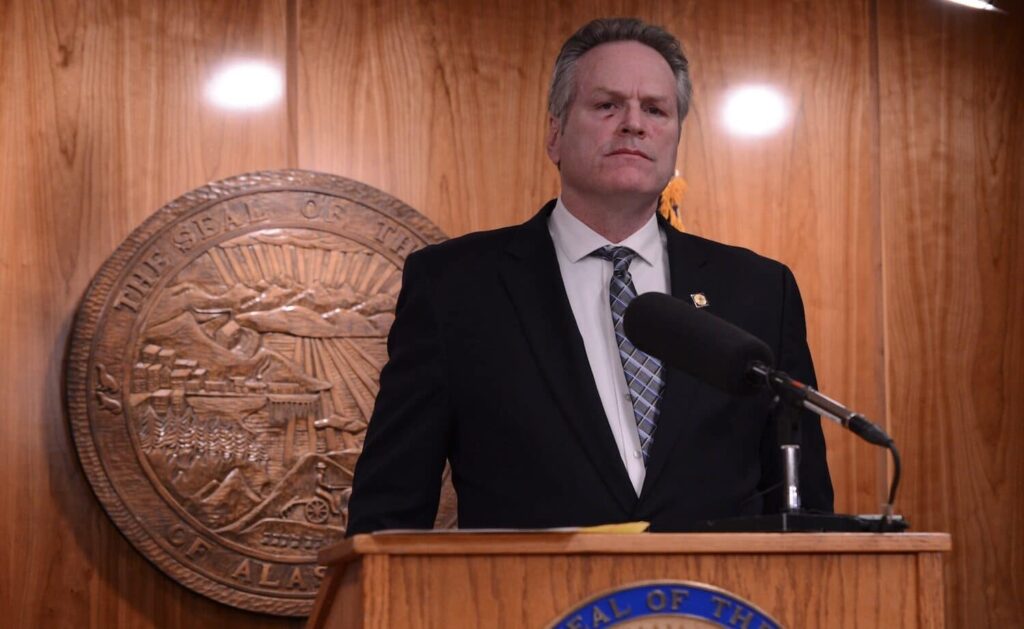
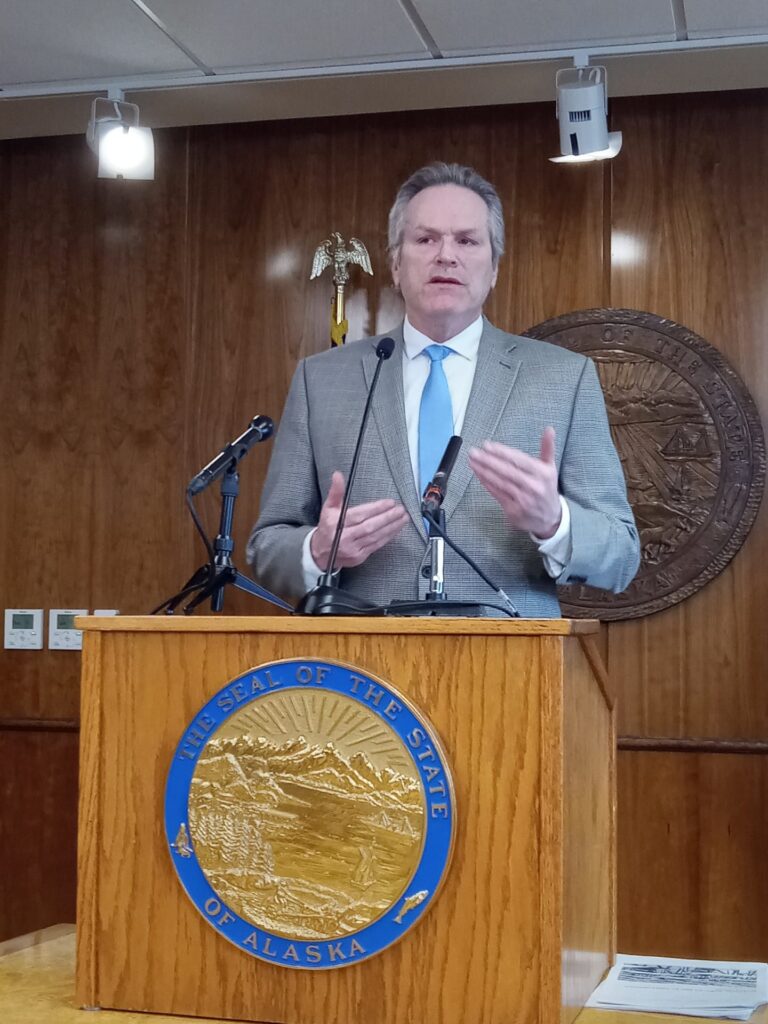
Alaska Gov. Mike Dunleavy talks to reporters during a news conference on Monday, May 19, 2025. (Photo by James Brooks/Alaska Beacon)
NOTN – Governor Mike Dunleavy is criticizing the Alaska Legislature for failing to take action on education reform, pointing out that the state remains last in the nation for student outcomes.
In a letter to legislators Friday, he emphasized that increasing funding won’t improve results without meaningful policy changes, and called on lawmakers to act immediately.
According to lawmakers who spoke with News of the North, Dunleavy has declined to call a second special session this year.
Dunleavy warned that if the legislature does not pass education reforms during the next regular session, he is prepared to call additional special sessions in 2026 until changes are made, stressing that each year of inaction affects an entire cohort of students.
NOTN- The Juneau School District Board of Education will hold a special meeting today, at noon via Zoom to consider a series of action items, from playground improvements to budget changes and contract approvals.
One of the key items up for a final vote is the acceptance of playground equipment donated by Juneau Rotary Clubs for the Dzantik’i Heeni campus. Rotary has secured $30,000 in funding to provide musical play elements for students at Montessori Borealis and the Juneau Community Charter School.
Volunteers have committed to installing the equipment this fall.
Also on the agenda is a first reading of a budget revision that would add universal free breakfast for all JSD students. The revision comes after an increase in state education funding, after the Base Student Allocation was restored to $700 per student.
The adjustment would provide an additional $1.5 million in revenue, allowing the district to potentially expand student meal programs.
The public can view the meeting online, and final adoption of the FY 2026 Budget Revision is expected at a subsequent board meeting.
Students begin their first day of school at the Tlingit Culture, Language and Literacy program at Harborview Elementary School in Juneau on Aug. 15, 2025 (Photo by Corinne Smith/Alaska Beacon)
The Alaska Legislature opened an 18-month study of the state’s troubled public education system on Tuesday as lawmakers convened the first meeting of their Task Force on Education Funding, established by law this spring.
Alaska’s public schools rank among the worst in the country according to national standardized testing data, and members of the bipartisan, bicameral task force have been charged with identifying ways to improve performance by changing the way schools are funded and manage their students.
Legislative leaders have said the task force will also have the opportunity to examine funding for schools and ways to address rising costs of transportation, utilities, insurance and maintenance.
Members of the task force will hold a series of hearings and discussions before drafting recommendations for new laws that legislators might implement. Those recommendations must be delivered before lawmakers arrive at the Alaska Capitol in January 2027.
Gov. Mike Dunleavy called legislators into a special session to address education issues, but lawmakers have ignored that call and are not planning to hold formal meetings before the special session ends at the end of the month. Legislative leaders have said they prefer to work through the task force instead.
Dunleavy is term-limited and will be out of office by the time the task force’s recommendations are complete.
“The current state of Alaska’s education is not where we’d like it to be, but I know that we can get to a better place if we all work together, we find common ground, and we build upon what we agree upon,” said Sen. Löki Tobin, D-Anchorage and co-chair of the task force.
But on Monday, it appeared that finding that common ground could be difficult, as task force participants identified different areas they prefer to focus upon.
“John Muir said that when we try to pick out anything by itself, we find it hitched to everything else in the universe. The same is true in education,” said Rep. Rebecca Himschoot, I-Sitka. If we take steps to improve teacher quality, that has an impact on the classroom. If we take steps to make sure kids are fed, that has an impact. If we take steps to make sure that we have the right ratios of teachers with students. All of these things have impacts.”
Rep. Justin Ruffridge, R-Soldotna, said he would like the task force to consider how it measures results. What standardized tests, if any, should be used to consider performance?
“I think accountability broadly is a place that I hope to go, and I hope that the (Alaska Department of Education and Early Development) can have some input on that,” he said.
Sen. Jesse Kiehl, D-Juneau, suggested that the task force should be “looking at how we empower local government” to deal with education decisions, while Sen. Mike Cronk, R-Tok, said he wants to make sure the task force is “focusing on policies like the READS Act,” which was a bipartisan bill intended to improve reading performance among younger students.
“We are seeing success in that, and those are the kind of policies we need,” he said.
This year, lawmakers voted to increase the base student allocation, core of the state’s per-pupil funding formula, but Ruffridge suggested that lawmakers need to examine other aspects of the formula to see whether they are delivering the intended results.
Alaska, for example, multiplies the base student allocation for students with “intensive needs” and those in rural Alaska.
“It’s a scary proposition to open up the foundation formula, but I think it’s something that we are really tasked with doing in this group,” he said, adding that the state has failed to properly maintain school facilities, particularly in rural Alaska.
Cronk, in prior comments, said he also is concerned about school maintenance. In most of Alaska, proper maintenance depends on funding from the state government.
“If we want to continue to have (stable) education funding, us as a collective group need to create a fiscal plan for this state,” he said.
“I’m hoping that if we’re talking about funding, that should be our goal as part of this, to make sure that we can come up with something so we do have a level funding for all the government services,” Cronk said.
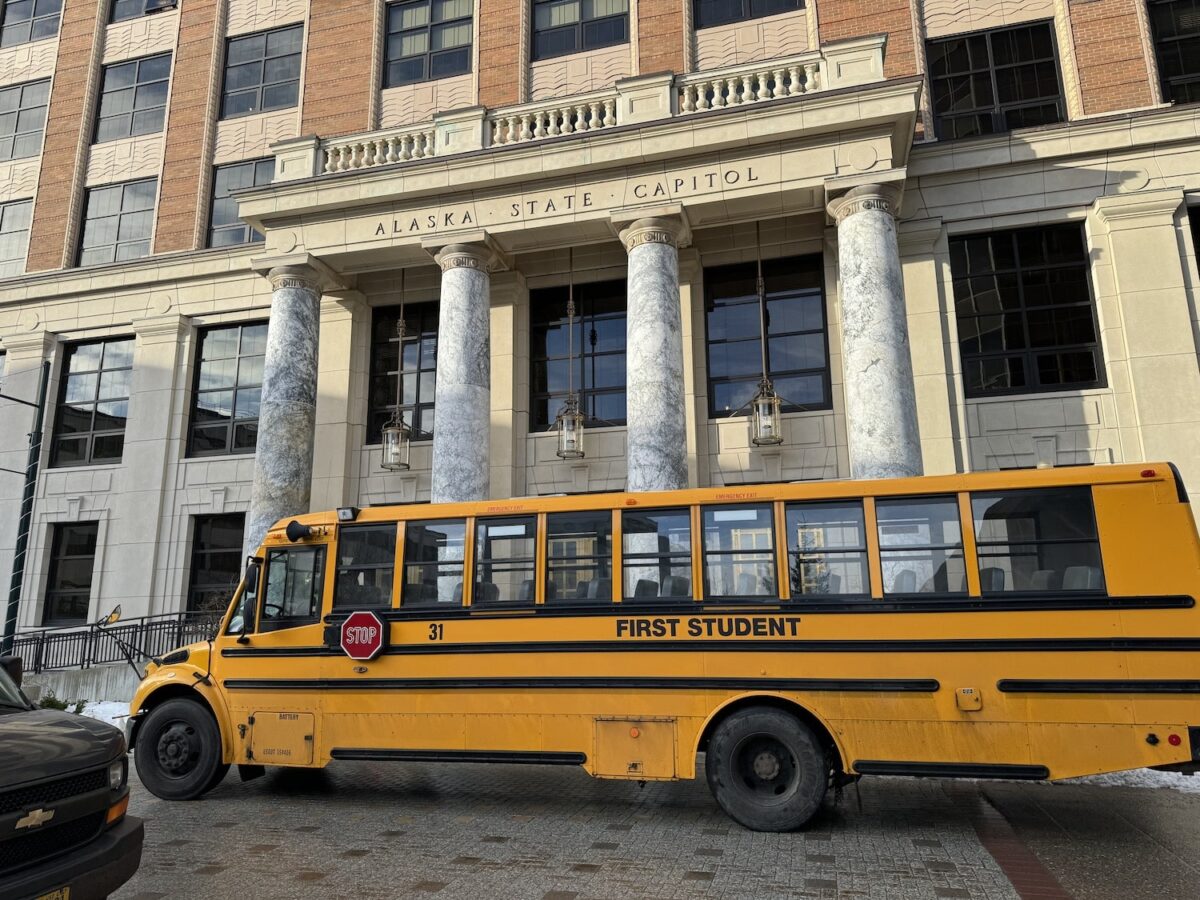
A school bus passes in front of the Alaska Capitol on Tuesday, Feb. 6, 2024. (Photo by James Brooks/Alaska Beacon)
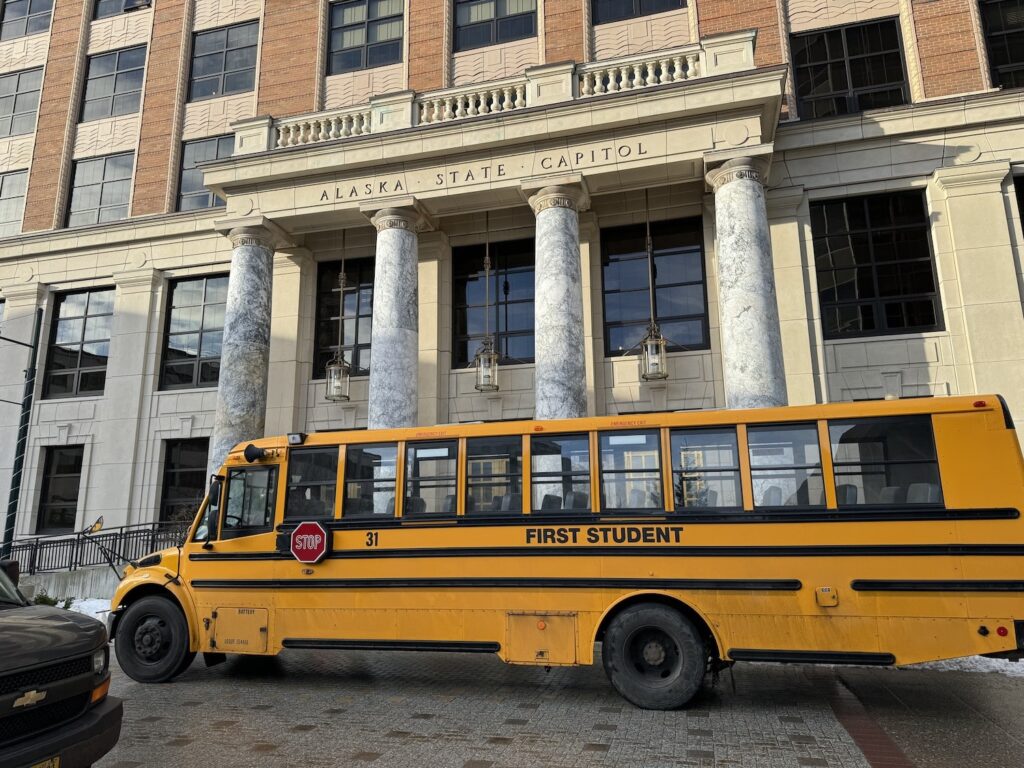
A school bus passes in front of the Alaska Capitol on Tuesday, Feb. 6, 2024. (Photo by James Brooks/Alaska Beacon)
NOTN- Alaska lawmakers will hold the first meeting of the Education Task Force today, beginning a 17-month process to evaluate the state’s approach to school funding and policy.
The task force, is charged with producing a report to the full legislature that will examine education funding formulas as well as policy items championed by the governor and other lawmakers.
“it’s a really broad mandate.” Said Juneau Senator Jessie Kiehl, we’ll look at education funding, look at some policy issues, including several that were on the governor’s wish list, and and really dig in.”
The Education Task force is described as multipartisan, with both democratic and republican leaders starting work this August.
“We’re going to bring in a lot of information, a lot of experts, and see if we can figure out what the state needs to do, to really improve education stability, education funding and outcomes for Alaska kids.” said Kiehl.
The panel’s creation stems from House bill 57, and is part of Alaska’s ongoing political and financial discussions surrounding education.
“This task force was in the bill that the Governor vetoed, that Bill had, of course, most importantly, the funding stabilization, but then it also had a number of education policy things that the governor wanted, some legislators wanted,” Kiehl said,”The governor’s veto, he said, was because he didn’t get all of the policy pieces he wanted. One of the things this task force is going to look into is some of those policy pieces that just did not have support in the legislature.”
Task force members said they will revisit some of those disputed policy proposals while focusing on long-term solutions to strengthen education in Alaska.
Nick Beckage, a graduate researcher, Davin Louangaphay, a research assistant, and Philippe Amstislavski, a professor of health sciences, stand among spruce trees on the University of Alaska Anchorage campus on April 30, 2025, with one of the insulating seafood boxes they created with a cellulose-mycelium blend. (Photo by Yereth Rosen/Alaska Beacon) Philippe Amstislavski, a professor of health sciences, holds a cube of insulating material created with a blend of cellulose from beetle-killed trees and mycelium, the fibers found in fungi. He and his research partners want to use these natural materials as a substitute for plastic foam. (Photo by Yereth Rosen/Alaska Beacon)
Every year, copious amounts of plastic foam boxes are used to ship Alaska seafood.
Instead of using plastics that contribute huge amounts of carbon emissions in their manufacture and huge amounts to pollution after their disposal, could Alaskans use environmentally friendly local materials to ship fish and provide other insulation?
University of Alaska Professor Phillippe Amstislavski, in his lab on June 9, 2025, holds a slab of moist cellulose, derived from spruce pulp, and mycelium, the fibers that cause fungal growth. The combination, once dried and hardened, will form a non-polluting type of insulation intended to be a substitute for Styrofoam and other plastic foam. (Photo by Yereth Rosen/Alaska Beacon)
A team led by a University of Alaska Anchorage professor is tackling that question.
Philippe Amstislavski, a professor of public health at UAA, and his colleagues have created an insulation box from a blend of cellulose and fibers from fungi. To him, it is an appropriate invention for Alaska, where he estimates that more than 1 million plastic foam boxes are used annually to hold fish.
“Our economy is dependent on seafood. And the ability to get fish to markets is really important,” he said. But while Alaskans value sustainable fish harvests, what about sustainable fish shipments? “How do we become materially independent?” he asks.
One solution, he believes, lies in materials that exist in abundance in Alaska’s boreal forest, including the woods on and near UAA’s campus: dead trees and fungi.
The key ingredient is mycelium, the fibrous, vegetative part of fungi. Mycelium creates a strong bond when it is weaved into web-like structures. Amstislavski and his team grow mycelium in their lab in cellulose foam created from wood pulp. The resulting material that, when dried, is durable, insulating and water-repellent. The growth process takes just days.
A beetle-infested spruce tree is seen at Goose Lake Park on July 29, 2025. The park borders the University of Alaska Anchorage campus. (Photo by Yereth Rosen/Alaska Beacon)
For cellulose, they use spruce trees that have been killed by a beetle infestation that has spread over millions of acres in Alaska, including to trees outside the door to the UAA lab building where they work.
The work addresses a global problem with special Alaska significance.
Over its lifetime, Styrofoam and similar plastic insulating foam are carbon intensive.
The product itself is generally made from fossil fuels. Its manufacture uses the energy from more fossil fuels. Though lightweight, it must be transported over long distances to reach Alaska, which also requires fossil fuels. As it ages, plastic foam can release gases known as volatile organic compounds. When it breaks down into debris, the foam crumbles into increasingly small pieces, eventually becoming tiny microplastics swirling in the ecosystem that are difficult to see and nearly impossible to corral but create a big impact.
“It’s this whole, kind of perfect cycle of carbon emissions and pollution that they’re generating every time you use it,” Amstislavski said. “So how do you break it up? How do you challenge it? How do you create alternatives?”
Philippe Amstislavski, a professor at the University of Alaska Anchorage, sits in his biomaterials laboratory on June 9, 2025. Amstislavski, who specializes in environmental health, is leading a project to create a natural, Alaska-grown subtitute for polluting plastic insulation foam. The cellulose-mycelium blend that he and his research partners have created draws on his longtime interest in mushrooms; mycelium is the fiber responsible for fungal growth. (Photo by Yereth Rosen/Alaska Beacon)
Plastic impacts on Alaska
For marine- and fish-dependent Alaska, where disposal or recycling options are limited, plastic pollution is a serious problem, even in remote locations.
Microplastics from distant sources have become concentrated in high latitudes, brought north by ocean and atmospheric currents.
Climate change, which is amplified in the far north, has helped concentrate microplastics in the region because debris previously locked into sea ice or glacier ice is now being released through accelerated melt.
A study by Chinese researchers published earlier this year found microplastics in every single ice sample taken from Elson Lagoon in Utqiagvik, the nation’s northernmost community, and from every sample of Chukchi Sea ice taken nearby off the coast of Point Barrow, the spit of land extending north from town. An earlier study found microplastics in every sample taken from waterways in Anchorage, Alaska’s largest city, and in other waterways in Southcentral Alaska.
Microplastics have been found in the bodies of walruses harvested by Indigenous hunters in the Bering Strait region, in fetuses of spotted seals and in Alaska fish such as pollock.
Polystyrene and other plastics litter a remote beach in Alaska in 2012. (Photo provided by the National Oceanic and Atmospheric Administration)
The abundance of plastic waste that has accumulated in Alaska is striking, said Amstislavski’s research assistants.
“I was driving to Eagle River, and I was looking at the side of the highway, and there was a bunch of plastic trash laying on the side,” said Davin Louangaphay, one of the technicians. “And I was, like, ‘Wow, there’s so much out there.’ And I feel like it’s just been increasing over the years as I’ve grown up.”
Eco-friendly boxes for Alaska seafood
The fish-box project is supported by a grant from the National Oceanic and Atmospheric Administration. The UAA team has partners on the Kenai Peninsula, including the Center for Alaskan Coastal Studies and seafood companies like Kachemak Bay Shellfish Growers Co-Op and Salmon Sisters.
The seafood industry partners are enthusiastic, said Alex Ravelo, a University of Alaska Fairbanks postgraduate researcher working on the project.
“Nobody likes Styrofoam. That’s the reality. Everybody’s well aware of how bad it is for the environment,” she said.
Results from a test conducted over the past winter and spring are promising.
Alex Ravelo, a postgraduate researcher, stands in the University of ALaska Anchorage biomaterial laboratory on June 9, 2025, holding an insulating seafood box made from a cellulose-mycelium mix. The project, led by UAA professor Philippe Amstislavski, aims to develop a natural substitute for plastic foam. The plastic foam used for insulation in Alaska and elsewhere has a big carbon footprint, from its manufacture to its disposal, and it creates widespread pollution that has become embedded in the marine food web. (Photo by Yereth Rosen/Alaska Beacon)
Prototypes of what the team has called “MyghtyBox” were built by Amstislavski, Ravelo and Davin. The Center for Alaskan Coastal Studies put frozen salmon, halibut, shrimp and scallops into them. The filled and sealed boxes were sent from Homer to New York, Kansas and Florida. In addition, a box with live Alaska oysters was sent to Minnesota.
All but one arrived safely and sufficiently chilled, according to federal safety standards. The exception was the shipment to Florida, which was delayed for three days after it was accidentally left on the hot tarmac.
The MyghtyBox project has yet to reach any kind of commercial stage. As of early summer, the number of constructed boxes totaled only about 30, Amstislavski said. Scaling up production is a challenge yet to be cracked.
Home insulation possibilities
The fish-box project is part of a larger mycelium-cellulose vision.
A mobile test lab, set up as a simulated cabin with cellulose-mycelium insulation, is seen on June 5, 2025, at the National Renewable Energy Laboratories site at the Cold Climate Housing Research Center in Fairbanks. (Photo by Yereth Rosen/Alaska Beacon)
A broad goal is to use this all-natural, all-Alaska foam for home insulation, particularly in rural areas. Housing there is notoriously expensive, overcrowded and unsuitable for the environment, especially as the climate continues to change.
Building new homes in rural Alaska is especially difficult because materials must travel over long distances to be used during short summer construction seasons. If materials don’t arrive in time, construction activities can be delayed for a full year.
Mycelium-based board could be a cheaper, faster-delivered, more convenient and higher-quality building material. In partnership with Amstislavski’s team, the National Renewable Energy Laboratory is investigating the possibility.
NREL researchers, operating at their site on the edge of the University of Alaska Fairbanks campus, have been testing different blends of cellulose-mycelium insulation.
There, at the site on the Cold Climate Housing Research Center campus, a mock cabin was set up as a mobile test lab, with panels of mycelium board of varying thicknesses, along with a section of currently used plastic insulation that served as a control. Performance has been measured at each of the panels.
Georgina Davis, a project manager at the National Renewable Energy Laboratory in Fairbanks, holds a sample of cellulose-mycelium insulation on June 5, 2025. Davis is standing in a mobile test lab set up as a mock cabin. It different sets of cellulose-mycelium panels. and instruments are measuring the performance of each. The hope is that the all-natural, all-Alaska materia will be an eco-friendly substitute for plastic insulation foam. (Photo by Yereth Rosen/Alaska Beacon)
The project is about more than eco-friendly building materials, said Georgina Davis, an NREL research project manager working on the experiment.
Mycelium insulation could also address a quality problem that plagues Alaska homes, and particularly those in rural areas, where homes are old and weather-beaten: mold. The materials used widely in the Lower 48 can fare poorly in Alaska’s climate, Davis said.
“If you put two inches of foam around any house in Alaska, you’re going to create prime conditions for mold,” she said. “That’s wrecking a good percentage of homes in rural Alaska.”
Unlike plastic foam, which traps moisture, mycelium insulation can be breathable, she said.
The result of the NREL experiment are now being analyzed.
Interest in mushrooms began in the Russian Arctic
For Amstislavski, the journey to the Alaska cellulose-mycelium project has been something of a circle covering wide geographic and cultural distances.
He grew up in Russia, where his fishery biologist father worked in the Nenets region in theEuropean Arctic. There, as a young boy, he was immersed in Indigenous Nenets culture, which includes mushroom harvesting. There, mushroom harvesting is not just a pastime, but an important subsistence activity, especially in Soviet times, when other foods were scarce.
“I was lucky enough to be in a place with people who understood the landscape and the world, in a deeper, introspective way,” he said.
A mushroom clings to a tree in Anchorage’s Goose Lake Park on July 29, 2025. This type of mushroom, sometimes called a hoof fungus, has been traditionally used by Indigenous tribes for medicinal purposes. (Photo by Yereth Rosen/Alaska Beacon)
After the Iron Curtain fell, he moved with his family to Israel, where he pursued a nursing career. He became interested in architecture, which led him to move to New York. Before he completed his architecture degree, he served as a first responder tending to victims of the Sept. 11 attack on the World Trade Center. That experience gave him first-hand knowledge of respiratory ailments and lung-damaging chemicals. It also further stimulated his interest in environmental health and its relationship to the built environment.
Amstislavski then earned a master’s degree from the Yale School of Forestry and Environmental Studies, where one of his mentors was Tom Siccama, an expert in fungi. “He knew everything about North American mushrooms,” he said.
He then got a Ph.D. in environmental sciences from the City University of New York and taught for a while at the State University of New York before being lured to Alaska. That happened when he presented his research at a circumpolar conference in Fairbanks in 2012, which led to a job as a state public health manager, a position involving travel to rural villages. He came to UAA in 2014, a position that enabled him to study in Finland in 2021 on a Fulbright scholarship.
Amstislavski and his team members are not the only researchers looking at fungus as a solution to plastic problems.
Oyster farmers in Maine, for example, have experimented with buoys made of mycelium. British fashion designer Stella McCartney in 2021 unveiled some faux-leather products crafted from mycelium. A Seattle company is developing a variety of products, from foods to construction materials, out of mycelium.
University of Alaska Professor Philippe checks on June 9, 2025, on the growth in a sample of mycelium-embedded cellulose blocks in a petri dish held by Alex Ravelo, a postgraduate researcher. Ravelo was testing a particular combination of cellulose and mycelium, the fibers that form the root structure of fungi. Mycelium, once dried, forms a strong bond. (Photo by Yereth Rosen/Alaska Beacon)
Alaska challenges
While mycelium development proceeds elsewhere, Alaska projects have some obstacles.
The University of Alaska does not have the type of well-connected business incubators that exist at universities like Harvard, though UAF’s Center for Innovation, Commercialization, and Entrepreneurship has supported the mycelium research.
Alaska, with its remote location and high shipping costs, lacks the type of well-developed manufacturing capacity that exists in most states. Manufacturing in Alaska is dominated by seafood processing, which provides about two-thirds of the sector’s employment, according to the state Department of Labor and Workforce Development.
A new challenge comes from Trump administration decisions to axe funding for environmental research and climate change work.
The $2.5 million U.S. Department of Energy grant awarded in 2023 for the building-insulation project at NREL will not be renewed, the team recently learned.
Funding for NOAA has been drastically cut, though impacts to its marine debris programs and services are yet to be determined.
The Trump administration has resisted attempts to curb plastic pollution, most recently putting up roadblocks that led to the collapse of negotiations on an international plastics treaty.
Amstislavski hopes that entities beyond the federal government, including the private sector, will step in to support mycelium product development.
Aside from its environmental benefits, mycelium could help build Alaska’s workforce, a subject of concern for state officials, he said.
“It’s an opportunity for interesting jobs that are meaningful to people that have positive impacts in the world,” he said.
Mushrooms growing on a trees stump at Anchorage’s Goose Lake are seen on July 29, 2025. In the background are birch and beetle-infested spruce trees. A University of Alaska Anchorage-led project is creating an eco-friendly insulation material from pulped beetle-killed spruce and mycelium, the strong fibers contained in mushrooms. The materials are widely available; Goose Lake Park borders the UAA campus. (Photo byYereth Rosen/Alaska Beacon)
The Juneau School District office in downtown Juneau.
(Photo courtesy City & Borough of Juneau)
The Juneau School District office in downtown Juneau.
(Photo courtesy City & Borough of Juneau)
NOTN- The Juneau School District has canceled all classes for Thursday, Aug. 14, citing ongoing flood warnings for the Mendenhall River and the need to assess damage in the Mendenhall Valley area.
JSD released a statement this morning, The district said it will continue to monitor the situation and notify families of any changes through automated calls, emails, texts, its mobile app and its website. “The safety of our staff and students is always our number one priority.”
The National Weather Service’s flood warning remains in effect until 8 a.m. Thursday. Three district schools are located in the affected area. Officials said the delay will allow Unified Command and safety crews to evaluate conditions before students return.
Classes for grades 1–12 are scheduled to begin Friday, Aug. 15, while the first day of kindergarten will be Monday, Aug. 19.
NOTN-Juneau’s Unified Command is preparing residents for the anticipated , Suicide Basin release that could cause flooding along the Mendenhall River.
Once water begins to spill from the basin, the National Weather Service will issue a flood warning, and the Unified Command will send evacuation advisories through multiple channels.
City and school district officials are preparing for possible closures affecting all Juneau schools, even though only three are located along the river. The district said closures could last as long as the evacuation advisory remains in effect.
Juneau Mayor Beth Weldon says they are moving through the evacuation as if the HESCO Barriers – which are placed along Mendenhall river – aren’t there.
“We’re assuming that they will work.” Said Mayor Weldon “We did this all with the Army Corps of Engineers, they were quite excited about them working, and we’re hopeful that things will be much better than last year. But again, it’s still a flood area, so we are asking people evacuate.”
If the advisory is issued before the school day begins, classes will be canceled. If flooding is expected during the day, at-risk schools may release students early or relocate them to safe sites for parent reunification. Guardians and emergency contacts must provide photo ID to pick up students.
In some cases, bus riders who live in the evacuation area but attend schools elsewhere may be taken to a central pickup point outside the flood zone rather than back into affected neighborhoods.
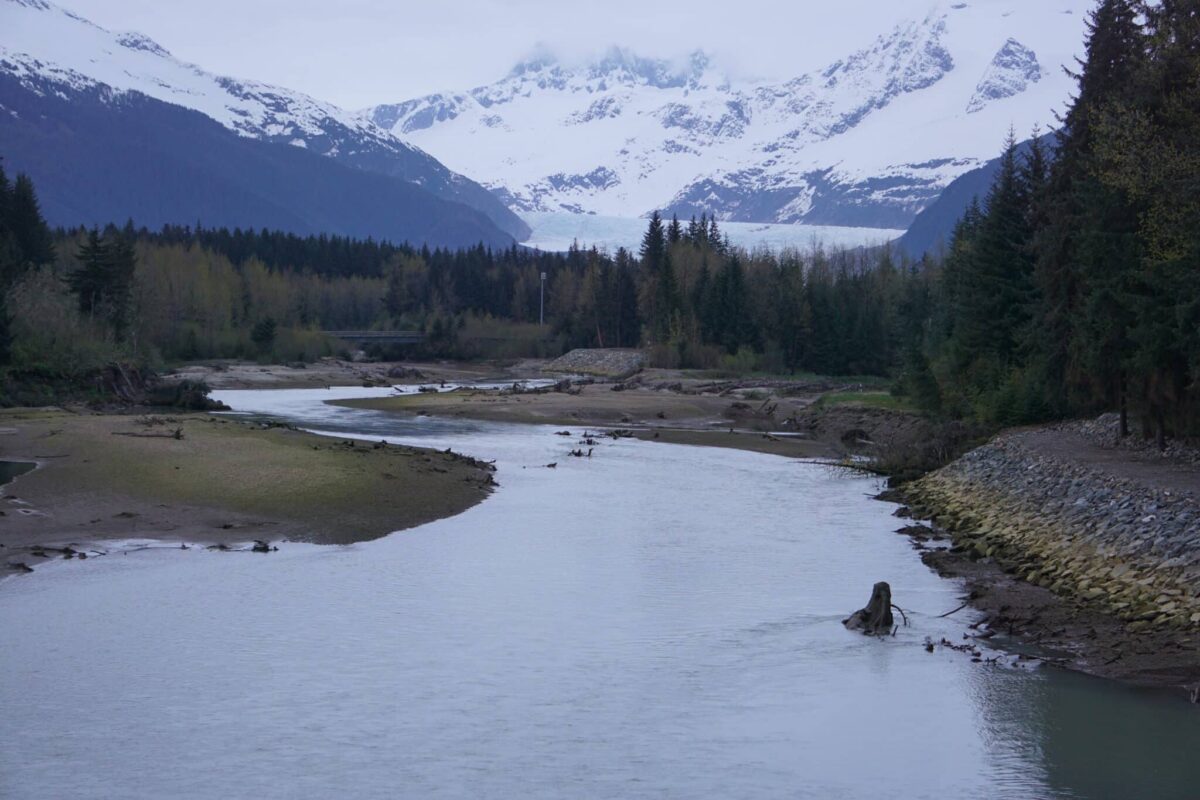
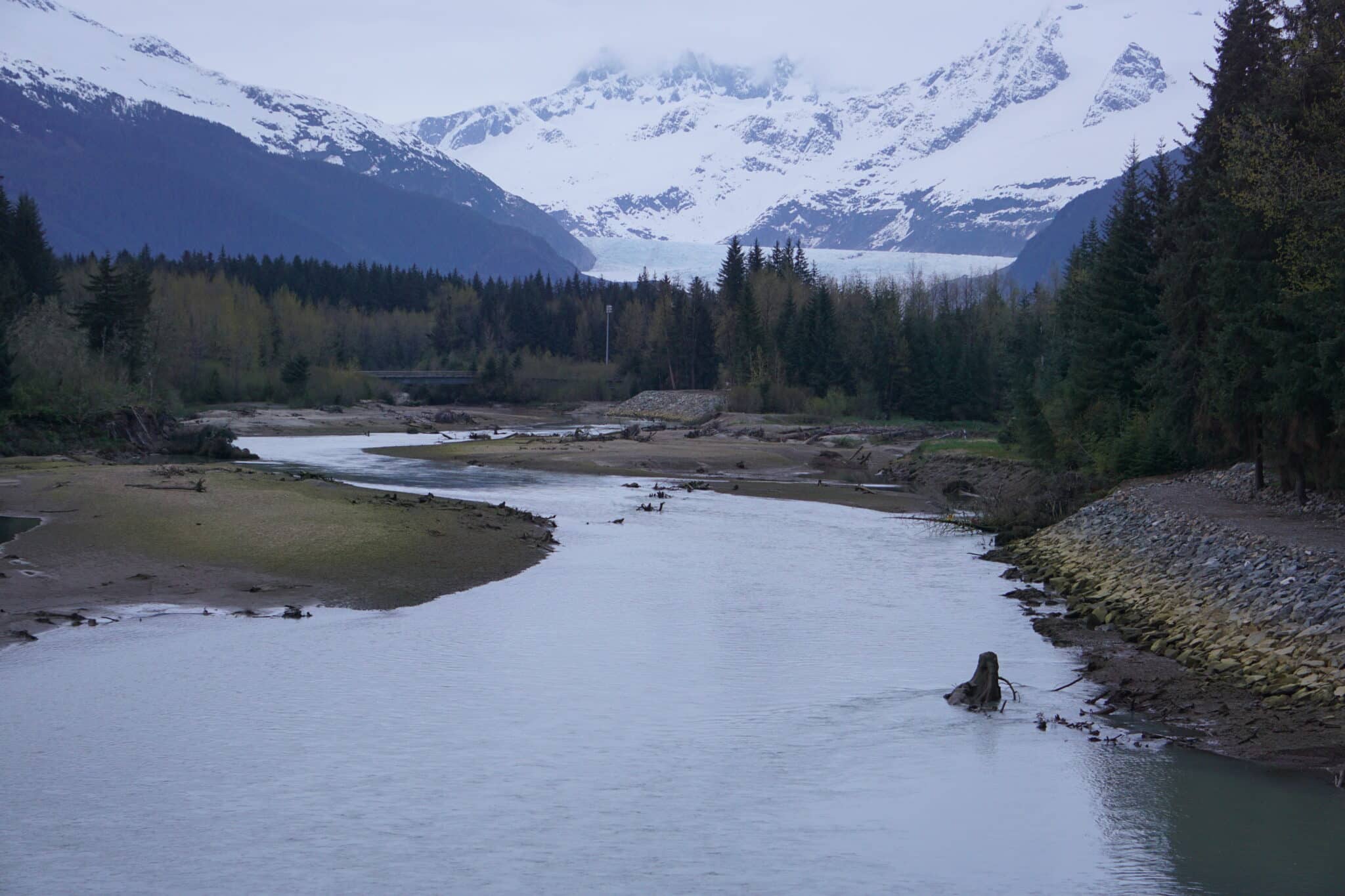
The Mendenhall River, which flows out of Mendenhall Glacier, is seen on May 14, 2025. (Photo by Yereth Rosen/Alaska Beacon)
Suicide Basin, the glacier-dammed side basin above the Mendenhall Glacier, may reach capacity around August 12 according to the National Weather Service.
The basin, which has released annual floods into Mendenhall Lake and River since 2011, has risen 20 feet in the past week and currently sits at 1,350 feet, according to a status update released Wednesday.
The most damaging flood occurred one year ago yesterday, August 6, 2024, causing record damage in Juneau.
Once the basin reaches its estimated capacity of 1,368 feet, it typically takes 4 to 6 days before an outburst begins, according to officials.
Officials are urging residents to stay informed and monitor updates from the National Weather Service and local emergency management.
The City and Borough of Juneau has plentiful resources, including emergency alerts, vehicle registration and Mendenhall inundation maps.
The most recent flood event from the basin occurred on October 20, 2024.
More information and updates will be shared as conditions change.
Alaska Gov. Mike Dunleavy speaks during a news conference on Friday, March 15, 2024. (Photo by James Brooks/Alaska Beacon)
Alaska Gov. Mike Dunleavy speaks during a news conference on Friday, March 15, 2024. (Photo by James Brooks/Alaska Beacon)
NOTN- The Alaska Legislature will reconvene in Juneau on Saturday for a special session called by Gov. Mike Dunleavy, with two major items on the agenda: education reform and the creation of a new Department of Agriculture. But lawmakers are also preparing to challenge some of the governor’s recent vetoes, including cuts to public school funding.
Under Alaska’s constitution, when the governor calls a special session, he sets the subjects lawmakers may address.
“He has, apparently, a new education bill. Most of it is stuff that we have seen before, that he’s proposed before, and that has not had a lot of support.” Said Juneau Senator Jessie Kiehl, “And the other thing he wants to take another crack at is creating an Alaska Department of Agriculture. We have a Division of Agriculture. He wants it to be its own State Department.”
But overriding vetoes may take center stage during the first five days of the session, a constitutionally limited window for legislators to reverse the governor’s decisions.
At the top of the list: restoring approximately $51 million in statewide public school funding that Dunleavy vetoed.
That override will require a three-quarters majority, or 45 votes.
“It is the highest, toughest veto override threshold in all 50 states or any of the territories.” Said Senator Kiehl, “I have talked to colleagues all over this state, Republicans, Democrats, rural, urban and the agreement is our schools are hurting, and they need that money.”
Lawmakers are also considering overriding a veto of a bipartisan bill that would empower the Legislative Auditor to review oil tax enforcement practices
That override will require two-thirds of the Legislature, or 40 votes.
In addition to the override votes, lawmakers may consider a commercial fishing bill and discuss items in the governor’s education package through the new legislative Education Task Force.
A recent report suggested that Dunleavy had asked some minority Republicans to stay home in an effort to block override votes. Kiehl said he believes most lawmakers plan to attend.
“My understanding is that in the last week or so, the governor has come the other way and said, everybody, go ahead and be there.” He said, “The Constitution has some rules for how you do your job when you raise your right hand as a legislator elected by the people and take on this duty, I don’t believe in cutting work when I’m on the job, I think the vast majority of my colleagues feel the same way.”
Bill introductions are scheduled for the session’s opening day, August 2, with hearings requested to begin Sunday, Aug. 3.
Governor Mike Dunleavy speaks during a press conference on Thursday, April 17 in Juneau. (Photo by Greg Knight/NOTN)
Governor Mike Dunleavy speaks during a press conference on Thursday, April 17 in Juneau. (Photo by Greg Knight/NOTN)
NOTN- Gov. Mike Dunleavy on Monday released the full policy agenda for a special session of the Alaska Legislature, scheduled to begin Saturday, Aug. 2. The session, first announced earlier this month, will focus on a sweeping package of education reforms the Governor says are aimed at improving student outcomes and securing long-term funding for public schools.
“This is an opportunity to address Alaska’s performance issues and funding issues in K-12 education well into the future.” Dunleavy said in the press release. “By addressing this now, school districts, students, parents, teachers, and policymakers will have certainty and will not have to debate this issue during the regular session that begins in January,”
The Governor’s office outlined their key priorities for the session, those include
Executive order creating a Department of Agriculture
Tribal Compacting between the state Department of education and select tribes
Expansion of corporate tax credit program for education.
Authorize the Department of Education as a charter school authorizer in addition to local districts
Open enrollment allowing public school students to enroll in any public school that has room including outside of a student’s resident district.
Grants for reading improvement and for a new after school reading tutoring program
Recruitment retention payments to classroom teachers to reduce turnover
Long-term certainty in funding for K-12 schools if agreement is reached on policy.
Education Commissioner Dr. Deena Bishop, a former teacher and superintendent, said the proposals are evidence-based and modeled after successful policies in other states.
Bill introductions are scheduled for the session’s opening day, with hearings requested to begin Sunday, Aug. 3.
However many lawmakers plan to override Gov. Mike Dunleavy’s decision to veto millions of dollars in public school funding from this year’s state operating budget.
according to the Alaska Beacon, It takes 45 votes to override an Alaska governor’s budget veto, and of the 46 legislators who voted this spring to override the governor’s veto of the education funding formula, all but a handful have committed to supporting a budget veto override as well.
That formula is subject to the state’s annual budget process, and Dunleavy chose to only partially fund it, causing a wave of cuts to services at public schools across the state. Dunleavy had said he would not agree to the full funding increase without the Legislature adopting other policies he’s proposed.