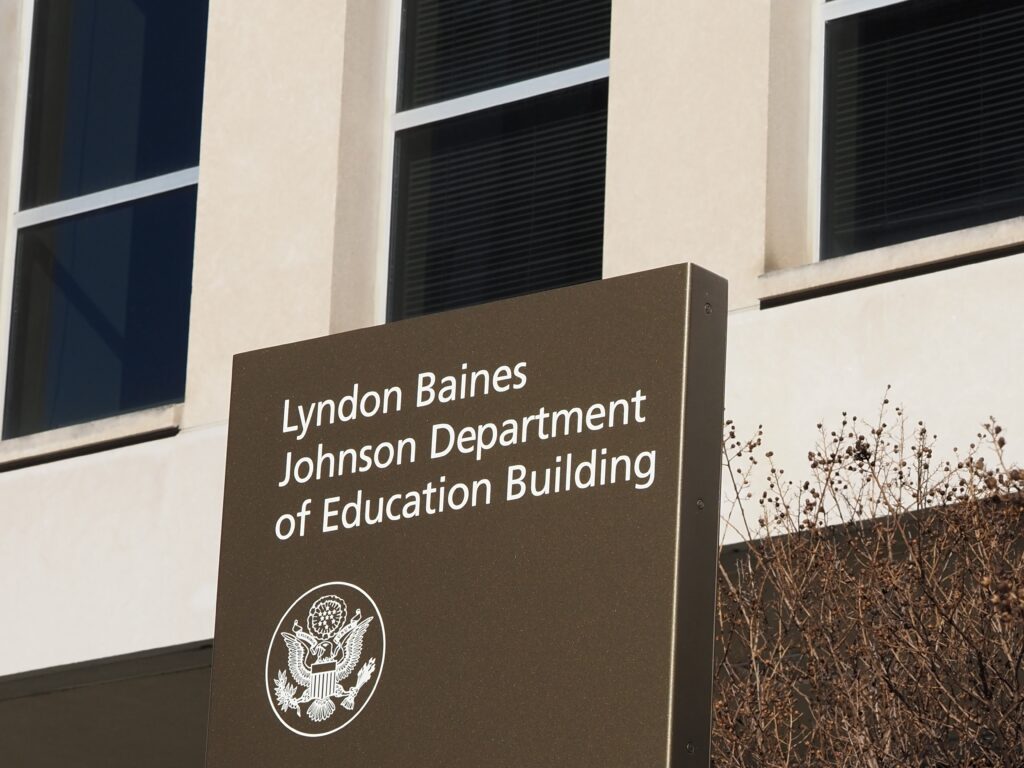
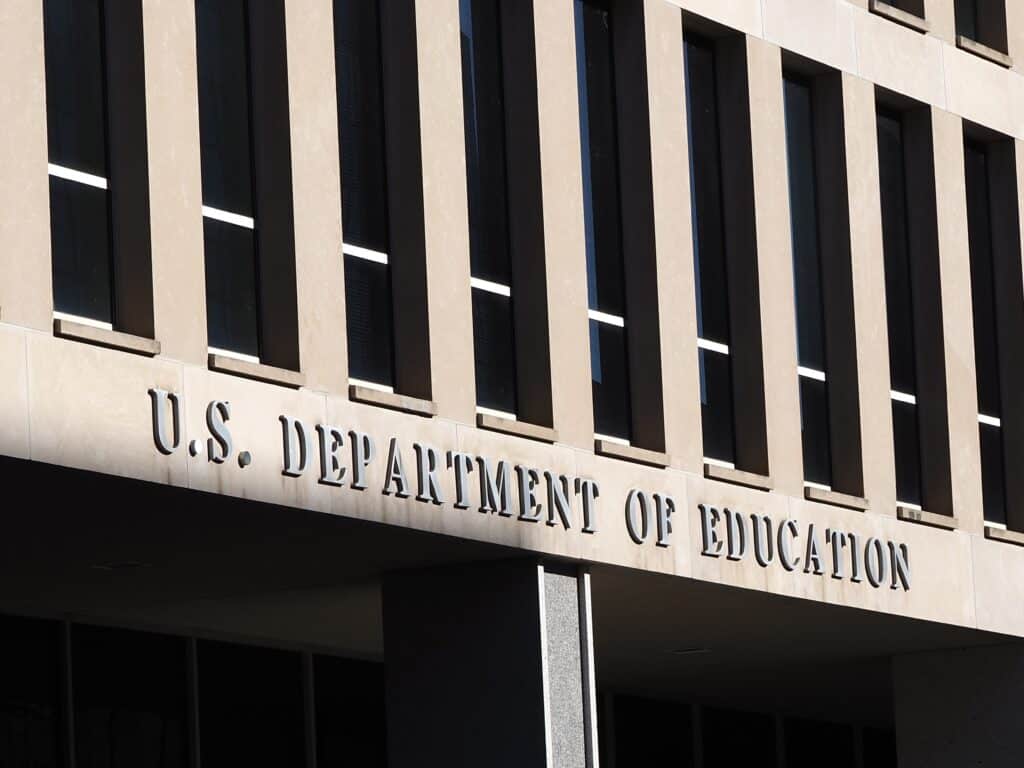
The Lyndon Baines Johnson Department of Education Building in Washington, D.C., in a file photo from November 2024. (Photo by Shauneen Miranda/States Newsroom)
WASHINGTON — The Trump administration said Friday it’ll soon release billions in Education Department funding that has been frozen for weeks, delaying disbursements to K-12 schools throughout the country.
The funding — which goes toward migrant education, English-language learning and other programs — was supposed to go out before July 1, but the administration informed schools just one day before that it was instead holding onto $6.8 billion while staff conducted a review. Members of both parties in Congress objected to the move.
The Education Department released $1.3 billion for before- and after-school programs as well as summer programs in mid-July, but the rest of the funding remained stalled.
Madi Biedermann, a Department of Education spokesperson, wrote in an email to States Newsroom that the White House budget office “has completed its review” of the remaining accounts and “has directed the Department to release all formula funds.”
The administration will begin sending that money to school districts next week, Biedermann wrote.
Appropriators cheer
Maine Republican Sen. Susan Collins, chairwoman of the Appropriations Committee, wrote in a statement the “funds are essential to the operation of Maine’s public schools, supporting everything from classroom instruction to adult education.”
“I am pleased that following outreach from my colleagues and me, the Administration has agreed to release these highly-anticipated resources,” Collins wrote. “I will continue working to ensure that education funds are delivered without delay so that schools have adequate time to plan their finances for the upcoming school year, allowing students to arrive back to class this fall to properly-funded schools.”
Collins and nine other Republican senators wrote a letter to Office of Management and Budget Director Russ Vought earlier this month asking him to “faithfully implement” the spending law Congress approved in March.
“The decision to withhold this funding is contrary to President (Donald) Trump’s goal of returning K-12 education to the states,” the GOP senators wrote. “This funding goes directly to states and local school districts, where local leaders decide how this funding is spent, because as we know, local communities know how to best serve students and families.
“Withholding this funding denies states and communities the opportunity to pursue localized initiatives to support students and their families.”
West Virginia Republican Sen. Shelley Moore Capito, chairwoman of the appropriations subcommittee that funds the Education Department, wrote in a statement released Friday she was glad to see the funding unfrozen.
“The programs are ones that enjoy longstanding, bipartisan support like after-school and summer programs that provide learning and enrichment opportunities for school aged children, which also enables their parents to work and contribute to local economies, and programs to support adult learners working to gain employment skills, earn workforce certifications, or transition into postsecondary education,” Capito wrote. “That’s why it’s important we continue to protect and support these programs.”
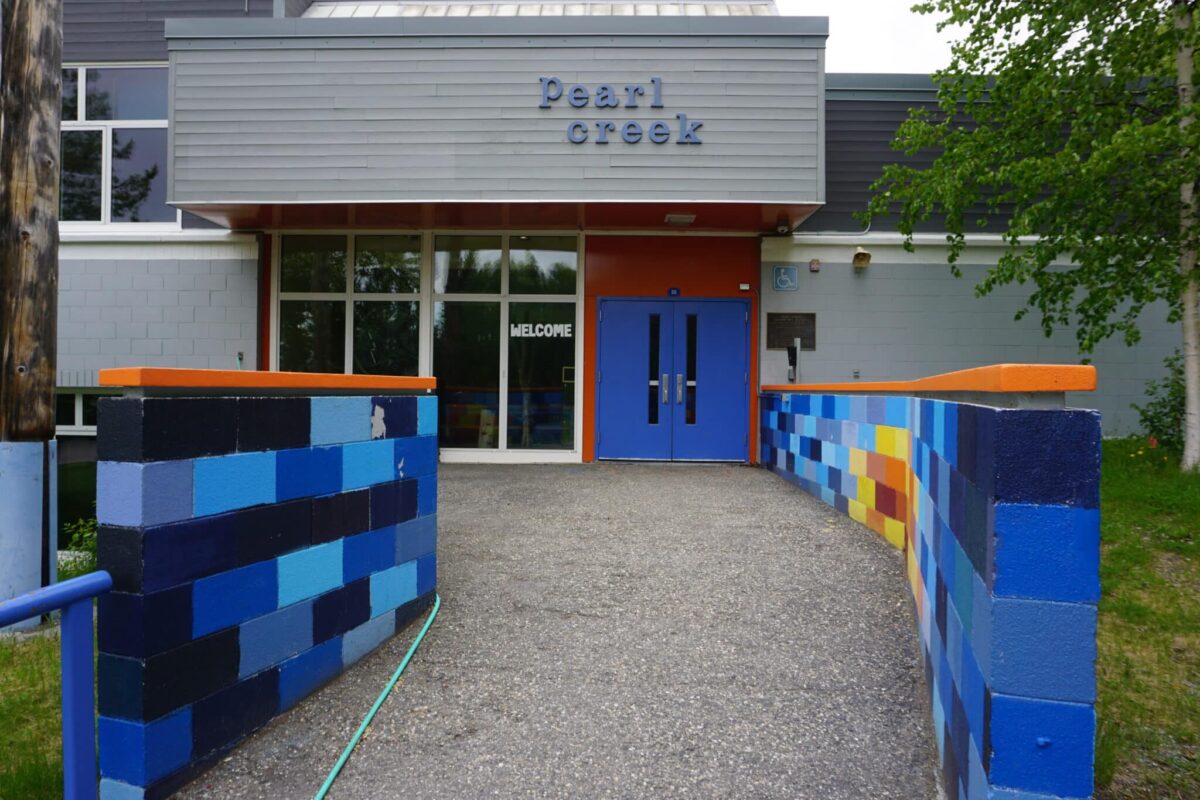
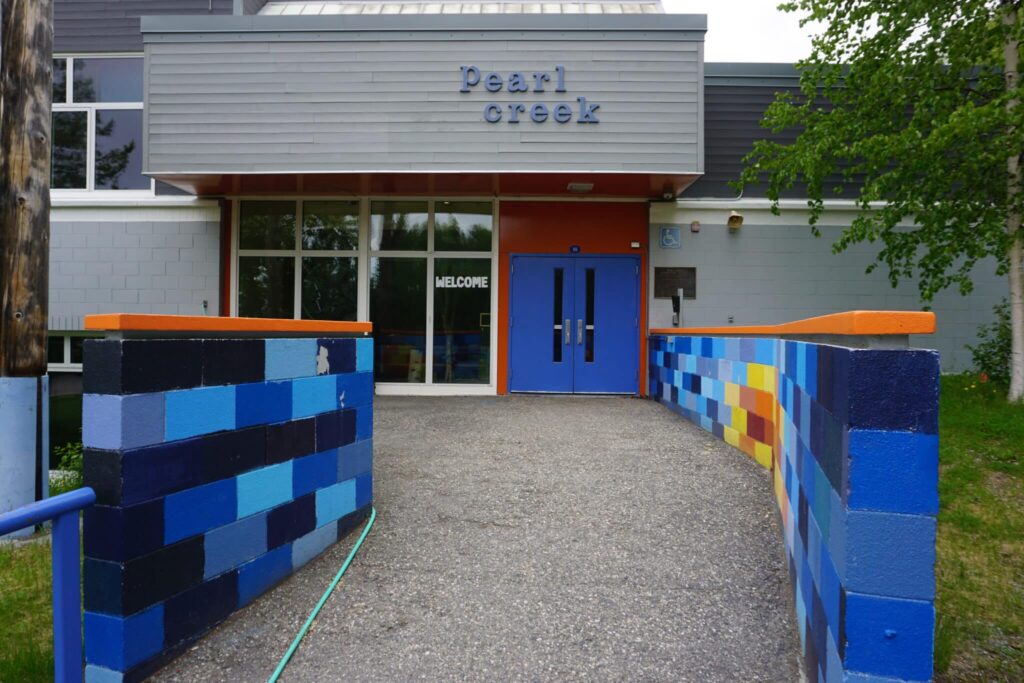
Pearl Creek Elementary School is seen on June 3, 2025. The Fairbanks North Star Borough School District decided to close the school at the end of the academic year due to budget cuts. (Photo by Yereth Rosen/Alaska Beacon)
Three Alaska school districts have joined a coalition from across the country — including school districts, teachers unions, parents and advocacy groups — suing the Trump administration for blocking $6.8 billion in congressionally approved education funding.
The Anchorage, Fairbanks North Star Borough, and the Kuspuk school districts joined the lawsuit filed Monday in federal court. The suit challenges the withholding of funds as unlawful and unreasonable, as well as violating Congress’ authority and the separation of powers.
“The lawless and last-minute withholding of federal education funds is not just a bureaucratic failure—it is a direct attack on our most vulnerable students. Less than a month before school starts, we’ve been forced to plan for cuts instead of preparing to serve children,” said Fairbanks Superintendent Luke Meinert in a statement announcing the lawsuit.
The Trump administration has said it’s withholding the funds pending a review of the grant programs to ensure they align with the Republican president’s priorities, and to “prevent them from promoting a ‘left-wing’ agenda,” according to the lawsuit.
For Alaska, an estimated $46.4 million was allocated across five grant programs, according to the Alaska Department of Education and Early Development. That includes funding to support migrant education, academic enrichment, English language learning, and other types of instruction, as well as teachers’ professional development. In addition, an estimated $1.1 million was withheld for adult education programs.
According to the lawsuit, school districts nationwide are facing millions in budget shortfalls, and have had to “cancel orders for new curriculum, delay critical teacher training, pause contracts for services for English language learners, or take other actions to avoid incurring expenses that they cannot afford to pay without the money normally provided by the Formula Grant Programs.”
The Fairbanks North Star Borough School District serves more than 12,000 students across 33 schools, and has seen over $2.57 million frozen, according to the lawsuit.
“Without these Title program funds, nearly 200 education jobs are in jeopardy,” Meinert said. “Our classrooms will be less supported, and students will be left behind. This isn’t just fiscal irresponsibility—it’s a moral failure that jeopardizes the future of the very students federal law is meant to protect.”
The Kuspuk School District serves 320 students in nine schools across 12,000 square miles in Western Alaska — and has received national attention for its deteriorating school buildings and severe maintenance needs. It is facing over $180,000 in frozen funds.
Students attend class in a Kuspuk elementary school. (Photo provided by the Kuspuk School District)
Among the grants frozen was funding to support teacher training, school supplies, enrichment programs and English language learning, including for over 130 staff. “Because English is not the first language for more than 60% of the district’s teaching staff, sustained … training has been critical to ensuring educators can effectively support English Learners across subjects and grade levels,” according to the lawsuit.
Superintendent Madeline Aguillard said in a statement the programs are “not line items, they are lifelines” for students.
“These are not extras. These are the programs that give our students a chance,” she said. “When funding is blocked, it does not just stall services. It dismantles the systems we have built to reach those most in need. When the federal government walks away from its obligation, it is not a delay. It is denial. Denial of access. Denial of progress. Denial of the futures our students have a right to pursue.”
For Anchorage, the state’s largest district by population at more than 43,000 students in 94 schools, the frozen funds are estimated at $11.8 million.
In an interview last week on the district’s budget challenges ahead of the lawsuit, Superintendent Jharrett Bryantt said the funding freeze on July 1, at the start of the fiscal year was “severe,” particularly having just signed new contracts for teachers and staff. “If you offer somebody a role and no longer have the funds for it — it’s so unprecedented that the federal government would not essentially pay its bills on time because these monies were appropriated. This is not a budget reduction conversation. This is a executing the will of the Congress of conversation,” he said.
Anchorage Superintendent Jharrett Bryantt (Photo provided by the Anchorage School District)
The freeze comes amid an ongoing state education funding debate with the Alaska State Legislature meeting for a special session on Aug. 2, as well as a dispute over local contributions to school funding. School officials said this combination of issues is devastating to public education in Alaska. Earlier this year, the Anchorage School District reported it had to lay off 42 staff positions, and cut more than $30 million in salaries, benefits and services.
Bryantt said the district had to immediately lay off five staff members following the funding freeze announcement, and transfer about a dozen more to alternate roles. “We can make sure that folks are employed. That’s my top priority, in addition to the continuity of our students’ learning,” he said, and recruiting and hiring teachers is an ongoing challenge.
“Teachers are a national commodity,” he added.
The lawsuit, filed in a federal court in Rhode Island, names the U.S. Office of Management and Budget, its director Russ Vought, the U.S. Department of Education and Secretary of Education Linda McMahon. It asks a judge to compel the department to release the funds.
Alaska U.S. Sen. Lisa Murkowski joined nine other Republican senators in a letter to the Office of Management and Budget urging the department to release K-12 funds, as well as over $700 million for adult education programs.
Last week, the U.S. Department of Education announced it will release some of the withheld grants, an estimated $1.3 billion that goes to support after-school care and summer school programs, though it’s unclear when those funds will be received by districts.
Deena Bishop, commissioner of the Alaska Department of Education and Early Development, at a news conference with Gov. Mike Dunleavy on education funding on Friday, Jan. 31, 2025. (Photo by Corinne Smith/Alaska Beacon)
The state of Alaska has filed an appeal with the U.S. Department of Education after federal officials said the state failed a test measuring the differences in funding between school districts, which put more than $80.8 million in federal aid at risk.
Each year, the state receives federal funding called “impact aid” intended to compensate districts with federally owned lands, which reduce the tax base to support schools. The state can put that funding toward its own funding for schools — which the state has done in the past — but only if it can pass what’s known as a disparity test.
Federal law requires there to be no more than a 25% gap between per-student revenue in districts near the highest in funding and districts near the lowest. The department found Alaska’s disparity to be 26.88%, given the state’s complex funding formula.
But Alaska has rejected the finding, filing a formal appeal on July 14 and submitting districts’ finance data to argue their expenditures meet the standard. The test puts federal funding at stake, according to the state, which this year amounts to an estimated $80.8 million.
Deena Bishop, commissioner of the Alaska Department of Education and Early Development, said in an interview last week that she feels good about the state’s accounting and a successful appeal.
“I’m confident that we did meet it,” Bishop said of the requirements. “If I base it off of the last appeal and how Alaska was able to share how transportation costs are truly that disparate, then I think we will do fine.”
The state failed the same disparity test in 2021, based on 2019 state data, and successfully appealed. This time, the state submitted 2024 data for evaluation.
“So a little bit of it is a huge math problem at the beginning,” Bishop said of the appeal process. “We wrapped our arms around it and figured that out, and then made an argument on … why we did it that way, given the background of those costs in Alaska.”
Bishop said Alaska sees high costs in rural school districts — especially for transportation, but also basic supplies and operating costs.
“The cost to do business is highly diverse in Alaska. If you just took the cost of a head of lettuce or a gallon of milk, you know, in Anchorage, as compared to Teller, it’s not just three times (higher in Teller). It could be up to five times. And really building and construction materials, supplies, all of those are such a significant increase due to the way you can only get in by barge or plane. So it’s just … again, understanding why we pay such large differences in different places in Alaska.”
The U.S. Department of Education notified the state that it failed the test on May 16, as first reported by KTOO. Bishop said it will take time to resolve. The 2021 appeal was resolved at the end of that fiscal year, in 2022.
“It is a long process, because I think they’re very careful at it,” she said. “You want to spend the time on it. They did spend the time to understand Alaska.”
In the meantime, the federal impact aid payments will continue to school districts.
DEED spokesperson Bryan Zadalis said by email those funds will continue through the appeal process. “School districts will continue to receive Impact Aid funding directly from US-ED through their regular processes of application approval and funding availability,” he said.
Added uncertainty for education funding
The results of the disparity tests add uncertainty for the state, and for Alaska schools.
That’s based on the state’s complex funding formula for schools – which includes federal, state and local contributions.
Alexei Painter, who directs the division of state government that analyzes the budget for the Legislature, said the Legislature passed a budget that funds whatever the state’s portion is in that funding formula. If the state passes the disparity test, it allows the state to deduct the federal impact aid dollars from the state school funding.
But if the state fails the test, Painter said, “that money doesn’t go away. It just goes directly to those districts.”
If the federal impact aid isn’t flowing through the state government, it no longer is distributed based on the state funding formula. That’s potentially a big problem for the state.
“If we fail, we can’t make that deduction,” Painter said in an interview Wednesday. “The result of that is that what the state would owe to pay the full formula would go up by $80 million.”
That’s because the state would still be required to distribute the remaining state aid according to formula, but it would have less revenue to do it.
Painter explained that the issue is further complicated by Gov. Mike Dunleavy’s budget veto of $50 million for the state’s education funding this year.
Under the original budget bill passed by the Legislature, the state had an open-ended commitment to provide school funding according to the formula. But in issuing the veto, Dunleavy crossed out the language, replacing it with a dollar amount.
“The governor vetoed that appropriation from an open-ended one to a fixed dollar amount,” Painter said. That means that if the state fails the disparity test, “that cost goes up by $80 million, and now the veto impact is $130 million.”
The Legislature is set to take a vote on whether to override Dunleavy’s veto of school funding during a special session, scheduled for Aug. 2.
Painter said that if the Legislature votes to override the veto, it would fund the education formula – including the $80.8 million.
Depending on the override vote and the appeal, the impacts to school districts could vary widely across the state, he said. The division issued a memo in June on the potential impacts.
Some districts that receive the federal impact aid because they include federal lands, like the Lower Kuskokwim or Fairbanks school districts, could see millions more. But others, like the Matanuska-Susitna or Anchorage districts could see millions less, as the state would not have enough money to fully balance its part in the funding formula.
“I would just assume the Legislature will address this in some way,” Painter said. A veto override would be one way to address it. Another way would be to provide more money for school districts after the Legislature reconvenes for its next regular session, in January, in a supplemental budget bill.
If the state loses its appeal and the Legislature doesn’t act, it could be a problem for districts.
“Otherwise there’s just a lot of uncertainty for districts,” Painter said. “Even if the department’s ultimately successful, in the meantime, it just adds uncertainty for districts.”
Sen. Löki Tobin, D-Anchorage and chair of the Senate Education Committee, said in a phone interview that she was glad the state has appealed. But she argued that the disparity is being driven by a lack of funding on the state’s part for public schools.
“That is ultimately on the shoulders of our state and also of our local communities, and with a decade of flat funding, it is clear why our school districts’ budgets are getting tighter, the deficits are getting larger,” and the disparity is growing, Tobin said.
Zadalis said no date has been set yet for a hearing on the appeal.
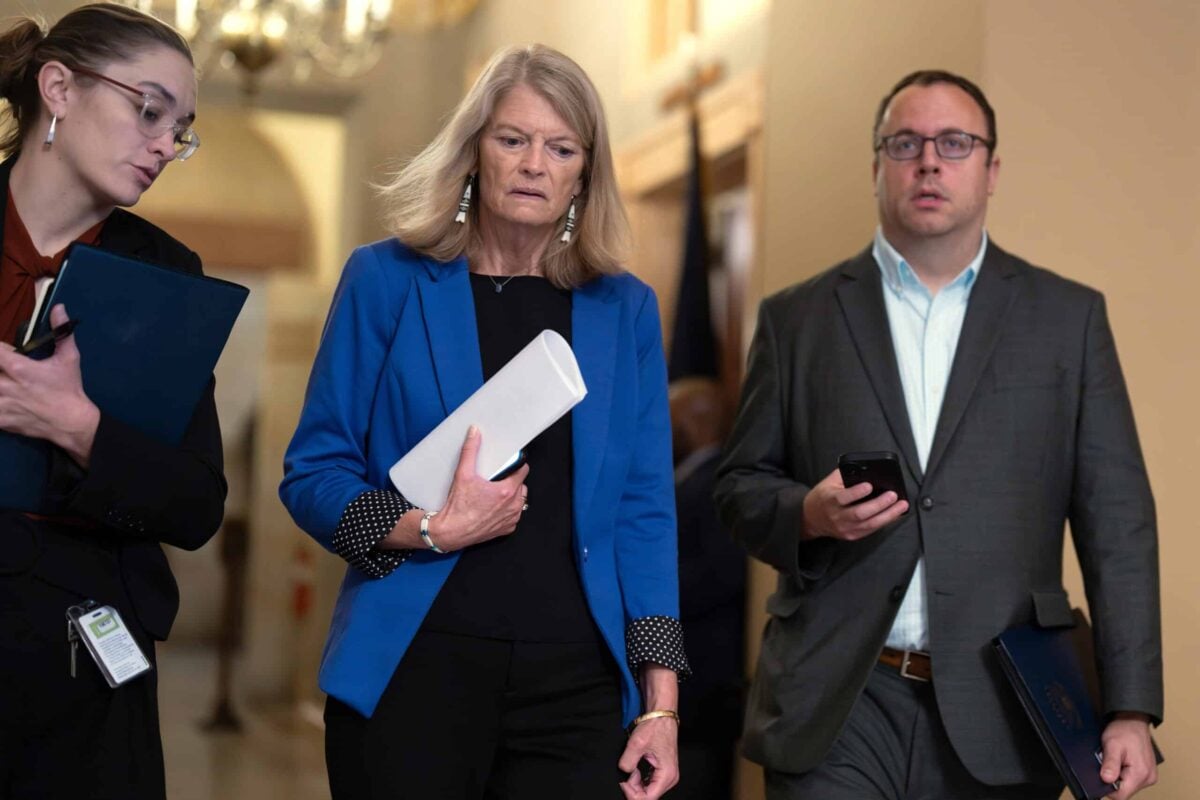
Sen. Lisa Murkowski, R-Alaska, center, a member of the Senate Appropriations Committee, arrives for a closed-door Republican meeting to advance President Donald Trump's sweeping domestic policy bill, at the Capitol in Washington, Friday, June 27, 2025. (AP Photo/J. Scott Applewhite)
Sen. Lisa Murkowski, R-Alaska, center, a member of the Senate Appropriations Committee, arrives for a closed-door Republican meeting to advance President Donald Trump’s sweeping domestic policy bill, at the Capitol in Washington, Friday, June 27, 2025. (AP Photo/J. Scott Applewhite)
U.S. Sen. Lisa Murkowski, R-Alaska, has joined a group of Republican senators urging the Office of Management and Budget (OMB) to release federal education funds already approved by Congress for the 2025 fiscal year.
In a letter sent to OMB Director Russell Vought, the senators asked the agency to fully implement the Fiscal Year 2025 Full-Year Continuing Resolution Act, which includes funding for several education programs supporting students, educators and adult learners.
“The decision to withhold this funding is directly contrary to President Trump’s goal of returning K-12 education to the states,” the senators wrote. “This funding goes directly to states and local school districts, where local leaders decide how this funding is spent, because as we know, local communities know how to best serve students and families. Withholding this funding denies states and communities the opportunity to pursue localized initiatives to support students and their families.”
The funding in question includes grants for Supporting Effective Instruction, 21st Century Community Learning Centers, Student Support and Academic Enrichment, English Language Acquisition, Migrant Education, and Adult Basic and Literacy Education, including integrated civics and language programs.
Murkowski and her colleagues argue the funds are essential for local school districts and adult education providers, especially those that support English learners, workforce training, and after-school care. They also emphasized the bipartisan nature of these programs, writing, ” We share your concern about taxpayer money going to fund radical left-wing programs. However, we do not believe that is happening with these funds. These funds go to support programs that enjoy longstanding, bipartisan support like after-school and summer programs that provide learning and enrichment opportunities for school aged children which also enables their parents to work and contribute to local economies.”
The letter was also signed by Senators Shelley Moore Capito (R-WV), Susan Collins (R-ME), John Boozman (R-AR), Katie Boyd Britt (R-AL), Deb Fischer (R-NE), John Hoeven (R-ND), Jim Justice (R-WV), Mitch McConnell (R-KY), and M. Michael Rounds (R-SD).
The senators said they welcome further collaboration with OMB and Education Secretary Linda McMahon, writing, ” We want to see students in our states and across the country thrive, whether they are adult learners, students who speak English as a second language, or students who need after-school care so that their parents can work. We believe you share the same goal.” They urged Vought to reverse the decision and release the congressionally approved funding without further delay.
A full copy of the letter is available on Sen. Murkowski’s official website, or on her Facebook page.
The Lyndon Baines Johnson Department of Education Building pictured on Nov. 25, 2024. (Photo by Shauneen Miranda/States Newsroom)
By: Corinne Smith, Alaska Beacon
Federal funds for adult education services were among those blocked by the Trump administration on July 1, causing immediate cuts to Alaska adult education and workforce development programs and staff layoffs.
The U.S. Department of Education has withheld more than $6 billion in congressionally approved grants for education, including over $629 million for adult education basic grants, and more than $85 million in adult integrated English literacy and civics education grants. The administration has said that it’s withholding the federal funding to review the grant programs to ensure they align with the Republican president’s priorities.
Adult education can range from classes that help adults learn basic literacy to programs that assist students in gaining certificates equivalent to high school diplomas, and can teach skills that are essential to performing certain jobs.
Alaska had over $1.1 million allocated as part of an adult education basic grant, according to the Alaska Department of Labor and Workforce Development, which administers the grants. A department spokesperson said on Tuesday the grant amounts for English literacy and civics education this year were not available, but the state received more than $99,600 last year.
The withheld funds means immediate cuts to services for Alaska adult learners and staff layoffs, according to grant recipients.
“We were definitely blindsided,” said Lucie Magrath, executive director of the Literacy Council of Alaska, a Fairbanks-based nonprofit that provides adult education programs, including adult literacy, English language learning, civics and General Educational Development, or GED, preparation classes.
Magrath said an estimated $180,000 in federal funding, or over half of their budget, was impounded, causing immediate cuts to services and staff layoffs. While the organization did not identify the number of layoffs in an interview last week, the Fairbanks Daily News-Miner has since reported that there were five layoffs.
“So we are having to make some pretty drastic decisions with staffing and programming,” she said in a phone interview on Thursday. “We likely will not be able to serve nearly as many people this year, and we’re making staffing cuts right now.”
The organization provides in-person and virtual instruction and mentoring to adult learners in Fairbanks, as well as in villages in the Interior and Western Alaska, stretching from the Yukon Flats to the Yukon-Kuskokwim Delta.
They also have a workforce development program, the Pathways Program, serving youths and young adults ages 16 to 24, and run the used bookstore Forget-Me-Not Books in Fairbanks, which provides revenues for its programs, jobs training and employment.
Shelby Cooke is the assistant executive director of the Literacy Council of Alaska, and said it’s difficult to fill such a large funding gap, especially on such short notice, and Alaskans will be impacted.
“The real detriment is to our students and Alaskans who need that GED credential to go to work, or maybe they’re a super-skilled person in their native tongue, but they need enough English to be able to navigate a job interview,” she said. “Those are the folks that are suffering, and in turn, our economy suffers too.”
Magrath said some programs will be suspended immediately. It’s possible that these suspensions will be temporary, as her organization figures out its next steps. “We’re looking at restructuring some of our programs just to be able to use the resources that we have to the maximum impact for our community and our students,” she said. “So we have a lot to figure out right now.”
Southeast Regional Resource Center, a nonprofit educational services agency that provides a variety of services statewide, including adult education, English language learning and workforce development programs. In addition, SERRC provides educational and business services to school districts, including special education programs, human resources and grant administration.
“We do have some state funds, and so we’ve had to modify our budget just off what we know we have for funding — for state funds — and we are looking at having to reduce our staffing,” said Chris Reitan, its executive director, in a phone interview Thursday. He said the organization is looking at cutting at least two staff positions and a few part-time positions. “So we are concerned about the ability to have the same level of impact.”
Reitan said the federal funding freeze withheld over $86,600 for adult education programs in Southeast Alaska, and over $64,000 in the Aleutians region.
Chris Reitan, executive director, SERRC, said SERRC’s program served 112 students last year in the areas of GED support, English language learning and workforce development across the state.
“Number one, adult education provides a kind of a lifeline for Alaskans seeking to improve their lives, and it also helps strengthen our state’s workforce,” he said, and will have an immediate impact on adult learners, “which then could immediately impact their ability in regards to getting good-paying jobs, their ability to provide for their families, their ability to contribute to their local communities.”
He added: “I see this as being a significant impact across the state, in regards to our citizens being able to have the opportunity to better themselves.”
SERRC and the Literacy Council of Alaska are two of 14 adult education programs across the state with grant funding administered by the Alaska Department of Labor and Workforce Development. A department spokesperson, Adam Weinert, said by email that the department has continued to award available state matching funds for the programs, totaling more than $1.9 million.
“Sub-grantees were informed that we were moving forward at this time with state funding only,” Weinert said of the programs. “Once federal funding is released, we will move forward with a budget modification to provide for the federal funding.”
The full impact of how the freeze will affect some programs in the long term remains unclear.
The University of Alaska system has several adult education programs, funded in part by federal funds, as well as state and local funding. Jonathan Taylor, the university’s director of communications, said by email Monday that “discussions are ongoing” around funding but those programs are scheduled to continue.
Taylor said at the University of Alaska Fairbanks, the Bristol Bay Adult Education program will start up in August with funding from Bristol Bay Economic Development Corp.
Within the University of Alaska Anchorage, there are adult education programs at Kodiak College, serving the Kodiak Island Borough; Kenai Peninsula College, serving the Soldotna, Homer and Seward regions; and Prince William Sound College, serving the Valdez, Cordova and Copper Basin regions.
“We have received assurances that all three will receive some sort of funding this year,” Taylor said. “To our knowledge, the state will initiate these awards using either state funding or federal funding it has access to. If additional Federal Funds become available, the state will amend the agreements to make up to the original intended funding amount. Currently, this is an active endeavor and ongoing discussion with the state.”
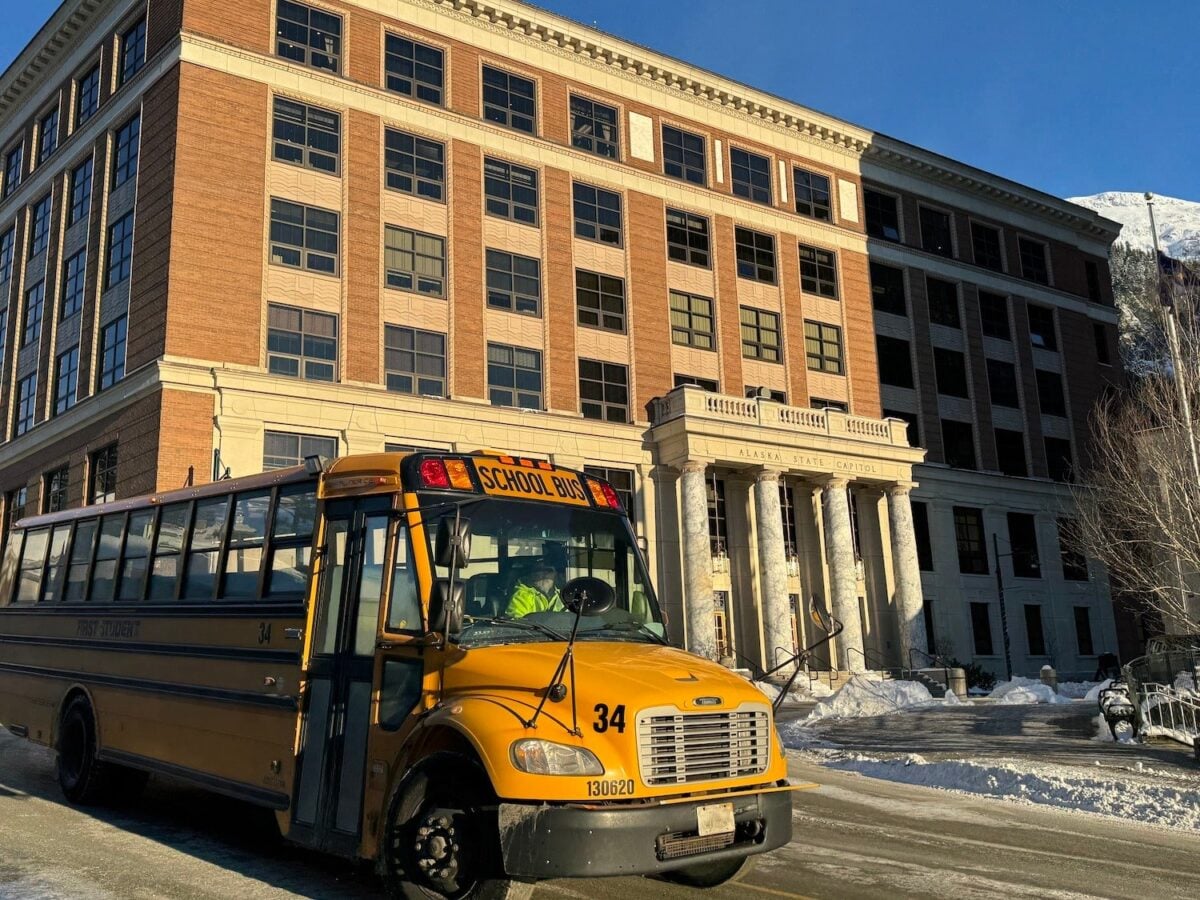
A school bus drives in front of the Alaska State Capitol on Monday, Feb. 3, 2025. (Photo by James Brooks/Alaska Beacon)
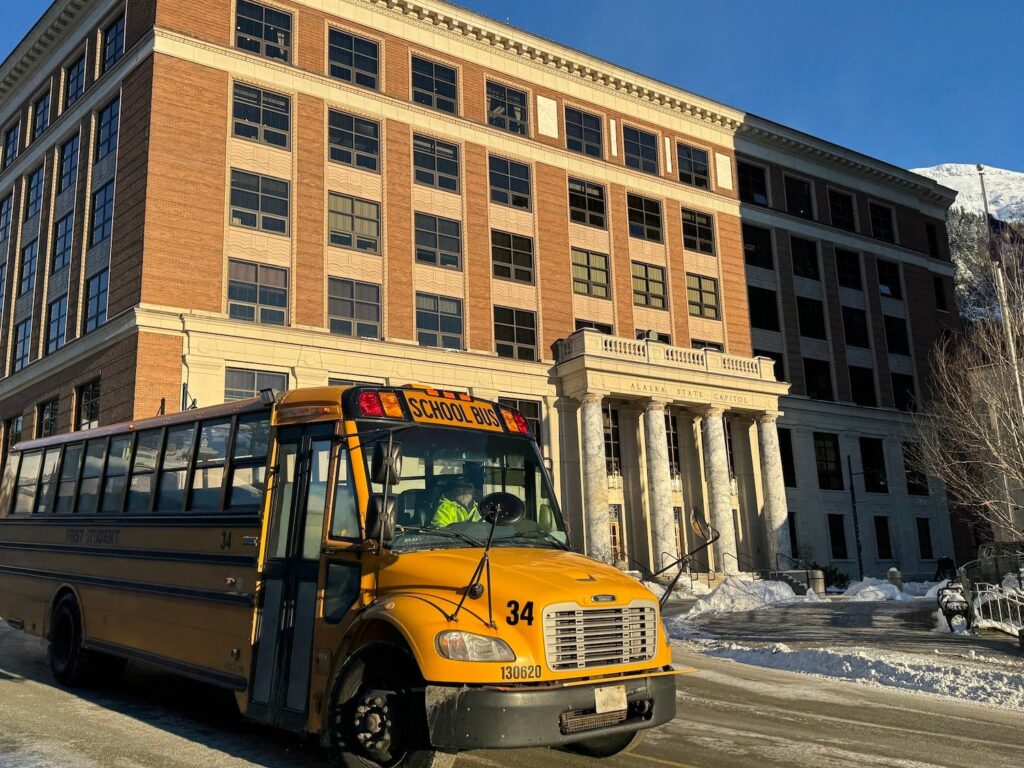
A school bus drives in front of the Alaska State Capitol on Monday, Feb. 3, 2025. (Photo by James Brooks/Alaska Beacon)
Governor Mike Dunleavy has called a special legislative session beginning Saturday, August 2, in Juneau.
The session will focus on two issues, education reform and the creation of a new Alaska Department of Agriculture.
The Governor’s recent budget vetoes have been raising concerns, the Governor cut over $122 million from the state budget, including $50 million from per student funding and major school maintenance projects. Juneau Senator Jesse Kiehl spoke with News of the North about the Base Student Allocation and had this to say, “when we look at the budget issues and the Governor’s special session coming up, what that really has to do with is, are we going to fund the BSA that we passed? it took an override to get that $700 per kid increase, and of course, the Governor vetoed that down, actually below a level that he proposed at one point during the session.”
Senator Kiehl is also a part of an education task force created by House Bill 57 which will look at a wide range of financial challenges and school policies, It’s charged with making recommendations before the 35th Alaska State Legislature convenes in January 2027.
When asked if the governor’s vetoes would affect the Education Task Force, Senator Kiehl said “I think those are going to be pretty separate issues. The task force has a lot of work ahead of us, to look both at the adequacy of how much we’re putting into schools and whether we’re doing it as well as we can be- Are there better ways to fund? are there more fair ways to fund? And then some other education policy issues.”
The group will dig into rising costs in transportation, energy, insurance, and school maintenance, along with accountability and student outcomes. The task force will present recommendations in a report on the first day of the January 2027 session.
For the second consecutive year, student reading scores in Alaska have risen, a trend state officials attribute to the success of the Alaska Reads Act.
According to new data from the Department of Education and Early Development, the percentage of students reading at or above average increased from 41% at the beginning of the 2023–2024 school year to 57% by year’s end.
In the 2024–2025 school year, that percentage rose again, starting at 44% and climbing to 60% by the end of the year, an increase which outpaces the national average for growth.
“This is promising evidence for our Alaskan students and their teachers as all the hard work and focus they have put in is coming to fruition,” said Education Commissioner Deena Bishop. “This achievement shows that the Alaska Reads Act was the right policy direction for our state, and more importantly, for our youngest learners. Congratulations!”
The Alaska Reads Act was signed into law in 2022 by Governor Mike Dunleavy with the goal of ensuring all students can read at grade level by the end of third grade. The legislation focuses on evidence-based instruction, early intervention, and high teaching standards.
“These results show why it’s critical to tie clear goals and strong commitments to education policy,” said Governor Dunleavy. “The Alaska Reads Act proves that coupling funding with real reform works. We made the right decision, and students across Alaska are seeing the benefits.”
However, despite those gains, the governor has made deep cuts to education funding in the newly signed state budget.
Dunleavy vetoed more than $122 million from Alaska’s annual budget, including over $50 million from the state’s per-student education funding formula and tens of millions meant for major school maintenance projects. It marks the first time in state history that a governor has failed to fully fund the education formula.
While the rise in student reading scores is being celebrated, many educators and lawmakers warn that continued progress may be at risk without sustained investment.
The governor will hold a special legislative session on August 2, with one of the topics being education reform.
Students swing on a playground at Meadow Lakes Head Start in Wasilla, Alaska. It closed in 2024 due to funding and staffing challenges. (Image by Lela Seiler, courtesy of CCS Early Learning)
By: Corinne Smith, Alaska Beacon
The budget vetoes that Alaska Gov. Mike Dunleavy issued last month included millions of dollars proposed by the Legislature to bolster child care and early intervention services for children with disabilities or developmental delays.
Dunleavy vetoed a proposed $1.86 million in additional funding for child care grant programs and place-based and home-based child care centers, citing declining state revenues. The budget retains $5.87 million for those programs for next year.
For early education and infant learning, the Legislature proposed a significant boost — $5.7 million more — for the state’s 17 programs that provide intervention services for families with children from infancy to 3 years old experiencing disabilities or developmental delays. Dunleavy rejected the increase, and allocated $10 million for the statewide programs.
“Governor Dunleavy’s goal is for Alaska to be the best place in the country to raise a family,” said Grant Robinson, a deputy press secretary for the governor in an email on Monday responding to a request for comment. “The budgeting process requires the Governor to consider all line items in view of the State’s fiscal situation. The budget the Governor signed still provides more than $5.8 million of funding for childcare benefits. Given the State’s revenue outlook, the Governor made the difficult yet fiscally responsible decision to veto increasing and expanding infant learning programs.”
The governor vetoed more than $127 million from the Legislature’s proposed budget, including $50 million for public schools. In a prerecorded video released with the veto announcement in June, Dunleavy cited lower state revenues due to falling oil prices.
“Basically, we don’t have enough money to pay for all of our obligations. So as a result of that, you’re going to see some reductions in this year’s budget. It’s not an easy thing to do. It’s certainly not a fun thing to do, but it’s necessary,” he said.
Anchorage Republican Sen. Cathy Giessel, who also serves as the Senate majority leader, agreed that the state is facing fiscal challenges, but said child care and early education programs should be prioritized, as the Legislature had proposed.
Senate Majority Leader Cathy Giessel, R-Anchorage, listens to a presentation about natural gas during a March 12, 2025, hearing of the Senate Resources Committee, which she chairs. (Photo by Yereth Rosen/Alaska Beacon)
“We had a balanced budget. It is true, it was very difficult to arrive at that balanced budget,” she said in a phone interview. “We searched all the couch cushions for one-time funding to fund this balanced budget, but we achieved it. The governor’s vetoes of these two critical services are just going to mean future costs, because these services were not provided for kids in their earliest development stages. So I was very disappointed.”
An estimated 1,800 Alaskan families are currently served each year by the state’s infant learning programs, funded by the state and federal Medicaid, at no cost to families. Children and families work with developmental specialists, and can receive speech, physical and occupational therapies. In addition, parents receive training and education on child development.
For example, in the Northwest Arctic region, an early learning and family program is administered by the Northwest Arctic Borough School District. It is based in Kotzebue and serves all the Northwest Arctic villages, as well as Point Hope in the North Slope Borough.
“We’re spread very thin,” said Tracey Schaeffer, one of the program’s three staff members. “And we definitely could use another staff person to help with traveling and seeing families and spending time in the villages.”
There is only one air carrier, Bering Air, serving the region, down from four companies operating a few years ago, she said, so with weather events and disruptions, it’s increasingly challenging.
“We have to change reservations a lot because of the weather,” she said, estimating the total cost for travel and flights at up to $25,000 per year, plus significant time. “As it gets warmer, we have a lot more days that are not very safe to fly here.”
Schaeffer said they work as much as possible by phone, but intervention services are very personal. “And all the while, you’re trying to kind of build a relationship with this family, because it’s a really intimate, sensitive situation when you’re working with a family who has a child that experienced, you know, something that wasn’t expected, a disability, or something, a medical issue, that has put their development at risk,” she said.
The proposed state funding increase would have been welcome, she said. “That would have been a huge relief, because there’s a lot of pressure. I mean, (with) early intervention, three years is a short period of time, you know, and we lose so much time because of weather, flight cancellations or something,” she said. “So there’s a lot of pressure there. We’ve done this job for a long time, and we know the time goes fast, and we want to provide as much intervention as we can. And it’s just hard to do that.”
Schaeffer also runs a small child care center in Kotzebue, serving eight children, the first licensed provider to open in the community in over a decade. She said more local and state support is needed to address the lack of child care and rippling impacts for the community. “We lose people all the time because of a lack of child care. You know, we have educators or providers that come and they start a family, and then they realize, like, ‘Wow, I can’t find a child care provider,’ and we lose them because of that.”
Shaeffer and her daughter opened the child care center in 2023, a challenging process documented in a short film by Laura Norton-Cruz, a social worker, public health advocate and film producer. She and filmmaker Joshua Albeza Branstetter created a documentary film series focused on the challenges of child care and early education programs called the “Early Childhood in Alaska” series.
Yulia Smith, a developmental specialist with the Mat-Su Valley infant learning program, is seen in a playroom with a young participant. The program is the subject of a short documentary film produced by Laura Norton-Cruz and Joshua Albeza Branstetter, part of the ‘Early Childhood in Alaska’ series. (Photo courtesy of Joshua Albeza Branstetter)
“Child care is just not a profitable business model. It’s an investment in child brain development and family well-being, and the economy,” Norton-Cruz said, emphasizing the need for increasing state and federal funding support. “Staffing is the majority of the costs. But also, if you run a home-based child care center, you have to pay your mortgage or you have to pay rent, you have to pay utilities: Those things cost money. And we need support from the government to be able to offer this essential service, to have a workforce, and to have children who are kindergarten ready.”
In April, Anchorage’s largest child care provider, Bright Beginnings Early Learning Center, closed, displacing 125 children. Norton-Cruz said while some progress has been made, like raising awareness around Alaska’s child care crisis, families and providers are still struggling.
“Others have cut back on hours or cut back on the number of rooms, or the number of kids they can take, in order to have this essential service for parents to be able to go to work, which we need them to do,” she said. “Because we have major workforce shortages, and parents need income to pay for, you know, rent and everything else, we have to do a better job of funding and supporting the sector.”
In 2023, Dunleavy launched a child care task force with the stated goal to develop a plan to improve availability and affordability of quality child care throughout Alaska. Norton-Cruz said the work of the task force was positive, and would like to see the governor put more state funding toward its recommendations.
“When we don’t have policy that supports child care and early childhood, we basically just rely on the unpaid labor of women,” Norton-Cruz said. “Whether that’s moms, or whether that’s grandmothers, or aunties, you can’t just say, ‘Oh, but grandmas and aunties can step in.’ That’s not policy. That relies on something that may not always be there for everyone, and isn’t fair. … People need to be able to make that choice, rather than have that choice made for them.”
Giessel also said there is a need for state funding for the governor’s own task force recommendations. She pointed to new state revenue measures that Dunleavy has opposed —like oil taxes — that leaders in the Alaska House multipartisan and Senate bipartisan majority caucuses want to pursue to bring in more state dollars.
“First of all, we have a huge gap in our tax structure on our oil resources,” Giessel said, referring to the difference between taxes paid by traditional corporations and by those corporations that report their income through their owners, known as “S corporations.”
“The S corporations pay no corporate tax to the state,” Giessel said. “There is legislation that would institute a requirement for S corporations to pay a corporate tax to the state, conservatively estimated, that would be $100 million per year.”
A bill to tax these corporations is in the Senate Rules Committee.
“That would pay for a huge amount of these child care and early education funding requirements,” Giessel said.
“For him to say that these cuts are because of declining revenue and ignoring his responsibility in this, is just amazing to me,” Giessel added.
The Legislature will meet for a special session on Aug. 2, when they will consider whether to override the budget vetoes.
The Alaska State Capitol is seen during the last week of the 2025 session on May 19, 2025. (Photo by Corinne Smith/Alaska Beacon)
By: Corinne Smith, Alaska Beacon
As many Alaska school districts grapple with steep budget deficits, and in the wake of Gov. Mike Dunleavy’s partial veto of an increase to per-student funding, the Alaska State Legislature has launched a joint bipartisan task force to focus on education funding.
The Legislature approved a $700 increase per student to the funding formula, but earlier this month the governor vetoed more than $50 million in education-related funding from the state’s budget, including a portion of the per-student increase, pushing it down to $500 per student.
Some lawmakers and education officials have expressed outrage and disappointment at the governor’s budget cuts, with leadership of both the House and Senate promising to hold a vote to override the budget veto to partially restore funding to schools, in the first five days of the January 2026 session. The Legislature previously overrode Dunleavy’s veto of a separate bill that enshrined the $700 increase as policy in state law; it required funding in the budget bill to put the increase into practice.
In the meantime, the task force, created by House Bill 57, will look at a wide range of financial challenges and school policies. It’s charged with making recommendations before the 35th Alaska State Legislature convenes in January 2027.
“This is a ‘yes, and’ moment,” said task force co-chair Rep. Rebecca Himschoot, I-Sitka, in a phone interview. “Is there a way by looking more globally at issues, that we can help contain some of those rising costs that districts have? But the fact remains that we haven’t given a significant increase to education in over 10 years.”
Rep. Rebecca Himschoot, I-Sitka, speaks in favor of a veto override on House Bill 69 on Tuesday, April 22, 2025. Himschoot also serves as co-chair of the House Education Committee and now co-chair of the education funding task force. (Photo by James Brooks/Alaska Beacon)
Education funding has been at the heart of Alaska’s ongoing political and financial debates among Dunleavy and the Legislature — as well as school officials, families and local municipalities — around state funding, policy changes, and how to improve students’ performance and learning outcomes. In a short video released the day of the line-item budget veto, Dunleavy cited declining state revenues and repeated his conviction that increasing education funding will not necessarily improve outcomes without policy changes.
The joint task force is set to start work in August, Himschoot said, and will not only look at how the state funds school districts, but also how it can address rising costs of transportation, energy, health insurance and school maintenance.
“We’re seeing double-digit increases in insurance costs, we’re seeing double-digit increases in energy costs. Is there something we can do to either arrest those increases, or a separate funding stream we should use?” she said.
“There’s been a lot of interest in trying to create some sort of an insurance pool to help with those costs,” she said, adding of the task force’s goals: “In general, examine the big picture to try to get down to that, so to speak, smaller picture of the annual funding cycle.”
Himschoot said solutions will vary as widely as Alaska’s 54 school districts, and the task force can take time on issues not afforded during the fast-paced legislative session.
“We can tweak individual levers of funding during the session. We can look at how we’re funding career and technical education and say, ‘We want to fund it more. We want to fund it less. We want to use this other mechanism or this other fund source,’” she said. “So by doing this work during the interim over the next two years, it gives us time to ask questions, which often lead to more questions, and during the session, it can be very difficult, on a very tight timeline, and bring in all the different perspectives that need to be heard.”
The task force is planning to meet monthly and meetings will be open to the public, Himschoot said. “It’s super important that this is a process that anyone and everyone can participate in,” she said. “That’s the only way that it has any real value.”
Republican member Sen. Mike Cronk, a former teacher and representative for the large Interior District R that includes nine school districts, said he sees participation from school officials as mandatory. “I’ve already talked to numerous superintendents in my district, and I am going to require some of their input on certain things, because they’re the experts,” he said, in a phone interview. “I believe that’s the buy-in. I don’t believe ‘legislators’ singular, should be making these decisions. We need buy-in from everybody.”
Then-Rep. Mike Cronk, R-Tok, speaks to a fellow lawmaker on Wednesday, Feb. 21, 2024. Cronk, now a senator, was appointed to the new education funding task force. (Photo by James Brooks/Alaska Beacon)
Cronk said he wants the task force to create an ongoing, stable fiscal plan for funding schools.
“We’re spinning our wheels. We just continue to not actually solve anything as a Legislature. We just prolong it to the next year, and the next year,” he said, after five years in the Legislature. “So that’s my desire, is to make sure that we have a fiscal plan in place where, if education needs more funding, we have the ability to get that. Or if roads need more attention, we have the ability to get more funding for that versus this. Just, ‘hey, oil prices are great, we could fund everything.’ Or ‘oil prices aren’t so good. Oh boy, we’re in a crisis situation.’ We shouldn’t be there. We should be working together, you know, for the betterment of Alaska.”
Cronk said he understands the governor’s concerns but disagreed with his partial veto of the school funding increase. “I respect the governor: He’s a separate office than the Legislature, so he has the ability to make decisions what he feels best, you know, and I feel the more we respect that, the better off we’ll all be working together,” he said. “But again, the override vote of the initial bill, I think, was pretty strong and showed that for the most part, most of us supported the increase.”
The task force will also examine student performance and accountability measures, including absenteeism, as well as policy changes sought by the governor throughout the session, like open enrollment, easing the application process for charter schools, and reading incentive grants.
Cronk said he’s open to looking at all policy changes to improve outcomes. “It’s not just straight up, how do we fund better? It’s, ‘How do we make our education system better for all students?’ So that’s what I hope to focus on,” he said.
Task force member Rep. Justin Ruffridge, R-Soldotna, said he’s interested in looking at the school funding formula. “So from some of the issues in the formula itself, like school size factor and district cost factor, which some of those haven’t been updated in decades, as well as some of the issues from the federal government, things like the disparity test,” he said, referring to the state failing a federal test and now proposing capping local municipalities’ contributions to their schools.
Rep. Justin Ruffridge, R-Soldotna, addresses the House during the debate on the school funding bill on Mar 10, 2025. He is a member of the House minority caucus and was appointed to the education funding task force. (Photo by Corinne Smith/Alaska Beacon)
“A task force is well suited to come out with some recommendations,” he said. “I think that we also need to discuss accountability measures, so things like testing, how we test, how we talk about testing … open enrollment, how does that affect Alaska schools? How does it affect military bases? There’s a lot that we have to look at.”
Ruffridge said he’s also focused on teacher recruitment and retention, and incentives for local residents to become certified teachers. “So developing an apprenticeship track to be engaged with teachers, and really growing some of our teachers in their homes and in their communities, I think, is a really good idea,” he said.
He and Cronk both said they hope the task force will be less of a political and more of an advisory body, “where … you take the time to understand these deeper, complex funding elements or other policy measures and bring forward a draft recommendation of ways that we could make things better — and then that would need to go through the political process,” Ruffridge said. “So, trying to be a little more apolitical.”
The task force also includes co-chair Sen. Löki Tobin, D-Anchorage; Sen. Jesse Kiehl, D-Juneau; and Rep. Andi Story, D-Juneau.
Many school districts are facing millions in budget shortfalls, and with Dunleavy’s budget veto, school boards are going back into budget meetings this summer to make further cuts to programs and staff.
Himschoot addressed criticism of the Legislature not calling an emergency special session this summer to override the line-item veto, saying some legislators are out of the country and unavailable and there is more of a possibility of having the votes to override in January.
“So the problem is, can we get everyone together? And if we do, will their votes hold? We know for sure we can get everyone together in January. We don’t know that we’ll have the votes, not now and not in January,” she said. “And so we are working on it.”
The task force will present recommendations in a report on the first day of the January 2027 session, the same month the task force sunsets.