Categories
Featured Juneau News Juneau Local Ketchikan Local News Feeds Sitka Local

Alaska Gov. Dunleavy vetoes corporate tax bill intended to fund public education programs

Alaska Gov. Mike Dunleavy shakes hands with Rep. Andrew Gray, D-Anchorage, following the annual State of the State address on Tuesday, Jan. 28, 2025, in the Alaska Capitol. (Photo by James Brooks/Alaska Beacon)

Alaska Gov. Mike Dunleavy on Monday vetoed his ninth bill of the year, canceling Alaska lawmakers’ efforts to fund public schools by rewriting a portion of the state’s corporate tax code.

Senate Bill 113, passed by the Alaska House and Senate in May by a combined vote of 42-18, would have required internet companies to pay corporate income taxes based on the location of their sales, not the location of their server farms or offices. 

That shift, already enacted by 36 other states, would have required companies like Netflix and Hulu, which do not have any in-state business presence, to pay corporate taxes based on sales to Alaskans. That shift was expected to generate between $25 million and $65 million per year for the state treasury once fully implemented.

In House Bill 57, which increased the state’s per-student public school funding formula, lawmakers included provisions that directed much of that money to vocational and technical instruction, as well as grants intended to help elementary school students improve their reading.

Without SB 113, those programs will not receive additional money.

In 2022, Dunleavy and the Legislature collaborated on the Alaska Reads Act, legislation intended to boost the reading skills of young Alaskans. Initial results have shown some benefits, and funding in SB 113 was intended to expand upon that effort. 

But in a message accompanying Monday’s veto, Dunleavy said he will not approve any tax measures unless they are part of a larger plan intended to bring state income and expenses into line over the long term.

Dunleavy said he wants to see a “truly durable fiscal plan” that includes “not only revenues but also clear guardrails: spending limits, statutory and regulatory reviews, and policies that make Alaska the most competitive state in the nation for investment and new business growth.”

Dunleavy called SB 113 “a simple tax bill that does not consider the comprehensive fiscal approach outlined above.”

The Legislature could override Dunleavy’s veto of SB 113, which would require 45 votes when lawmakers reconvene for the regular session in January, but that’s a level of support larger than the bill received when it originally passed.

Sen. Robert Yundt, R-Wasilla, sponsored the amendment that would have diverted SB 113 funding to education. He did not answer a phone call seeking comment on Monday afternoon. 

Sen. Bill Wielechowski, D-Anchorage, sponsored SB 113 in the Senate and lambasted the governor’s decision in a written statement. 

“SB 113 was a common-sense, bipartisan solution to help close our revenue gap without costing Alaskans or Alaska businesses a penny,” Wielechowski said. “The Governor had the opportunity to stand with Alaska families, students, and communities – but instead, he chose to side with tech corporations that profit from Alaskans and utilize our infrastructure, while paying nothing back to our state.”

Wielechowski said that the bill would have modernized Alaska’s corporate tax structure using reforms already adopted by other states.

“Every Alaskan knows Alaska is facing a revenue crisis, and that our education system needs critical resources. This bill would have been a step towards closing those gaps without taxing Alaskans while asking these corporations to contribute to the state that they use for their business ventures,” Wielechowski said. “The Governor’s veto sends the message that outside corporations come before Alaska’s schools, Alaska’s workforce, and Alaska’s future.”

Asked whether the governor had a comment about the veto’s effects on education funding, his communications director responded by email.

“Governor Dunleavy continues to encourage lawmakers, as he has done for the past several years, to work with him on a durable and comprehensive fiscal plan,” said Jeff Turner, the communications director. “Passing more taxes without spending limits and policies that give existing businesses the confidence they need to expand and new businesses the confidence they need to invest in Alaska will make our state less competitive.”

SB 113 was the last bill awaiting gubernatorial action this year. Of 33 bills passed by the House and Senate this year, Dunleavy vetoed nine, or 27%, the highest proportion since statehood. Legislators overrode two of Dunleavy’s vetoes during a special session in August.

Categories
Featured Juneau News Juneau Local Ketchikan Local Music News Feeds Sitka Local

Murkowski, Sullivan join 10 US senators urging reversal of funding cuts for Native students

By: Corinne Smith, Alaska Beacon

Alaska Republican U.S. Sens. Lisa Murkowski and Dan Sullivan (Alaska Beacon file photos)

Alaska Republican U.S. Sens. Lisa Murkowski and Dan Sullivan signed on to a letter with 10 other U.S. senators, calling on the U.S. Department of Education to reverse the decision to cut millions in congressionally approved grant funding for Native American-serving colleges and universities nationwide. 

The letter, addressed to U.S. Secretary of Education Linda McMahon, argues that an estimated $36.1 million in grant funding already allocated under the Higher Education Act should be distributed to colleges and universities serving Native students nationwide. 

Senators wrote the funds are already authorized and appropriated by Congress and should go toward its intended colleges and universities nationwide, “including dollars that are part of ongoing grants – projects, programs, and services that are already in motion and that are serving currently enrolled students,” they said. 

“These institutions are statutorily authorized to receive federal support from the Department to strengthen their capacity to serve American Indian, Alaska Native, and Native Hawaiian students, and rely on this federal support to adequately serve enrolled students,” they said. 

“The Department’s decision to reprogram this critical source of funding for these colleges jeopardizes not just their continued existence, but also undermines the federal government’s trust and treaty obligations to provide Native students an education,” they wrote.

Earlier this month, Sec. McMahon announced that $350 million in congressionally approved funding for minority-serving institutions, a federal grant category that includes funding for Black, Hispanic, Asian-American and Native American students, would be reallocated. McMahon cited “racial quotas” as discriminatory and unconstitutional. “To further our commitment to ending discrimination in all forms across federally supported programs, the Department will no longer award Minority-Serving Institution grants that discriminate by restricting eligibility to institutions that meet government-mandated racial quotas,” McMahon said. 

The group of three Republican and nine Democratic senators rejected the claims, saying “to be clear, these grants do not impose racial quotas or restrict admissions based on race, but support institutions that deliver on the federal trust responsibility to provide an education for American Indians, Alaska Natives, and Native Hawaiians because of their unique legal status and political relationship with the United States.”

In Alaska, University of Alaska officials say they are still reviewing the extent of the funding freeze, but University of Alaska Fairbanks officials report the grant elimination totals at least $8.8 million across campuses. 

Senators argued that the funding cut contradicts the Trump administration’s expressed focus on career and technical education, and said the funds boost capacity for institutions serving not only Native students, but wider student populations. 

“As such, we again urge you to reverse the decision,” the senators wrote, “to release these funds, as appropriated by Congress, so that the work these schools do to support the trust responsibility, as well as the next generation of leaders as part of our nation’s bright future, can continue.

The letter was signed by Murkowski, as the chair of the US Senate Committee on Indian Affairs, and committee co-chair U.S. Sen. Brian Shatz, D-Hawaii; along with Sens. Dan Sullivan, R-Alaska; Mazie Hirono, D-Hawaii; Thom Tillis, R-North Carolina; Ben Ray Luján, D-New Mexico; Ruben Gallego, D-Arizona; John Hickenlooper, D-Colorado; Michael Bennett, D-Colorado; Mark Kelly, D-Arizona; Tina Smith, D-Minnesota; and Amy Klobuchar, D-Minnesota. 

A spokesperson for Murkowski said as of Wednesday they have not had a response from the department

Categories
Featured Juneau News Juneau Local Ketchikan Local News Feeds Sitka Local

Trump cuts to University of Alaska programs for Native students worse than previously announced

By: Corinne Smith, Alaska Beacon

The campus of the University of Alaska Fairbanks is seen from the air on Sept. 20, 2022. (Photo by James Brooks/Alaska Beacon)

Officials at the University of Alaska said this week that previously announced cuts to federally funded programs for Alaska Native and Native Hawaiian students will be worse than initially thought. 

At the University of Alaska Fairbanks, the canceled funding will amount to an estimated $8.8 million, and University of Alaska Southeast programs will also be affected but to a lesser degree. 

“​​It was quite a shock, because there was no forewarning to this,” said Bryan Uher, interim vice chancellor for rural, community and Native education at UAF in a phone interview Wednesday. 

Uher said the elimination of the grant funding for the University of Alaska Fairbanks affects programs at the Bristol Bay campus in Dillingham and in Fairbanks at the Community and Technical College focused on career training and workforce development, as well as student services. 

In total, for the five-year grant programs, Uher said the cancellation is estimated at $8.8 million of $12.9 million in grant funding previously awarded.

“This award funding is unique in that it funds faculty for new program development, and then it also funds staff for student support — so advisors, outreach, individual wellness coordinators, admissions, graduation – student services, essentially,” he said. 

Uher said new programs in development that will be impacted — for students in person or through distance education — include American Sign Language, information technology technician training and private pilot ground school, helping students train for their pilot’s license.

Uher said those programs will continue through this academic year, and then the university will evaluate whether or how to continue them. University officials say they were given one year to close out grant-funded programs. 

UAF includes campuses in Fairbanks, Dillingham, Bethel, Nome and Kotzebue. Uher said while these programs must have at least 20% Native students to be eligible for the funding, they serve a wider student population, especially student services at rural campuses that serve wider regions of rural Alaska. 

“They provide follow-ups, financial aid support like, how do you apply for financial aid? Are there scholarships out there?” Uher said. “They provide financial literacy to students. So it really is a comprehensive service that we provide to these students who are not living in or located in urban centers like Fairbanks or Anchorage.”

An estimated 17% of the University of Alaska student population identified as Alaska Native in 2024, or 3,254 students statewide, and roughly 1.3% or 266 students identified as Native Hawaiian. 

UAA and UAS expect less impact

University of Alaska Anchorage has grant-funded programs for Native students, but officials say they are not expecting them to be affected.

University of Alaska Southeast Chancellor Aparna Palmer said in a university-wide email Monday that a grant-funded program on its Sitka campus to support student services is already set to end this month, and the university is authorized to continue to spend remaining funds for another year. 

“I want to assure you that we will continue to support the many ways in which we are rooted in Alaska Native culture, history, language, and arts,” Palmer said, adding emphasis by underlining her statement.

Palmer said programs and courses in Indigenous studies, as well as support for Indigenous students, will continue. “Our programs and courses in Indigenous Studies at UAS are strong and will continue to thrive and grow. The UA President, Pat Pitney, and I are fully aligned on this,” she said. “Our Native and Rural Student Center will continue to be a space that provides support for Alaska Native students while welcoming all students.”

Faculty union president Jill Dumesnill, professor of mathematics at UAS, said by email on Monday that the announcement also disrupts future programs, faculty positions and student services.

“Writing these grant applications takes an enormous amount of faculty time and effort, and the Sitka proposal would have provided two additional faculty on the Sitka campus. That loss is significant because there are currently no Alaskan Native faculty members on the Sitka campus,” she said. “You don’t make campuses welcoming simply by calling them welcoming.”

Alaska’s U.S. Senators say they’re working to fund higher education

U.S. Sen Lisa Murkowski, R-Alaska, said in a statement Wednesday that the funds are already legally authorized by Congress, and support students as well as address workforce shortages in the state. 

Alaska Republican U.S. Sens. Lisa Murkowski and Dan Sullivan (Alaska Beacon file photos)

“I am working with my colleagues to reinforce to the administration that these are statutory grant programs authorized and appropriated by Congress that align with the President’s goal of providing career technical education to the next generation for high-impact workforce needs such as fisheries, healthcare, skilled trades, and energy,” Murksowski said.

“As Alaska partners with this administration on several large-scale and exciting projects that can help transform our state, we need a local workforce trained to meet this moment,” she said. “Cancelling these funds takes us further away from that objective.”

A spokesperson for U.S. Sen. Dan Sullivan, R-Alaska, also repeated the impact on career training and workforce development education.

“Senator Sullivan and his team are in touch with the Department of Education regarding these grants. The University of Alaska serves thousands of students across the state, including Alaska Natives, and provides critical programs, such as job training and technical education, that build up Alaska’s trained workforce. President Trump’s Day 1 executive order to ‘Unleash Alaska’s Extraordinary Resource Potential’ makes it clear we must be training the next generation to power projects like the Alaska LNG pipeline and keep these good-paying jobs in Alaska,” said spokesperson Amanda Coyne by email on Tuesday. 

“Senator Sullivan will continue to work with the administration to fund secondary education and job training to continue building up Alaska’s economy and workforce,” she said. 

Alaska’s U.S. House Representative Nick Begich did not respond to a request for comment on Wednesday. 

The announcement follows the Trump administration’s move to cancel $350 million in congressionally approved grant funding for minority-serving institutions last week, saying the funds will be allocated elsewhere. 

There are an estimated 5 million students enrolled in 800 minority-serving institutions nationwide. The grant funding is aimed at supporting students of color and from low-income backgrounds to pursue and complete higher education.

Categories
Featured Juneau News Juneau Local Ketchikan Local News Feeds Sitka Local

Trump administration terminates University of Alaska grants for Alaska Native, Indigenous students

By: Corinne Smith, Alaska Beacon

 The sign at the entrance to the University of Alaska Fairbanks campus welcomes students on Sept. 20, 2023. (Photo by Yereth Rosen/Alaska Beacon)

The U.S. Department of Education has terminated grant funding for universities’ Alaska Native and Native-Hawaiian-serving programs and support services, an act that University of Alaska Fairbanks Chancellor Mike Sfraga said “will have a substantial and negative impact on a large number of Alaskans, including our Alaska Native students.”

Sfraga announced the federal decision in a campus-wide email on Thursday.

Mike Sfraga spoke at an Alaska Senate hearing in April. (Photo by James Brooks/Alaska Beacon)
Mike Sfraga spoke at an Alaska Senate hearing in April 2025. (Photo by James Brooks/Alaska Beacon)

Sfraga said the funding cut for UAF is estimated at $2.9 million, and the full effects are still under review. More than 20%, or an estimated 1,450 students at UAF are Indigenous, Sfraga noted. 

The full extent of the grant funding freeze across the University of Alaska system is still being analyzed, said Jonathon Taylor, UA director of public affairs, by email on Friday.

UA President Pat Pitney said in an emailed statement on Friday that the university will continue to create a welcoming environment for all students. 

“We are evaluating the impact these changes will have on our services to Alaska Native students, and are communicating directly with students, staff, and faculty who may be affected,” Pitney said. “A significant part of UA’s identity is our commitment to Alaska Native culture, language, art, heritage, business, and tribal management and governance; that remains unchanged. We proudly embrace our global leadership in Alaska Native and Indigenous studies, and will continue to sustain a welcoming environment where all – including our Alaska Native and Indigenous students – can thrive and succeed.”

Taylor said the University of Alaska Southeast has at least one grant-funded program on the Sitka campus aimed at improving student services, and university officials are waiting to hear whether it will be eliminated. Taylor said the University of Alaska Anchorage does not have any programs funded by this federal grant.

As of fall 2024, there were 3,254 students enrolled at the University of Alaska that identified as Alaska Native or American Indian, and 266 that identified as Hawaiian Native or Pacific Islander, according to the university, and 19,629 students total across the UA system. 

The University of Alaska announcements came after the Trump administration said Wednesday it will withhold an estimated $350 million of congressionally-approved funding for minority serving colleges and universities, saying the money will be allocated elsewhere. The measure continues President Donald Trump’s initiative to eliminate programs that focus on diversity, equity and inclusion. 

Sfraga said the federal government is allowing up to a year to close out the programs. UAF has multiple grants which fall under the program, Sfraga said, and most are under the College of Indigenous Studies and the UAF Community and Technical College.

Sfraga said the grant program does not fund student aid, but it does support degree programs and support services like student advising and recruiting, workforce development and student success initiatives across campuses. 

University officials report that to date, the Trump administration has cancelled $6.6 million in research grants and almost $45 million has been frozen.

Each year, the university receives an estimated $250 million in federal research funds, Taylor said, adding that “95% of the university’s broad research portfolio remains intact. UA has experienced only minor disruptions as a result of the rapidly shifting policy picture in Washington, D.C., and we are closely monitoring developments as they evolve.”

Categories
Featured Juneau News Juneau Local Ketchikan Local News Feeds Sitka Local

Former Alaska House Speaker reflects on legislative process, State and Federal issues in memoir

Jim Duncan portrait

NOTN- Jim Duncan, a former Alaska House Speaker and longtime labor leader, is looking back on more than four decades in public life in a new memoir he says shows how politics is a lot like making sausage.

Duncan, who served in the Legislature from the 1970s through the 1980s eventually becoming Speaker of the House. Over that time, he sponsored dozens of bills and says he learned that compromise was the only way to get things done.

Duncan also lead Alaska’s largest public employee union and said his book Making Sausage aims to put Alaska’s political issues into perspective, he says much of what was covered in the 70s and 80s is still applicable today.

“It was a long process, but it was worthwhile in my mind, because it really brought me back to how important the issues are that we were addressing and how those issues are still alive today.” Said Duncan, “The one thing I mentioned in the book is that it’s, about history, but it’s not ancient history, because what we did when I was serving in the legislature and after, are still alive today, those issues still need to be addressed. And I hope that there will be some encouragement given to some folks too, if they read this and say, Okay, let’s get busy and try to resolve these issues. They need to be done.”

Duncan recalled sifting through nearly 20 boxes of legislative files to piece together the book, which details his work on oil taxes, education, and labor negotiations.

He said one of his proudest achievements was securing finality in collective bargaining for school employees, a fight that spanned 15 years.

“Education funding has been at the top of the list for past legislators and legislators for a number of years.” Duncan said, “You know, we didn’t adequately address it when I was in the legislature. We tried to, and we put together a foundation, a formula program, but unfortunately, that hasn’t been kept up to date, and there hasn’t been adequate funding. And we complain about our schools and the fact that we don’t think that they’re providing a good education, but we’re asking our teachers to do more with less. There’s less teachers. The classroom sizes have increased. They’ve got to bring in their own supplies, so it’s very difficult.”

Locally, he pointed to helping secure funding for the University of Alaska Southeast library, which he argued cemented the campus’ future in Juneau.

Much of Duncan’s book also revisits Alaska’s battles over oil taxes, a debate he said shaped his career and even led to his removal as House Speaker.

“You know, the fact that the state doesn’t have a long-term fiscal plan, so we can really clearly set our goals and attain those, it’s got to be resolved.” Said Duncan, “And the one reason that hasn’t happened is because, so far, when they talk about creating fiscal plan, what they look at is decreasing spending and increasing the permanent fund dividend, but they forget about the fact they need more revenues, and unfortunately, revenues, the ones that we can get would come from oil companies.”

Duncan said that Alaska’s state issues like education and state funding are also federal issues.

“Education is being attacked with the current administration, the Department of Education is being decimated, and they’re reworking the way that the federal government helps provide education, health care is under attack, as we know, there’s talks about trying to repeal parts of Obamacare, doing away with Medicaid funding and or reducing it and Medicare, and that’s going to have a tremendous impact.” Duncan said “So the important thing I think here, is that the issues that we were addressing, trying to address years ago, are still alive today and need to be addressed. And I hope that this might spur some if folks read this.”

Duncan spoke on today’s political landscape and expressed concerns on partisanship, “I think Alaska, we do better working on a bipartisan nature than some other states do, and what they do on the federal level.” he said, “I think there’s good ideas on both sides, whether you’re Republican or Democrat. The goal you is to try to bring folks together, and you gotta be willing to accept their thoughts and views. Also, I think unfortunately, on the federal level, that’s not happening. It’s become very strident.”

Duncan also weighed in on the Alaska Permanent Fund Dividend, which he helped establish during his time in office. While he said he supports a larger dividend to benefit rural and low-income residents, he argued it must be paired with new revenue sources, including changes to oil production taxes.

“The challenge is, how do you maintain the dividend, provide government services and see the dividend grow? You know, the dividend has been going down in recent years. It’s going to be the lowest this year than it has been for some time. And in fact, it’s probably the lowest it’s ever been.” Duncan said “The reason is because so much of those earnings needs to be used to help support government services, I support that we should have a larger dividend, because it does a lot of good for people who really need it in rural Alaska and elsewhere, in order to do that, you need to find revenues outside of the permanent fund earnings and outside of the general fund money that’s just generated from other sources.”

Making Sausage is available online through Amazon and Google Books, with audio and additional formats expected soon.

Categories
Featured Juneau News Juneau Local Ketchikan Local News Feeds Sitka Local

Alaska officials impose statewide ban on two kinds of invasive berry-producing trees

By: Yereth Rosen, Alaska Beacon

Tricia Howe, a volunteer working at the Aug. 19, 2023, “weed smackdown” at Anchorage’s Tikishla Park, pulls another felled European bird cherry tree to put on a pile near the park’s softball field. European bird cherry trees, also known as chokecherry trees, are invasive plants that were once popular ornamentals in Anchorage and elsewhere but have since spread into wooded areas. (Photo by Yereth Rosen/Alaska Beacon)
showy and fragrant white flowers, seen in this undated photo. (Photo provided by the Alaska Department of Natural Resources)
 The invasive Prunus tree species have showy and fragrant white flowers, seen in this undated photo. (Photo provided by the Alaska Department of Natural Resources)

State officials have barred the import, transport and sale of two fast-growing invasive species that were once popular garden ornamentals but have now wreaked havoc on natural vegetation.

The Alaska Division of Agriculture on Friday said it issued a quarantine for the two species: Prunus padus, commonly known as the European bird cherry tree or mayday tree, and Prunus virginiana, commonly known as the Canada red or chokecherry tree.

An invasive Prunus tree sprouts from a fallen branch in Anchorage. (Photo provided by the Alaska Department of Natural Resources)
 An invasive Prunus tree sprouts from a fallen branch in Anchorage. (Photo provided by the Alaska Department of Natural Resources)

The order went into effect Monday.

In essence, it will extend through the state a ban that was imposed in 2017 in Anchorage. The trees have become a particular nuisance in Alaska’s largest city, where they have proliferated in greenbelts and other spaces and crowded out native species like birch and spruce.

State and local officials have been trying to remove these non-native trees, and the new policy should help that effort, said Division of Agriculture Director Bryan Scoresby.

“This quarantine prohibits the importation, transport, and sale within the state of these two trees and their parts,” Scoresby said in a statement. “Many agencies continue to pursue control measures with the goal of eliminating these invasive trees. With this quarantine, the flow of trees into Alaska will stop, making this goal more attainable.”

Invasive Prunus trees bloom along the Tony Knowles Coastal Trail in Anchorage in this undated photo. (Photo provided by the Alaska Department of Natural Resources)
 Invasive Prunus trees bloom along the Tony Knowles Coastal Trail in Anchorage in this undated photo. (Photo provided by the Alaska Department of Natural Resources)

The ornamentals quickly spread, displacing native vegetation, impeding animals’ access and upsetting natural food webs, according to the University of Alaska Fairbanks Cooperative Extension Service.

Their berries can be toxic to moose, causing cyanide poisoning that is sometimes fatal.

Along with those problems, the invasives might be spreading disease to other trees, according to the Division of Agriculture. A fungal disease called “Black Knot” was recently discovered on chokecherry trees on the University of Alaska Anchorage campus, making the invasive trees potential disease spreaders, the division said.

The two tree species are prime targets of annual Anchorage “weed smackdown” invasive-removal events. There is also a concerted effort to remove the trees from Fairbanks, including on the UAF campus, where officials have been methodically replacing them with native trees.

Eradicating the trees might require more than simply cutting them down because new trees can grow out of root systems below stumps, according to the Cooperative Extension Service.

For all the damage the two invasive tree species cause in Alaska, however, some people have found ways to benefit from them. The toxin in their berries can be neutralized and eaten by people.

Seedlings of invasive Prunus trees cover a forest floor by a bike trail. (Photo provided by the Alaska Department of Natural Resources)
 Seedlings of invasive Prunus trees cover a forest floor by a bike trail. (Photo provided by the Alaska Department of Natural Resources)

Categories
Featured Juneau News Juneau Local Ketchikan Local News Feeds Politics Sitka Local

Gov. Dunleavy says no additional special session this year, but promises more if no action taken on his education policy requests

Alaska Gov. Mike Dunleavy talks to reporters during a news conference on Monday, May 19, 2025. (Photo by James Brooks/Alaska Beacon)

NOTN – Governor Mike Dunleavy is criticizing the Alaska Legislature for failing to take action on education reform, pointing out that the state remains last in the nation for student outcomes. 

In a letter to legislators Friday, he emphasized that increasing funding won’t improve results without meaningful policy changes, and called on lawmakers to act immediately.

According to lawmakers who spoke with News of the North, Dunleavy has declined to call a second special session this year.

Dunleavy warned that if the legislature does not pass education reforms during the next regular session, he is prepared to call additional special sessions in 2026 until changes are made, stressing that each year of inaction affects an entire cohort of students.

Categories
Featured Juneau News Juneau Local Ketchikan Local News Feeds Sitka Local

JSD board to consider playground donation, universal breakfast plan at today’s meeting

NOTN- The Juneau School District Board of Education will hold a special meeting today, at noon via Zoom to consider a series of action items, from playground improvements to budget changes and contract approvals.

One of the key items up for a final vote is the acceptance of playground equipment donated by Juneau Rotary Clubs for the Dzantik’i Heeni campus. Rotary has secured $30,000 in funding to provide musical play elements for students at Montessori Borealis and the Juneau Community Charter School.

Volunteers have committed to installing the equipment this fall.

Also on the agenda is a first reading of a budget revision that would add universal free breakfast for all JSD students. The revision comes after an increase in state education funding, after the Base Student Allocation was restored to $700 per student.

The adjustment would provide an additional $1.5 million in revenue, allowing the district to potentially expand student meal programs.

The public can view the meeting online, and final adoption of the FY 2026 Budget Revision is expected at a subsequent board meeting.

Categories
Featured Juneau News Juneau Local Ketchikan Local News Feeds Sitka Local

As Alaska Legislature convenes education task force, lawmakers have different views of where to go

By: James Brooks, Alaska Beacon

Students begin their first day of school at the Tlingit Culture, Language and Literacy program at Harborview Elementary School in Juneau on Aug. 15, 2025 (Photo by Corinne Smith/Alaska Beacon)

The Alaska Legislature opened an 18-month study of the state’s troubled public education system on Tuesday as lawmakers convened the first meeting of their Task Force on Education Funding, established by law this spring. 

Alaska’s public schools rank among the worst in the country according to national standardized testing data, and members of the bipartisan, bicameral task force have been charged with identifying ways to improve performance by changing the way schools are funded and manage their students.

Legislative leaders have said the task force will also have the opportunity to examine funding for schools and ways to address rising costs of transportation, utilities, insurance and maintenance. 

Members of the task force will hold a series of hearings and discussions before drafting recommendations for new laws that legislators might implement. Those recommendations must be delivered before lawmakers arrive at the Alaska Capitol in January 2027.

Gov. Mike Dunleavy called legislators into a special session to address education issues, but lawmakers have ignored that call and are not planning to hold formal meetings before the special session ends at the end of the month. Legislative leaders have said they prefer to work through the task force instead.

Dunleavy is term-limited and will be out of office by the time the task force’s recommendations are complete.

“The current state of Alaska’s education is not where we’d like it to be, but I know that we can get to a better place if we all work together, we find common ground, and we build upon what we agree upon,” said Sen. Löki Tobin, D-Anchorage and co-chair of the task force.

But on Monday, it appeared that finding that common ground could be difficult, as task force participants identified different areas they prefer to focus upon.

“John Muir said that when we try to pick out anything by itself, we find it hitched to everything else in the universe. The same is true in education,” said Rep. Rebecca Himschoot, I-Sitka. If we take steps to improve teacher quality, that has an impact on the classroom. If we take steps to make sure kids are fed, that has an impact. If we take steps to make sure that we have the right ratios of teachers with students. All of these things have impacts.”

Rep. Justin Ruffridge, R-Soldotna, said he would like the task force to consider how it measures results. What standardized tests, if any, should be used to consider performance?

“I think accountability broadly is a place that I hope to go, and I hope that the (Alaska Department of Education and Early Development) can have some input on that,” he said.

Sen. Jesse Kiehl, D-Juneau, suggested that the task force should be “looking at how we empower local government” to deal with education decisions, while Sen. Mike Cronk, R-Tok, said he wants to make sure the task force is “focusing on policies like the READS Act,” which was a bipartisan bill intended to improve reading performance among younger students.

“We are seeing success in that, and those are the kind of policies we need,” he said.

This year, lawmakers voted to increase the base student allocation, core of the state’s per-pupil funding formula, but Ruffridge suggested that lawmakers need to examine other aspects of the formula to see whether they are delivering the intended results.

Alaska, for example, multiplies the base student allocation for students with “intensive needs” and those in rural Alaska.

“It’s a scary proposition to open up the foundation formula, but I think it’s something that we are really tasked with doing in this group,” he said, adding that the state has failed to properly maintain school facilities, particularly in rural Alaska.

Cronk, in prior comments, said he also is concerned about school maintenance. In most of Alaska, proper maintenance depends on funding from the state government.

“If we want to continue to have (stable) education funding, us as a collective group need to create a fiscal plan for this state,” he said. 

“I’m hoping that if we’re talking about funding, that should be our goal as part of this, to make sure that we can come up with something so we do have a level funding for all the government services,” Cronk said. 

legislative task force in 2021 did draft a long-term state plan to bring expenses and revenue into balance, but lawmakers have not adopted any legislation suggested by that task force.

The next meeting of the education task force is scheduled for Oct. 30 in Juneau.

Categories
Featured Juneau News Juneau Local Ketchikan Local News Feeds Sitka Local

Alaska’s education funding task force will have it’s first meeting today

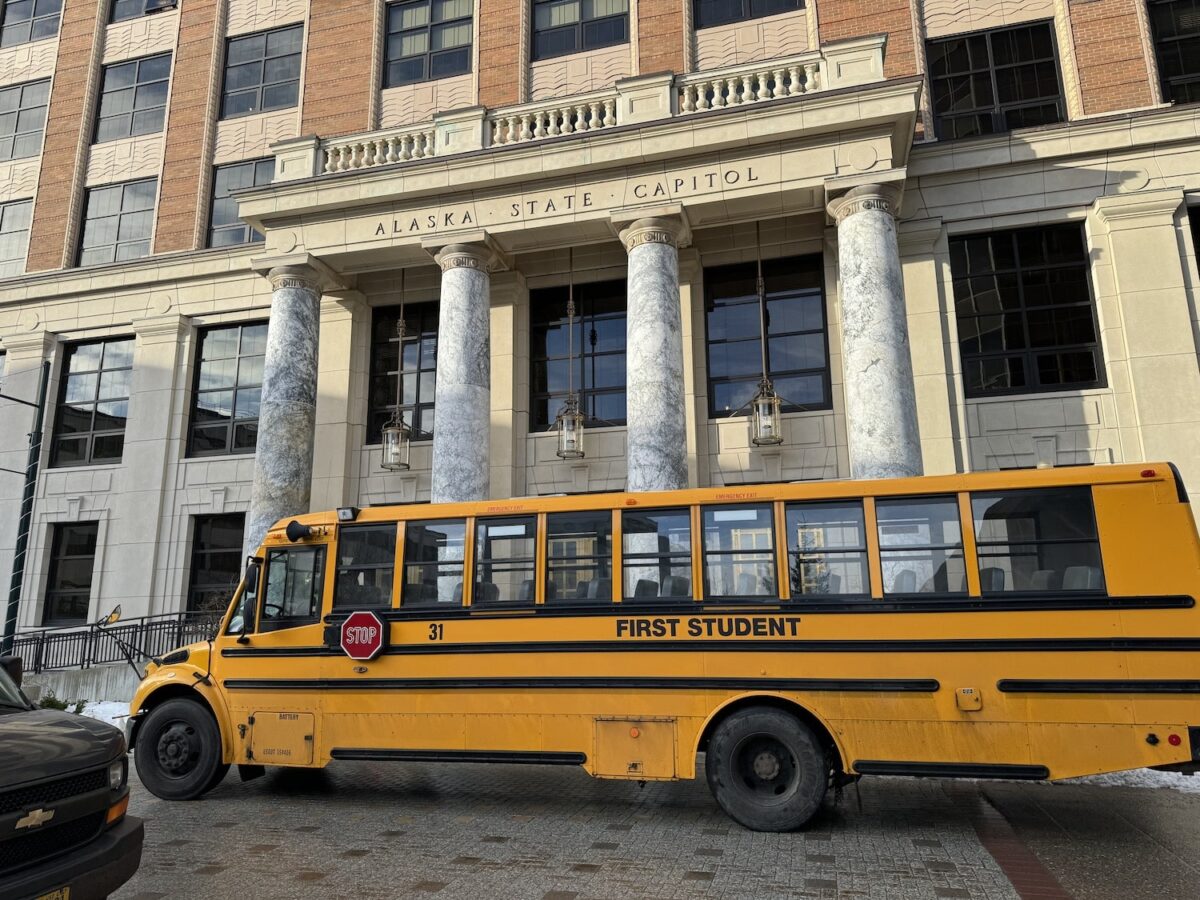
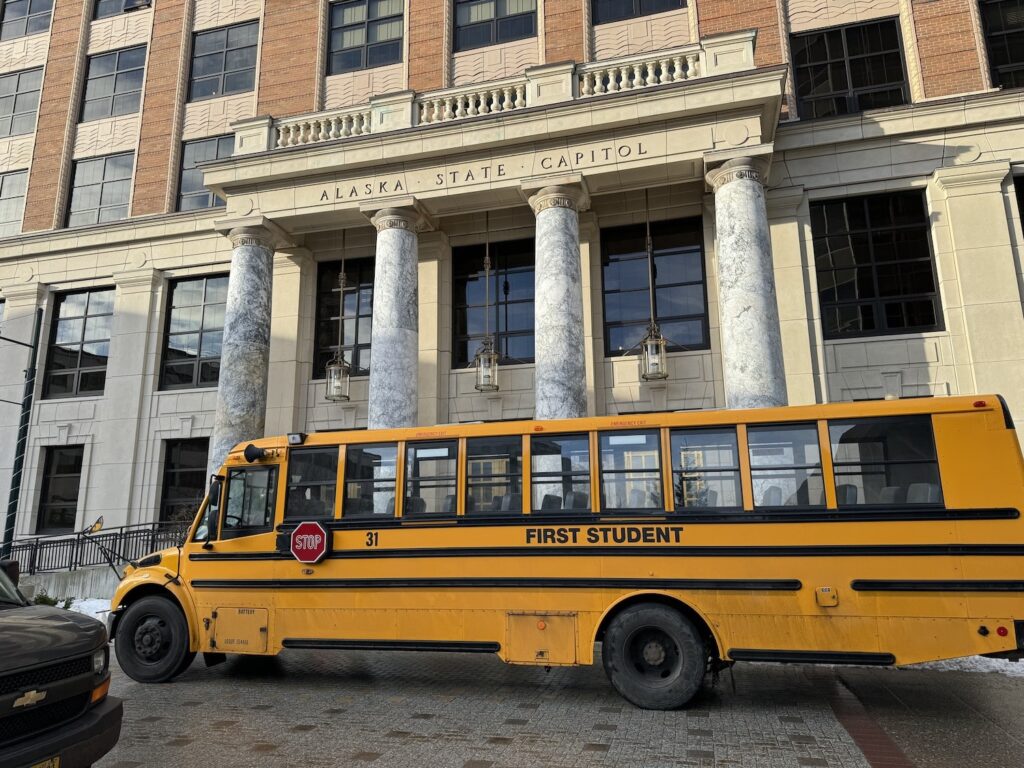
A school bus passes in front of the Alaska Capitol on Tuesday, Feb. 6, 2024. (Photo by James Brooks/Alaska Beacon)

NOTN- Alaska lawmakers will hold the first meeting of the Education Task Force today, beginning a 17-month process to evaluate the state’s approach to school funding and policy.

The task force, is charged with producing a report to the full legislature that will examine education funding formulas as well as policy items championed by the governor and other lawmakers.

“it’s a really broad mandate.” Said Juneau Senator Jessie Kiehl, we’ll look at education funding, look at some policy issues, including several that were on the governor’s wish list, and and really dig in.”

The Education Task force is described as multipartisan, with both democratic and republican leaders starting work this August.

“We’re going to bring in a lot of information, a lot of experts, and see if we can figure out what the state needs to do, to really improve education stability, education funding and outcomes for Alaska kids.” said Kiehl.

The panel’s creation stems from House bill 57, and is part of Alaska’s ongoing political and financial discussions surrounding education.

“This task force was in the bill that the Governor vetoed, that Bill had, of course, most importantly, the funding stabilization, but then it also had a number of education policy things that the governor wanted, some legislators wanted,” Kiehl said,”The governor’s veto, he said, was because he didn’t get all of the policy pieces he wanted. One of the things this task force is going to look into is some of those policy pieces that just did not have support in the legislature.”

Task force members said they will revisit some of those disputed policy proposals while focusing on long-term solutions to strengthen education in Alaska.