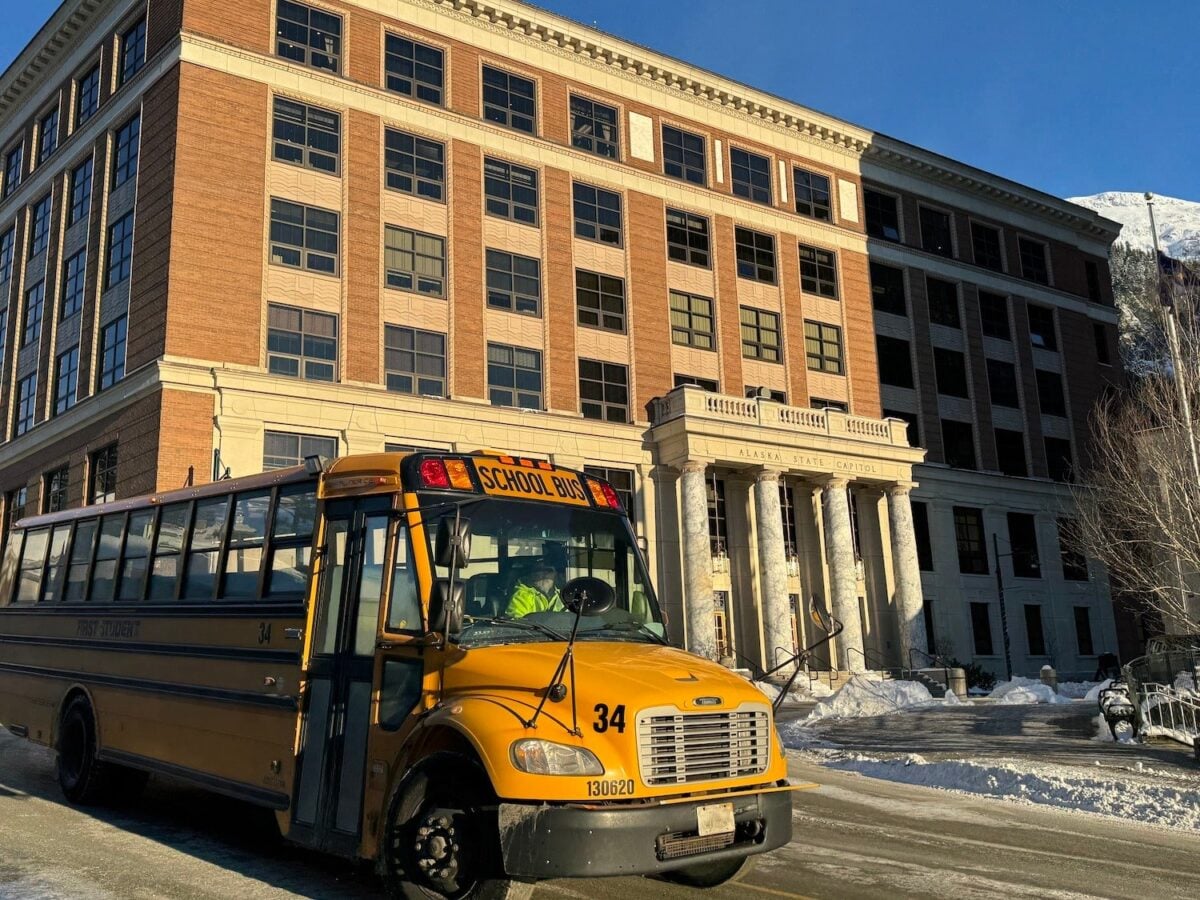
A school bus drives in front of the Alaska State Capitol on Monday, Feb. 3, 2025. (Photo by James Brooks/Alaska Beacon)
A school bus drives in front of the Alaska State Capitol on Monday, Feb. 3, 2025. (Photo by James Brooks/Alaska Beacon)
NOTN- The Juneau School District has begun work on a new five-year strategic plan aimed at guiding the district through academic, organizational and financial challenges ahead.
“Strategic planning is a really important process for school districts being able to plan for the future.” Said Board of Education member David Noon, “Everyone is focused on the direction and the vision, where a district wants to go.”
Superintendent Frank Hauser said the planning process comes as the district concludes its previous strategic plan, adopted in 2020. School district strategic plans are typically updated every five years.
The current planning process began last spring and has included focus groups, surveys and meetings with community members, staff and district stakeholders. The goal, Hauser said, is to define clear priorities and outcomes for the next phase of the district’s work.
Noon said the plan centers on several key areas, “There’s a couple of major areas that we are aiming to focus our attention on over the course of the next five years, obviously starting first with the students, the second couple of which deal with the organization itself, the district staff. How do we recruit talented teachers? How do we as an organization act in a responsible way that’s driven by integrity? And then there’s also the financial, fiscal and operational sort of security that we’re trying to guarantee.” Noon said, “So we definitely are using the experience of the consolidation and thinking about the atmosphere of education funding in Alaska and, of course, nationwide as we develop this plan for the next five years. We can’t predict the future, but we can create a structure that allows us to adapt to whatever happens over the next couple of years while not just reacting to it.”.
Hauser said the strategic plan will also play a critical role in guiding budget decisions based on community priorities.
“From a budget perspective, when the community comes together and develops that strategic plan and everyone gets behind that, the board, through the budgeting process, can identify what the primary goals are.” Hauser said.
The draft strategic plan is now in its final phase and is expected to be presented to the Board of Education for a first reading in January, followed by a second reading shortly after.
Public input remains part of the process. The draft plan is available on the Juneau School District website, and community members may provide feedback during regular board meetings, held on the second Tuesday of each month, or by contacting board members directly.
Hauser, who announced earlier this year that he will be leaving the superintendent position, said the strategic plan is intended to provide continuity as leadership transitions occur.
“We’ve done a lot of great work here, the Juneau school district staff are some of the best staff in the world.” Hauser said, “Consolidation was hard. Those were really tough decisions. But I think, in looking at the future, we’re on much better financial footing. There are still challenges with the budget, but I think coming together and putting together a fiscal plan that is more focused, and having opportunities for kids, and even through the consolidation, being able to maintain those opportunities for our students and still see growth, those are the things I’m really proud of.”
Students swing on a playground at Meadow Lakes Head Start in Wasilla, Alaska. It closed in 2024 due to funding and staffing challenges. (Image by Lela Seiler, courtesy of CCS Early Learning)
The Alaska Supreme Court has ruled that the state’s child support system has first priority when a foreclosed property is sold to pay multiple debts.
The court issued its opinion on Nov. 28, resolving a long-running lawsuit brought by Global Federal Credit Union (formerly Alaska USA) against the state and several other defendants.
“This is a pretty important case from my client’s perspective,” said Jonathan Clement, a senior assistant attorney general who represented Alaska’s child support system.
“This is the first time that a court has actually decided that child support gets priority over all other judgment lien holders, even liens recorded earlier, when there’s surplus funds at issue,” he said.
The case decided by the court involved property in Eagle River that was mortgaged by Wells Fargo. In 2017, Global levied a lien against the property for unpaid debt. Shortly afterward, the state’s child support division recorded another lien against the property for unpaid debt.
Typically, liens are repaid in chronological order: First filed, first paid.
In 2018, a law firm sold the property through foreclosure and paid off the remaining Wells Fargo mortgage. There was money left over, but not enough to pay both Global and the state.
The state protested the law firm’s plans to pay Global first, and the firm complied with a state order that required it to pay the state first.
Global sued in state court, but a district court judge and a superior court judge each ruled against the credit union before it appealed to the supreme court.
Writing on behalf of the court, Justice Jude Pate concluded, “Our interpretation of (state law) provides an effective priority for CSSD liens over competing judgment liens.”
Alaska’s Child Support Services Division (CSSD) is now known as the Child Support Enforcement Division (CSCD).
That priority doesn’t put the state above a bank holding a mortgage or “deed of trust” but it does give the state priority over other liens on the property.
“The important thing for this case is that it gives CSCD another tool where they can try to collect money that’s owed by the obligors,” Clement said.
“I would say of all the cases I’ve worked on, this is the one that will have the most impact in my career going forward,” he said.
An attorney representing Global declined comment on behalf of the credit union.
In a footnote attached to the case, Pate wrote that the court’s ruling could cause people to behave differently during foreclosure auctions.
He suggested that if the Legislature disagrees with the court’s interpretation, it might want to pass a law clarifying two conflicting statutes interpreted by the court.
“If our interpretation is contrary to the legislature’s intent,” he wrote, “amendments to the relevant child support statutes could clarify the interaction between child support liens, other liens, and mortgages.”
CBJ- Tlingit & Haida and the City and Borough of Juneau (CBJ) are pleased to announce a new partnership to expand early childhood education and youth development opportunities in Juneau. Through a recently finalized lease agreement, Tlingit & Haida will utilize classroom space at Floyd Dryden to bring three Head Start classrooms, LEARN and youth programs under one roof.
Construction and remodeling of the new space are currently underway and are scheduled for completion by January 2026. Once finished, the updated facility will provide a welcoming, child-centered environment designed to support high-quality education and holistic youth programming for Juneau’s families.
“This partnership represents a shared commitment to Tribal citizen children and their futures,” said Tlingit & Haida President Chalyee Éesh Richard Peterson. “We are grateful to the City and Borough of Juneau for working collaboratively with us to create a unified space for learning and growth. When we invest in our youth, we invest in the strength and resilience of our community. This project brings together education, culture, and care in one place—helping our youngest learners and future leaders thrive.”
Mayor Beth Weldon emphasized the importance of community partnerships in expanding access to education and youth resources. “The City and Borough of Juneau is proud to partner with Tlingit & Haida on this project,” said Weldon. “Providing quality early education and youth programming is a shared goal that benefits the entire community. By working together, we’re ensuring that families have access to the resources and support their children need to succeed.”
The lease agreement ensures that Floyd Dryden Middle School continues to be an active and valuable part of the community. The building is far from sitting empty—it will soon be home to Tlingit & Haida’s early education and youth services while maintaining community access to shared spaces. The gymnasium is not part of the lease and will remain available for scheduled programming and public use through CBJ Parks and Recreation’s regular scheduling process.
A Central Hub for Tlingit & Haida Youth and Family Services The Floyd Dryden site will be the home to a growing number of Tlingit & Haida’s youth services and will serve as a central hub for:
Three Head Start classroomspromoting school readiness at no cost to families for any eligible child age 3 to 5 years (Head Start Pre-School) and 18 months to 3 years (Early Head Start)
Little Eagles and Raven’s Nest, a licensedchildcare center that provides year-round, full day care and early learning for any child age 0 to 6 years.
Haa Yoo X̲’atángi Kúdi, a pre-kindergarten Lingít language immersion nest program that serves tribal citizen children age 3 to 5 years.
The future Native Boys & Girls Club, which will expand after-school, cultural, and family engagement opportunities for youth age 6-18 and the broader Juneau community.
“Wayfinders, Wellness, and the Native Boys & Girls Club all work toward the same goal—helping our youth discover their strengths and lead with confidence,” said Tlingit & Haida Youth Engagement Manager Jasmine James. “We’re investing in the next generation of leaders who will carry forward our values, culture, and community pride.”
Bringing early education and youth programs together under one roof strengthens Tlingit & Haida’s ability to support children and families from early learning through adolescence. The project reflects both partners’ long-term vision of fostering education, wellness, and community connection.
A guided tour of the facilities is scheduled for today, November 18 at 1 PM.
A community open house is planned for early 2026 to celebrate the completion of the space and to recognize the collaboration that made the project possible.
About the City and Borough of Juneau The City and Borough of Juneau (CBJ) is the capital city of Alaska and serves as the hub of government, education, and culture for the region. CBJ is committed to partnerships that support thriving families and strong educational foundations for all residents.
About Tlingit & Haida The Central Council of the Tlingit & Haida Indian Tribes of Alaska is a sovereign tribal government representing over 38,000 citizens worldwide. The Tribe provides a wide range of services and programs to support the well-being of its citizens and strengthen communities across Southeast Alaska.
The Lyndon Baines Johnson Department of Education Building pictured on Nov. 25, 2024. (Photo by Shauneen Miranda/States Newsroom)
AP- The Trump administration says its plan to dismantle the Education Department offers a fix for the nation’s lagging academics — a solution that could free schools from the strictures of federal influence.
Yet to some school and state officials, the plan appears to add more bureaucracy, with no clear benefit for students who struggle with math or reading.
Instead of being housed in a single agency, much of the Education Department’s work now will be spread across four other federal departments. For President Donald Trump, it’s a step toward fully closing the department and giving states more power over schooling. Yet many states say it will complicate their role as intermediaries between local schools and the federal government.
The plan increases bureaucracy fivefold, Washington state’s education chief said, “undoubtedly creating confusion and duplicity” for educators and families. His counterpart in California said the plan is “clearly less efficient” and invites disruption. Maryland’s superintendent raised concerns about “the challenges of coordinating efforts with multiple federal agencies.”
“States were not engaged in this process, and this is not what we have asked for — or what our students need,” said Jill Underly, Wisconsin’s state superintendent. Underly urged the Trump administration to give states greater flexibility and cut down on standardized testing requirements.
Education Secretary Linda McMahon said schools will continue receiving federal money without disruption. Ultimately, schools will have more money and flexibility to serve students without the existence of the Education Department, she said.
Yet the department is not gone — only Congress has the power to abolish it. In the meantime, McMahon’s plan leaves the agency in a version of federal limbo. The Labor Department will take over most funding and support for the country’s schools, but the Education Department will retain some duties, including policy guidance and broad supervision of Labor’s education work.
Similar deals will offload programs to the Department of Health and Human Services, the State Department and the Interior Department. The agreements were signed days before the government shutdown and announced Tuesday.
Inking agreements to share work with other departments isn’t new: The Education Department already had dozens of such agreements before Trump took office. And local school officials routinely work with other agencies, including the U.S. Agriculture Department, which oversees school meals. What’s different this time is the scale of the programs offloaded — the majority of the Education Department’s funding for schools, for instance.
Yet Virginia schools chief Emily Anne Gullickson, for one, said schools are accustomed to working with multiple federal agencies, and she welcomed the administration’s efforts to give states more control.
Where some see risk of upheaval, others see a win over bureaucracy
Response to the plan has mostly been drawn along political lines, with Democrats saying the shakeup will hurt America’s most vulnerable students. Republicans in Congress called it a victory over bureaucracy.
Yet some conservatives pushed back against the dismantling. U.S. Sen. Lisa Murkowski, an Alaska Republican, said on social media that moving programs to agencies without policy expertise could hurt young people. And Margaret Spellings, a former education secretary to Republican President George W. Bush, called it a distraction to a national education crisis.
“Moving programs from one department to another does not actually eliminate the federal bureaucracy, and it may make the system harder for students, teachers and families to navigate and get the support they need,” Spellings said in a statement.
There’s little debate about the need for change in America’s schooling. Its math and reading scores have plummeted in the wake of COVID-19. Before that, reading scores had been stagnant for decades, and math scores weren’t much better.
McMahon said that’s evidence the Education Department has failed and isn’t needed. At a White House briefing Thursday, she called her plan a “hard reset” that does not halt federal support but ends “federal micromanagement.”
Randi Weingarten, president of the American Federation of Teachers union and one of McMahon’s sharpest opponents, questioned the logic in her plan.
“Why would you put a new infrastructure together, a new bureaucracy that nobody knows anything about, and take the old bureaucracy and destroy it, instead of making the old bureaucracy more efficient?” Weingarten said at a Wednesday event.
Schools fear the impact of lost expertise on education laws
The full impact of the shakeup may not be clear for months, but already it’s stoking anxiety among states and school districts that have come to rely on the Education Department for its policy expertise. One of the agency’s roles is to serve as a hotline for questions about complicated funding formulas, special education laws and more.
The department has not said whether officials who serve that role will keep their jobs in the transition. Without that help, schools would have few options to clarify what can and can’t be paid for with federal money, said David Law, superintendent of Minnetonka Public Schools in Minnesota.
“What could happen is services are not provided because you don’t have an answer,” said Law, who is also president of AASA, a national association of school superintendents.
Some question whether other federal departments have the capacity to take on an influx of new work. The Labor Department will take over Title I, an $18 billion grant program that serves 26 million students in low-income areas. It’s going to a Labor office that now handles grants serving only 130,000 people a year, said Angela Hanks, who led the Labor office under former President Joe Biden.
At best, Hanks said, it will “unleash chaos on school districts, and ultimately, on our kids.”
In Salem, Massachusetts, the 4,000-student school system receives about $6 million in federal funding that helps support services for students who are low-income, homeless or still mastering English, Superintendent Stephen Zrike said. He fears moving those programs to the Labor Department could bring new “rules of engagement.”
“We don’t know what other stipulations will be attached to the funding,” he said. “The level of uncertainty is enormous.”
Other critics have noted the Education Department was created to consolidate education programs that were spread across multiple agencies.
Rep. Bobby Scott, D-Va., the ranking member on the House Education and Workforce Committee, urged McMahon to rethink her plan. He cited the 1979 law establishing the department, which said dispersion had resulted in “fragmented, duplicative, and often inconsistent Federal policies relating to education.”
___
AP education writers Moriah Balingit in Washington, Bianca Vázquez Toness in Boston and Makiya Seminera in Raleigh, N.C., contributed to this report.
One of the outdoor sculptures at the University of Alaska Anchorage campus is integrated into a fountain, pictured here on May 16, 2022. More than half of the University of Alaska system schools attend UAA or one of its satellite campuses. (Photo by Yereth Rosen/Alaska Beacon)
The University of Alaska is anticipating an increase of up to 10% for health care costs this fiscal year, on par with what employers are anticipating nationally, according to officials presenting to the Board of Regents at their meeting on Nov. 6.
Nikole Conley, chief of human resources for the university system, gave a presentation outlining the university system’s health care costs so far, and projections for the rest of this fiscal year, ending in July 2026. Her presentation included medical, dental and pharmacy care.
“We do see health care costs across the nation going up and increasing, and we’re not necessarily expecting this to decline anytime soon,” she said.
The university is projecting 8% to 10% overall cost increases across the system for this fiscal year. That means health coverage for 3,442 employees is estimated to cost $85.5 million.
A screenshot from a University of Alaska presentation on health care costs on Nov. 6, 2025, shows a rise in costs in recent years.
“We are seeing trend increases of 8% for medical, 13% for pharmacy and 4% for dental. We’ll do another recast in January of 2026 and hopefully try to firm up that figure and what that’s going to look like,” Conley said.
Nationally, employers are expecting an 8.5% increase in medical costs and an 11% increase in pharmacy costs, she said, so the university’s costs and projections are mirroring that trend.
Health care costs in Alaska are among the highest in the nation, according to state data. Since 2023, the average cost of a health insurance marketplace plan in Alaska rose by more than 16% each year. In 2023 alone, the cost went up by an average of 18.4%.
The university has a cost split for health care with 18% paid by employees in premiums, and 82% paid by the universities. Conley presented total cost projections to the board.
Conley said the number of university employees isn’t growing, but more people are opting into the university’s health care plan. She said system-wide the largest cost increase is in pharmacy claims, but her department is expecting to renegotiate pharmacy costs, which could save the university about $3 million.
Last year, the university saw pharmacy spending increase 11.2% from the year before. Over the last five years, overall pharmacy costs more than doubled from $9.2 million to $19.2 million, she said.
Conley said that’s partly due to a rise in prescriptions for drugs used for weight loss and to treat diabetes, known as GLP-1 drugs like Ozempic. They were the second highest pharmacy claim within the university’s plan, totaling $4.1 million last fiscal year.
“We’re also looking at the potential elimination of GLP-1s, because they are a major cost driver for us,” she added.
University of Alaska Regent Karen Perdue pushed back against that idea, pointing out that weight loss can also improve employees’ health outcomes and result in less health care costs. “It’s not just a plus, there can be a minus on the bottom line as well,” she said.
A screenshot from a University of Alaska presentation on health care costs on Nov. 6, 2025 shows the highest claims for medical and pharmacy care
University of Alaska President Pat Pitney also pointed out other high pharmacy costs last year. The largest costs were on inflammatory diseases, with the highest cost at $4.3 million, and cancer treatments at $1.3 million.
The highest medical costs for the university last fiscal year were for muscle, joint and bone claims at $10.7 million, followed by cancer at $7 million, and behavioral health and disorder treatments at $5.3 million.
Last year, the university’s total costs came in at $80.1 million, which was $1.1 million over the university’s projection. Conley said next year’s premiums will go up to recover those costs.
Conley said her department is working to push more education and use of wellness programs and preventative health care.
“Not only are we seeing this growth of 8% to 10% in cost, but we’re also seeing less use, for some reason, of our preventative health care. And so we’re really trying to encourage folks to use preventative health care, because that will help minimize some of our costs in the future,” she said.
According to university data presented by Conley, only half of health care participants used preventative screenings, like annual physical exams or checkups; nearly 38% of emergency room visits could have been avoided with better primary care or urgent care use; and 38% of participants are categorized as pre-obese or obese.
The university is insured through Premera Blue Cross, and Conley said her department discusses health care plan changes with the university’s Joint Health Care Committee, an advisory committee made up of representatives from the faculty union, management and staff.
The university is also expecting a health care rebate, which is a benefit paid back to employees if they utilize the prevention programs throughout the year, like cancer screenings, dental care, and regular check ups.
“We’re estimating about a $1.5 million rebate,” Conley said, for this year, ending in July 2026. “We’re going to see up to a $2.5 million rebate increase in FY27 with new rates. So that’s a good positive.”
The debate around national health care, federal tax credits, and costs for Americans has been at the heart of bitter negotiations around ending the longest government shutdown in U.S. history. The U.S Congress approved a stopgap spending bill ending the shutdown. Democrats have introduced a discharge petition to force a vote to extend tax credits for three years under the Affordable Care Act. White the Senate Majority leader has promised a vote by the end of the year, leaders of the Republican-majority House have remained opposed, and discussions on health care are ongoing.
NOTN- University of Alaska President Pat Pitney formally announced her retirement.
She was appointed the University system’s 17th president in 2022 and served as interim president in 2020.
Previously Pitney served as the state’s Director of the Division of Legislative Finance. She was the former Vice Chancellor of Administration, University of Alaska Fairbanks and worked at UA Statewide for 17 years. In all, Pitney spent 23 years with the University of Alaska before leaving to serve as the State Budget Director in the administration of former Governor Bill Walker.
Pitney moved to Fairbanks in 1987 from Billings, Montana. She earned her MBA from UAF and an engineering physics degree from Murray State University (Kentucky). She has three adult children and four grandchildren. All three of her children are UA graduates, with degrees from UAF, UAA and UAS.
Before moving to Alaska, she was a member of the 1984 U.S. Olympic Team and won a gold medal in women’s air rifle.
Below is the email announcing Pitney’s retirement;
Dear UA Community – It has been my honor and privilege to serve as University of Alaska president for the past five years. When the Board hired me in 2020, I wasn’t seeking either the interim or permanent president position, but I felt my skill set would be an asset to UA and our mission. I committed initially to two years of service, and more than five years later, I’m proud of how far we’ve come and excited about the opportunities ahead. There’s much to celebrate, but it is time for me and the UA system to be looking toward the next chapter. Several months ago, I informed the Board of Regents that I plan to retire after their May 2026 board meeting. I’m confident that the University of Alaska will continue to thrive long after I step away. As an alum, and the parent of alums from each of our three universities, it’s been one of the greatest honors of my life to serve all of you and the people of Alaska. Since 2020, we’ve made some incredible progress.
We’ve reversed enrollment declines and grown student headcount for three straight years.
We’ve stabilized our budget after a period of uncertainty compounded by a once-in-a-century pandemic.
We’ve substantially increased our competitive research position.
And we’ve reminded Alaskans of UA’s vital role in empowering our workforce, economy, and communities.
There’s still work to do, but the future is strong. The Board’s recent focus on student recruitment, retention, and graduation, along with expanded scholarships and financial aid, is already paying off and positioning UA for success. Retirement will be bittersweet. I’m looking forward to spending more time with my kids, my grandkids, and my mom, and exploring the state I love so deeply. But until May, I’ll remain full-speed ahead: advocating for our budget priorities in Juneau, and working closely with the Board to ensure a seamless leadership transition in my role and at the Universities.
In the weeks ahead, the Board will share more about the presidential search and how you can take part in shaping UA’s next chapter. I hope you’ll stay engaged in that process. For over three decades, I’ve seen how the University of Alaska empowers this state. Our education, research, and partnerships make a difference in every community. Serving as your president has been the honor of my career. I look forward to finishing this chapter strong and cheering you on as you continue UA’s work to empower Alaska. Thanks for all you do for our students and our state.
CBJ- Several Glacial Lake Outburst Flood (GLOF) mitigation topics will be presented by local experts and federal agencies during a Special GLOF Assembly Committee of the Whole Meeting on Thursday, Oct. 30.
The special meeting agenda includes presentations on recent key studies and understanding of the science of Suicide Basin from University of Alaska Southeast and the National Weather Service. Representatives from two branches within the United States Army Corps of Engineers (USACE) will be present to walk through next steps for their respective programs, including both short-term mitigation and progress toward identification of an enduring solution.
The Natural Resources Conservation Service (NRCS) will present on the Emergency Watershed Protection Program and the potential buyout program for View Drive.
Thursday’s meeting will begin at 6 p.m. in City Hall Assembly Chambers and online at the link below. As is standard with Committee of the Whole meetings, public testimony is not included in the agenda, however, members of the public are invited to share questions and comments on the topic at boroughassembly@juneau.gov and emergencyresponse@juneau.gov.
FILE – Bear sculptures sit outside the Boney Courthouse, where the Alaska Supreme Court hears cases, in downtown Anchorage, Alaska, Sept. 10, 2024. (AP Photo/Mark Thiessen, File)
AP- The Alaska Supreme Court is weighing a case that is expected to determine who can provide abortion care in the state.
The court heard arguments Wednesday in a 2019 case challenging the constitutionality of a law that states only a doctor licensed by the State Medical Board can perform an abortion in Alaska.
The law, dating to the 1970s, was struck down as unconstitutional by Superior Court judge Josie Garton last year, a victory for the group that brought the challenge, Planned Parenthood Great Northwest, Hawaii, Alaska, Indiana, Kentucky. The state appealed Garton’s ruling.
Planned Parenthood has argued there is no medical justification for the restriction and that it unfairly burdens those seeking an abortion by limiting the pool of those qualified to provide care. In 2021, Garton granted the group’s request to allow advanced practice clinicians — health care workers, such as nurse practitioners and physician assistants — to provide medication abortion pending her decision in the underlying case. They have continued to do so and since the 2024 ruling also have been able to provide procedural abortions, Planned Parenthood says.
Advanced practice clinicians routinely provide care similar in risk and complexity to that of providing abortion services, and in 25 states can provide medication abortion, attorneys for Planned Parenthood said in court documents. Planned Parenthood’s advanced practice clinicians seek to provide abortion care in just the first trimester, the attorneys said.
Since Garton’s 2021 decision, advanced practice clinicians have been providing “nearly all” medication abortions in Alaska, and Planned Parenthood clinics in the state have been able to offer medication abortion each day they’ve been open, the attorneys wrote. Before that, doctors hired by Planned Parenthood on a per diem basis — at the clinics on limited days — were able to offer medication abortions perhaps once or twice a week at each clinic, they wrote.
A vital statistics report released by the state this year shows that the total number of abortions in Alaska has been fairly consistent — 1,229 in 2021, 1,247 in 2022, 1,222 in 2023 and 1,224 last year. The report says that could include cases where medication was provided to manage a miscarriage, but without providing a number. It also says reasons for ending pregnancies are not reported to the state.
The U.S. Supreme Court in 2022 overturned a federal right to abortion, leaving it up to each state to regulate.
Access to health care has been a longstanding concern in Alaska, with travel — sometimes covering hundreds of miles — required for many residents. Compounding that are ongoing challenges to recruit and keep medical providers.
Most Alaska communities are not connected to the state’s main road system, and health care in many small communities is often limited, requiring residents to fly to larger cities, such as Anchorage or Seattle, for more options or for specialized care. Roundtrip flights can easily cost hundreds of dollars. In remote communities, fog or poor weather can cause flight delays.
Planned Parenthood has two clinics in Alaska, in Anchorage and Fairbanks. It closed its clinic in Juneau last year.
The Alaska Supreme Court has long interpreted the right to privacy in the state’s constitution as encompassing abortion rights.
But attorneys for the state argued in court filings that Planned Parenthood did not show that the law at the center of the legal challenge had “inhibited women in Alaska from exercising their right to choose an abortion.” Planned Parenthood could have hired more doctors but chose not to, wrote the attorneys, including Laura Wolff, an assistant attorney general.
“Even if an occasional patient were prevented from getting an abortion, the physician-only law is not unconstitutional as applied to all women who are not significantly affected by the law because the law has a plainly legitimate sweep,” the filing states.
Wolff and Camila Vega, an attorney representing Planned Parenthood, argued their respective sides in court Wednesday. The court did not indicate when it might rule.
Members of the Tlingit, Haida and Tsimshian group Aanchich’x Kwaan perform on Oct. 18, 2025, at the Alaska Federation of Natives convention in Anchorage. The dance and singing group has members of all age groups, from young children to elders. The group was among several that performed traditional dances at the convention. (Photo by Yereth Rosen/Alaska Beacon)
The Alaska Federation of Natives convention in Anchorage, while it featured the usual cultural celebrations, socializing and discussions of state and federal policies, had a strong focus this year on a particular subject: the ravages on the Yukon-Kuskokwim Delta of ex-Typhoon Halong.
Natasha Singh poses for photos in the hallway of the Dena’ina Civic and Convention Center, site of the Alaska Federation of Natives annual convention. Singh, who is president of the Alaska Native Tribal Health Consortium, had just delivered her keynote speech on the opening morning of the convention. (Photo by Yereth Rosen/Alaska Beacon)
Speaker after speaker at the convention, the largest annual convention of any kind in Alaska and one of the largest Indigenous gatherings in the nation, referenced the storm. It has displaced more than 1,500 people, killed at least one person and dislodged houses from their foundations. Residents of stricken villages have been airlifted away, with hundreds getting temporary residency in Anchorage. The state’s largest city is about 490 miles east of the evacuees’ home villages, and vastly different in culture and character from the highly rural Indigenous communities.
“My heart with everyone impacted by the recent coastal storms,” Natasha Singh, the president of the Alaska Native Tribal Health Consortium and the keynote speaker on the first day of the convention, said at the start of her address.
“While the damage is so vast, the love for our people is even greater. And even as we feel the pain and the loss, I also feel a sense of inspiration to see so many people reach out to help,” she continued.
Volunteers work on Oct. 18, 2025, to sort donated items being collected in a room in the Dena’ina Civic and Coonvention Center, site of the Alaska Federation of Natives annual convention. Donations of diapers, clothing, hygiene products, bottled water, shelf-stable food and other items were being collected for Yukon-Kuskokwim Delta residents displaced by the remnants of Typhoon Halong. (Photo by Yereth Rosen/Alaska Beacon)
A special feature of the convention was a second-floor room at the Dena’ina Civic and Convention Center that was set aside to collect donations headed to the storm victims. Over two days, as convention proceedings unfolded in the third-floor ballroom, the collection room became filled with boxes of diapers, toiletries, clothing items, shelf-stable food and other necessities that were sorted by volunteers.
On Saturday, the final day, delegates passed a resolution seeking an immediate national disaster declaration, and investment by the federal government in better infrastructure in rural Alaska to protect against future disasters.
The ravages of the remnants ofTyphoon Halong demand more than an emergency response, the resolution said. The disaster “has continued to expose vulnerabilities in infrastructure, housing, and emergency preparedness for rural Alaska/extreme remote America, and highlights the need for stronger tribal-state-federal collaboration,” it said.
Alaska Federation of Natives convention attendees from the Yukon-Kuskokwim region listen on Oct. 16, 2025, to the keynote address delivered by Natasha Singh, president of the Alaska Native Tribal Health Consortium. (Photo by Yereth Rosen/Alaska Beacon)
The call for a national disaster declaration and the aid that would come with it was among a packet of resolutions passed on Saturday. Many of the resolutions concerned food security and efforts to ensure that Alaska Natives can safely practice their traditional fishing and hunting practices.
One highly anticipated convention speaker was former U.S. Rep. Mary Peltola, D-Alaska, who is considered a possible candidate for governor or U.S. Senate.
But Peltola made no campaign announcement.
“I want to preface everything I’m saying with: This is going to be very anticlimactic for everybody, I think,” she said at the start of her speech. “No big announcements, no big declarations.”
Former U.S. Rep. Mary Peltola, D-Alaska, speaks at the Alaska Federation of Natives convention on Oct. 17, 2025, about subsistence food gathering. Peltola is Yup’ik and from Bethel. (Photo by Yereth Rosen/Alaska Beacon)
Instead, she discussed subsistence – the traditional harvests of wild foods and arts materials – and the legal and environmental threats to its continued practice.
State legislators sit onstage at the Alaska Federation of Natives convention on Oct. 17, 2025, as House Speaker Bryce Edgmon, I-Dillingham, addresses the audience. Lawmakers pictured are, from the left, Rep. Neal Foster, D-Nome; Rep. Maxine Dibert, D-Fairbanks; Rep. Andrew Gray, D-Anchorage; Rep. Zack Fields, D-Anchorage; Rep. Robyn Burke, D-Utqiagvik; Rep. Louise Stutes, R-Kodiak; Sen. Donny Olson, D-Golovin; and Rep. Nellie Jimmie, D-Toksook Bay. (Photo by Yereth Rosen/Alaska Beacon)
She spoke about the way subsistence ties Alaska Natives to their home regions.
“Those spots, the places that we hunt and fish, they’re like another personality to us,” Peltola said.
She referred to a close friend who recently died. When she was on her deathbed, her family gathered around, Peltola said. “And at one point, they just talked about places. They just said the names of the places where they pick berries, or get whitefish, gather greens. And it was one of the most beautiful moments I’ve ever experienced, just reciting names.”
Kendra Berlin mans a pro-voting table at the Alaska Federation of Natives convention on Oct. 16, 2025. Berlin, originally from Bethel but now living in Palmer, was distributing T-shirt and buttons promoting the Natives Vote cause. (Phot by Yereth Rosen/Alaska Beacon)
NOTN- Sealaska Heritage Institute held a public ceremony yesterday to officially open new Indigenous Science Building and dedicate a newly carved totem pole that will take its place on Juneau’s waterfront.
The event, held on Indigenous People’s Day included the formal naming of the facility, the dedication of a Sukteeneidí kootéeyaa (totem pole), and cultural performances at Heritage Plaza next to the Walter Soboleff Building.
SHI President Rosita Worl said the four-story building will serve as a hub for education programs that center Indigenous knowledge, languages and values while incorporating modern science and technology.
“The Indigenous Science Building will offer learning experiences that showcase the traditional knowledge of Tlingit, Haida and Tsimshian peoples that has existed for thousands of years. By bringing Indigenous knowledge that integrates Western science into the classroom, we will empower youth and community members with critical thinking skills that will strengthen regional economies and deepen our knowledge of the environment,” Worl Said.
The building will feature a traditional foods kitchen, digital media lab, Indigenous science research lab, and fabrication and makerspace facilities. It will host K–12 and community programs, after-school and weekend classes, and summer workshops for students from Alaska and beyond.
The façade features a monumental art installation based on an original piece by the renowned Haida artist Robert Davidson, whose work also inspired the facades of the institute’s Walter Soboleff Building and Atnané Hít, the Sealaska Heritage Arts Campus building, which SHI opened in 2015 and 2022 respectively. During the ceremony, the facility will officially be given the name Indigenous Science Building.
During Monday’s ceremony, the new totem pole was dedicated as part of SHI’s Kootéeyaa Deiyí (Totem Pole Trail) project in downtown Juneau. The pole was carved in Ketchikan by Haida artist Lee Wallace and five apprentices.