By: James Brooks, Alaska Beacon
Last year, a state-owned Alaska corporation transferred leadership of the proposed trans-Alaska natural gas pipeline project to a private developer.
Now, a newly revealed draft of the agreement between the state-owned Alaska Gasline Development Corp. and Glenfarne, the private developer, shows that if the project fails to go forward under certain conditions, the state could be required to pay in order to retake control of the project.
The contract between AGDC and Glenfarne has never been published and remains confidential, but a handful of state senators obtained a leaked draft copy during debates over the size and scope of a $16 billion tax break intended to benefit the pipeline project.
The draft offers the best glimpse to date about the relationship between the state-owned AGDC and Glenfarne, which together are pursuing a multibillion-dollar effort to sell natural gas from the North Slope.
“It’s a significant document. It should be taken seriously,” said Sen. Bert Stedman, R-Sitka.
As legislators debated the bill containing the tax break this month, the leaked document inspired some members of the Senate to amend the legislation. Meanwhile, the document stayed secret from other senators, members of the House and Alaskans overall.
Gov. Mike Dunleavy and members of the House criticized the Senate’s version of the tax-break bill, calling it unacceptable. The governor and House lawmakers said they prefer a separate version passed by the House.
“I don’t know how the document got out to people that it got out to, but somehow it did, and quite frankly, thank God it did,” said Sen. Bill Wielechowski, D-Anchorage.
When the Beacon asked AGDC and Glenfarne about the document and its contents, each said they are bound by a confidentiality rule and cannot discuss them.
“We believe Glenfarne can deliver something enormously important for the state: reliable and affordable energy, thousands of jobs, and the opportunity to finally unlock the value of North Slope natural gas for future generations of Alaskans,” said Tim Fitzpatrick, a spokesman for Glenfarne, by email. “Business documents are protected as a matter of ethical and good faith principles. For that reason, rather than any document specifics, the inappropriate distribution of draft AGDC materials is very disappointing.”
With the House and Senate having passed different versions of the tax-break legislation, lawmakers are negotiating a compromise that could come as early as the first week of July and as late as never.
If the bill advances, the protections inspired by the leaked document could be preserved, diluted or removed entirely.
“The structure of the state’s agreements that could leave Alaskans paying for something is something Alaskans should know,” said Sen. Jesse Kiehl, D-Juneau.
“I’m worried, and I don’t have full information, so we’re doing the best we possibly can,” he said.
Details of the confidential document
The document obtained by the senators dates from a key point in the pipeline project’s history.
Glenfarne announced in January 2025 that it had an agreement with AGDC to take over the project. The two companies said on March 27 of that year that Glenfarne would take the leading role.
That timing indicates the draft obtained by lawmakers and the Beacon was written relatively late in the process and may be close to the final version.
“My impression is that it is a highly refined draft,” Stedman said.
By email, AGDC president Frank Richards said it was written by an AGDC staff member for the corporation’s board of directors.
“The document you reference is a confidential memorandum meant for use by the AGDC Board to make an informed decision on a significant business partnership to move the Alaska LNG Project forward. Alaska LNG has made historic progress in the past fourteen months and development momentum continues,” he wrote.
Glenfarne officials have testified that they will allow legislators who sign non-disclosure agreements to examine financial documents. Members of the Senate Finance Committee have said in hearings that they are unwilling to accept that precondition.
In public statements and in testimony to the Legislature, Glenfarne Alaska president Adam Prestidge has said that the tax break under discussion by the Legislature is critically needed to attract financial support from banks and investors.
Richards reiterated that by email.
“AGDC has identified that Alaska’s oil and gas property taxes are very high compared to other jurisdictions where LNG facilities are built and need to be lowered to help the Alaska LNG Project be competitive to attract capital investment and achieve (final investment decision),” he wrote.
With an officially estimated construction price of between $44.5 billion and $54.5 billion, the project — formally named Alaska LNG or AKLNG — would be one of the largest natural gas projects on Earth.
Under current law, Alaska would levy a 2% property tax on that project when it finishes construction. Legislators are considering whether to replace that tax with a tax on natural gas pumped through the pipeline. The resulting tax break would be worth about $16 billion over the project’s first 30 years of operation.
Alaska would still receive royalties and production taxes from natural gas sold through the pipeline, and it would receive assorted other fees as well, such as the proceeds of carbon dioxide sequestration.
Altogether, the state treasury stands to earn as much as $800 million per year for 30 years. That’s on top of the economic benefits caused by having thousands of extra workers in the state to build the pipeline, and potentially cheaper natural gas for residents and local industries.
As explained in public and in the confidential document, AKLNG would be built in two phases. The first phase would include a “764-mile, 42-inch-diameter pipeline” from the North Slope “into the Southcentral Alaska gas pipeline system.”
Coupled with a small gas treatment facility on the North Slope, that first phase would provide gas for in-state use by Alaskans.
Because the pipeline will not be built before Southcentral Alaska begins running out of gas, the confidential agreement also calls for AGDC and Glenfarne to build a gas import facility together.
Once the pipeline is operating, the partnership would use that equipment for exports.
The second phase would involve connecting the pipeline to the Prudhoe Bay and Point Thomson oil and gas fields, plus construction of a larger gas treatment facility and a liquefied natural gas export facility on the Kenai Peninsula “capable of (exporting) up to 20 million tons per annum.”
The pipeline, North Slope facility and Kenai Peninsula facility are each considered “sub projects” under the agreement between AGDC and Glenfarne.
“Glenfarne will negotiate contracts for construction, equipment, materials, and gas supply,” the document states. “No projects can create an obligation for AGDC or the State of Alaska without prior approval by AGDC or the State of Alaska, respectively.”
Currently, lawmakers are considering whether to restrict AGDC’s ability to borrow money without input from the Legislature. The House version of the tax-break bill would allow AGDC to borrow without permission, but lawmakers could halt the borrowing. The Senate version would require AGDC to ask permission first.
When AGDC and Glenfarne reach a final investment decision — a last decision on whether to build at all — there will be new development agreements that determine the ownership of each subproject.
Ownership would be split among any investors, AGDC and Glenfarne.
In presentations to the Legislature, AGDC officials explained that while the state currently owns 25% of the project, that share will be diluted on each subproject as investors are brought on board. The state will only keep its 25% share if it invests more money.
The confidential draft agreement says Glenfarne must reach “clawback milestones” to continually prove that it is operating in good faith.
If AGDC decides Glenfarne hasn’t met a milestone — such as signing a binding agreement to sell natural gas to a particular customer — it could seek to retake the project. That may require AGDC to pay.
The structure of the state’s agreements that could leave Alaskans paying for something is something Alaskans should know.
– Sen. Jesse Kiehl, D-Juneau
If Glenfarne disputes AGDC’s assessment, the two parties would consult a third party.
AGDC isn’t required to repurchase Glenfarne’s part of the project, but if it does, Glenfarne would be the one proposing the price, “based on the value Glenfarne has added to the company.”
AGDC could dispute that price, and if it does, an “independent investment bank” would determine the final amount.
Senators familiar with the confidential draft said this language was new to them, and they see it as a potential financial liability.
Under the draft agreement, confidentiality is required
In the 15 months since AGDC transferred 75% of the pipeline project to Glenfarne, the companies’ financial and legal arrangements have been kept confidential.
That secrecy is required by the draft agreement, but it has aggravated legislators and slowed work on the issue.
“We are trying to craft legislation to protect the state’s interests, and we’ve been put in a position where we have had to guess what is in the contract or not in the contract in order to protect our interests. That is an awful place to be as a state and as a legislature,” Wielechowski said.
Secrecy between Alaska’s state-owned corporations and their investment partners isn’t unprecedented, nor are controversies over that secrecy.
The Alaska Permanent Fund Corp., for example, is exempt from state public records laws and keeps the details of its investments secret. That fact drew public and legislative ire when the corporation launched a $200 million in-state investment program.
The APFC eventually disclosed a list of in-state investments and wound down the in-state program after several years, citing poor performance.
Elsewhere, investors have favored states that keep their deals secret and exempt from public records laws.
When it comes to the gas pipeline, Glenfarne released an updated estimate for the project’s cost earlier this month, but state lawmakers still don’t have all the financial information they’ve been seeking, including estimates about the project’s profitability.
The confidential draft states that AGDC would share profits with Glenfarne and other partners, but lawmakers don’t know what that share would be or how the project’s economics would change under the tax break being discussed by legislators.
The Alaska Department of Revenue has provided public estimates, but Glenfarne and AGDC have not.
“On the whole, it gets down to the level of information that we need to make good decisions, and we have a little bit more than we had when the bill came out of the House, but we are still pretty short,” said Sen. Jesse Kiehl, D-Juneau and one of the lawmakers who had access to the document.
How we reported this article
The Beacon obtained the draft agreement discussed in this article on Friday from a source who does not work for the Legislature and was able to compare it with a separate paper copy the following day.
The text of the copies was identical, though the paper copy — used by a senator — had its control number and other identifying information clipped out. The senator said they would be shredding their copy after the examination.
We do not know who originally leaked the document, whether there were multiple leakers, or why they shared the document.
After verifying the document, the Beacon called and emailed Glenfarne on Monday about its contents and sent a list of questions by email when asked to do so.
AGDC’s Frank Richards responded by email. Glenfarne officials spoke on the phone but were not willing to be quoted directly, and provided a written statement.
Richards asked for a copy of the “document or documents” the Beacon had. The Beacon declined to send that document — and we are declining to post it in this article — because even with control numbers and other identifying information redacted, it could still contain language that would allow the source to be identified.
The Beacon did not receive answers to all of its questions, including details about how much has been spent on the project to date and possible partnerships with companies mentioned in the draft agreement.
Lawmakers have concerns over the clawback
Senators familiar with the confidential agreement said they don’t recall when they first received it, in part because they initially overlooked its importance.
Sen. Cathy Giessel, R-Anchorage, said she became aware of the draft when her aide, Paige Brown, read through it.
“It wasn’t actually until the last couple weeks that … I found it in a pile of my desk and said, “‘Paige, look this over, I think there might be some stuff in here,’ and she started flagging sections, and we started looking at it more closely,” Giessel said.
Stedman said that when he first saw the document, “I was struggling, quite frankly, on how to handle it.”
He briefly considered releasing it to the general public.
“I actually thought about putting it on the table, and I didn’t do it … because it’s marked confidential. It’s highly sensitive,” he said.
The clawback section drew senators’ attention. Members of the Senate majority have been openly concerned about the risks to the state if the project doesn’t go forward or is only partially built.
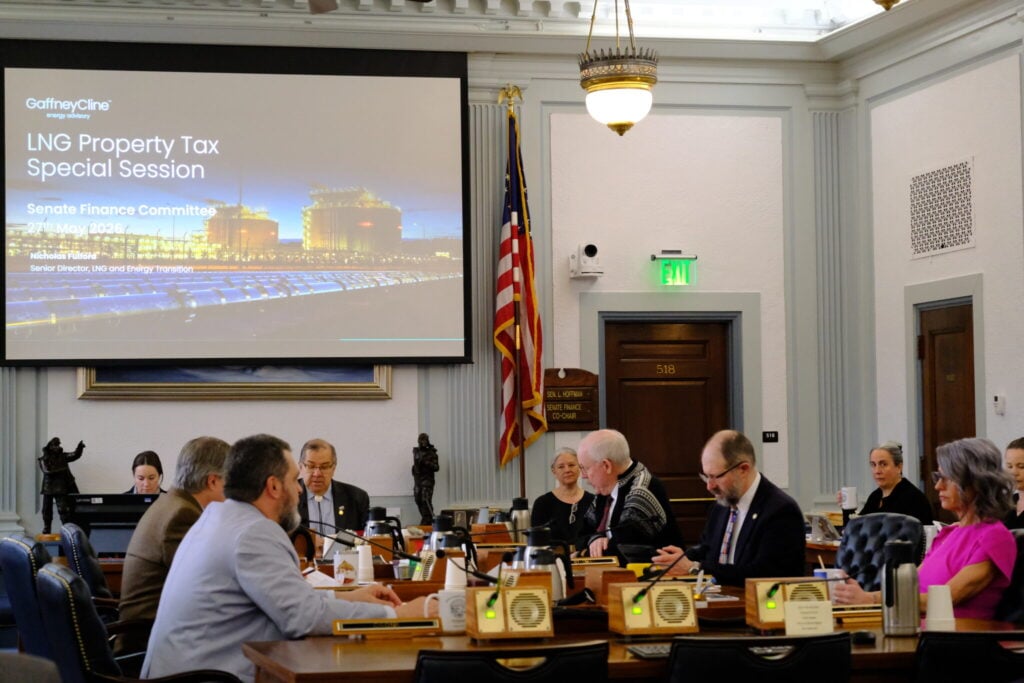
In a Senate Finance hearing on June 16, members of the Senate Finance Committee grilled AGDC consultant Matt Kissinger and Glenfarne Alaska president Adam Prestidge with questions drawn from the draft.
“There is no scenario where we will ask the state for money,” Prestidge said under questioning.
The state will be given a chance to invest money in the project, he said, but “even the state investment option is an option to the state that doesn’t come with a formal request or pressure from Glenfarne.”
Prestidge didn’t mention the clawback, so Stedman went a different direction: “Was there preliminary discussions when all this came together, about any exit strategies and purchases, buybacks, any of that stuff?” he asked.
“There is a different provision around making the developer leave, which would require a payment, but as far as the developer quitting themselves and no longer pursuing diligent development efforts, no, there was never even a discussion of a payment in regards to that,” Kissinger said, alluding to the clawback but not explicitly stating it.
Afterward, Stedman said he wasn’t pleased with the answers.
“It’s hard sitting at the table when you knew some of the answers weren’t as direct and accurate as they should be,” he said.
Days later, the Senate rewrote the tax break bill. One of its amendments — adopted by a 14-6 vote, with all members of the majority voting yes — states that if the project does not go forward, the developer must transfer all of the project’s assets back to AGDC within six months “at no cost to the corporation or the state.”
Another amendment, adopted by an identical 14-6 vote, requires AGDC and Glenfarne to report any relationships with foreign companies.
One section of the confidential agreement states that Glenfarne will work with Canadian natural gas firm Enbridge on the proposed import terminal. Another section says Glenfarne will talk with South Korean conglomerate Hanwha Group and Japan’s Inpex about the export terminal.
The document also provided senators with a definition of “final investment decision” as determined by AGDC and Glenfarne.
That mattered, Stedman said, because if legislators used a different definition for that term than AGDC and Glenfarne did, any law covering the term might be ineffective.
Dismay from AGDC’s president
Before the Senate voted on the pipeline tax break, some members of the Senate Majority invited AGDC president Richards into the office of Senate President Gary Stevens, R-Kodiak, and told him what they had.
None of the participants in that meeting were willing to discuss it in depth.
Richards said by email that he was “dismayed” when senators told him last week.
“I think you’ll find AGDC is very concerned about this document,” Stedman said this week, “and potential liability exposure between them and Glenfarne.”
Richards said AGDC’s board is considering an investigation.
“The protection of confidential information is specifically and purposefully allowed in AGDC’s statutes to fulfill the corporation’s mission to deliver North Slope natural gas for the benefit of Alaskans,” he said by email.
While the Capitol has a reputation for information leaks, the text of the document stayed closely held, even as rumors about its existence spread.
I have not liked this process where we are working in the dark and we are not getting information that we need to protect the state’s interests. We are being forced to just guess where the landmines are, guess where the pitfalls are. I don’t like being in that situation at all, and every Alaskan should be concerned about that.
– Sen. Bill Wielechowski, D-Anchorage
Each of the three co-chairs of the House Finance Committee said they had not seen the document. Rep. Neal Foster, D-Nome, said he had heard about it, though.
“I just know there’s something out there, and everybody was kind of getting excited,” he said.
Foster said the document was never discussed in deliberations within the House Finance Committee nor was it discussed among members of the House’s majority coalition.
Sen. James Kaufman, R-Anchorage, and Senate Minority Leader Mike Cronk, R-Tok, are on the Senate Finance Committee and said they had not seen the draft.
Even some Senate majority members said they had not seen it.
“Is that the secret document everyone’s talking about?” said Sen. Kelly Merrick, R-Eagle River, when asked.
“I have not seen that, and I don’t care to see it. I don’t want to be responsible for confidential information,” she said.
Members of the state House and Senate are scheduled to meet July 1 and may consider a compromise tax break on that day.
A preliminary meeting is scheduled for 2 p.m. Friday.
Even if the confidential Glenfarne-AGDC agreement becomes more widely known, senators said lawmakers will be crafting a compromise with incomplete information.
“I have not liked this process where we are working in the dark and we are not getting information that we need to protect the state’s interests,” Wielechowski said. “We are being forced to just guess where the landmines are, guess where the pitfalls are. I don’t like being in that situation at all, and every Alaskan should be concerned about that.”